 Click main image to view in full screen. Unlock all 9 preview images:
Retail & Office Unit Rental Property Model – Excel XLSX
Excel (XLSX) + supplemental PDF


REAL ESTATE EXCEL DESCRIPTION
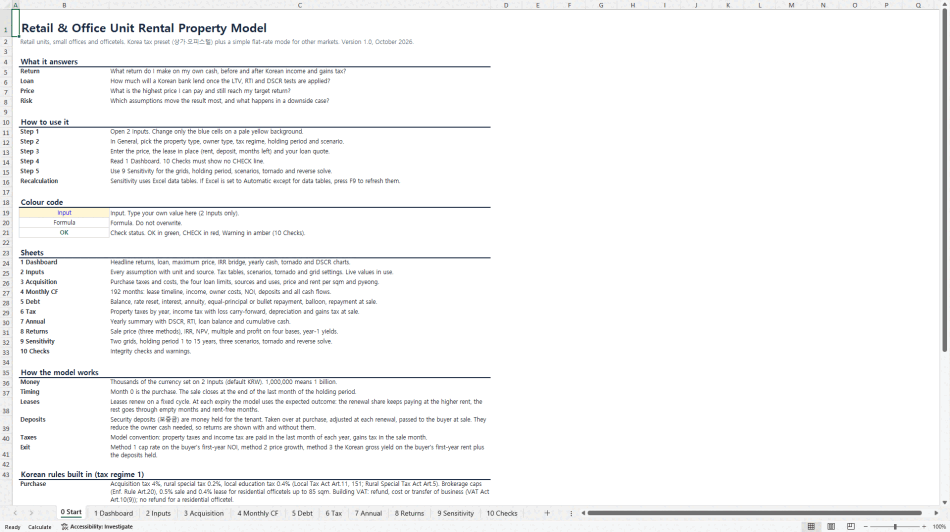
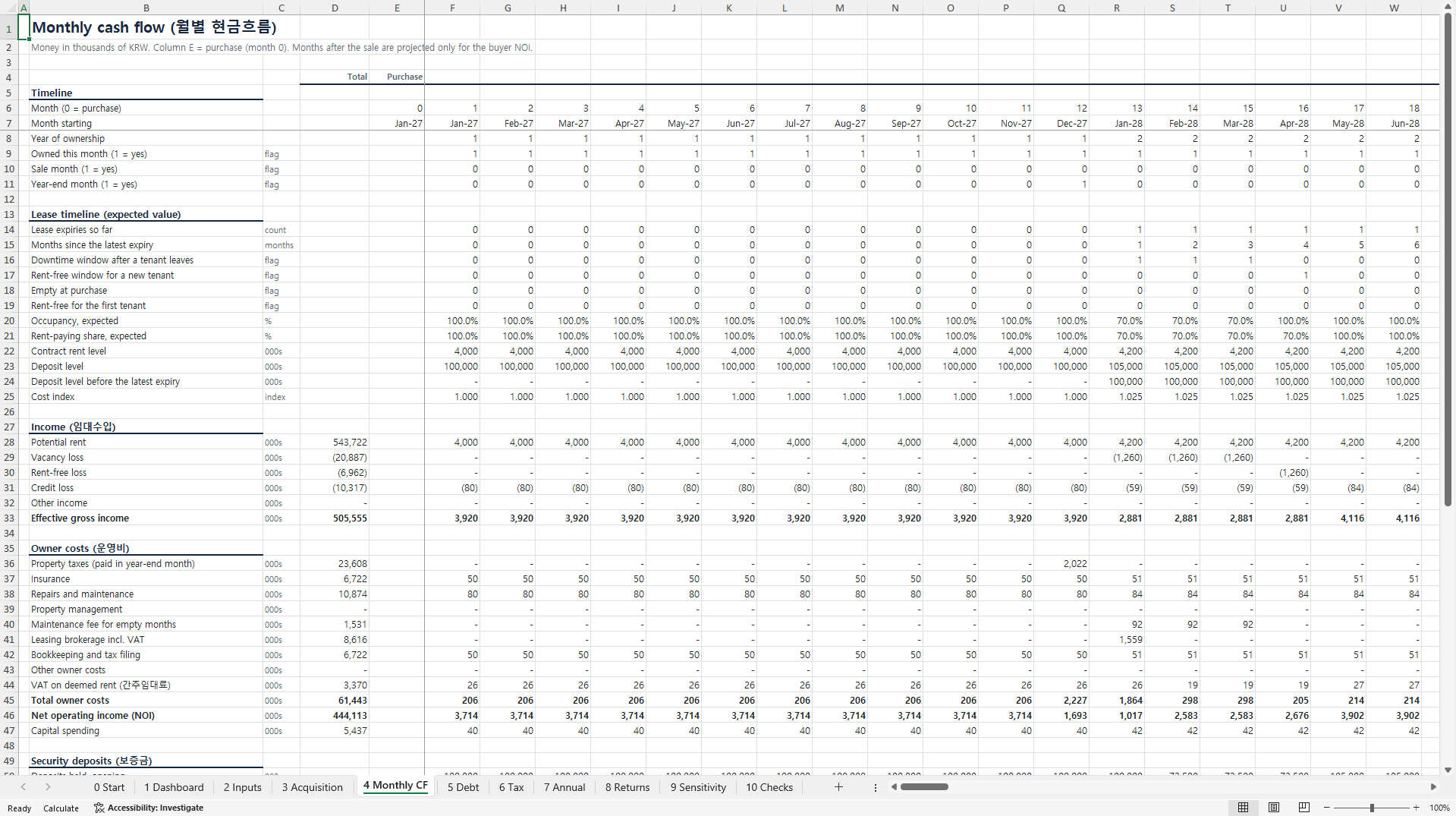
Model the purchase, leasing, financing and sale of a single income property unit, such as a retail unit, an office unit or an officetel, month by month for up to 15 years, and see the return on your own cash before and after tax.
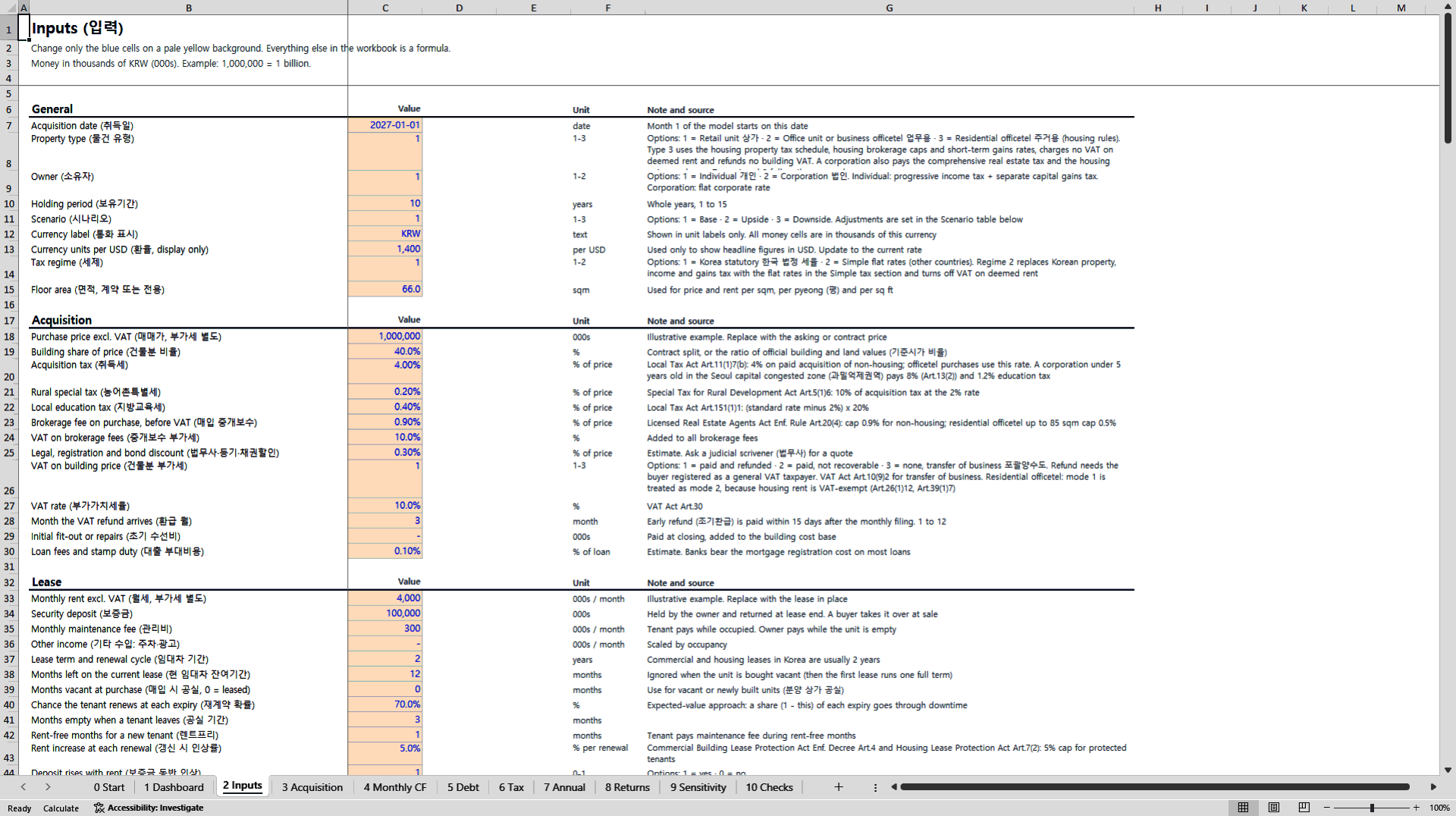
The workbook is built for small commercial property investors, brokers, lenders and analysts who need more than a one-page yield calculator but less than an institutional development model. All assumptions sit on one input sheet, and every result is a live formula, so you can trace each number back to its inputs. Nothing is hard-coded.
Leases are modelled by expected outcome. At each expiry the model takes the expected outcome of renewal or re-letting: the renewing share keeps paying at the new rent, the rest goes through empty months and rent-free months, and leasing brokerage is charged on the share that re-lets. Security deposits are taken over at purchase, adjusted at renewals and passed to the buyer at sale, and returns are shown with and without them.
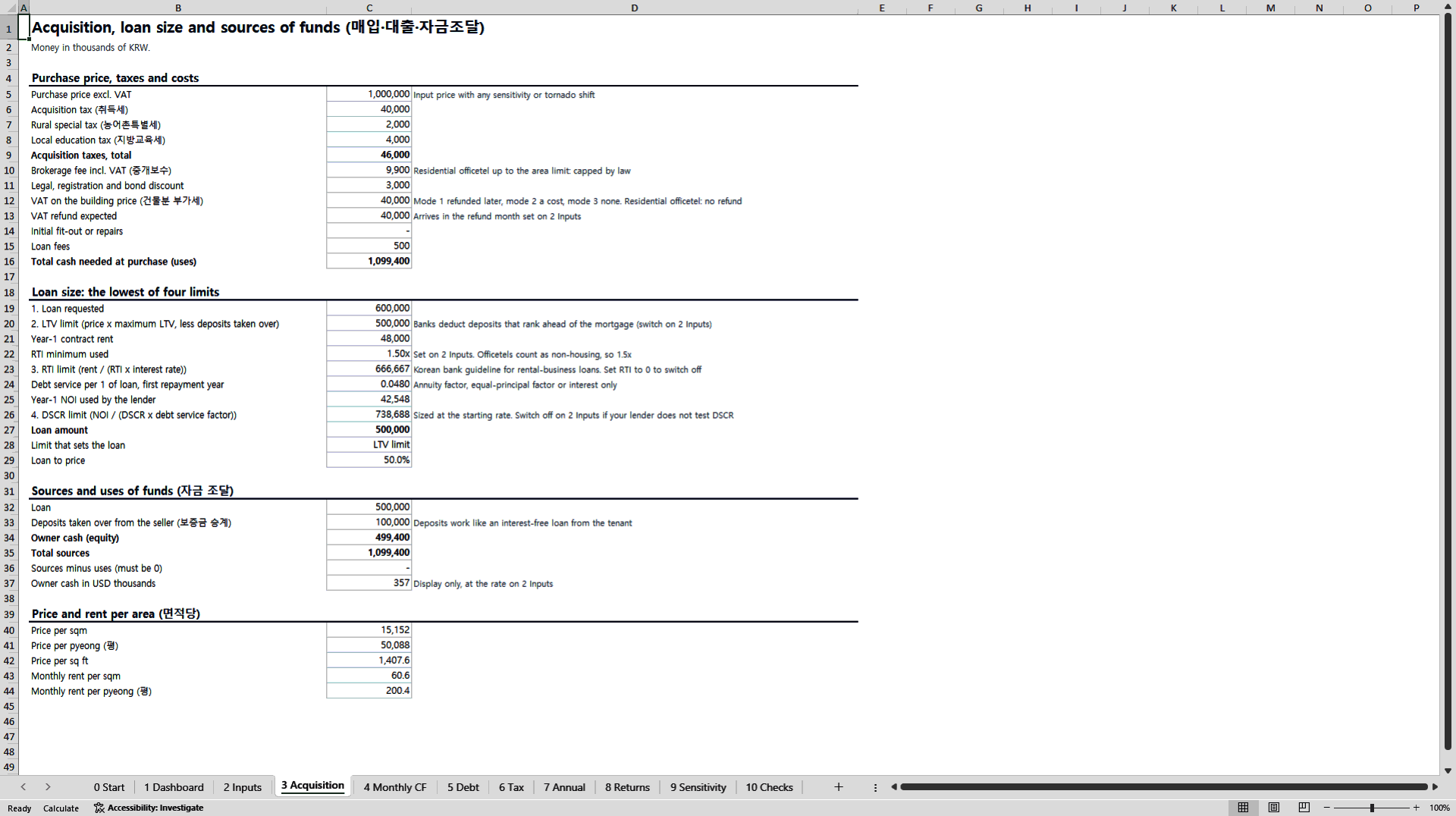
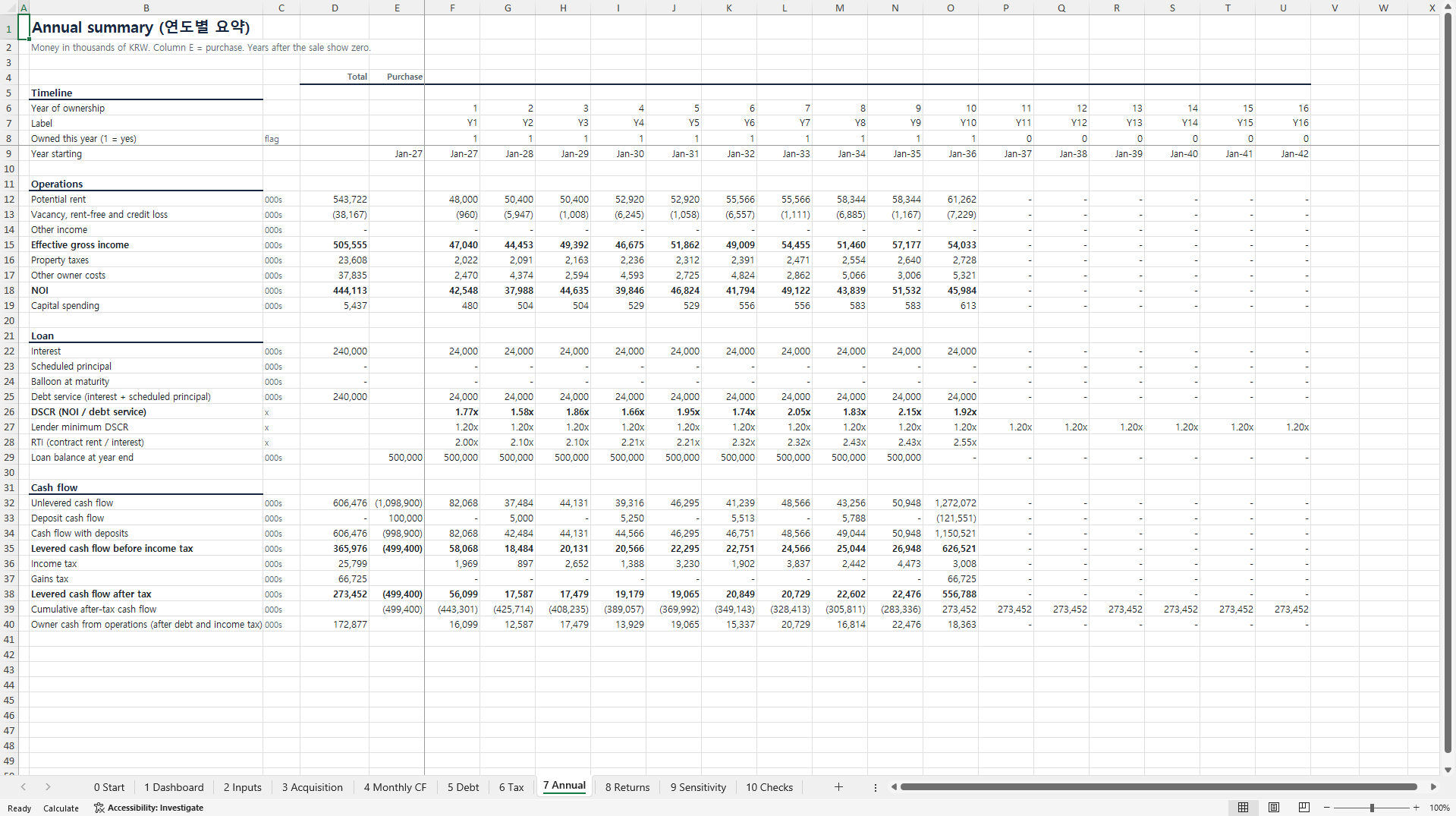
The loan is sized as the lowest of four limits: the amount requested, loan-to-value less the deposits taken over, rent-to-interest (RTI) and debt service cover (DSCR). Choose annuity, equal principal or bullet repayment, a rate reset, interest-only years and a prepayment fee. The model reports DSCR for every year and flags any year below the lender minimum.
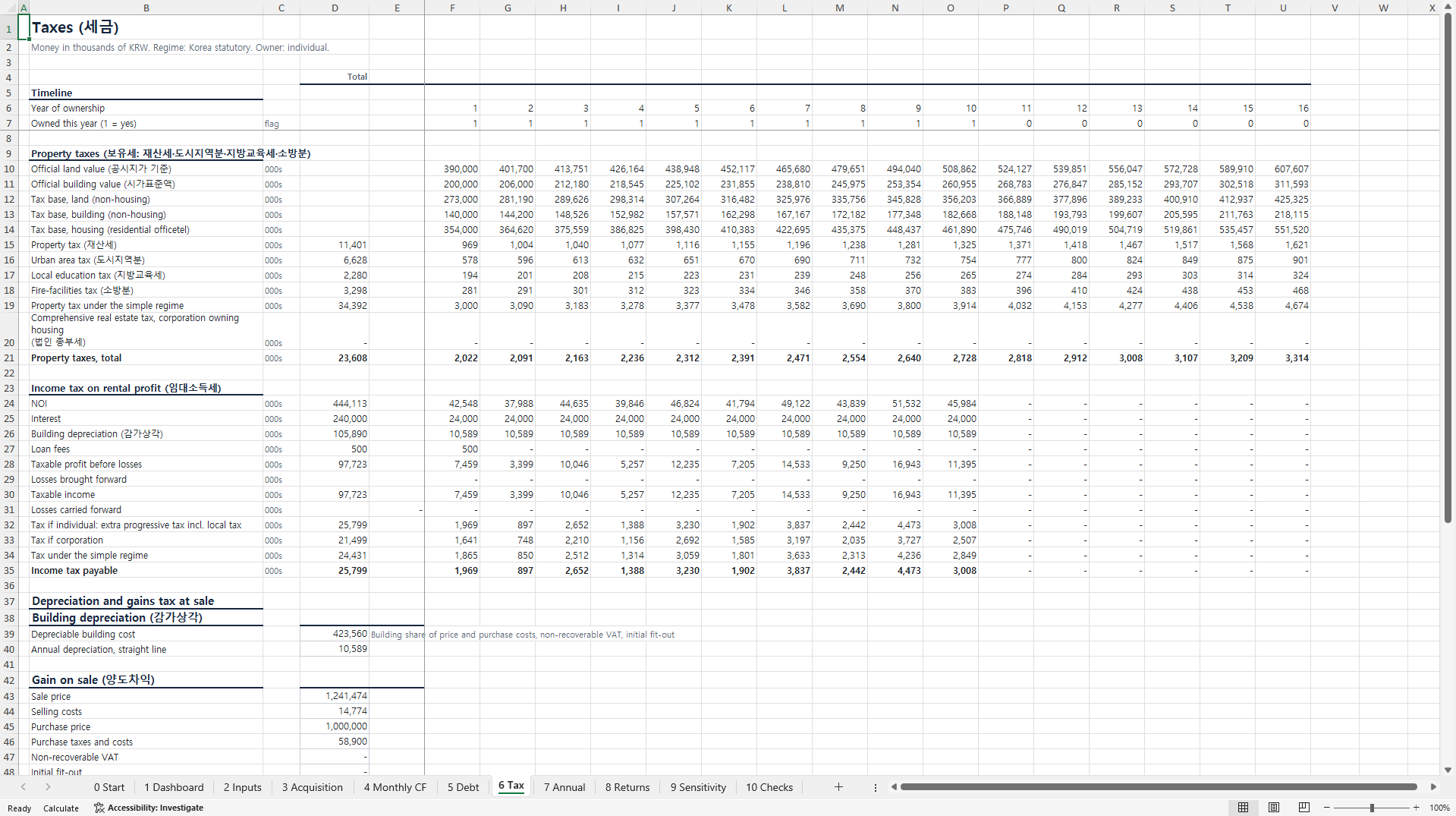
Korean taxes are built in as a preset, each rate with its legal article: acquisition tax, property taxes, VAT on the building price and on deemed rent from deposits, progressive income tax or corporate tax, and capital gains tax with the long-term holding deduction. Outside Korea, it still works. Switch to the simple tax regime, enter flat rates for property, income and gains tax, set your currency label and price the exit with a cap rate.
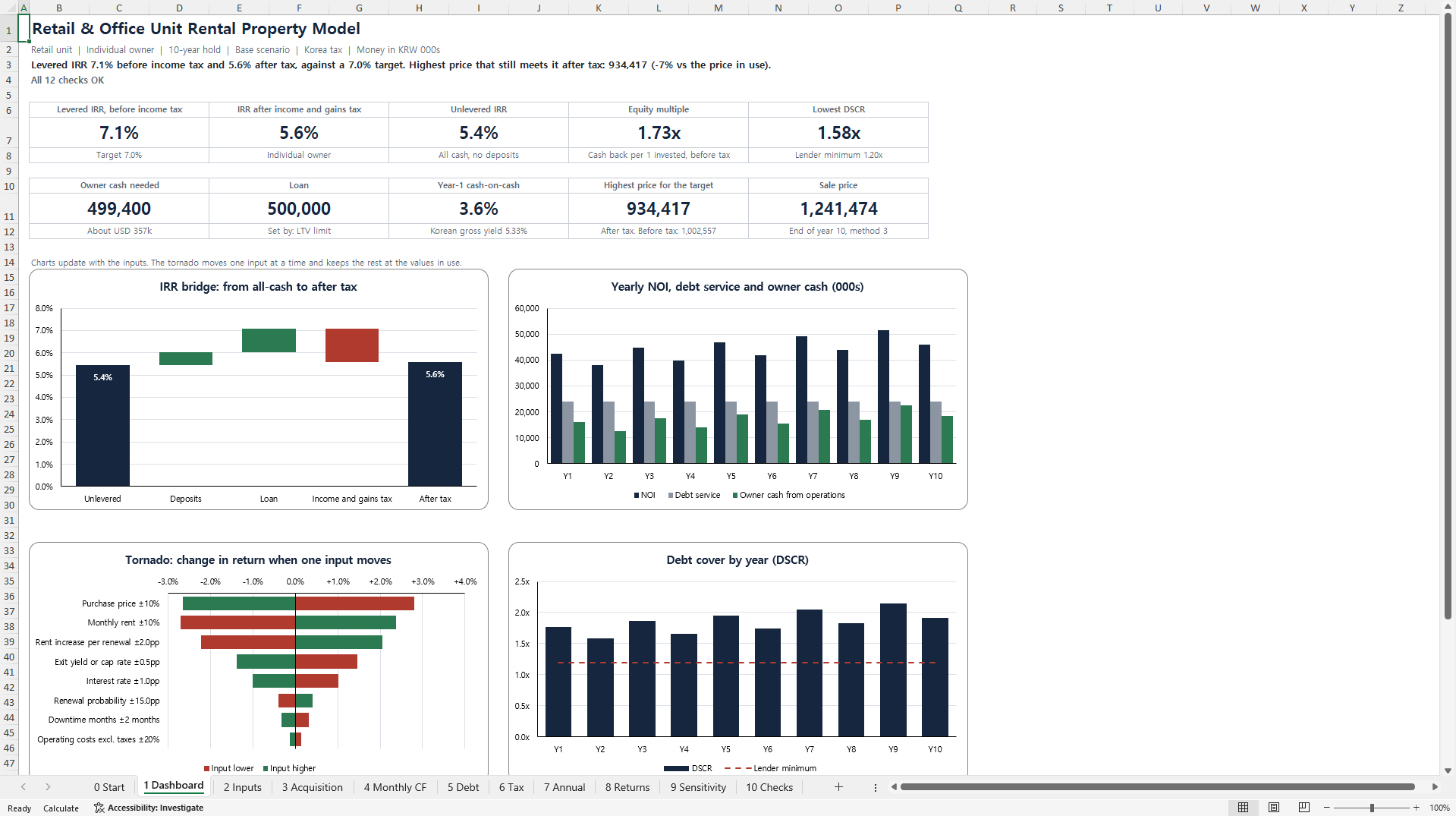
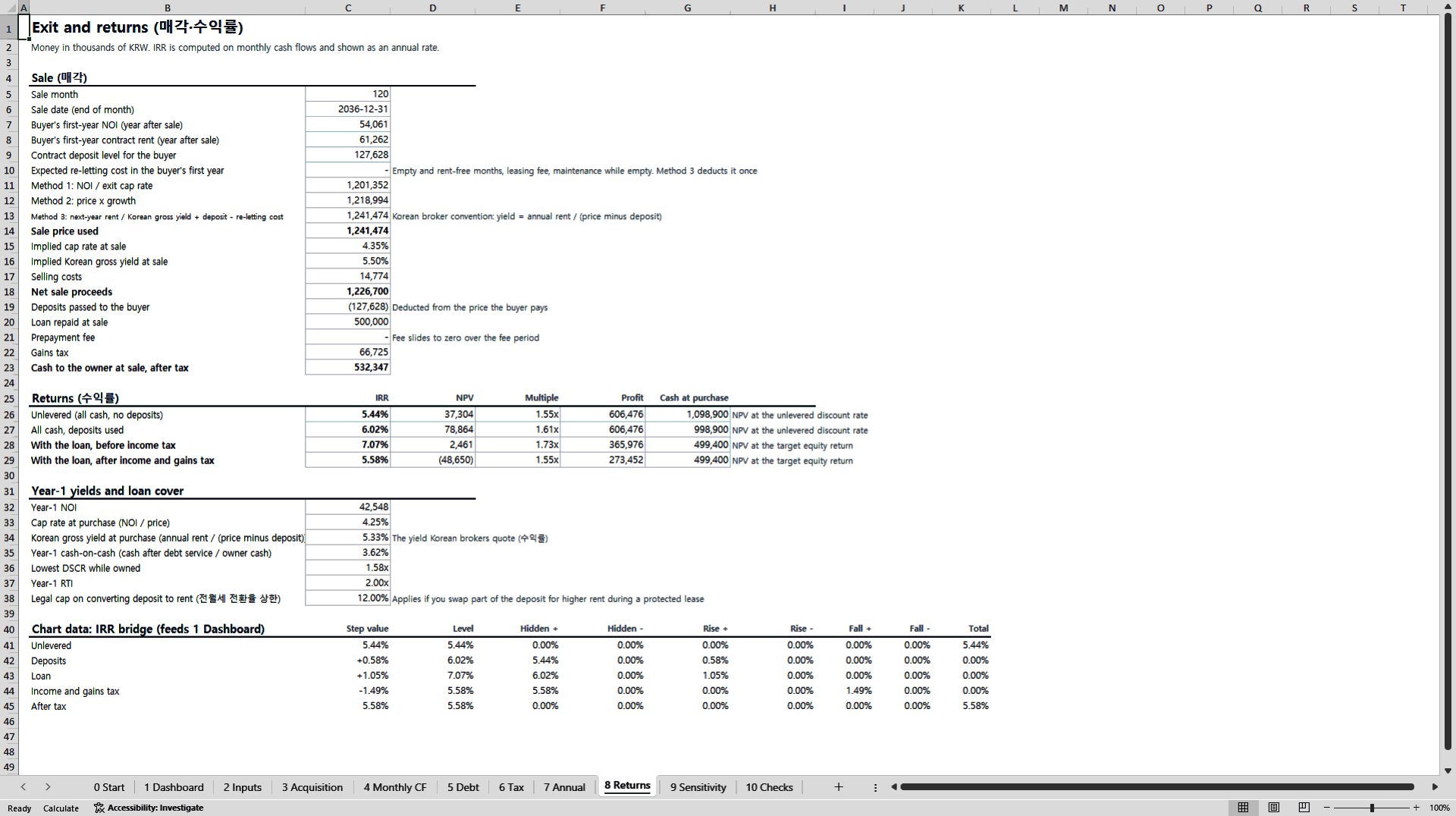
Results include levered, unlevered and after-tax IRR, NPV, equity multiple, cash-on-cash, cap rate, gross yield, lowest DSCR, the highest price you can pay for your target return, the rent you need and the breakeven exit yield. The sensitivity sheet uses Excel data tables for two grids (exit yield against rent growth, price against interest rate), holding periods from 1 to 15 years, three scenarios, a tornado chart of eight inputs and a reverse solve. Twelve integrity checks and seven warnings sit on their own sheet.
No macros. No hidden sheets. No protection. Before release it was recalculated in Excel with zero error cells and cross-checked against a separate Python build of the same specification, with zero mismatches across 296 data-table cells and 30 option combinations. Twenty-three edge cases were recalculated too. A separate AI-run adversarial review of the Korean rules and the model logic followed, and its corrections are included. An 8-page user guide explains every input and calculation. Default figures are an illustrative example, not market data, and the model is not tax or investment advice.
If the file does not open or you find a calculation error, message us within 30 days and we will send a corrected file at no charge.
The workbook and guide were built with the help of AI coding tools and tested as described above.
Got a question about the product? Email us at support@flevy.com or ask the author directly by using the "Ask the Author a Question" form. If you cannot view the preview above this document description, go here to view the large preview instead.
Source: Best Practices in Real Estate, Integrated Financial Model Excel: Retail & Office Unit Rental Property Model Excel (XLSX) Spreadsheet, MCP Lab