
 Click main image to view in full screen. Unlock all 17 preview images:
Nuclear Fusion Project Finance Model – Excel XLSX
Excel (XLSX) + supplemental PDF


BENEFITS OF THIS DOWNLOADABLE EXCEL DOCUMENT
- Converts fusion-specific technical milestones into financial outputs that investors, analysts, and project developers can evaluate.
- Integrates FOAK/NOAK CapEx, tritium economics, DOE financing, LCOFE benchmarking, 3-statement forecasting, and risk analysis in one workbook.
- Helps users assess project viability through scenario analysis, sensitivity analysis, Monte Carlo simulation, and automated audit checks.
PROJECT FINANCE EXCEL DESCRIPTION
🚀 Nuclear Fusion Project Finance Model – Advanced Financial Model for Frontier Energy Economics
The Nuclear Fusion Project Finance Model is a premium Excel-based financial model built to evaluate the economics, funding structure, milestone risk, technical uncertainty, and long-term commercial viability of a nuclear fusion energy project.
Unlike conventional renewable energy, thermal power, or nuclear fission models, fusion economics require a completely different modeling approach. A fusion project does not simply depend on installed capacity, tariff, and operating cost assumptions. Its investment case is driven by technical achievement milestones, Q-factor improvement, first-of-a-kind capital intensity, tritium fuel-cycle economics, plasma confinement pathway, government financing support, technology learning curves, and commercialization timing.
This model is designed to help users convert those complex fusion-specific drivers into a structured project finance and valuation framework.
⚡ What This Model Is Used For
This model can be used to assess the financial feasibility, funding requirement, investment return, and risk profile of a nuclear fusion project across its development, demonstration, commercialization, and steady-state operating phases.
It is suitable for analyzing:
🔹 Fusion project development economics
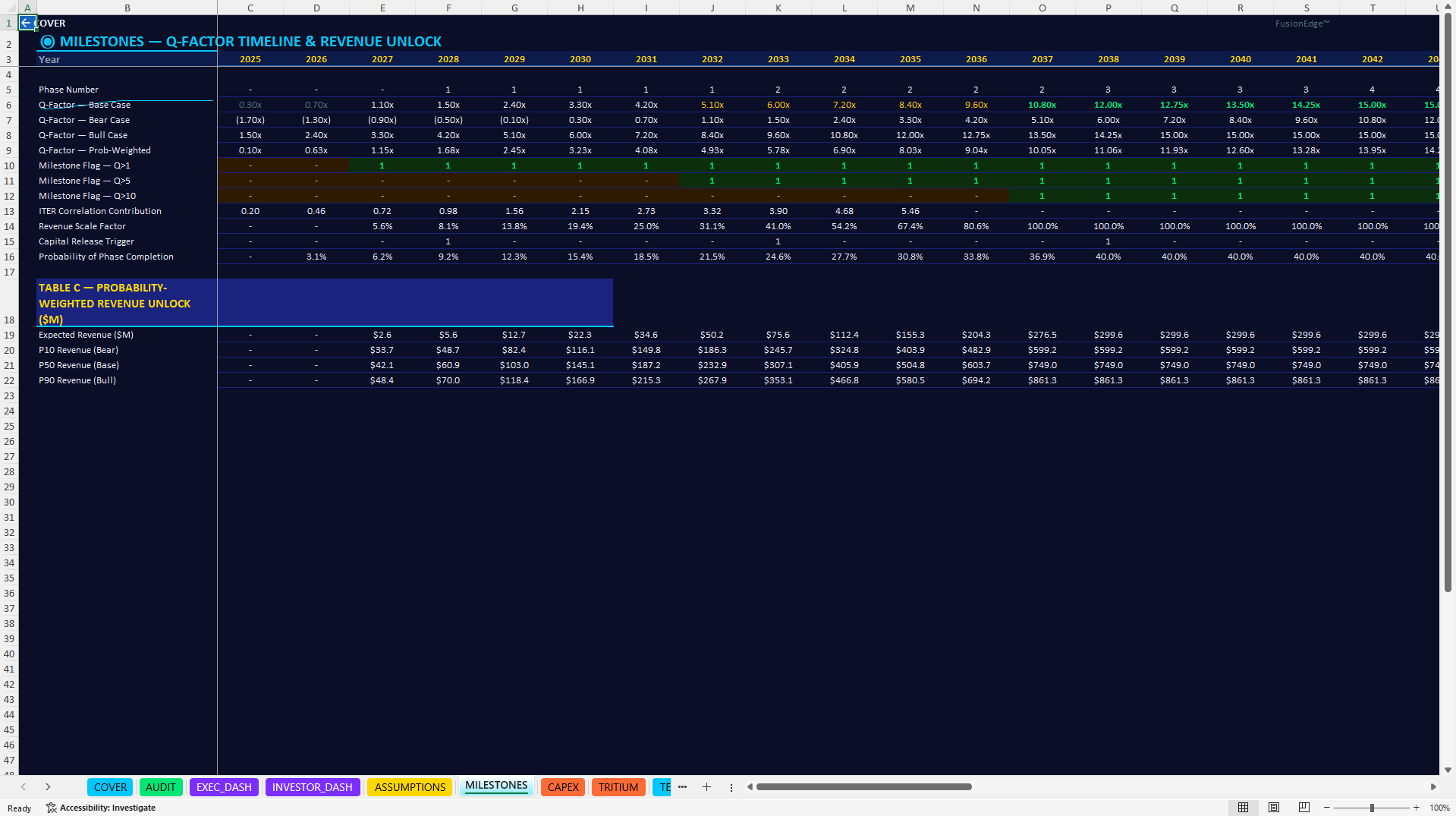
🔹 Q-factor milestone timing and revenue unlock
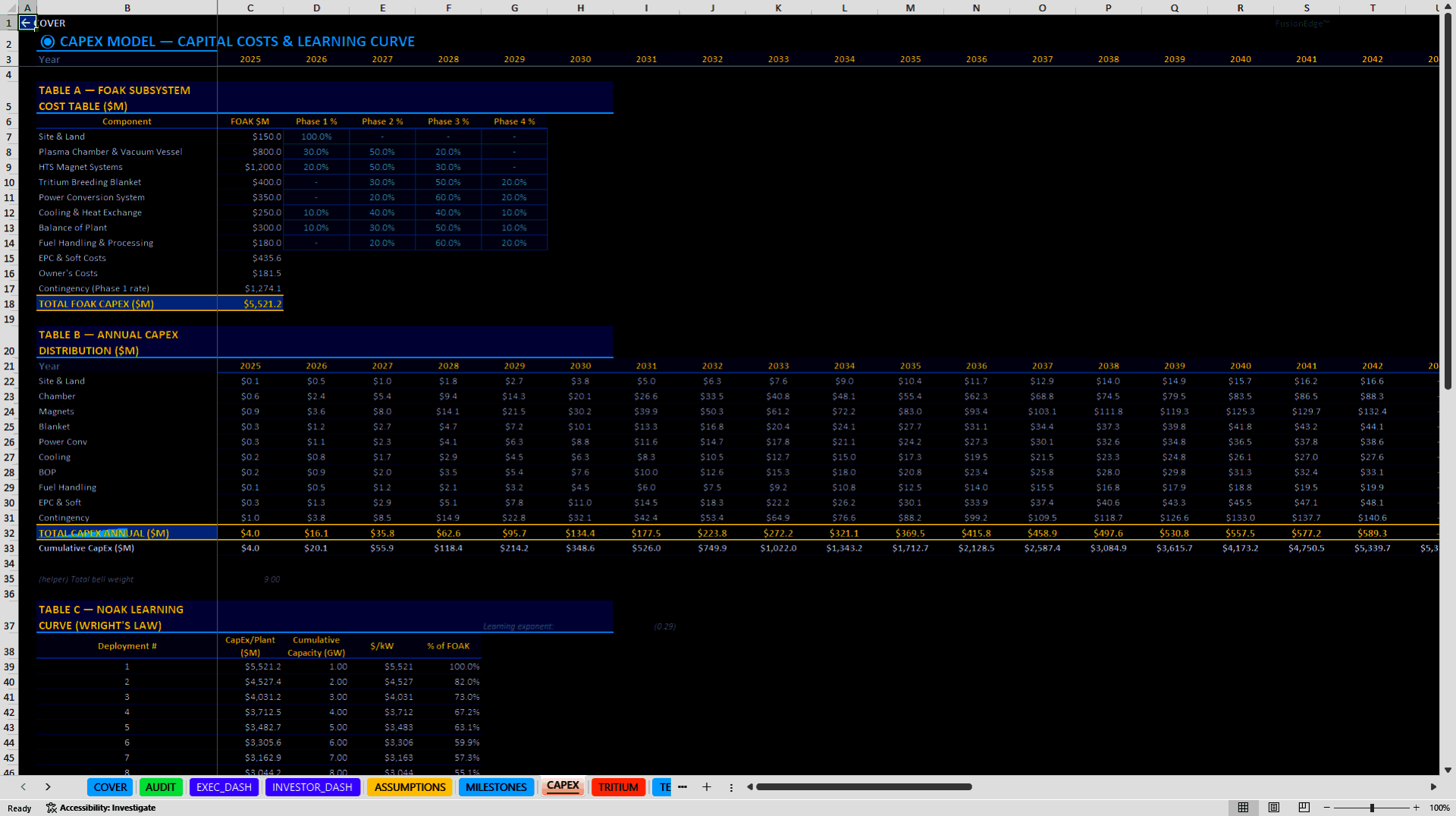
🔹 First-of-a-kind versus nth-of-a-kind capital cost transition
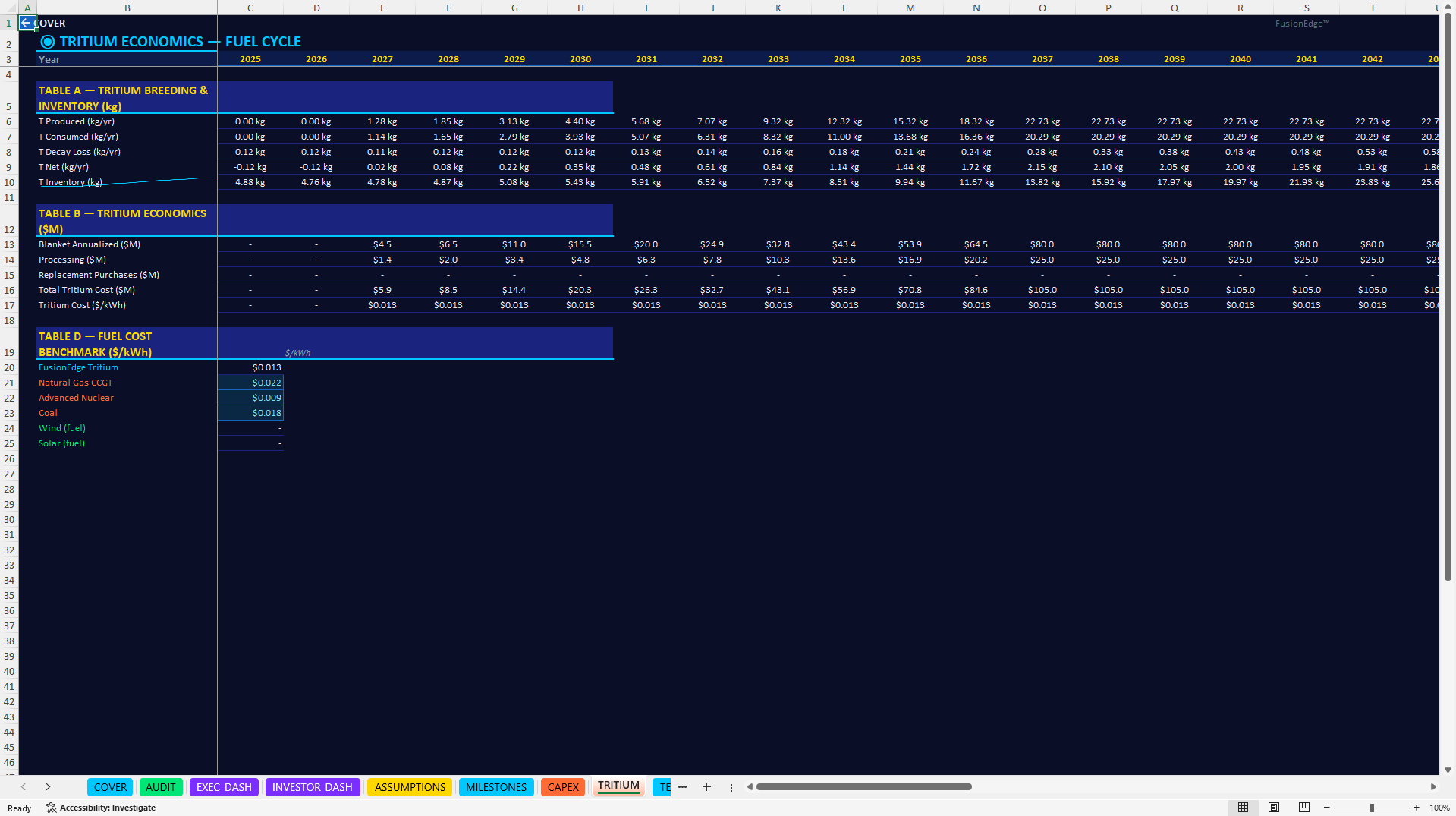
🔹 Tritium breeding and fuel-cycle cost exposure
🔹 DOE loan guarantee and government funding structures
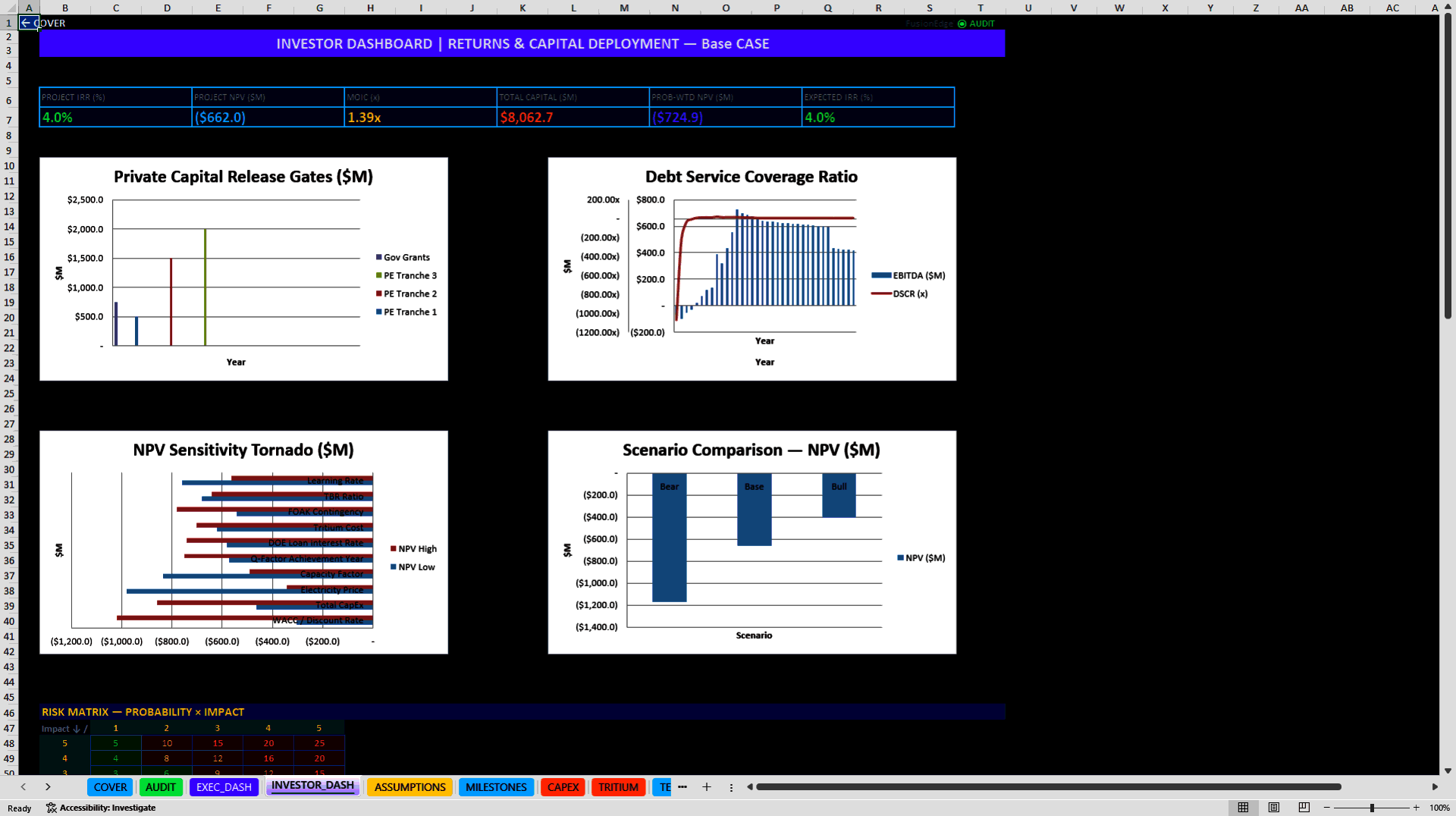
🔹 Private capital release schedules tied to technical milestones
🔹 Long-term electricity, hydrogen, carbon credit, and licensing revenue
🔹 Levelized cost of fusion electricity compared with competing technologies
🔹 Bear, base, and bull case commercial outcomes
🔹 Monte Carlo risk-adjusted valuation and downside probability
🔥 Core Model Features
1. Q-Factor Milestone and Commercialization Logic
The model includes a milestone-based structure that links technical progress to commercial financial outcomes. It allows users to assess the timing and probability-weighted impact of moving from research and demonstration phases toward commercial energy production.
This is important because fusion project value is not created evenly over time. Large value inflection points occur when the project reaches key technical and regulatory milestones.
2. FOAK vs. NOAK Capital Cost Learning Curve
Fusion projects are exposed to extremely high first-of-a-kind capital costs. This model separates FOAK economics from future NOAK cost expectations and incorporates a learning curve structure to evaluate how capital efficiency may improve as the technology matures.
The CapEx module includes structured development and construction cost modeling, making it easier to understand capital intensity, cost escalation, contingency risk, and long-term deployment economics.
3. Tritium Breeding and Fuel-Cycle Economics
The model includes a dedicated tritium economics module covering production, consumption, decay loss, inventory, blanket costs, processing costs, replacement purchases, and tritium cost per kWh.
This is a critical feature because tritium availability and breeding efficiency can materially affect fusion project economics, operating risk, and long-term energy cost competitiveness.
4. Plasma Confinement Technology Comparison
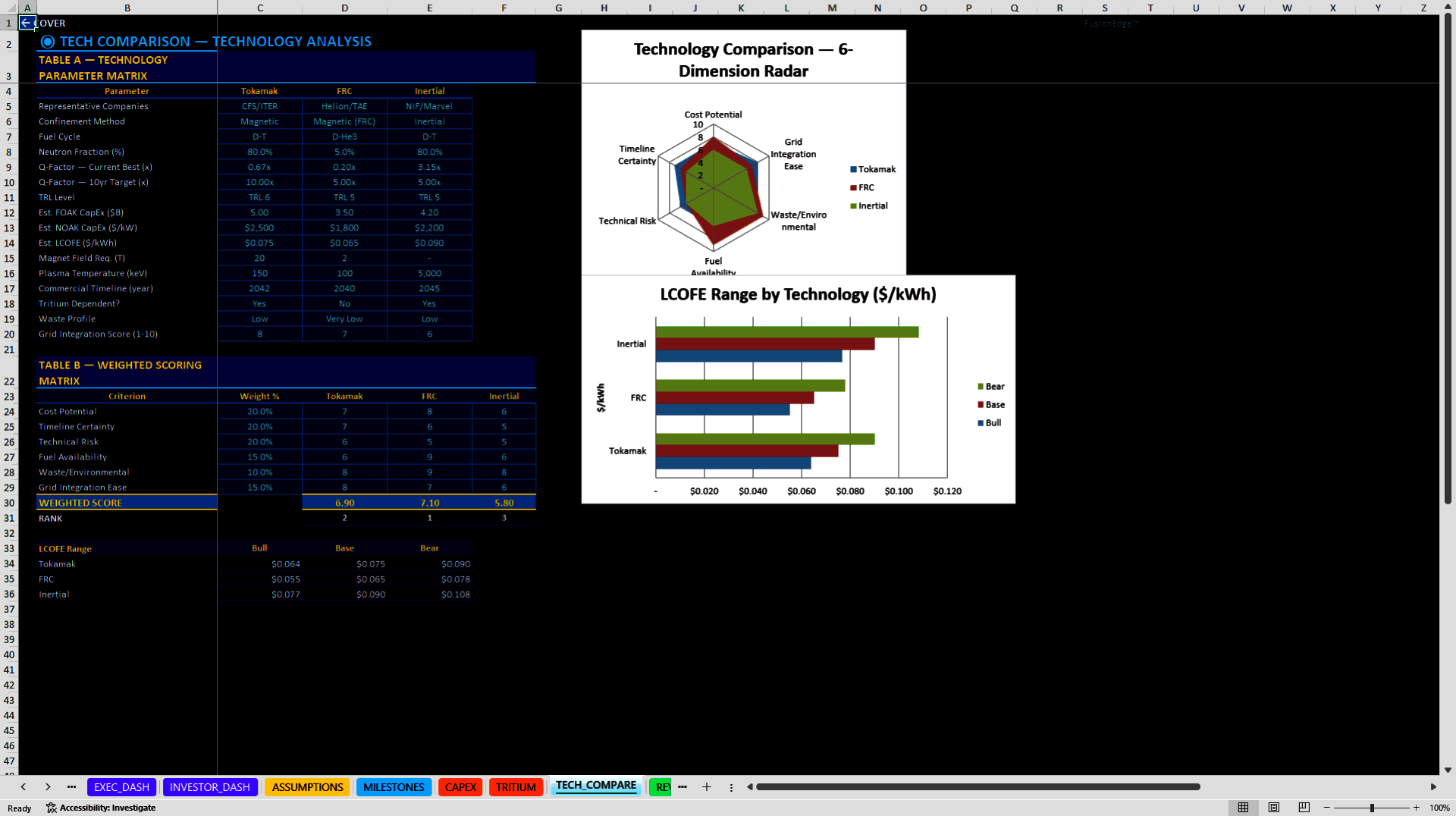
The workbook includes a technology comparison module covering major fusion pathways such as:
✅ Tokamak
✅ Field-Reversed Configuration / FRC
✅ Inertial confinement
The model compares these pathways using technology parameters, fuel cycle assumptions, Q-factor potential, technology readiness, estimated CapEx, LCOFE, commercial timeline, waste profile, grid integration, and weighted scoring.
This gives buyers a decision-support framework rather than a generic power project spreadsheet.
5. DOE Loan Guarantee and Funding Structure
The financing module includes project capital structure, DOE loan drawdown, loan guarantee coverage, government grants, private equity contributions, milestone payments, interest expense, repayment logic, and debt service coverage analysis.
This makes the model useful for project finance teams, public-private infrastructure funding analysis, government-supported energy projects, and institutional investment evaluation.
6. Full 3-Statement Financial Forecast
The model includes integrated financial statements, including:
📌 Income Statement
📌 Balance Sheet
📌 Cash Flow Statement
The forecast structure supports long-term financial analysis across revenue, OPEX, depreciation, interest, tax, working capital, capital expenditure, financing, debt repayment, cash balance, free cash flow, and valuation outputs.
7. Revenue and Operating Cost Modules
The revenue module includes multiple monetization streams, including electricity revenue, hydrogen revenue, carbon credit revenue, and licensing/R&D revenue.
The OPEX module includes staff costs, tritium and fuel costs, maintenance, insurance, regulatory costs, sustaining R&D, and G&A expenses.
This structure reflects the fact that early fusion companies may have mixed revenue streams before full-scale commercial power generation.
8. LCOFE Benchmarking
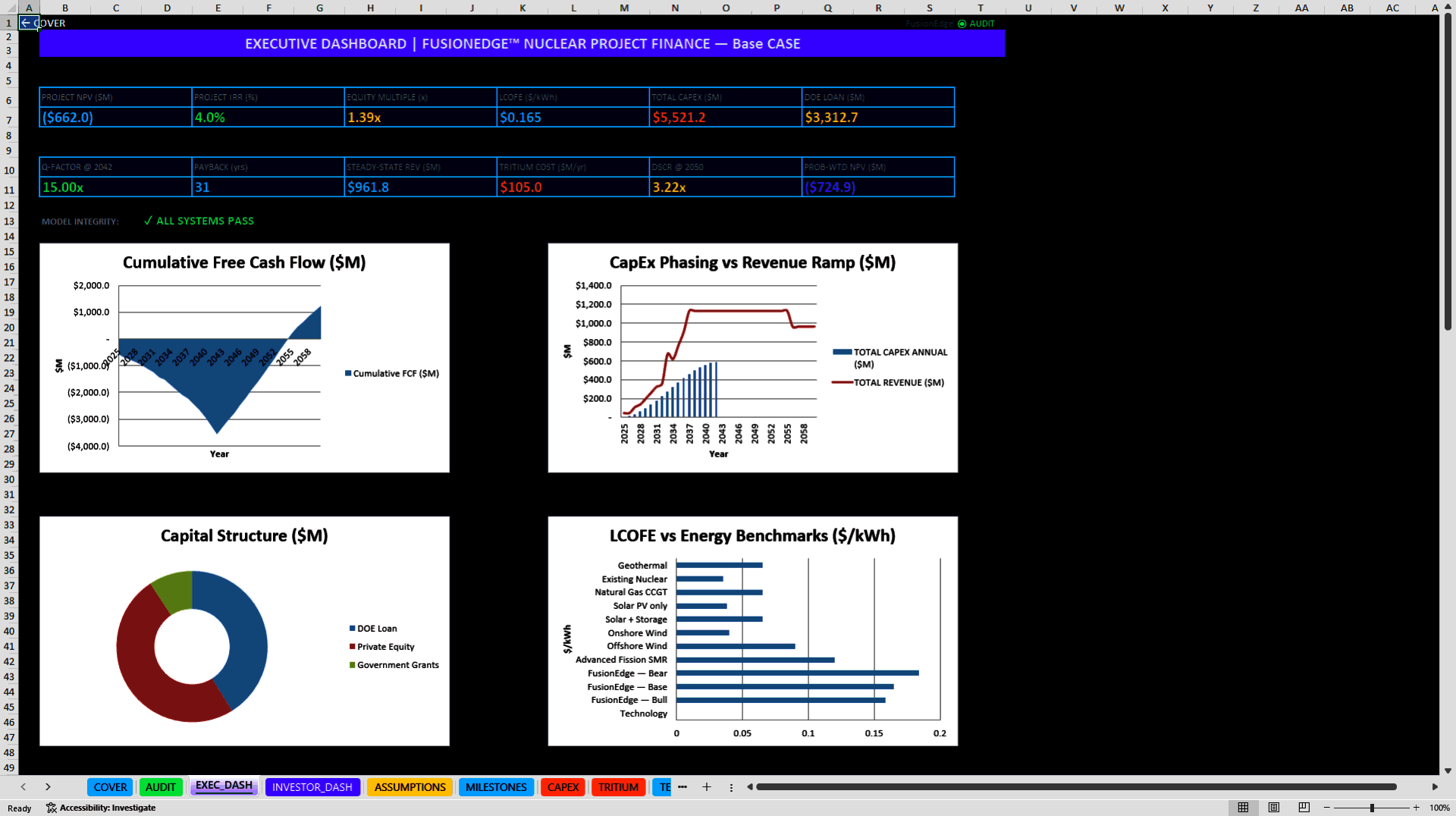
The model includes a Levelized Cost of Fusion Electricity analysis and benchmark comparison against other energy technologies, including advanced fission, offshore wind, onshore wind, solar plus storage, natural gas CCGT, existing nuclear, geothermal, and coal.
This allows users to test whether fusion electricity can become cost-competitive under different capital cost, operating cost, fuel cost, and financing assumptions.
9. Scenario, Sensitivity, and Monte Carlo Analysis
The model includes:
📊 Bear / Base / Bull scenario analysis
📊 NPV and IRR comparison
📊 Probability-weighted NPV
📊 Sensitivity tables
📊 Tornado-style risk analysis
📊 Spider-style IRR sensitivity
📊 Monte Carlo simulation with 1,000 simulation cases
📊 Probability of positive NPV and downside risk assessment
This helps users understand not only the base case, but also the risk-adjusted investment profile.
10. ESG and Risk Register
The workbook includes an ESG scoring framework and a risk register covering technical, regulatory, fuel-cycle, operational, and governance risks.
This is particularly useful for investors, infrastructure funds, climate-tech analysts, and energy transition professionals who need to evaluate both financial and non-financial risk factors.
🧭 How to Use This Model
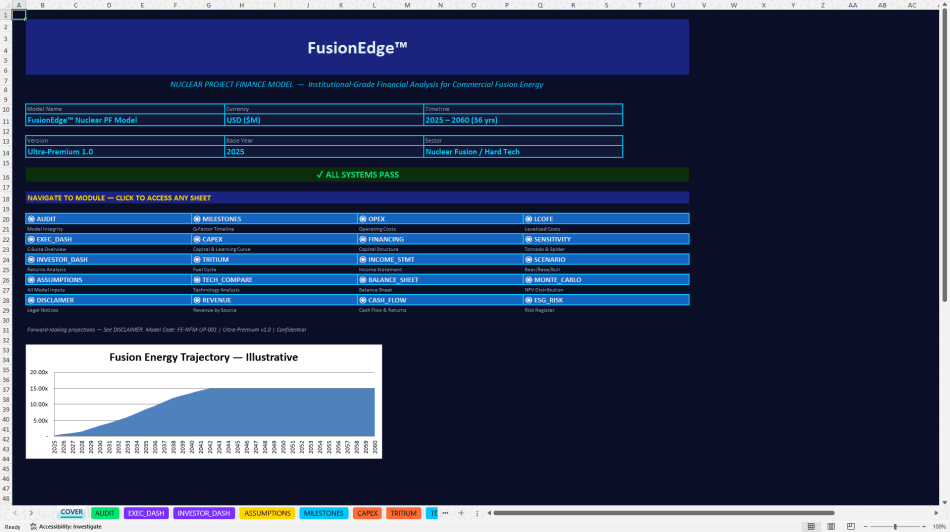
Start with the Cover and dashboard sheets to understand the structure and high-level outputs.
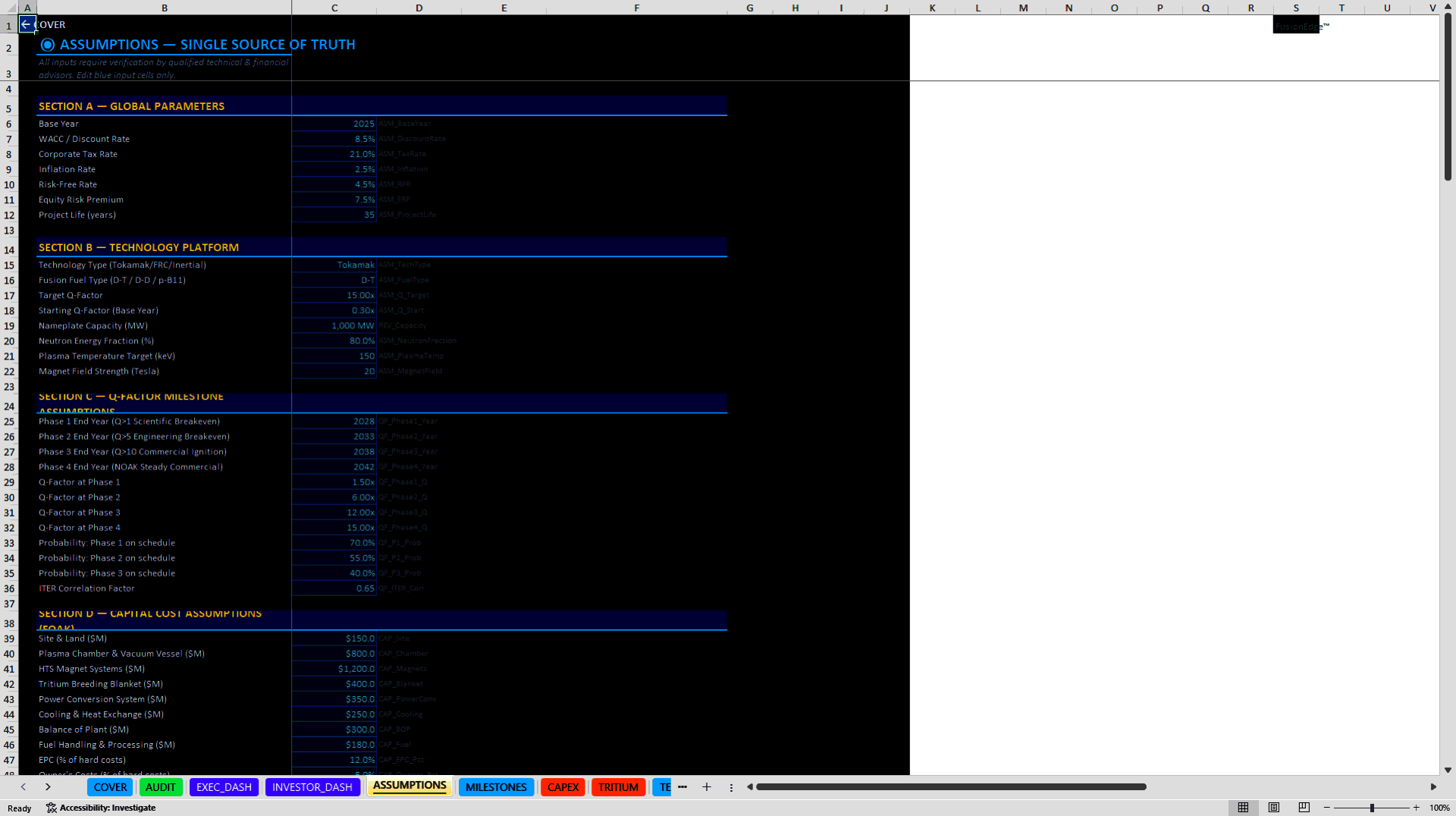
Then move to the Assumptions sheet to update key project assumptions, including timeline, technology pathway, capital cost, operating cost, revenue assumptions, financing terms, and scenario drivers.
Use the Milestones, CapEx, Tritium, and Technology Comparison sheets to review the technical-financial logic behind the model.
The financial outputs then flow into the Revenue, OPEX, Financing, Income Statement, Balance Sheet, and Cash Flow sheets.
Finally, use the LCOFE, Scenario, Sensitivity, Monte Carlo, and ESG/Risk sheets to evaluate commercial feasibility, investor returns, downside risk, and strategic decision-making.
The model also includes an Audit sheet with automated model integrity checks.
🎯 Who Should Buy This Model?
This model is suitable for:
✅ Fusion energy startups
✅ Project finance analysts
✅ Infrastructure investors
✅ Climate-tech investors
✅ Energy transition consultants
✅ Venture capital and private equity teams
✅ Advanced nuclear and hard-tech analysts
✅ Government-backed energy project advisors
✅ Corporate finance teams evaluating frontier energy investments
✅ Researchers and professionals studying fusion commercialization economics
💡 Why This Model Is Valuable
Nuclear fusion is not modeled properly using a standard solar, wind, gas, or nuclear fission financial template. Fusion projects involve long technical development cycles, milestone-based financing, uncertain commercialization timing, complex fuel-cycle risk, FOAK capital costs, and large public-private financing structures.
This model gives buyers a dedicated framework for evaluating those drivers in one integrated workbook.
It is especially useful when the user needs to answer questions such as:
❓ When does the project become commercially viable?
❓ How sensitive is NPV to Q-factor achievement timing?
❓ What is the impact of FOAK CapEx on project returns?
❓ How does tritium cost affect LCOFE?
❓ Can DOE financing materially improve project bankability?
❓ How does fusion compare with advanced fission, renewables, and gas generation?
❓ What is the downside risk under bear case or Monte Carlo outcomes?
Got a question about the product? Email us at support@flevy.com or ask the author directly by using the "Ask the Author a Question" form. If you cannot view the preview above this document description, go here to view the large preview instead.
Source: Best Practices in Project Finance, Integrated Financial Model Excel: Nuclear Fusion Project Finance Model Excel (XLSX) Spreadsheet, PDMM Financial Models
ABOUT THE AUTHOR

PDMM Financial Models develops professional, decision-ready Excel models for business owners, entrepreneurs, investors, consultants, analysts, and finance teams. Our objective is to transform complex business assumptions into clear, structured analysis that supports better planning and investment decisions.
Our models cover business planning, forecasting, budgeting, feasibility analysis,
... [read more]
Ask the Author a Question
You must be logged in to contact the author.




























