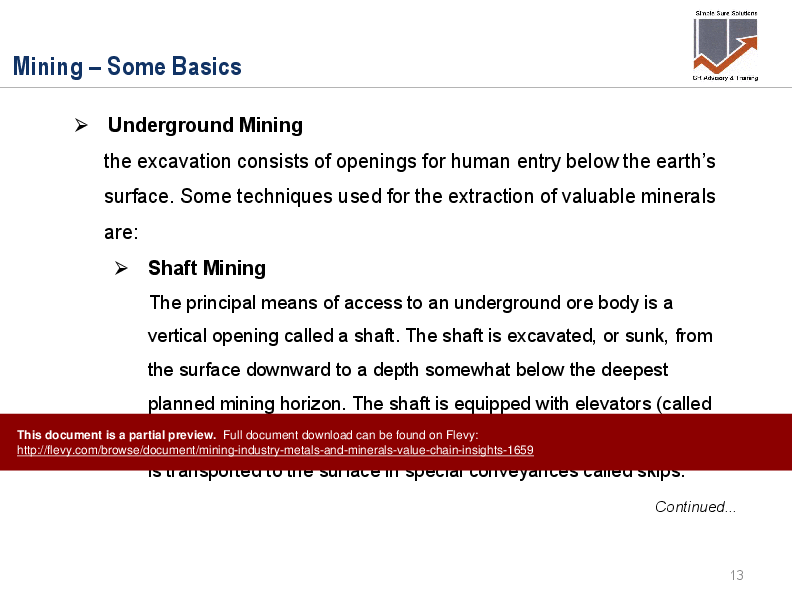
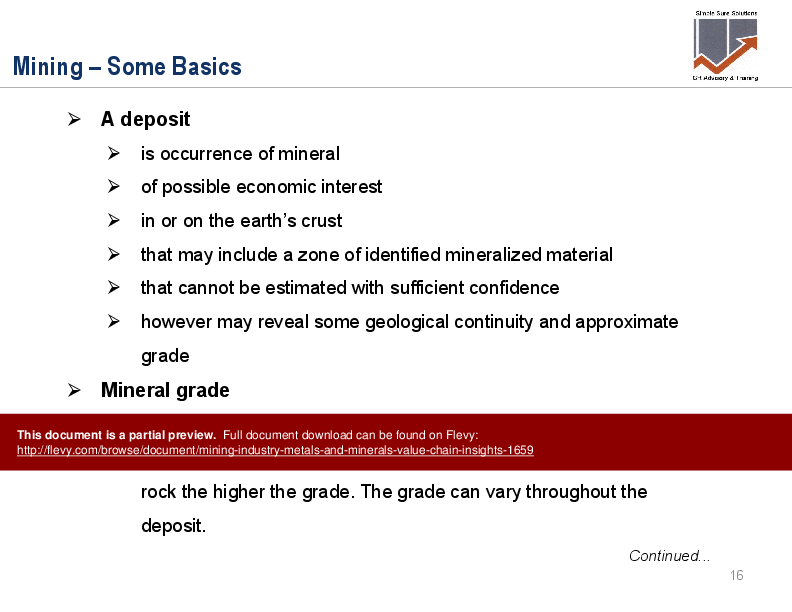
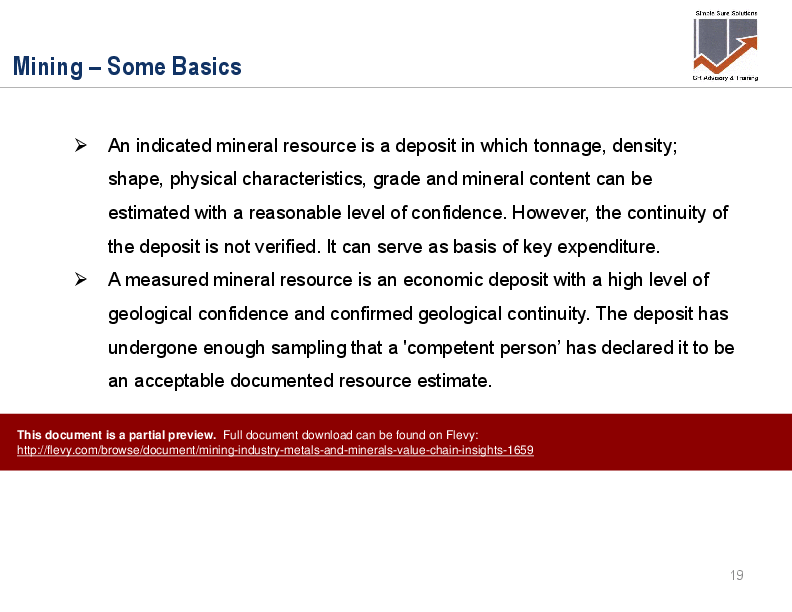

Mining Industry (Metals & Minerals) - Value Chain Insights   232-slide PPT PowerPoint presentation slide deck (PPTX)
$96.00

Mining Industry (Metals & Minerals) - Value Chain Insights (232-slide PPT PowerPoint presentation slide deck (PPTX)) Preview Image
Log in to unlock full preview.
Mining Industry (Metals & Minerals) - Value Chain Insights (232-slide PPT PowerPoint presentation slide deck (PPTX)) Preview Image
Arrow   Click main image to view in full screen.

Mining Industry (Metals & Minerals) - Value Chain Insights (PowerPoint PPTX Slide Deck)

PowerPoint (PPTX) + Zip archive file (ZIP) 232 Slides

Top 1,000 Best Practice $96.00

Add to Cart


Immediate download
Fully editable PowerPoint
Free lifetime updates

BENEFITS OF THIS POWERPOINT DOCUMENT

  1. Extensive coverage of the mining industry value chain with detailed slide notes, illustrations & examples.
  2. Slide deck with a presentation perspective with a step by step progress & animation.
  3. Can be used for a one week to three weeks training program based on required depth of coverage.

VALUE CHAIN ANALYSIS PPT DESCRIPTION

Editor Summary 232-slide PowerPoint deck titled "Mining Industry (Metals & Minerals) - Value Chain Insights" by Ganesh Rajagopalan, delivering a business-focused walkthrough of the mining value chain from Prospect through Market & Sell, plus brief mine closure coverage. Read more

This is an extensive slide deck (232 slides) providing a fairly deep insight into the mining industry value chain for metals & minerals. The slide points are supported by a detailed (close to ninety pages) slide note document which not only explains the points made but also provides a number of examples & illustrations. Further, for additional information, greater clarification and getting a visual perspective a number of web-links have also been provided. Even those who are not very familiar with the industry will therefore find it reasonably easy to understand the value chain processes. A glossary of terms related to the presentation has also been provided for quick reference.

The broad coverage is as follows:

1. Mining – Some Basics
2. Mining Value Chain – Top Level
3. Mining Value Chain – Prospect
4. Mining Value Chain – Explore
5. Mining Value Chain – Establish Feasibility
6. Mining Value Chain – Mine & Move
7. Mining Value Chain – Extract & Process
8. Mining Value Chain – Market & Sell
9. Mining Value Chain – Mine Closure
10. Mining Value Chain & Porter's Value Chain Model

The slide deck has been prepared with a perspective of presentation to an audience with step by step progress and use of animations. It can also be used for training on this subject with programs spanning from one week to three weeks depending upon the depth to which the slide points are covered. Shorter programs can also be done by culling the slides accordingly.

The PPT also delves into the core methodologies of mining, including open pit mining, strip mining, and underground mining, providing a comprehensive understanding of each technique. It covers the classification of mineral resources and reserves, emphasizing the importance of geological knowledge and confidence levels. The insights into sustainable development highlight the environmental, social, and governmental components crucial for modern mining operations. This slide deck is an indispensable resource for executives seeking to enhance their strategic approach to the mining value chain, ensuring informed decision-making and optimized operational efficiency.

Got a question about the product? Email us at support@flevy.com or ask the author directly by using the "Ask the Author a Question" form. If you cannot view the preview above this document description, go here to view the large preview instead.

MARCUS OVERVIEW

This synopsis was written by Marcus [?] based on the analysis of the full 232-slide presentation.


Executive Summary

This slide deck is a business-oriented walkthrough of the mining industry value chain for metals and minerals, built to help a non-technical audience understand how value is created from prospecting through marketing and sale. It opens with foundational mining concepts, then moves through a staged value chain covering Prospect, Explore, Establish Feasibility, Mine & Move, Extract & Process, and Market & Sell, with a brief final treatment of mine closure. The presentation is explicitly framed as a generalist guide rather than a technical manual, and it is designed for direct presentation use with detailed notes on many slides. It gives the buyer a structured way to explain mining activities, connect upstream geological work to downstream commercial outcomes, and understand where different operators participate in the chain. It also distinguishes metallic minerals, industrial minerals, construction minerals, and gem minerals, which makes it useful for cross-commodity discussions. The deck is especially practical for strategy work because it links operational steps to feasibility, permits, risk, social and environmental issues, processing choices, logistics, pricing, and revenue generation. A buyer can use it to build a mining industry overview, orient a project team, support internal training, or adapt sections into a commodity-specific strategy or investment discussion.

Who This Is For and When to Use

•  Corporate strategy teams that need a structured mining industry value chain overview for metals and minerals
•  Consultants building market overviews, operating model discussions, investment screening decks, or client education materials
•  Business development and commercial teams that need to link products, suppliers, segments, pricing, and logistics
•  Project evaluation teams reviewing exploration, prefeasibility, feasibility, mine development, and closure considerations
•  Cross-functional mining support teams in finance, procurement, technology, risk, community relations, and compliance
•  Executives who need a business perspective on mining without relying on a highly technical engineering document

Best-fit moments to use this deck:

•  Early industry familiarization when a team needs common language around deposits, resources, reserves, beneficiation, and value chain stages
•  Opportunity screening before entering a commodity, geography, or mining subsegment
•  Internal workshops on how exploration, feasibility, mining, processing, and marketing connect
•  Commercial planning work involving product strategy, segmentation, pricing, contracts, and logistics
•  Board, investor, or management presentations that need a broad but disciplined mining value chain narrative
•  Closure, rehabilitation, or ESG discussions where mine life cycle context matters

Learning Objectives

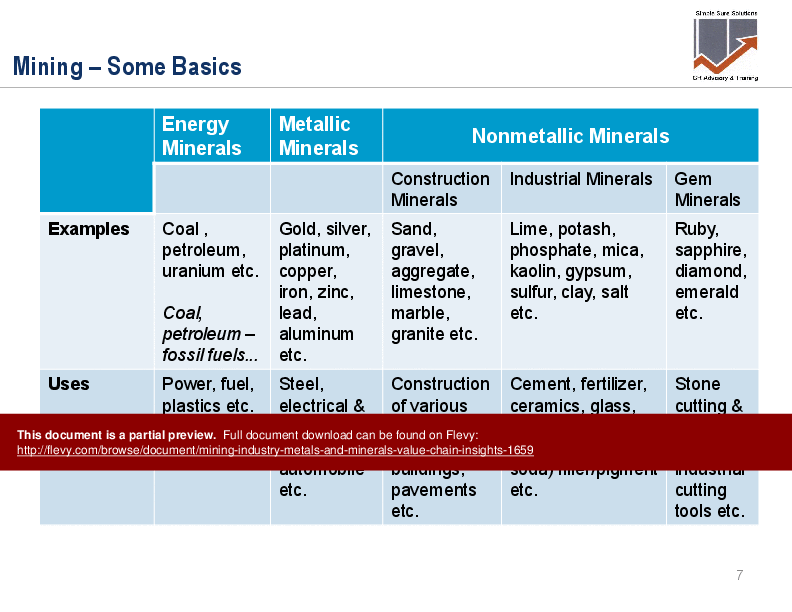
•  Define the main categories of minerals and explain the presentation’s focus on metallic and nonmetallic minerals from land-based mining
•  Distinguish deposits, grade, cutoff grade, mineral resources, mineral reserves, and the confidence ladder from inferred to proven
•  Map the mining value chain from Prospect through Market & Sell, including where recycling and mine closure sit relative to the main flow
•  Build a practical understanding of what happens in prospecting, exploration planning, licensing, sampling, and prefeasibility work
•  Establish what a feasibility study must cover, from geology and mine design through infrastructure, market, cost, risk, valuation, and closure
•  Explain how mine development, permits, infrastructure, production planning, and ore movement support downstream processing
•  Describe mineral processing steps such as comminution, sizing, enrichment, washing, dewatering, agglomeration, smelting, leaching, refining, and primary manufacturing
•  Compare different commercial realities for metals, industrial minerals, construction minerals, and precious stones
•  Structure a mining marketing and sales discussion around product strategy, segmentation, competition, contracts, logistics, revenue generation, and review cycles
•  Summarize the top-level mine closure process, including cessation, decommissioning, rehabilitation or remediation, and monitoring

Table of Contents

•  Mining - Some Basics (page 4)
•  Mining Value Chain - Top Level (page 37)
•  Mining Value Chain - Prospect (page 49)
•  Mining Value Chain - Explore (page 65)
•  Mining Value Chain - Establish Feasibility (page 78)
•  Mining Value Chain - Mine & Move (page 85)
•  Mining Value Chain - Extract & Process (page 95)
•  Mining Value Chain - Market & Sell (page 157)
•  Mining Value Chain - Mine Closure (page 206)
•  Mining Value Chain - Timescale & Outlay (page 213)
•  Mining Value Chain & Porter’s VC Model (page 214)

Primary Topics Covered

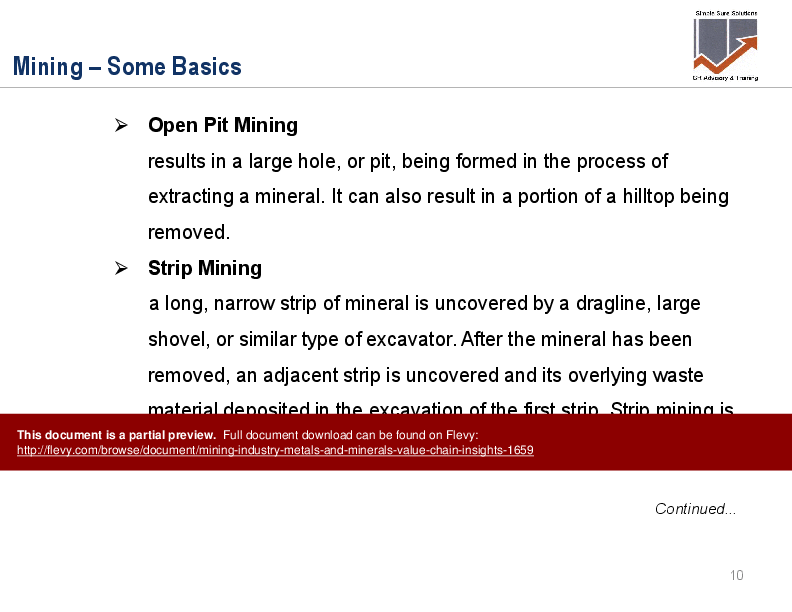
•  Mining Basics and Terminology - The deck establishes core mining language before entering the value chain, including mineral classes, surface and underground mining methods, grade, cutoff grade, breakeven grade, ore, mineral processing, metallurgical processing, mineralogy, mining tenements, sustainable development, and risk factors. It gives enough grounding for a business audience to follow later operating and commercial discussions.
•  Resource and Reserve Classification - A major thread is the progression from inferred, indicated, and measured mineral resources to probable and proven reserves, with modifying factors such as governmental, social, environmental, economic, legal, technology, financial, and market conditions shaping the move toward mineability and profitability.
•  Top-Level Mining Value Chain - The presentation lays out the end-to-end sequence of Prospect, Explore, Establish Feasibility, Mine & Move, Extract & Process, and Market & Sell. It also shows recycling and temporary closure or rehabilitation in relation to the main chain, while stating that the core discussion focuses on Prospect through Market & Sell and only briefly touches permanent mine closure.
•  Prospecting and Early-Stage Assessment - The Prospect section covers desk study, area selection, prospecting permits, regional study and report, regional geological study methods, and initial community engagement. It shows how a broad search narrows to promising land for more detailed exploration.
•  Exploration, Phasing, and Prefeasibility - The Explore section defines exploration as the process of gathering information to assess size, quality, and economic recoverability. It then lays out exploration planning, licensing, activity execution, three escalating exploration phases, and a prefeasibility report used to rank technical and business scenarios before more detailed study.
•  Feasibility Study and Project Commitment - The Establish Feasibility module frames feasibility as the stage where extraction becomes reasonably justified as economically mineable or viable. It lists the key components of a feasibility study, including geology, mine design, material handling, plant design, infrastructure, waste management, contractor and supplier management, social and environmental impact, closure, cost, risk, valuation, and product or market issues.
•  Mining, Movement, and Mine Development - The Mine & Move section explains the removal of mineral resources and transport of classified broken rock to processing destinations. It links this stage to permits, mining leases, environmental and social clearances, mine design, infrastructure, production planning, equipment selection, and site logistics.
•  Extraction, Beneficiation, and Further Processing - The deck breaks Extract & Process into mineral processing and later processing stages. It covers comminution and sizing, concentration or enrichment, washing, dewatering, agglomeration, smelting, leaching, refining, and primary manufacturing, supported by process examples for sand and gravel, silica, phosphorus, and diamond.
•  Market Structure, Commercial Strategy, and Sales Execution - The Market & Sell section covers saleable product types, supplier archetypes, industrial minerals market dynamics, pricing factors, product strategy, segmentation, competition strategy, marketing systems, marketing and sales planning, execution, revenue generation, and review or re-strategize loops. It treats mining products as commercial offerings with segment-specific quality, approval, service, contract, and logistics requirements.
•  Mine Closure and Value Chain Fit With Porter - The final sections briefly cover permanent mine closure and then relate the mining value chain to Porter’s Value Chain model, including a generalized view of support activities such as infrastructure, technology, procurement, people management, information systems, finance, risk, and community relationship management.

Deliverables, Templates, and Tools

•  Prospecting area selection report template based on geological fertility indicators, target commodity, financial strength, deposit size assumptions, hazard exposure, and regulatory or political climate
•  Regional study and shortlist report example that captures outcrops, sample collection, mineral and chemical analysis, airborne surveys, and promising areas for deeper work
•  Exploration planning checklist covering objectives, environmental baseline data, consultation, approvals, work planning, quality control, risk assessment, controls, and documentation
•  Exploration activity governance model including land access agreements, training, permits, sampling plans, compliance, progress reporting, audits, rehabilitation, and stakeholder engagement
•  Prefeasibility report structure for evaluating technical and business options, sensitivity to parameter changes, and scenario ranking
•  Feasibility study framework listing geology, mine design, processing systems, infrastructure, waste management, market and sales, cost, financial and risk analysis, valuation, and mine closure
•  Mine design and development plan example spanning access roads, haul roads, rail, conveyors, pipelines, ventilation, hoisting, haulage, conveying, backfill, and processing facility design
•  Mineral processing flow example covering comminution, sizing, enrichment, washing, dewatering, agglomeration, and auxiliary handling operations
•  Product strategy and product-market segment mapping template for mining marketing strategy work
•  Marketing and sales plan format that translates long-term strategy into annual tactics, channel mix, sample and trial processes, pricing authorities, contracts, warehouses, post-sales support, and MIS
•  Revenue generation and review cycle model linking marketing strategy, marketing plan, execution, revenue generation, evaluation of results, and re-strategizing
•  Mine closure process map covering cessation of operations, decommissioning, rehabilitation or remediation, and monitoring

Slide Highlights

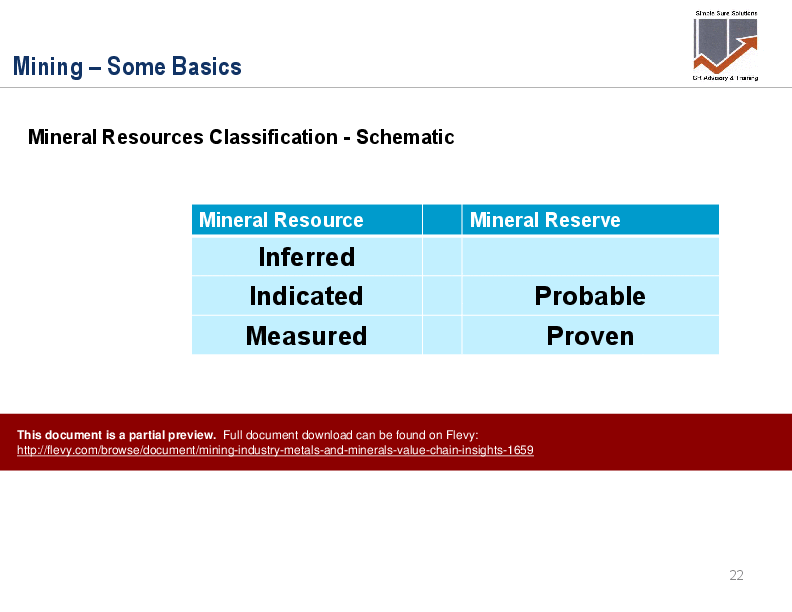
•  Resources Classification schematic that visually shows movement from inferred, indicated, and measured resources toward probable and proven reserves, with modifying factors explicitly called out
•  Top-level value chain arrow sequence that makes the full mining life cycle easy to explain on one slide, including where recycling and closure sit outside the main operating flow
•  Prospect section flow that turns a broad desk study into area selection, permits, regional study, and initial community engagement
•  Exploration phases view that clearly separates Discovery, Scoping, and Prefeasibility by intensity, evidence, economic evaluation, and social or environmental work
•  Feasibility slide that consolidates the full content set of a mining feasibility study into one management-ready checklist
•  Probability of exploration success slide that compresses the funnel from many prospects to one new mine development outcome
•  Extract & Process recap slide that strings together ROM, crushing, screening, beneficiation, and upgrading in process-flow form
•  Commodity examples for construction minerals, industrial sand or silica, phosphorus, and diamond that translate abstract processing concepts into real process chains
•  Market & Sell framework that moves from saleable products and supplier types to segment strategy, plan execution, revenue generation, and review
•  Porter fitment slides that map mining primary and support activities onto a familiar strategy model for management audiences

Potential Workshop Agenda

Mining Value Chain Orientation Session - 90 minutes
•  Align on the deck’s scope, including what is and is not covered within metals and minerals
•  Walk through core terminology such as deposit, grade, cutoff grade, resource, reserve, beneficiation, and mine closure
•  Review the top-level value chain and define where the client or team currently participates

Prospect to Feasibility Working Session - 120 minutes
•  Map prospecting, exploration planning, licensing, activity execution, and exploration phases to the buyer’s target commodity or geography
•  Review what should sit inside a prefeasibility report and full feasibility study
•  Identify the main technical, economic, environmental, social, and governmental decision points

Operations and Processing Deep Dive - 120 minutes
•  Examine Mine & Move requirements across permits, infrastructure, mine design, production planning, and ore movement
•  Review comminution, enrichment, washing, dewatering, agglomeration, smelting, leaching, refining, and primary manufacturing
•  Use one or more process examples from the deck to build a simplified operating flow

Commercial Strategy and Closure Session - 90 minutes
•  Review saleable products, supplier types, segmentation, competition, pricing, logistics, contracts, and revenue generation
•  Discuss how industrial minerals differ commercially from metals
•  Close with mine closure steps and the Porter value chain fitment view for executive synthesis

Customization Guidance

•  Tailor the Prospect and Explore sections around a chosen deposit or mineral type and geography, since the deck explicitly notes that early work can be focused by commodity or geography
•  Expand or collapse the Extract & Process flow depending on whether the audience needs only beneficiation or also post-beneficiation stages such as smelting, leaching, refining, and primary manufacturing
•  Replace the generic commercial examples with the buyer’s actual segment logic, approval process, contract terms, warehouse strategy, and post-sales support model
•  Adapt the closure discussion to local regulations, monitoring periods, and land rehabilitation expectations in the target jurisdiction
•  Use the author’s intended flexibility to incorporate your own views, perspectives, and operating assumptions where required for presentation use

Secondary Topics Covered

•  Brownfield versus greenfield exploration areas
•  Mining tenements, including prospecting permits, exploration permits, mineral development licenses, and mining leases
•  Sustainable development components across environmental, social, and governmental dimensions
•  Broad mining risk categories spanning geological, technical, environmental, social, political, and economic risk
•  Gangue, tailings, ore concentrates, and residue disposal
•  Mineralogy and mineralogical investigations as inputs to separation decisions
•  Community and stakeholder engagement during prospecting and exploration
•  Auxiliary material handling operations such as storage, conveying, sampling, weighing, and feeding
•  Supplier archetypes from prospectors and juniors to seniors
•  Industrial minerals market economics, including place value, technical support, and substitution complexity
•  Timescale and outlay prompt for value chain stages
•  Support activities in the mining context, including infrastructure, procurement, technology, finance, risk, administration, and community relationships

Topic FAQ

What are the main stages of a metals and minerals mining value chain I should understand?

The mining value chain in this context is presented as Prospect, Explore, Establish Feasibility, Mine & Move, Extract & Process, and Market & Sell, with recycling and mine closure shown relative to the main flow. The deck organizes the lifecycle into these 6 stages.

What components should a mining feasibility study cover at a management level?

A feasibility study checklist at management level should cover geology, mine design, material handling, plant and processing design, infrastructure, waste management, contractor and supplier management, social and environmental impact, closure, cost and financial analysis, risk and valuation, and market issues, as in the feasibility study framework.

How are mineral resources and reserves classified and why does that matter for project decisions?

Classification moves from inferred, indicated, and measured mineral resources toward probable and proven reserves; modifying factors like legal, environmental, economic, technical, and market conditions determine what becomes economically extractable, as shown in the resource-to-reserve schematic for resource confidence progression.

What processing steps are typically involved from run-of-mine to saleable product?

Typical processing steps include comminution and sizing, concentration/enrichment, washing, dewatering, agglomeration, smelting, leaching, refining, and in some cases primary manufacturing; the deck also provides process-flow examples such as sand and gravel, silica, phosphorus, and diamond process chains.

What should I look for when choosing a mining value-chain toolkit for corporate strategy use?

For corporate strategy use, prioritize a business-focused value-chain structure, slide notes for presentation, adaptable templates (prospecting area selection, exploration planning, prefeasibility and feasibility frameworks), commercial modules for product strategy and marketing, and clear linkage from operations to market — for example, the prospecting area selection report template.

How long and how deeply can this content be used for training or workshops?

The slide deck is prepared for presentation and training; it can support programs ranging from one to 3 weeks depending on depth, with shorter workshops achievable by selecting relevant modules and culling slides, and includes extensive slide notes across roughly ninety pages.

I need to brief executives unfamiliar with mining — what single-slide framework helps explain the full lifecycle?

Use the top-level value chain arrow slide that sequences Prospect through Market & Sell and shows where recycling and closure sit outside the main flow; pair it with the glossary and the resources-to-reserves schematic to explain lifecycle decisions in one management-ready slide.

How can exploration prospects be evaluated using standard industry steps?

Early-stage evaluation follows desk studies and area selection, prospecting permits, regional studies with outcrop and airborne survey inputs, sampling and analysis, then 3 escalating exploration phases (Discovery, Scoping, Prefeasibility) supported by an exploration planning checklist and a prospecting area selection report template.

Document FAQ
These are questions addressed within this presentation.


What part of the mining industry does this deck actually cover?
It focuses on the mining value chain for metals and minerals, specifically metallic and nonmetallic minerals obtained from land. It explicitly excludes oil, gas, coal, and ocean or deep-sea mining.

Is this a technical mining engineering manual or a business overview?
It is positioned as a generalist, business-perspective presentation rather than a technical document. The goal is to make it easier for users to present insights into mining value chain activities.

Does the deck only describe the value chain at a high level?
No. It starts with a top-level value chain view, then drills down into prospecting, exploration, prefeasibility, feasibility, mine development, processing, commercial strategy, and mine closure. It also uses process examples to make later-stage processing more concrete.

What does the deck say about resources and reserves?
It distinguishes inferred, indicated, and measured resources from probable and proven reserves, and emphasizes that modifying factors such as market, legal, environmental, social, and financial conditions affect what becomes economically extractable.

Does the deck cover exploration in a structured way?
Yes. It lays out exploration planning, licensing, field activity, reporting, audits, rehabilitation, and continuous stakeholder engagement. It also divides exploration into Discovery, Scoping, and Prefeasibility phases with increasing intensity and confidence.

What kinds of processing steps are included?
The Extract & Process section covers comminution and sizing, concentration or enrichment, washing, dewatering, agglomeration, smelting, leaching, refining, and primary manufacturing. It also includes example flows for sand and gravel, industrial sand or silica, phosphorus, and diamond.

Does the deck address commercial and marketing issues, or only operations?
It clearly addresses commercial topics. The Market & Sell section discusses saleable products, supplier types, segmentation, competition strategy, pricing, contracts, logistics, marketing systems, revenue generation, and review loops.

Is there anything in the deck about industrial minerals specifically?
Yes. It includes industrial minerals examples and market discussion covering technical support, substitution complexity, byproducts, customized specifications, longer sales cycles, branding potential, and pricing drivers such as geography, processing cost, freight, and customer relationship structure.

Does the deck help explain mine closure, or is closure outside scope?
Closure is not the main focus, but it is covered briefly at the end. The deck defines mine closure, explains planned and unplanned closure drivers, and outlines cessation, decommissioning, rehabilitation or remediation, and monitoring.

Can this be adapted into a commodity-specific or client-specific presentation?
Yes. The author explicitly notes that users can incorporate their own views or perspectives where necessary, and several parts of the deck are framed around adapting the analysis by deposit or mineral type, geography, market segment, and process path.

Does the deck connect the mining value chain to a broader strategy framework?
Yes. The final section maps the mining value chain to Porter’s Value Chain model and adds mining-relevant support activities such as infrastructure, people management, procurement, technology, information systems, finance, risk, and community relationship management.

Glossary

•  Deposit - Occurrence of mineral in or on the earth’s crust that may be of possible economic interest
•  Mineral Grade - Concentration of mineral within mineral rock
•  Cutoff Grade - Grade below which it is not profitable to mine
•  Mill Cutoff Grade - Grade below which it is not profitable to process
•  Breakeven Grade - Grade where mining and mineral processing costs just equal revenues
•  Ore - Material with grade above the breakeven threshold
•  Mineral Resource - Mineral concentration with estimated grade and tonnage and reasonable prospects for economic extraction
•  Inferred Resource - Resource estimate with approximate and uncertain grade and tonnage
•  Indicated Resource - Resource estimate with reasonable confidence but unverified continuity
•  Measured Resource - Resource estimate with high geological confidence and confirmed continuity
•  Reserve - Portion of a mineral resource that may be extracted at a profit after considering modifying factors
•  Probable Reserve - Economically minable part of an indicated resource and in some cases a measured resource
•  Proven Reserve - Economically minable part of a measured resource with the highest confidence level
•  Gangue - Unwanted material, minerals, or rock associated with ore minerals
•  Tailings - Post-processing waste made up largely of gangue material
•  Mineral Processing - Beneficiation or ore-dressing used to physically separate and concentrate ore minerals
•  Metallurgical Processing - Process used to obtain pure mineral or metal from concentrate
•  Prospecting Permit - Permit allowing early-stage search activities and sample collection to identify potential mineralized areas
•  Exploration License - Authority to explore a defined land area without granting mining rights
•  Mine Closure - Permanent cessation of mining activities at a specific mine or mining site

Source: Best Practices in Value Chain Analysis, Mining Industry PowerPoint Slides: Mining Industry (Metals & Minerals) - Value Chain Insights PowerPoint (PPTX) Presentation Slide Deck, Ganesh Rajagopalan


$96.00

Add to Cart
  

ABOUT THE AUTHOR

Additional documents from author: 4

Consulting experience in Strategic Planning, Business Planning, Business Modeling, Financial Planning, Tactical Planning, Industry Analysis, Investment Analysis, Credit Analysis, Financial Systems Planning, Team Building, Organizational Structuring. Also in academic content support and training in the the finance and banking domain.

Was formerly employed with Standard Chartered Bank, Oracle ... [read more]

Ask the Author a Question

You must be logged in to contact the author.

Click here to log in Click here register

Did you know?
The average daily rate of a McKinsey consultant is $6,625 (not including expenses). The average price of a Flevy document is $65.


Trusted by over 10,000+ Client Organizations
Since 2012, we have provided business templates to over 10,000 businesses and organizations of all sizes, from startups and small businesses to the Fortune 100, in over 130 countries.
AT&T GE Cisco Intel IBM Coke Dell Toyota HP Nike Samsung Microsoft Astrazeneca JP Morgan KPMG Walgreens Walmart 3M Kaiser Oracle SAP Google E&Y Volvo Bosch Merck Fedex Shell Amgen Eli Lilly Roche AIG Abbott Amazon PwC T-Mobile Broadcom Bayer Pearson Titleist ConEd Pfizer NTT Data Schwab



Read Customer Testimonials

 
"I like your product. I'm frequently designing PowerPoint presentations for my company and your product has given me so many great ideas on the use of charts, layouts, tools, and frameworks. I really think the templates are a valuable asset to the job."

– Roberto Fuentes Martinez, Senior Executive Director at Technology Transformation Advisory
 
"Flevy is now a part of my business routine. I visit Flevy at least 3 times each month.

Flevy has become my preferred learning source, because what it provides is practical, current, and useful in this era where the business world is being rewritten.

In today's environment where there are so "

– Omar Hernán Montes Parra, CEO at Quantum SFE
 
"FlevyPro has been a brilliant resource for me, as an independent growth consultant, to access a vast knowledge bank of presentations to support my work with clients. In terms of RoI, the value I received from the very first presentation I downloaded paid for my subscription many times over! The "

– Roderick Cameron, Founding Partner at SGFE Ltd
 
"Last Sunday morning, I was diligently working on an important presentation for a client and found myself in need of additional content and suitable templates for various types of graphics. Flevy.com proved to be a treasure trove for both content and design at a reasonable price, considering the time I "

– M. E., Chief Commercial Officer, International Logistics Service Provider
 
"One of the great discoveries that I have made for my business is the Flevy library of training materials.

As a Lean Transformation Expert, I am always making presentations to clients on a variety of topics: Training, Transformation, Total Productive Maintenance, Culture, Coaching, Tools, Leadership Behavior, etc. Flevy "

– Ed Kemmerling, Senior Lean Transformation Expert at PMG
 
"I have used Flevy services for a number of years and have never, ever been disappointed. As a matter of fact, David and his team continue, time after time, to impress me with their willingness to assist and in the real sense of the word. I have concluded in fact "

– Roberto Pelliccia, Senior Executive in International Hospitality
 
"The wide selection of frameworks is very useful to me as an independent consultant. In fact, it rivals what I had at my disposal at Big 4 Consulting firms in terms of efficacy and organization."

– Julia T., Consulting Firm Owner (Former Manager at Deloitte and Capgemini)
 
"As a consultant requiring up to date and professional material that will be of value and use to my clients, I find Flevy a very reliable resource.

The variety and quality of material available through Flevy offers a very useful and commanding source for information. Using Flevy saves me time, enhances my expertise and ends up being a good decision."

– Dennis Gershowitz, Principal at DG Associates


Customers Also Bought These Documents

10-slide PowerPoint, Excel template
$30.00


Customers Also Like These Documents

Explore Templates on Related Management Topics


Your Recently Viewed Documents
Download our FREE Strategy & Transformation Framework Templates

Download our free compilation of 50+ Strategy & Transformation slides and templates. Frameworks include McKinsey 7-S, Balanced Scorecard, Disruptive Innovation, BCG Curve, and many more.









