 Click main image to view in full screen. Unlock all 15 preview images:
Long-Duration Energy Storage Model - 25-Year Project Finance – Excel XLSX
Excel (XLSX) + supplemental PDF


BENEFITS OF THIS DOWNLOADABLE EXCEL DOCUMENT
- Compare five long-duration storage technology options across 300 monthly periods, with configurable capacity, efficiency, degradation and operating assumptions.
- Connect energy delivery, revenue stacking, CAPEX, replacements and debt financing to financial statements, LCOS, IRR, NPV and DSCR.
- Explore five indicative economic scenarios, evaluate technology cost differences and identify cash shortfalls using transparent model checks.
ENERGY INDUSTRY EXCEL DESCRIPTION
⚡ LONG-DURATION ENERGY STORAGE FINANCIAL MODEL | 25-YEAR PREMIUM EDITION
Multi-Technology Storage • Dispatch Economics • Revenue Stacking • LCOS • Project Finance • IRR & NPV
CONNECT STORAGE CAPACITY, ENERGY DELIVERY AND LONG-TERM PROJECT ECONOMICS.
How does storage technology affect capital investment, operating efficiency and long-term energy delivery? Which revenue streams can support a storage project? How do degradation, replacement requirements and debt service influence project and equity returns?
The Long-Duration Energy Storage Financial Model by SheetworksStudio brings these questions together within an editable 25-year Excel financial planning framework.
Designed for energy storage developers, renewable infrastructure investors, project finance teams, technology evaluators and consultants, the model connects storage performance, representative dispatch, market revenues, capital costs and financing.
The workbook includes 25 structured worksheets, 300 monthly forecast periods, 25 annual reporting periods, five configurable storage technologies, eight native Excel dashboard charts, five indicative scenario cases and a dedicated nine-page English PDF guide.
All sample inputs and financial projections are fictional and illustrative.
📊 01 | EXECUTIVE DASHBOARD & EIGHT NATIVE CHARTS
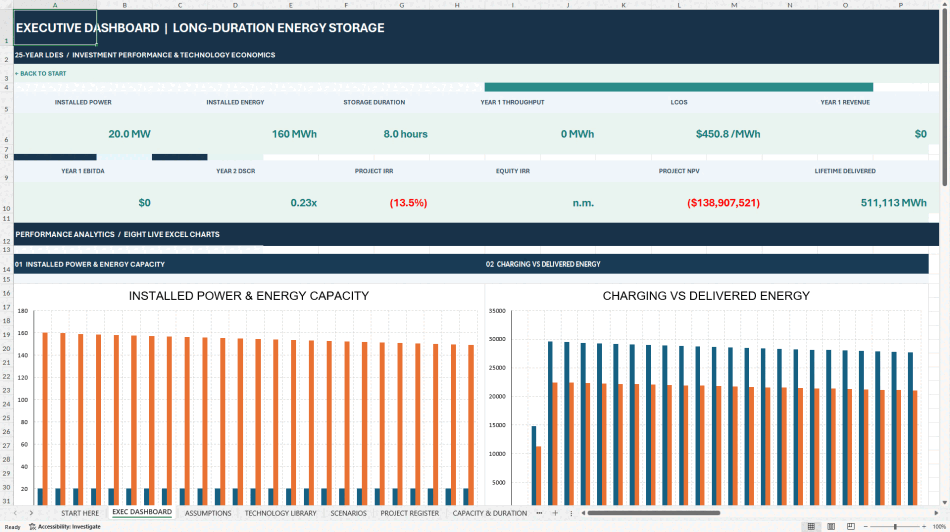
The executive dashboard brings together storage operating performance and financial results.
Eight native Excel charts visualize:
• Installed Power and Energy Capacity
• Charging versus Delivered Energy
• Annual Revenue by Energy Service
• LCOS by Storage Technology
• Capacity and Efficiency Degradation
• EBITDA versus Free Cash Flow
• Outstanding Debt versus DSCR
• Indicative Scenario IRR and NPV
The visual framework helps users evaluate physical storage performance alongside revenue, investment requirements and financial risks.
Charts are linked to underlying workbook calculations.
🔋 02 | FIVE STORAGE TECHNOLOGY CONFIGURATIONS
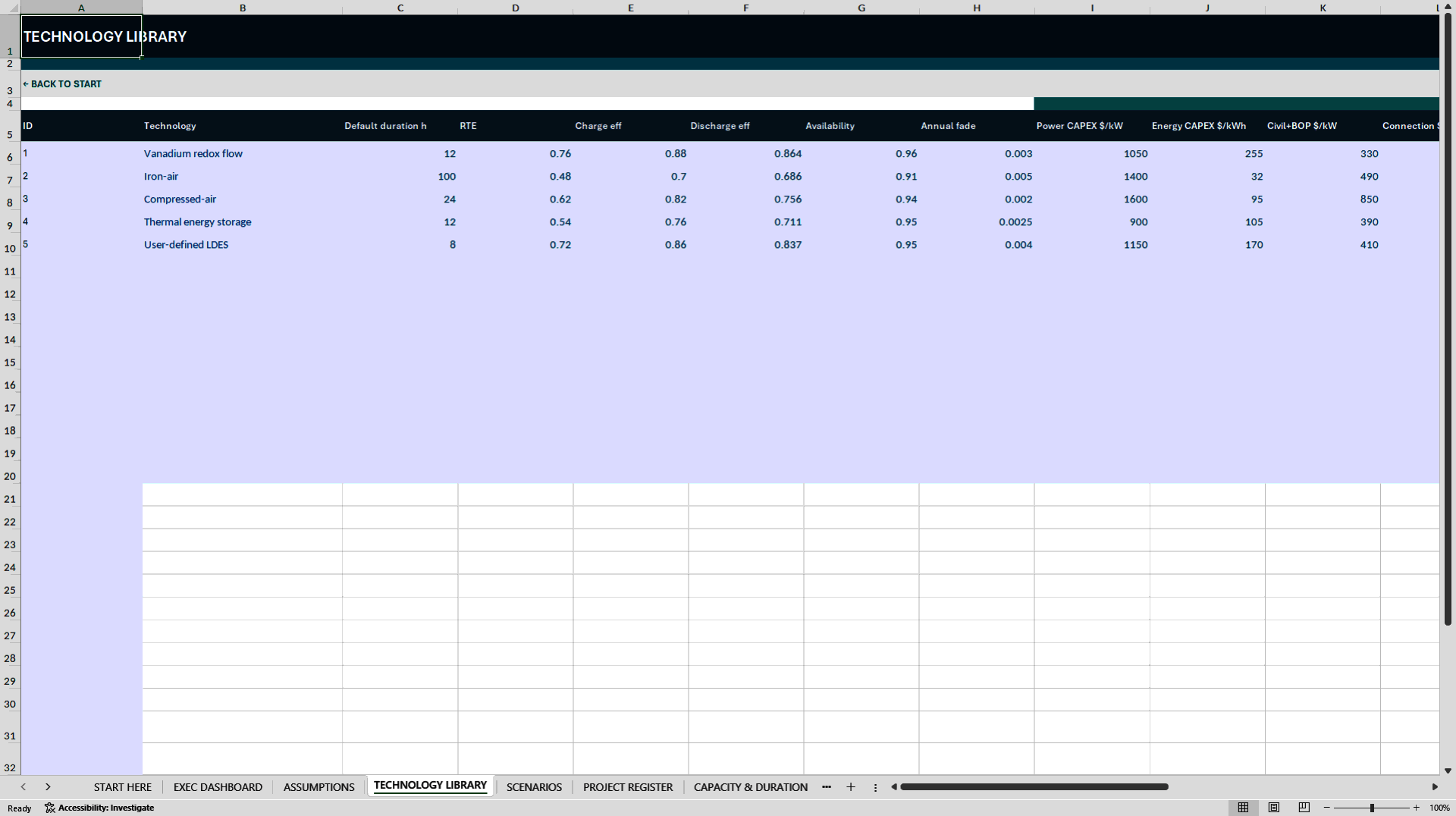
The TECHNOLOGY LIBRARY includes five configurable technology options:
1. Flow Battery
2. Iron-Air Storage
3. Compressed-Air Energy Storage
4. Thermal Energy Storage
5. Editable Long-Duration Storage Configuration
Configure technology-specific operating and investment assumptions.
Key parameters include:
• Installed Power Capacity (MW)
• Installed Energy Capacity (MWh)
• Discharge Duration
• Round-Trip Efficiency
• Plant Availability
• Auxiliary Energy Losses
• Capacity Degradation
• Operating Cycles
• Replacement Requirements
• Investment and Operating Costs
The technology framework allows users to explore alternative storage configurations using a consistent project-finance structure.
The technologies are represented through simplified planning assumptions rather than full engineering simulations.
🏗️ 03 | PROJECT REGISTER & CAPACITY PLANNING
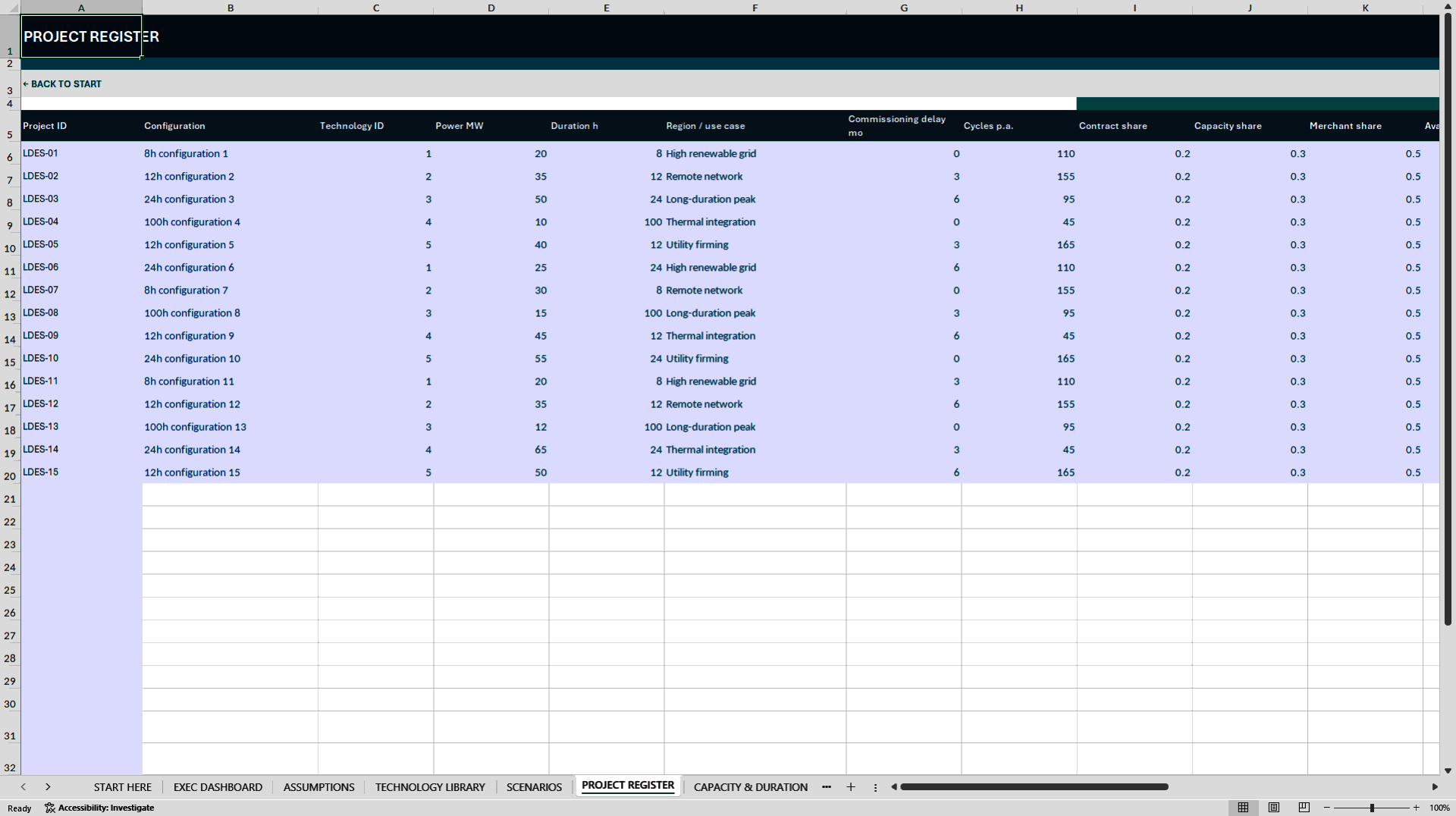
The PROJECT REGISTER contains 15 illustrative project configurations.
Use these examples to organize potential storage projects and evaluate different technology and capacity assumptions.
The CAPACITY & DURATION worksheet translates installed power and energy specifications into the operating constraints used in the monthly calculations.
Distinguish power capacity from energy capacity when examining the economics of long-duration storage.
Installed MW describes maximum power capability, while MWh represents stored energy capacity.
The workbook supports project screening and comparative analysis, not detailed grid interconnection engineering or automated portfolio optimization.
⚙️ 04 | DISPATCH ENGINE & ENERGY BALANCE
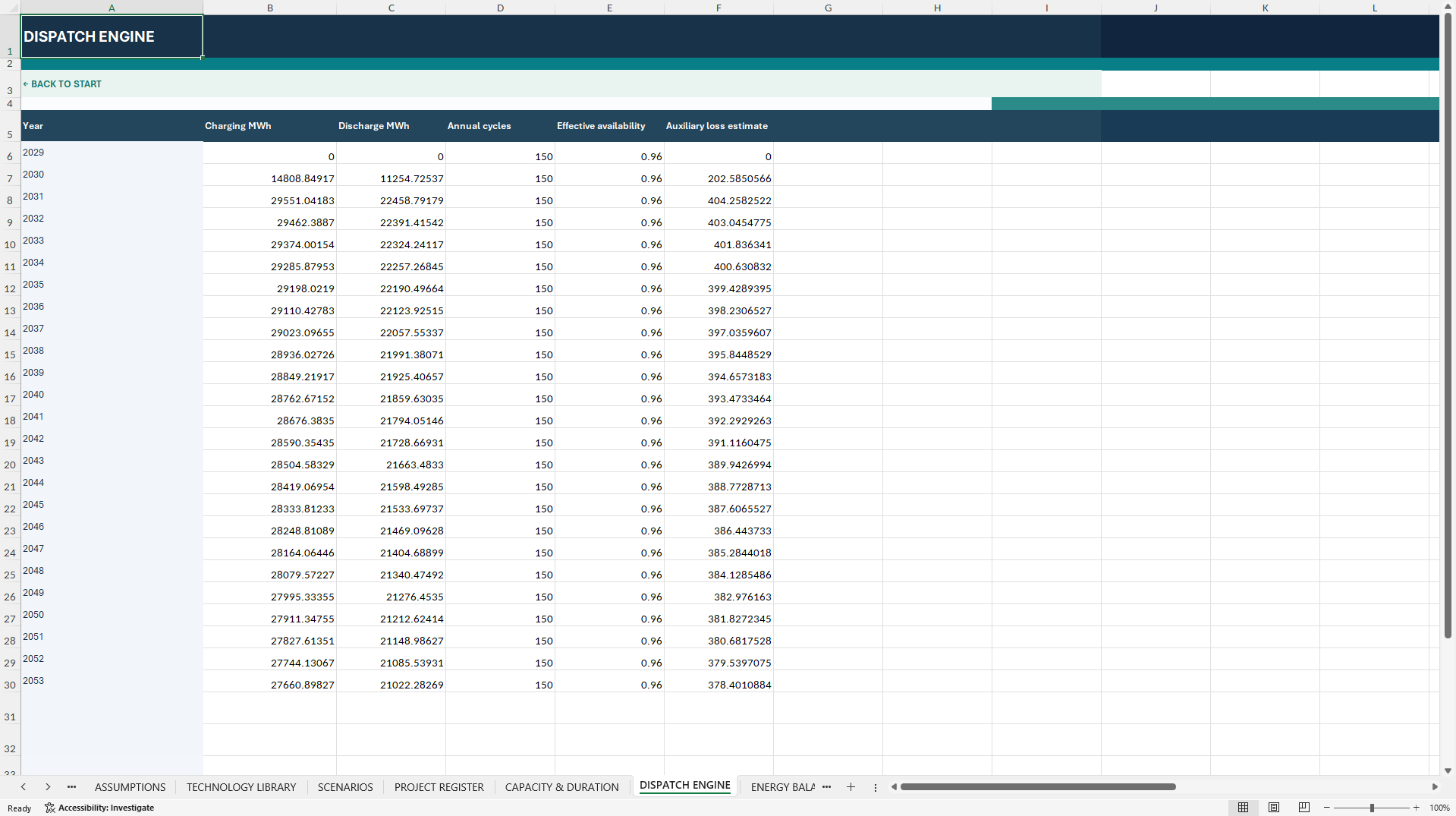
The DISPATCH ENGINE and ENERGY BALANCE worksheets connect storage operating assumptions with modeled energy delivery.
The calculation framework considers:
• Available Storage Capacity
• Charging Energy
• Discharged and Delivered Energy
• Round-Trip Efficiency
• Auxiliary Losses
• Operating Cycles
• Availability
• Degradation
• Storage Duration
These schedules help estimate how energy losses and operating conditions influence commercially available energy over time.
IMPORTANT MODEL LIMITATION
The workbook uses representative monthly dispatch assumptions.
It is not an hourly energy-market optimizer, real-time dispatch controller or certified operational simulation.
Actual charging opportunities, discharge requirements and simultaneous service commitments must be assessed independently.
💰 05 | ENERGY MARKETS & REVENUE STACKING
Evaluate the potential commercial contribution of multiple storage-related services.
The revenue framework includes:
ENERGY ARBITRAGE
Illustrative revenue associated with charging and discharging electricity under different market-price conditions.
CAPACITY SERVICES
Modeled payments related to available storage capacity.
ANCILLARY SERVICES
Potential revenue associated with eligible grid support and flexibility services.
TOLLING ARRANGEMENTS
Illustrative contracted commercial value from providing storage capacity or operating rights to a third party.
RENEWABLE INTEGRATION
Potential value associated with integrating storage into renewable electricity projects.
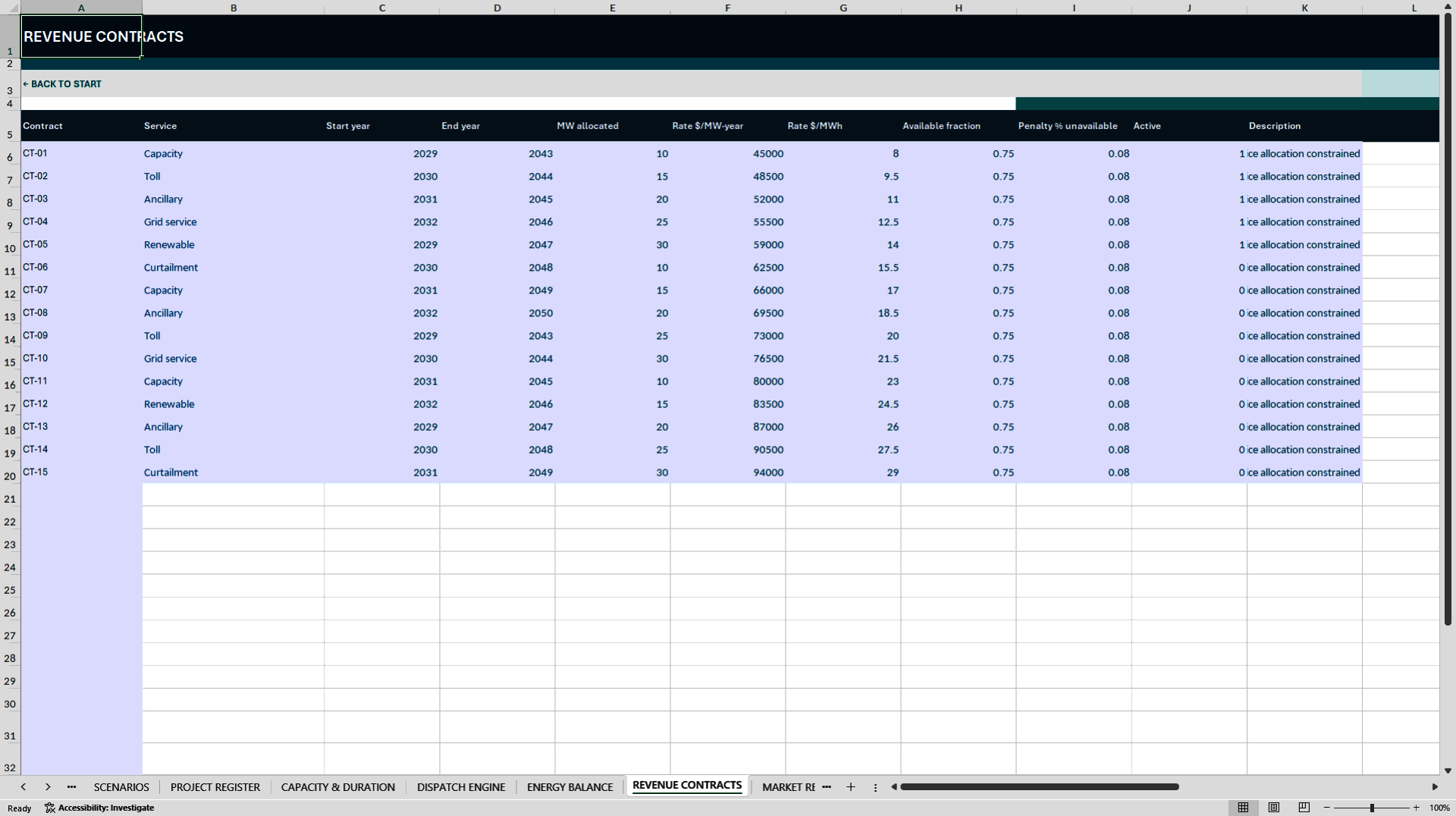
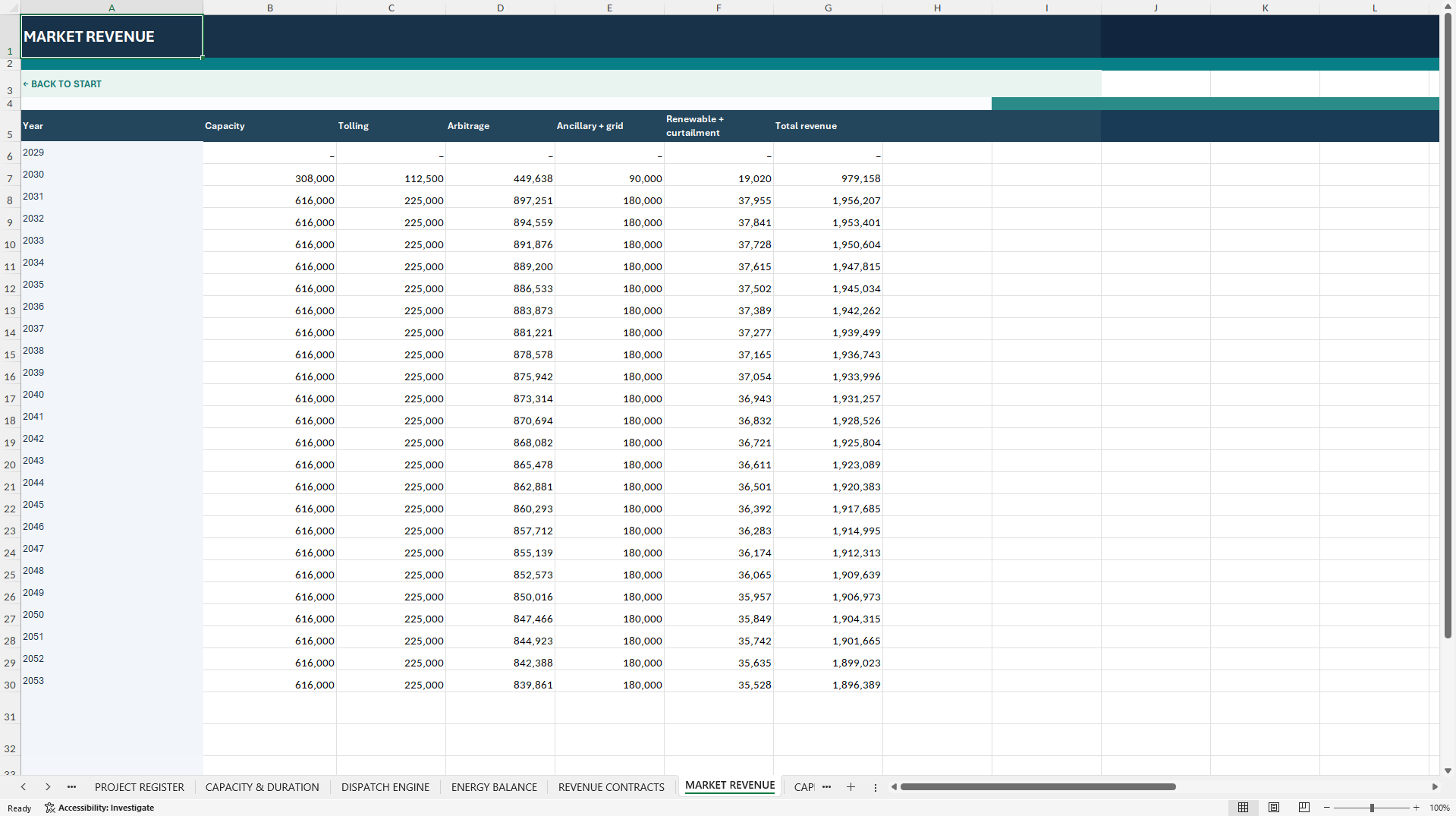
The REVENUE CONTRACTS and MARKET REVENUE worksheets support the commercial calculation framework.
Revenue stacking assumptions are useful for screening, but they are not confirmation that all selected services can be earned simultaneously.
Actual service eligibility, capacity reservation, contract expiry, dispatch rights and market rules must be independently verified.
📉 06 | CAPEX, OPEX & TECHNOLOGY REPLACEMENTS
The CAPEX worksheet connects power capacity, energy capacity and other project infrastructure assumptions to initial investment requirements.
Review installation costs, power-related CAPEX, energy-related CAPEX and supporting project expenditure.
The workbook distinguishes installed cost per kW from installed cost per kWh.
For the supplied fictional Base Case, installed cost is approximately USD 3,861/kW and USD 482.63/kWh.
The OPEX and REPLACEMENTS worksheets model recurring operating expenditure and selected equipment replacement requirements.
Explore how degradation and replacement investment affect long-term operating performance and cash flow.
These cost figures are illustrative model outputs, not current supplier quotations.
🏦 07 | PROJECT FINANCING & DEBT SERVICE
The FINANCING worksheet connects debt and sponsor funding assumptions with the project's investment and operating schedules.
Analyze:
• Initial Project Funding
• Sponsor Equity
• Project Borrowing
• Interest Expense
• Principal Repayment
• Outstanding Debt
• Debt Service
• Cash Availability
• Funding Requirements
The model also provides debt service coverage indicators.
Debt Service Coverage Ratio (DSCR) supports an illustrative assessment of the relationship between available project cash flow and scheduled debt obligations.
Negative cash balances remain visible rather than being automatically eliminated through assumed financing.
The workbook is not a lender-approved debt-sizing model or a complete contractual financing waterfall.
📑 08 | INTEGRATED FINANCIAL STATEMENTS
The workbook provides financial reporting across the 25-year forecast.
PROFIT & LOSS
Review modeled revenue, operating expenses, EBITDA, depreciation, interest and earnings.
BALANCE SHEET
Analyze project assets, cash, debt, liabilities and shareholders' equity.
CASH FLOW
Follow operating cash generation, capital investment, financing movements and cash balances.
The MONTHLY ENGINE and ANNUAL ENGINE support the financial calculation framework.
These schedules help users distinguish operating profitability from actual cash generation and financing requirements.
The workbook uses simplified project accounting assumptions and is not a substitute for independently audited financial statements.
📈 09 | PROJECT VALUATION & INVESTMENT RETURNS
The INVESTMENT RETURNS worksheet consolidates major valuation and financial performance measures.
Review:
• Project IRR
• Equity IRR
• Project NPV
• Equity NPV
• Levelized Cost of Storage (LCOS)
• Lifetime Energy Delivery
• Installed Cost per kW
• Installed Cost per kWh
• Project Cash Flow
• Debt Coverage
• Investment and Financing Requirements
LCOS provides an illustrative measure of the modeled cost of delivered storage energy, subject to the workbook's assumptions and calculation conventions.
Project and equity returns should be interpreted separately because they represent different cash-flow perspectives.
⚠️ 10 | TRANSPARENT BASE-CASE RESULTS
The workbook deliberately preserves economically adverse financial results.
Under the supplied fictional Base Case:
• Project NPV: approximately negative USD 138.91 million
• Project IRR: approximately negative 13.53%
• Equity NPV: approximately negative USD 62.87 million
• Equity IRR: approximately negative 20.73%
• Minimum modeled cash balance: approximately negative USD 76.02 million
These illustrative results indicate significant commercial and financing challenges under the selected assumptions.
They should not be interpreted as an economically viable or fully funded project.
The workbook is intended to help users identify such concerns, test alternative assumptions and understand financial dependencies.
A negative return or funding shortfall is not, by itself, evidence of a spreadsheet formula error.
🔀 11 | FIVE INDICATIVE SCENARIOS
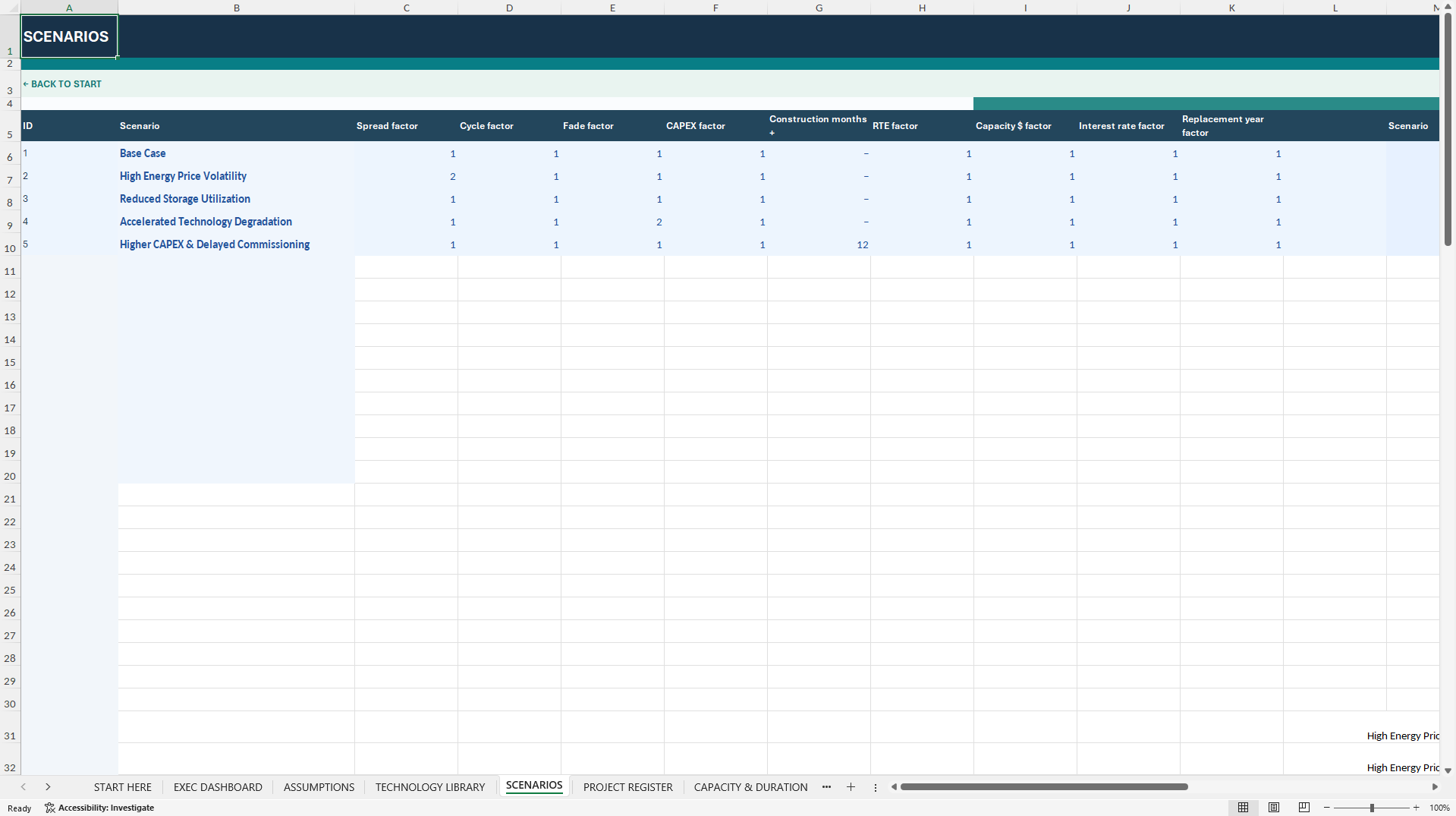
The SCENARIOS worksheet provides five economic planning cases.
BASE CASE
Central illustrative capacity, dispatch, revenue and cost assumptions.
HIGH ENERGY PRICE VOLATILITY
Tests a more favorable energy price-spread environment.
REDUCED STORAGE UTILIZATION
Examines the effect of fewer operating cycles and reduced energy delivery.
ACCELERATED TECHNOLOGY DEGRADATION
Explores the financial implications of weaker long-term storage performance.
HIGHER CAPEX & DELAYED COMMISSIONING
Tests increased investment costs and delayed commercial operation.
The scenario comparison framework provides simplified annual economic results.
IMPORTANT DISTINCTION
These scenario comparisons are indicative. They are not five independently financed and recalculated 300-month project models.
For detailed project evaluation, individual operating, financing and cash-flow assumptions should be tested and independently validated.
📊 12 | TECHNOLOGY COMPARISON & SENSITIVITY
The TECHNOLOGY COMPARISON worksheet provides a structured basis for comparing selected storage technology assumptions.
Review indicative differences in investment requirements and modeled storage economics.
A separate SENSITIVITY worksheet evaluates how changes in selected commercial and investment drivers affect indicative project NPV.
The sensitivity calculations support early-stage assumption screening.
They are not complete independently optimized dispatch and financing forecasts for every sensitivity combination.
✅ 13 | MODEL CHECKS & FINANCIAL WARNINGS
The MODEL CHECKS worksheet includes selected accounting, operating and physical constraint diagnostics.
Controls address matters such as:
• Accounting Reconciliation
• Power Capacity Constraints
• Efficiency Assumptions
• Revenue and Energy Relationships
• Debt Balances
• Operating Integrity
• Financing and Cash Warnings
The workbook preserves adverse financial outcomes instead of automatically generating artificial project funding.
A PASS result confirms that the implemented model control conditions are satisfied.
It does not confirm adequate liquidity, viable project economics, engineering feasibility, contractual eligibility or financing approval.
📦 WHAT YOU RECEIVE
PRIMARY DOCUMENT – EDITABLE EXCEL FINANCIAL MODEL
• 25 Structured Worksheets
• 300 Monthly Forecast Periods
• 25 Annual Reporting Periods
• Five Configurable Storage Technology Options
• 15 Illustrative Project Configurations
• Eight Native Dashboard Charts
• Power and Energy Capacity Analysis
• Representative Dispatch and Energy Balance
• Revenue Contracts and Commercial Revenue Stacking
• CAPEX, OPEX and Replacement Schedules
• Debt and Equity Financing
• Three Financial Statements
• Project and Equity IRR / NPV
• LCOS and Debt Coverage Analysis
• Five Indicative Scenario Cases
• Technology Comparison and Sensitivity Analysis
• Built-In Model Checks
• START HERE Navigation and Embedded Guidance
SUPPLEMENTARY DOCUMENT – PROFESSIONAL ENGLISH USER GUIDE
A nine-page PDF guide covering workbook setup, technology configurations, capacity and dispatch assumptions, revenue modeling, operating and capital costs, financing, valuation, scenarios, dashboard interpretation, model checks and limitations.
🧭 HOW TO GET STARTED
1. Save a separate project copy of the Excel workbook.
2. Open START HERE and review the PDF guide.
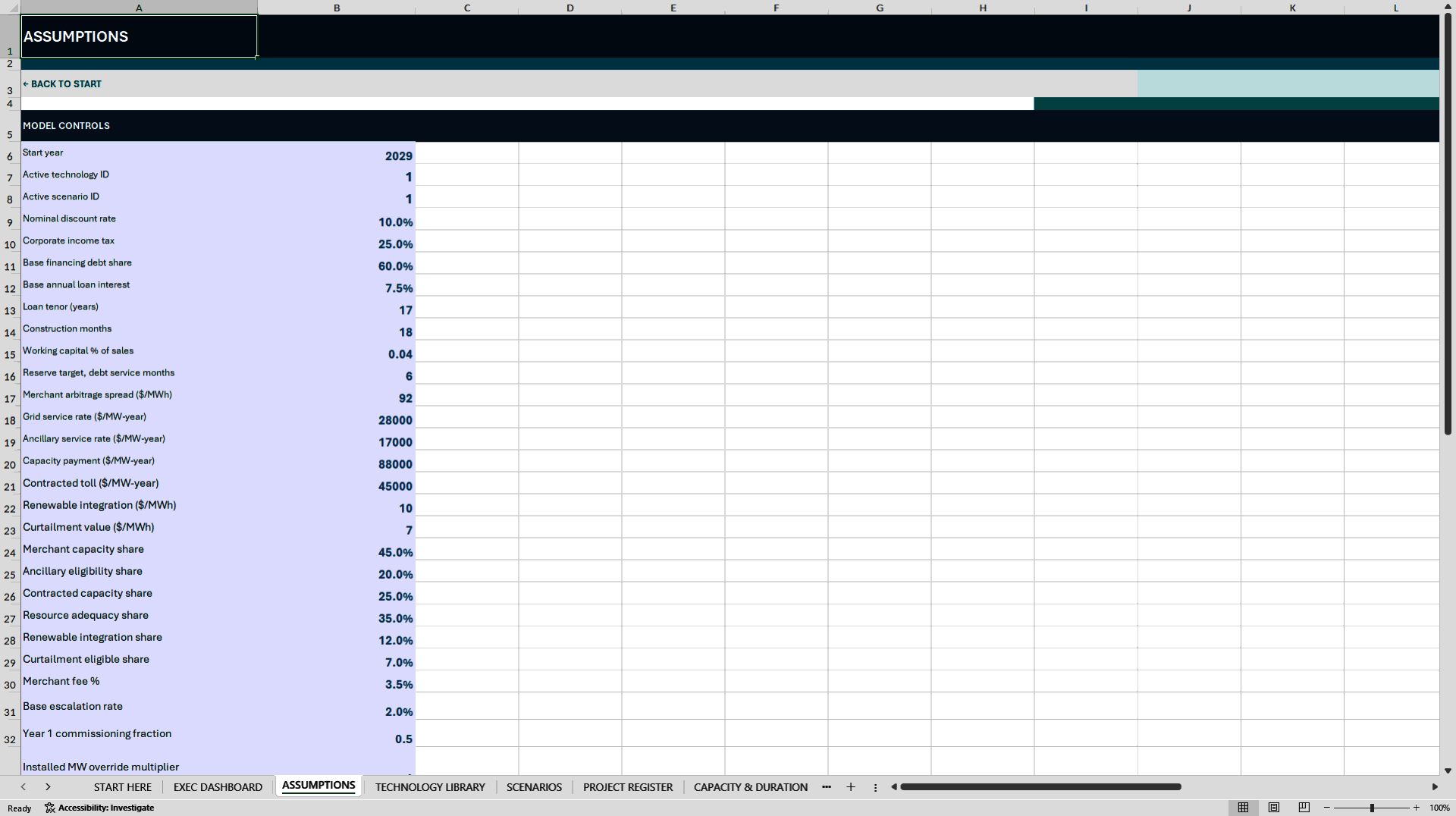
3. Select a storage technology and configure ASSUMPTIONS.
4. Review TECHNOLOGY LIBRARY and PROJECT REGISTER.
5. Check capacity and duration assumptions.
6. Examine DISPATCH ENGINE and ENERGY BALANCE.
7. Customize revenue contracts and market assumptions.
8. Review CAPEX, OPEX, replacements and financing.
9. Analyze the financial statements and INVESTMENT RETURNS.
10. Explore scenarios, sensitivities and MODEL CHECKS.
👥 WHO THIS MODEL IS FOR
• Long-Duration Energy Storage Developers
• Battery and Alternative Storage Project Teams
• Renewable Energy Infrastructure Investors
• Energy Technology Evaluators
• Project Finance Analysts
• Power Market Consultants
• Corporate Finance Professionals
• Financial Modeling Educators
⚙️ TECHNICAL SPECIFICATIONS
File Format: Editable Microsoft Excel XLSX.
Forecast: 300 months and 25 annual periods.
Illustrative Period: 2029–2053.
Worksheets: 25.
Dashboard Charts: Eight native Excel charts.
Storage Technology Options: Five.
Scenarios: Five indicative economic comparisons.
Macros / VBA: None.
Required External Workbook Connections: None.
Recommended Software: Microsoft Excel Desktop.
A complete independent native Excel Desktop recalculation and Google Sheets import test have not been performed.
Changing the reporting currency label does not automatically convert financial amounts.
The workbook is a representative financial planning system, not an hourly dispatch optimizer, engineering-certified storage design, audited valuation or lender-approved financial model.
🛡️ INDEPENDENT TEMPLATE DISCLAIMER
This is an independently developed, unofficial financial planning and educational template by SheetworksStudio.
All sample technology assumptions, energy quantities, commercial revenues, capital costs and financial projections are fictional and illustrative.
The product is not audited, certified, regulator-approved, bank-approved or endorsed by any energy market, technology manufacturer, lender, financial institution or software provider.
Actual storage projects require independent validation of technology performance, degradation, operating constraints, revenue eligibility, contractual arrangements, financing terms and applicable regulations.
No energy performance, market revenue, financing availability, profitability or investment return is guaranteed.
The template does not provide individualized financial, investment, engineering, accounting, tax or legal advice.
Digital product only. No physical storage equipment, electricity, installation service or software subscription is included.
CONNECT LONG-DURATION STORAGE TECHNOLOGY, ENERGY DELIVERY AND PROJECT FINANCE IN ONE STRUCTURED 25-YEAR EXCEL PLANNING FRAMEWORK.
Got a question about the product? Email us at support@flevy.com or ask the author directly by using the "Ask the Author a Question" form. If you cannot view the preview above this document description, go here to view the large preview instead.
Source: Best Practices in Energy Industry, Integrated Financial Model Excel: Long-Duration Energy Storage Model - 25-Year Project Finance Excel (XLSX) Spreadsheet, SheetworksStudio
ABOUT THE AUTHOR

SheetworksStudio creates premium Excel-based business templates, dashboards, trackers, financial models, and management systems for professionals, consultants, entrepreneurs, and organizations.
Our portfolio covers finance, project management, operations, risk management, compliance, AI governance, HR, supply chain, performance management, and business planning. Each product is designed to
... [read more]
Ask the Author a Question
You must be logged in to contact the author.