 Click main image to view in full screen.
Insurance Agency Acquisition and SBA Underwriting Model – Excel XLSX
Excel (XLSX) + supplemental PDF


BENEFITS OF THIS DOWNLOADABLE EXCEL DOCUMENT
- Rolls the book forward as retention times existing commission plus new business, built bottom-up from premium and carrier commission rates by line.
- Breaks contingent and profit-sharing commissions onto their own line, normalizes them to a three-year average and keeps them out of the cash flow the coverage ratio uses.
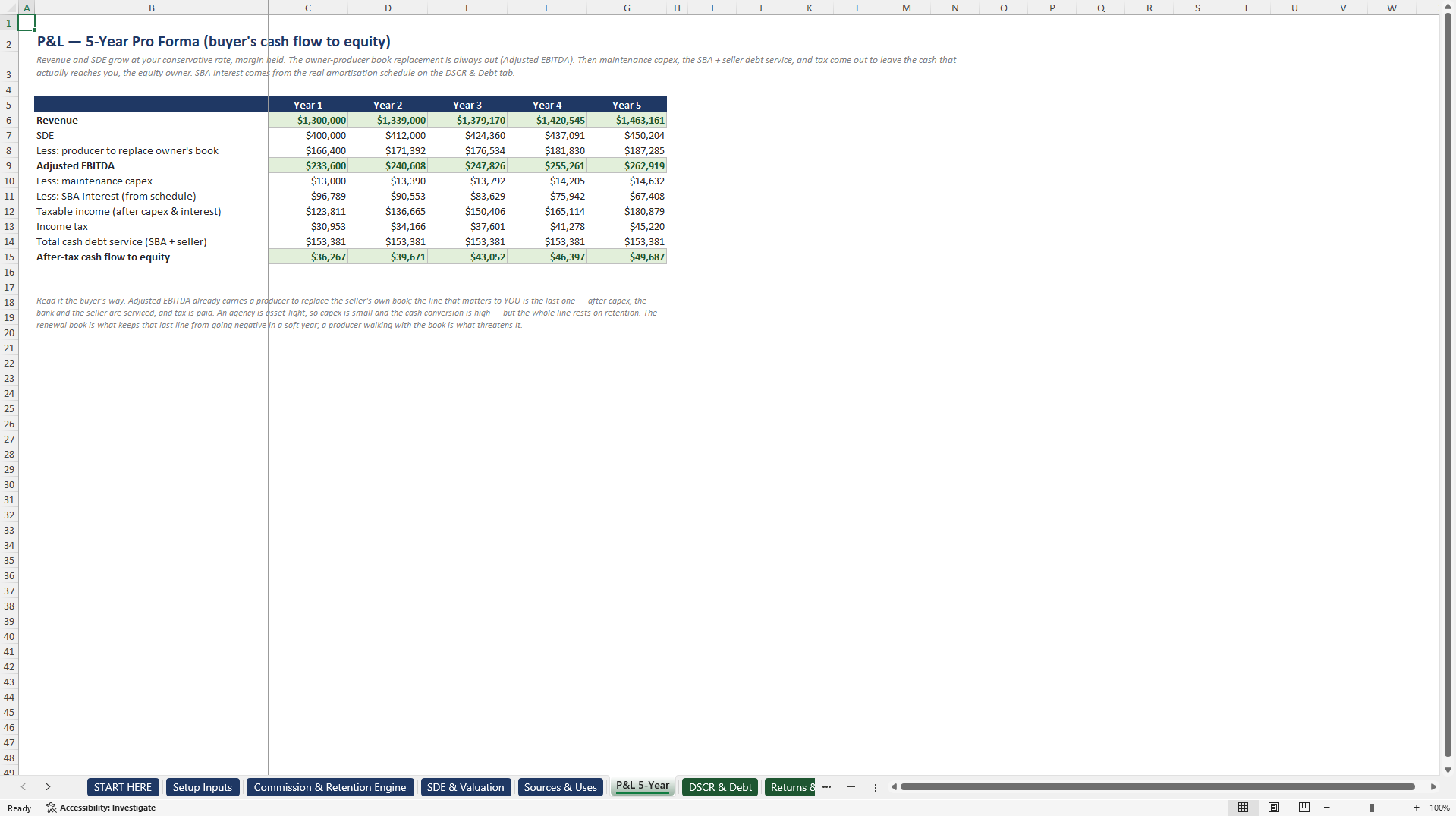
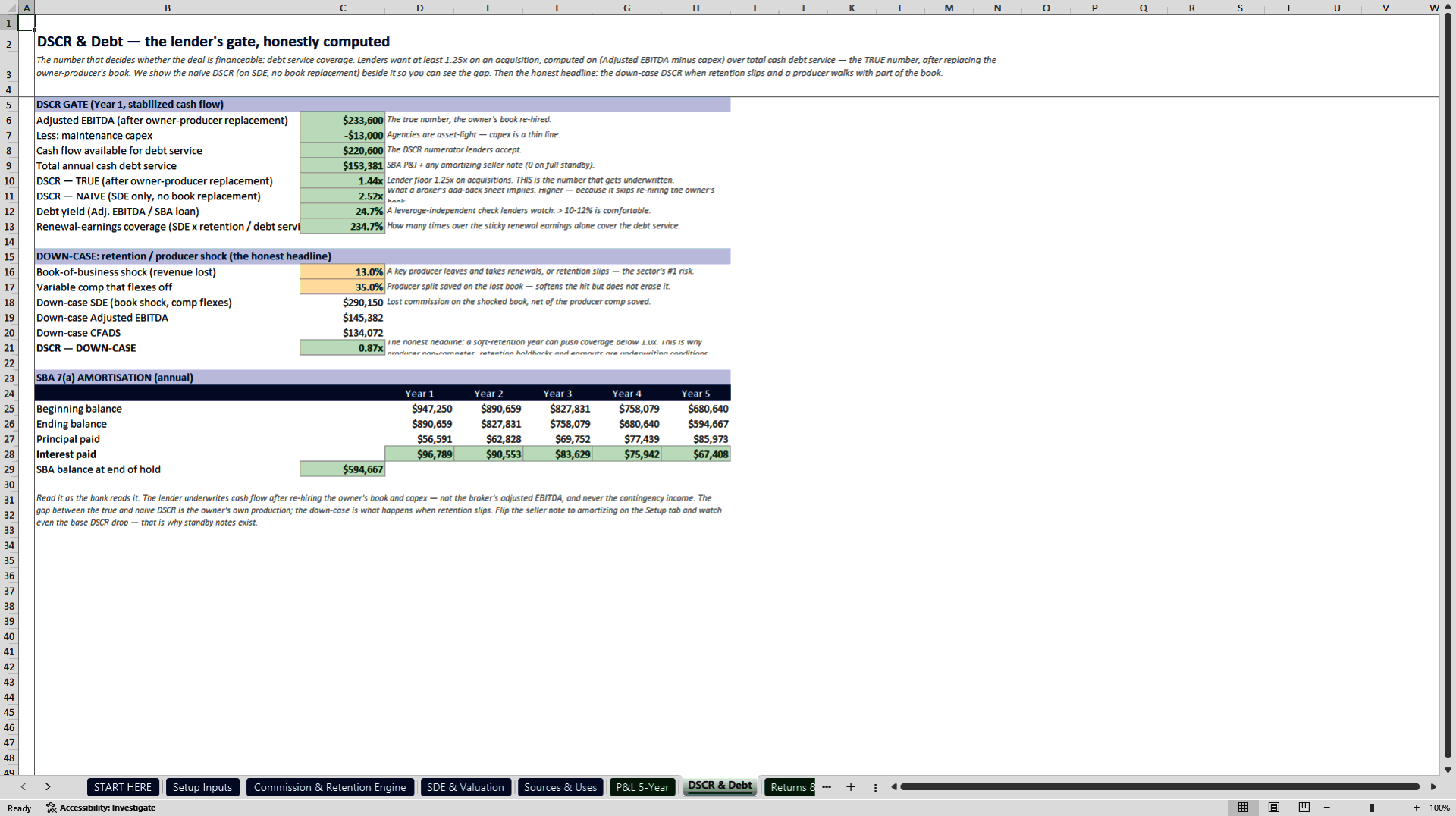
- Deducts a producer at a commission split to replace the owner's personal book, showing a true DSCR of 1.44x beside the naive 2.52x and a producer-loss down-case of 0.87x.
INSURANCE EXCEL DESCRIPTION
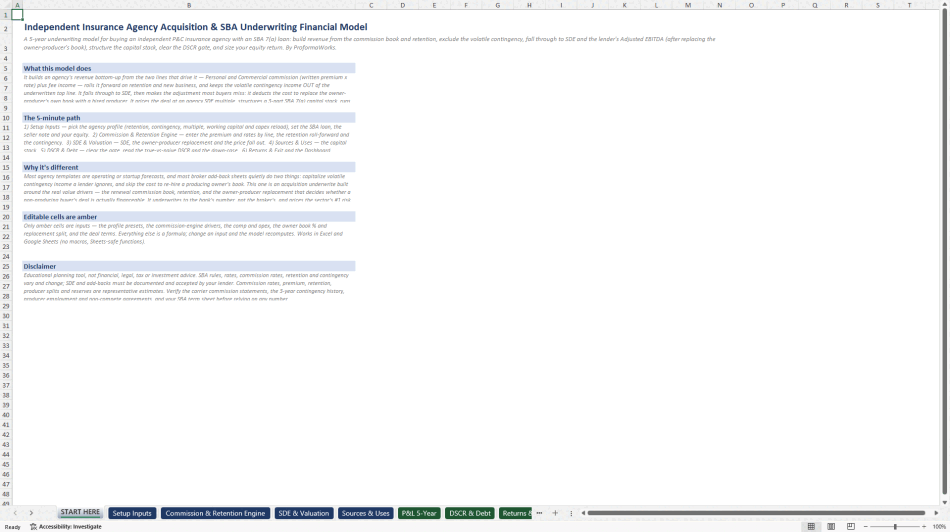
This is a lender-ready acquisition model for a single independent property and casualty insurance agency bought with an SBA 7(a) loan. It is built around the two things a real underwriter tests and a broker's add-back sheet quietly overstates: which commission income you can actually bank on, and what it costs to replace the owner-producer's personal book once you own it.
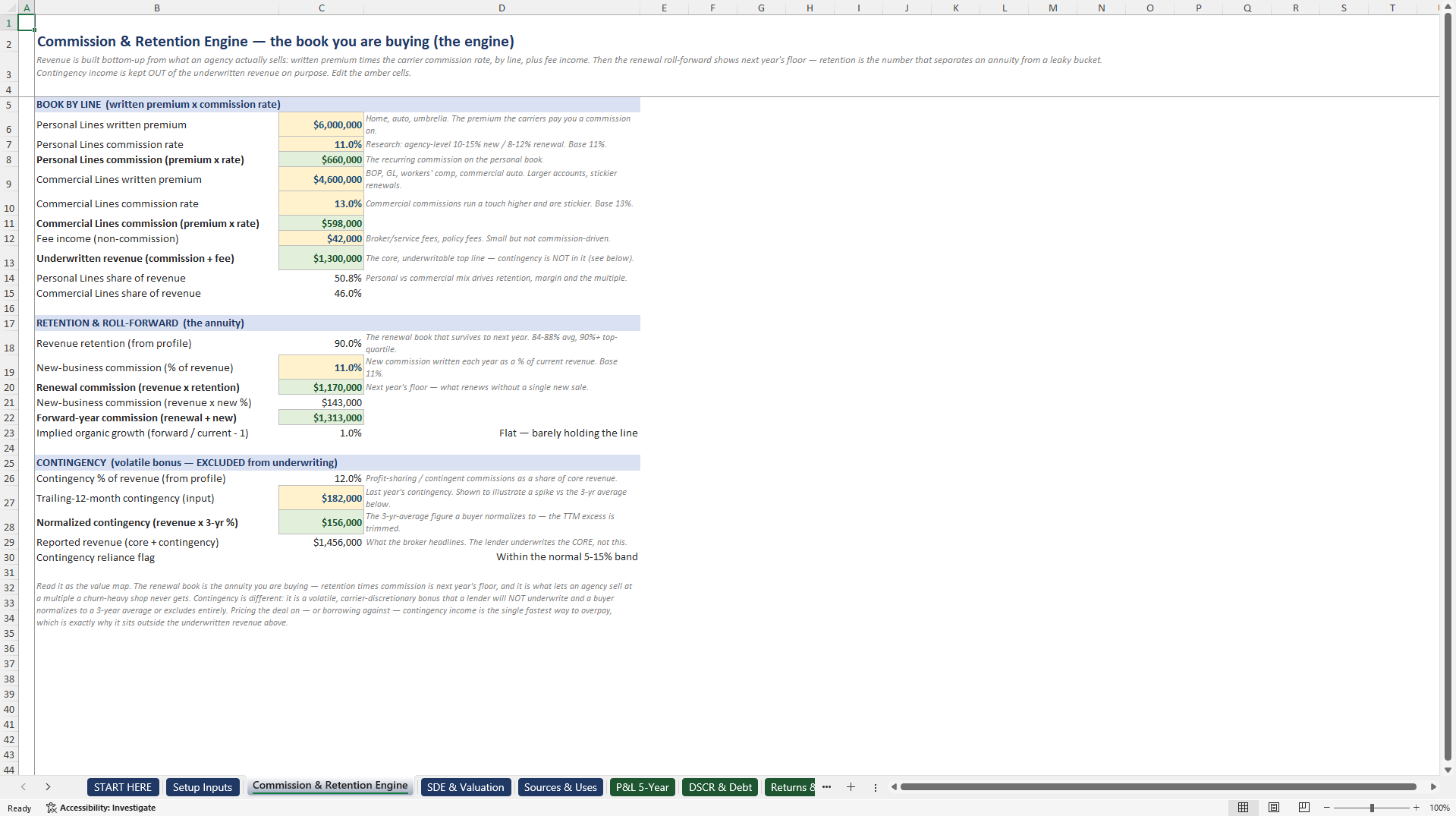
The revenue side is a retention-driven commission engine rather than a guessed growth line. The book is built bottom-up by line, personal and commercial premium times each carrier commission rate, then rolled forward the way an agency really compounds: next-year commission equals retention times book plus new business. Retention is the single number that turns a book into an annuity, so it drives the renewal-earnings coverage, the down-case and the value.
The first correction is the contingency exclusion. Contingent and profit-sharing commissions are real money, but they are volatile, driven by carrier loss ratios and volume, and they are not contractually guaranteed. Lenders do not underwrite them as a repayment source. The model breaks them onto a separate line, normalizes them to a three-year average, and excludes them from the cash flow the coverage ratio is built on, with a memo showing how much you would overpay if you capitalized them.
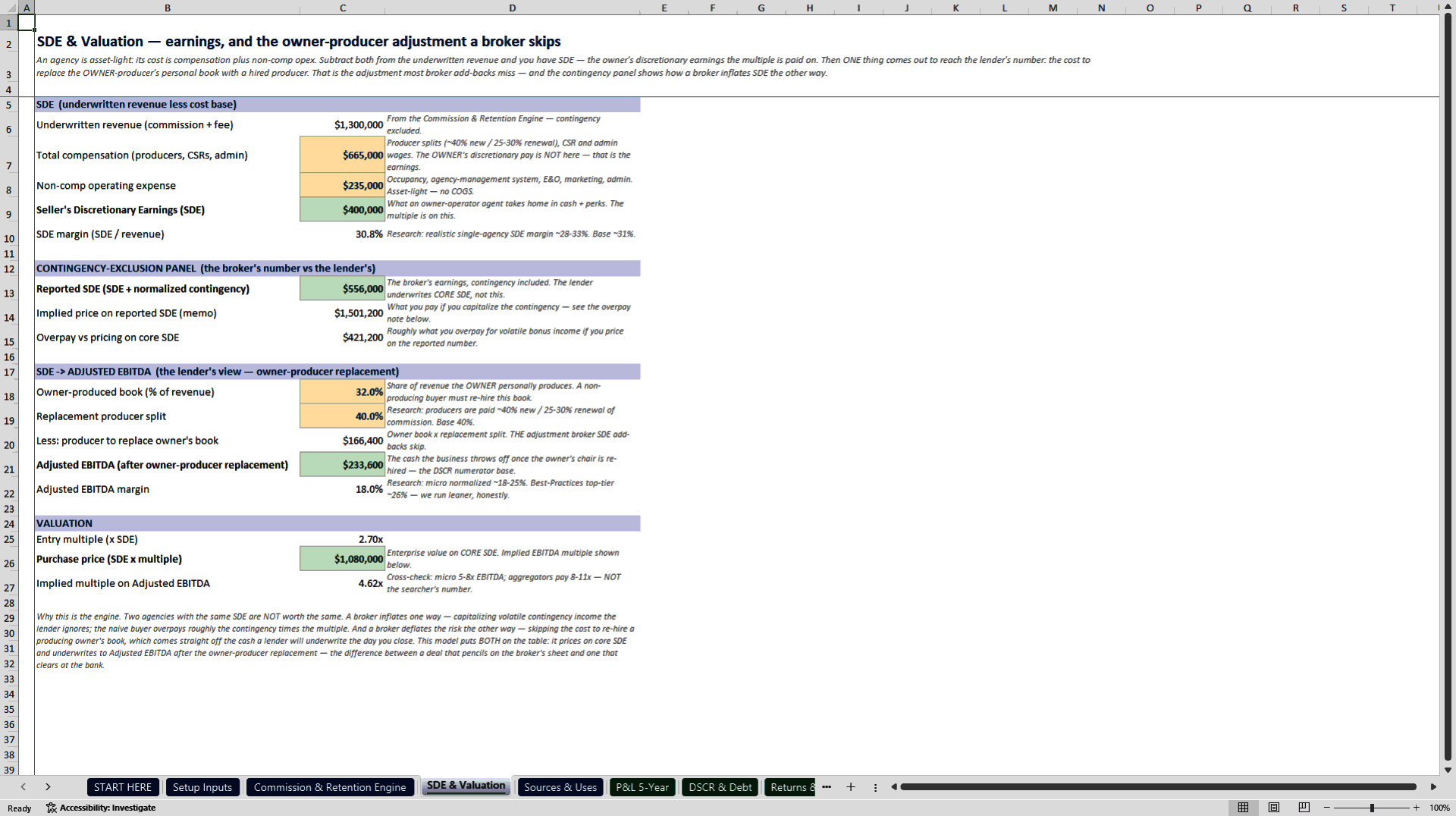
The second correction is the owner-producer. In most small agencies the owner personally produces and services part of the book. If you are not going to sit in that seat you must re-hire it, a producer at a commission split, and the model deducts that to reach Adjusted EBITDA. The true DSCR of 1.44x is printed directly beside the naive broker-style DSCR of 2.52x. The gap is the seller's own production. The sector's main risk is priced as a down-case: a producer leaves, retention drops, and coverage falls to 0.87x, while renewal earnings still cover debt service 2.35x in the base case.
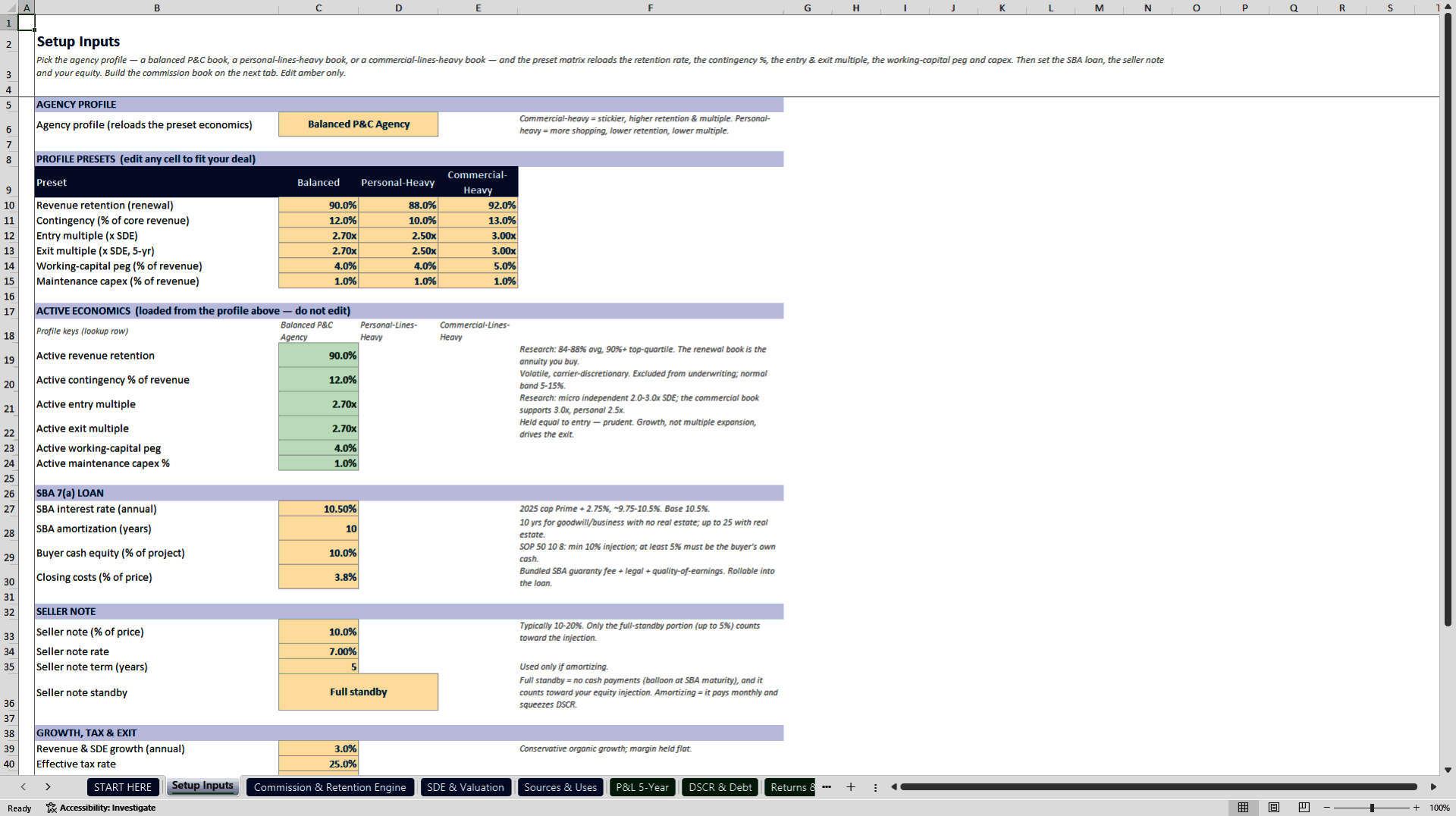
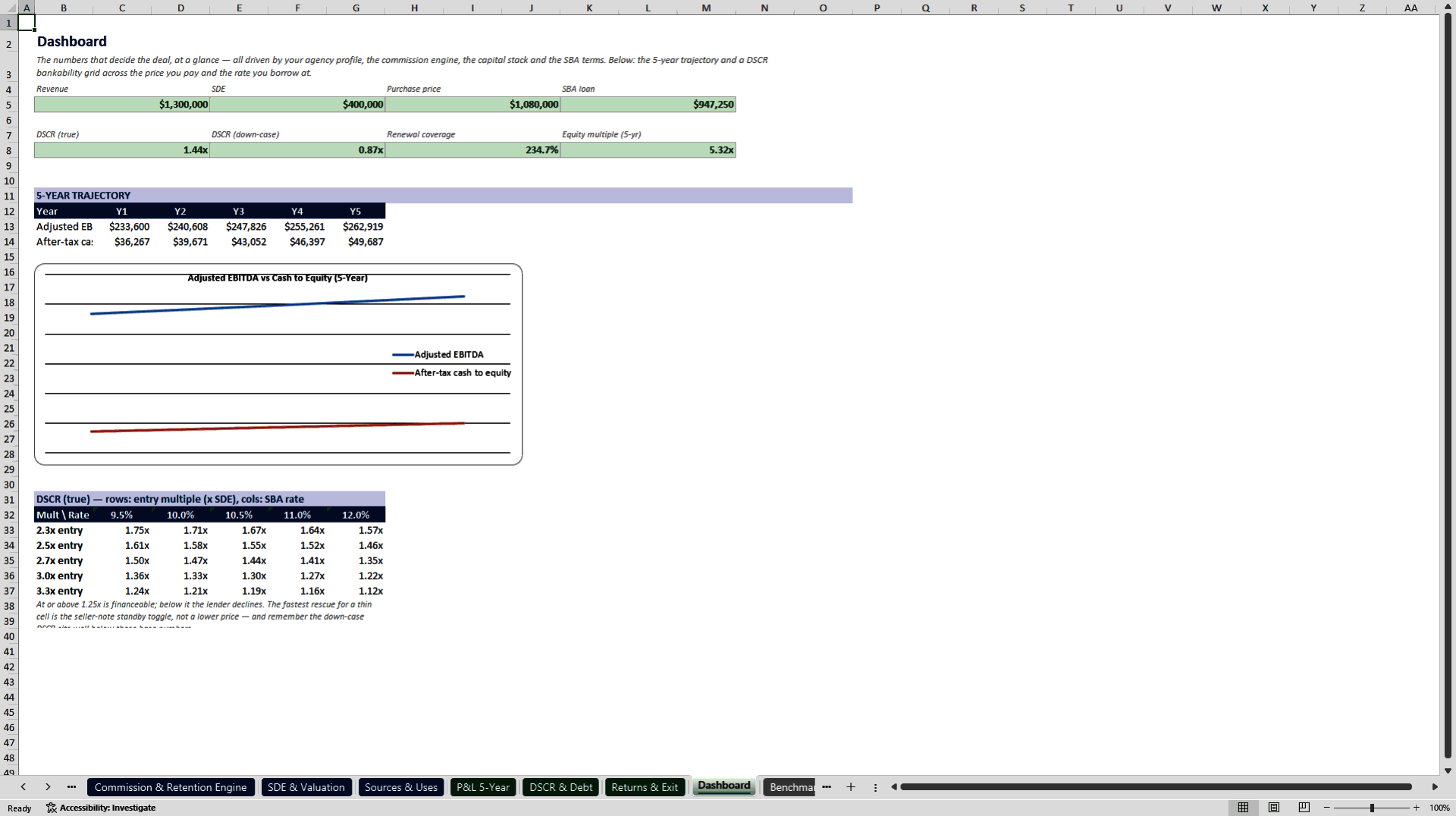
Ten sheets cover the Commission and Retention Engine with the roll-forward and the contingency panel, SDE and Valuation with the owner-producer replacement and the price at your SDE multiple, an 80/10/10 SBA 7(a) capital stack with a full-standby versus amortizing seller-note toggle, the DSCR and Debt gate with debt yield, a five-year P&L, Returns and Exit, a Dashboard with a bankability grid across price and rate, and a Benchmarks and Sources tab giving every assumption a range and a source. A three-way profile toggle, balanced, personal-lines-heavy or commercial-lines-heavy, reloads retention, contingency, multiple, working capital and capex.
What it does not do. It does not headline an IRR, because on one small deal it is hostage to the exit multiple. It holds SDE margin near 31% and Adjusted EBITDA near 18%, below top-tier best-practice figures, because a normalized micro-agency runs lower. It prices a searcher at roughly 2.0 to 3.0x SDE and does not sell the aggregator's 8 to 11x EBITDA as your return. Machine-verified across three engines. Educational planning tool, not financial, legal, tax or investment advice: verify carrier statements, the three-year contingency history, producer non-competes and your SBA term sheet.
Got a question about the product? Email us at support@flevy.com or ask the author directly by using the "Ask the Author a Question" form. If you cannot view the preview above this document description, go here to view the large preview instead.
Source: Best Practices in Insurance, Integrated Financial Model Excel: Insurance Agency Acquisition and SBA Underwriting Model Excel (XLSX) Spreadsheet, ProformaWorks
ABOUT THE AUTHOR

ProformaWorks builds acquisition-grade financial models for Main Street and lower-middle-market businesses - the kind of deal financed with an SBA 7(a) loan or a small commercial facility.
Every model answers one question: does this deal pencil at the bank? That means SDE or NOI rebuilt from the seller's own numbers, the add-backs a lender will and will not accept, a debt-service
... [read more]
Ask the Author a Question
You must be logged in to contact the author.




























