
 Click main image to view in full screen. Unlock all 20 preview images:
Green Hydrogen LCOH Model – Excel XLSX
Excel (XLSX) + supplemental PDF


BENEFITS OF THIS DOWNLOADABLE EXCEL DOCUMENT
- Provides a structured framework for calculating gross and net levelized cost of hydrogen across electrolyzer, renewable power, degradation, subsidy, and financing assumptions.
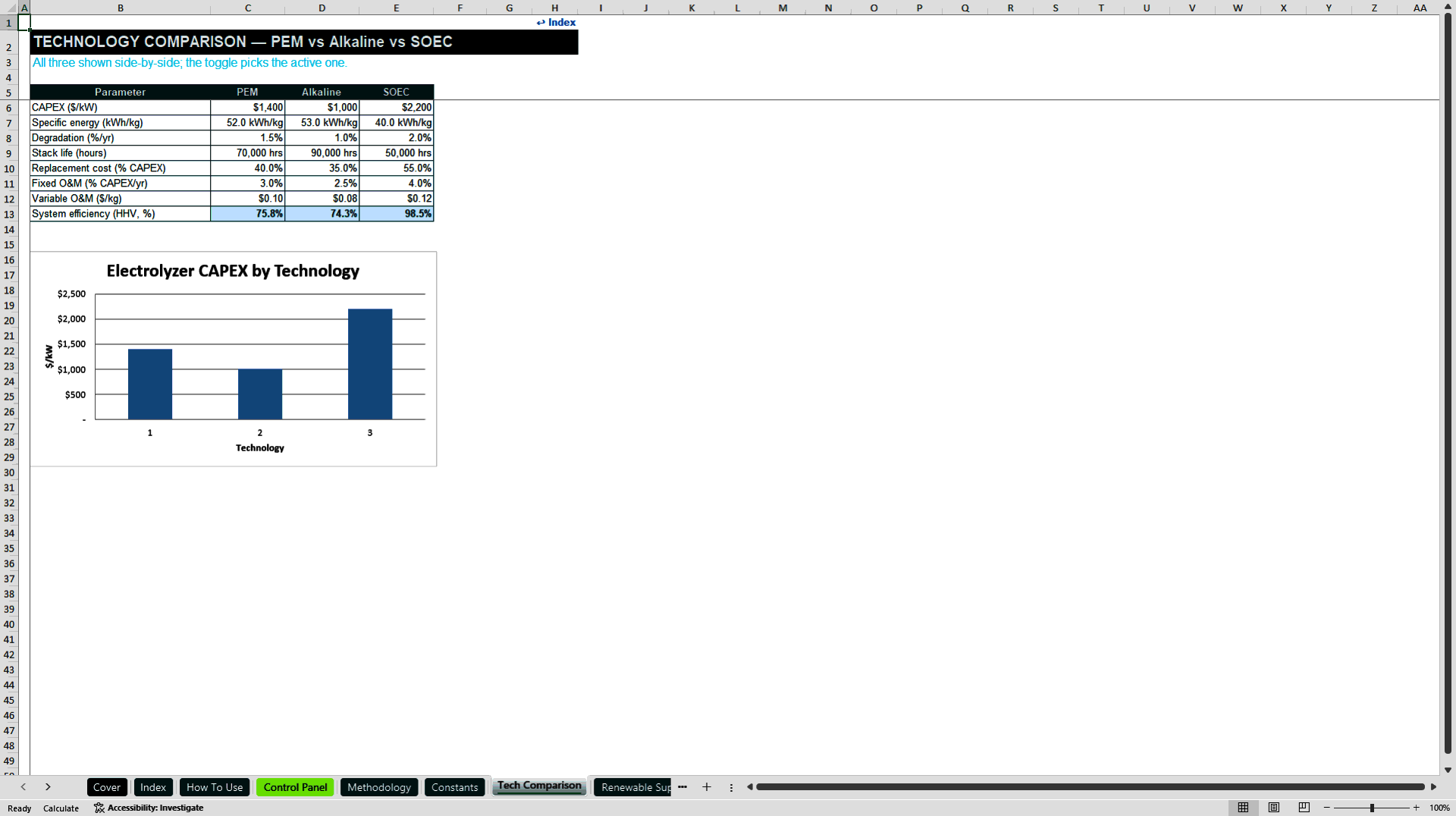
- Helps users compare PEM, Alkaline, and SOEC electrolyzer economics using technology-specific CapEx, efficiency, degradation, stack life, and O&M assumptions.
- Supports investment decision-making through dashboards, cash flow analysis, LCOH waterfall, carbon intensity scoring, sensitivity analysis, and audit checks.
RENEWABLE ENERGY EXCEL DESCRIPTION
🚀 Green Hydrogen Production LCOH Financial Model
The Green Hydrogen Production Levelized Cost of Hydrogen Financial Model is a premium Excel-based model designed to evaluate the economics, cost structure, subsidy impact, carbon intensity, and investment feasibility of a green hydrogen production project.
Green hydrogen economics are not simple. A proper model must account for electrolyzer type, renewable power supply, plant uptime, capacity factor variability, stack degradation, replacement CapEx, electricity price, subsidy eligibility, offtake pricing, spot market exposure, carbon intensity classification, project financing, and long-term cash flow impact.
This model brings all those drivers into one structured workbook.
⚡ What This Model Is Used For
This model is used to calculate and analyze the Levelized Cost of Hydrogen (LCOH) for a green hydrogen production facility.
It helps users answer important commercial questions such as:
✅ What is the gross LCOH of the hydrogen plant?
✅ What is the net LCOH after subsidy or production tax credit support?
✅ Which electrolyzer technology performs better: PEM, Alkaline, or SOEC?
✅ How does renewable electricity cost affect hydrogen economics?
✅ How sensitive is LCOH to capacity factor, CapEx, stack degradation, and replacement timing?
✅ What is the impact of offtake contract pricing versus spot hydrogen market exposure?
✅ Does the project meet green hydrogen carbon intensity thresholds?
✅ What are the expected NPV, IRR, payback, cash flow, and financing outputs?
🔋 Core Model Features 1. Electrolyzer Technology Selector
The model includes a technology selector for:
🔹 PEM electrolyzer
🔹 Alkaline electrolyzer
🔹 SOEC electrolyzer
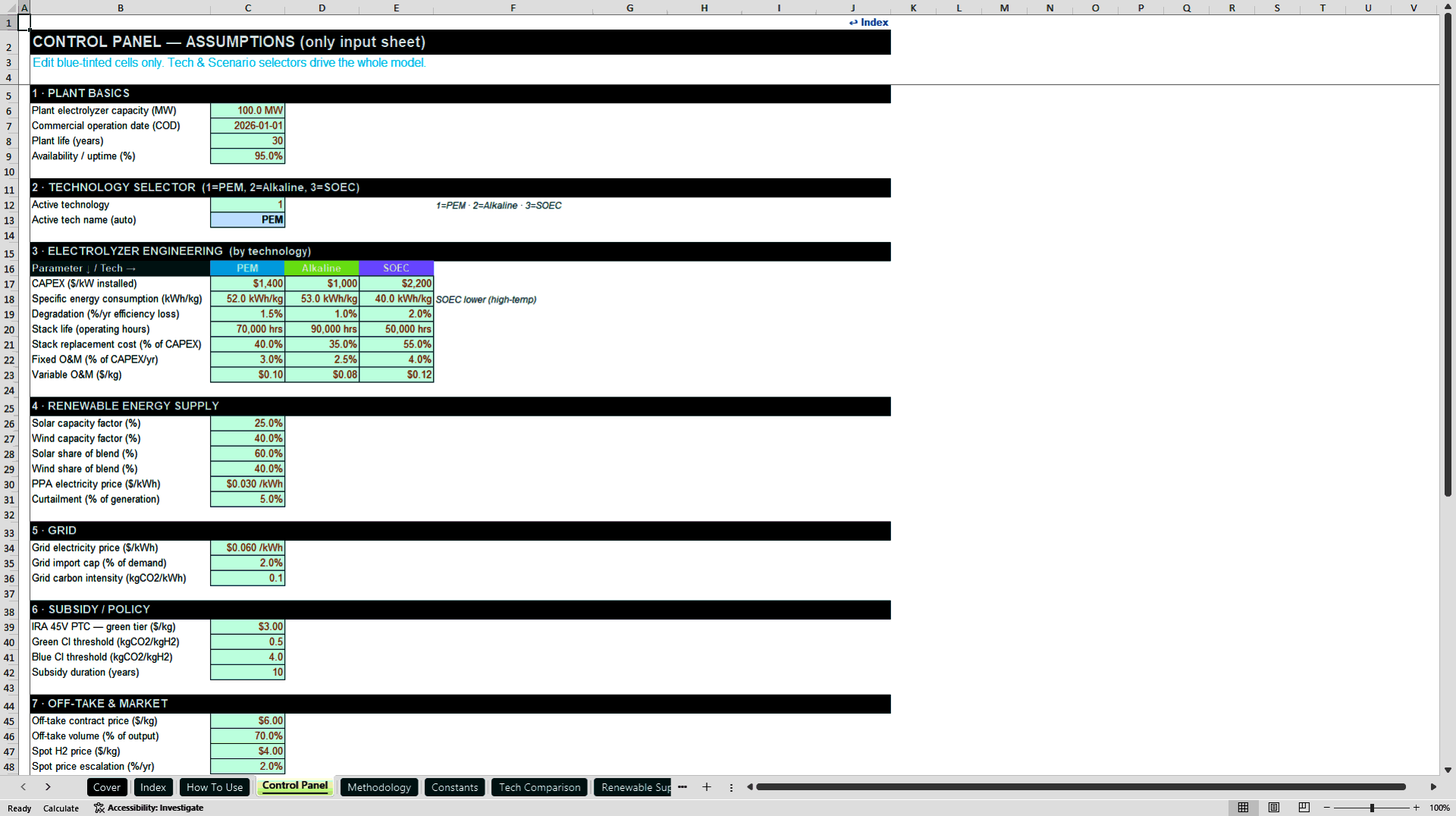
Each technology can be analyzed with different assumptions for installed CapEx, specific energy consumption, degradation rate, stack life, replacement cost, fixed O&M, and variable O&M.
This allows the user to compare cost curves and technology economics instead of relying on one fixed hydrogen production assumption.
2. Levelized Cost of Hydrogen Calculation
The workbook includes a dedicated LCOH calculation engine that calculates hydrogen cost at the plant level.
It includes gross LCOH and net-of-subsidy LCOH outputs. The model also includes independent LCOH method checks so users can validate whether the calculation logic ties properly.
The LCOH structure captures:
📌 Initial CapEx
📌 Annual operating cost
📌 Renewable electricity cost
📌 Stack replacement CapEx
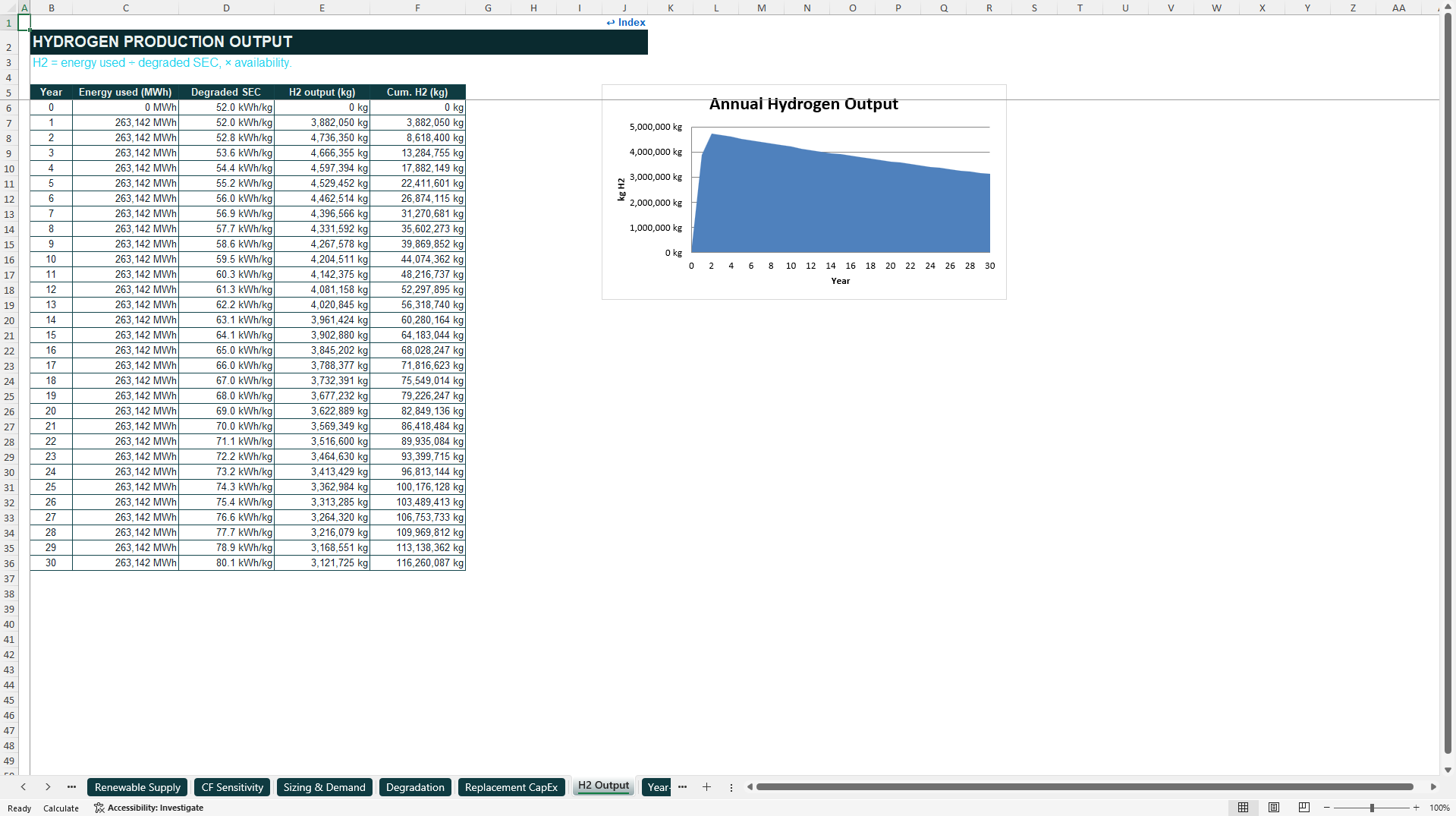
📌 Hydrogen output
📌 Discounting
📌 Subsidy benefit
📌 Long-term plant life economics
3. Renewable Energy Supply Module
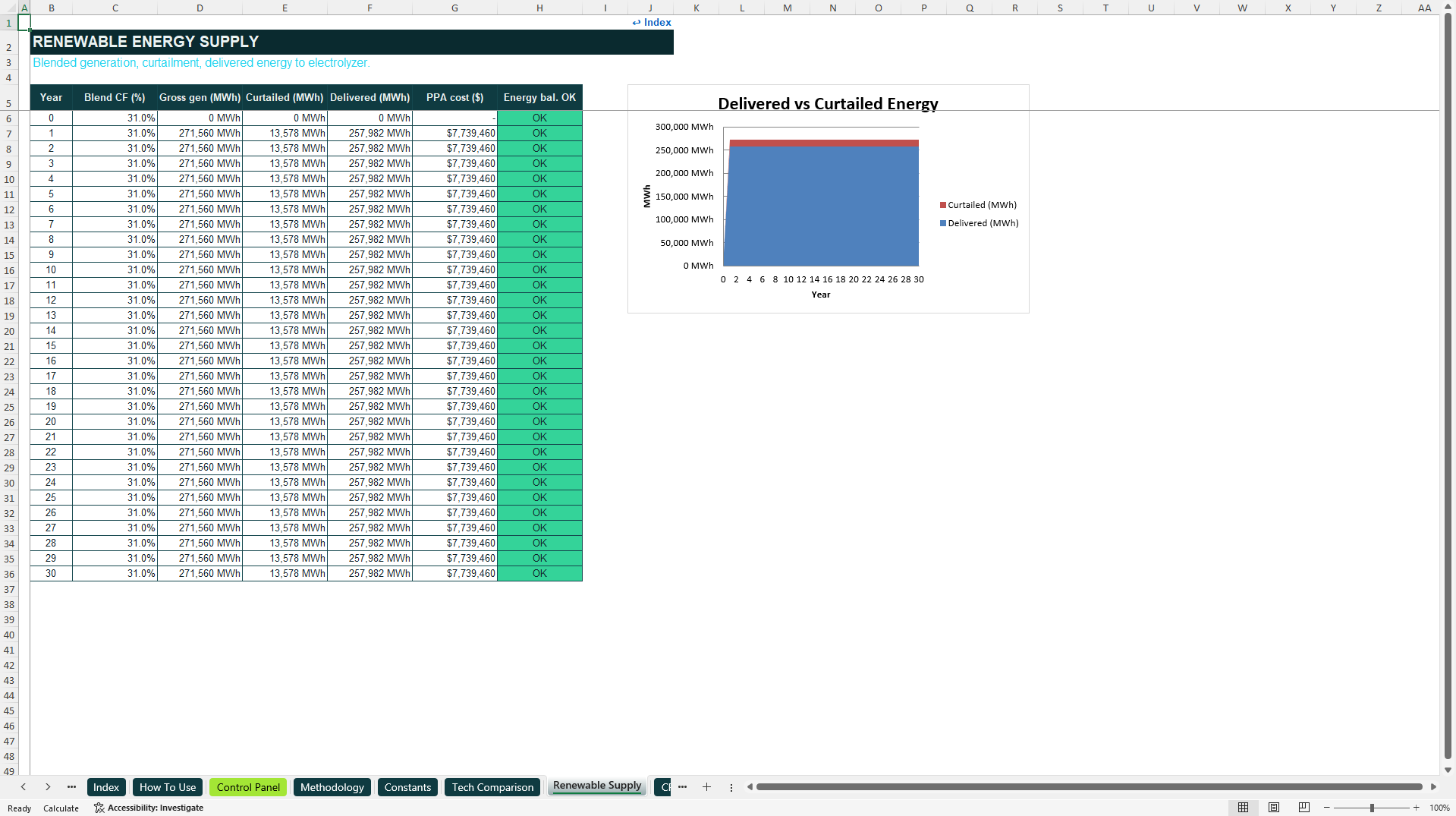
Green hydrogen production depends heavily on renewable electricity assumptions. This model includes solar and wind capacity factor inputs, solar/wind blend assumptions, PPA electricity price, curtailment logic, and renewable supply analysis.
Users can test how plant economics change when renewable capacity factor, electricity cost, and power supply mix change.
4. Stack Degradation and Replacement CapEx
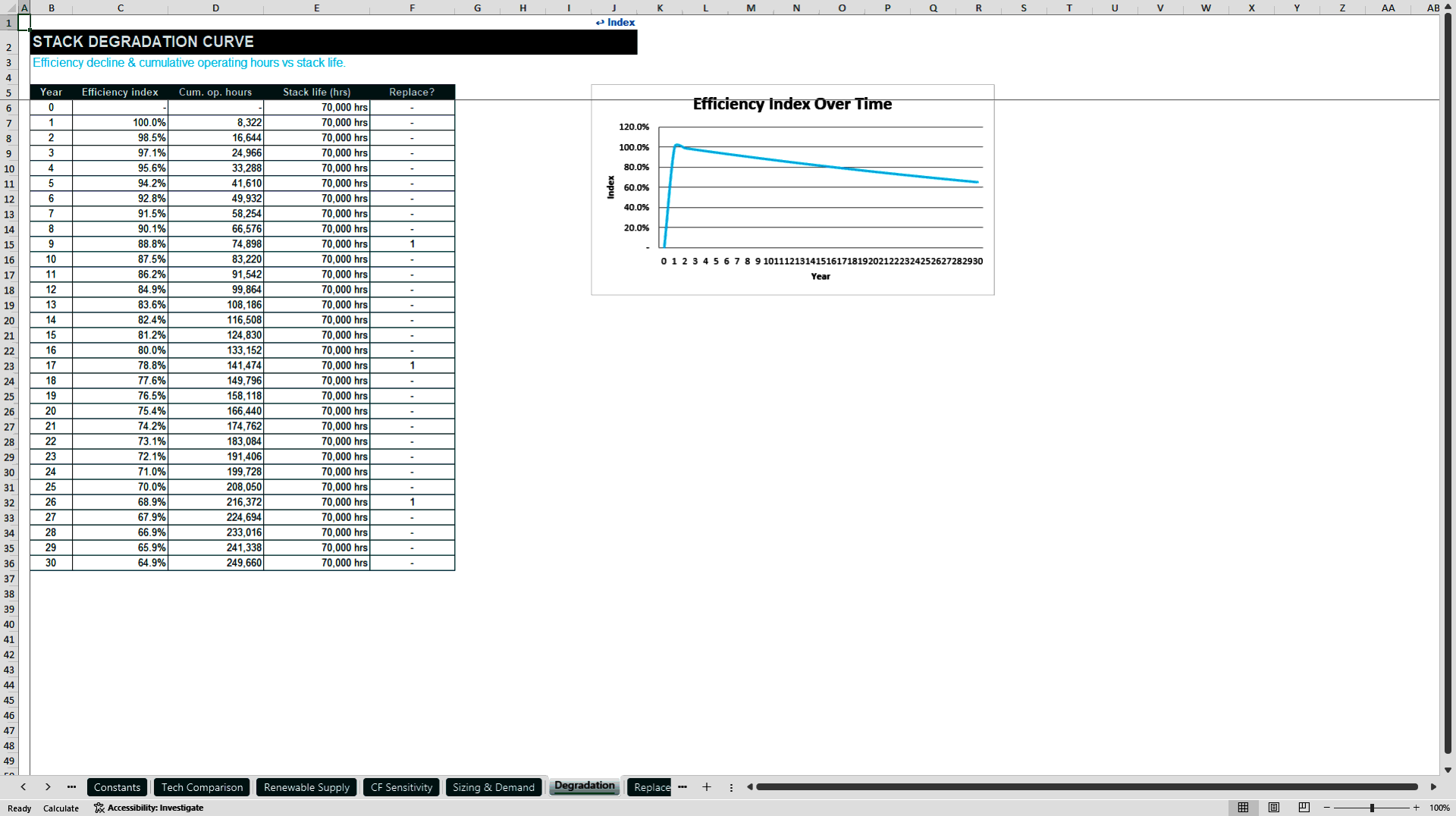
Electrolyzer degradation is one of the most important cost drivers in hydrogen production economics.
The model includes a dedicated degradation module and replacement CapEx schedule. This allows users to evaluate how stack efficiency decline, operating hours, and stack replacement cost affect long-term LCOH.
5. Subsidy and Incentive Analysis
The model includes a subsidy module to analyze the impact of hydrogen-related production incentives, credits, or policy support.
Users can model gross LCOH, subsidy benefit, and net LCOH, which is essential for understanding whether a project becomes commercially competitive after government support.
6. Offtake Contract vs. Spot Market Analysis
The model includes an offtake and spot market scenario module.
This helps users compare contracted hydrogen pricing against spot market pricing assumptions and assess the revenue stability, upside, and downside risk of different commercialization strategies.
7. Carbon Intensity Scoring
The workbook includes carbon intensity scoring to help users classify the hydrogen pathway and assess whether the project is aligned with green hydrogen thresholds.
This is important because buyer demand, subsidy eligibility, regulatory treatment, and project bankability can all depend on carbon intensity performance.
8. Full Cash Flow and Financing Modules
The model includes cash flow and financing calculations to support investment analysis.
It can be used to evaluate:
💰 Project CapEx
💰 Operating cost
💰 Revenue assumptions
💰 Debt financing
💰 Debt repayment
💰 Project cash flow
💰 NPV
💰 IRR
💰 Payback period
💰 Investor return indicators
9. Dashboards, KPIs, and Sensitivities
The workbook includes executive dashboards, technical dashboard outputs, KPI summary, sensitivity analysis, and scenario-driven views.
The model includes sensitivity analysis for electricity cost, capacity factor, CapEx, and other core drivers that directly affect LCOH and project returns.
10. Built-In Audit Checks
The workbook includes an audit sheet with model integrity checks covering renewable blend, energy balance, demand versus available production, LCOH method reconciliation, net LCOH logic, hydrogen output, discount factors, selector validity, carbon classification, CapEx, and NPV calculation.
This is useful for buyers who want a structured model with internal consistency checks.
🧭 How to Use the Model
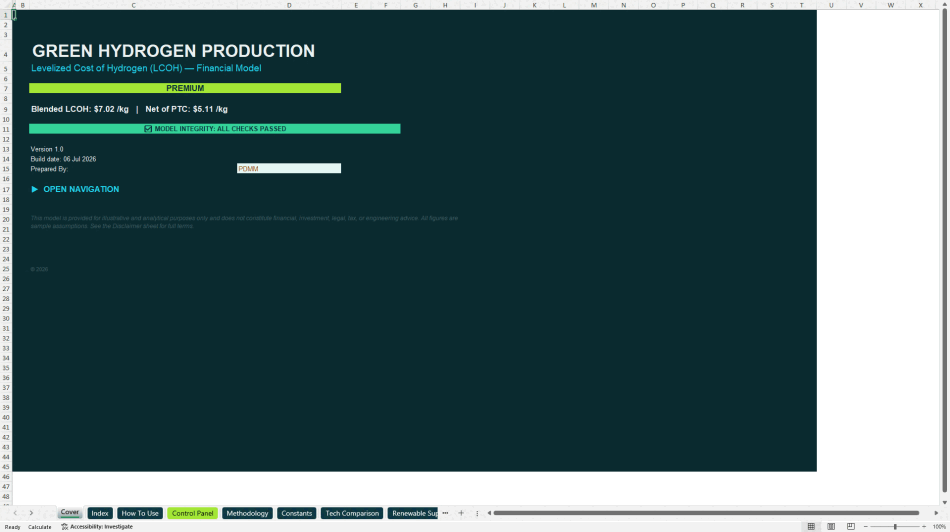
Start with the Cover and Index sheets to understand the workbook structure.
Then go to the Control Panel sheet. This is the key input sheet where users can update major assumptions such as plant capacity, COD, plant life, technology selection, electrolyzer assumptions, renewable supply mix, PPA price, capacity factor, subsidy assumptions, financing terms, and commercial assumptions.
After updating the input assumptions, the workbook automatically flows into the operating, production, LCOH, subsidy, carbon, financing, cash flow, and dashboard sheets.
Users can then review:
📊 LCOH Waterfall
📊 LCOH Engine
📊 Subsidy Impact
📊 Offtake vs. Spot Pricing
📊 Carbon Intensity
📊 Cash Flow
📊 Financing
📊 Sensitivity Analysis
📊 KPI Summary
📊 Executive Dashboard
📊 Audit Sheet
🎯 Who Should Buy This Model?
This model is suitable for:
✅ Green hydrogen project developers
✅ Renewable energy investors
✅ Infrastructure investors
✅ Project finance analysts
✅ Energy transition consultants
✅ Corporate finance teams
✅ Hydrogen offtake analysts
✅ Climate-tech investors
✅ Industrial decarbonization teams
✅ Government subsidy and incentive analysts
✅ Financial modeling professionals
💡 Why You Need This Model
Green hydrogen economics are highly sensitive to power cost, renewable capacity factor, electrolyzer efficiency, degradation, replacement timing, subsidy support, and offtake price.
A generic energy model will not properly capture these relationships.
This model is built specifically for green hydrogen production and gives users a structured way to evaluate LCOH, project feasibility, pricing requirements, financing outcomes, and downside risk.
It is designed to support serious decision-making, investment screening, business planning, and project finance analysis.
Got a question about the product? Email us at support@flevy.com or ask the author directly by using the "Ask the Author a Question" form. If you cannot view the preview above this document description, go here to view the large preview instead.
Source: Best Practices in Renewable Energy, Integrated Financial Model Excel: Green Hydrogen LCOH Model Excel (XLSX) Spreadsheet, PDMM Financial Models
ABOUT THE AUTHOR

PDMM Financial Models develops professional, decision-ready Excel models for business owners, entrepreneurs, investors, consultants, analysts, and finance teams. Our objective is to transform complex business assumptions into clear, structured analysis that supports better planning and investment decisions.
Our models cover business planning, forecasting, budgeting, feasibility analysis,
... [read more]
Ask the Author a Question
You must be logged in to contact the author.




























