
 Click main image to view in full screen. Unlock all 18 preview images:
EU Battery Passport Compliance Economics Model – Excel XLSX
Excel (XLSX) + supplemental PDF


BENEFITS OF THIS DOWNLOADABLE EXCEL DOCUMENT
- Quantifies battery-passport, recycled-content, carbon, due-diligence, EPR, recovery, and closed-loop compliance economics in one 10-year model.
- Connects compliance cost per kWh to EV and stationary-storage gross margin, pricing pass-through, supplier strategy, and scenario decisions.
- Provides dashboards, scenario comparison, two-way sensitivity, and discounted supplier-switching and closed-loop decision economics for management use.
COMPLIANCE EXCEL DESCRIPTION
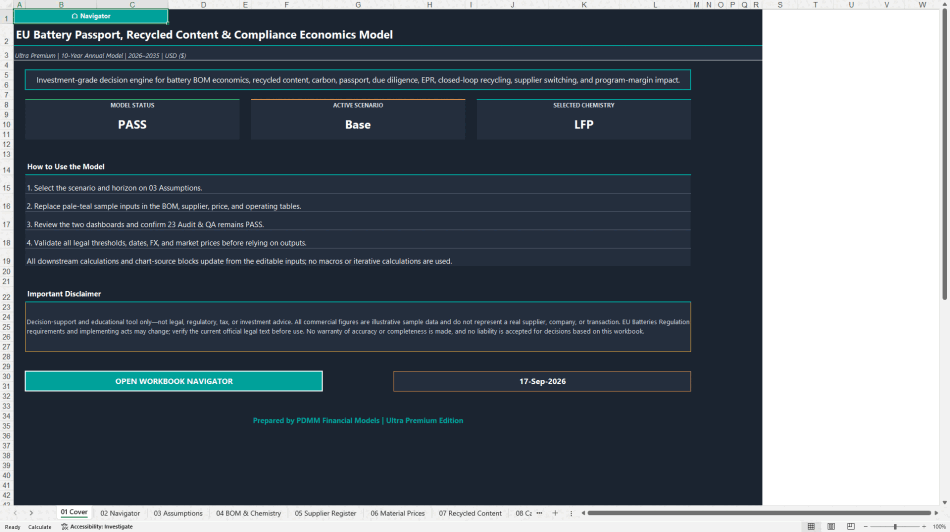
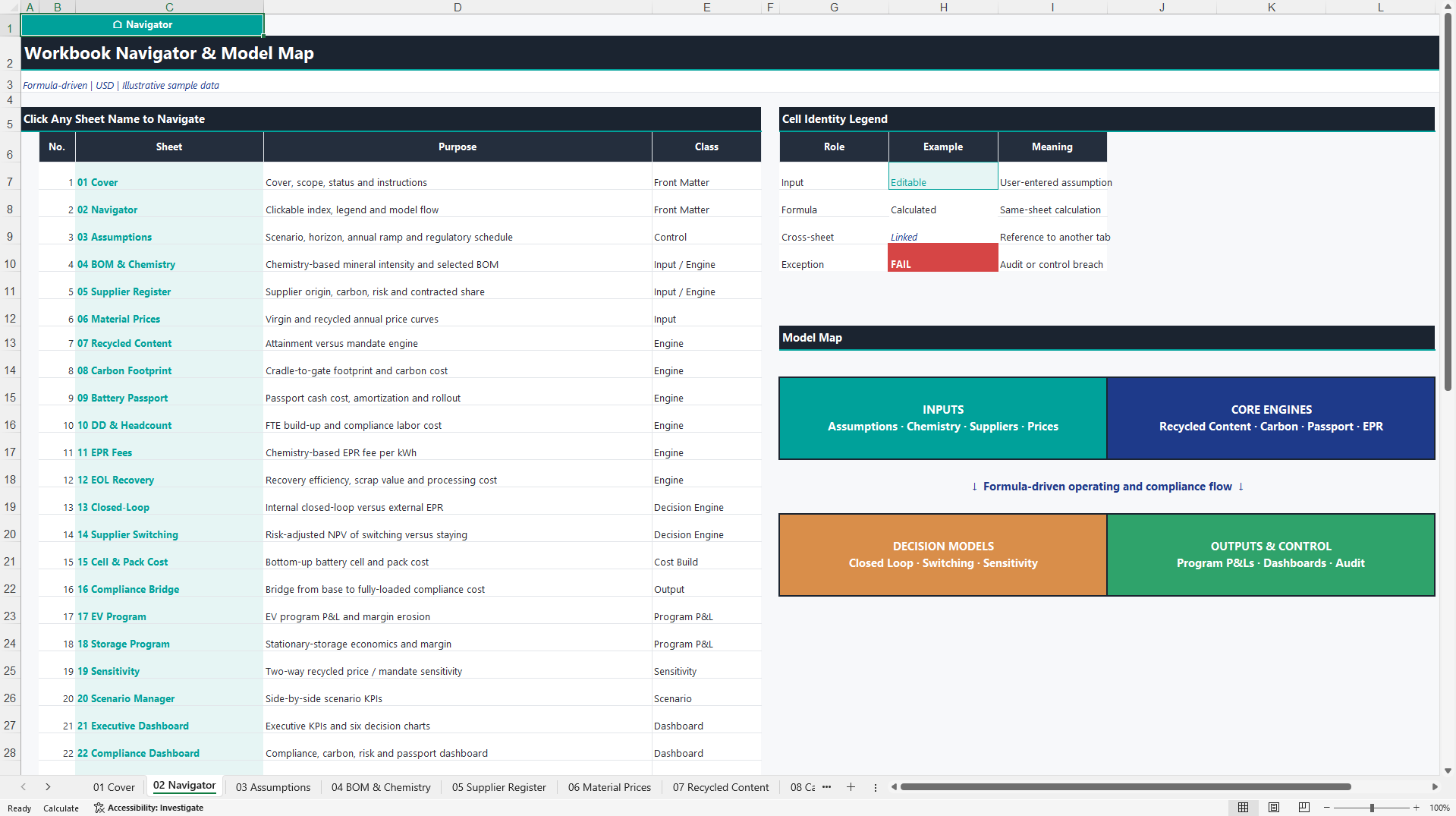
EU Battery Passport Compliance Economics Model is a 10-year Excel decision tool for companies and advisers that need to translate battery regulation, sourcing, recycling, and carbon requirements into operating and financial consequences. The workbook covers 2026-2035 and links battery chemistry, supplier characteristics, material prices, recycled-content attainment, carbon footprint, battery-passport implementation, supplier due diligence, EPR fees, end-of-life recovery, closed-loop recycling, supplier switching, battery cost, and downstream program margins.
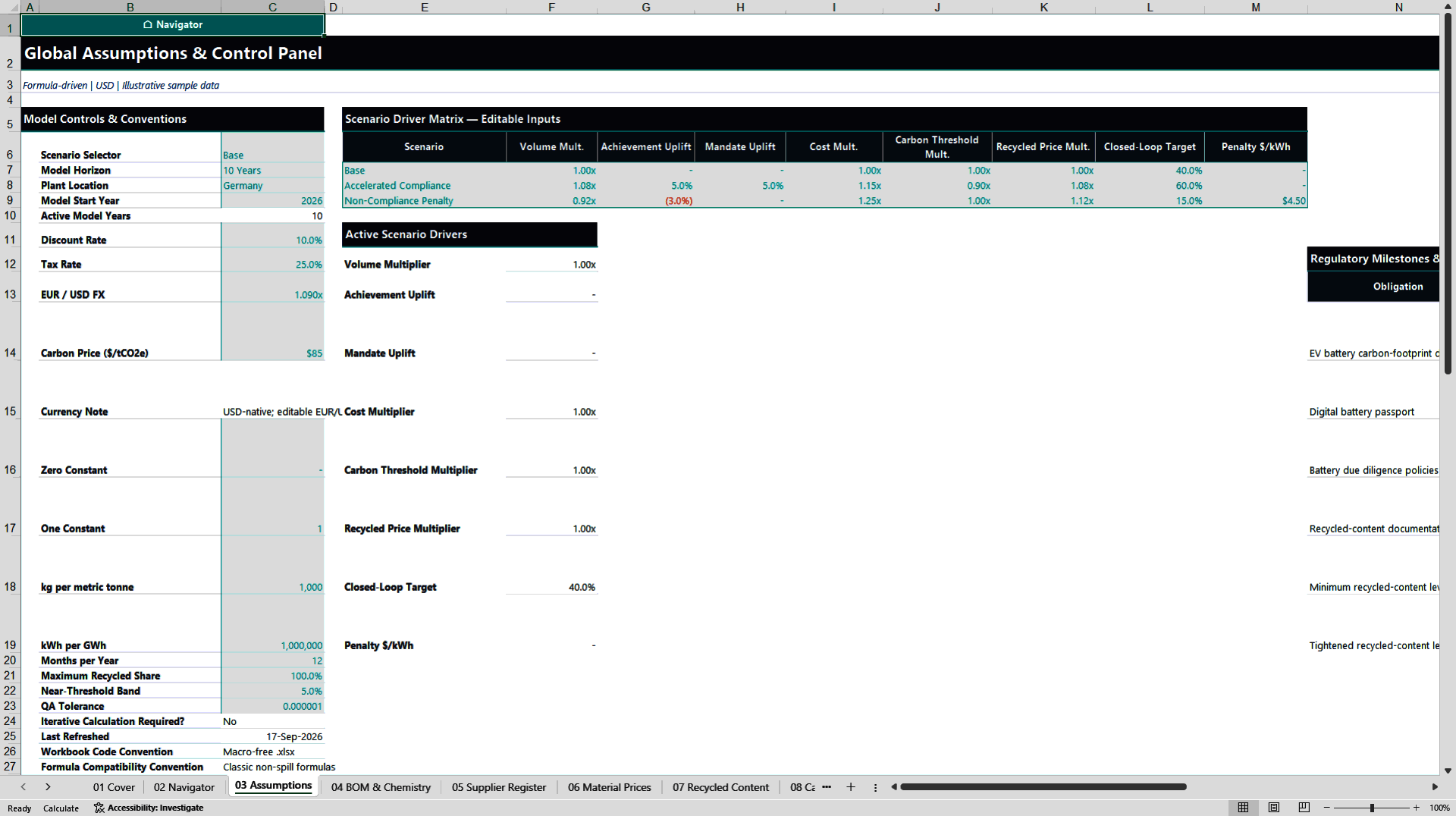
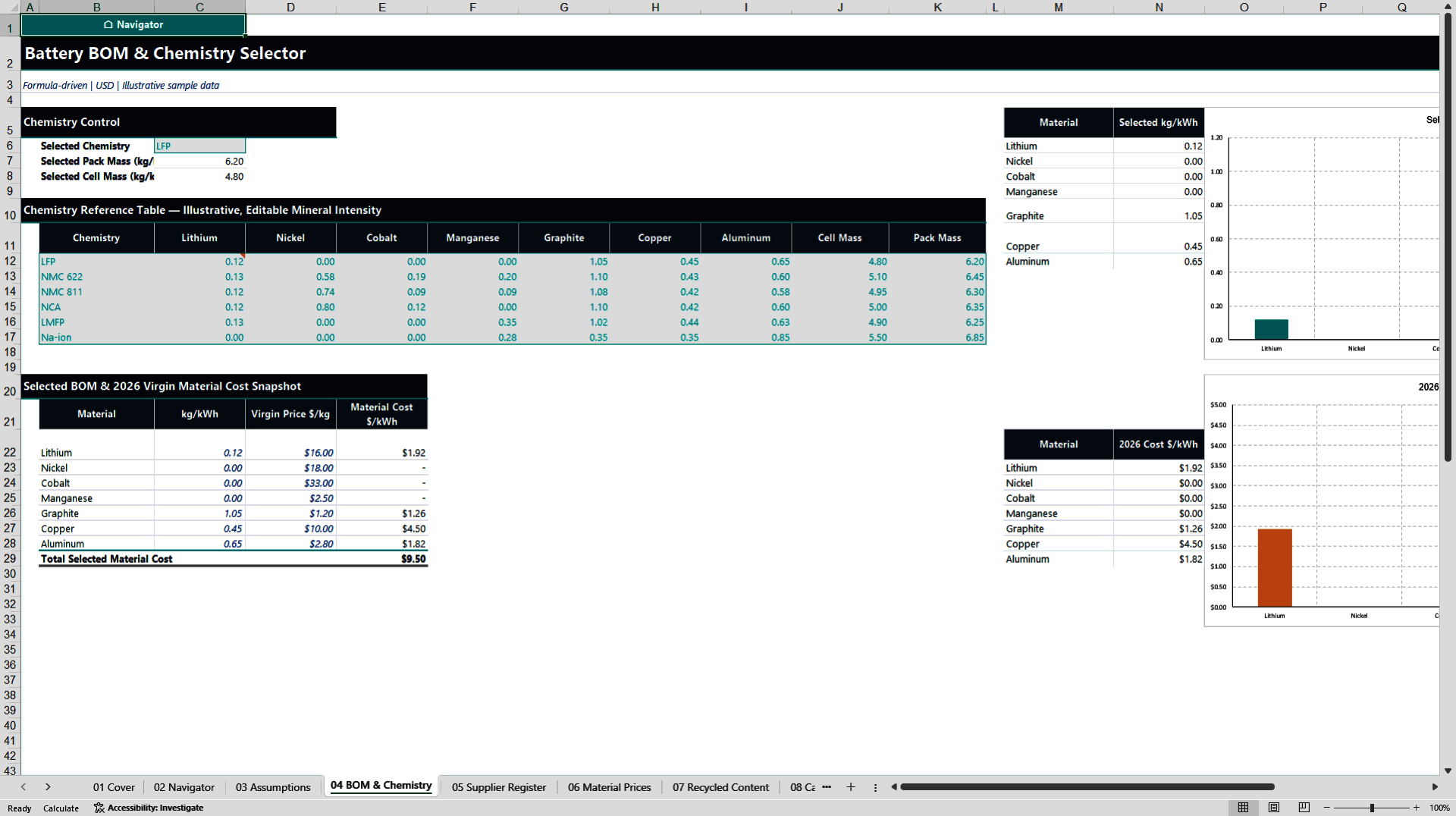
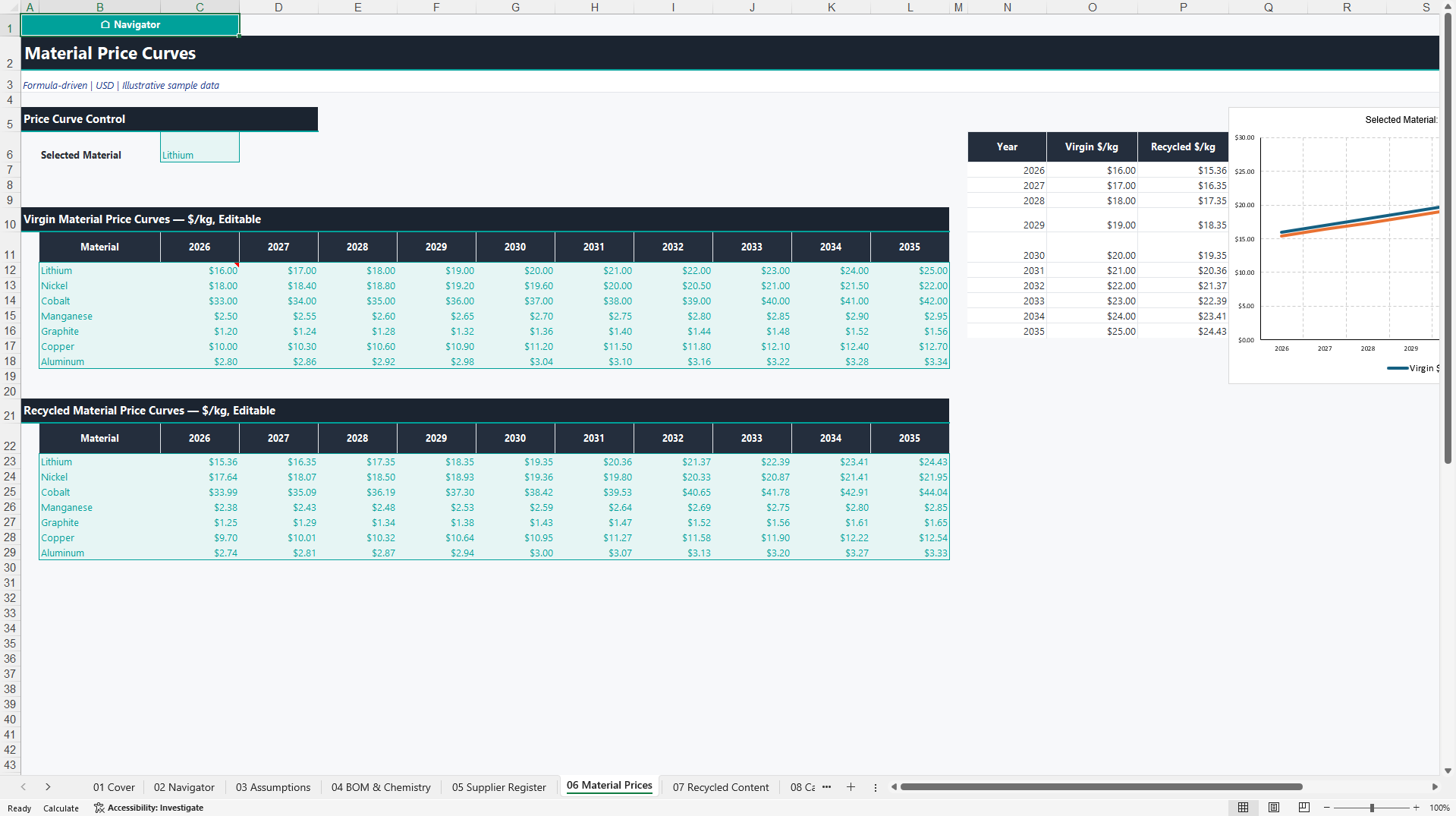
Users begin with a global assumptions and scenario control panel. They can select the model horizon and chemistry, edit volume and scenario drivers, change FX and carbon-price assumptions, and update regulatory timing. Chemistry tables support LFP, NMC 622, NMC 811, NCA, LMFP, and Na-ion with editable mineral intensity and pack/cell mass. The supplier register captures country, manufacturing footprint, due-diligence risk, volume share, compliance status, contract adjustment, switching cost, and lead time. Separate annual curves model virgin and recycled material prices.
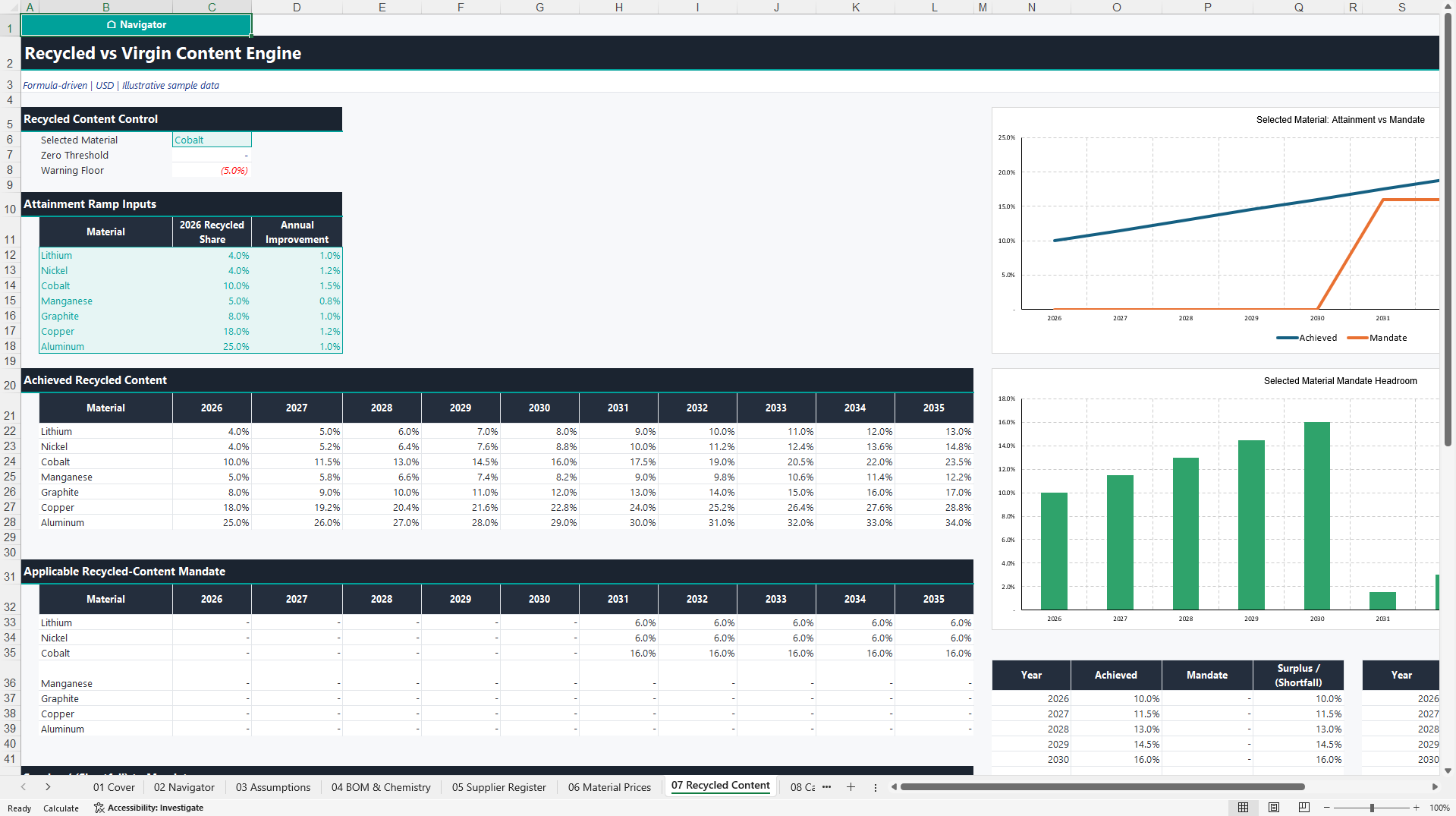
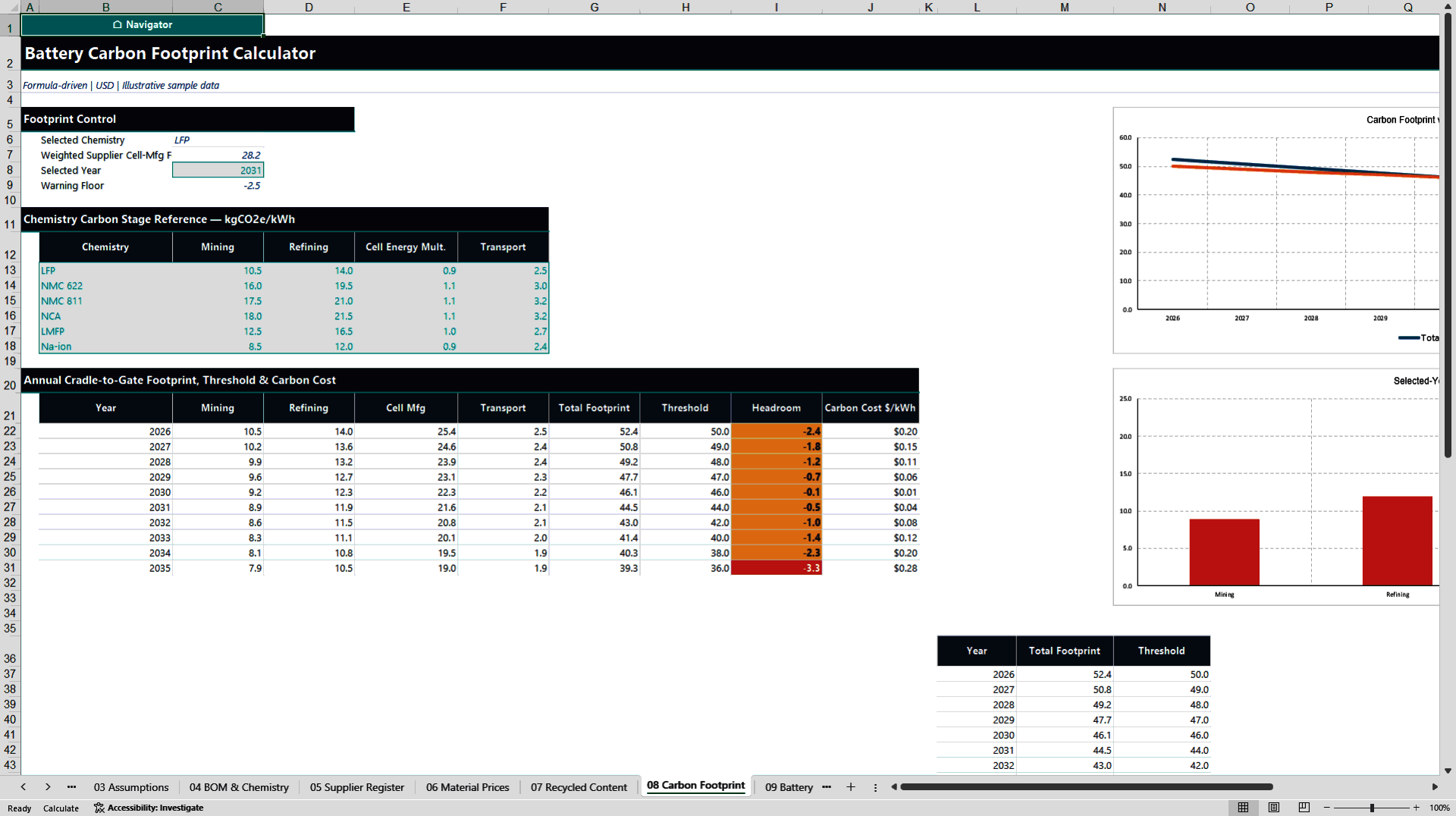
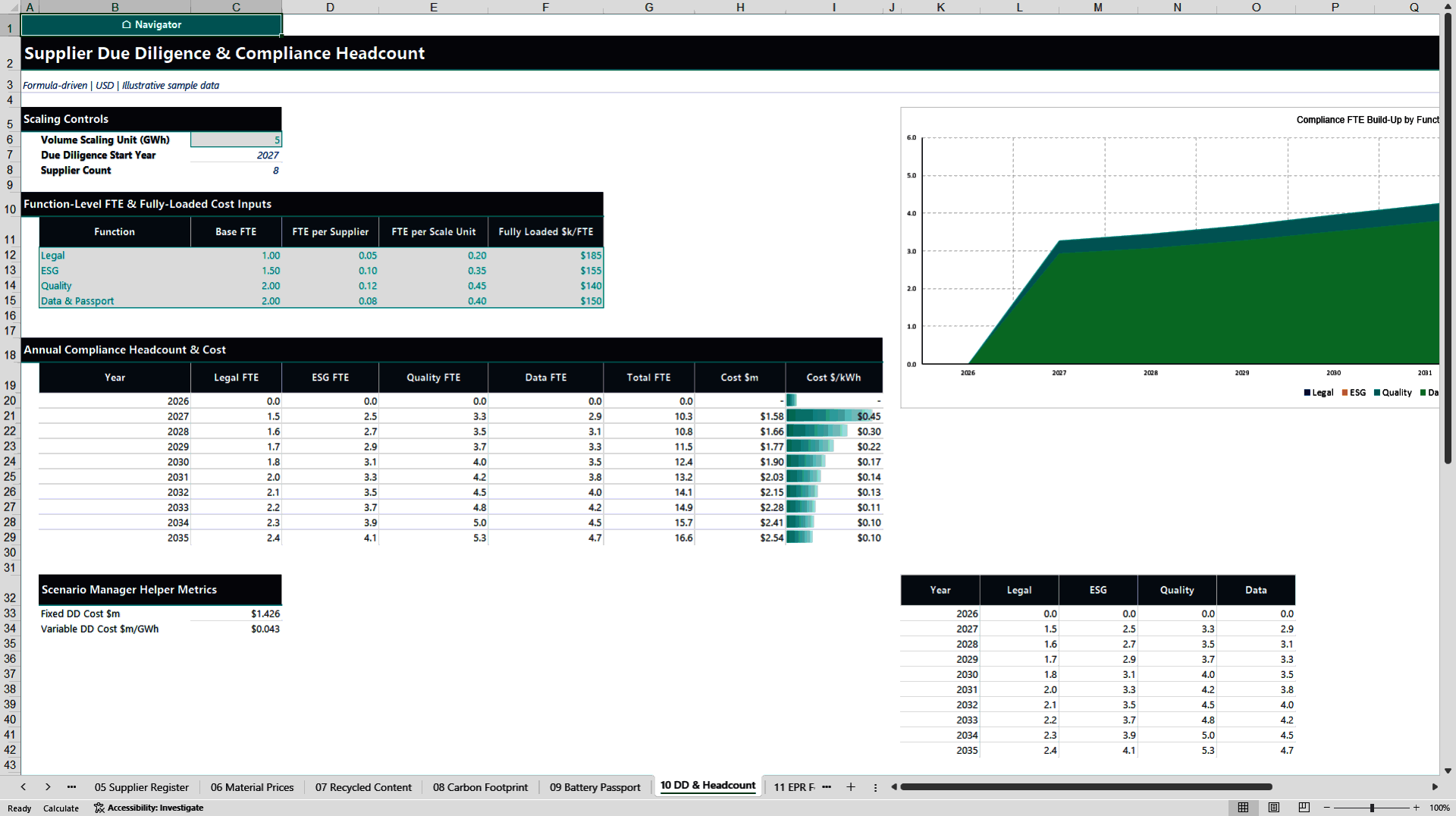
The model then calculates achieved recycled content versus mandate levels, cradle-to-gate carbon footprint and threshold headroom, passport cash cost and amortization, compliance headcount, EPR cost, end-of-life recovery value, and the economics of internal closed-loop processing versus external EPR. A supplier-switching module compares current and target suppliers and incorporates requalification cost, validation capex, lead time, disruption probability, revenue at risk, regulatory exposure, and discounted decision economics.
A bottom-up cell and pack cost build feeds a transparent compliance-cost bridge. That fully loaded battery cost then flows into separate EV and stationary-storage program analyses covering volume, unit economics, revenue, gross profit, gross margin, compliance pass-through, and margin erosion. A scenario manager compares Base, Accelerated Compliance, and Non-Compliance Penalty cases, while a two-way sensitivity table stresses recycled-material prices and mandate levels for a selected material and year.
Two management dashboards summarize cost, margin, recycled-content attainment, carbon headroom, supplier risk, passport status, closed-loop share, and scenario comparisons. The workbook also includes its own Audit & QA control/status worksheet and methodology/source-reference worksheet as authored in the supplied file. Seller-supplied and already tested; no Studio workbook audit was performed. The package also includes a 24-page full-sheet PDF preview and twelve buyer-facing PNG screenshots. The model is intended for battery manufacturers, EV and storage teams, finance and FP&A, procurement, ESG and compliance functions, consultants, advisers, and investors seeking a structured Excel framework for battery-compliance economics.
Got a question about the product? Email us at support@flevy.com or ask the author directly by using the "Ask the Author a Question" form. If you cannot view the preview above this document description, go here to view the large preview instead.
Source: Best Practices in Compliance, Battery Industry Excel: EU Battery Passport Compliance Economics Model Excel (XLSX) Spreadsheet, PDMM Financial Models
ABOUT THE AUTHOR

PDMM Financial Models develops professional, decision-ready Excel models for business owners, entrepreneurs, investors, consultants, analysts, and finance teams. Our objective is to transform complex business assumptions into clear, structured analysis that supports better planning and investment decisions.
Our models cover business planning, forecasting, budgeting, feasibility analysis,
... [read more]
Ask the Author a Question
You must be logged in to contact the author.




























