 Click main image to view in full screen.
EU AI Act Obligations Workbook – Excel XLSX
Excel (XLSX)


BENEFITS OF THIS DOWNLOADABLE EXCEL DOCUMENT
- Classifies every AI system under Regulation (EU) 2024/1689 from a one-row-per-system register.
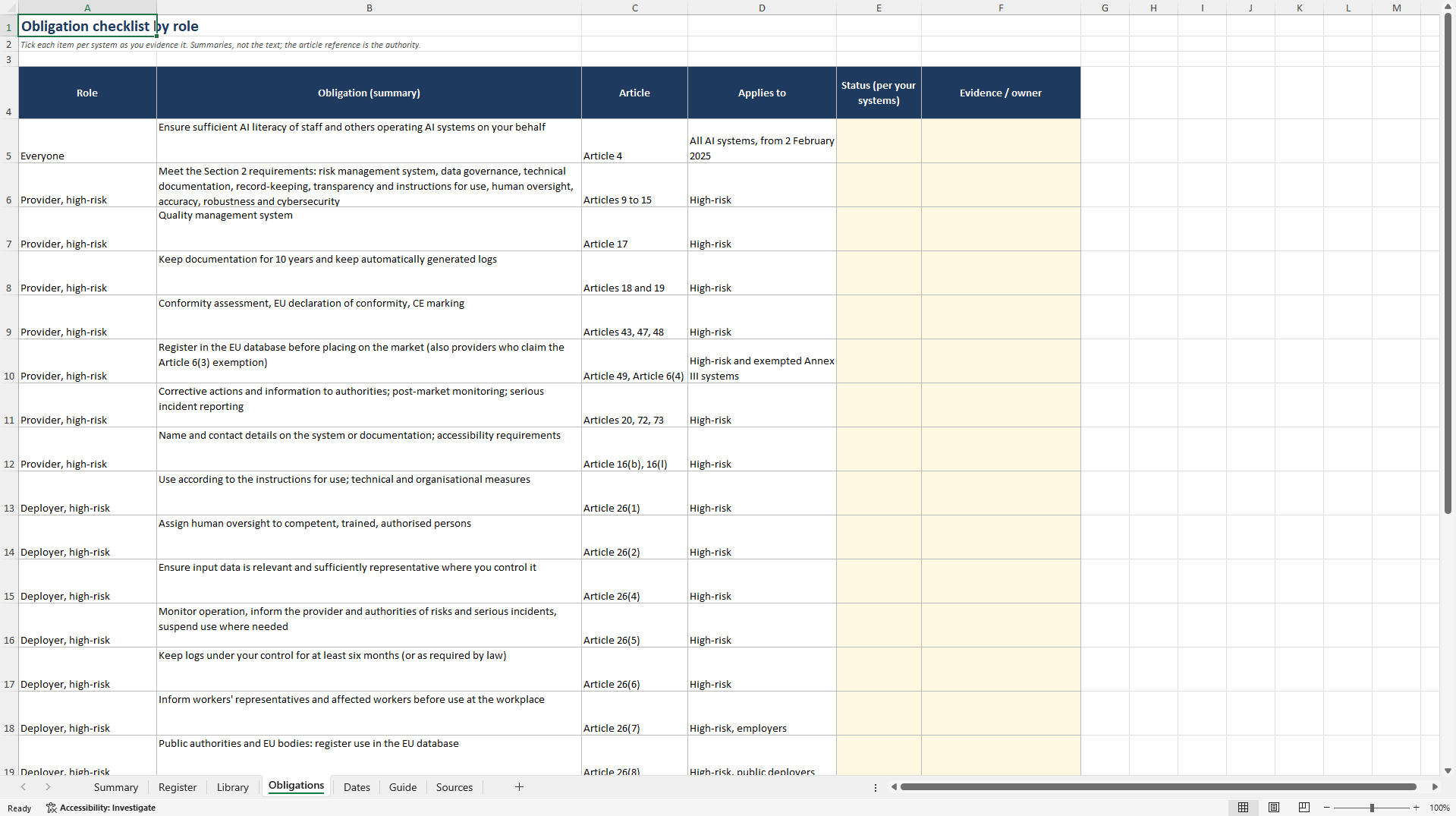
- Lists the 23 duties by role with article references, status and evidence columns.
- Shows the application date and fine ceiling per system, with the SME cap.
ARTIFICIAL INTELLIGENCE EXCEL DESCRIPTION
The AI Act applies in full on 2 August 2026, the prohibitions have applied since 2 February 2025 and the general-purpose model duties since 2 August 2025. Most companies still do not have a list of the AI systems they use, let alone a view of which ones are high-risk. This workbook gives you the register, the classification and the duty list in one file.
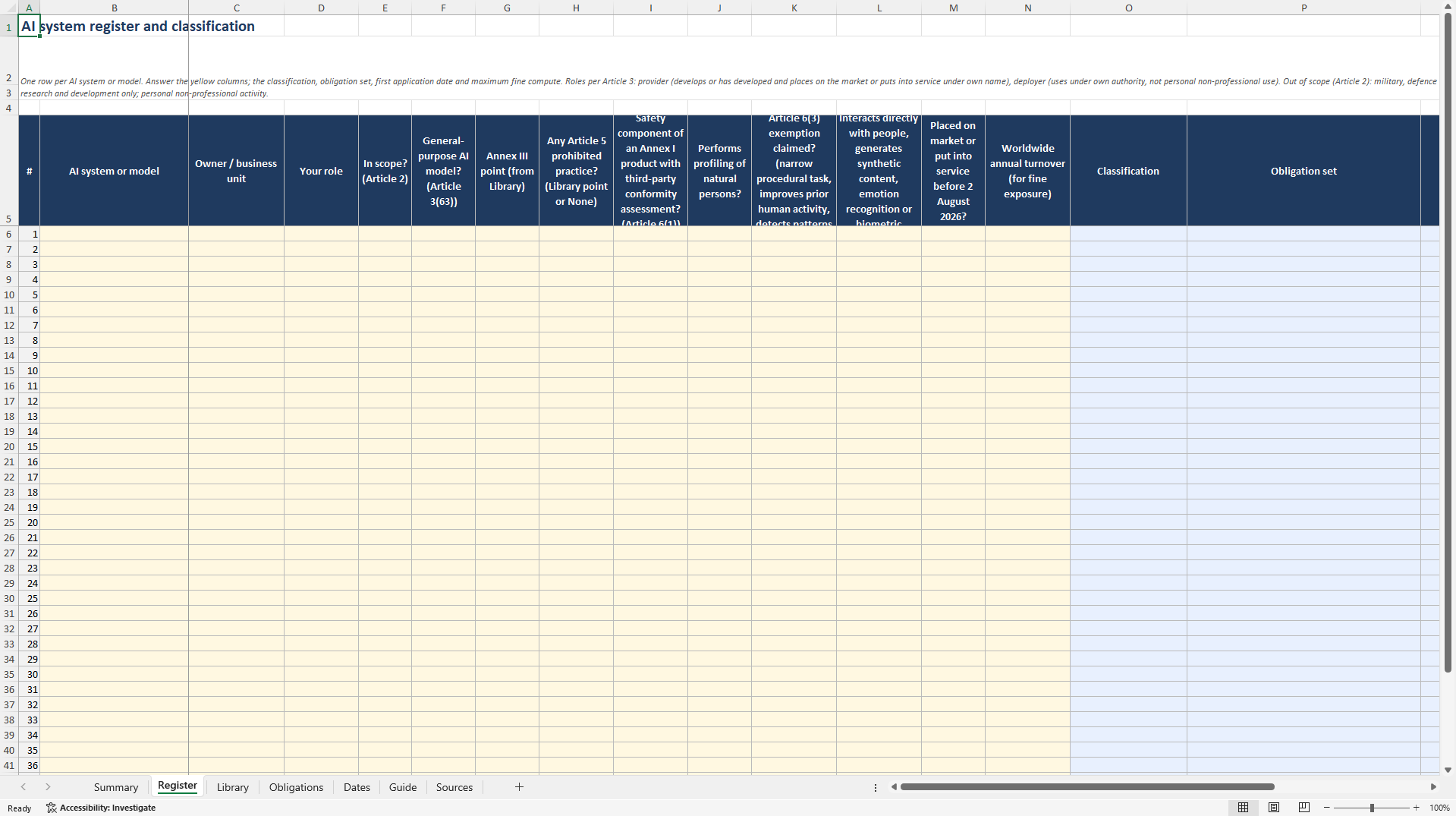
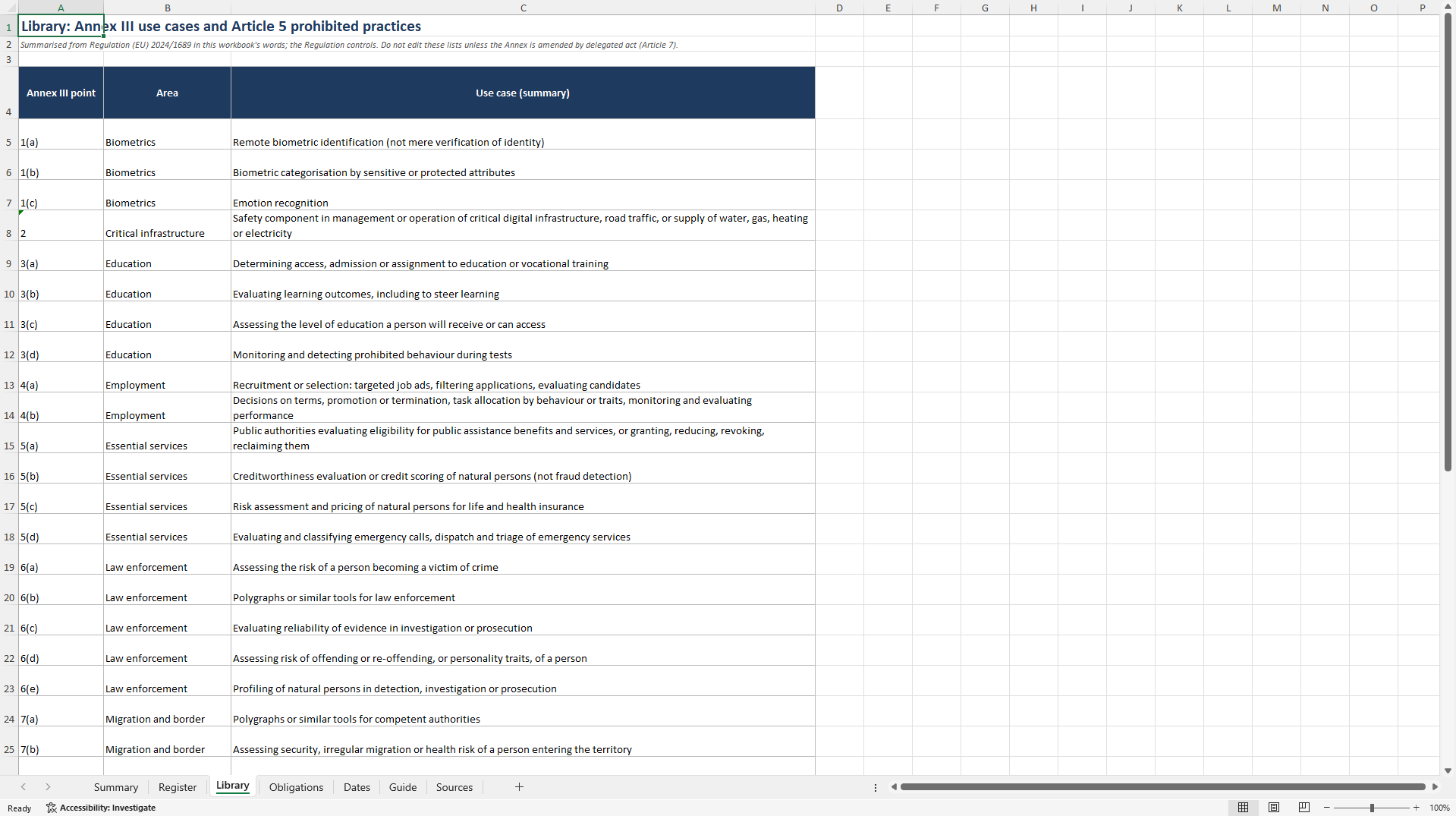
Register: one row per AI system or model with your role (provider, deployer, both, importer, distributor), the Article 2 scope test, the Annex III use case picked from a library of all 25 points, the Article 5 prohibited-practice screen (all eight), the Article 6(1) product-safety route, profiling, the Article 6(3) exemption, the Article 50 transparency triggers, whether it was on the market before 2 August 2026, and worldwide turnover.
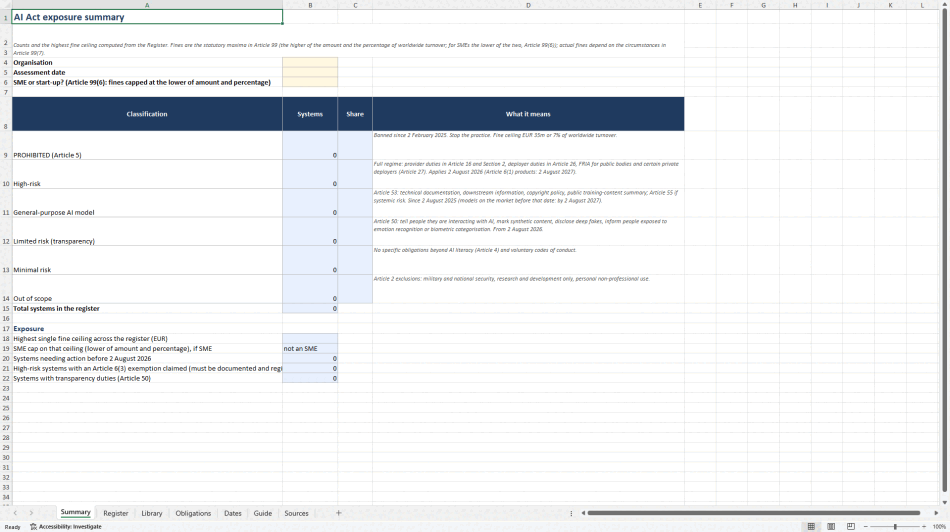
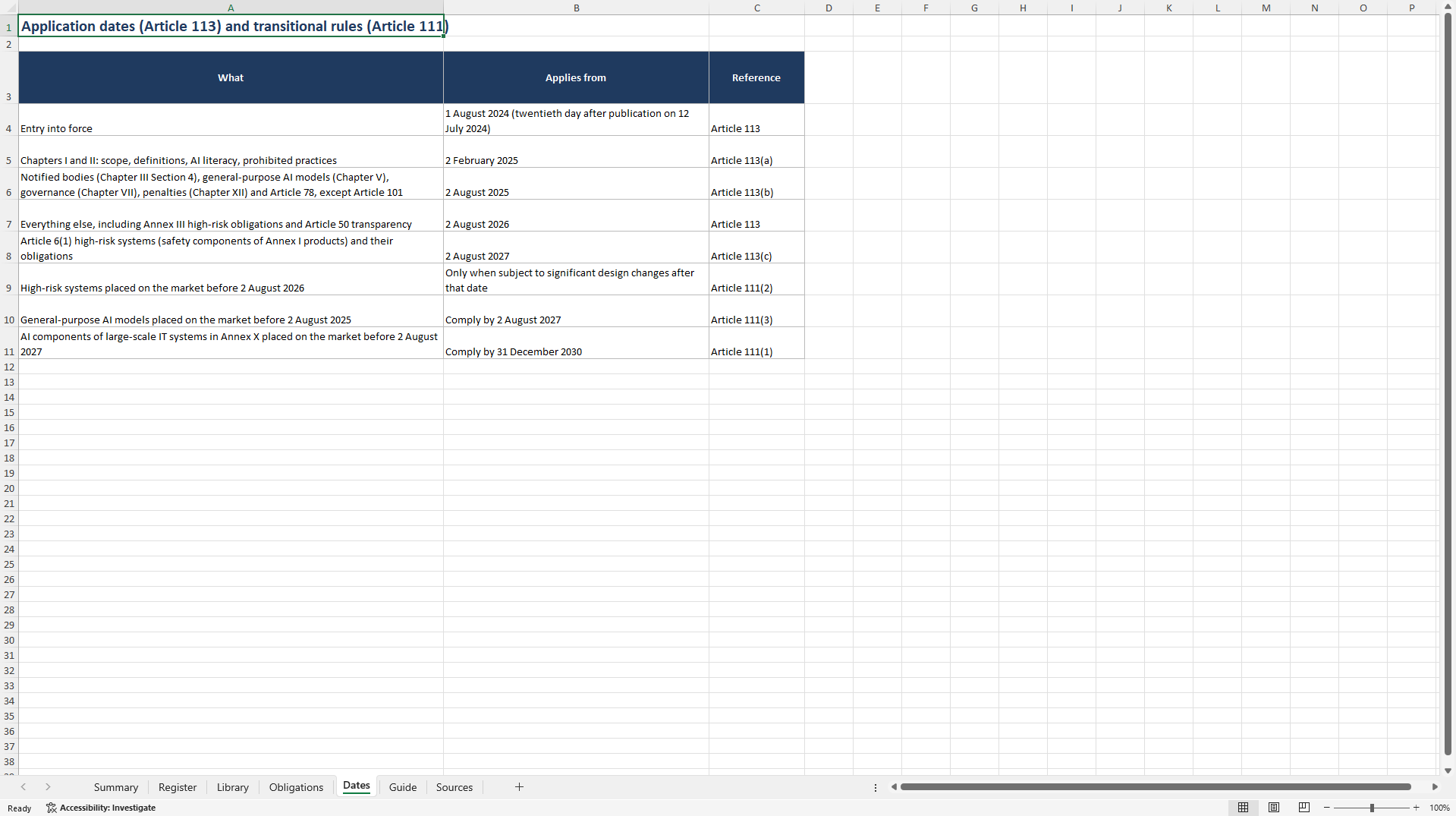
Classification computed per row: prohibited, high-risk, general-purpose AI model, limited risk (transparency), minimal risk or out of scope, with the precedence the Regulation implies (prohibited beats everything; an Annex III use case with profiling is always high-risk; a 6(3) exemption only works without profiling). Beside it: the obligation set, the date it applies (Article 113 with the Article 111 transitional rules for legacy systems and models) and the fine ceiling under Article 99, plus the SME cap.
Obligations: 23 duties summarised with their article numbers, from Article 4 AI literacy through the Article 16 provider list, the Article 26 deployer list, the Article 27 fundamental rights impact assessment, Article 50 transparency, Article 53 and 55 general-purpose model duties, and Article 23 and 24 for importers and distributors. Status and evidence columns per duty.
Summary: systems per class, share, the highest fine ceiling in the register, the SME cap, systems needing action before 2 August 2026, exemptions claimed that must be registered under Article 6(4), and Article 50 systems.
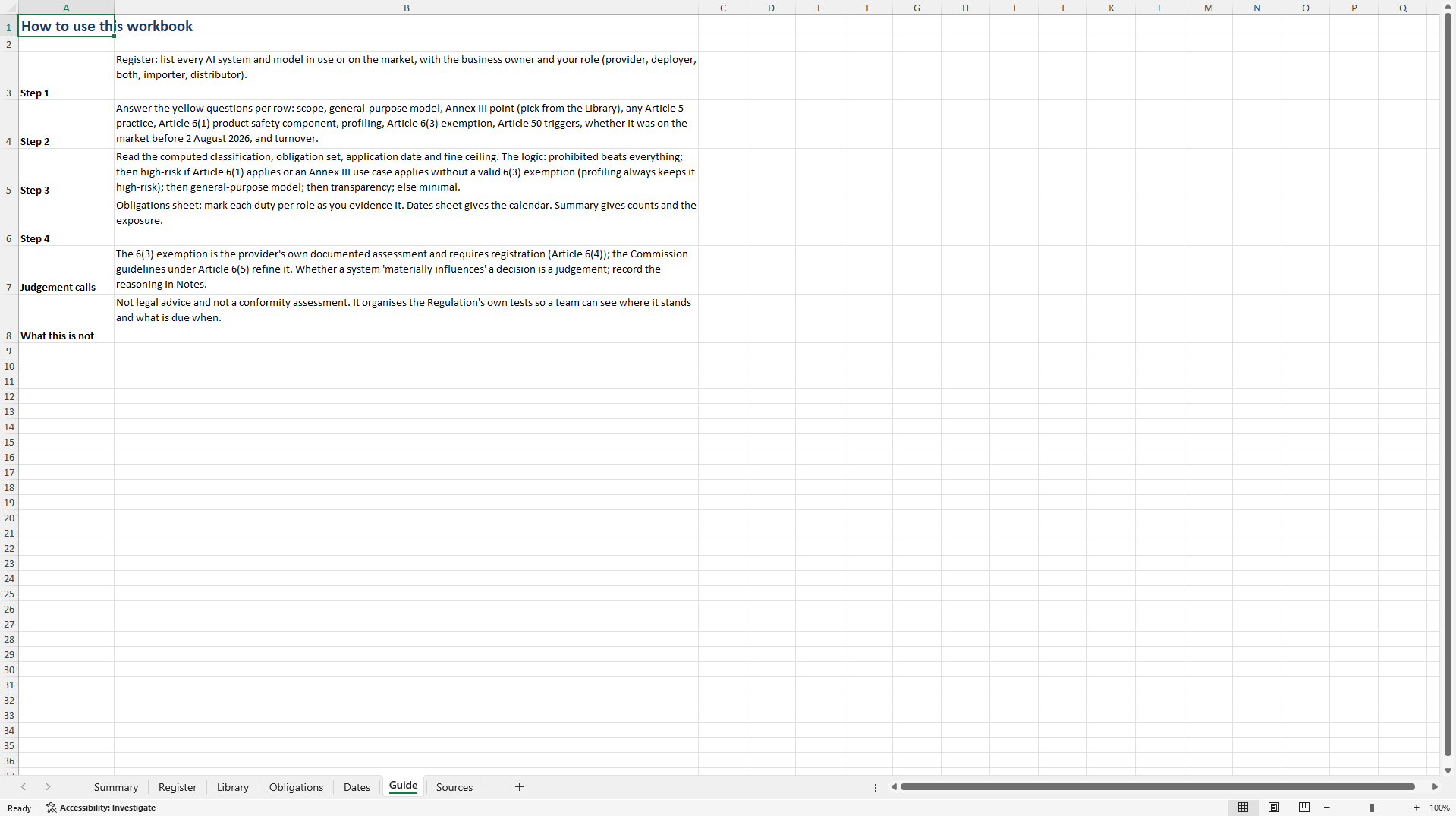
Dates: the full calendar from entry into force to the 2030 backstop for Annex X systems. Library: Annex III and Article 5 in full. Guide and Sources.
Every summary is written from the EUR-Lex text of Regulation (EU) 2024/1689 and cites the article. The classification logic was tested against nine hand-worked cases (hiring screener, chatbot, social scoring, foundation model, spam filter, military system, exempted credit tool, legacy Annex III system, machinery safety component) before listing. Live formulas, no macros, no locked cells. Excel and Google Sheets. Not legal advice; the Regulation and the Commission guidelines control, and the Guide says where judgement is needed.
Who it is for: compliance, legal and IT teams building their first AI inventory; consultancies running AI Act readiness reviews for clients; product teams deciding whether a feature lands in Annex III.
How to work with it. Open the workbook in Excel or Google Sheets. Yellow cells are inputs, blue cells are formulas. Start with the Guide sheet, which walks through the sheets in the order they are meant to be used, then replace the example values with your own data. Every figure traces through live formulas to the inputs and to the cited source, so an auditor, lender or client can follow the working.
Use it if: You need an AI inventory and a defensible first classification under the AI Act before 2 August 2026.
Not suited if: You need a full conformity assessment or legal sign-off; this organises the tests, it does not replace counsel.
Contents: 1 Excel workbook (.xlsx), sheets: Summary, Register, Library, Obligations, Dates, Guide, Sources. No macros, no locked cells, no hidden sheets. Built and verified by Bindler.
Got a question about the product? Email us at support@flevy.com or ask the author directly by using the "Ask the Author a Question" form. If you cannot view the preview above this document description, go here to view the large preview instead.
Source: Best Practices in Artificial Intelligence, Compliance Excel: EU AI Act Obligations Workbook Excel (XLSX) Spreadsheet, Bindler
ABOUT THE AUTHOR

Bindler builds Excel workbooks that turn a regulation or a financing structure into live formulas: CSRD double materiality, GHG Protocol inventory, EU Taxonomy, SFDR PAI, PCAF, green bond reporting, IFRS S2, ESRS E1 transition plans, CBAM, the EU AI Act, UAE Corporate Tax, and project finance models for solar, onshore wind and battery storage.
Every workbook is built from the primary text
... [read more]
Ask the Author a Question
You must be logged in to contact the author.




























