 Click main image to view in full screen.
AI Act Revenue Protection Scanner - Basic – Excel XLSX
Excel (XLSX)


BENEFITS OF THIS DOWNLOADABLE EXCEL DOCUMENT
- Quantifies exact financial exposure per AI system, market, and penalty tier in under 15 minutes.
- Maps every AI system against the EU AI Act's official risk classification framework (Annex III + Article 6)
- Produces a prioritized action matrix grounded in verified Article 99 penalty calculations from Regulation (EU) 2024/1689.
ARTIFICIAL INTELLIGENCE EXCEL DESCRIPTION
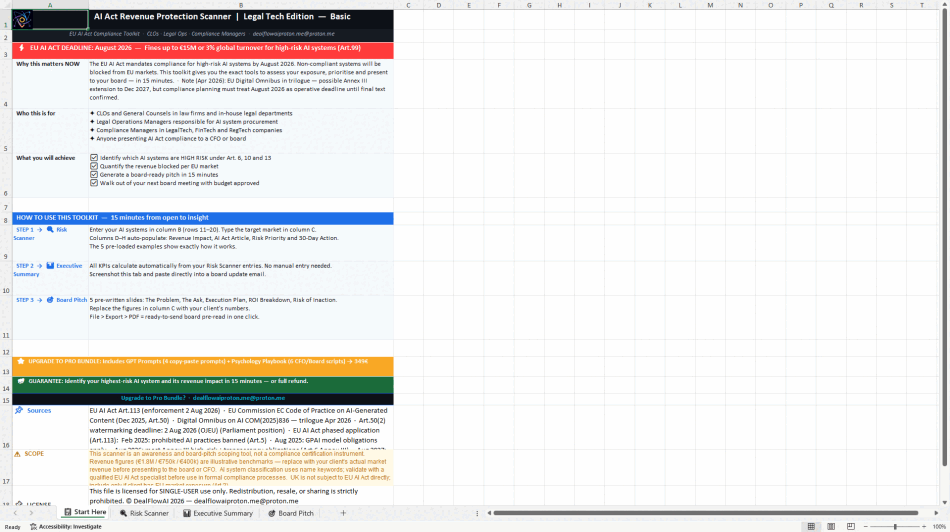
The Venactis AI Act Revenue Protection Scanner – Basic is an advanced Microsoft Excel template (XLSX) available for immediate download upon purchase.
The EU AI Act's prohibited practices (Art. 5) and transparency obligations (Art. 50) have been enforceable since August 2026, carrying fines of up to 35 million EUR or 7% of global annual turnover. High-risk system obligations (Arts. 9-15) were deferred to December 2027 under the Digital Omnibus (Regulation (EU) 2026/1744) – this Scanner tracks both timelines so your financial exposure model reflects what's enforceable now versus what's coming.
Most compliance teams know they need to act—but cannot quantify the financial exposure clearly enough to prioritize resources or build a business case for leadership.
The Venactis AI Act Revenue Protection Scanner solves this problem in 15 minutes.
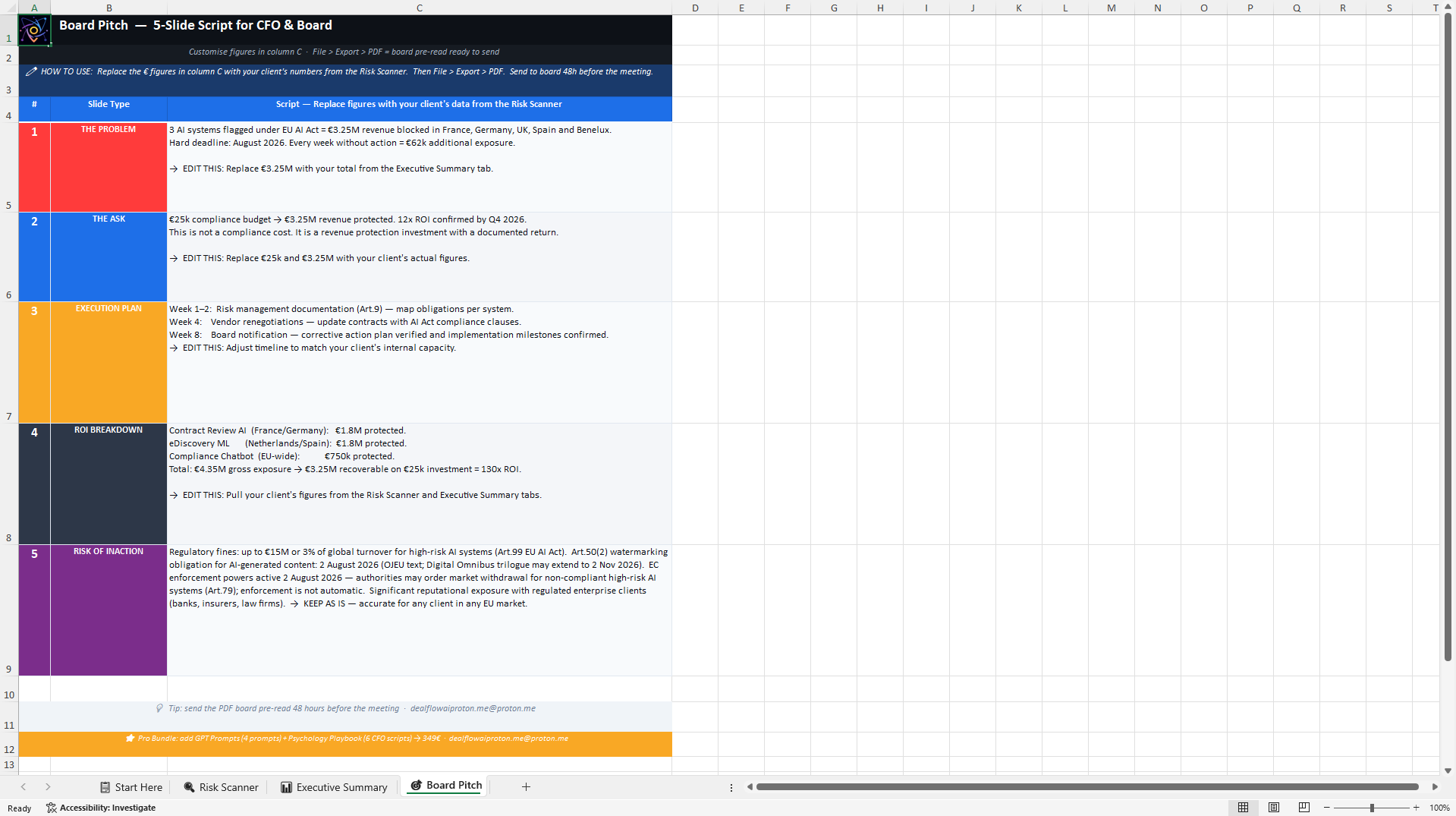
This operational Excel tool gives compliance officers, legal teams, and AI product managers a structured framework to assess their EU AI Act exposure by market, risk tier, and revenue stream—producing a clear financial output ready to present to senior management.
WHAT THE SCANNER DOES
The scanner works in three stages:
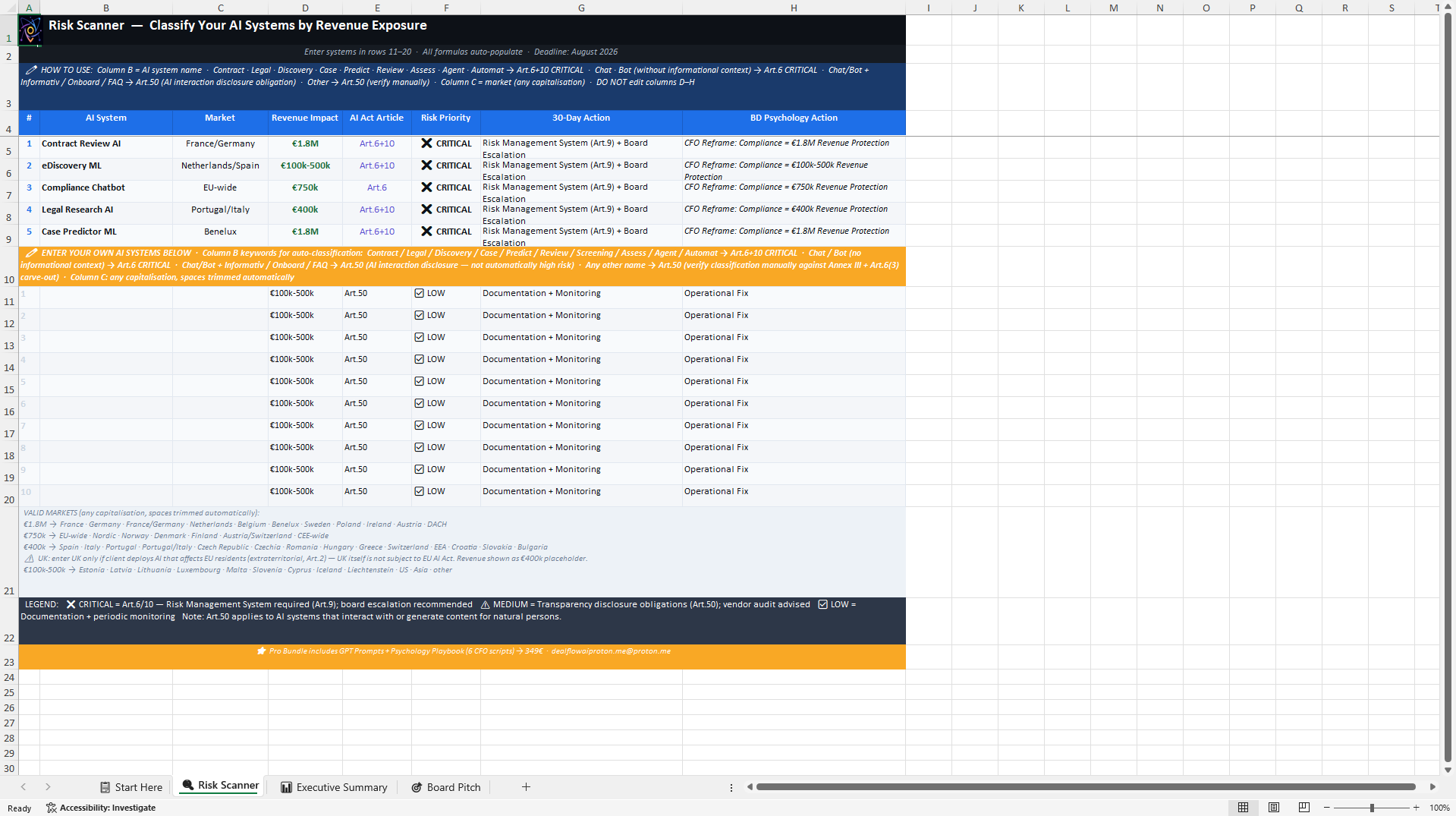
Stage 1 – AI System Inventory
Input your active AI systems, their deployment markets, and primary functions. The tool maps each system against the EU AI Act risk classification framework based on Annex III categories and Article 6 criteria.
Stage 2 – Revenue Exposure Calculation
For each system, the scanner calculates the revenue at risk based on your annual turnover inputs and the applicable penalty tier under Article 99:
Prohibited practices (Art. 5): up to 35M EUR or 7% of global turnover – enforceable now
High-risk system failures (Arts. 8-15): up to 15M EUR or 3% of global turnover [deferred to Dec 2027 under Reg. (EU) 2026/1744]
Transparency violations (Art. 50): up to 7.5M EUR or 1.5% of global turnover – enforceable now
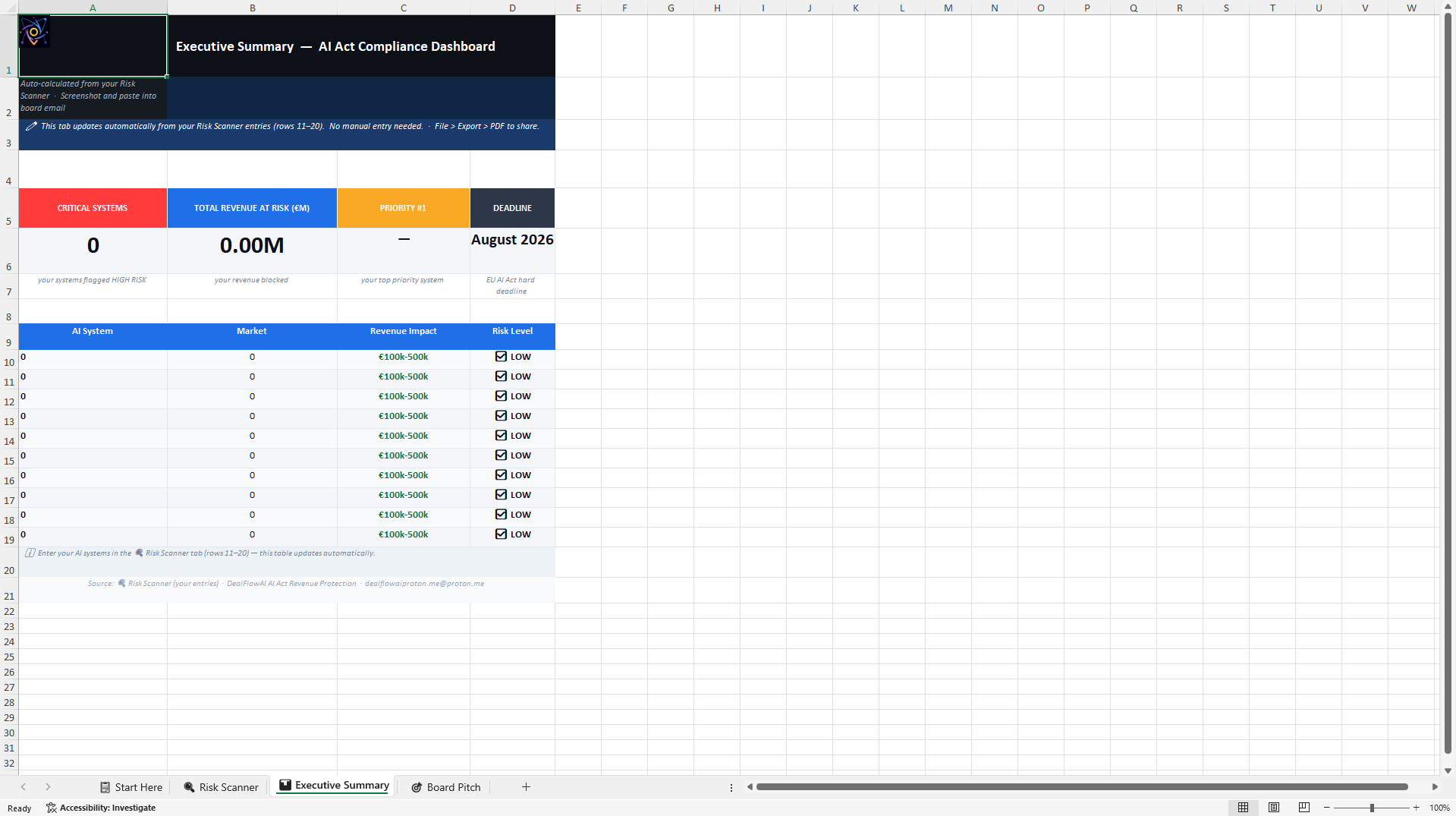
Stage 3 – Priority Output
The scanner produces a prioritized action matrix showing which systems carry the highest financial exposure, which markets are most affected, and what remediation steps are required first.
WHO THIS IS FOR
This tool is designed for:
Chief Legal Officers and Legal Operations Directors assessing AI portfolio exposure
Compliance Officers building the business case for EU AI Act remediation investment
AI Product Managers documenting risk for high-risk system certification
Management consultants conducting AI Act readiness assessments for clients
REGULATORY BASIS
All calculations are grounded in the official text of Regulation (EU) 2024/1689, published in the Official Journal of the European Union (OJ L 2024), as amended by Regulation (EU) 2026/1744.
Article references used throughout:
Article 5: Prohibited AI practices – enforceable since August 2026
Article 6 + Annex III: High-risk system classification
Articles 9-15: High-risk system obligations – deferred to December 2027
Article 49: EU database registration
Article 50: Transparency obligations – enforceable since August 2026
Article 99: Penalties and fines
MARKETS COVERED
The scanner includes verified national authority data and implementation status for:
Germany (Bundesnetzagentur / BNetzA)
France (DGCCRF – designation pending)
Netherlands (Autoriteit Persoonsgegevens / AP)
Spain (AESIA – Agencia Española de Supervisión de la Inteligencia Artificial)
United Kingdom (outside EU scope – sector-led framework)
FORMAT AND COMPATIBILITY
Microsoft Excel workbook (.xlsx)
Compatible with Excel 365 and Google Sheets
No macros required
Pre-configured dropdowns and protected formulas
Print-ready layout for executive reporting
DISCLAIMER
This tool is an operational assessment aid. It does not constitute legal advice or regulatory certification. All outputs must be validated by qualified legal counsel before regulatory submission or decision-making. Legal basis: Regulation (EU) 2024/1689 (OJ L 2024), as amended by Regulation (EU) 2026/1744.
Got a question about the product? Email us at support@flevy.com or ask the author directly by using the "Ask the Author a Question" form. If you cannot view the preview above this document description, go here to view the large preview instead.
Source: Best Practices in Artificial Intelligence, Compliance Excel: AI Act Revenue Protection Scanner - Basic Excel (XLSX) Spreadsheet, Venactis
ABOUT THE AUTHOR

Global business development and regulatory strategist with over 20 years of experience executing cross-border licensing agreements, market entry strategies, and complex transactions across more than 30 countries. Known for translating intricate international regulations into actionable, enterprise-grade frameworks.
Specializes in designing institutional-grade tools for the EU AI Act, risk
... [read more]
Ask the Author a Question
You must be logged in to contact the author.




























