
 Click main image to view in full screen. Unlock all 16 preview images:
Equipment Rental Marketplace Financial Projection Model – Excel XLSX
Excel (XLSX)


BENEFITS OF THIS DOWNLOADABLE EXCEL DOCUMENT
- Save weeks of work by generating a complete 5-year financial forecast in minutes with a simple, assumption-driven setup.
- Impress investors and lenders with built-in DCF, IRR, NPV, and unit economics that make your pitch credible and fundable.
- Make smarter decisions faster by stress-testing pricing, marketing spend, and growth scenarios without touching a single formula.
ASSET MANAGEMENT EXCEL DESCRIPTION
Download this Construction Equipment Rental Marketplace Financial Projection Model to build a clear, investor-ready forecast for your startup without starting from scratch. This simple, ready-to-use spreadsheet is designed for equipment rental marketplace startups, peer-to-peer equipment rental platforms, and founders who want a professional financial model for fundraising, planning, and valuation.
Built by Excel Business Resource, the model gives you a complete picture of your marketplace economics – from revenue model & costing to 3 financial statements, 5-Year Pro-Forma Financial Statements, cash runway, burn rate, unit economics, and sensitivity analysis. It is built to help you explain not just how your business grows, but how it makes money, scales, and creates value.
Why this model matters 🚀
A construction equipment rental marketplace has multiple moving parts: buyer demand, vendor supply, booking frequency, transaction value, commissions, listing fees, subscription income, and add-on services. This model brings all of that together in one place so you can understand the real economics of the platform and make smarter decisions before launch.
It is especially useful when you need to answer investor questions like:
How does revenue grow over time?
What drives GMV and bookings?
How much cash is needed to reach break-even?
What is the CAC payback period?
What are the valuation outcomes under different scenarios?
What's included in the model 🔍
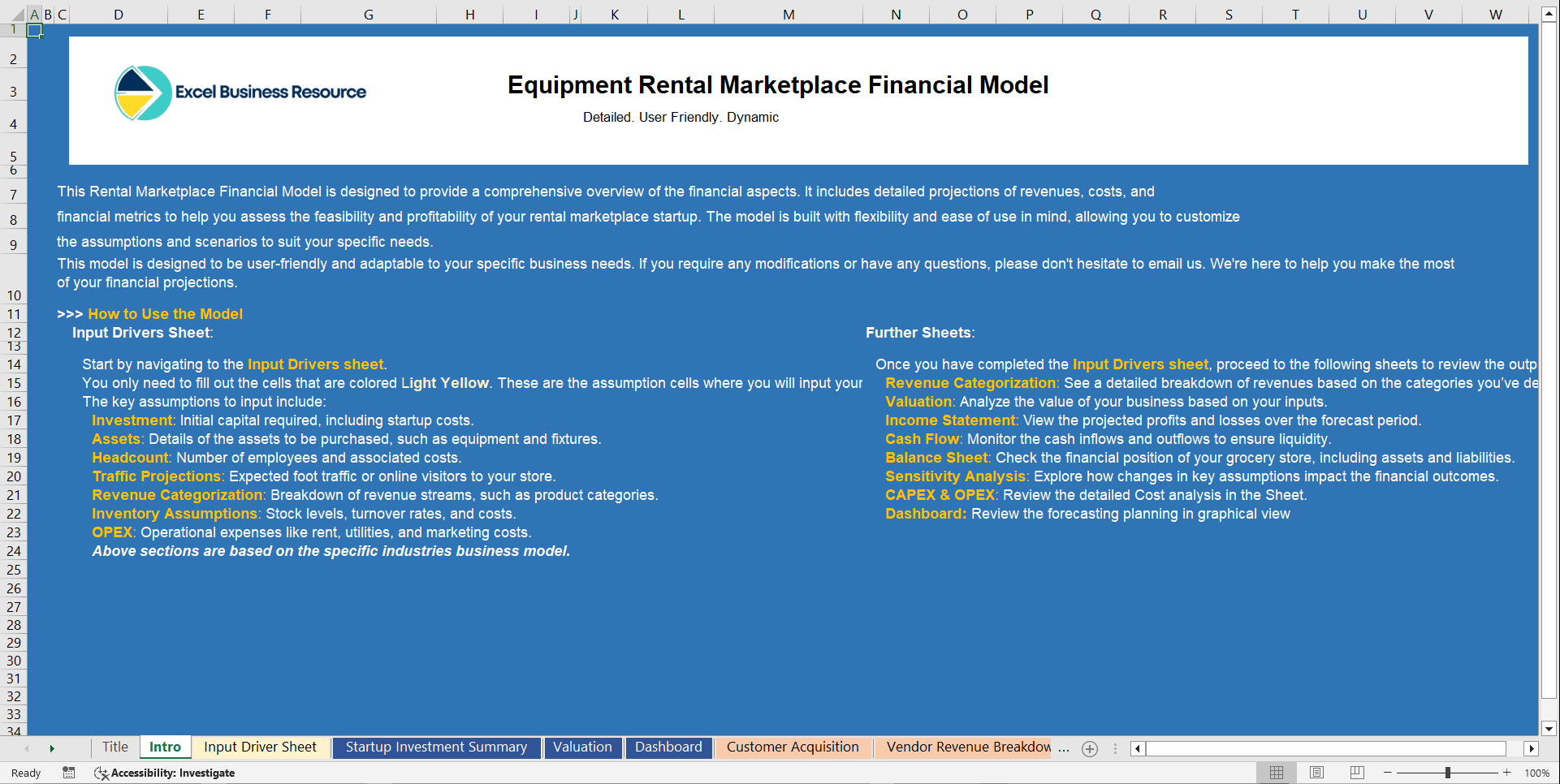
Based on the uploaded workbook, the model includes several key tabs and sections that support full startup forecasting and valuation.
• Tabs and sections included
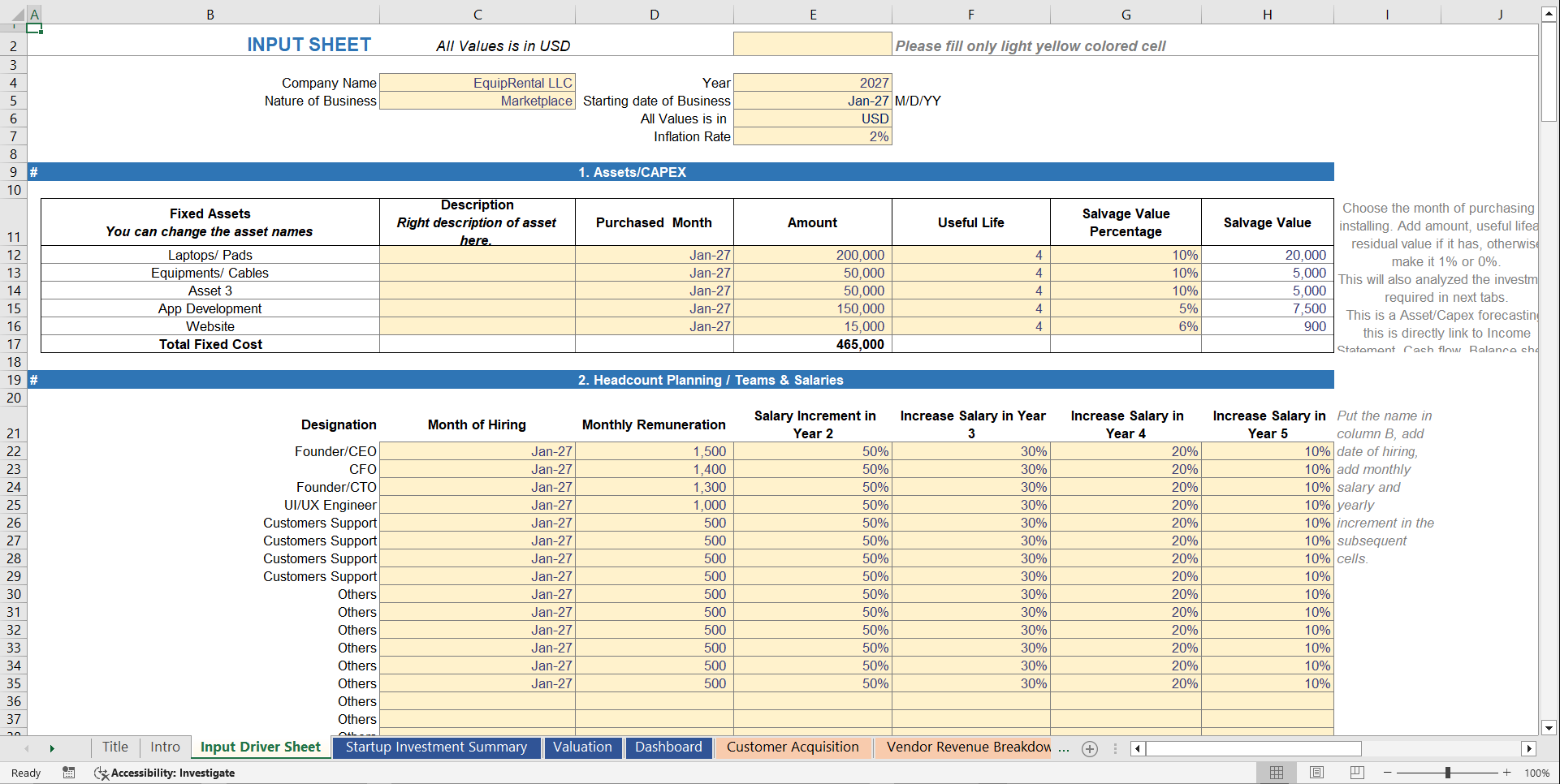
Input Driver Sheet for core assumptions and editable inputs.
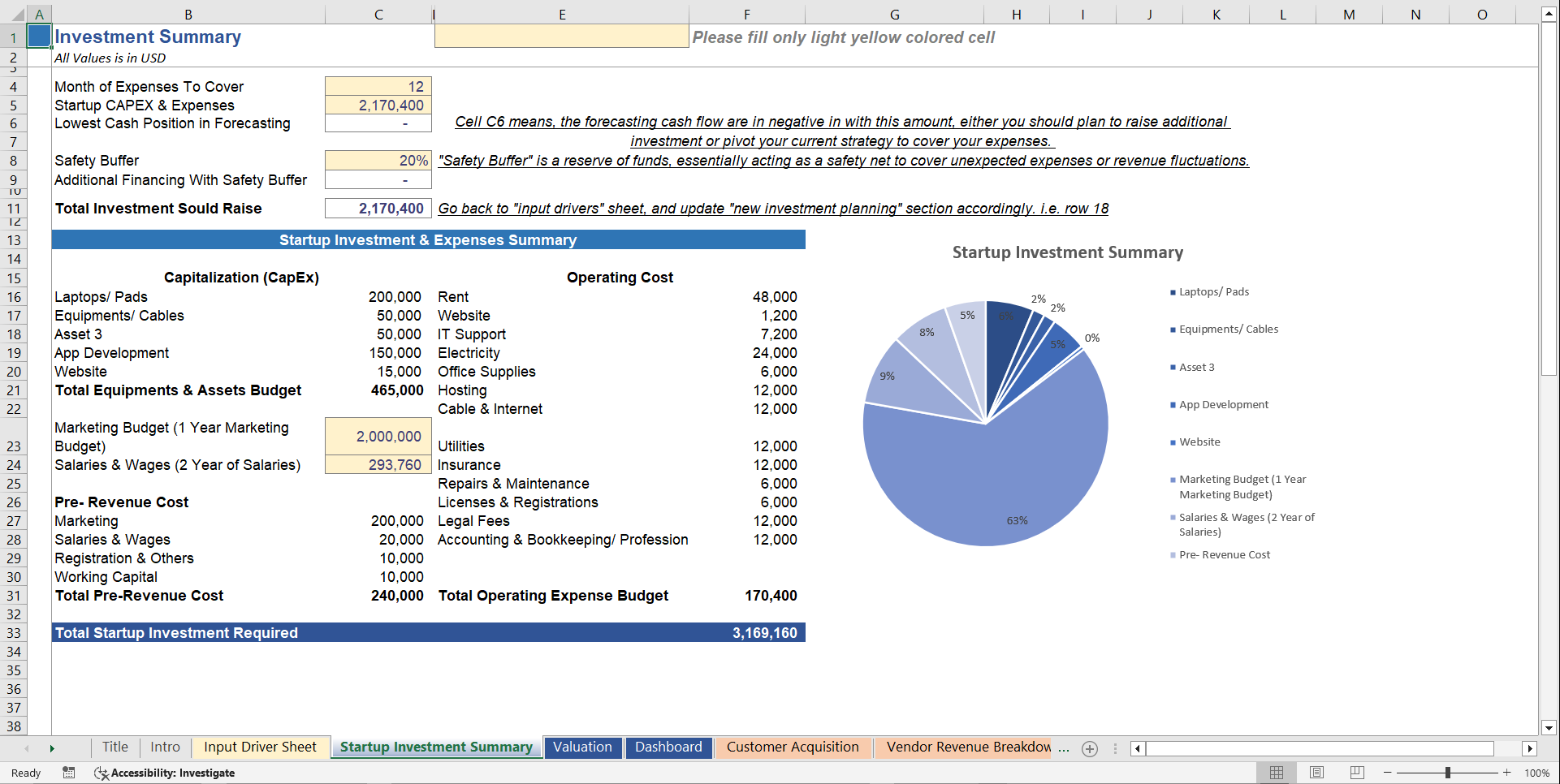
Startup Investment Summary for funding needs and startup cost structure.
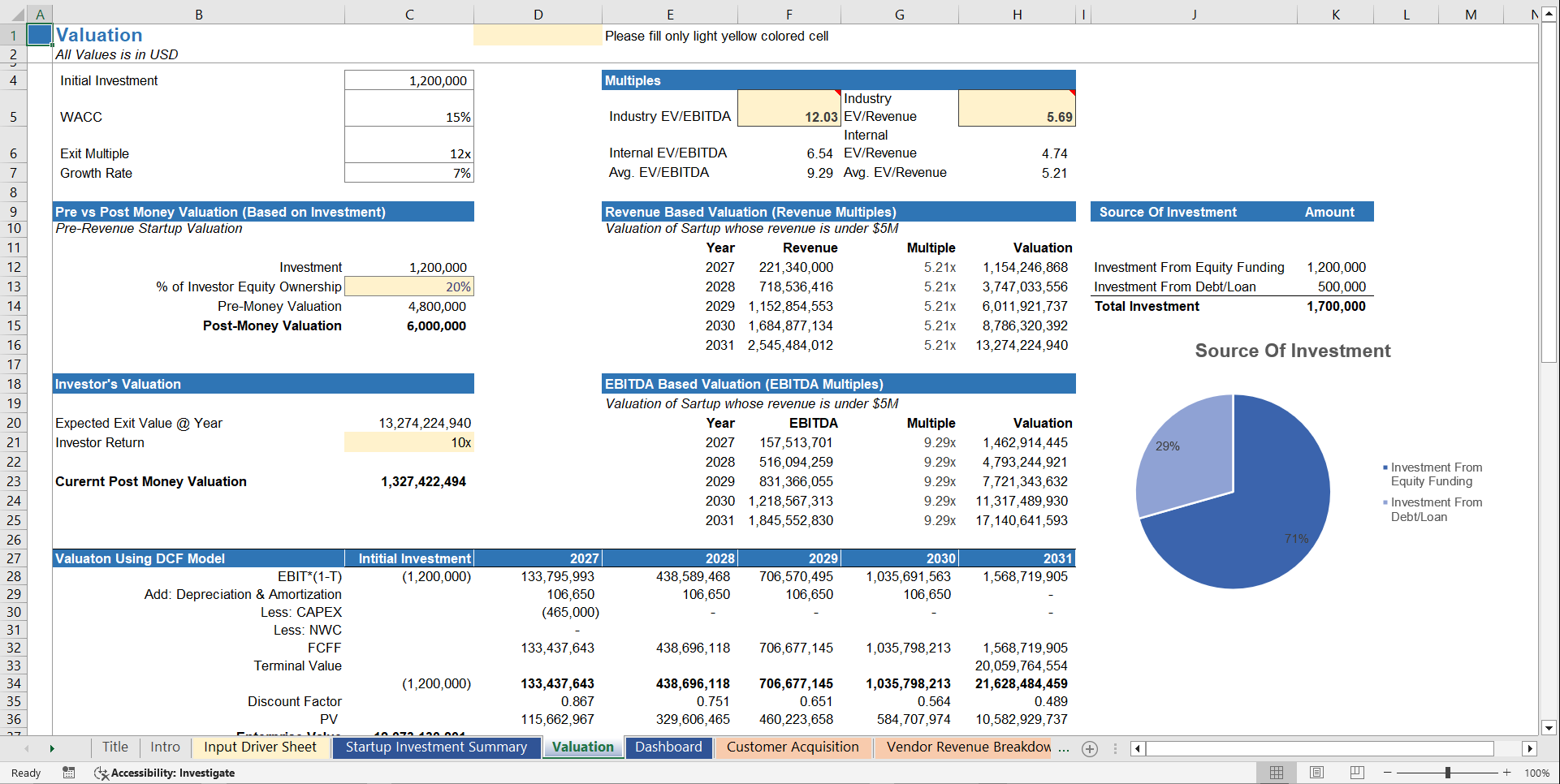
Valuation for revenue multiple, EBITDA multiple, and DCF-based valuation.
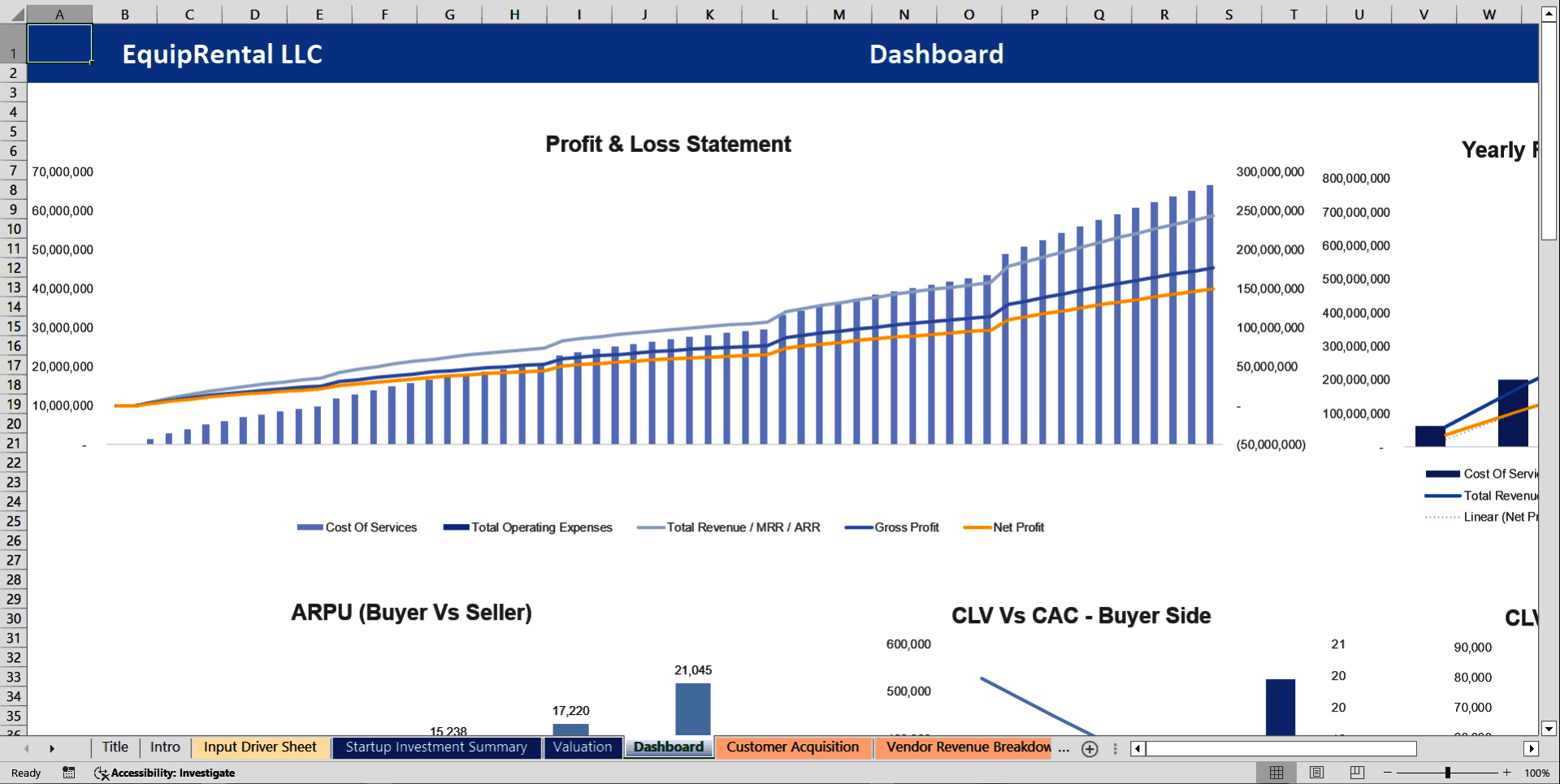
Dashboard for visual performance tracking and summary outputs.
Income Statement for profitability forecasting.
Cash Flow Statement for liquidity and cash management.
Balance Sheet for financial position and capital structure.
Supporting sections for revenue breakdown, operating expenses, investment planning, debt service, and sensitivity-style outputs.
Variable inputs you can control ⚙️
This template is built around flexible assumptions, so users can update the model for different geographies, pricing strategies, and funding structures.
• Main input categories
• Company setup: company name, business start date, inflation rate, and base currency.
• CAPEX assumptions: laptops, equipment, app development, website, and other fixed assets with useful life and salvage value.
• Headcount planning: founders, CFO, CTO, UI/UX, customer support, salary increases, bonus, payroll tax, and benefits.
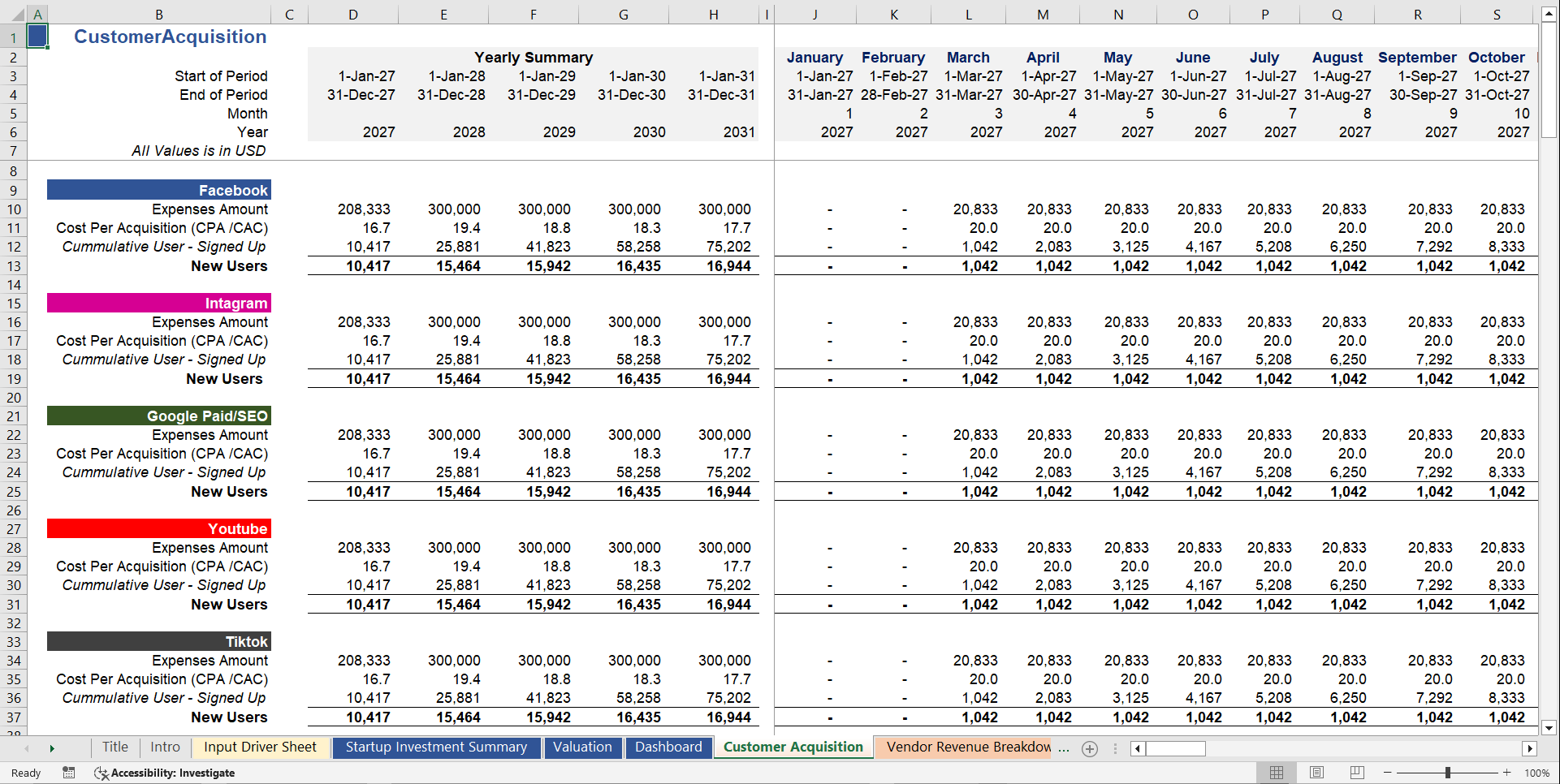
• Marketing inputs: paid ads budgets, CAC/CPA, and channel-level spend across Facebook, Instagram, Google, YouTube, TikTok, lead generation, and other channels.
• Marketplace demand drivers: traffic, conversion rate, churn rate, buyer-vendor mix, and growth assumptions.
• Revenue assumptions: rental frequency, unit capacity per month, pricing by rental duration, and category-level buyer mix.
• Marketplace monetization: buyer commissions, insurance/damage protection, logistics delivery, inspection fees, payment processing, vendor commissions, listing fees, subscriptions, and ads revenue.
• Funding and capital structure: equity injections, debt financing, loan term, interest rate, payment schedule, WACC, tax rate, and dividend policy.
• Previous financials: prior invested amount, revenue, expenses, assets, and cash balance.
Revenue model breakdown 💰
This model is strong because it captures the full marketplace monetization structure instead of relying on one income stream.
• Revenue streams modeled
Buyer-side revenue: commission fee, insurance/damage protection, logistics delivery, inspection services, and payment processing fees tied to GMV.
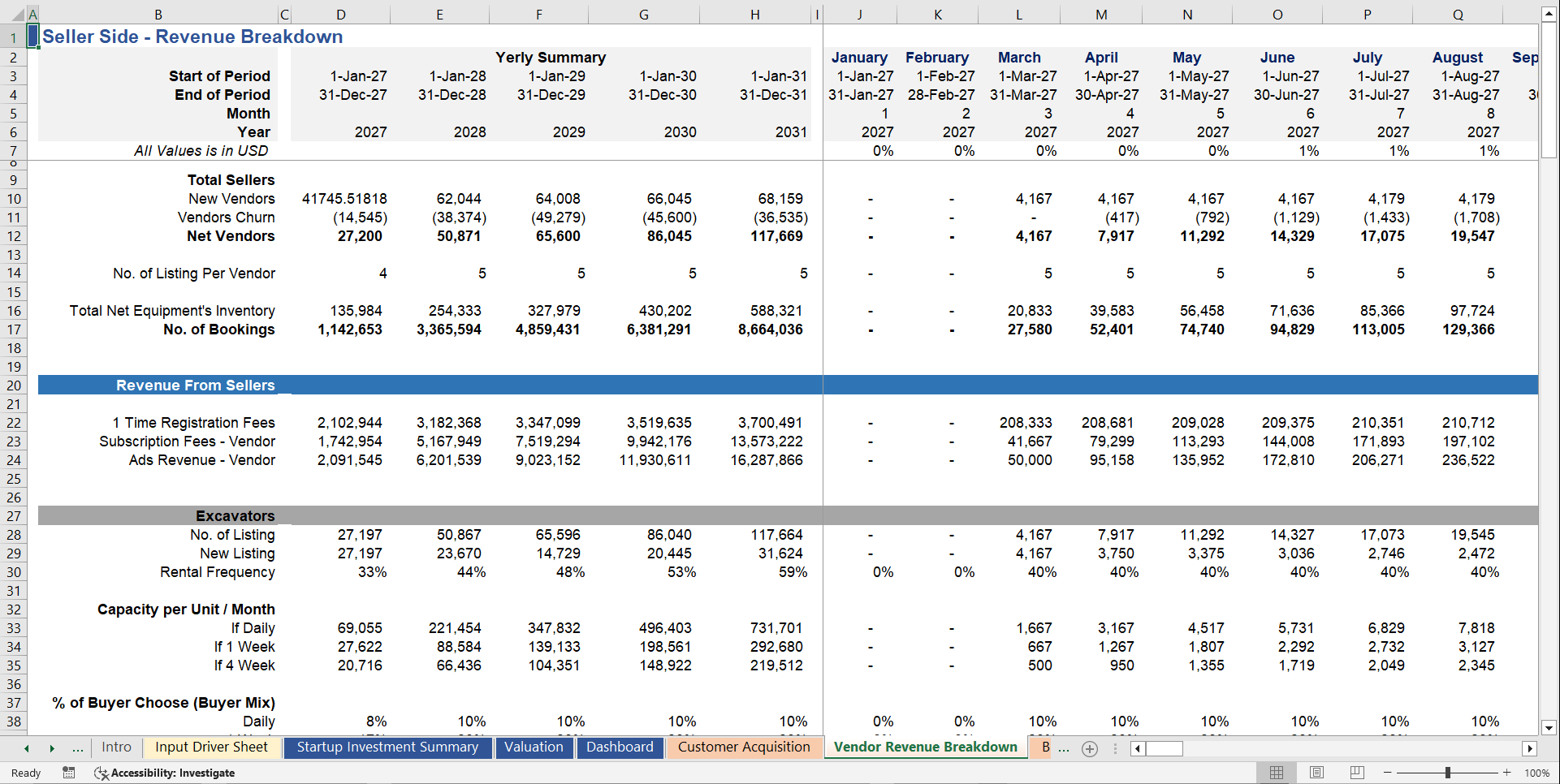
Vendor-side revenue: commission on transactions, listing fees, subscription fees, one-time registration fees, and advertising revenue.
Equipment purchase option revenue: commissions and inspection fees from equipment sales transactions.
This makes the workbook highly relevant for a rental marketplace financial projection model, equipment rental marketplace financial plan, or peer-to-peer equipment rental marketplace financial model because it reflects how real marketplaces monetize both sides of the platform.
Financial analysis and valuation 📈
The template goes beyond basic forecasting and includes advanced analytical tools that investors usually expect in a serious startup model.
• Key analysis included
Revenue and EBITDA multiple valuation.
DCF valuation.
IRR and NPV analysis.
Rule of 40.
Payback period and discounted payback period.
Burn rate and funding runway logic.
Unit economics metrics such as GMV, ARPU, CLTV, CAC, and CAC payback.
These features make the model useful not only for startup planning but also for investor meetings, lender reviews, and internal strategic decisions.
💡Benefits for startups
This template helps founders turn a complicated marketplace idea into a structured financial story. Instead of guessing at profitability, you can test pricing, operating leverage, acquisition efficiency, and capital requirements with real assumptions.
💡Why use this model?
• It saves time compared to building a model from scratch.
• It helps founders validate business viability before spending heavily.
• It supports fundraising with professional financial outputs
• It shows how demand, pricing, and marketing affect profitability
• It provides a framework for sensitivity analysis and scenario planning.
For an equipment rental marketplace startup, that matters because small changes in conversion, churn, commission rates, or customer acquisition costs can dramatically affect long-term value.
Got a question about the product? Email us at support@flevy.com or ask the author directly by using the "Ask the Author a Question" form. If you cannot view the preview above this document description, go here to view the large preview instead.
Source: Best Practices in Asset Management, Integrated Financial Model Excel: Equipment Rental Marketplace Financial Projection Model Excel (XLSX) Spreadsheet, Excel Business Resource
ABOUT THE AUTHOR

Excel Business Resource offers a leading-edge solution for streamlined financial modeling, budgeting, and reporting. Our customizable templates, curated by FP&A and FMVA experts, provide the foundation for precise, tailored financial analysis. From dynamic modeling to flexible budgeting and board-ready reports, our platform empowers informed decision-making for businesses of all sizes. ... [read more]
Ask the Author a Question
You must be logged in to contact the author.




























