 Click main image to view in full screen. Unlock all 11 preview images:
Distribution Waterfall Models - PE, VC & Real Estate – Excel XLSX
Excel (XLSX)


BENEFITS OF THIS DOWNLOADABLE EXCEL DOCUMENT
- Presents 4 different examples of Distribution Waterfalls for Private Equity, Venture Capital and Real Estate Investments.
INVESTMENT VEHICLES EXCEL DESCRIPTION
A distribution waterfall describes the method by which investment returns are allocated among participants of a group or pooled investment. Essentially, the total capital gains earned are distributed according to a cascading structure made up of sequential tiers, hence the reference to a waterfall.
Usually, the general partners receive a disproportionately larger share of the total profits relative to their initial investment once the allocation process is complete. This is done to incentivize the fund's general partner to maximize profitability for its investors.
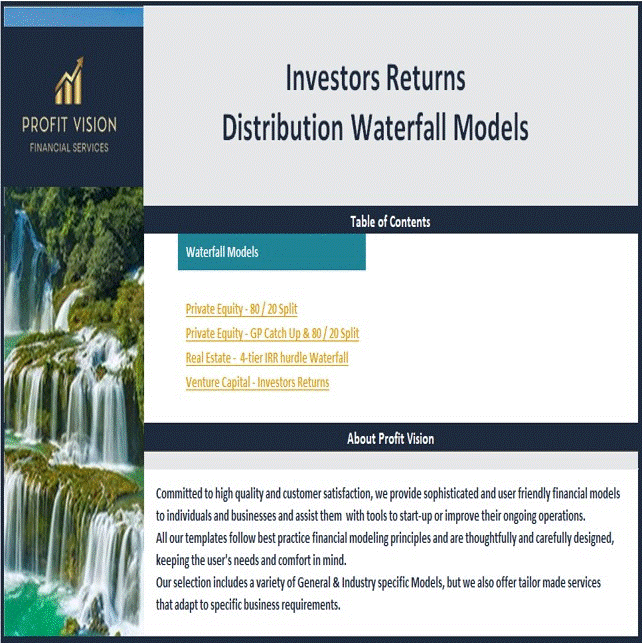
This template includes 4 different examples of Distribution Waterfalls for Private Equity, Venture Capital, and Real Estate Investments.
Contents:
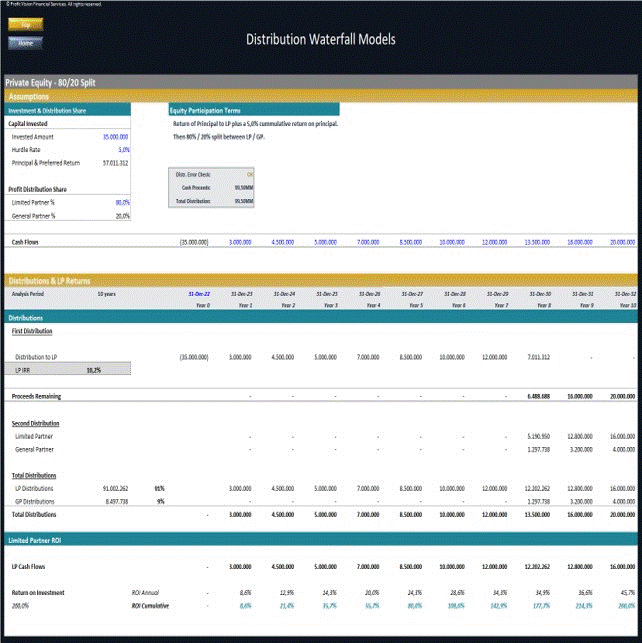
• Private Equity – 80/20 Split
The 80/20 Model assumes that the Limited Partner contributes all equity investment and receives first the Principal and Preferred Return
Then the remaining proceeds are distributed 80% to the investors and 20% to the Private Equity Firm.
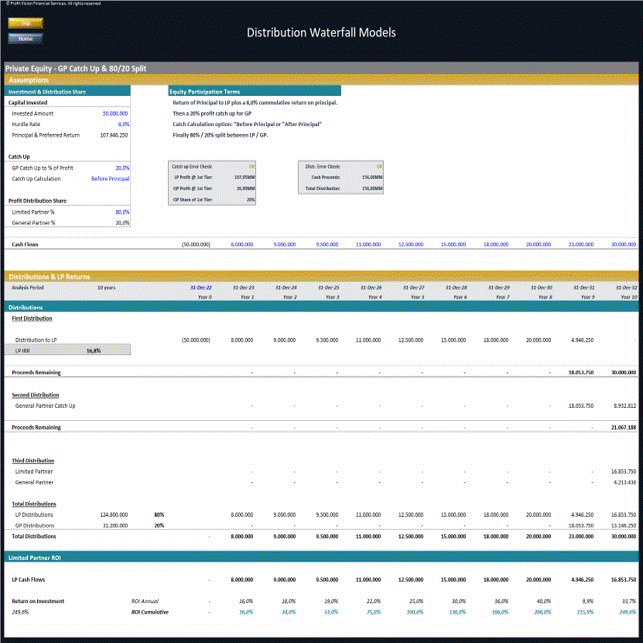
• Private Equity – GP Catch Up & 80/20 Split
This model assumes that equity contribution is split between LP and GP based on the % inputs. In a preferred return with GP catchup, once the preferred return hurdle is met, the GP receives all or most of the future profits until the GP catches up to its 20% carry amount. After that, the profits are split 80% to the LPs and 20% to the GP.
The steps are as below:
1. First 100% of all cash inflows are distributed to the LP until the cumulative distributions equal the original capital invested.
2. Then 100% of all cash inflows to the LP until the LP has received a preferred return on the capital invested
3. Then 100% of all cash inflows are distributed to the GP until the cumulative distributions equal the original capital invested.
4. After that a "20% catch-up" to the GP equivalent to 20% of the remaining proceeds
5. Finally all remaining proceeds are distributed 80% to the LP and 20% to the GP.
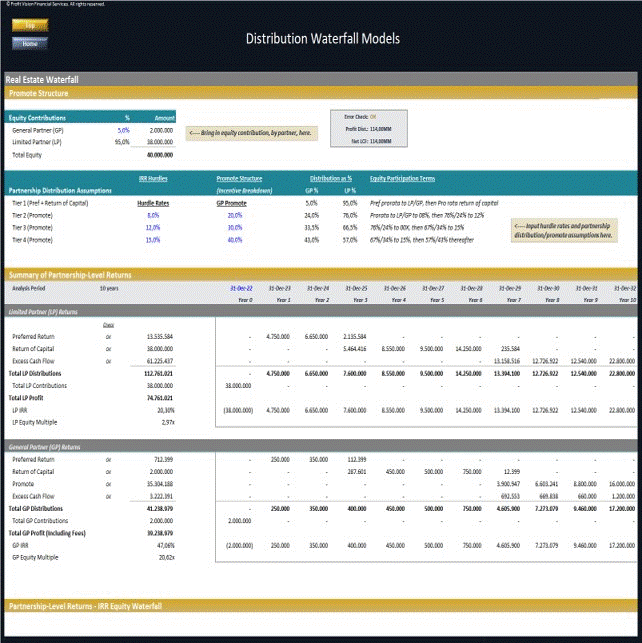
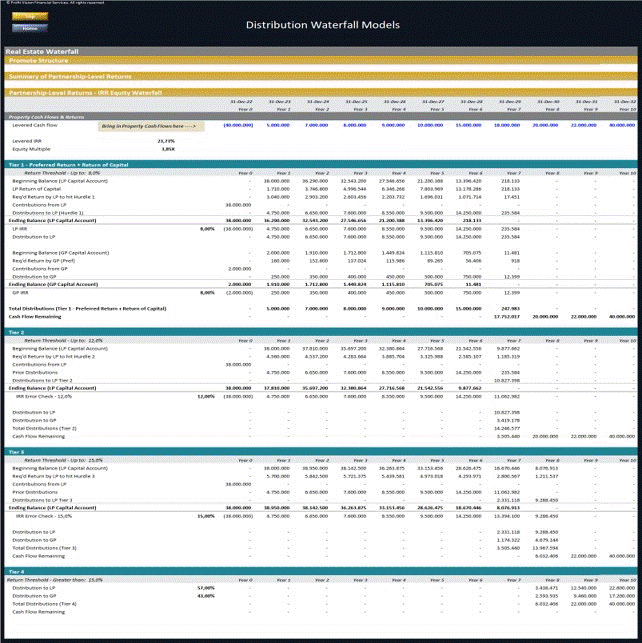
• Real Estate – 4-tier IRR hurdle Waterfall
The model allows for up to four tiers (IRR hurdles) and assumes only one sponsor (i.e. GP) and one LP.
The first tier distributes cash flow to the partners until the LP has achieved some defined preferred return and received a full return of capital.
After the preferred return hurdle is hit in tier one, cash flow is distributed in tiers two through four based on a defined promote structure and hurdle rates as outlined by the user.
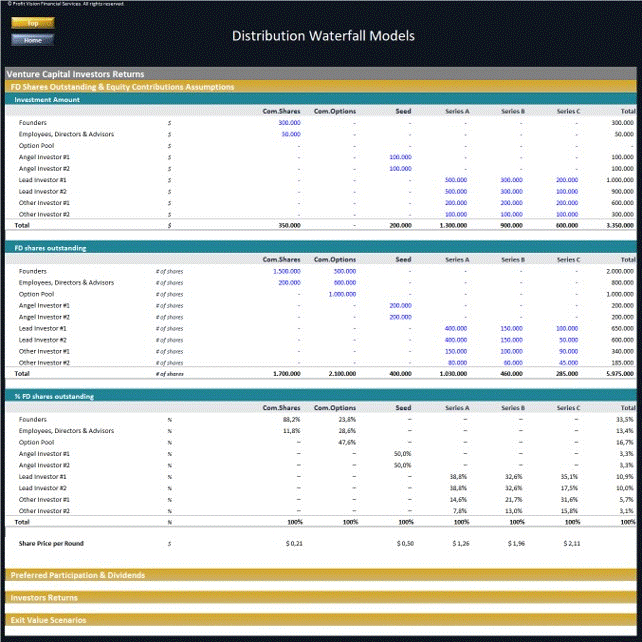
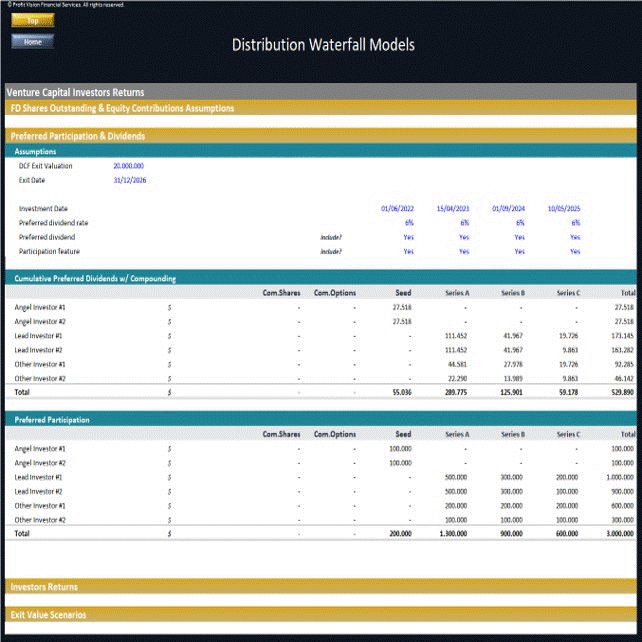
• Venture Capital – Investor Returns with multiple Exit Scenarios
This model is suitable for a startup company or early-stage venture including multiple rounds of investments and investor's returns analysis.
It includes assumptions per round of FD Shares Outstanding and Invested amount from Owners, Employees, Seed, Lead, and Other Investors.
The model calculates Preferred Participation and Dividends per round, Ownership percentages at each round, and Total Cash Flows at Exit and computes the Internal Rate of Return (IRR) and Cash-on-Cash multiple (CoC) for each investor using different exit value scenarios.
Help & Support
Committed to high quality and customer satisfaction, all our templates follow best-practice financial modeling principles and are thoughtfully and carefully designed, keeping the user's needs and comfort in mind.
No matter if you have no experience or are well versed in finance, accounting, and the use of Microsoft Excel, our professional financial models are the right tools to boost your business operations!
If you however experience any difficulty while using this template and you are not able to find the appropriate guidance in the provided instructions, please feel free to contact us for assistance.
If you need a template customized for your business requirements, please e-mail us and provide a brief explanation of your specific needs.
This template provides detailed cash flow projections and ROI analysis for each investment scenario, ensuring precise financial planning. Designed for ease of use, it includes comprehensive assumptions and calculations, making it an invaluable tool for strategic decision-making.
Got a question about the product? Email us at support@flevy.com or ask the author directly by using the "Ask the Author a Question" form. If you cannot view the preview above this document description, go here to view the large preview instead.
TOPIC FAQ
What is a distribution waterfall and how are returns typically allocated among LPs and GPs?
A distribution waterfall is a cascading allocation method that distributes total capital gains across participants using sequential tiers. Typical mechanics return capital and preferred returns to LPs first, then apply promotes or catch‑ups so GPs receive a higher share afterward, as illustrated by examples like an 80/20 split.How does a GP catch‑up waterfall structure work in practice?
In a GP catch‑up structure, distributions follow ordered steps: return of capital to LPs, payment of LP preferred return, distributions to GP until it catches up to its carried interest, a designated catch‑up allocation, then a final pro rata split. The overview describes this as a five‑step sequence.What are IRR hurdle tiers in a real estate waterfall and how are they applied?
IRR hurdle tiers set success thresholds where cash flows shift allocation between sponsor and LP. The model in the overview supports up to 4 tiers: initial tier returns capital and preferred return to the LP, then tiers two–four distribute per a defined promote structure after hurdle rates are met, up to 4 tiers.How can I model VC investor returns across multiple financing rounds and exit scenarios?
Model each financing round with fully diluted shares outstanding and invested amounts by Owners, Employees, Seed, Lead, and Other Investors; calculate preferred participation, dividends per round, ownership percentages at each round, and project total cash flows at exit to derive IRR and Cash‑on‑Cash multiples across exit scenarios.What should I look for when choosing an Excel distribution‑waterfall template for fund modeling?
Prioritize templates that include multiple waterfall examples (PE, VC, real estate), support GP catch‑up and multi‑tier IRR promotes, handle multi‑round VC assumptions (FD shares and invested amounts), provide clear assumptions and calculations, and come in XLSX format; the product overview lists 4 different examples in XLSX.How do waterfall templates support LP reporting and cash‑flow projections?
Waterfall templates provide detailed cash‑flow projections and ROI analyses for each investment scenario, enabling scheduled distribution calculations and investor reporting. The discussed template explicitly delivers detailed cash‑flow projections and ROI analysis tailored to each investment scenario.I need to model a preferred return followed by a GP catch‑up and final carry split — which example applies?
The Private Equity – GP Catch Up & 80/20 Split example is designed for that sequence: return of capital to LPs, payment of preferred return, distributions to GP until catch‑up, a 20% catch‑up allocation, then an 80/20 residual split as described in the model.How do templates handle ownership dilution and preferred participation across VC rounds?
Templates that cover VC rounds include assumptions per round for fully diluted shares outstanding and invested amounts, calculate preferred participation and dividends per round, and compute ownership percentages and exit cash flows to produce investor IRR and Cash‑on‑Cash metrics per round.Source: Best Practices in Investment Vehicles, Private Equity Excel: Distribution Waterfall Models - PE, VC & Real Estate Excel (XLSX) Spreadsheet, Profit Vision
ABOUT THE AUTHOR

Profit Vision provides Consulting & Outsourced Financial Services as well as Financial Planning & Performance analysis to small and mid-size businesses by implementing efficient and effective tools to assist them with start-up business plans or improve their ongoing operations.
Our range of services include Financial & Operational Analysis, Business Planning, Budgeting & Forecasting, Cash Flow
... [read more]
Ask the Author a Question
You must be logged in to contact the author.