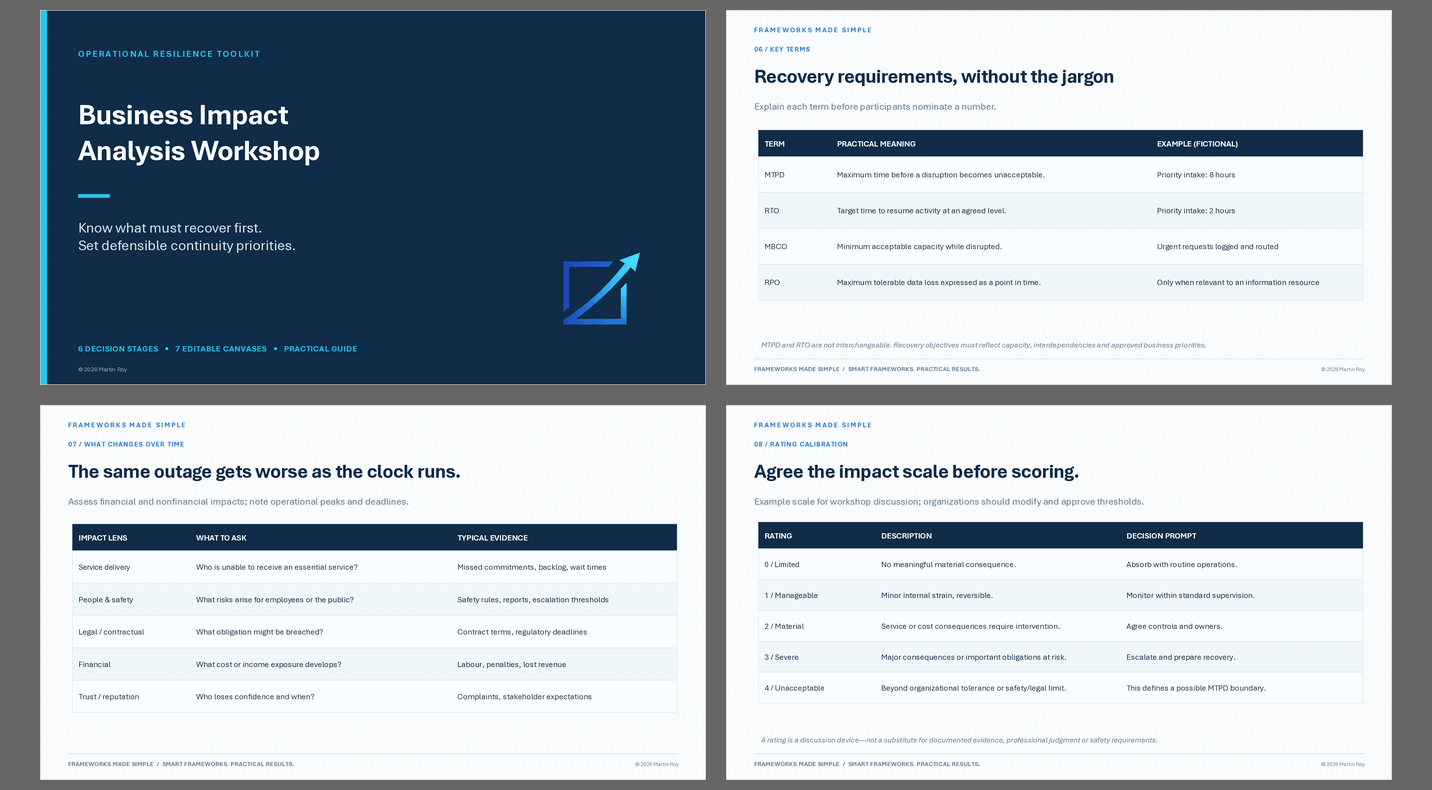
 Click main image to view in full screen. Unlock all 13 preview images:
Business Impact Analysis (BIA) Workshop Toolkit – PowerPoint PPTX Template
PowerPoint (PPTX) + Zip archive file (ZIP) 38 Slides


BENEFITS OF THIS DOWNLOADABLE POWERPOINT DOCUMENT
- Guides operations teams through a practical six-stage BIA workshop to prioritize critical activities and document disruption impacts over time.
- Includes seven editable PowerPoint canvases, completed fictional examples, printable worksheets and a detailed facilitator guide for immediate use.
- Helps translate business impacts into proposed recovery objectives, minimum operating requirements and clear management decisions.
BCP PPT TEMPLATE DESCRIPTION
A business interruption rarely affects every activity equally. Some services can absorb a delay, while others quickly generate unacceptable consequences for customers, employees, contractual obligations or core operations. Yet teams often select recovery priorities using intuition or technical availability rather than documented business impacts.
Business Impact Analysis (BIA) Workshop Toolkit is a practical, manager-friendly toolkit for defining and defending continuity priorities. Designed for operations managers, risk and continuity professionals, internal facilitators and process owners, it turns an important but frequently technical exercise into a guided decision process.
THE BUSINESS PROBLEM
When a critical system or resource fails, teams need to know which services matter most, which activities support them, when disruption becomes unacceptable, what minimum level of service must resume and which recovery objectives should be validated.
A generic checklist or unstructured spreadsheet cannot replace a structured conversation with accountable business owners.
WHAT THIS TOOLKIT DOES
The workshop guides participants through six practical steps:
1. SCOPE – Define prioritized services, stakeholder expectations, obligations, boundaries and accountable activity owners.
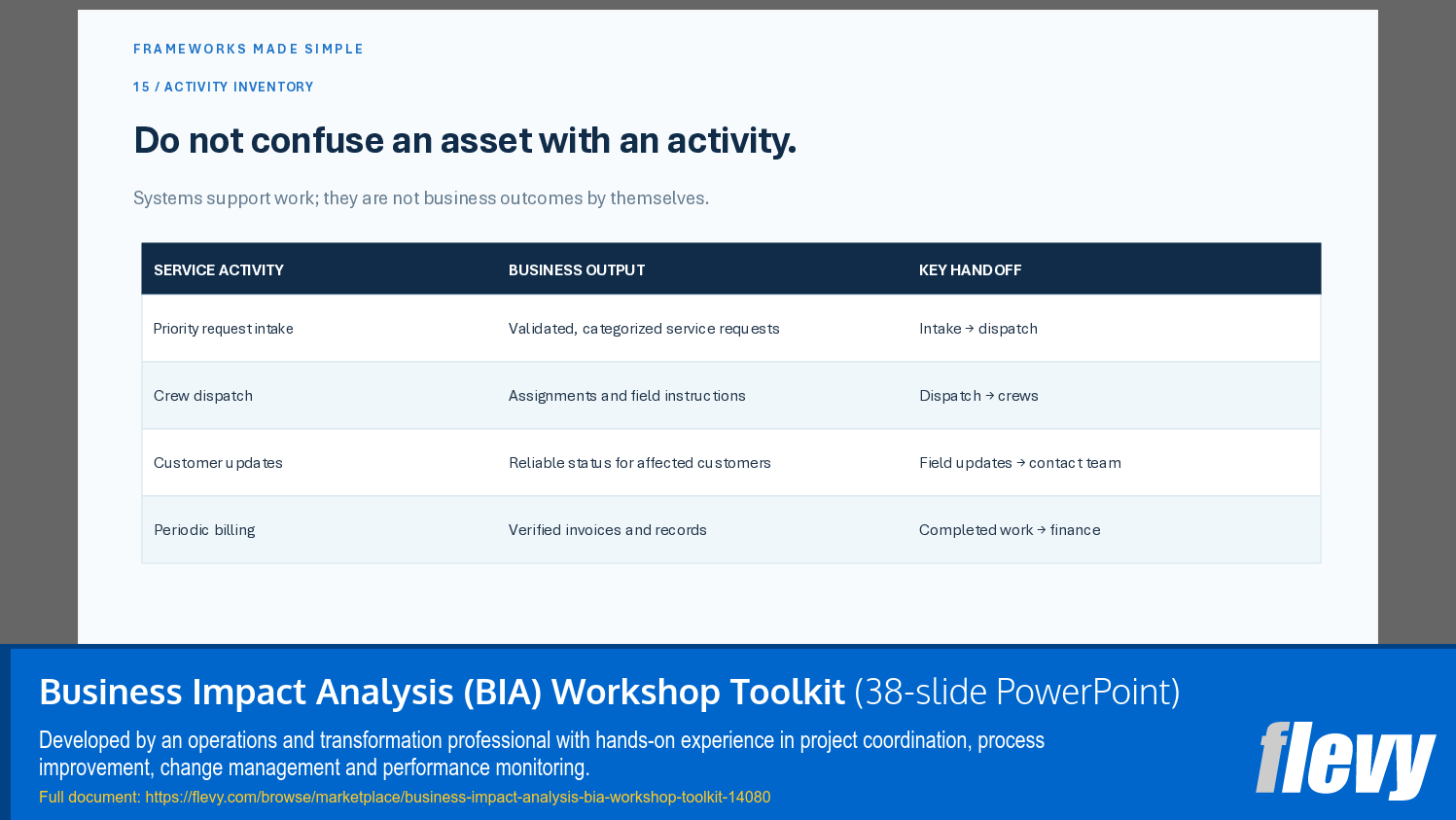
2. MAP – Identify activities, outputs, peak business periods and interdependencies behind the service.
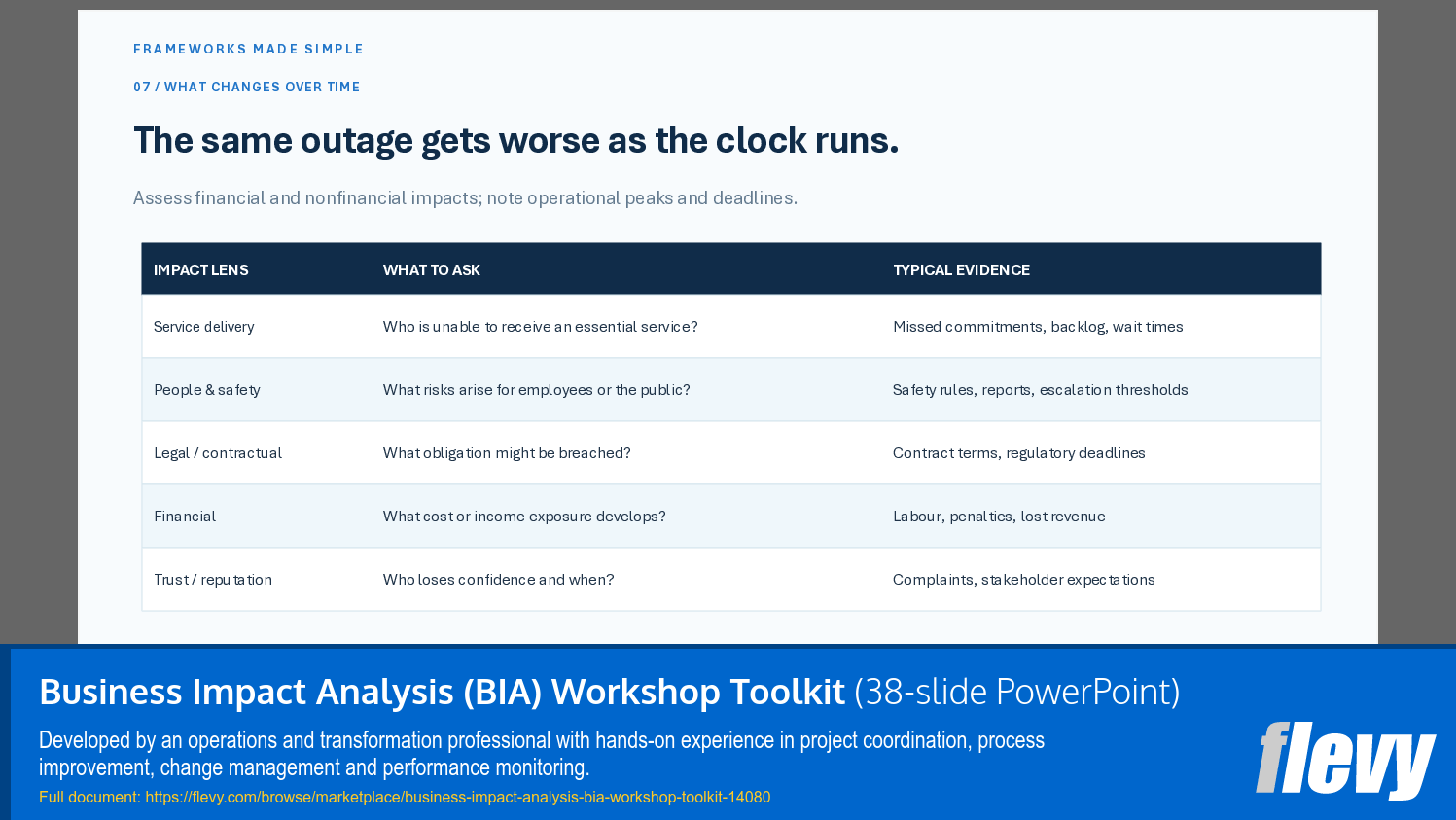
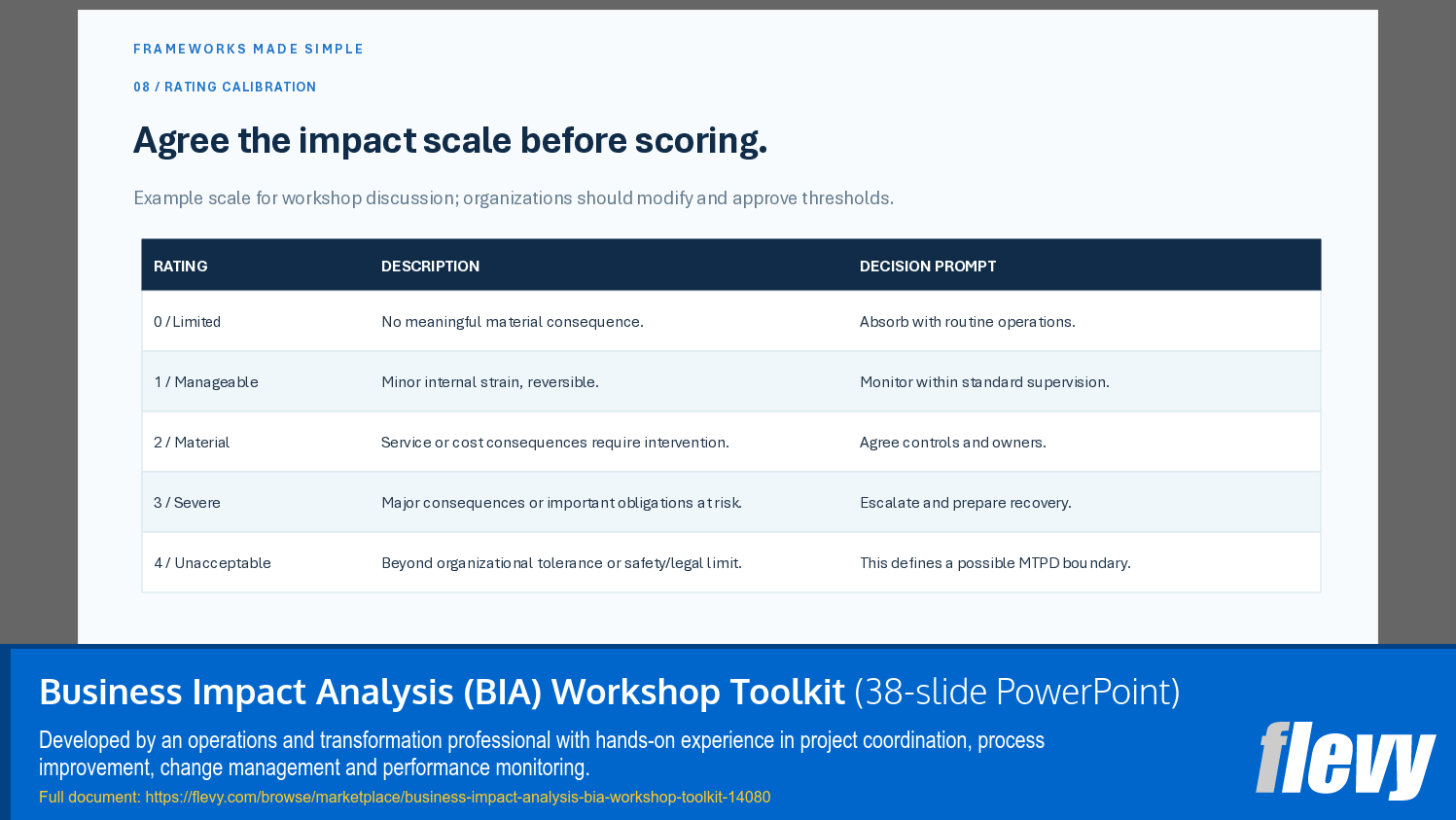
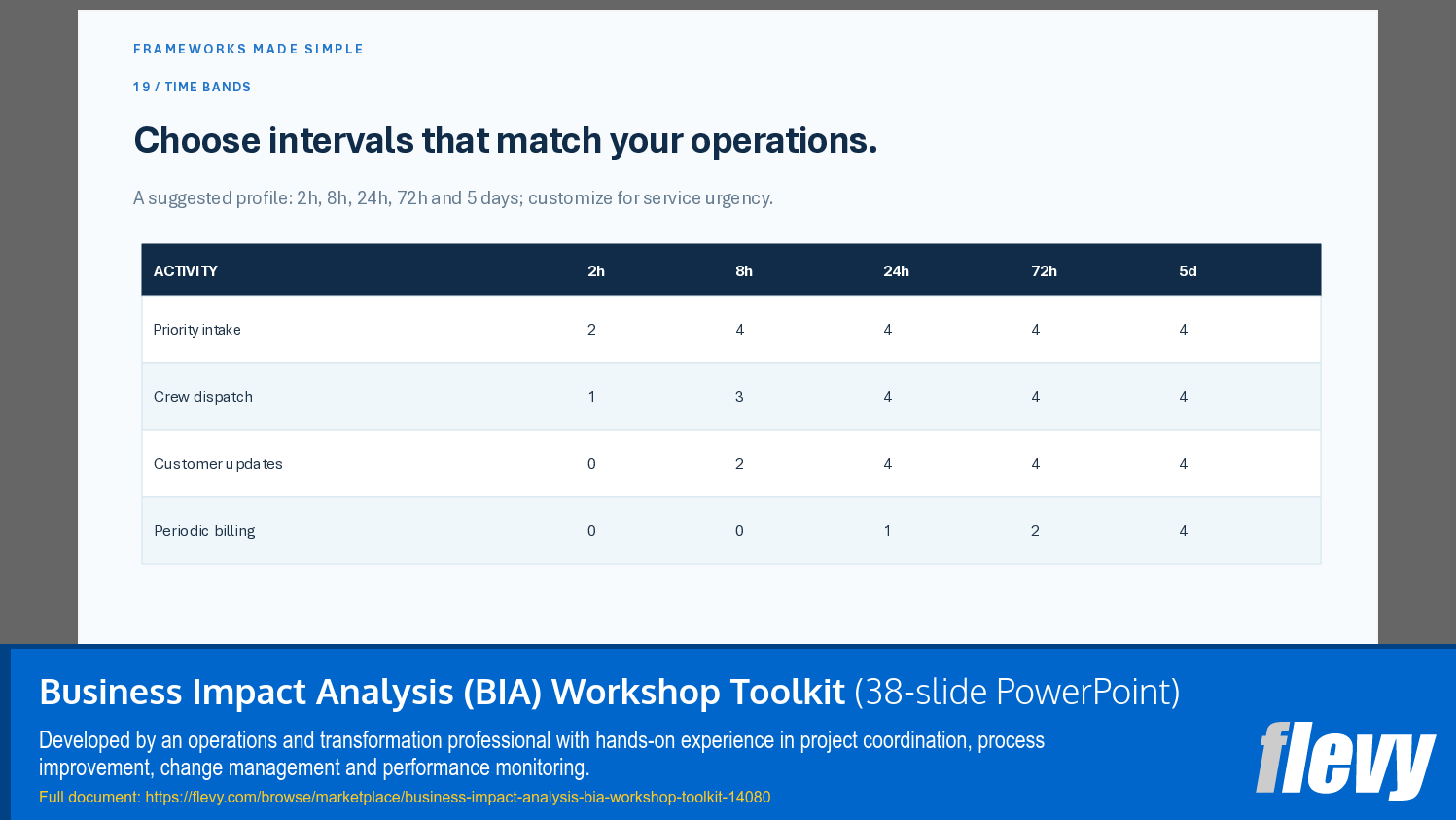
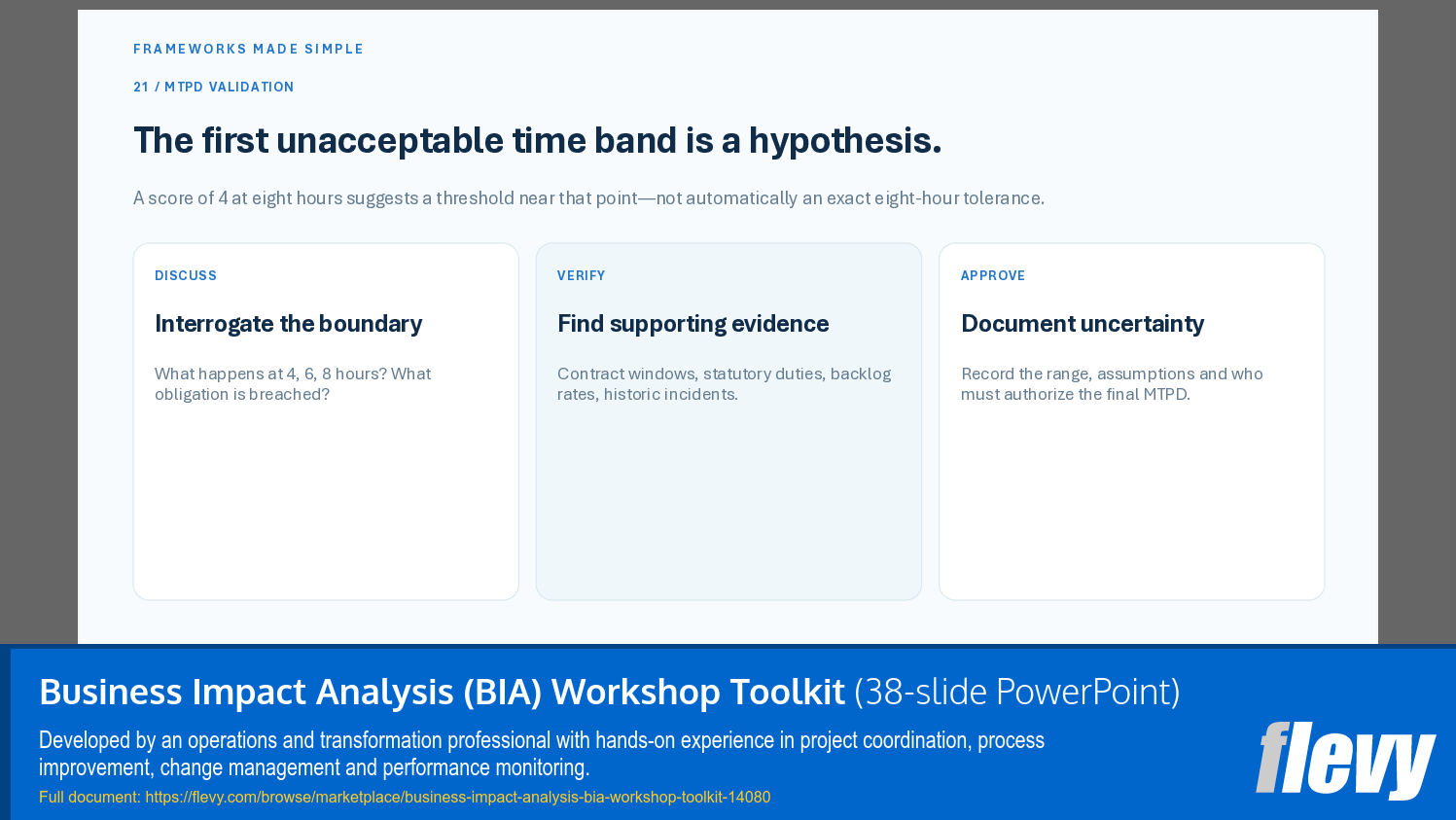
3. ASSESS – Profile financial and nonfinancial impact severity over selected time bands and record when adverse effects may become unacceptable.
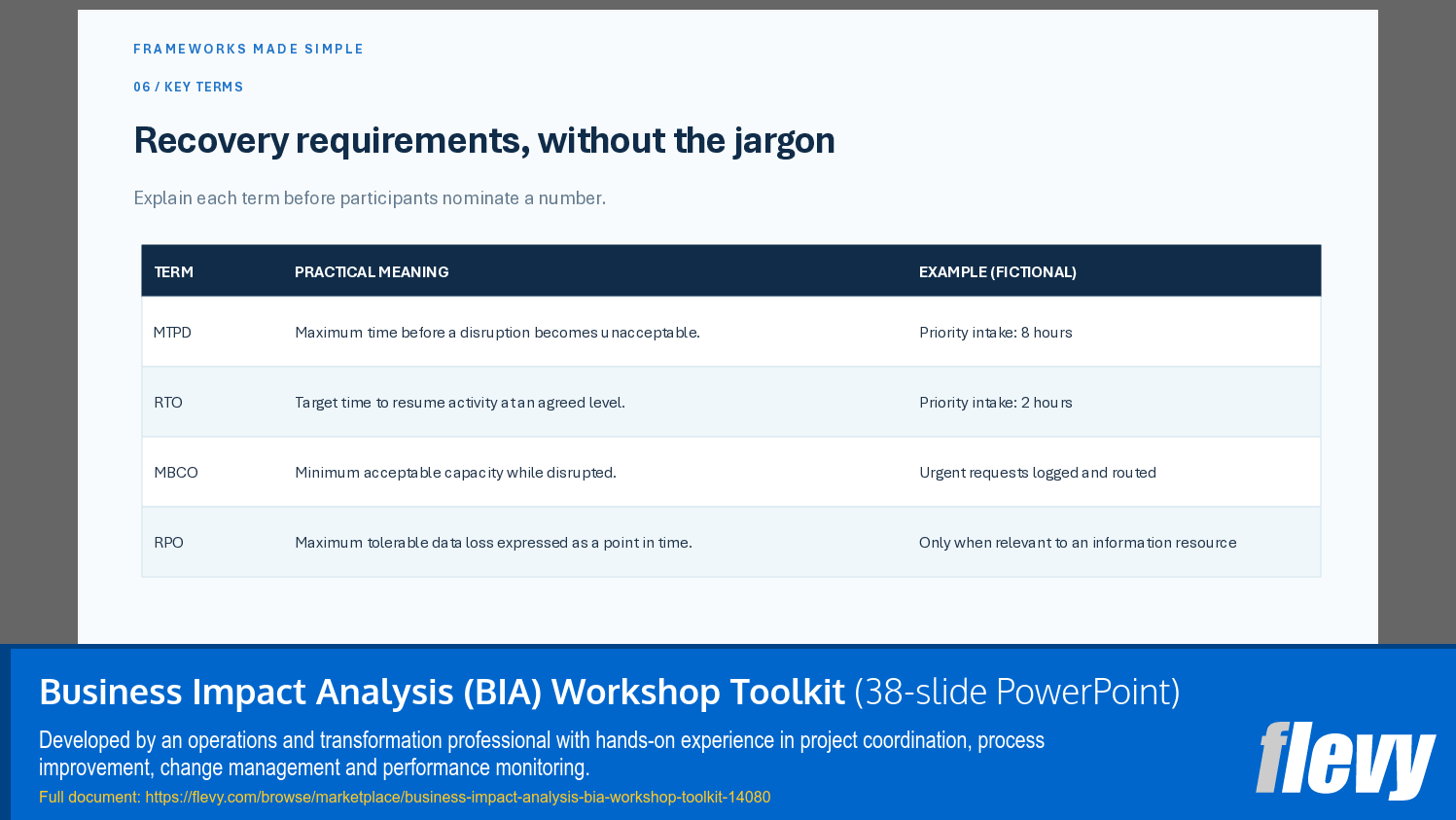
4. DEFINE – Propose and distinguish maximum tolerable period of disruption (MTPD), recovery time objective (RTO), minimum acceptable business continuity capacity and relevant data recovery requirements (RPO).
5. VALIDATE – Examine people, information, technology, facilities, external partners, workaround limits and single points of failure.
6. APPROVE – Consolidate proposed priorities, conflicts, evidence gaps and decisions into a management-ready summary.
WHAT IS INCLUDED
Primary Document – 38-Slide Editable PowerPoint Workshop
The main presentation covers the BIA process, time-based impact rating, key continuity concepts, recovery targets, activity interdependencies, business prioritization, fictional examples and post-workshop validation.
The companion ZIP includes four additional resources:
1. Editable BIA Canvases – 15 PowerPoint Slides
Seven blank working canvases (C01–C07), each accompanied by a completed fictional example, plus a navigation cover. All working elements are editable in PowerPoint.
The seven canvases are:
• Scope & Service Priorities.
• Activity Inventory.
• Time-Based Impact Profile.
• Recovery Requirements.
• Dependencies & Minimum Capacity.
• Priorities & Decisions.
• Executive BIA One-Page.
2. Facilitator Guide – 17-Page PDF
A practical guide containing a Start Here roadmap, workshop agenda, exact slide references, step-by-step facilitation questions, recovery terminology, validation guidance and conditions of use.
3. Printable BIA Canvases – 7-Page PDF
Landscape worksheets for paper-based workshops, interviews or collaborative exercises.
4. Stakeholder Interview Prompts – 3-Page PDF
A structured interview and evidence-gathering guide to confirm assumptions, impact assessments and unresolved recovery requirements after the workshop.
A fictional Northstar Field Services case illustrates how analysis can progress from service mapping to proposed recovery priorities. All ratings, thresholds and capacity examples are fictional educational material.
HOW TO USE THE TOOLKIT
Step 1 – Prepare the workshop using the Facilitator Guide, available service information and supporting evidence.
Step 2 – Run the suggested 90-minute workshop using the main PowerPoint presentation and seven editable or printable canvases.
Step 3 – Validate preliminary findings through interviews with activity owners and other relevant stakeholders.
Step 4 – Resolve evidence gaps, review feasibility constraints and submit recovery priorities for management approval.
Step 5 – Use the approved BIA findings to inform business continuity planning, recovery strategies and operational preparedness.
WHO SHOULD USE THIS TOOLKIT?
Operations managers and team leaders.
Business continuity and operational resilience professionals.
Risk managers and internal consultants.
Project managers overseeing business-critical implementations.
Department managers responsible for critical services.
Organizations developing or improving their business continuity planning practices.
PRACTICAL BENEFITS
This toolkit helps organizations move from subjective prioritization toward documented business requirements and defensible recovery decisions.
It promotes clear ownership, time-based impact analysis, visibility into operational dependencies and structured management approval.
Unlike generic BIA questionnaires, the toolkit explicitly distinguishes business recovery requirements from existing technical recovery capabilities.
No Excel file, coding skills or specialized business continuity platform is required.
IMPORTANT LIMITATIONS AND TERMS OF USE
This toolkit is an original independent educational and operational planning resource informed by general published guidance, including ISO/TS 22317:2021 and .
It does not provide certification, guarantee compliance with any standard or guarantee successful recovery from a disruption.
Frameworks Made Simple – Smart frameworks. Practical results.
Copyright © 2026 Martin Roy. All rights reserved.
The materials are original creations inspired by general professional practices. They do not reproduce proprietary documents, processes or tools belonging to any specific organization and are not affiliated with or endorsed by ISO, Flevy or any other organization.
Purchased materials may be adapted for personal or internal organizational use, subject to the applicable marketplace license. Resale, redistribution and standalone republication of the original or modified templates are prohibited.
The purchaser remains responsible for reviewing, adapting, approving and using the materials according to their operational, contractual, legal, safety and data-protection requirements. No specific outcomes are guaranteed.
Digital sales are final, subject to applicable law and Flevy's terms.
Got a question about the product? Email us at support@flevy.com or ask the author directly by using the "Ask the Author a Question" form. If you cannot view the preview above this document description, go here to view the large preview instead.
Source: Best Practices in BCP, Business Impact Analysis PowerPoint Slides: Business Impact Analysis (BIA) Workshop Toolkit PowerPoint (PPTX) Presentation Slide Deck, Frameworks Made Simple
ABOUT THE AUTHOR

Frameworks Made Simple creates practical, editable business tools that help managers and professionals turn established management frameworks into actionable results.
Created by Martin Roy, the brand draws on hands-on professional experience in operations, cross-functional project coordination, process improvement, organizational change and performance monitoring.
Our approach focuses on a
... [read more]
Ask the Author a Question
You must be logged in to contact the author.