
 Click main image to view in full screen. Unlock all 15 preview images:
Biochar Carbon Removal Financial Model - 20-Year Forecast – Excel XLSX
Excel (XLSX) + supplemental PDF


BENEFITS OF THIS DOWNLOADABLE EXCEL DOCUMENT
- Connect biomass inputs, pyrolysis yields, carbon removal eligibility and credit issuance across 240 monthly periods in one editable planning model.
- Analyze biochar, carbon credit and energy revenues alongside operating costs, project debt, DSCR and three linked financial statements.
- Compare five indicative economic scenarios, test carbon prices against feedstock costs and assess NPV, funding gaps and return limitations.
SUSTAINABILITY EXCEL DESCRIPTION
🌿 BIOCHAR CARBON REMOVAL FINANCIAL MODEL | 20-YEAR EDITION
Biomass Pyrolysis • Carbon Accounting • Credit Issuance • Project Finance • NPV & DSCR
FROM BIOMASS TO CARBON REMOVAL ECONOMICS.
How much saleable biochar can a facility produce? How many tonnes of CO₂ removal might qualify for credit issuance? When can those credits be delivered and monetized? And can project revenues cover operating expenses, equipment investment and debt service?
The Biochar Carbon Removal Financial Model by SheetworksStudio connects these questions within a structured, editable 20-year Excel financial planning system.
Designed for biochar developers, pyrolysis operators, carbon removal consultants, infrastructure analysts and project finance teams, the workbook links physical production, estimated carbon removal, commercial revenues and financing to long-term project economics.
The model contains 23 worksheets, 240 monthly forecast periods, 20 annual summaries, eight native Excel dashboard charts and five indicative scenario comparisons.
All supplied project data is fictional. The template is an independent planning tool, not a certified carbon removal methodology or an assured investment forecast.
📊 EXECUTIVE DASHBOARD | PHYSICAL AND FINANCIAL PERFORMANCE
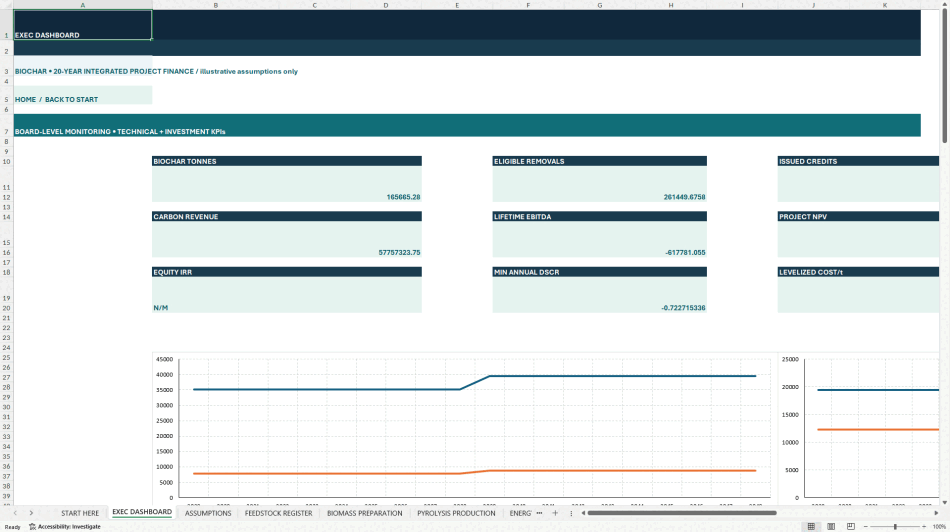
The executive dashboard combines twelve operating and financial KPI fields with eight native Excel charts.
Review biochar production, eligible CO₂ removals, carbon credit issuance and deliveries, carbon revenue, EBITDA, project returns, debt coverage and credit inventory.
Eight chart groups visualize:
• Biomass Input versus Biochar Production
• Gross versus Eligible Carbon Removal
• Credits Issued versus Delivered
• Revenue Composition
• Operating Cost Components
• EBITDA versus Project Free Cash Flow
• Debt Balances and Debt Service Coverage
• Indicative Scenario NPV Comparison
The dashboard helps users trace how changes in operating assumptions affect carbon removal quantities and financial performance.
⚙️ 01 | FEEDSTOCK SUPPLY AND BIOMASS PREPARATION
Analyze the relationship between wet biomass feedstock, moisture content, dry feedstock and available processing capacity.
Editable assumptions include:
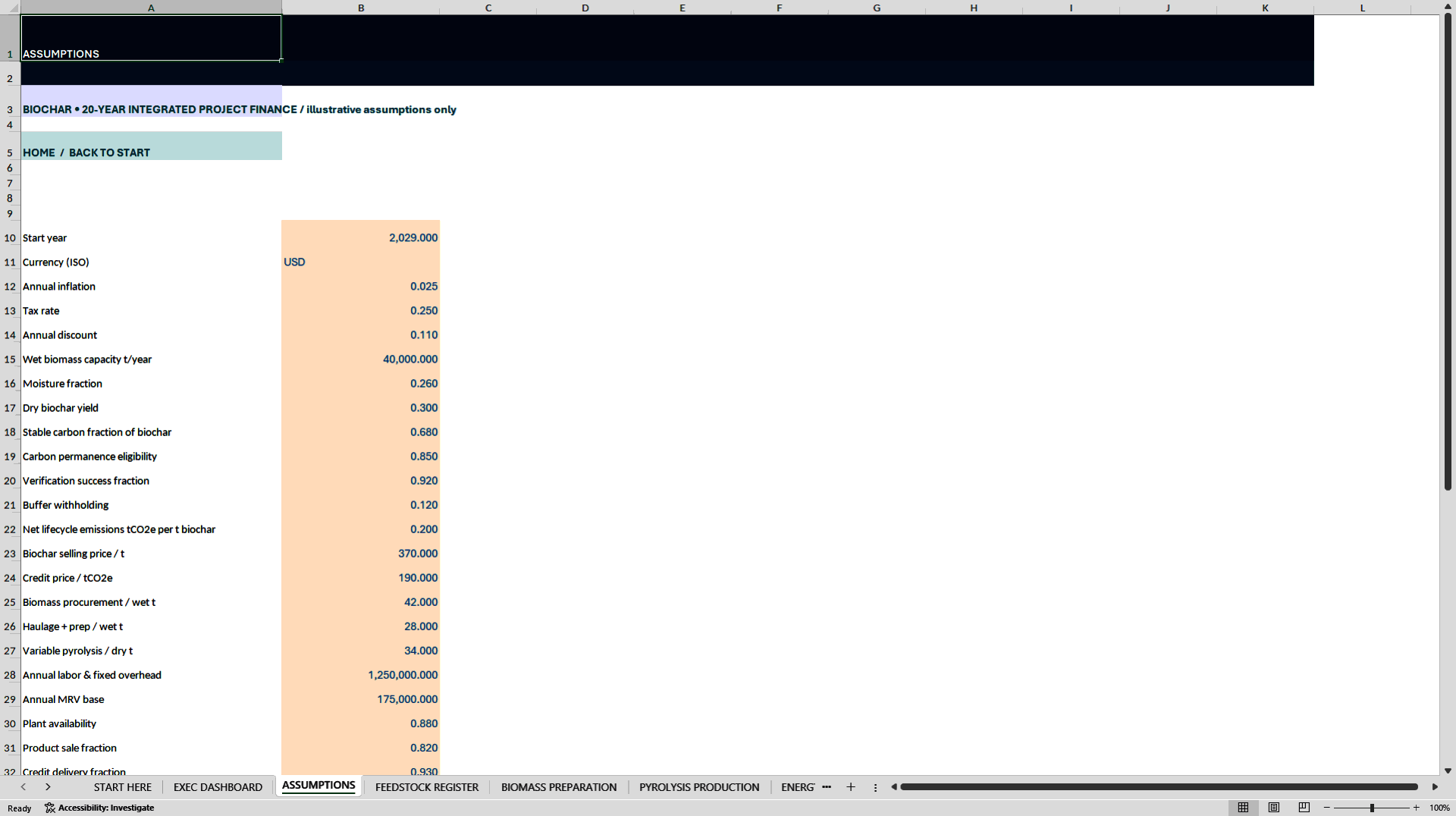
• Annual wet biomass processing capacity
• Moisture content
• Plant availability
• Feedstock procurement costs
• Transportation and preparation expenses
• Processing costs and operating conditions
The production schedule translates physical input assumptions into dry biomass quantities available for pyrolysis.
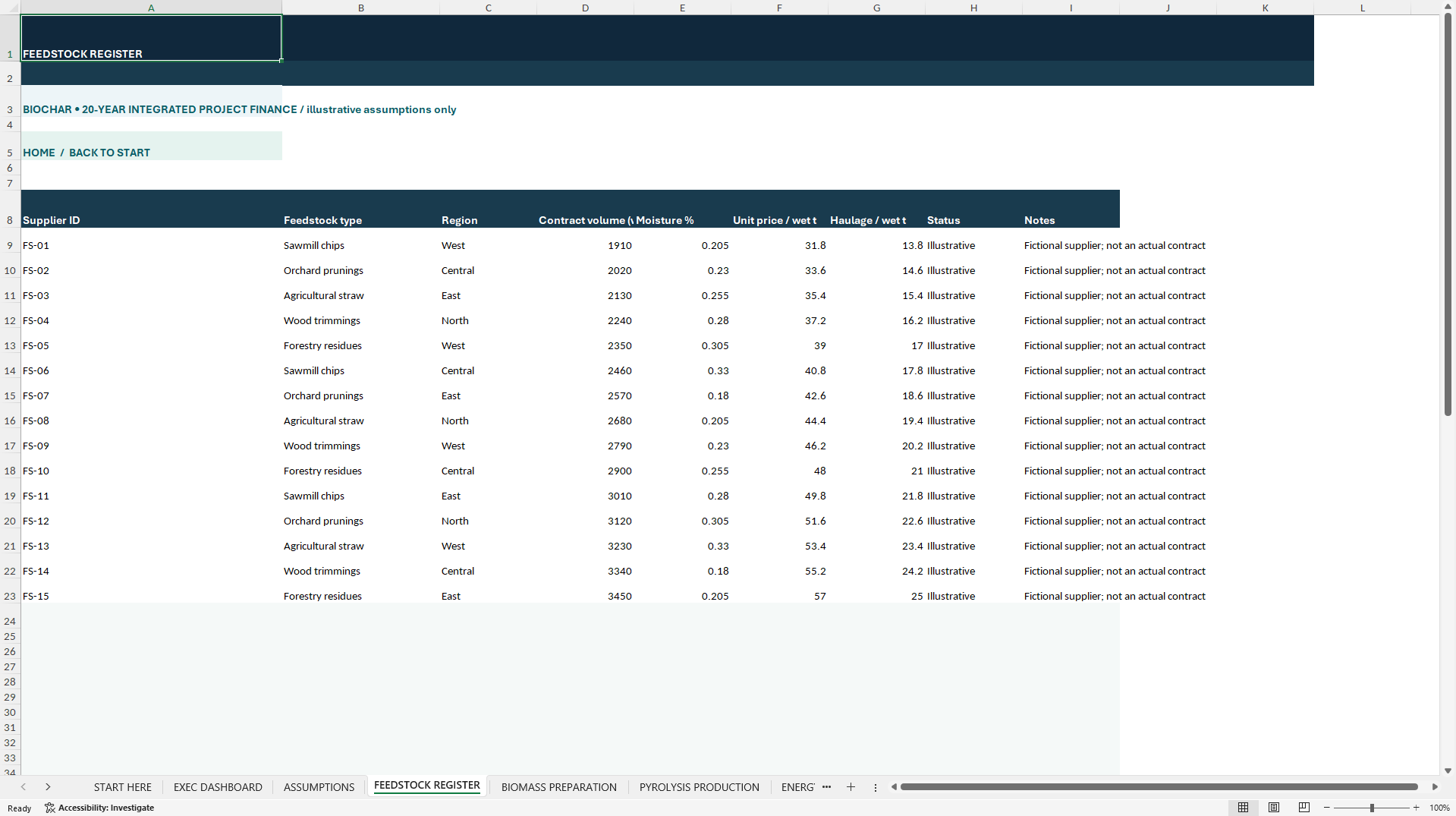
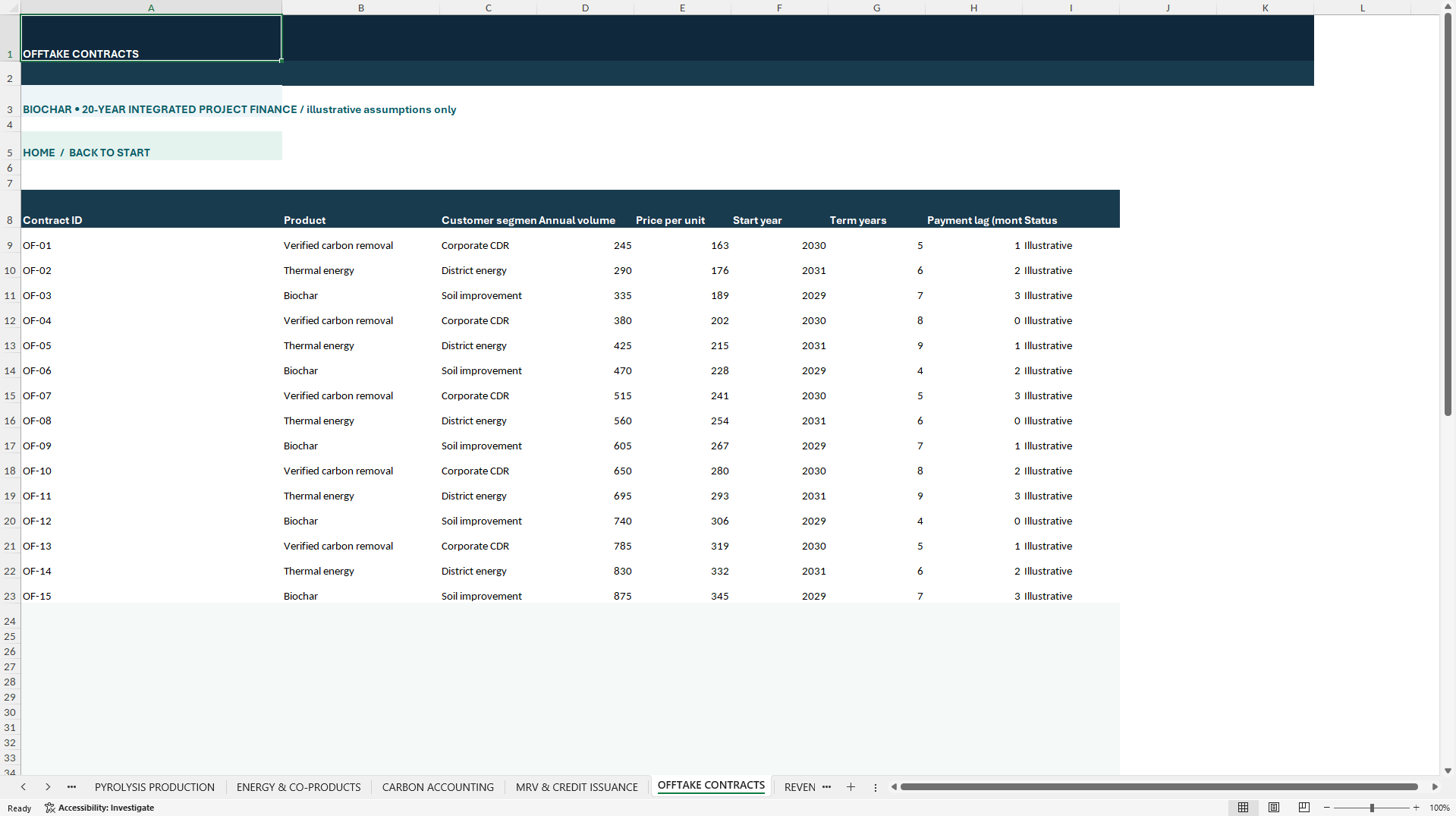
The workbook includes illustrative feedstock records for planning and documentation. However, the central operating assumptions drive the principal production calculations.
It is not a contract-by-contract procurement optimization system.
🏭 02 | PYROLYSIS PRODUCTION AND BIOCHAR ECONOMICS
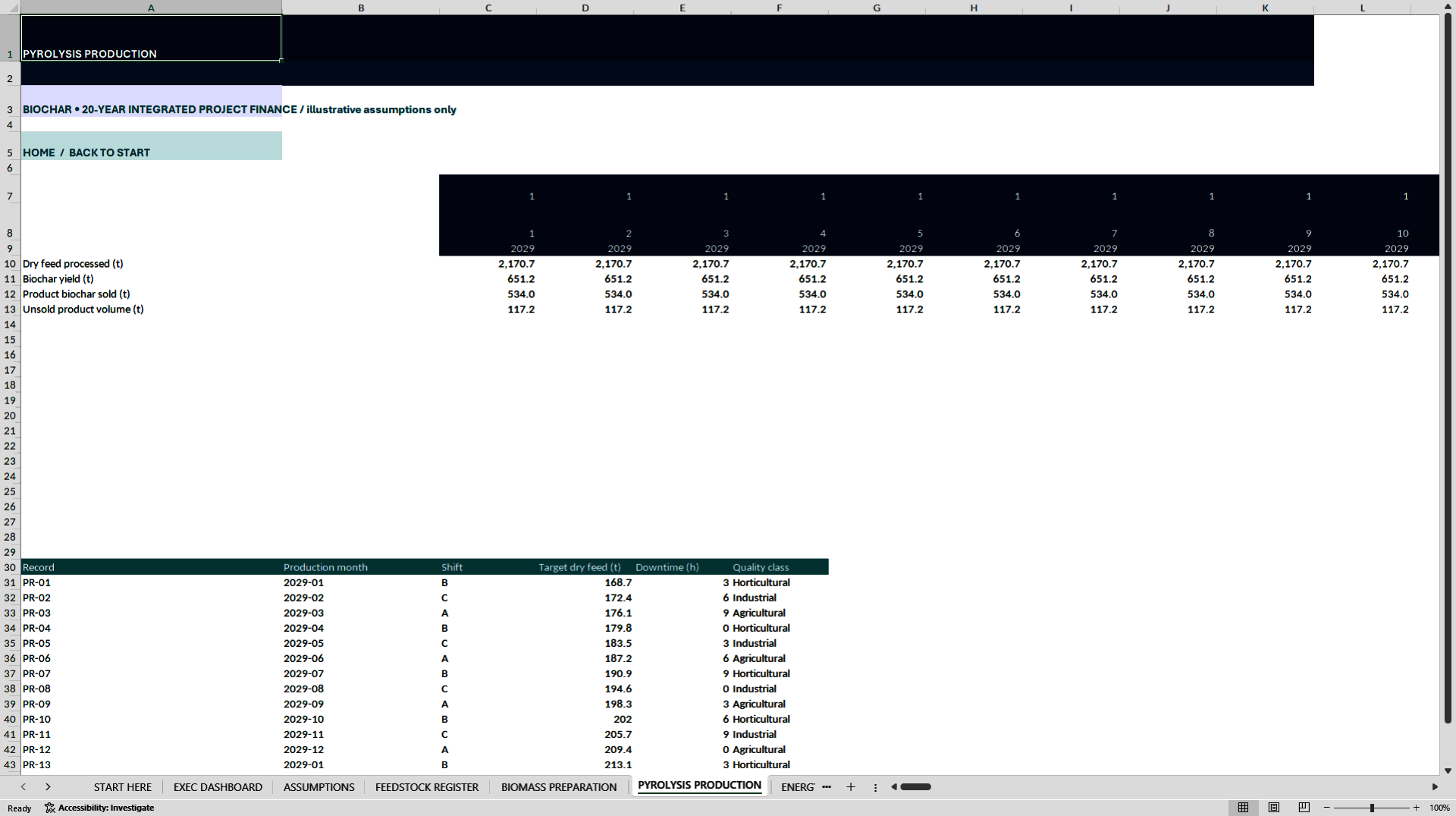
Model the conversion of prepared dry feedstock into biochar through editable production-yield assumptions.
Review biochar output, saleable production, product delivery assumptions, selling prices and estimated commercial revenue.
The model supports illustrative capacity expansion and equipment renewal assumptions within the 20-year forecast.
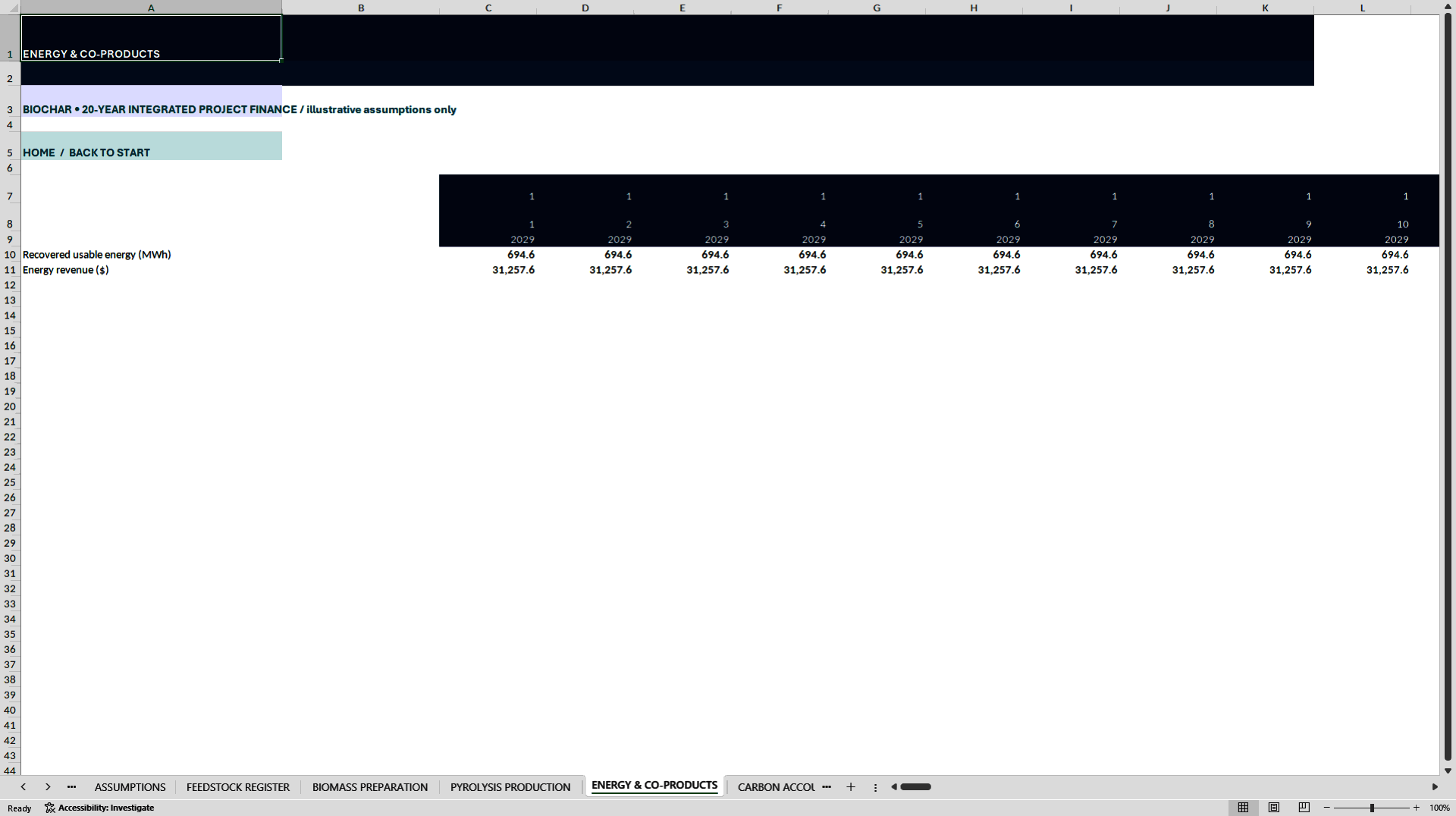
Energy recovery is modeled separately from biochar sales, allowing users to distinguish potential energy revenue from the primary biochar and carbon removal businesses.
These calculations are financial planning estimates, not certified process engineering results.
🌍 03 | CARBON REMOVAL ACCOUNTING
A dedicated CARBON ACCOUNTING worksheet connects biochar production to estimated stable carbon and CO₂-equivalent removal quantities.
Edit assumptions covering:
• Stable carbon fraction
• Carbon permanence eligibility
• Lifecycle emissions deductions
• Verification success
• Buffer withholding
• Additional carbon eligibility factors
The workbook distinguishes gross estimated sequestration from eligible removal quantities.
This separation is important because biochar production volume and marketable carbon removal credits are not interchangeable.
Actual carbon removal eligibility, lifecycle calculations and permanence requirements depend on the applicable methodology and independent verification.
🧾 04 | MRV, CARBON CREDIT ISSUANCE AND DELIVERY
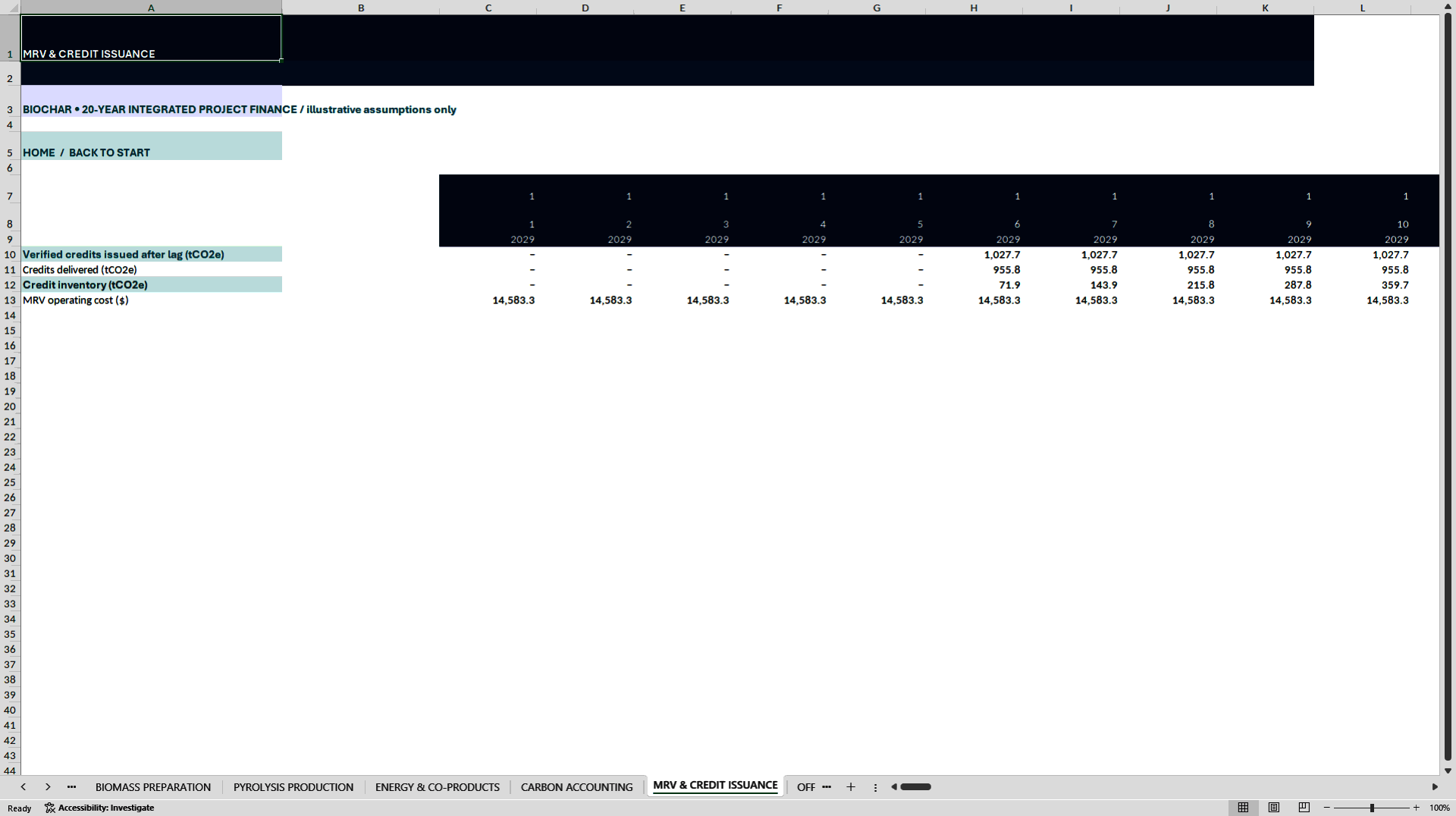
The MRV & CREDIT ISSUANCE schedule tracks the progression from estimated eligible removals to issued and commercially delivered credits.
Model verification assumptions, issuance delays, delivery fractions and remaining credit inventory.
The financial model distinguishes physical removal estimates, modeled credit issuance and credited quantities delivered for revenue recognition.
Credit quantities are illustrative and do not represent actual registry-issued instruments.
The workbook does not connect to a carbon registry or independently verify issued credits.
💰 05 | THREE COMMERCIAL REVENUE STREAMS
Analyze the contribution of three potential revenue sources:
BIOCHAR SALES
Revenue generated from modeled biochar deliveries and editable product selling prices.
CARBON CREDIT SALES
Revenue associated with modeled credit deliveries, realized carbon credit prices and illustrative annual price escalation.
ENERGY RECOVERY
Revenue associated with estimated recoverable energy and commercial energy pricing.
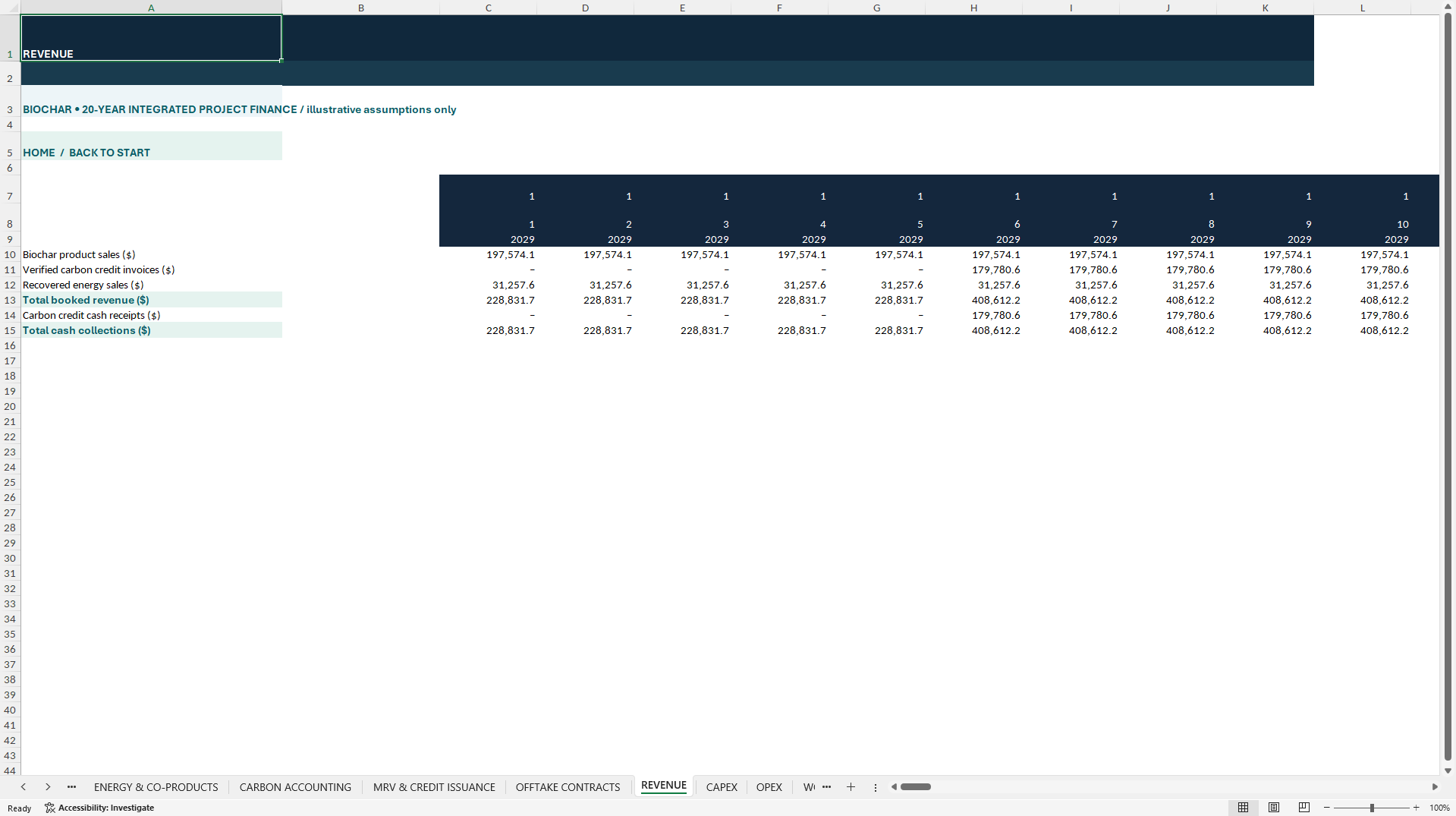
A dedicated REVENUE worksheet consolidates these modeled income streams.
The model allows users to examine the commercial importance of carbon credit prices relative to biochar and energy revenues.
📉 06 | OPERATING EXPENSES, CAPEX AND WORKING CAPITAL
Operating costs include feedstock procurement, transportation, processing, personnel, fixed overhead and monitoring, reporting and verification expenses.
Separate schedules support construction expenditure, equipment renewal, depreciation and simplified working capital requirements.
Review how these costs affect annual EBITDA, free cash flow, closing cash and long-term project economics.
The model does not assume that revenue automatically covers operating costs or investment requirements.
🏦 07 | PROJECT DEBT, EQUITY AND FINANCING
The financing schedules connect sponsor capital and modeled project borrowing to investment and debt repayment assumptions.
Review:
• Initial project capital expenditure
• Sponsor equity financing
• Project debt
• Interest costs
• Scheduled principal repayments
• Closing loan balances
• Annual debt service coverage
Debt Service Coverage Ratio (DSCR) helps compare modeled cash available for debt service with scheduled financing obligations.
The calculation is simplified and may differ from lender-specific contractual definitions.
The workbook does not automatically raise additional equity or debt to eliminate funding shortfalls.
📑 08 | THREE CONNECTED FINANCIAL STATEMENTS
The 240-month forecast includes linked financial statements.
PROFIT & LOSS
Review revenues, operating expenses, EBITDA, depreciation, financing costs, taxes and modeled earnings.
CASH FLOW
Trace operating cash generation, capital expenditure, financing movements, debt repayments and closing liquidity.
BALANCE SHEET
Monitor modeled assets, cash, liabilities, debt and sponsor equity.
A VALUATION worksheet consolidates operating and financial results into twenty annual periods.
🔀 09 | FIVE INDICATIVE SCENARIOS
The SCENARIOS worksheet presents five planning cases:
BASE – Central illustrative project assumptions.
UPSIDE – More favorable biochar and credit prices, production yield and operating conditions.
DOWNSIDE – Weaker sales prices, increased feedstock costs and reduced project performance.
CREDIT PRICE COLLAPSE – Significant reduction in carbon credit pricing.
FEEDSTOCK SHORTAGE – Lower biomass availability, increased feedstock costs and reduced production.
Scenario comparisons estimate the effects of selected economic drivers on project value and EBITDA.
IMPORTANT: These five scenario comparisons are simplified economic calculations. They do not independently rerun five complete sets of monthly financial statements.
📈 10 | PROJECT VALUATION AND SENSITIVITY
The VALUATION worksheet includes Project NPV, annualized return indicators, cash-flow analysis, debt service coverage, project payback status and levelized carbon removal costs.
A separate 5 × 5 sensitivity grid estimates how variations in carbon credit prices and feedstock costs affect indicative Project NPV.
The model uses annual year-end discounting conventions for its project valuation.
When an economically meaningful IRR cannot be calculated, the workbook displays N/M instead of presenting a misleading investment-return percentage.
⚠️ 11 | TRANSPARENT FUNDING WARNINGS
The fictional Base Case is deliberately not presented as a commercially viable project.
Under its supplied demonstration assumptions:
• Project NPV is approximately negative USD 18.45 million.
• Lifetime EBITDA is approximately negative USD 0.62 million.
• Negative monthly cash balances occur throughout the 240-month forecast.
• Project and Equity IRR are displayed as N/M.
• Project payback is not achieved.
These results highlight the importance of independently reviewing carbon credit pricing, operating margins, capital spending and financing requirements.
The model does not automatically disguise these outcomes through artificial funding assumptions.
✅ 12 | MODEL CHECKS AND FINANCIAL INTEGRITY
The MODEL CHECKS worksheet reviews key internal relationships, including biomass accounting, biochar output, carbon credit inventory, debt balances, financial statements and EBITDA arithmetic.
Economic warnings are presented separately from numerical reconciliation tests.
A reconciliation PASS confirms that specified internal relationships agree within their calculation tolerances.
It does not establish engineering feasibility, credit eligibility, commercial viability or financing approval.
📦 WHAT YOU RECEIVE
PRIMARY DOCUMENT – EDITABLE EXCEL MODEL
• 23 connected worksheets
• 240 monthly periods
• 20 annual summaries
• 12 executive KPI fields
• 8 native Excel charts
• Feedstock and pyrolysis production calculations
• Carbon accounting and modeled credit issuance
• Biochar, carbon credit and energy revenue schedules
• CAPEX, OPEX, working capital and financing
• Three financial statements
• Project NPV, DSCR and return-status analysis
• Five indicative scenarios
• 5 × 5 sensitivity matrix
• Integrated model checks and navigation
SUPPLEMENTARY DOCUMENT – PROFESSIONAL PDF GUIDE
A 25-page English How-to-Use guide explaining workbook setup, inputs, feedstock, pyrolysis, carbon removal assumptions, credit timing, revenue, financing, financial reporting, valuation, sensitivities, dashboard interpretation and troubleshooting.
🧭 HOW TO GET STARTED
1. Save a separate project copy.
2. Open START HERE and review the guide.
3. Customize project inputs in ASSUMPTIONS.
4. Examine biomass preparation and pyrolysis production.
5. Review CARBON ACCOUNTING and MRV & CREDIT ISSUANCE.
6. Adjust operating costs, capital investment and financing.
7. Review the financial statements and VALUATION.
8. Compare indicative scenarios and sensitivity results.
9. Investigate MODEL CHECKS and funding warnings before drawing conclusions.
👥 WHO THIS MODEL IS FOR
• Biochar project developers
• Biomass processing businesses
• Pyrolysis plant operators
• Carbon removal project analysts
• Carbon market consultants
• Infrastructure finance professionals
• Sustainability and climate technology teams
• Financial modeling educators
⚙️ TECHNICAL SPECIFICATIONS
Format: Editable Microsoft Excel XLSX.
Forecast: 240 monthly periods and 20 annual summaries.
Illustrative timeline: 2029–2048.
Macro-free: No VBA or required live external data connections.
Recommended software: Microsoft Excel Desktop.
The currency label does not perform foreign-exchange conversion.
A complete Microsoft Excel Desktop recalculation and Google Sheets import test has not been independently completed.
This model is not a certified lifecycle assessment, carbon registry platform, engineering design package or lender-approved financial model.
🛡️ INDEPENDENT TEMPLATE DISCLAIMER
This is an independent, unofficial financial planning template developed by SheetworksStudio.
All example project data, credit quantities, assumptions and results are fictional and illustrative.
The workbook is not audited, certified, registry-approved, regulator-approved, bank-approved or endorsed by any carbon standard, financial institution or software provider.
The model does not guarantee carbon credit eligibility, verification, permanence, financing, profitability or investment returns.
Users are responsible for obtaining qualified technical, environmental, financial, tax and legal review before relying on its results.
This template does not provide individualized investment, financial, engineering, environmental certification, tax or legal advice.
Digital product only. No physical goods are supplied.
Bring biomass production, carbon removal assumptions and long-term project finance into one transparent Excel planning framework.
Got a question about the product? Email us at support@flevy.com or ask the author directly by using the "Ask the Author a Question" form. If you cannot view the preview above this document description, go here to view the large preview instead.
Source: Best Practices in Sustainability, Integrated Financial Model Excel: Biochar Carbon Removal Financial Model - 20-Year Forecast Excel (XLSX) Spreadsheet, SheetworksStudio
ABOUT THE AUTHOR

SheetworksStudio creates premium Excel-based business templates, dashboards, trackers, financial models, and management systems for professionals, consultants, entrepreneurs, and organizations.
Our portfolio covers finance, project management, operations, risk management, compliance, AI governance, HR, supply chain, performance management, and business planning. Each product is designed to
... [read more]
Ask the Author a Question
You must be logged in to contact the author.