
 Click main image to view in full screen. Unlock all 17 preview images:
Autonomous Vehicle Robotaxi Fleet Operations Model – Excel XLSX
Excel (XLSX) + supplemental PDF


BENEFITS OF THIS DOWNLOADABLE EXCEL DOCUMENT
- Provides a structured framework for modeling autonomous vehicle and robotaxi fleet economics across revenue per mile, utilization, geofence expansion, insurance and liability.
- Helps users evaluate safety driver phase-out savings against fallback infrastructure investment and teleoperation cost.
- Supports better investment and operating decisions through business model toggles, collision sensitivity, reserve analysis, dashboards and valuation outputs.
TRANSPORTATION EXCEL DESCRIPTION
🚘 Autonomous Vehicle Robotaxi Fleet Operations Model is a professional financial planning workbook built for autonomous vehicle companies, robotaxi operators, mobility platforms, fleet investors, hard-tech startups, strategic finance teams and transportation analysts.
Robotaxi operations are not the same as traditional taxi fleets, ride-hailing platforms, logistics fleets or automotive manufacturing.
A robotaxi financial model must evaluate:
Revenue per autonomous mile
Teleoperated mile economics
Safety driver phase-out
Fallback infrastructure investment
Geofence ODD expansion
Weather and city-specific deployment cost
Revenue miles versus deadhead miles
Fleet utilization
Insurance premium by autonomy level
Software licensing versus fleet ownership
Robotaxi-as-a-service economics
Collision liability exposure
Reserve requirement sensitivity
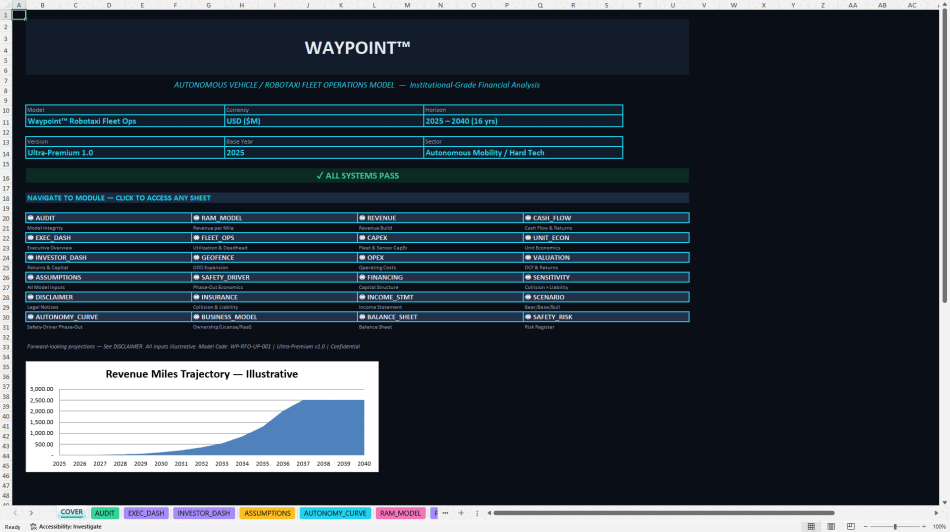
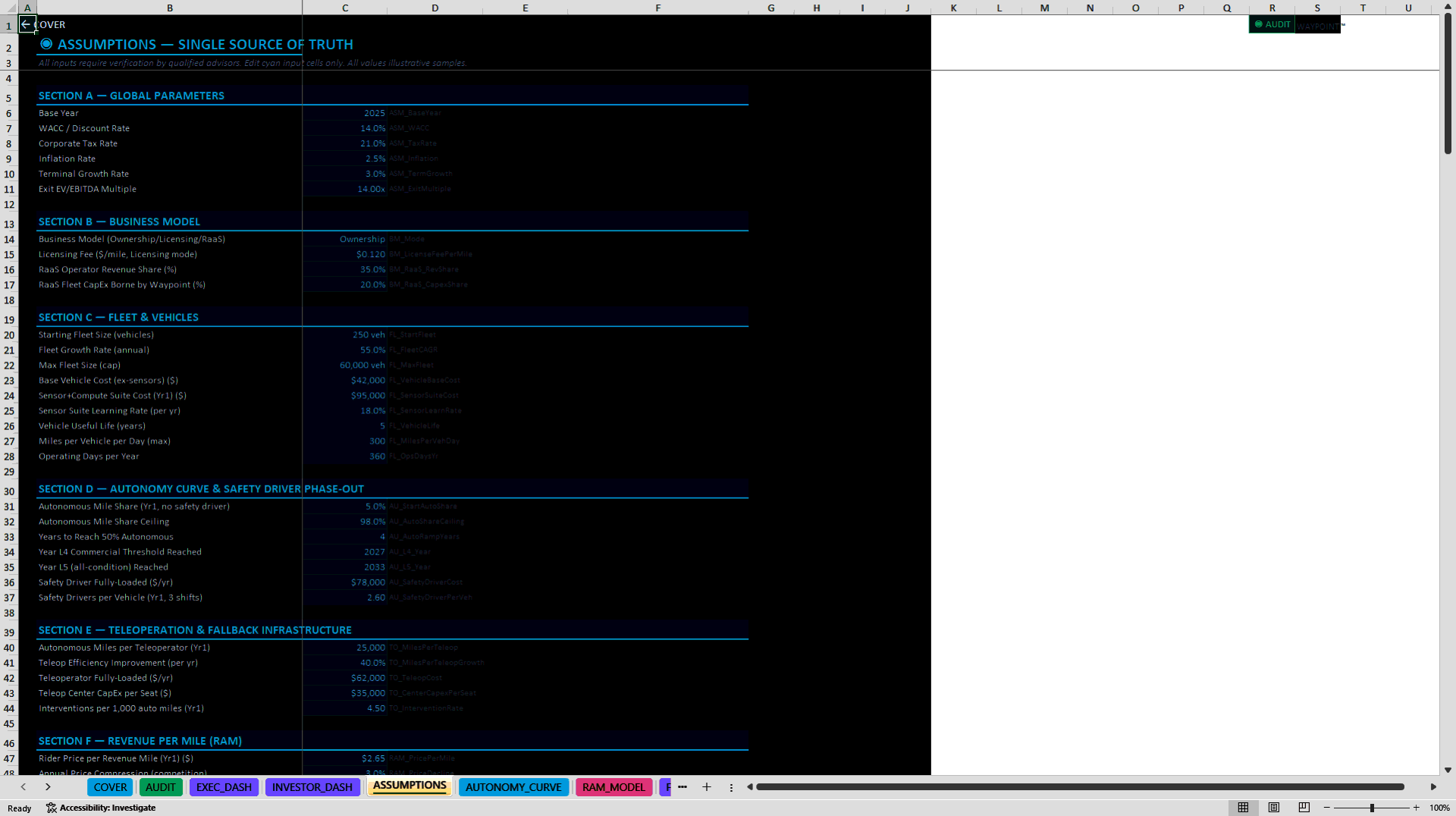
This workbook brings those operating and financial drivers into one structured model.
What the Model Covers
The model includes:
✅ Revenue per autonomous mile
✅ Teleoperated mile revenue and cost
✅ L3, L4 and L5 autonomy assumptions
✅ Safety driver phase-out timeline
✅ Driver cost savings analysis
✅ Fallback infrastructure investment
✅ Geofence ODD expansion cost
✅ City and weather-specific expansion assumptions
✅ Fleet utilization model
✅ Revenue miles vs deadhead miles
✅ Dead mileage cost
✅ Per-vehicle insurance premium by autonomy level
✅ Software licensing scenario
✅ Fleet ownership scenario
✅ Robotaxi-as-a-service scenario
✅ Collision rate sensitivity
✅ Liability exposure sensitivity
✅ Reserve requirement analysis
✅ Fleet P&L
✅ Cash flow forecast
✅ Valuation outputs
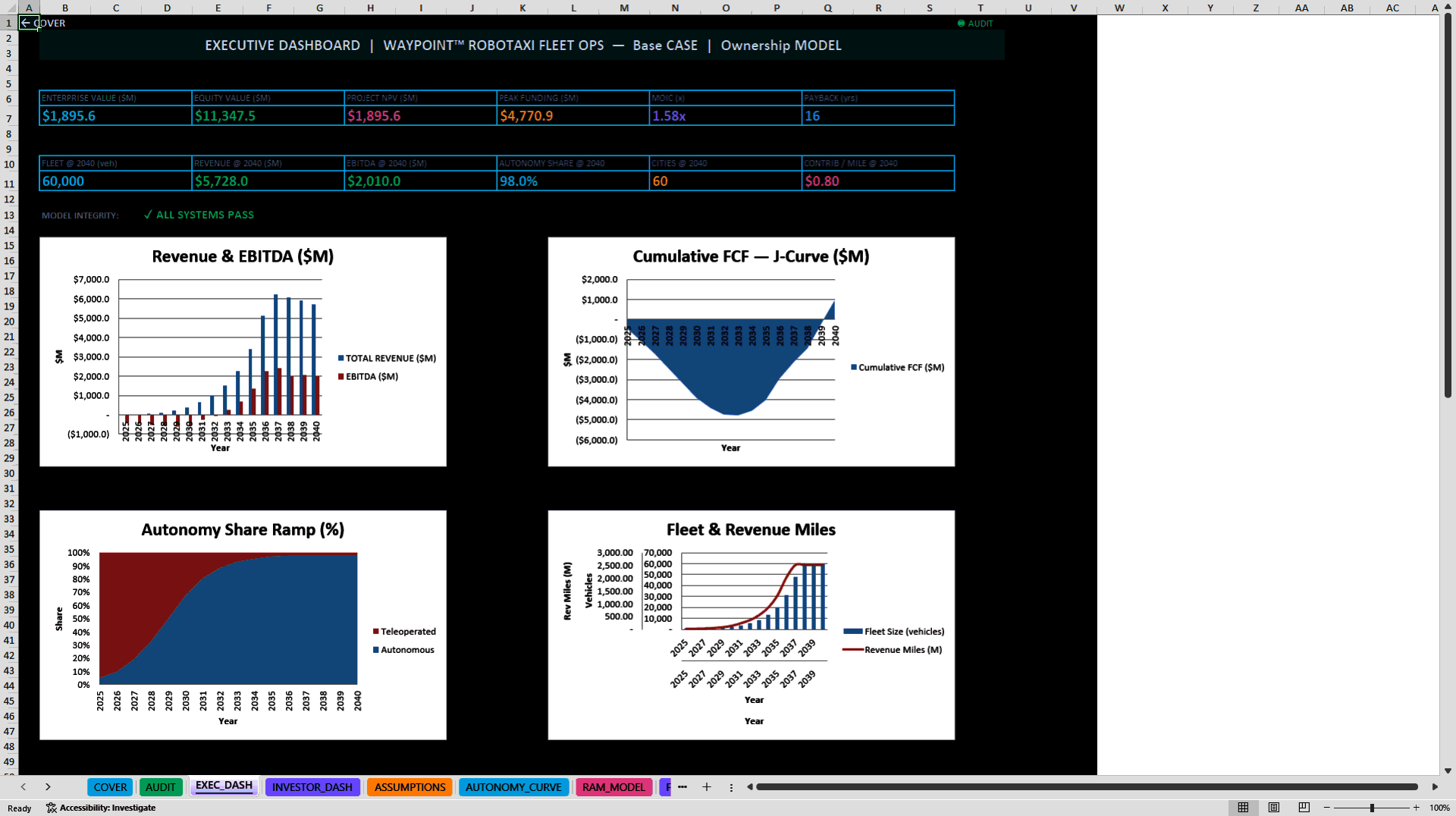
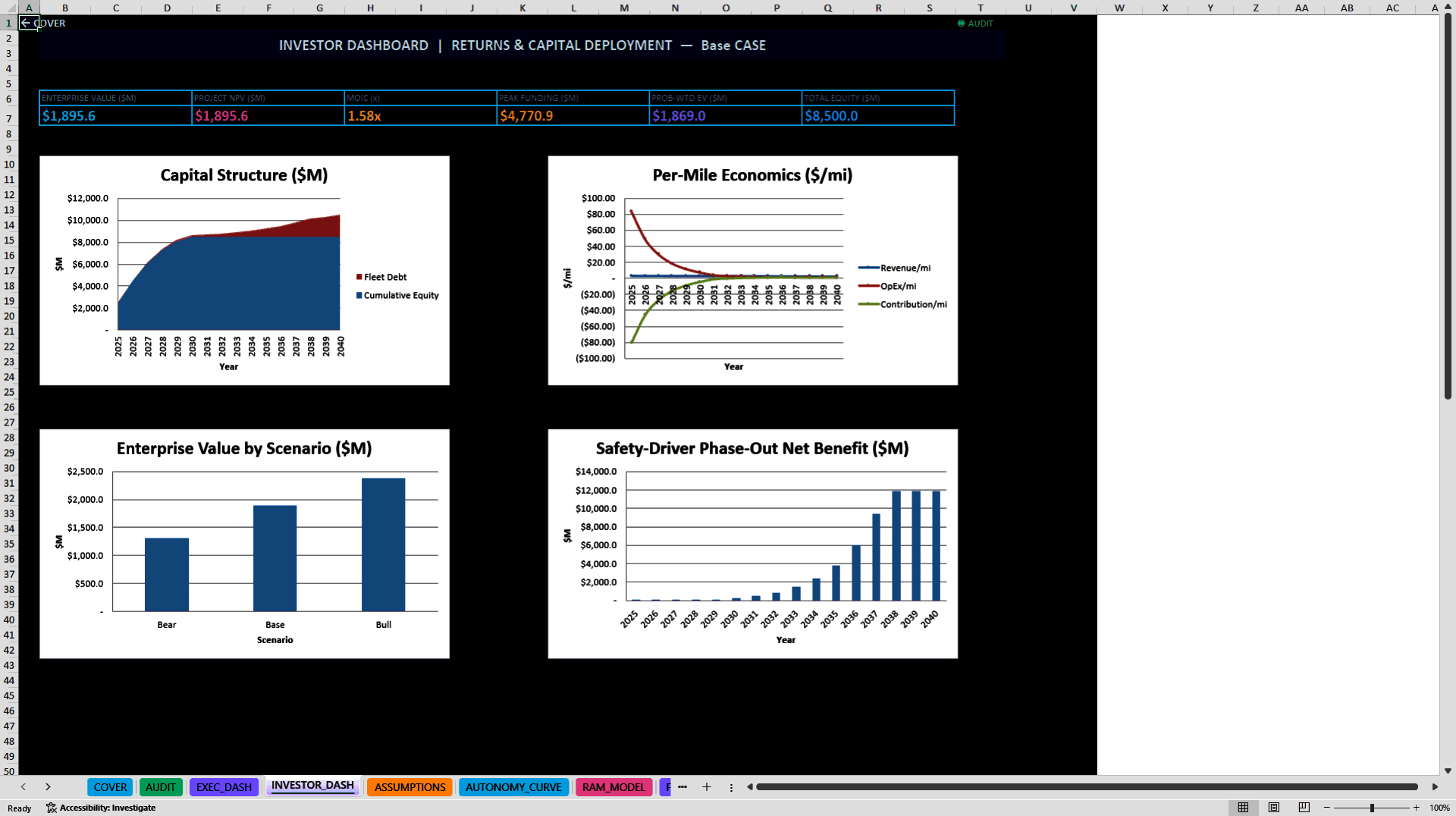
✅ Dashboards, KPIs and audit checks
The model is designed to help users evaluate whether an autonomous vehicle fleet can scale profitably under different operating, autonomy and risk scenarios.
Revenue per Autonomous Mile
🚗 The model includes a revenue per autonomous mile framework.
Users can analyze:
Revenue per autonomous mile
Revenue per teleoperated mile
Autonomous mile mix
Teleoperated mile mix
Yield per mile
Autonomy-level impact
Pricing and revenue sensitivity
This is important because robotaxi operators do not generate revenue only from trips. Their economics depend on mile-level performance, autonomy capability, utilization and operating support requirements.
Safety Driver Phase-Out and Fallback Infrastructure
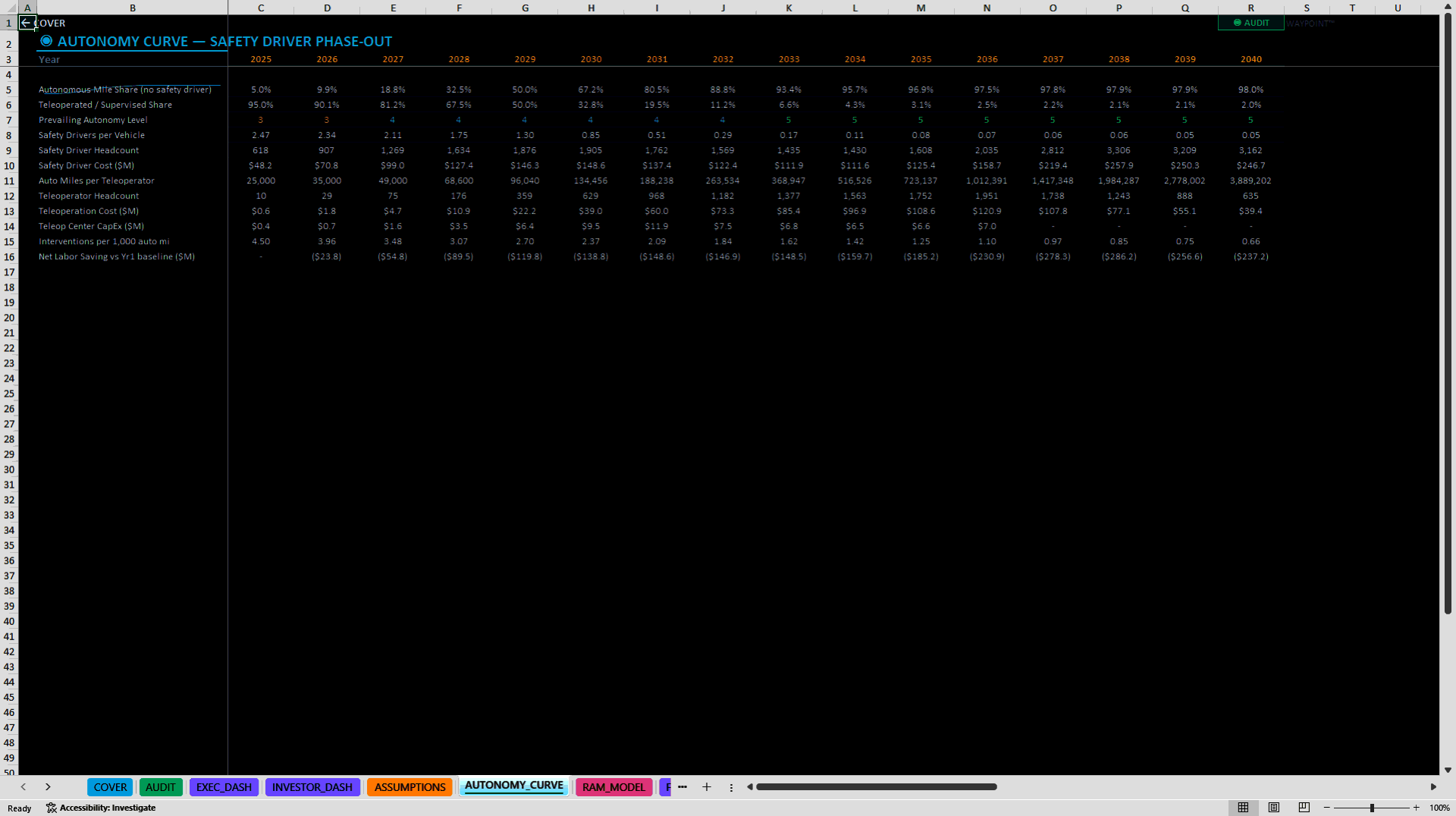
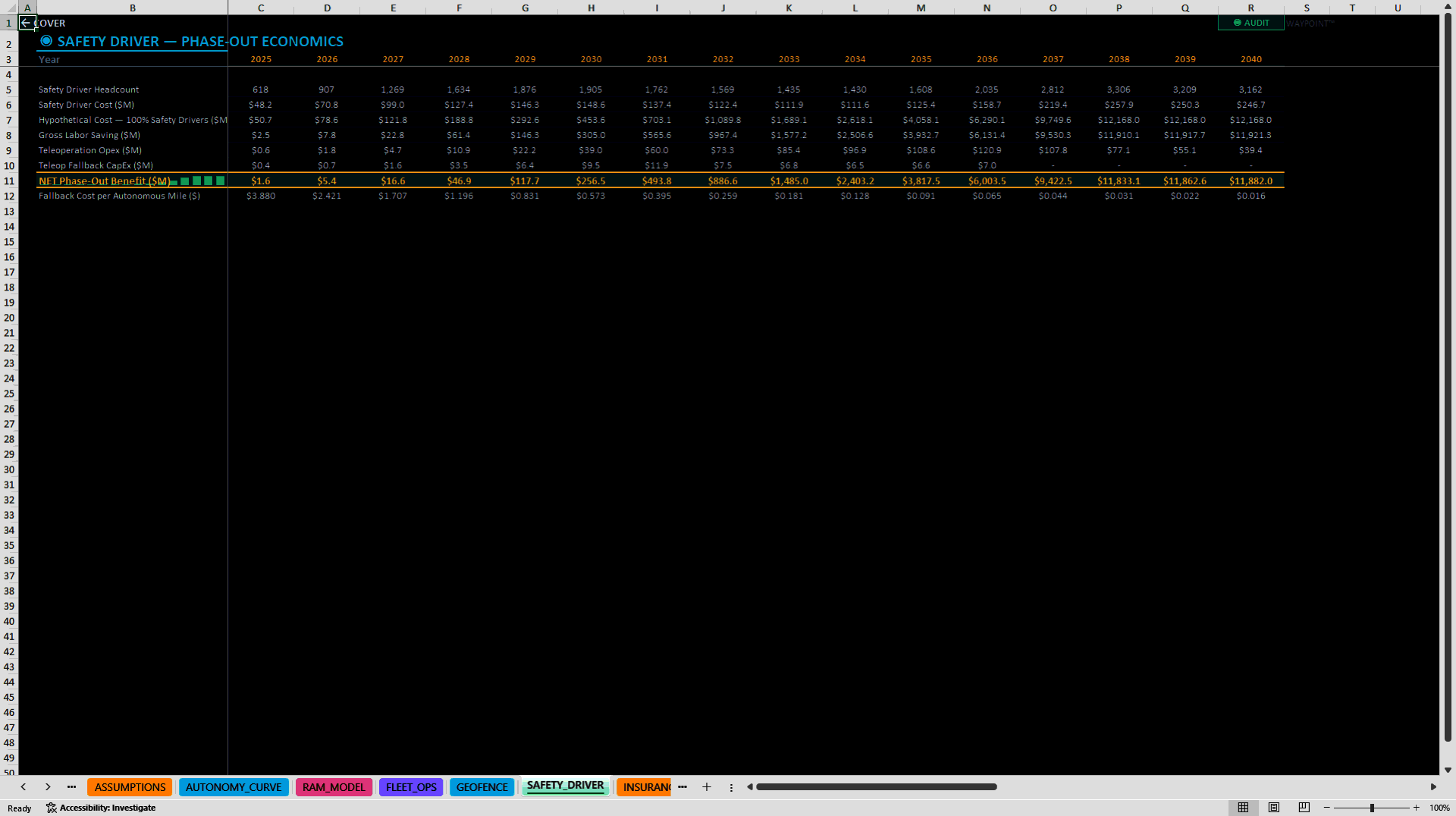
👨✈️ A key section of the workbook evaluates the safety driver phase-out timeline.
The model compares:
Safety driver cost savings
Remaining support cost
Fallback infrastructure investment
Remote assistance requirements
Operating margin improvement
Transition timing
This helps users understand when autonomy reduces cost and when new infrastructure investment offsets those savings.
Geofence ODD Expansion
🗺️ Autonomous fleets usually begin in controlled operating zones before expanding into more complex cities and weather environments.
The model includes geofence expansion cost by:
City
Operating zone
Weather type
Mapping requirement
Validation requirement
Expansion phase
ODD complexity
This helps users evaluate the cost of entering new markets and scaling beyond limited launch zones.
Fleet Utilization and Deadhead Miles
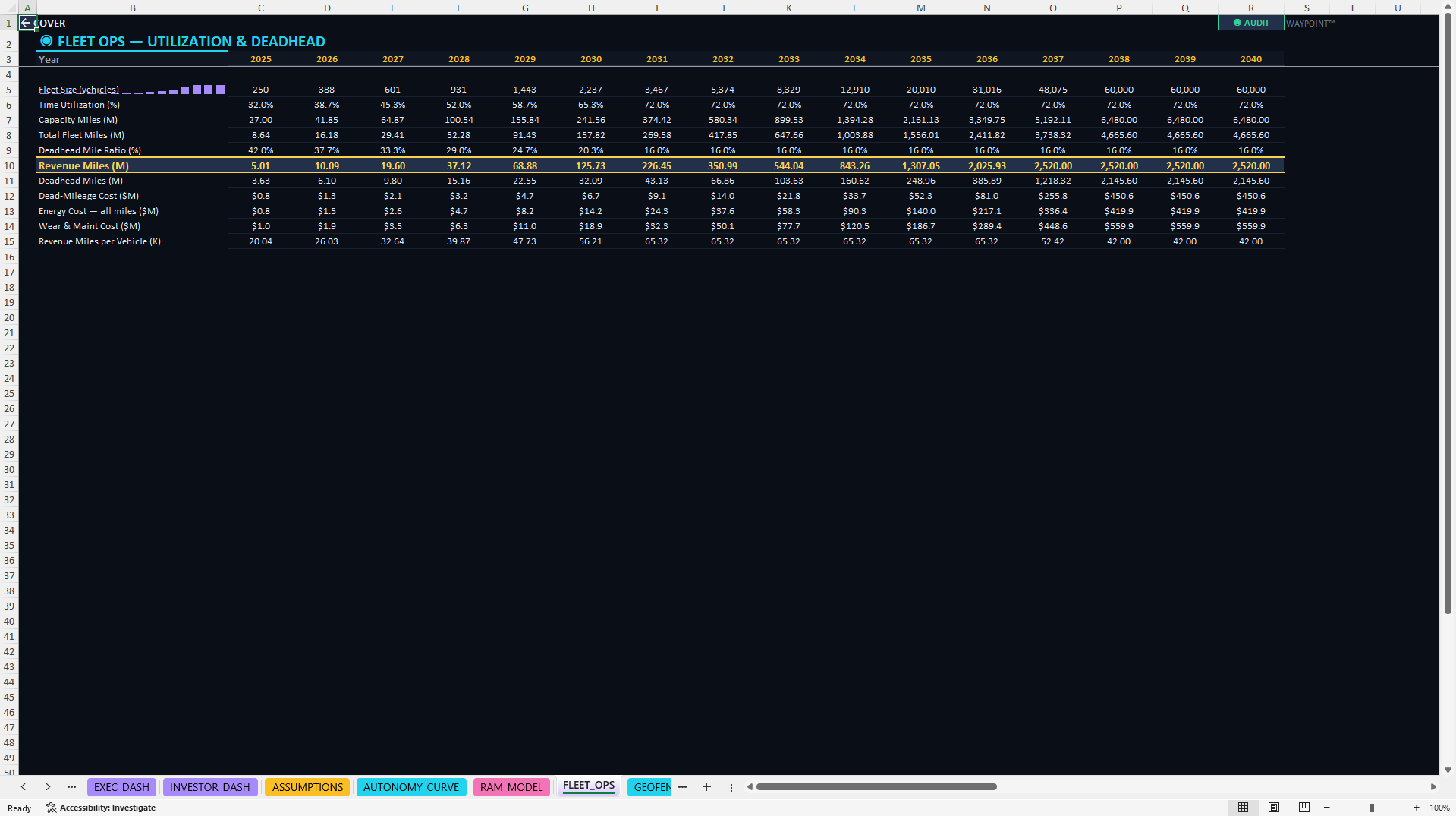
⚙️ The model includes a fleet utilization engine.
It separates:
✅ Revenue miles
✅ Deadhead miles
✅ Deadhead ratio
✅ Vehicle utilization
✅ Cost per mile
✅ Dead mileage cost
✅ Margin impact from non-revenue miles
This is important because a robotaxi fleet may have high customer demand but poor profitability if vehicles spend too much time repositioning, charging or driving without passengers.
Insurance, Liability and Reserve Requirements
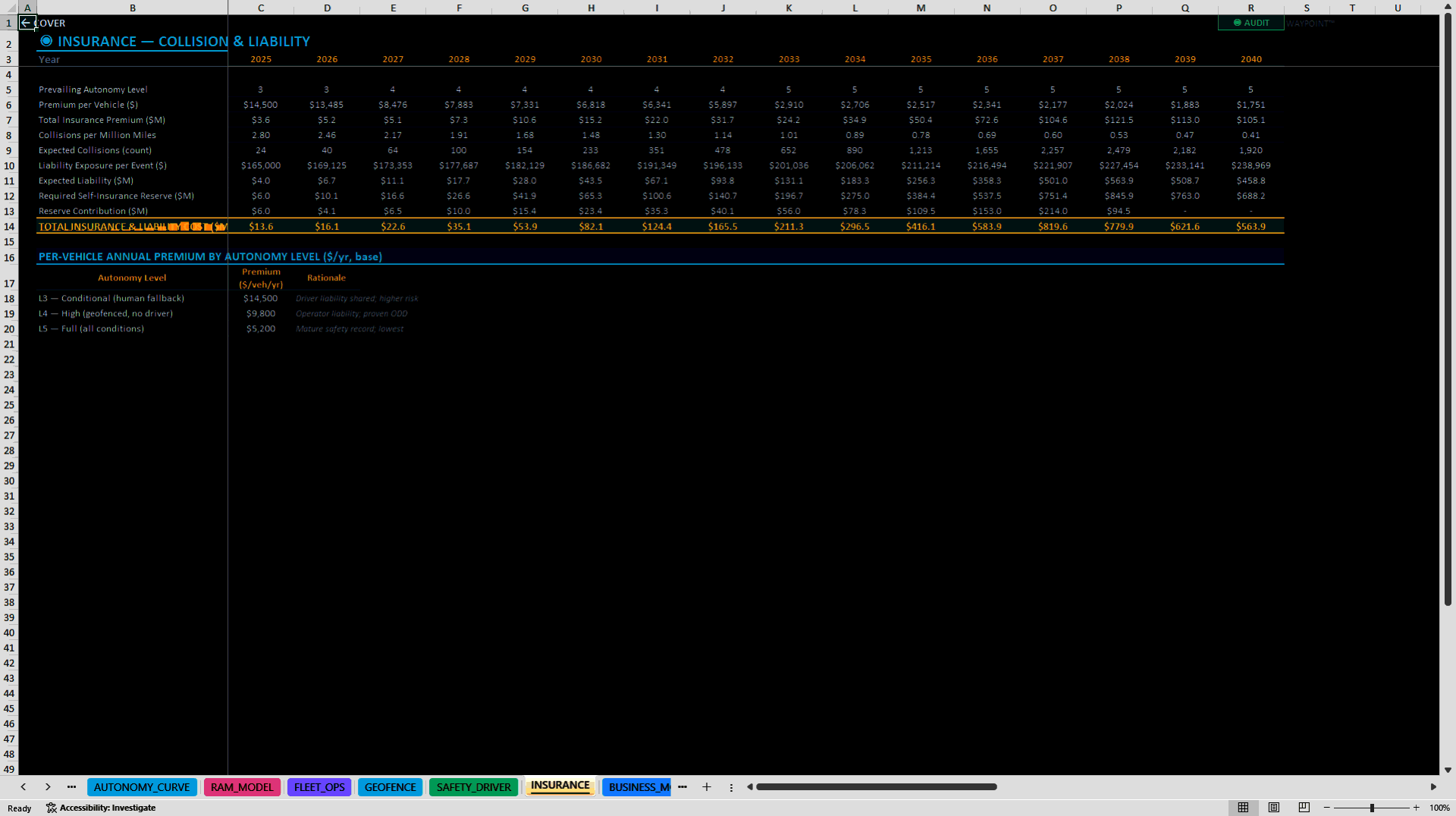
🛡️ The workbook includes per-vehicle annual insurance premium assumptions by autonomy level.
It also includes a collision rate × liability exposure sensitivity table to estimate reserve requirements under different risk scenarios.
This helps users analyze how safety performance, insurance pricing and liability exposure affect fleet economics.
Business Model Toggle
💻 The model includes a toggle-style framework for comparing:
Software licensing
Fleet ownership
Robotaxi-as-a-service
This allows users to compare asset-light, asset-heavy and platform-service economics within one framework.
Outputs Included
📊 The workbook includes:
✅ Control Panel
✅ Revenue per Autonomous Mile
✅ Teleoperated Mile Economics
✅ Safety Driver Phase-Out
✅ Fallback Infrastructure
✅ Geofence Expansion
✅ ODD Cost by City
✅ Weather Cost Assumptions
✅ Fleet Utilization
✅ Deadhead Miles Analysis
✅ Insurance Premium by Autonomy Level
✅ Business Model Toggle
✅ Collision Liability Sensitivity
✅ Reserve Requirement Analysis
✅ Fleet P&L
✅ Cash Flow Forecast
✅ Valuation
✅ Scenario Summary
✅ Sensitivity Analysis
✅ KPI Summary
✅ Executive Dashboard
✅ Risk Dashboard
✅ Audit Checks
✅ Disclaimer
✅ Glossary
Who This Document Is For
This model is suitable for:
Autonomous vehicle companies
Robotaxi fleet operators
Mobility startups
Hard-tech founders
Venture capital investors
Transport analysts
Fleet operations teams
Corporate strategy teams
Infrastructure investors
Smart city planners
Automotive strategy teams
Insurance and risk teams
Consultants and advisors
Got a question about the product? Email us at support@flevy.com or ask the author directly by using the "Ask the Author a Question" form. If you cannot view the preview above this document description, go here to view the large preview instead.
Source: Best Practices in Transportation, Integrated Financial Model Excel: Autonomous Vehicle Robotaxi Fleet Operations Model Excel (XLSX) Spreadsheet, PDMM Financial Models
ABOUT THE AUTHOR

PDMM Financial Models develops professional, decision-ready Excel models for business owners, entrepreneurs, investors, consultants, analysts, and finance teams. Our objective is to transform complex business assumptions into clear, structured analysis that supports better planning and investment decisions.
Our models cover business planning, forecasting, budgeting, feasibility analysis,
... [read more]
Ask the Author a Question
You must be logged in to contact the author.




























