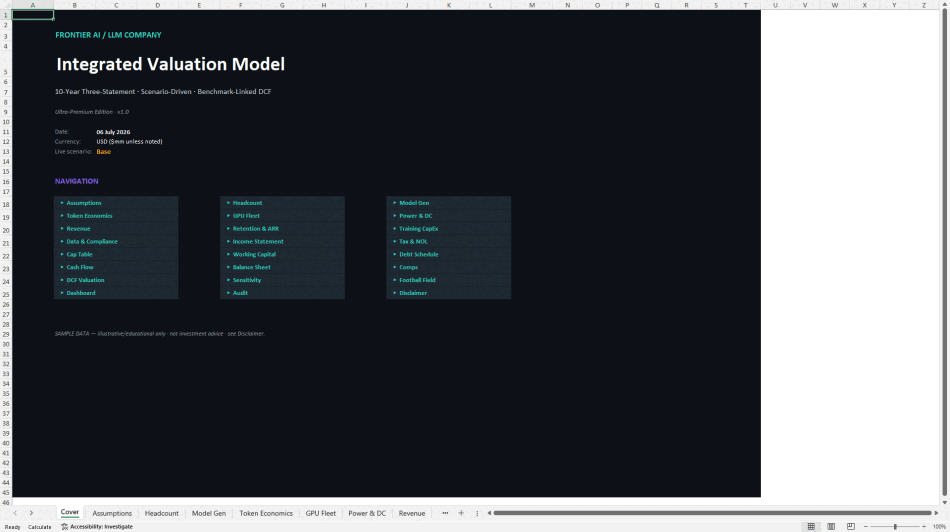

 Click main image to view in full screen. Unlock all 20 preview images:
AI / LLM Company Valuation Model – Excel XLSX
Excel (XLSX) + supplemental PDF


BENEFITS OF THIS DOWNLOADABLE EXCEL DOCUMENT
- Provides a structured framework for valuing AI / LLM companies using compute cost, token economics, revenue mix, training CapEx and inference margin assumptions.
- Helps users evaluate profitability and scalability through GPU amortization, cost per million tokens, revenue per million tokens and margin compression logic.
- Supports investor-ready AI valuation analysis through retention-adjusted ARR, benchmark-linked multiples, scenarios, sensitivities, dashboards and valuation outputs.
ARTIFICIAL INTELLIGENCE EXCEL DESCRIPTION
🔥 AI / LLM Company Valuation Model is a professional financial planning and valuation workbook built for AI startups, LLM companies, foundation model businesses, AI SaaS platforms, API-first AI companies, enterprise AI providers, investors, consultants and strategic finance teams.
AI companies do not follow the same economics as traditional SaaS companies.
A serious AI valuation model must evaluate:
GPU and compute cost amortization
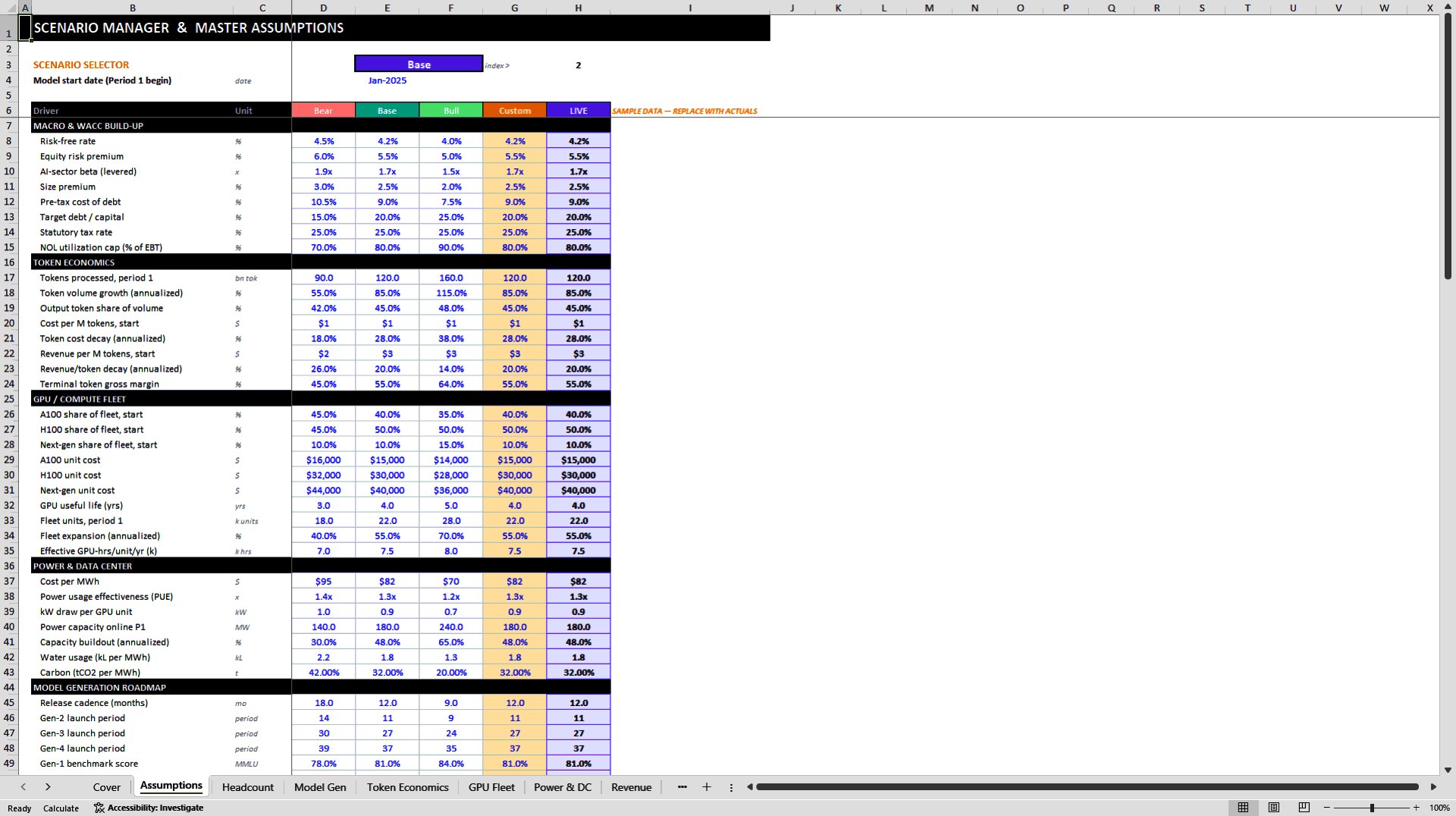
A100, H100 and next-generation GPU cost assumptions
Token-level unit economics
Cost per million tokens versus revenue per million tokens
API, SaaS and enterprise revenue stream blending
Model training CapEx capitalization versus expensing
Inference margin compression
Retention-adjusted ARR
AI-assisted churn dynamics
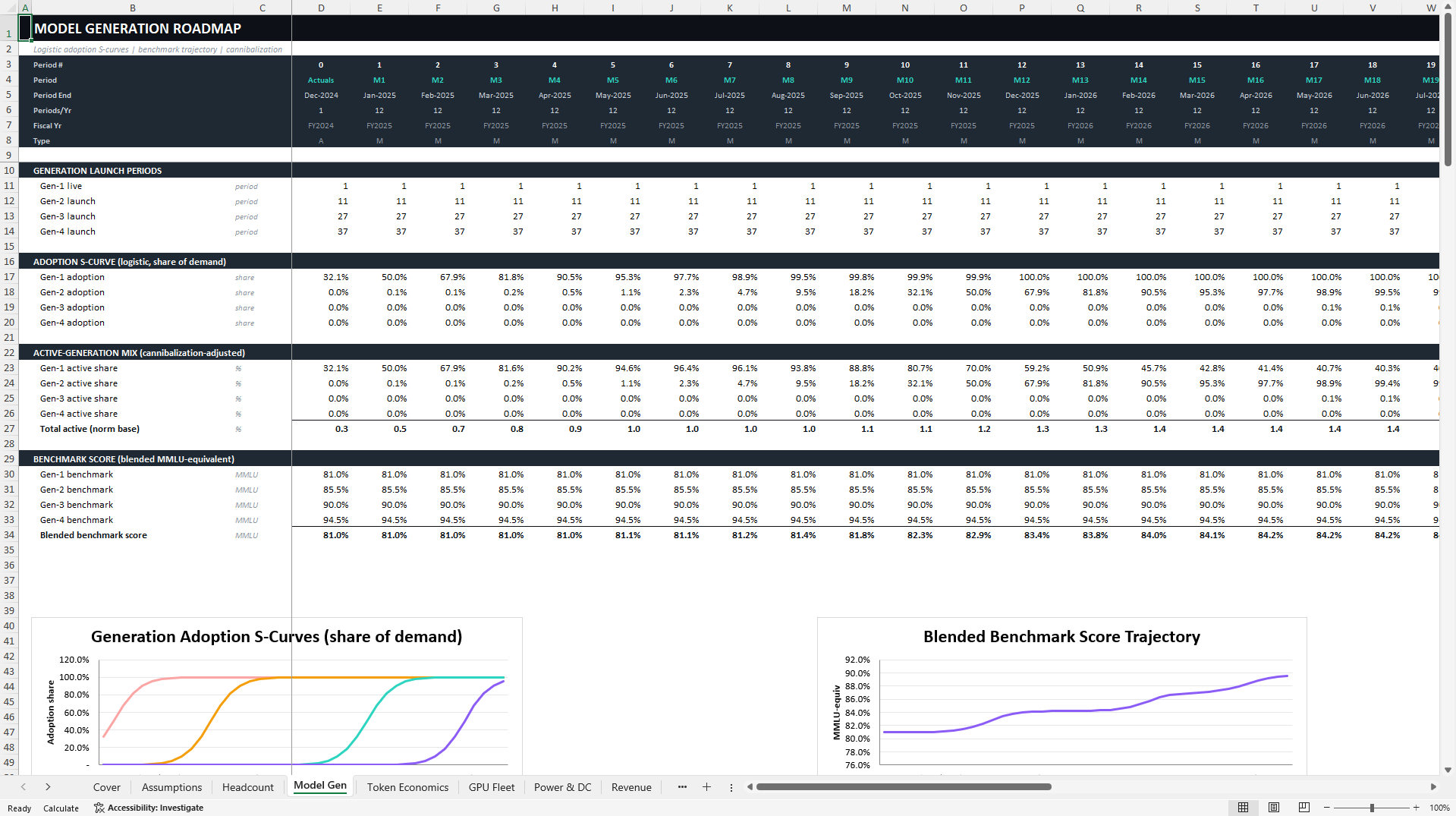
Benchmark-linked valuation multiples
This workbook brings those AI-specific drivers into one structured model.
What the Model Covers
The model includes:
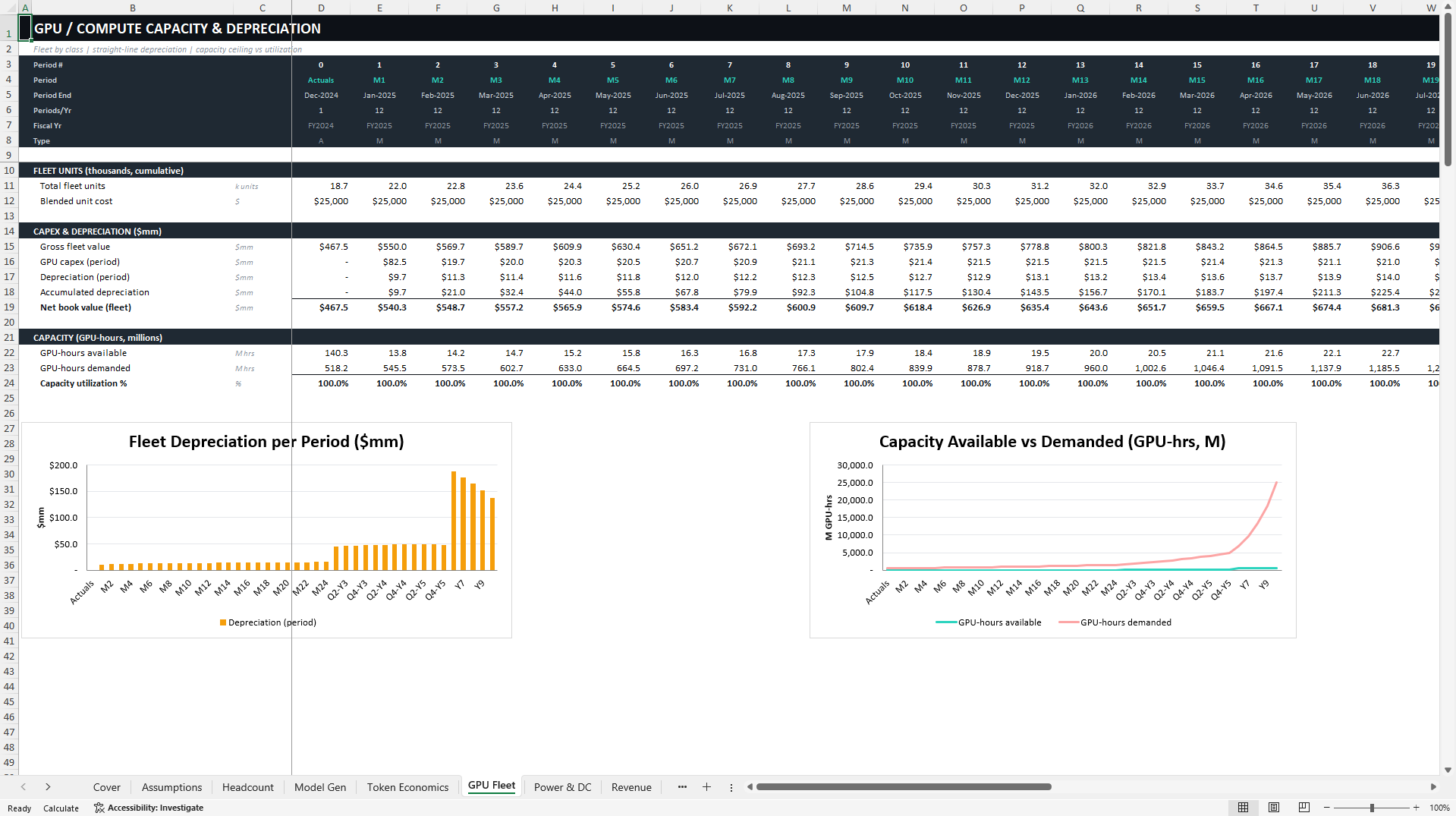
✅ GPU / compute cost amortization schedules
✅ A100 compute assumptions
✅ H100 compute assumptions
✅ Next-generation GPU assumptions
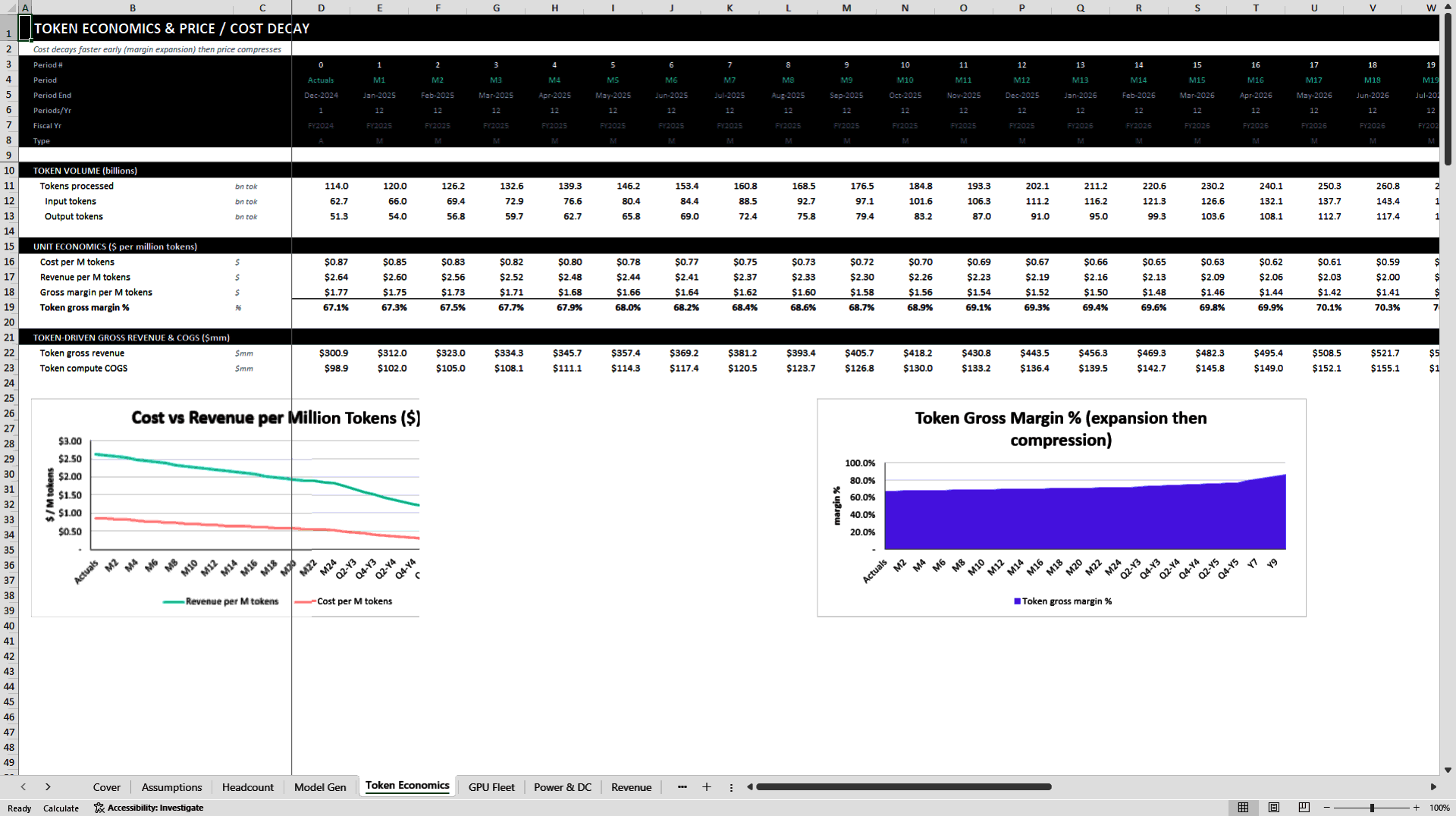
✅ Token-level unit economics
✅ Cost per million tokens
✅ Revenue per million tokens
✅ API revenue forecast
✅ SaaS revenue forecast
✅ Enterprise revenue forecast
✅ Revenue stream blending
✅ Model training CapEx schedule
✅ Capitalization vs. expensing treatment
✅ Inference margin compression curve
✅ Retention-adjusted ARR
✅ AI-assisted churn modeling
✅ Benchmark-linked valuation multiple assumptions
✅ DCF valuation
✅ Revenue multiple valuation
✅ Scenario analysis
✅ Sensitivity analysis
✅ Dashboards, KPIs and audit checks
The model is designed to help users evaluate whether an AI company can scale profitably under different compute, pricing, retention, training cost and valuation scenarios.
GPU / Compute Cost Amortization
💻 The model includes compute cost amortization schedules for different GPU infrastructure assumptions.
Users can analyze:
A100 compute cost
H100 compute cost
Next-generation GPU assumptions
Useful life
Amortization schedule
Compute cost allocation
Margin impact
Cash flow impact
This is important because compute intensity can materially affect profitability and valuation.
Token-Level Unit Economics
🧮 The workbook includes token-level unit economics.
It helps users compare:
Cost per million tokens
Revenue per million tokens
Input and output token assumptions
API pricing
Gross margin per token
Token volume growth
Unit economics by usage level
This is useful for API-first AI companies, LLM platforms and usage-based AI products.
Revenue Stream Blending
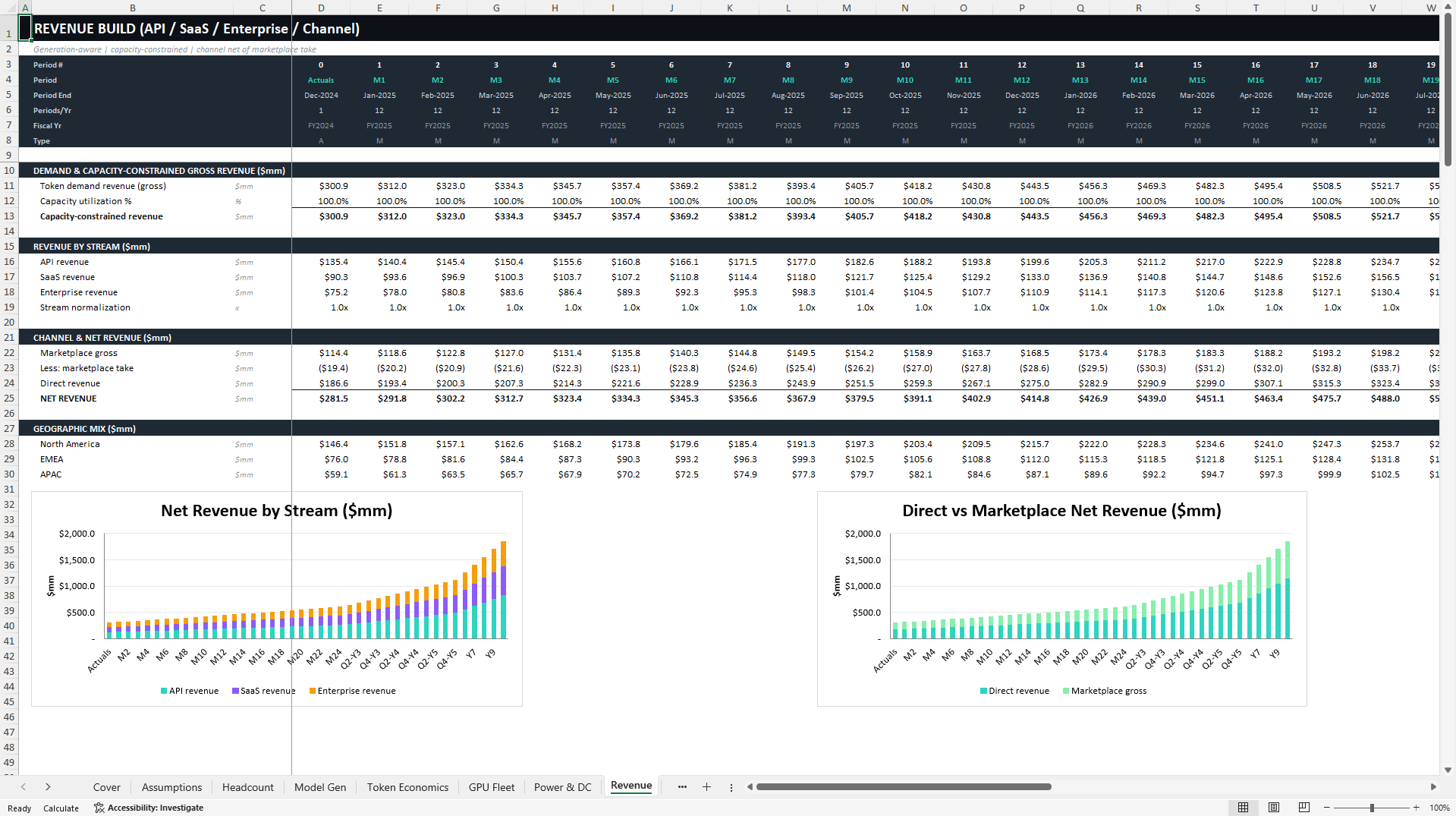
🔁 The model includes revenue blending across API, SaaS and enterprise streams.
Users can analyze:
Usage-based API revenue
Subscription revenue
Enterprise contract revenue
Customer mix
Gross margin by revenue stream
Revenue quality
Scalability of each monetization channel
This helps identify which revenue streams create the strongest valuation profile.
Training CapEx and Margin Compression
🏗️ The workbook includes model training CapEx capitalization versus expensing treatment.
It also includes an inference margin compression curve to evaluate margin pressure over the product lifecycle.
This helps users assess whether the company can maintain profitability as inference costs, competition and pricing pressure evolve.
Retention-Adjusted ARR and Benchmark Valuation
📊 The model includes retention-adjusted ARR for AI-assisted churn modeling.
🎯 It also includes benchmark-linked valuation multiple logic, allowing users to connect model performance indicators with valuation assumptions.
This supports a more AI-specific valuation framework than a generic revenue multiple model.
Outputs Included
📊 The workbook includes:
✅ Control Panel
✅ GPU Compute Schedule
✅ Compute Cost Amortization
✅ Token Unit Economics
✅ API Revenue Forecast
✅ SaaS Revenue Forecast
✅ Enterprise Revenue Forecast
✅ Revenue Mix Analysis
✅ Model Training CapEx
✅ CapEx vs. Expensing Treatment
✅ Inference Margin Compression
✅ Retention-Adjusted ARR
✅ AI Churn Modeling
✅ Benchmark-Linked Multiples
✅ Valuation Summary
✅ DCF Valuation
✅ Revenue Multiple Valuation
✅ Scenario Summary
✅ Sensitivity Analysis
✅ KPI Summary
✅ Executive Dashboard
✅ Audit Checks
✅ Disclaimer
✅ Glossary
Who This Document Is For
This model is suitable for:
AI startups
LLM companies
Foundation model companies
AI SaaS businesses
API-first AI platforms
Enterprise AI providers
Venture capital investors
Corporate development teams
Private equity analysts
M&A advisors
CFOs and finance teams
Consultants and strategic finance professionals
Got a question about the product? Email us at support@flevy.com or ask the author directly by using the "Ask the Author a Question" form. If you cannot view the preview above this document description, go here to view the large preview instead.
Source: Best Practices in Artificial Intelligence, Integrated Financial Model Excel: AI / LLM Company Valuation Model Excel (XLSX) Spreadsheet, PDMM Financial Models
ABOUT THE AUTHOR

PDMM Financial Models develops professional, decision-ready Excel models for business owners, entrepreneurs, investors, consultants, analysts, and finance teams. Our objective is to transform complex business assumptions into clear, structured analysis that supports better planning and investment decisions.
Our models cover business planning, forecasting, budgeting, feasibility analysis,
... [read more]
Ask the Author a Question
You must be logged in to contact the author.




























