Your AI assistant becomes a Flevy-powered consultant, with direct access to our full library of frameworks, templates, and case studies. Free to connect. No account, sign-in, or API key required.
STEP 1 · CHOOSE YOUR ASSISTANT
STEP 2 · CONNECT
1
No copying needed. Flevy is in the official Claude Connectors Directory.
2
Click the button below, then click Connect on the Flevy listing.
This framework is developed by a team of former McKinsey and Big 4 consultants. The presentation follows the headline-body-bumper slide format used by global consulting firms.
Editor Summary
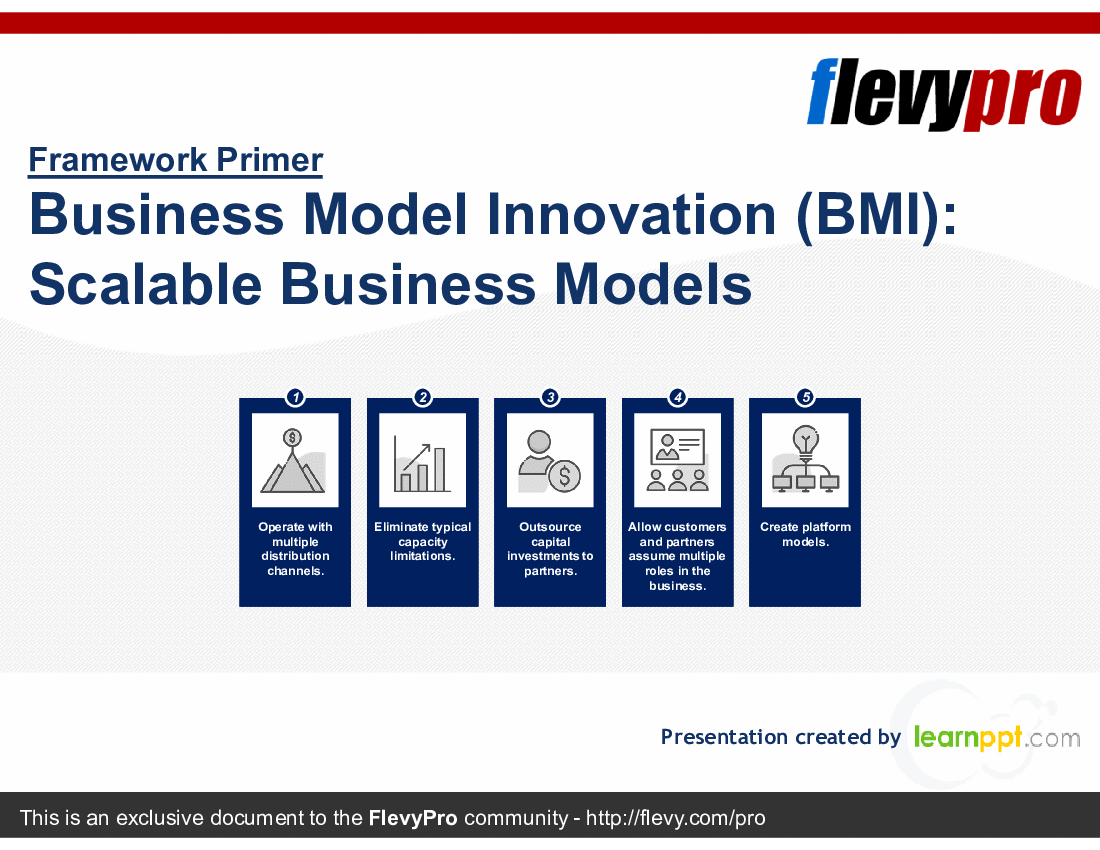
Business Model Innovation (BMI): Scalable Business Models is a 29-slide PowerPoint (PPTX) by LearnPPT Consulting that outlines 5 scalability patterns—multiple distribution channels; eliminating capacity limitations; outsourcing capital investments to partners; customers/partners assuming multiple roles; and platform models—and describes 3 potential levers to implement scalable models.
Read moreIncludes slide templates for business presentations. Targeted at executives and strategy leaders evaluating profitability, staffing and capacity impacts. Sold as a digital download on Flevy with immediate digital download.
Use this deck when leadership must evaluate or redesign business models to support profitable growth despite competitive pressure, regulation changes, or capacity constraints.
Chief Strategy Officers assessing business prospects and staffing implications by mapping options against the 5 scalability patterns.
Product managers designing platform models and partner roles to expand value creation and engagement.
Business development leaders testing new distribution-channel mixes and outsourcing capital to partners for faster expansion.
The 5-pattern plus 3-lever roadmap follows a structured pattern-and-lever analysis commonly used in strategy consulting.
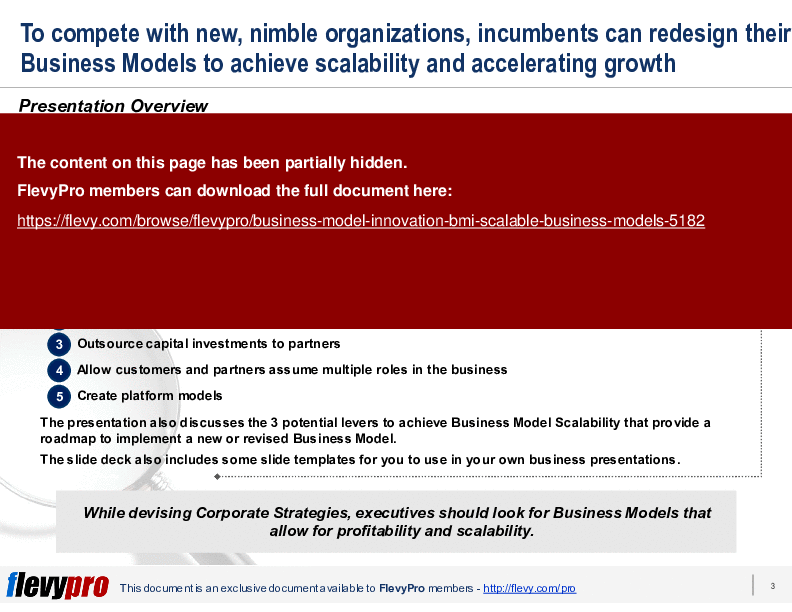
Scalability is the capability of a system to enhance productivity with resource augmentation. Scalability provides the organization the capabilities to develop compelling Value Propositions—that are hard to imitate by the rivals—and achieve profitable growth even in the wake of external threats, cut-throat rivalry, amended laws, or financial downturns. While devising Corporate Strategies, executives should look for Business Models that allow for profitability and scalability.
Business Model Scalability offers to the executives the means to evaluate business prospects, which effects an organization's staffing and resources' capacity development.
This presentation deliberates on 5 key patterns of Business Model Scalability that are typical for successful organizations:
1. Operate with multiple distribution channels.
2. Eliminate typical capacity limitations.
3. Outsource capital investments to partners.
4. Allow customers and partners assume multiple roles in the business.
5. Create platform models.
The presentation also discusses the 3 potential levers to achieve Business Model Scalability that provide a roadmap to implement a new or revised Business Model.
The slide deck also includes some slide templates for you to use in your own business presentations.
This PPT provides a comprehensive framework for executives to evaluate and enhance their business models for scalability. It emphasizes the importance of leveraging multiple distribution channels, eliminating capacity constraints, and outsourcing capital investments to strategic partners. The insights offered are grounded in real-world examples and best practices from leading organizations.
Executives will find actionable strategies to allow customers and partners to assume multiple roles within the business, fostering collaboration and growth. The presentation also delves into creating platform models that drive scalability and innovation. This resource is essential for leaders aiming to future-proof their business models against market disruptions and competitive pressures.
What are the common patterns companies use to make business models scalable?
Scalability patterns include operating with multiple distribution channels; eliminating typical capacity limitations; outsourcing capital investments to partners; enabling customers and partners to assume multiple roles; and creating platform models. These 5 patterns form the core scalability classifications discussed in the resource.
How can I assess whether my business model can scale under resource augmentation?
Assess whether productivity can increase when resources are augmented, whether the value proposition resists imitation, and whether profitability holds under external threats. Also evaluate staffing and resource-capacity implications against the 5 scalability patterns and the 3 implementation levers in Business Model Innovation (BMI): Scalable Business Models.
How do platform models contribute to business model scalability?
Platform models enable third parties—customers or partners—to create value and assume roles that extend reach and capabilities, which can reduce direct operational scaling constraints and foster innovation. Creating platform models is identified as one of the 5 scalability patterns in the presentation.
In what ways does outsourcing capital investment support scaling a business model?
Outsourcing capital investments to partners shifts capital burden away from the firm, enabling growth without proportional internal capital deployment and supporting capacity expansion. The presentation lists outsourcing capital investments to partners as one of the 5 scalability patterns to consider.
What should I look for when choosing a business model scalability toolkit or slide deck?
Look for frameworks that map concrete scalability patterns (distribution channels, capacity limits, outsourcing, partner/customer roles, platform models), a practical roadmap of implementation levers, and usable slide templates for executive communication—attributes present in Business Model Innovation (BMI): Scalable Business Models, a 29-slide PPTX.
How can the slide templates in a scalability deck be used in executive presentations?
Slide templates can be adapted to summarize diagnosis, compare distribution-channel options, show capacity constraints, outline partner-capital structures, and present platform concepts to stakeholders. The product provides ready-to-edit slides within a 29-slide PPTX to support those presentation needs.
Who in an organization should lead a scalability assessment and what activities should they perform?
Executives or strategy leads should lead assessments, performing activities such as mapping current channels, identifying capacity bottlenecks, modeling partner capital arrangements, and testing customer/partner role extensions against scalability criteria. These activities are evaluated against the 5 scalability patterns described in the deck.
What value do prebuilt scalability frameworks provide versus building from scratch?
Prebuilt frameworks provide a structured way to evaluate business prospects, clarify staffing and resource-capacity impacts, and present options to stakeholders faster than building frameworks internally. The deck frames evaluations around 5 scalability patterns and a three-lever implementation roadmap to speed decision-making.
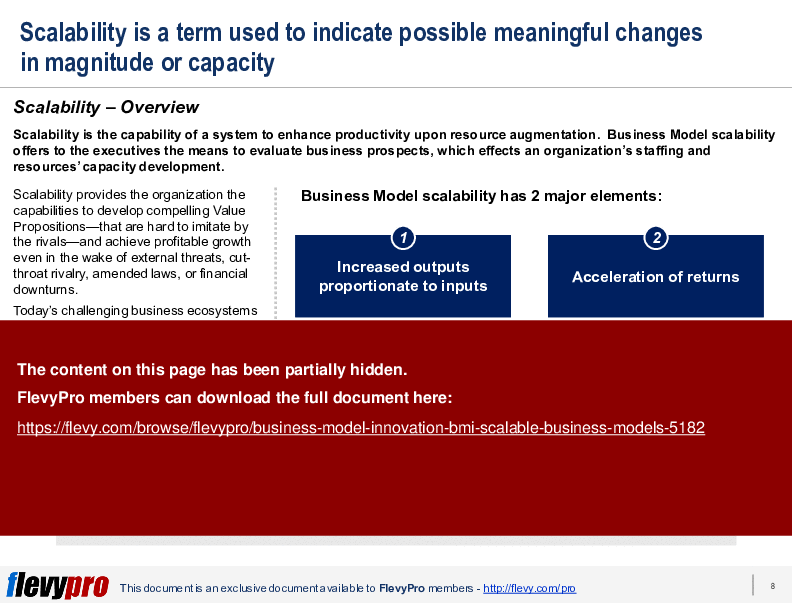
This PPT slide template provides an overview of scalability in business models, defined as a system's ability to increase output relative to resource augmentation. Two primary elements of scalability are "Increased outputs proportionate to inputs," emphasizing the need for organizations to optimize operations for greater returns without escalating costs, and "Acceleration of returns," highlighting the capacity to generate quicker earnings from additional investments. In today's complex business environment, leaders must innovate, resolve capacity issues, enhance partnerships, and develop new platforms to remain competitive. Executives are advised to invest in scalable options only when confident of boosting returns, underscoring the importance of strategic decision-making in scaling efforts.
This PPT slide template presents a framework for managing capital investments through outsourcing, highlighting business model scalability and the importance of sharing cash flow and working capital with partners. Leading organizations prioritize capital investments while addressing cash flow limitations, allowing them to focus on growth-driving investments. Adopting open platform business models enables companies to shift financial responsibilities to partners, optimizing resource allocation. An example is Sky-Watch A/S, which leverages an open platform to avoid cash and liquidity challenges, allowing partners to contribute hardware and software, thus sharing capital costs. A cost-sharing business model creates mutual benefits for organizations and partners, enhancing scalability while minimizing financial risks.
This PPT slide template outlines the second lever for achieving scalability in business models through effective brainstorming. Brainstorming is essential for analyzing and revising business models, enabling adaptation to changing market conditions. Key aspects for evaluation include organizational agility in managing new entrants and technologies, which is vital for competitiveness. Understanding the impact of new business methods on workforce mindsets is crucial, as employee buy-in affects implementation success. Identifying gaps in the current business model can hinder the adoption of new practices. Benchmarking against other organizations provides a comparative perspective for strategic decisions. Recognizing value-driving factors and the need for strategic partnerships can enhance offerings at marginal costs. Assessing existing roles and responsibilities ensures alignment with new strategies, while exploring alternatives for capacity issues supports effective scaling.
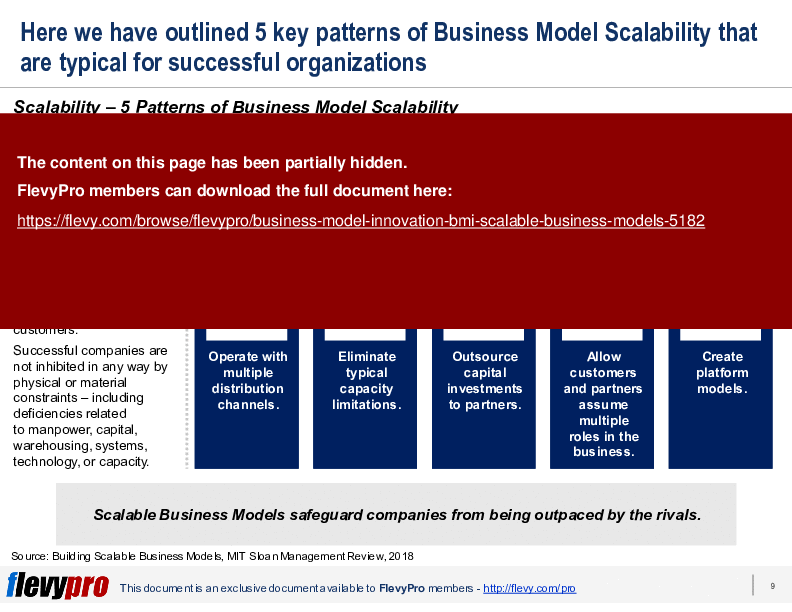
This PPT slide template outlines 5 essential patterns of business model scalability characteristic of successful organizations. Scalable business models enhance revenue by integrating additional resources. Benchmarking against successful peers allows organizations to adapt their business models to withstand internal and external pressures.
The first pattern emphasizes multiple distribution channels to broaden customer reach and mitigate risks. The second pattern addresses capacity limitations to seize market opportunities. The third pattern involves outsourcing capital investments to leverage external resources, freeing internal capital for strategic initiatives. The fourth pattern encourages customers and partners to assume multiple roles, enhancing engagement and driving innovation.
Lastly, creating platform models facilitates stakeholder interactions, fostering a network effect that increases value. Embracing these patterns equips organizations to thrive in competitive environments.
This PPT slide template outlines a framework for enhancing the scalability of business models, emphasizing the need for strategic alignment between internal capabilities and those of strategic partners and customers. Three primary levers are identified:
1. "Determine potential strategic partners" focuses on identifying and engaging with partners to enhance scalability.
2. "Brainstorm a scalability plan" encourages developing a comprehensive strategy for achieving scalability.
3. "Select viable and scalable business model options" involves evaluating different business models to ensure they support growth.
Collaboration and strategic planning are crucial for achieving scalability, improving performance, and enhancing market responsiveness.
This PPT slide template presents a framework for understanding the significance of multiple distribution channels in achieving scalability for businesses. Successful companies utilize diverse distribution methods to enhance scalability and increase sales opportunities. Examples include Google and Apple, which strategically expanded their channels to avoid cannibalizing existing sales while spreading overhead costs. Diversifying distribution maximizes profit margins and drives growth. Copenhagen Seafood A/S illustrates this by transitioning from high-end restaurant sales to retail, reducing waste and creating a new revenue stream. This example demonstrates how leveraging additional channels can tap into new customer bases and uncover opportunities for expansion.
Source: Best Practices in Growth Strategy, Corporate Strategy, Business Model Innovation, Business Model Design PowerPoint Slides: Business Model Innovation (BMI): Scalable Business Models PowerPoint (PPTX) Presentation Slide Deck, LearnPPT Consulting
This framework is developed by a team of former McKinsey and Big 4 consultants. The presentation follows the headline-body-bumper slide format used by global consulting firms.
For $10.00 more, you can download this document plus 2 more FlevyPro documents. That's just $13 each.
ABOUT FLEVYPRO
This document is part of the FlevyPro Library, a curated knowledge base of documents for our FlevyPro subscribers.
FlevyPro is a subscription service for on-demand business frameworks and analysis tools. FlevyPro subscribers receive access to an exclusive library of curated business documents—business framework primers, presentation templates, Lean Six Sigma tools, and more—among other exclusive benefits.
Since 2012, we have provided business templates to over 10,000 businesses and organizations of all sizes, from startups and small businesses to the Fortune 100, in over 130 countries.
"As an Independent Management Consultant, I find Flevy to add great value as a source of best practices, templates and information on new trends. Flevy has matured and the quality and quantity of the library is excellent. Lastly the price charged is reasonable, creating a win-win value for
the customer, Flevy and the various authors. This is truly a service that benefits the consulting industry and associated clients. Thanks for providing this service.
"
– Jim Schoen, Principal at FRC Group
"The wide selection of frameworks is very useful to me as an independent consultant. In fact, it rivals what I had at my disposal at Big 4 Consulting firms in terms of efficacy and organization."
– Julia T., Consulting Firm Owner (Former Manager at Deloitte and Capgemini)
"I have used FlevyPro for several business applications. It is a great complement to working with expensive consultants. The quality and effectiveness of the tools are of the highest standards."
– Moritz Bernhoerster, Global Sourcing Director at Fortune 500
"Flevy is now a part of my business routine. I visit Flevy at least 3 times each month.
Flevy has become my preferred learning source, because what it provides is practical, current, and useful in this era where the business world is being rewritten.
many challenges and there is the need to make the right decisions in a short time, with so much scattered information, we are fortunate to have Flevy. Flevy investigates, selects, and puts at our disposal the best of the best to help us be successful in our work.
"
– Omar Hernán Montes Parra, CEO at Quantum SFE
"As a consulting firm, we had been creating subject matter training materials for our people and found the excellent materials on Flevy, which saved us 100's of hours of re-creating what already exists on the Flevy materials we purchased."
– Michael Evans, Managing Director at Newport LLC
"I have used Flevy services for a number of years and have never, ever been disappointed. As a matter of fact, David and his team continue, time after time, to impress me with their willingness to assist and in the real sense of the word. I have concluded in fact
that it is not at all just a repository of documents/resources but, in the way that David and his team manage the firm, it is like dealing with consultants always ready to assist, advise and direct you to what you really need, and they always get it right.
I am an international hospitality accomplished senior executive who has worked and lived during the past 35 years in 23 countries in 5 continents and I can humbly say that I know what customer service is, trust me.
Aside from the great and professional service that Flevy's team provide, their wide variety of material is of utmost great quality, professionally put together and most current.
Well done Flevy, keep up the great work and I look forward to continue working with you in the future and to recommend you to a variety of colleagues around the world.
"
– Roberto Pelliccia, Senior Executive in International Hospitality
"I have found Flevy to be an amazing resource and library of useful presentations for lean sigma, change management and so many other topics. This has reduced the time I need to spend on preparing for my performance consultation. The library is easily accessible and updates are regularly provided. A wealth of great information."
– Cynthia Howard RN, PhD, Executive Coach at Ei Leadership
"Flevy.com has proven to be an invaluable resource library to our Independent Management Consultancy, supporting and enabling us to better serve our enterprise clients.
The value derived from our [FlevyPro] subscription in terms of the business it has helped to gain far exceeds the investment made, making a subscription a no-brainer for any growing consultancy – or in-house strategy team."
– Dean Carlton, Chief Transformation Officer, Global Village Transformations Pty Ltd.
Save with Bundles
This document is available as part of the following discounted bundle(s):

 Click main image to view in full screen. Unlock all 11 preview images: