
This presentation is created by former McKinsey, BCG, Deloitte, EY, and Capgemini consultants. It teaches a practical consulting framework actively used by tier-1 consulting firms.
Editor Summary
Activity Based Costing is a 29-slide PowerPoint presentation (PPT) sold as a digital download on Flevy that teaches a 7-phase consulting framework for assigning costs to the activities that drive them.
Read moreDeveloped by former McKinsey, BCG, Deloitte, EY, and Capgemini consultants, it includes templates and tools such as a cost object identification template, process mapping framework, cost driver analysis tool, profitability analysis model, spreadsheet income-statement templates, and benchmarking tools. Target users include financial analysts, corporate executives, consultants, and operations managers; used to evaluate product, customer, and channel profitability and inform pricing and product-mix decisions. Immediate digital download.
Use this presentation when an organization needs more accurate cost and profitability insight than traditional costing provides—typical triggers include high overhead structures, a move to product- or customer-level profitability analysis, post-merger cost-realignment, or workshops on process improvement.
Financial analysts performing product- and customer-level profitability analysis using the profitability analysis model and spreadsheet templates.
Corporate executives evaluating pricing and product-mix choices based on activity-driven cost allocations.
Consultants mapping general ledger costs to activities and verifying economic logic during a costing-methods migration.
Operations managers identifying high-cost activities through process mapping to target efficiency efforts.
The structured 7-phase approach—defining cost objects, process mapping, mapping GL costs, allocating costs, and verifying economic logic—aligns with the stepwise, hypothesis-driven implementations used at McKinsey, BCG, Deloitte, EY, and Capgemini.
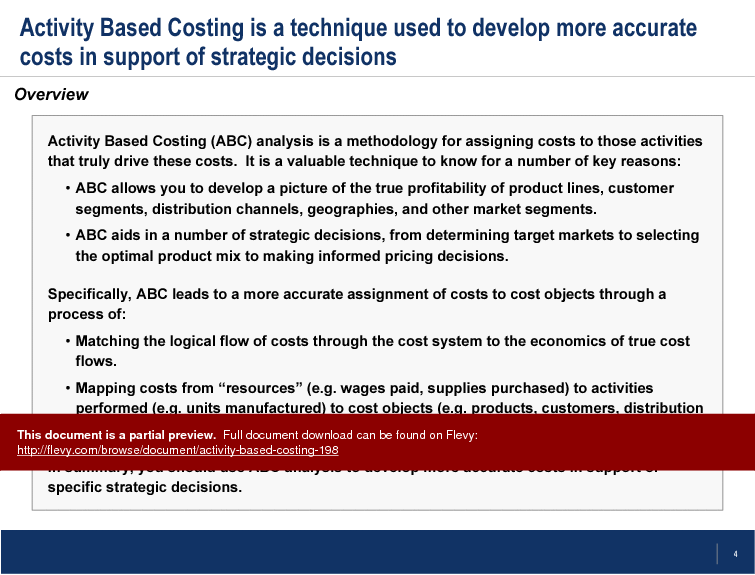
Activity Based Costing (ABC) analysis is a methodology for assigning costs to those activities that truly drive these costs. It is tangibly more accurate than traditional costing methods. Traditional costing methods overlook product-specific R&D, advertising, distribution/channel, and administration costs. As a result, there is no way to capture different behaviors tied to specific customers or products.
ABC costing analysis is a valuable costing technique to know for a number of key reasons:
• ABC allows you to develop a picture of the true profitability of product lines, customer segments, distribution channels, geographies, and other market segments.
• ABC aids in a number of strategic decisions, from determining target markets to selecting the optimal product mix to making informed pricing decisions.
Specifically, Activity Based Costing analysis leads to a more accurate assignment of costs to cost objects through a process of:
• Matching the logical flow of costs through the cost system to the economics of true cost flows.
• Mapping costs from "resources" (e.g. wages paid, supplies purchased) to activities performed (e.g. units manufactured) to cost objects (e.g. products, customers, distribution channels) that drive those costs.
ABC is an invaluable tool for making strategic decisions, as it allows you to develop a picture of true profitability of product lines, customer segments, geographies, distribution channels, and other markets. This document explains a 7-phase approach to Activity Based Costing:
1. Develop Cost Objects
2. Group Cost Objects
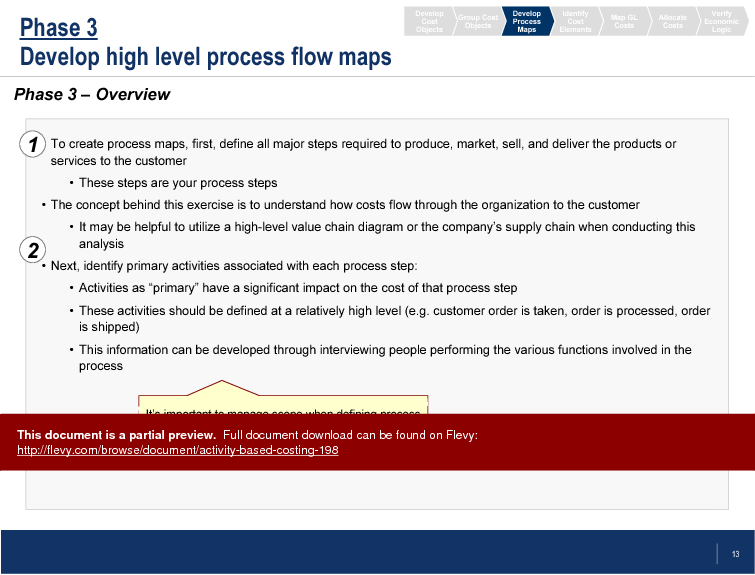
3. Develop Process Maps
4. Identify Cost Elements
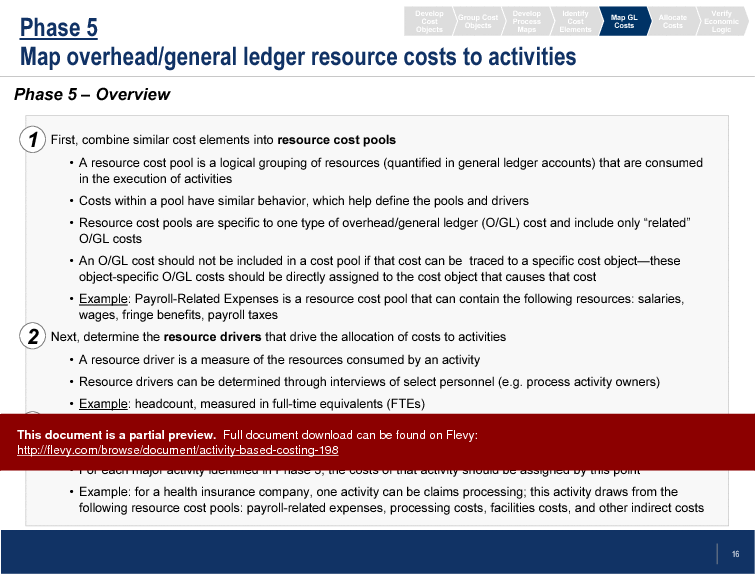
5. Map General Ledger Costs
6. Allocate Costs
7. Verify Economic Logic
In this Activity Based Costing PowerPoint presentation, each phase is discussed in detail and includes examples.
Additional topics discussed in this Activity Based Costing PPT include ABC vs. traditional costing methods, advantages and drawbacks of ABC, spreadsheet modeling, product profitability-driven customer profitability, among others. With this in-depth presentation, you can gain the understanding of how to develop an Activity Based Costing formula and Activity Based Costing System for your organization.
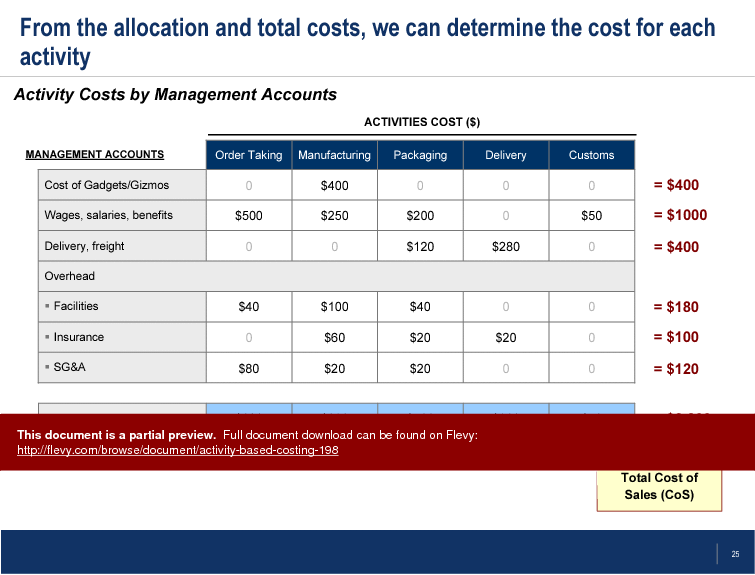
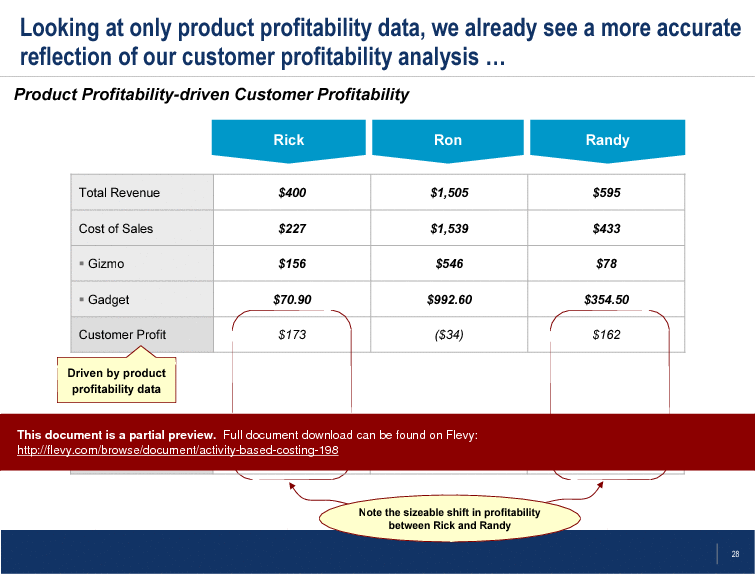
A full Activity Based Costing example is also included, which breaks down the financials overview, key activities, activity costs, activity drivers, product profitability analysis, and activity based customer profitability.
Gain insights into how ABC can be leveraged for cost object-level decisions, such as dropping unprofitable product lines. Understand the role of resource cost pools and resource drivers in accurately attributing costs to activities.
Got a question about the product? Email us at support@flevy.com or ask the author directly by using the "Ask the Author a Question" form. If you cannot view the preview above this document description, go here to view the large preview instead.
MARCUS OVERVIEW
This synopsis was written by Marcus [?] based on the analysis of the full 29-slide presentation.
Executive Summary
The Activity Based Costing (ABC) presentation provides a comprehensive methodology for accurately assigning costs to activities that drive those costs, surpassing traditional costing methods. Developed by former consultants from McKinsey, BCG, Deloitte, EY, and Capgemini, this consulting-grade resource equips corporate executives and consultants with the tools to make informed strategic decisions. By utilizing ABC, users can gain insights into the true profitability of product lines, customer segments, and distribution channels, enabling them to optimize pricing and product mix. This presentation outlines a structured 7-phase approach to implementing ABC, ensuring clarity and precision in cost management.
Who This Is For and When to Use
• Financial analysts tasked with cost management and profitability analysis
• Corporate executives seeking to enhance strategic decision-making
• Consultants advising businesses on cost allocation methods
• Operations managers aiming to improve efficiency and reduce costs
Best-fit moments to use this deck:
• During financial strategy sessions to evaluate product and customer profitability
• When transitioning from traditional costing methods to more accurate ABC analysis
• In workshops focused on process improvement and operational efficiency
Learning Objectives
• Define Activity Based Costing and its advantages over traditional methods
• Develop a clear understanding of cost objects and their significance
• Implement a 7-phase approach to ABC for effective cost allocation
• Analyze profitability at the product and customer level using ABC
• Identify and map cost drivers to enhance cost management
• Utilize ABC for strategic decision-making in complex environments
Table of Contents
• Overview (page 3)
• Comparison with Traditional Costing Methods (page 5)
• Advantages and Drawbacks (page 7)
• Approach (page 9)
• Overview of 7 Phases (page 10)
• Example (page 22)
Primary Topics Covered
• Overview of ABC - Activity Based Costing is a methodology for assigning costs to activities that drive costs, providing a clearer picture of profitability across various segments.
• Comparison with Traditional Costing - ABC offers a more accurate assignment of both direct and indirect costs, correcting misallocations often found in traditional methods.
• Advantages of ABC - ABC supports fact-based strategic decisions by revealing the true profitability of products and customers, crucial for high-overhead environments.
• Drawbacks of ABC - While ABC provides improved accuracy, it may not address opportunity costs or reflect current operations if the system is outdated.
• 7-Phase Approach - A structured method for implementing ABC, including developing cost objects, mapping costs, and verifying economic logic.
• Example Application - A practical case study demonstrating the application of ABC in a manufacturing context, showcasing its effectiveness in profitability analysis.
Deliverables, Templates, and Tools
• Cost object identification template for defining products, customers, and markets
• Process mapping framework to visualize cost flow through activities
• Cost driver analysis tool to allocate costs accurately
• Profitability analysis model for assessing product and customer profitability
• Spreadsheet templates for income statements reflecting ABC analysis
• Benchmarking tools for comparing ABC results with industry standards
Slide Highlights
• Overview slide detailing the importance of ABC in strategic decision-making
• Comparison slide illustrating the differences between ABC and traditional costing methods
• Visual representation of the 7-phase approach to implementing ABC
• Example slide showcasing a case study of a manufacturer using ABC
• Slide summarizing the advantages and drawbacks of ABC analysis
Potential Workshop Agenda
Introduction to Activity Based Costing (30 minutes)
• Overview of ABC principles and methodology
• Discussion on the importance of accurate cost allocation
Implementing the 7-Phase Approach (60 minutes)
• Step-by-step guide through the 7 phases of ABC
• Group activity: Identifying cost objects and mapping processes
Case Study Analysis (45 minutes)
• Review of the example application of ABC
• Group discussion on insights and lessons learned
Customization Guidance
• Tailor cost object definitions to align with your organization’s specific products and services
• Adjust process maps to reflect your operational workflow and activities
• Modify cost driver metrics based on industry standards and organizational needs
Secondary Topics Covered
• Cost allocation methods and their implications for financial reporting
• The role of overhead costs in overall profitability
• Strategies for integrating ABC with existing financial systems
• Best practices for maintaining ABC systems over time
• The impact of ABC on pricing strategies and market positioning
Topic FAQ
What are the main phases of an Activity Based Costing implementation?
Activity Based Costing implementations follow a structured 7-phase approach as described in the product: 1) Develop Cost Objects, 2) Group Cost Objects, 3) Develop Process Maps, 4) Identify Cost Elements, 5) Map General Ledger Costs, 6) Allocate Costs, and 7) Verify Economic Logic, totaling 7 phases.
How does ABC allocate indirect overhead differently than traditional costing?
ABC maps costs from resources to activities and then to cost objects, assigning indirect overhead based on activity consumption rather than spreading it uniformly. This corrects misallocations by using cost drivers and activity cost pools and relies on resource-to-activity-to-cost object mapping.
What are common drawbacks or limitations of Activity Based Costing?
Known limitations include that ABC may not capture opportunity costs and can produce static or outdated results if the system is not regularly updated. Maintaining accuracy requires ongoing updates to reflect current operations and processes to avoid stale allocations.
What should I look for when choosing an ABC toolkit or PPT template?
Buyers should look for templates that support each ABC step: cost object identification, process mapping, cost driver analysis, GL mapping, allocation tools, and worked examples or case studies. Flevy’s Activity Based Costing PPT explicitly provides a cost object identification template and cost driver analysis tool.
How do I evaluate the cost/value of purchasing ABC templates for my team?
Evaluate whether your organization needs product-, customer-, or channel-level profitability insight and whether the toolkit includes spreadsheets and models you can adopt. The presence of a profitability analysis model, spreadsheet income-statement templates, and a worked example indicates usable deliverables for analysis.
I need to decide whether to drop an unprofitable product line—how can ABC help?
ABC assigns costs to activities and then to product cost objects, revealing the true profitability of product lines by linking resource consumption to products. Use the profitability analysis model and the included manufacturing example in Flevy’s Activity Based Costing PPT to assess product-level profitability.
After a merger, how can we transition from traditional costing to ABC without disrupting reporting?
A phased ABC rollout begins with defining cost objects and grouping them, then mapping processes and GL costs before reallocating and verifying logic; integration may require adjustments to existing financial systems. The presentation highlights mapping general ledger costs as a dedicated phase (phase 5).
What are cost drivers and how should I select them for ABC?
Cost drivers are factors that cause changes in activity costs and are used to allocate activity costs to cost objects. Select drivers that most logically reflect how activities consume resources, supported by process maps and cost driver analysis tools such as the cost driver analysis tool included in the presentation.
Document FAQ
These are questions addressed within this presentation.
What is Activity Based Costing?
Activity Based Costing is a methodology for assigning costs to activities based on their actual consumption of resources, providing a more accurate reflection of profitability than traditional methods.
How does ABC differ from traditional costing methods?
ABC assigns both direct and indirect costs to specific cost objects, correcting misallocations common in traditional methods that often spread costs uniformly across products.
What are the main advantages of using ABC?
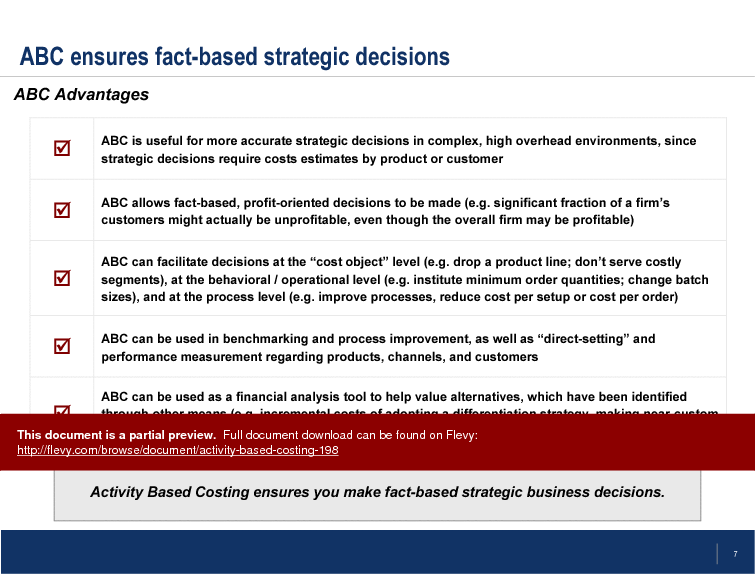
ABC allows for more accurate strategic decisions by revealing the true profitability of products and customers, especially in high-overhead environments.
Are there any drawbacks to ABC?
ABC may not address opportunity costs and can produce static data if the system is not regularly updated to reflect current operations.
How can I implement ABC in my organization?
Implement ABC by following the structured 7-phase approach outlined in this presentation, starting with identifying cost objects and mapping costs.
What tools can assist with ABC analysis?
Utilize spreadsheet models and templates for income statements, cost driver analysis, and profitability assessments to facilitate ABC implementation.
Can ABC be integrated with existing financial systems?
Yes, ABC can be integrated with current financial systems,, but it may require adjustments to ensure accurate data flow and reporting.
How often should ABC systems be updated?
Regular updates are essential to maintain the accuracy of cost allocations and reflect changes in operations, processes, and market conditions.
Glossary
• Activity Based Costing (ABC) - A method for assigning costs to activities based on their actual consumption of resources.
• Cost Object - Any end item to which activity costs are assigned, such as products or customers.
• Cost Driver - A factor that causes a change in the cost of an activity, used for allocating costs.
• Resource Cost Pool - A logical grouping of resources consumed in executing activities.
• Activity Cost Pool - The total costs associated with performing a specific activity.
• Profitability Analysis - The assessment of the profitability of products, customers, or segments based on cost allocations.
• Overhead Costs - Indirect costs that cannot be directly traced to a specific cost object, such as utilities and administrative expenses.
• Direct Costs - Costs that can be directly attributed to a specific cost object, such as raw materials and labor.

• Financial Statements - Reports that summarize the financial performance and position of a business, including income statements and balance sheets.
• Process Mapping - The visualization of the steps involved in producing, marketing, and delivering products or services.
• Benchmarking - The process of comparing business processes and performance metrics to industry bests or best practices from other companies.
• Value Chain - A model that describes the full range of activities required to create a product or service.
• Segmentation - The process of dividing a market into distinct groups of buyers with different needs or behaviors.
• Sanity Check - A review process to ensure that the results of an analysis make logical sense and are consistent with expectations.
• Financial Analysis Tool - Software or methods used to evaluate financial data and support decision-making.
• Incremental Costs - The additional costs incurred when a business adopts a new strategy or makes changes to existing operations.
• Management Accounts - Internal financial reports used for decision-making and performance evaluation within an organization.
• Strategic Decision-Making - The process of making choices that will shape the direction and performance of an organization.
• Cost Allocation - The process of identifying, aggregating, and assigning costs to cost objects.
• Operational Efficiency - The ability to deliver products or services in the most cost-effective manner without compromising quality.
• Customer Profitability - The assessment of the profitability of individual customers based on their purchases and associated costs.
• Financial Reporting - The process of producing statements that disclose an organization's financial status to stakeholders.
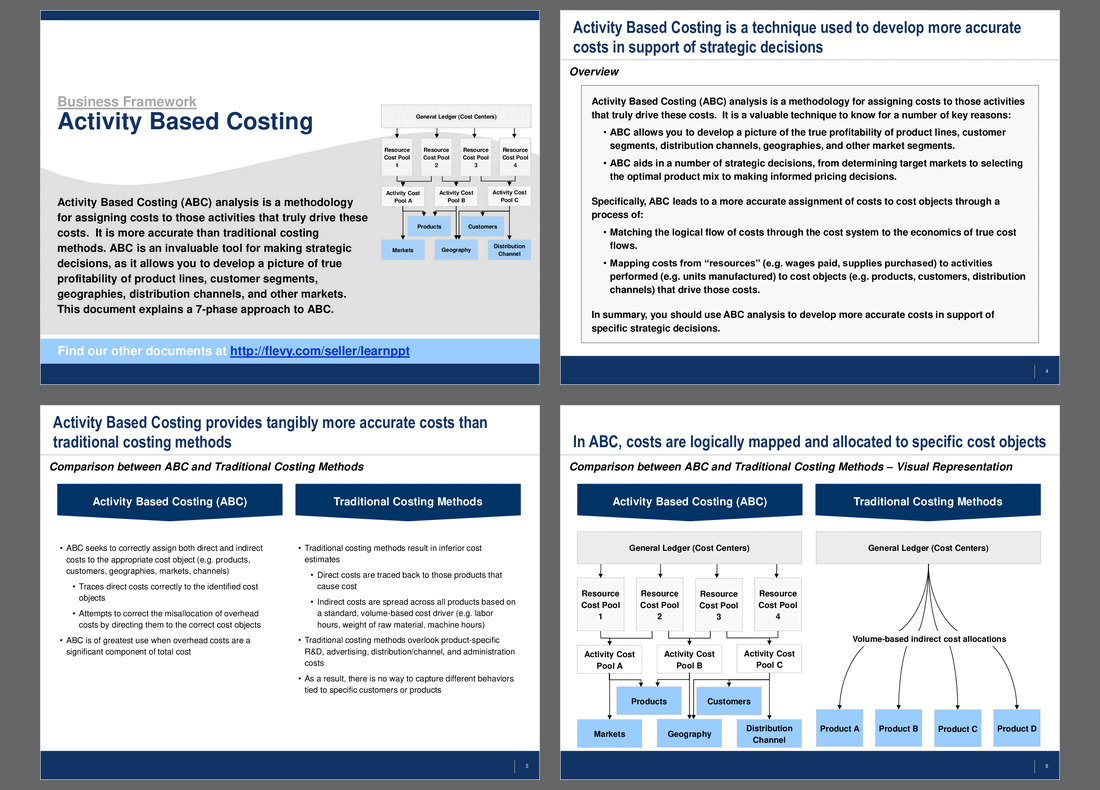
This PPT slide presents a comparative analysis of Activity Based Costing (ABC) and Traditional Costing Methods. ABC allocates costs through a structured flow, starting with the General Ledger divided into Resource Cost Pools, which feed into Activity Cost Pools that allocate costs to Products and Customers. This method allows for precise cost allocation based on actual activities, enhancing insights into resource usage and profitability. In contrast, Traditional Costing Methods distribute costs through volume-based indirect allocations, leading to less accurate cost assignments and potential inefficiencies. ABC provides a detailed, activity-focused view, supporting informed decision-making and resource management, while Traditional methods risk oversimplifying cost assignments, affecting financial assessments.
This PPT slide outlines a structured approach to identifying cost drivers and calculating unit costs within a business framework. Total costs are categorized into 5 areas: Order Taking ($620), Manufacturing ($830), Packaging, Delivery, and Customs. The cost per unit for specific items is detailed, with Manufacturing costing $730 per Gadget and $100 per Gizmo. Key cost drivers include the number of calls for Order Taking and the number of Gadgets produced for Manufacturing, with values such as 200 calls and 200 Gadgets identified. Unit costs are calculated based on these drivers, resulting in $3.10 for Order Taking and $3.65 per Gadget for Manufacturing. This systematic approach aids in understanding cost structures and supports informed decision-making regarding pricing and resource allocation.
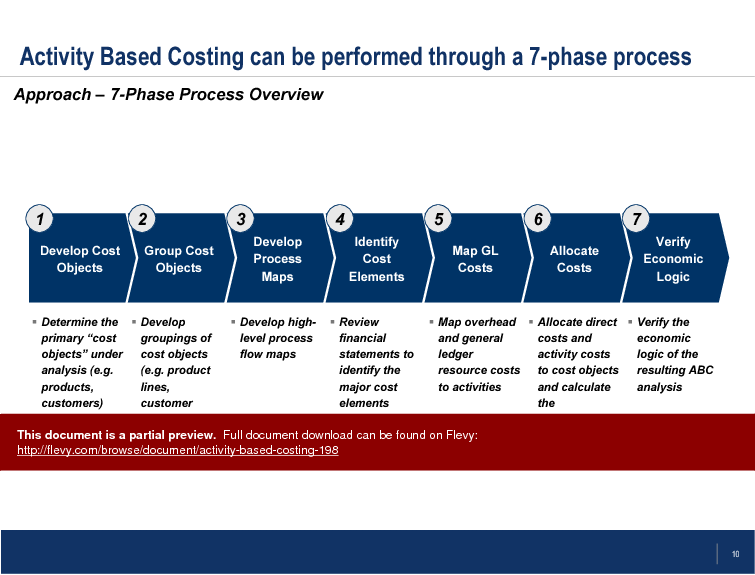
This PPT slide outlines a structured 7-phase process for implementing Activity Based Costing (ABC). The first phase, "Develop Cost Objects," identifies primary cost objects, such as products or customers. The second phase, "Group Cost Objects," categorizes these objects into logical groupings like product lines or customer segments. The third phase, "Develop Process Maps," creates flow maps to visualize workflows and identify cost areas. The fourth phase, "Identify Cost Elements," reviews financial statements to pinpoint major cost elements. In the fifth phase, "Map GL Costs," overhead and general ledger costs are mapped to specific activities. The sixth phase, "Allocate Costs," allocates direct and activity costs to identified cost objects for profitability assessment. Finally, the seventh phase, "Verify Economic Logic," ensures the ABC analysis's economic rationale is sound, validating the approach and ensuring actionable insights.
This PPT slide presents a comparative analysis of Activity Based Costing (ABC) and traditional costing methods. ABC accurately assigns direct and indirect costs to specific cost objects, such as products and customers, effectively tracing direct costs while addressing overhead misallocation. This method is particularly advantageous when overhead costs are significant. In contrast, traditional costing methods yield less reliable estimates, tracing direct costs to products, but allocating indirect costs based on generalized cost drivers like labor hours. This can lead to inaccuracies, as it overlooks unique costs associated with specific products, such as research and development and advertising. Organizations aiming to enhance cost management should consider implementing ABC for a nuanced understanding of their cost structures and improved decision-making.
This PPT slide outlines a structured approach to building an income statement for various cost objects using a spreadsheet model. The model's rows represent revenues, costs, and profitability metrics, while the columns denote distinct cost objects such as products, customers, markets, or geographical segments. The revenue section captures income from each cost object, with costs categorized into salaries, wages, fringe benefits, and other expenses for granular expense tracking. Profit is calculated by subtracting total costs from total revenues, revealing financial performance. Determining individual profitability of each cost object is essential for informed resource allocation and operational adjustments. Software tools enhance accuracy and efficiency in cost allocation, supporting detailed financial modeling for better decision-making and strategic planning.
This PPT slide outlines the initial phase of Activity-Based Costing (ABC) analysis, focusing on identifying primary cost objects, defined as items to which activity costs are assigned. Cost objects are categorized into 5 areas: products, customers, markets, geographies, and distribution channels. Examples include specific product lines, customer segmentation methods, and regional considerations such as the US and China. The slide emphasizes that cost objects must be MECE—mutually exclusive and collectively exhaustive—to avoid overlaps and gaps in financial analysis. This structured approach is essential for effectively managing and understanding costs.
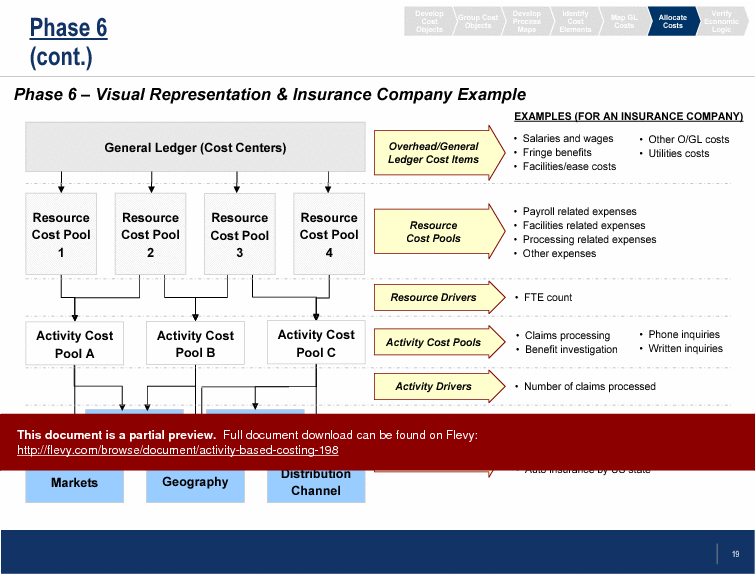
This PPT slide outlines the fifth phase of an activity-based costing model, focusing on the General Ledger that organizes costs into 4 Resource Cost Pools. This segmentation facilitates manageable cost analysis, with a breakdown of 4 to 7 pools aligning resources with the value chain. Resource Drivers link costs to activities, manifesting as headcount or product quantities, and identifying these drivers requires engaging with process owners. Each activity must correspond to an Activity Cost Pool, ensuring accurate cost attribution. The visual flow from Resource Cost Pools to Activity Cost Pools and then to Products and Customers illustrates the interconnectedness of costs and activities, highlighting the impact of resource allocation on business performance. A systematic approach to cost management enhances decision-making and strategic planning.
Source: Best Practices in Cost Optimization, Management Accounting, Activity Based Costing PowerPoint Slides: Activity Based Costing PowerPoint (PPT) Presentation Slide Deck, LearnPPT Consulting
This presentation is created by former McKinsey, BCG, Deloitte, EY, and Capgemini consultants. It teaches a practical consulting framework actively used by tier-1 consulting firms.
We are a team of management consultants trained by top tier global consulting firms (including McKinsey, BCG, Deloitte, EY, Capgemini) with a collective experience of several decades. We specialize in business frameworks based on real-life consulting engagements.
We have served 100s of clients that range from Fortune 500 companies to tech startups to
... [read more] $1B+ private companies.
Utilize our consulting frameworks to apply structured thinking & analysis to address your business challenges, uncover strategic insights, and implement workable solutions. Our PowerPoint presentations follow traditional consulting slide design formats, starting with a clear slide headline. Easily customize and repurpose our slides for your own business presentations.
Beyond business frameworks & methodologies, we also offer PowerPoint templates and other business templates. Our templates are professionally designed and have been used in thousands of deliverables & work products across hundreds of clients.
Since 2012, we have provided business templates to over 10,000 businesses and organizations of all sizes, from startups and small businesses to the Fortune 100, in over 130 countries.
"My FlevyPro subscription provides me with the most popular frameworks and decks in demand in today’s market. They not only augment my existing consulting and coaching offerings and delivery, but also keep me abreast of the latest trends, inspire new products and service offerings for my practice, and educate me
in a fraction of the time and money of other solutions. I strongly recommend FlevyPro to any consultant serious about success.
"
– Bill Branson, Founder at Strategic Business Architects
"I am extremely grateful for the proactiveness and eagerness to help and I would gladly recommend the Flevy team if you are looking for data and toolkits to help you work through business solutions."
– Trevor Booth, Partner, Fast Forward Consulting
"[Flevy] produces some great work that has been/continues to be of immense help not only to myself, but as I seek to provide professional services to my clients, it gives me a large "tool box" of resources that are critical to provide them with the quality of service and outcomes they are expecting."
– Royston Knowles, Executive with 50+ Years of Board Level Experience
"As a young consulting firm, requests for input from clients vary and it's sometimes impossible to provide expert solutions across a broad spectrum of requirements. That was before I discovered Flevy.com.
Through subscription to this invaluable site of a plethora of topics that are key and crucial to consulting, I
have been able to exceed expectations and deliver quality advice and solutions to my clients. The quality and expertise of the authors are exemplary and gives me great confidence to use as part of my service offerings.
I highly recommend this company for any consultant wanting to apply international best practice standards in their service offerings.
"
– Nishi Singh, Strategist and MD at NSP Consultants
"One of the great discoveries that I have made for my business is the Flevy library of training materials.
As a Lean Transformation Expert, I am always making presentations to clients on a variety of topics: Training, Transformation, Total Productive Maintenance, Culture, Coaching, Tools, Leadership Behavior, etc. Flevy
It is well worth the money to purchase these presentations. Sure, I have the knowledge and information to make my point. It is another thing to create a presentation that captures what I want to say. Flevy has saved me countless hours of preparation time that is much better spent with implementation that will actually save money for my clients.
"
– Ed Kemmerling, Senior Lean Transformation Expert at PMG
"The wide selection of frameworks is very useful to me as an independent consultant. In fact, it rivals what I had at my disposal at Big 4 Consulting firms in terms of efficacy and organization."
– Julia T., Consulting Firm Owner (Former Manager at Deloitte and Capgemini)
"As a niche strategic consulting firm, Flevy and FlevyPro frameworks and documents are an on-going reference to help us structure our findings and recommendations to our clients as well as improve their clarity, strength, and visual power. For us, it is an invaluable resource to increase our impact and value."
– David Coloma, Consulting Area Manager at Cynertia Consulting
"As a consulting firm, we had been creating subject matter training materials for our people and found the excellent materials on Flevy, which saved us 100's of hours of re-creating what already exists on the Flevy materials we purchased."
– Michael Evans, Managing Director at Newport LLC
Save with Bundles
This document is available as part of the following discounted bundle(s):
Receive our FREE presentation on Operational Excellence
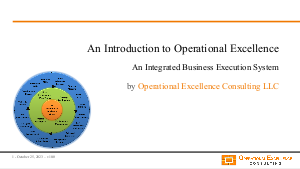
This 50-slide presentation provides a high-level introduction to the 4 Building Blocks of Operational Excellence. Achieving OpEx requires the implementation of a Business Execution System that integrates these 4 building blocks.