 Click main image to view in full screen. Unlock all 32 preview images:
Value Innovation Strategy – PowerPoint PPTX Template
PowerPoint (PPTX) + Zip archive file (ZIP) 113 Slides


BENEFITS OF THIS DOWNLOADABLE POWERPOINT DOCUMENT
- Escape price wars by unlocking simultaneous differentiation and low-cost Value Innovation.
- Visualize strategy on one page using the Strategy Canvas, ERRC Grid, and Six Paths Framework.
- Deliver turn-key executive workshops with 113 editable slides, facilitator guides, and A3 worksheets.
VALUE INNOVATION PPT TEMPLATE DESCRIPTION
VALUE INNOVATION STRATEGY TRAINING PRESENTATION & IMPLEMENTATION TOOLKIT
More than just "differentiation"—it is the foundation of market-creating leadership and value innovation. Grounded in W. Chan Kim and Renée Mauborgne's Blue Ocean Strategy and integrated with Lean management practices, this 110+ slide masterclass provides a comprehensive roadmap for implementing Value Innovation Strategy. From visual strategy canvases to 100-day execution roadmaps, learn how to break out of saturated market competition, aggregate noncustomer demand, and render rivals irrelevant.
EXECUTIVE SUMMARY
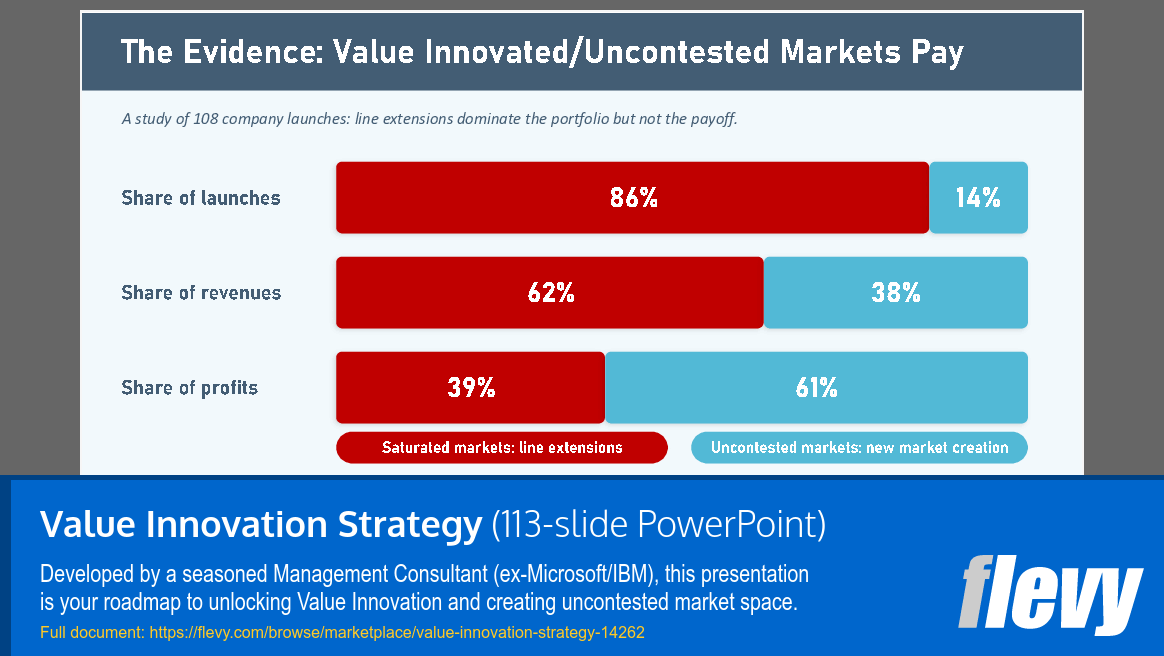
Traditional strategy views industry boundaries as static, forcing companies to choose between differentiation and low cost. Value Innovation Strategy proves that market boundaries can be reshaped systematically via Value Innovation. Research across 108 corporate launches showed that while 86% were incremental extensions, the 14% creating uncontested market space captured 61% of total profits. Analyzing the Strategic Move across 150+ initiatives in 30+ industries, this toolkit delivers a repeatable visual process to chart value curves, unlock noncustomer demand, eliminate waste, and align execution.
KEY BENEFITS FOR YOUR ORGANIZATION
★ Stop Benchmarking Rivals: Create leaps in buyer value while lowering cost structures instead of imitating competitors.
★ Make Strategy Visual on One Page: Diagnose industry over-engineering and align teams using a clear Strategy Canvas profile.
★ Discover Untapped Markets: Apply the Six Paths Framework to uncover fresh demand across conventional industry boundaries.
★ Mitigate Business Model Risk: Validate commercial viability through the 4-step sequence (Utility, Price, Cost, Adoption).
★ Ensure Voluntary Execution: Overcome organizational hurdles via Tipping Point Leadership and Fair Process (Engagement, Explanation, Expectation Clarity).
TARGET AUDIENCE
• Senior Executives & Business Unit Leaders: Setting long-term growth direction, escaping cutthroat saturated markets, and championing market-creating Value Innovation.
• Strategy & Innovation Executives: Redefining market boundaries, capturing untapped noncustomer pools, and validating scalable business models.
• Operational Excellence & Lean Practitioners: Linking strategic value curves to frontline Lean execution, Gemba walks, VSM, and Hoshin Kanri.
• Corporate Transformation & Planning Teams: Seeking a visual, structured alternative to traditional benchmarking, SWOT analysis, and MBO.
WHAT'S INCLUDED IN THE BOX?
★ Master Presentation Deck (PPTX): 110+ widescreen (16:9) slides styled in executive Bahnschrift typography with color-coded module banners.
★ Masterclass Facilitation Guide (DOCX): Complete facilitator manual featuring timing schedules, speaker prompts, debrief questions, and Lean integrations.
★ Team Exercise Facilitation Notes (DOCX): Step-by-step instructions for all 8 team activities, run sheets, coaching cues, and worked solutions.
★ Print-Ready Workshop Templates (PPTX): High-resolution A3 worksheets covering the Strategy Canvas, ERRC Grid, Buyer Utility Map, VII Index, and 100-Day Action Plan.
LEARNING OBJECTIVES
Upon completing this masterclass, participants will be able to:
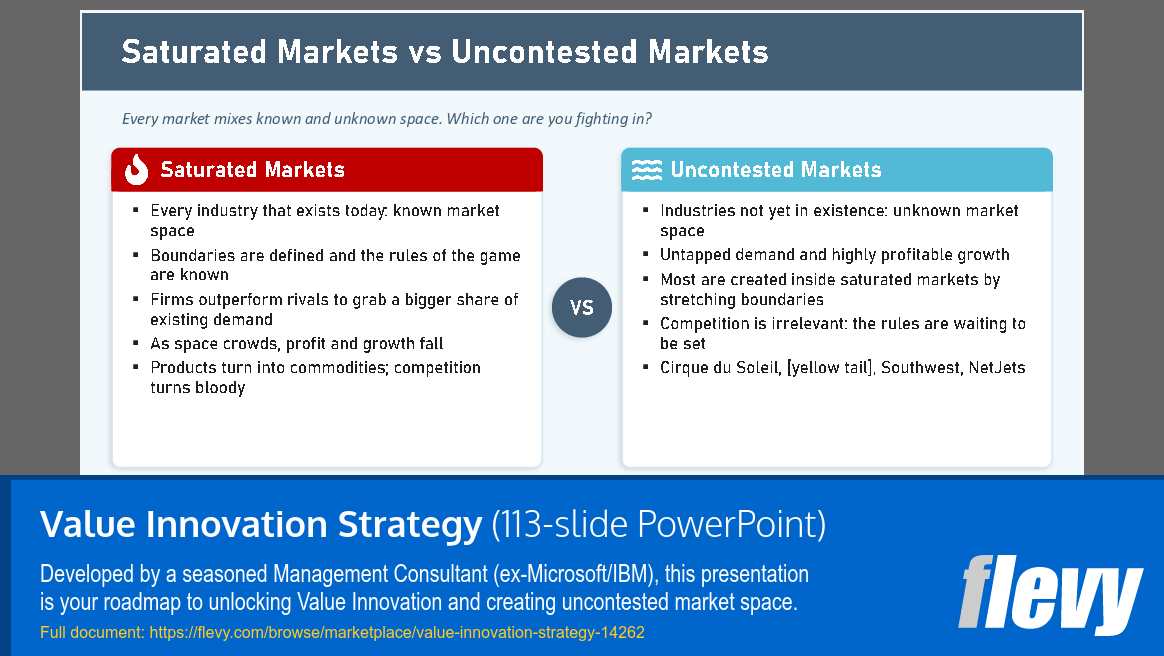
• Explain why saturated markets intensify and contrast saturated market versus value innovation strategies.
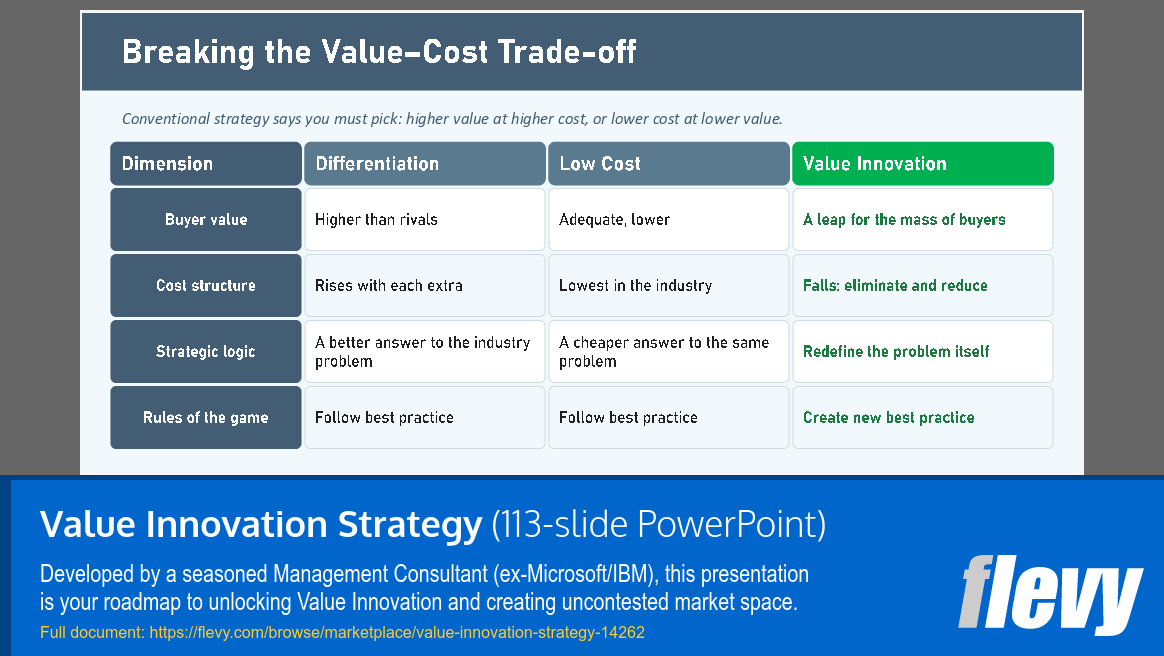
• Define Value Innovation and demonstrate how it breaks the value–cost trade-off.
• Construct and interpret a Strategy Canvas using the Four Actions Framework and ERRC Grid.
• Apply the Six Paths Framework to reshape industry boundaries and unlock new demand.
• Visualize strategy via the four-step process and assess portfolios using the PMS Map.
• Segment and prioritize three tiers of noncustomers to identify shared demand drivers.
• Validate business ideas across utility, price, cost, and adoption using the VII Index.
• Surmount execution hurdles through Tipping Point Leadership, Fair Process, and aligned propositions.
• Integrate Value Innovation tools with Lean practices including Gemba, VSM, A3, VOC, target costing, and Hoshin Kanri.
• Sidestep ten saturated market traps and execute a structured 100-Day Action Plan.
DETAILED TRAINING CONTENTS
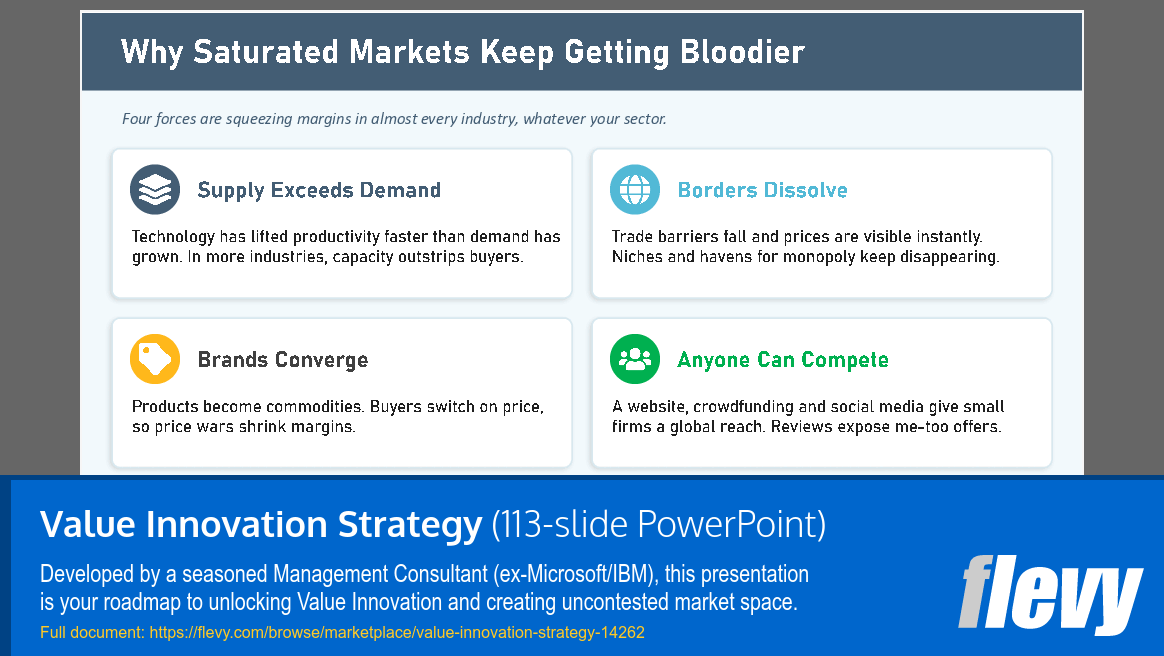
• Module 1: Why Value Innovation? The Strategic Imperative – Analyzes saturated market pressures and introduces Value Innovation to simultaneously drive differentiation and low cost.
• Module 2: The Analytical Tools: Canvas, Four Actions & ERRC – Deploys the Strategy Canvas, Four Actions Framework, and ERRC Grid to visualize strategy and align cost savings with buyer value.
• Module 3: Six Paths to Reconstruct Market Boundaries – Explores six systematic search paths across market boundaries while linking exploration to Lean tools like Gemba and VSM.
• Module 4: Visualise Strategy: Big Picture, Not Numbers – Covers the four-step visual strategy process and applies the Pioneer-Migrator-Settler (PMS) Map to evaluate growth portfolios.
• Module 5: Reach Beyond Existing Demand: Noncustomers – Demonstrates how to reverse hyper-segmentation by aggregating demand across the Three Tiers of Noncustomers.
• Module 6: Strategic Sequence & Business Model Viability – Applies the four-step sequence (Utility, Price, Cost, Adoption) via the Buyer Utility Map and VII Index to verify commercial viability.
• Module 7: Executing Value Innovation: Hurdles, Fair Process & Alignment – Resolves execution barriers using Tipping Point Leadership, Fair Process (3 E's), and alignment across Value, Profit, and People propositions.
• Module 8: Renew, Avoid Traps & Your 100-Day Action Plan – Exposes ten saturated market traps, establishes imitation barriers, and translates strategy into an actionable 100-Day Action Plan.
• Appendix: Standard Workshop Templates & Worksheets – Supplies 10 print-ready A3 templates for core tools including the Strategy Canvas, ERRC Grid, and VII Index.
PROPOSED 1-DAY WORKSHOP AGENDA
• 09:00–09:45 Module 1: Why Value Innovation? The Strategic Imperative
• 09:45–10:45 Module 2: Analytical Tools (Canvas, Four Actions & ERRC Grid) + Activity: Draw Your Strategy Canvas
• 11:00–12:15 Module 3: Six Paths to Reconstruct Market Boundaries + Activity: Six Paths Idea Sprint
• 13:00–13:40 Module 4: Visualise Strategy: Big Picture, Not Numbers (PMS Map & Strategy Fair)
• 13:40–14:20 Module 5: Reach Beyond Existing Demand: 3 Tiers of Noncustomers
• 14:35–15:20 Module 6: Strategic Sequence & Business Model Viability (Buyer Utility Map & VII Index)
• 15:20–16:00 Module 7: Executing Value Innovation: 4 Hurdles, Fair Process & Strategic Alignment
• 16:00–17:00 Module 8: Renew, Avoid Traps & 100-Day Action Plan + Activity: Commit to Your First 30 Days
GLOSSARY OF KEY TERMS
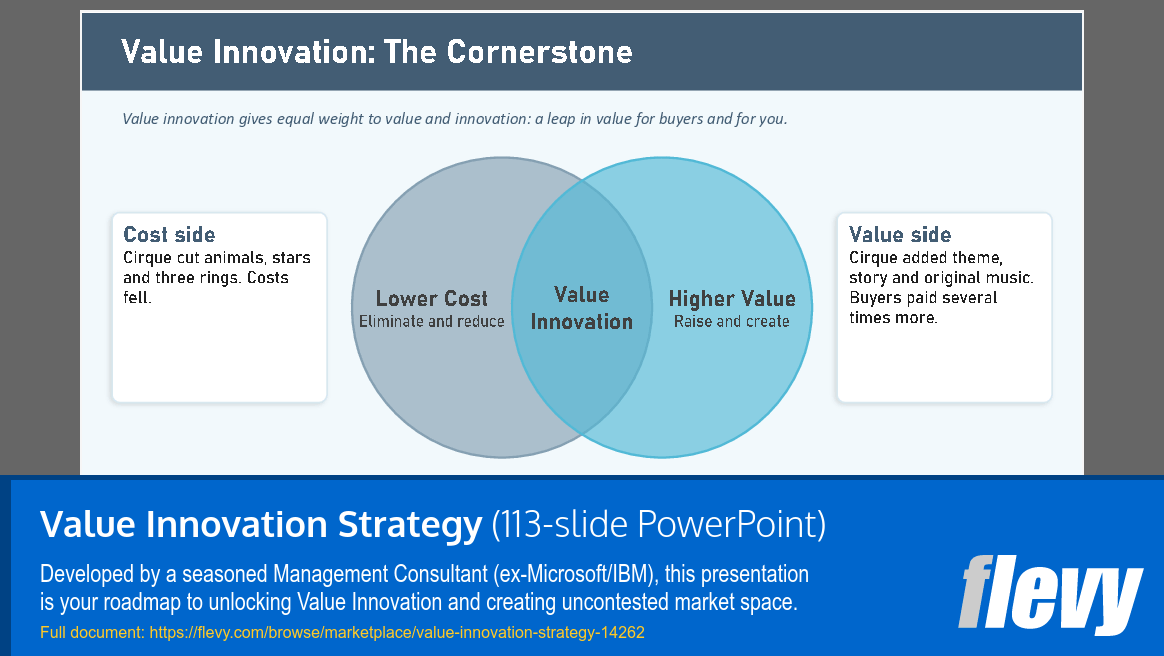
• Value Innovation: Pursuing differentiation and low cost simultaneously to break the value–cost trade-off and create leaps in buyer value.
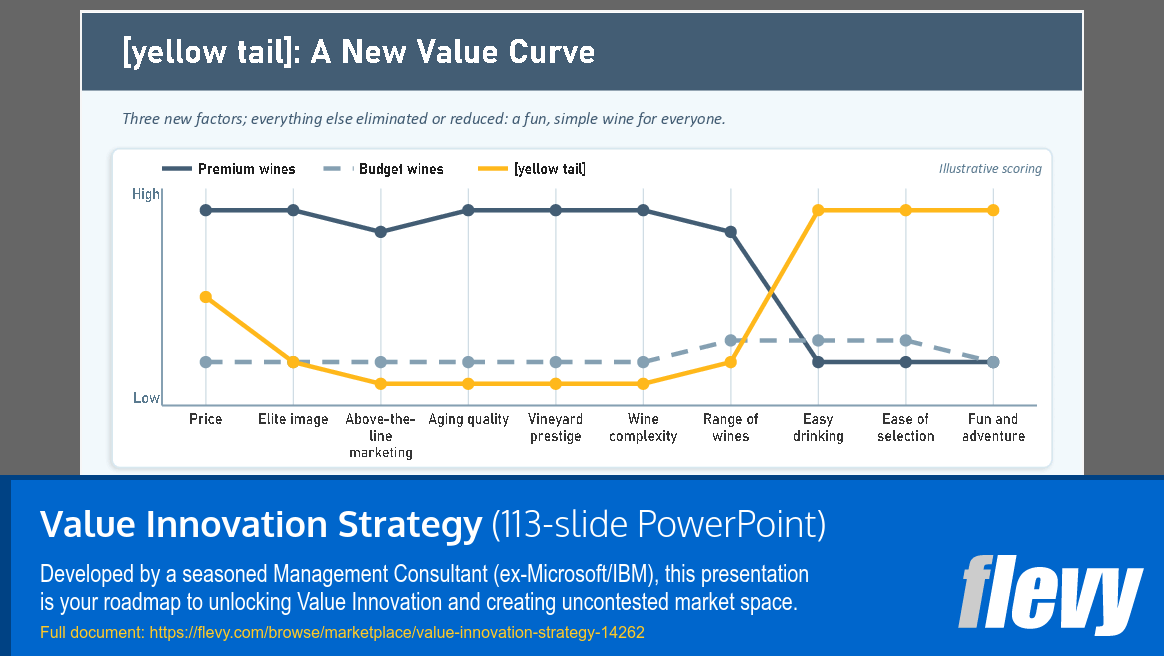
• Strategy Canvas: A visual diagnostic and action tool plotting an industry's competing factors and strategic profiles.
• ERRC Grid: A four-action matrix (Eliminate, Reduce, Raise, Create) designed to challenge industry assumptions and lower costs.
• Six Paths Framework: Systematic pathways across alternative industries, strategic groups, buyer chains, and complementary offerings to reframe boundaries.
• Three Tiers of Noncustomers: Untapped demand pools consisting of Tier 1 ("soon-to-be"), Tier 2 ("refusing"), and Tier 3 ("unexplored") buyers.
• Buyer Utility Map: A 36-cell matrix crossing 6 buyer experience stages with 6 utility levers to pinpoint industry pain points.
• Value Innovation Idea (VII) Index: A commercial viability checklist assessing Utility, Strategic Price, Target Cost, and Adoption hurdles.
• Tipping Point Leadership: An execution approach targeting disproportionate influence factors to overcome cognitive, resource, motivational, and political hurdles.
FREQUENTLY ASKED QUESTIONS (FAQs)
How does Value Innovation Strategy differ from traditional differentiation?
Traditional differentiation raises buyer value alongside costs, whereas Value Innovation achieves differentiation and low cost concurrently.
Is Value Innovation Strategy applicable to B2B and regulated sectors?
Yes; it has succeeded across B2B industries including industrial transit (NABI), commercial cement (Cemex), and corporate aviation (NetJets).
How does this toolkit integrate Value Innovation Strategy with Lean Management?
Lean optimizes processes inside an existing value curve, while Value Innovation Strategy reshapes the curve; Gemba and VSM feed empirical data into value innovation search paths.
What is included in the editable PowerPoint presentation package?
You receive 110+ widescreen slides with visual diagrams, structured matrices, module banners, and 10 print-ready A3 workshop templates.
How do the facilitation guides assist trainers and consultants?
They provide slide-by-slide speaker notes, timing guides, coaching tips, Lean linkages, and debrief prompts for all 8 group exercises.
What is the recommended workshop duration?
The core program runs as a 1-day executive masterclass with 3 core activities, expandable to 2 days using all 8 exercises.
Why focus on noncustomers rather than existing buyers?
Targeting existing customers drives fine segmentation and shrinking markets, whereas noncustomers reveal common pain points that unlock mass demand.
How does the 100-Day Action Plan drive post-workshop execution?
It converts strategy into phased milestones (Days 1–30: See, Days 31–60: Create, Days 61–100: Commit) with assigned owners.
Got a question about the product? Email us at support@flevy.com or ask the author directly by using the "Ask the Author a Question" form. If you cannot view the preview above this document description, go here to view the large preview instead.
Source: Best Practices in Value Innovation PowerPoint Slides: Value Innovation Strategy PowerPoint (PPTX) Presentation Slide Deck, Operational Excellence Consulting
ABOUT THE AUTHOR

Operational Excellence Consulting, founded in 2009 by Allan Ung, draws from extensive experience at Microsoft, IBM, and Underwriters Laboratories (UL). We specialize in strategy deployment, customer experience design, and operational excellence, applying Design Thinking, Lean, and Systems Thinking to maximize customer value and minimize waste.
Our
... [read more]
Ask the Author a Question
You must be logged in to contact the author.