
 Click main image to view in full screen. Unlock all 9 preview images:
Solar CapEx, Underwriting & Investment Committee Pack – Excel XLSX
Excel (XLSX) + Zip archive file (ZIP)


BENEFITS OF THIS DOWNLOADABLE EXCEL DOCUMENT
- Moves a defined utility-scale solar program from construction budget to financing structure and investment committee decision.
- Links every construction line to a monthly funding requirement, then finances those requirements month by month against P90 cash flow.
- Allows multiple fully financed structures or scenarios to compete under one committee framework rather than comparing isolated IRRs.
SOLAR ENERGY EXCEL DESCRIPTION
This three-model Excel pack covers the investment stages of a utility-scale solar project that begin once the site and its energy yield have already been established. It takes a defined development program from construction budget, through financing structure, to a documented investment committee decision.
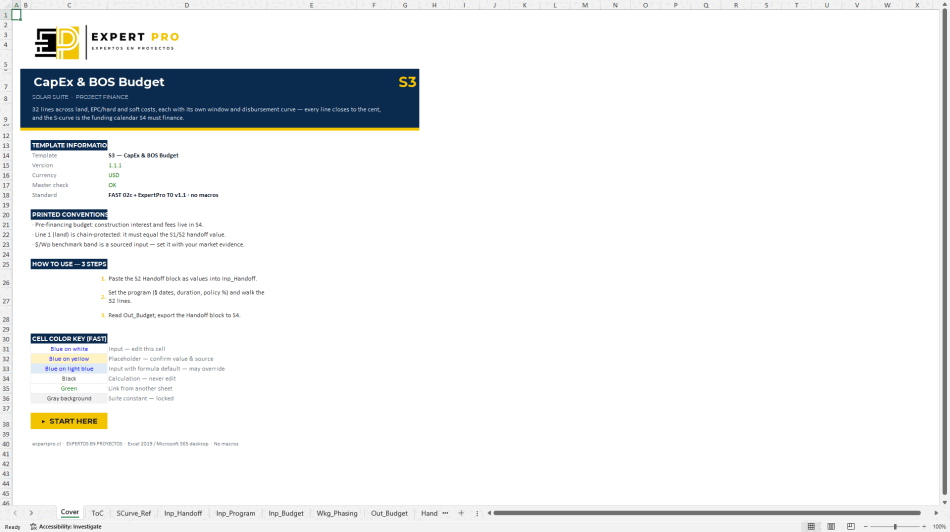
S3 – CAPEX AND BALANCE OF SYSTEM BUDGET
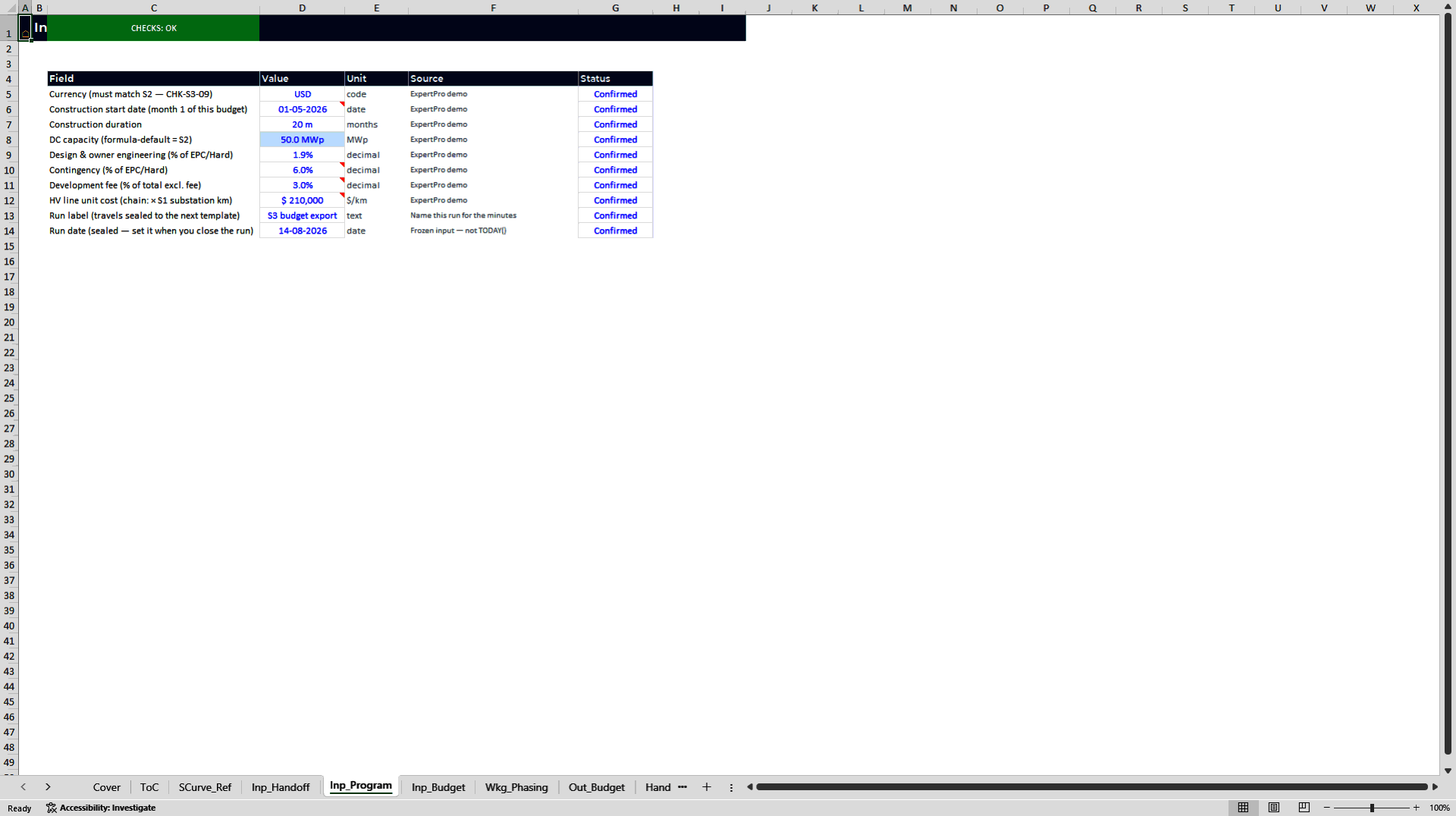
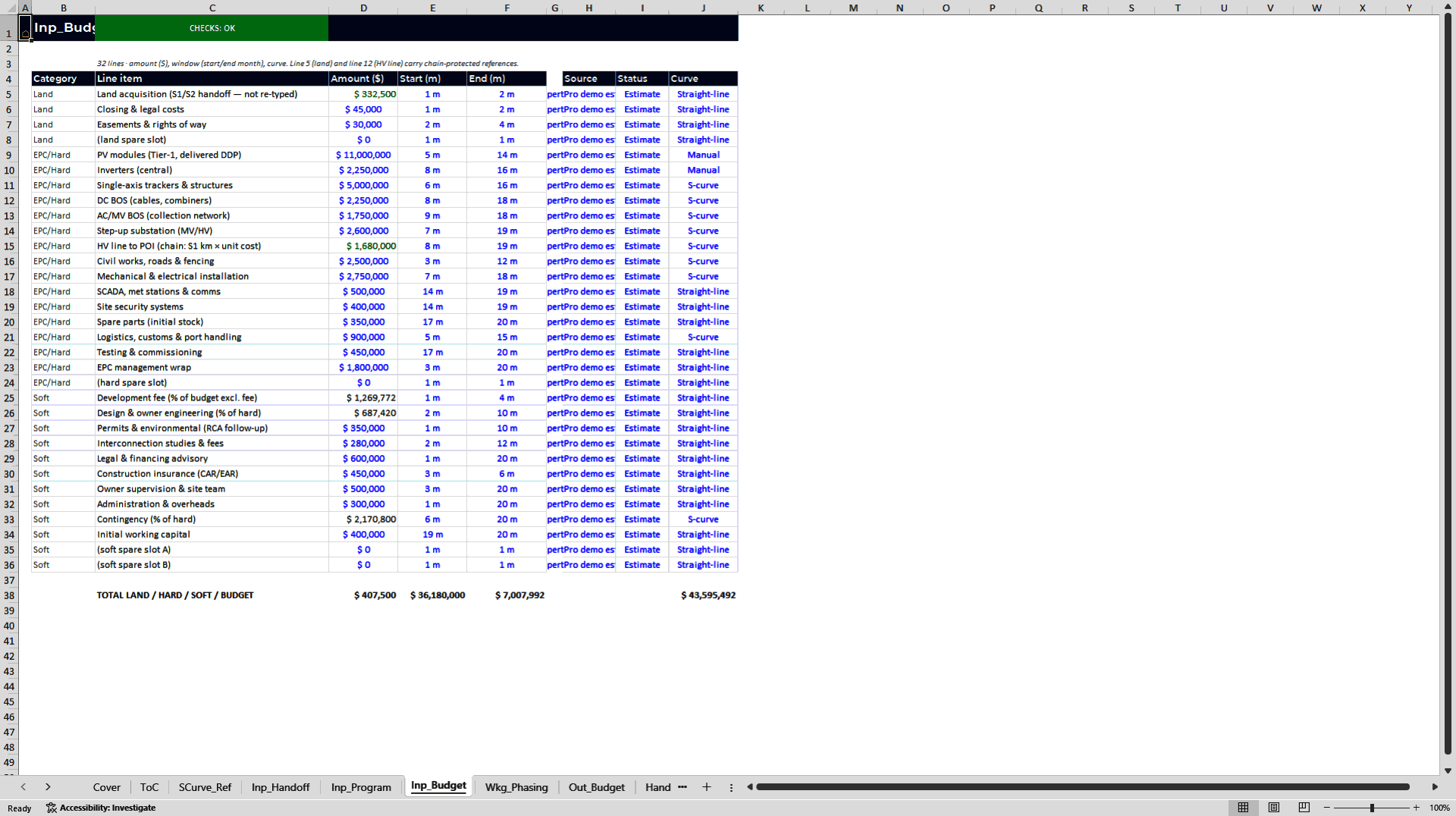
S3 builds a conceptual construction budget across land, hard costs and soft costs, covering the cost blocks of a utility-scale photovoltaic plant: land and civil works, modules, inverters, mounting structure and balance of system, electrical works and interconnection, EPC and owner's costs.
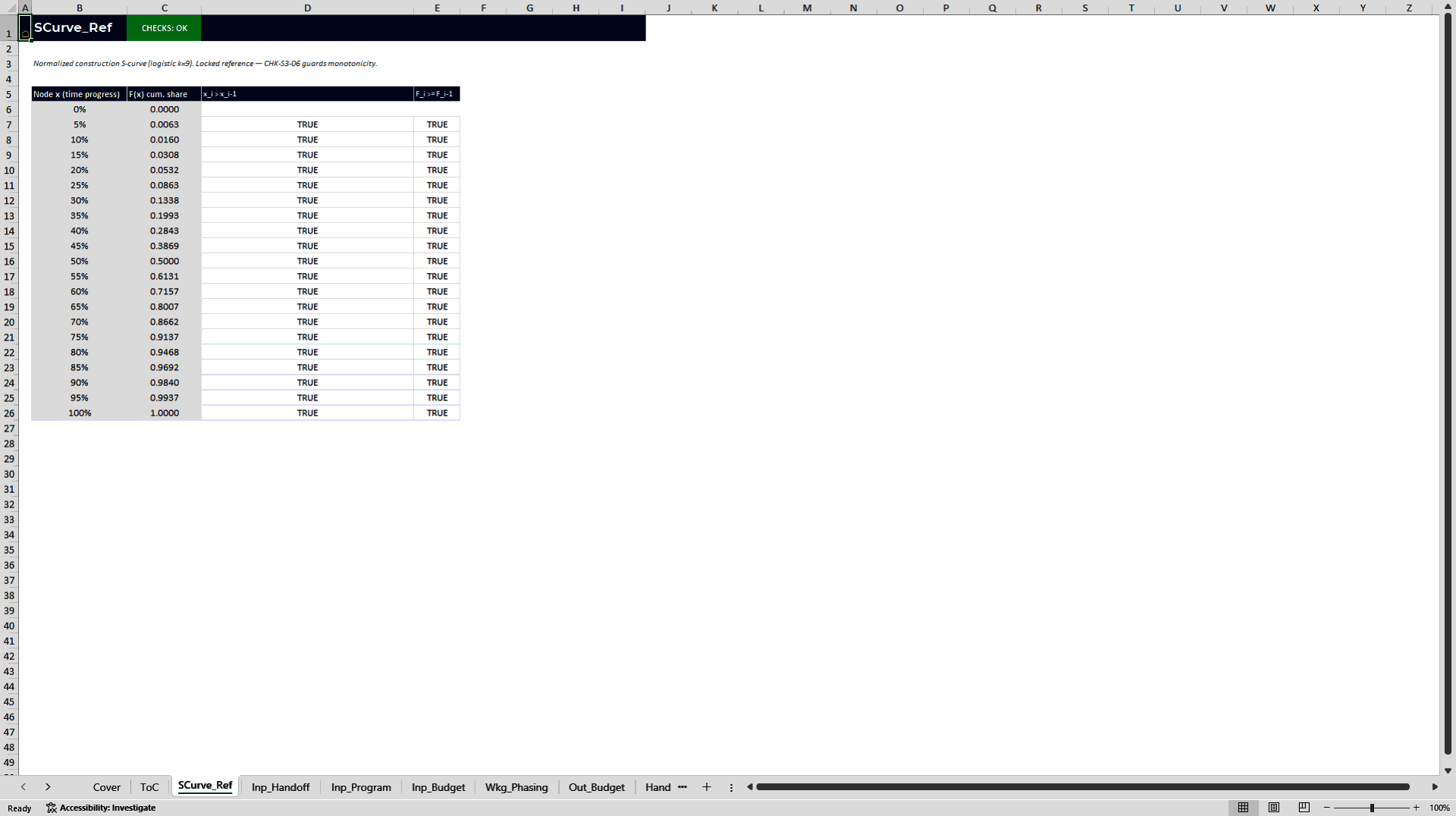
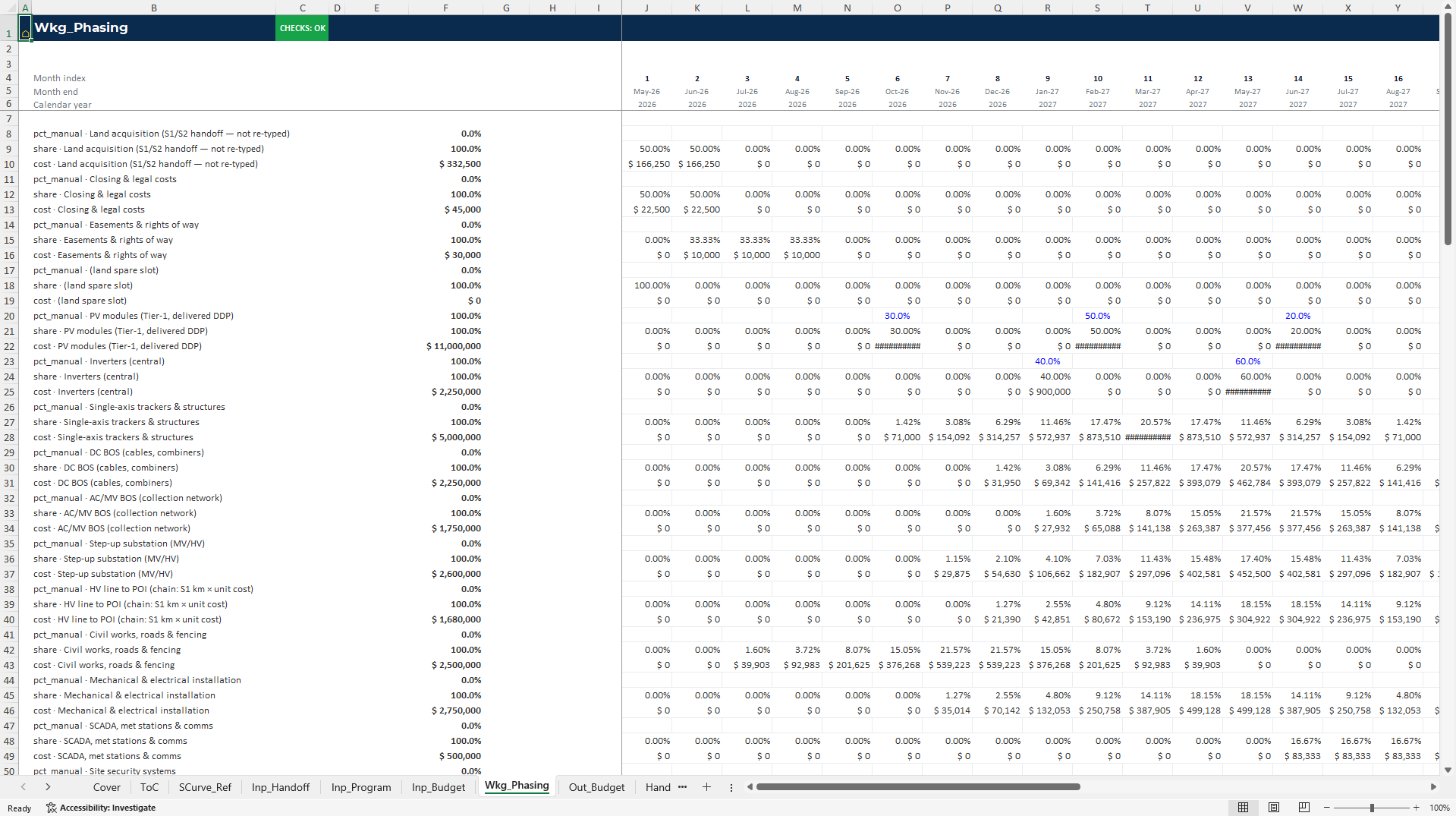
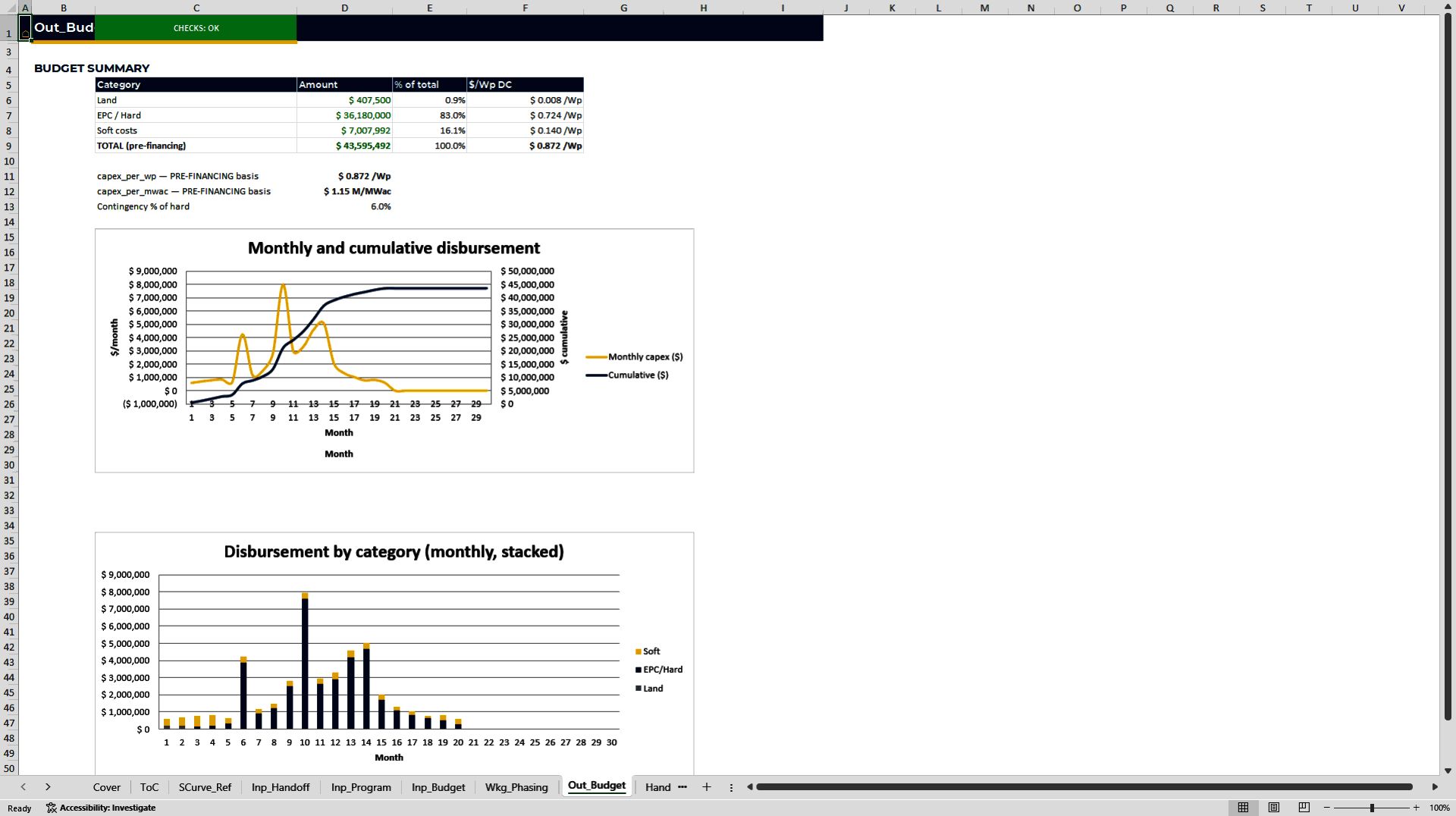
Each budget line has its own execution window and a straight-line, S-curve or manual disbursement profile. The result is a monthly CapEx calendar and a construction S-curve, so the model answers both how much the plant costs and when the money must actually be funded.
S4 – PROJECT FINANCE MODEL
S4 receives the construction calendar and the commercial assumptions and builds a 25-year underwriting case. Construction is modeled monthly and operations annually.
It covers contracted PPA and merchant revenue, operating costs, senior debt sizing and gearing constraints, DSCR-based debt sculpting, interest during construction, financing fees, Debt Service Reserve Account funding and release, a configurable simplified corporate-tax treatment, and equity and project returns.
A core design choice is the separation between investor and lender perspectives: the equity case can be run against the selected production scenario while debt capacity is calculated from P90 cash flow, so an optimistic equity sensitivity cannot quietly inflate the debt case.
S5 – INVESTMENT COMMITTEE DASHBOARD
S5 receives up to twelve completed S4 runs and compares scenarios or financing structures against configurable absolute hurdles: minimum equity IRR, minimum P90 DSCR, minimum equity NPV and maximum payback.
Outputs include a validated ranking, a sensitivity tornado and a one-page committee recommendation. S5 never modifies the runs it receives, so the board is a decision record rather than another modeling layer.
HOW THE THREE MODELS CONNECT
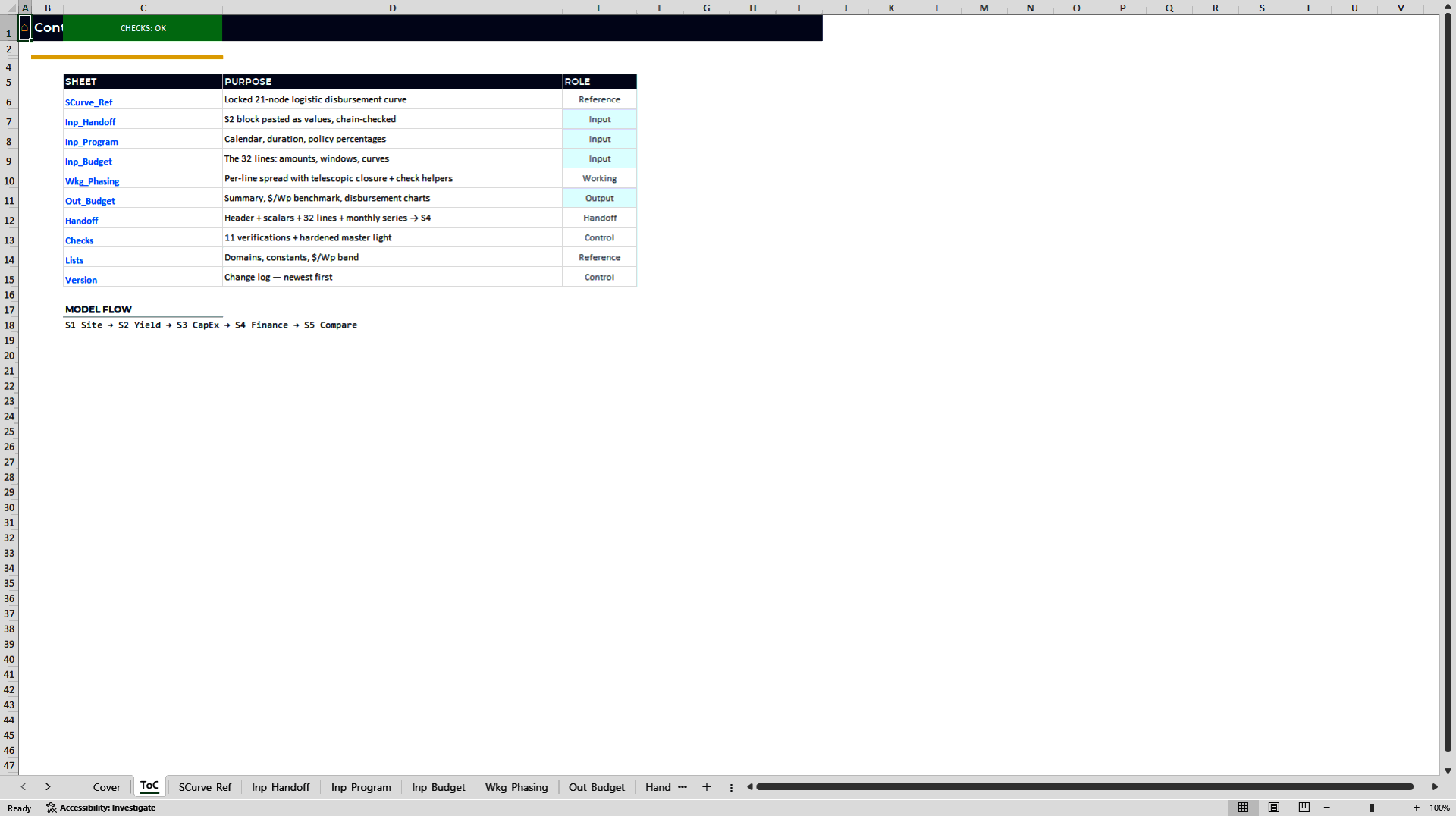
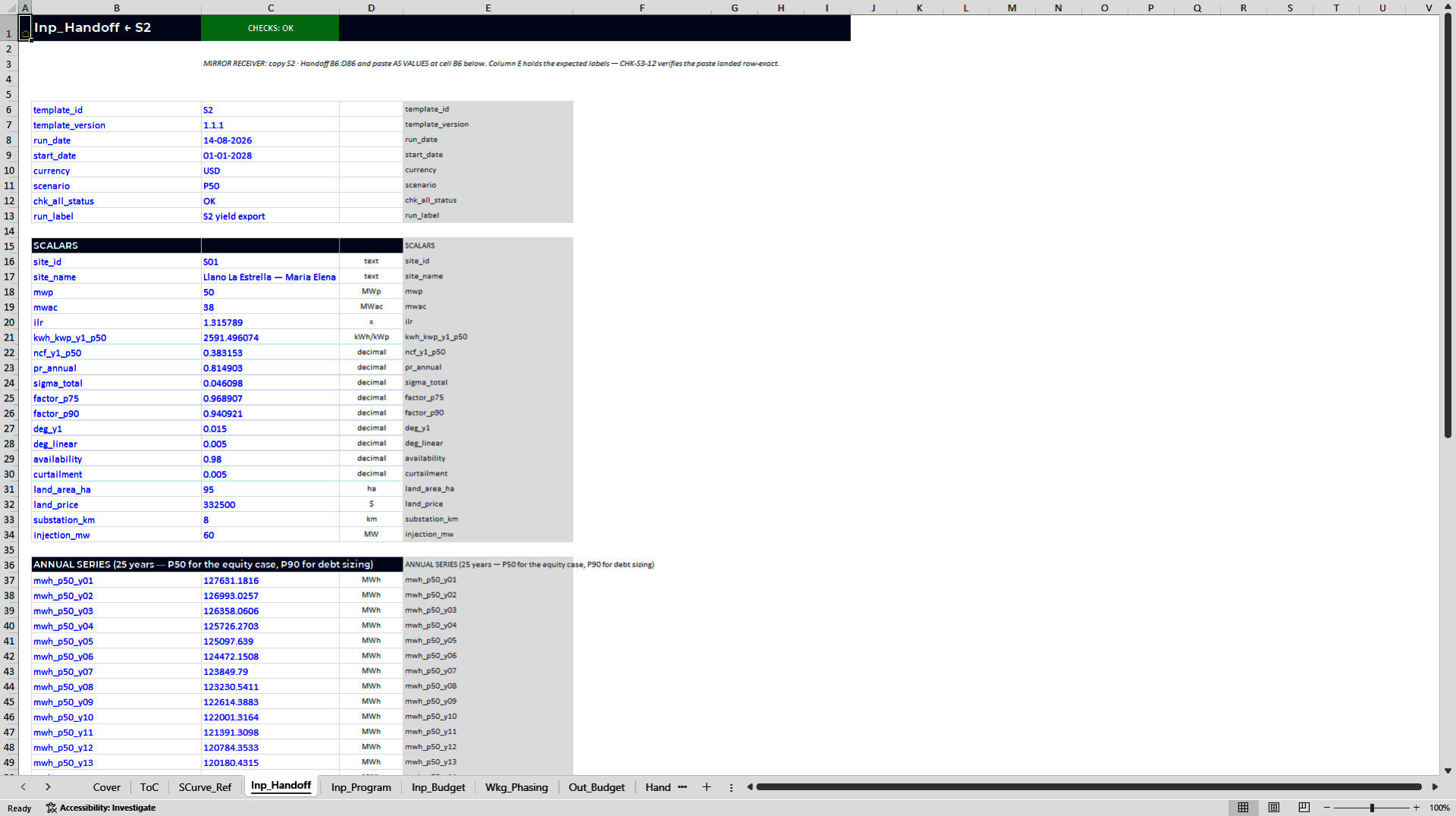
The models pass information forward through controlled handoffs rather than live external links. S3 produces the monthly funding requirement that S4 finances, and S4 exports completed runs that S5 compares. This protects the chain from broken workbook links and silent upstream changes.
WHAT YOU RECEIVE
Three Excel models, three dedicated user manuals, a Pack Quick Start, a worked demonstration case and the licence, scope and disclaimer documentation. The secondary file is a ZIP bundle containing the complete set.
WHO IT IS FOR
Solar developers, independent power producers, infrastructure and energy transition funds, investment committees, project finance analysts, banks and credit teams, transaction advisors, financial modelers and investors underwriting utility-scale solar programs.
WHAT IT IS NOT
The pack does not include the site-screening and energy yield models contained in S1 and S2. The buyer must already have a defined project and an externally prepared P50 and P90 energy study.
It is an underwriting and decision toolkit, not a complete tax model, legal model, final lender model or substitute for technical due diligence.
Got a question about the product? Email us at support@flevy.com or ask the author directly by using the "Ask the Author a Question" form. If you cannot view the preview above this document description, go here to view the large preview instead.
Source: Best Practices in Solar Energy, Integrated Financial Model Excel: Solar CapEx, Underwriting & Investment Committee Pack Excel (XLSX) Spreadsheet, ExpertPro Consulting
ABOUT THE AUTHOR

ExpertPro is an advisory firm that builds the financial and decision infrastructure behind capital projects. Our work sits at the intersection of project finance, engineering economics and data: we model, stress-test and document infrastructure investments so that sponsors, lenders and investment committees can decide on evidence rather than intuition.
The practice is led by Eduard Kofman, .
... [read more]
Ask the Author a Question
You must be logged in to contact the author.




























