
BENEFITS OF THIS POWERPOINT DOCUMENT
- This will help improve quality using various quality tools, root cause analysis and ultimately error proofing
PROBLEM SOLVING PPT DESCRIPTION
Editor Summary
Problem Solving & Error Proofing - 1 Day Course is a 112-slide PowerPoint training presentation (PPT with a supplemental ZIP of 41 Lean documents) developed by OpEx Academy NZ and a Lean pioneer who is a certified LSS Master Black Belt and has trained 5,000+ students; endorsed by CMI Consortium, NZTE, HERA, NZPICS, CBAFF.
Read more
Covers Root Cause Analysis (RCA), PDCA, Poka-Yoke, Fishbone Diagrams, Pareto and Control Charts, DoE and 7 Quality Tools. Target users include Quality Assurance Managers, Operations Managers, Team Leaders, Continuous Improvement Practitioners and frontline staff. Sold as a digital download on Flevy with immediate digital download.
Use this deck when your organization needs a structured, instructor-led session to reduce defects, embed error-proofing, or launch a process improvement project—typical triggers include new quality initiatives, waste-reduction drives, or skills workshops.
Quality Assurance Managers running defect-reduction programs using Pareto charts and Cost of Quality analysis.
Operations Managers mapping processes and applying PDCA cycles to reduce waste.
Team Leaders facilitating RCA workshops with Fishbone Diagrams and PDCA worksheets.
Continuous Improvement Practitioners designing Poka-Yoke systems and using DoE for optimization.
The course’s reliance on PDCA, RCA and Poka-Yoke reflects standard Lean continuous improvement practices used in operational excellence programs.
This presentation discusses the following: 112 slides
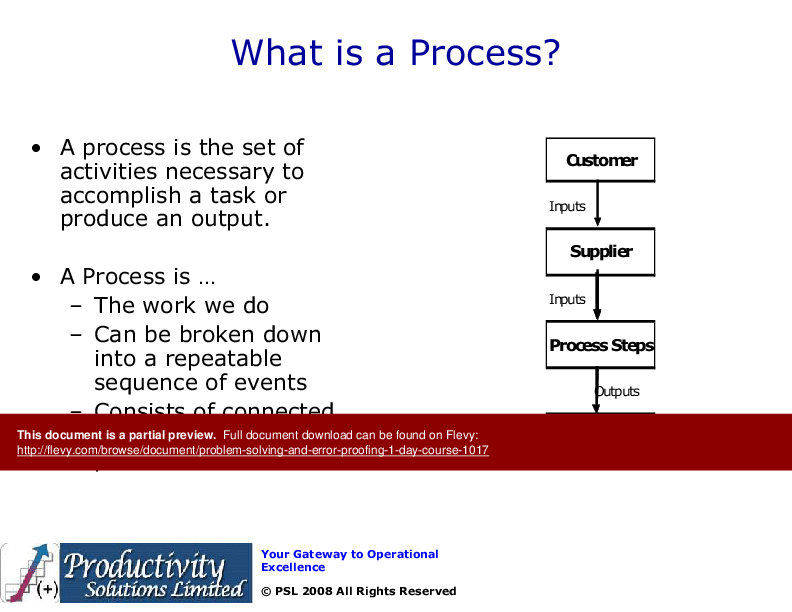
What is Process and Problem Solving
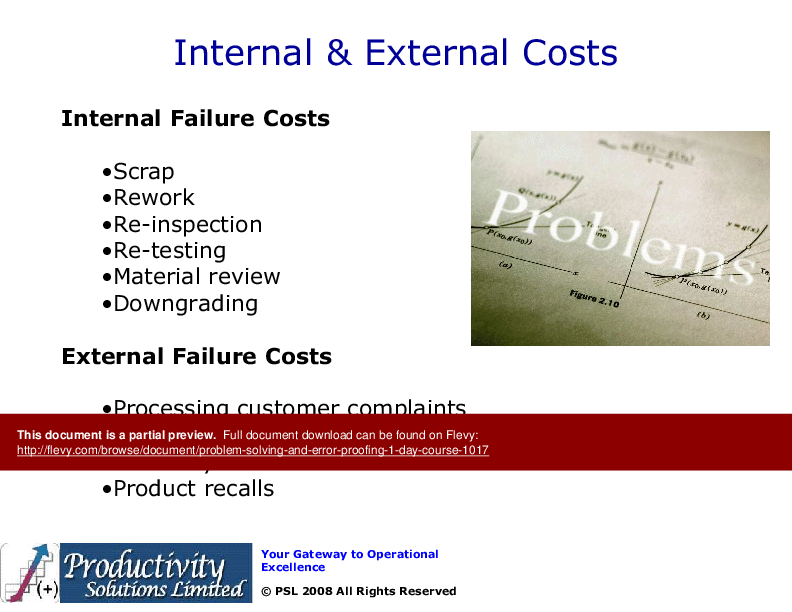
Costs of Quality
Tools for Process Improvements
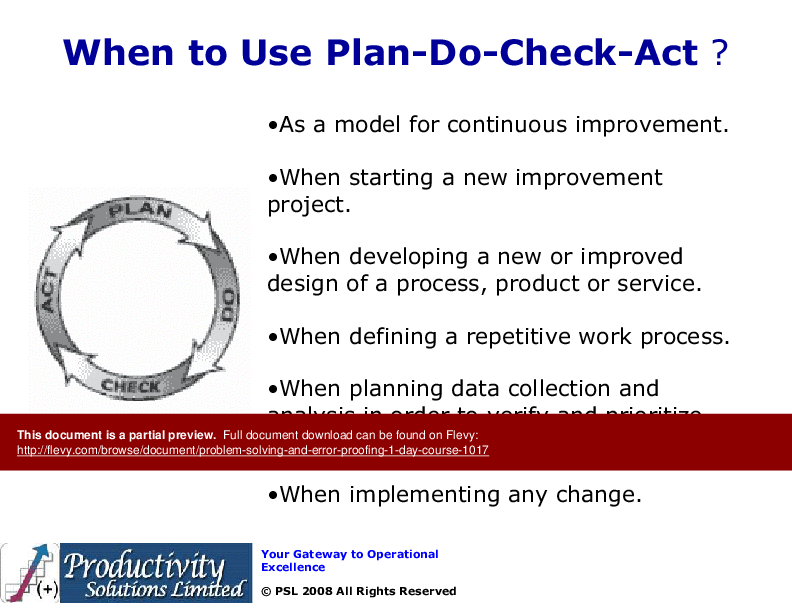
PDCA (Plan-Do-Check-Act)
7 Quality Tools
DoE (Design of Experiments)
Brain Storming and Nominal Group Techniques
Affinity Diagrams
RCA (Root Cause Analysis)
5 Steps in Problem Solving – A Systemic Approach
Error Proofing – Intro to ZQC
Approaches to Inspection
Poka-Yoke techniques
Also included with this document is a bonus zip of 41 Lean documents (includes templates, case studies, articles, posters, charts, and more).
Got a question about the product? Email us at support@flevy.com or ask the author directly by using the "Ask the Author a Question" form. If you cannot view the preview above this document description, go here to view the large preview instead.
MARCUS OVERVIEW
This synopsis was written by Marcus
[?] based on the analysis of the full 112-slide presentation.
Executive Summary
The Problem Solving & Error Proofing course presentation equips participants with essential tools and methodologies for enhancing operational efficiency and quality. Developed by a Lean pioneer and certified LSS Master Black Belt, this training is designed for professionals at all levels, from executives to shop floor staff. The course covers critical concepts such as Root Cause Analysis (RCA), PDCA (Plan-Do-Check-Act), and Poka-Yoke techniques, enabling attendees to systematically identify and eliminate process gaps. Download this comprehensive 1-day course presentation to foster a culture of continuous improvement within your organization.
Who This Is For and When to Use
• Quality Assurance Managers focused on reducing defects and improving processes
• Operations Managers seeking to enhance efficiency and minimize waste
• Team Leaders responsible for implementing quality control measures
• Continuous Improvement Practitioners aiming to embed Lean methodologies
• Frontline Staff engaged in daily operations and quality checks
Best-fit moments to use this deck:
• During team training sessions on quality improvement methodologies
• When initiating a new project aimed at process optimization
• In workshops focused on problem identification and resolution
• As a resource for developing standard operating procedures
Learning Objectives
• Define the concept of quality and its impact on operational success
• Identify gaps in performance through systematic problem-solving techniques
• Apply the PDCA cycle to drive continuous improvement initiatives
• Utilize quality tools such as Fishbone Diagrams and Pareto Charts for analysis
• Implement Poka-Yoke systems to prevent errors in processes
• Establish a culture of quality at the source to enhance overall productivity
Table of Contents
• Vision and Objectives (page 3)
• Understanding Processes (page 5)
• Costs of Quality (page 7)
• Tools for Process Improvement (page 10)
• PDCA Cycle (page 12)
• 7 Quality Tools (page 15)
• Root Cause Analysis (page 20)
• Error Proofing Techniques (page 25)
• Poka-Yoke Systems (page 30)
• Implementation Strategies (page 35)
• Conclusion and Next Steps (page 40)
Primary Topics Covered
• Quality at Source - Focus on building quality into processes to prevent defects before they occur.
• Root Cause Analysis (RCA) - A systematic approach to identifying the fundamental causes of performance gaps.

• PDCA Cycle - A framework for continuous improvement through planning, executing, checking, and acting on results.
• Poka-Yoke Techniques - Error-proofing methods designed to prevent mistakes in manufacturing and service processes.
• 7 Quality Tools - Fundamental tools for quality control, including Fishbone Diagrams and Control Charts.
• Costs of Quality - Understanding the financial impact of poor quality and the importance of prevention.
Deliverables, Templates, and Tools
• RCA templates for identifying and documenting root causes
• PDCA cycle worksheets for planning and tracking improvement initiatives
• Quality tool checklists for implementing 7 Quality Tools
• Poka-Yoke design templates for creating error-proofing systems
• Cost of Quality analysis frameworks for assessing financial impacts
• Implementation planning guides for standardizing work practices
Slide Highlights
• Vision slide emphasizing the importance of quality at the source
• PDCA cycle diagram illustrating the continuous improvement process
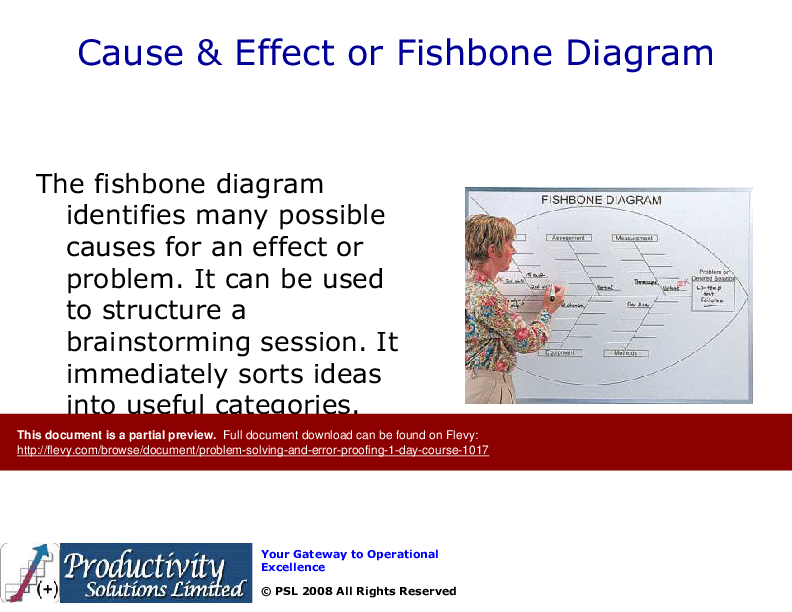
• Fishbone Diagram example for visualizing potential causes of problems
• Poka-Yoke system illustrations showing practical applications in manufacturing
• Cost of Quality breakdown highlighting internal and external failure costs
Potential Workshop Agenda
Introduction to Quality Concepts (60 minutes)
• Overview of quality principles and their importance
• Discussion on the costs of poor quality
Problem Solving Techniques (90 minutes)
• Introduction to RCA and its methodologies
• Hands-on activity using Fishbone Diagrams
Implementing PDCA and Poka-Yoke (90 minutes)
• Interactive session on applying the PDCA cycle
• Group work on designing Poka-Yoke systems
Wrap-Up and Next Steps (30 minutes)
• Review key takeaways and action items
• Discuss how to integrate learnings into daily operations
Customization Guidance
• Tailor the presentation to reflect specific industry challenges and terminology
• Incorporate company-specific examples and case studies for relevance
• Adjust the workshop agenda based on team size and available time
• Include metrics and KPIs relevant to your organization's quality goals
Secondary Topics Covered
• Design of Experiments (DoE) for process optimization
• Brainstorming techniques for generating creative solutions
• Affinity Diagrams for organizing complex information
• Continuous Improvement methodologies and their applications
Topic FAQ
What are the core steps of the PDCA cycle and how is it used in problem solving?
PDCA is a four-step continuous improvement cycle: Plan what to change, Do the implementation, Check the results, and Act on lessons learned. It’s used to structure iterative experiments and implementation in operational improvement work and is presented as a four-step PDCA cycle in the course.
What is Root Cause Analysis and how should teams apply it to recurring defects?
Root Cause Analysis (RCA) is a systematic method for identifying the fundamental causes of problems so you can address origins rather than symptoms. Teams apply RCA by mapping causes, using tools like Fishbone Diagrams, and documenting findings using RCA templates supplied in the course’s materials.
What are Poka-Yoke systems and when should a process adopt them?
Poka-Yoke systems are error-proofing techniques designed to prevent mistakes or make errors immediately obvious, reducing defects even when human error occurs. They’re appropriate once causes are understood and are illustrated in the course with Poka-Yoke system examples and design templates.
Which of the 7 Quality Tools are most useful for incident analysis and prioritization?
For incident analysis and prioritization, common 7 Quality Tools include Fishbone (cause-and-effect) Diagrams for root cause visualization, Pareto Charts for prioritizing issues by frequency or impact, and Control Charts for monitoring process stability, with Fishbone Diagram, Pareto Chart, Control Chart as examples.
What should I look for in a problem-solving training deck for my operations team?
Look for explicit RCA templates, PDCA worksheets, Poka-Yoke design templates, Cost of Quality frameworks, and a sample workshop agenda to structure delivery. Problem Solving & Error Proofing - 1 Day Course includes those elements and comes with 112 slides plus a supplemental ZIP of 41 Lean documents.
How much time and what agenda should I plan for a one-day problem solving workshop?
A practical one-day agenda can include an introductory quality concepts session (60 minutes), problem solving techniques with RCA (90 minutes), PDCA and Poka-Yoke application (90 minutes), and a wrap-up (30 minutes), totaling about 4.5 hours; the example agenda aligns with a 112-slide deck and supporting templates.
After a process change I’m seeing more defects—what tools should I apply first to diagnose and stop them?
Start with data-driven prioritization using a Pareto Chart to focus on the most frequent or costly defects, then run RCA with a Fishbone Diagram to identify root causes, and follow with PDCA to test countermeasures before implementing Poka-Yoke prevention methods like those described in the course.
How can frontline staff use error-proofing techniques day-to-day to reduce mistakes?
Frontline staff can use check sheets to collect defect data, follow standardized work and quality-at-source practices to prevent variation, and adopt simple Poka-Yoke devices or procedures to make errors obvious or impossible; the course supplies check sheet examples and Poka-Yoke design templates.
Document FAQ
These are questions addressed within this presentation.
What is the main goal of the Problem Solving & Error Proofing course?
The course aims to equip participants with tools and techniques to identify root causes of problems and implement effective solutions to enhance quality and efficiency.
Who should attend this course?
This course is designed for professionals across various roles, including quality assurance, operations management, and frontline staff involved in process execution.
What are Poka-Yoke systems?
Poka-Yoke systems are error-proofing techniques that help prevent mistakes in processes, ensuring that defects do not occur even when human errors happen.
How does the PDCA cycle work?
The PDCA cycle is a four-step process: Plan what to do, Do the implementation, Check the results, and Act on what has been learned to drive continuous improvement.
What tools are covered in the course?
Participants will learn about essential quality tools, including Fishbone Diagrams, Pareto Charts, Control Charts, and Check Sheets.
How can I implement the learnings from this course in my organization?
The course provides actionable strategies and templates that can be customized to fit your organization's specific needs and processes.
What is Root Cause Analysis (RCA)?
RCA is a method for identifying the underlying causes of problems, allowing organizations to address issues at their source rather than just treating symptoms.
What are the costs associated with poor quality?
The costs of quality include internal failure costs (like rework and scrap) and external failure costs (such as warranty claims and customer complaints).
Glossary
•
PDCA - Plan-Do-Check-Act; a cycle for continuous improvement.
•
RCA - Root Cause Analysis; a method for identifying the fundamental causes of problems.
•
Poka-Yoke - Error-proofing techniques designed to prevent defects.
•
Cost of Quality - The costs associated with not producing a quality product or service.
•
7 Quality Tools - Essential tools for quality control, including Fishbone Diagrams and Control Charts.
•
Internal Failure Costs - Costs incurred from defects found before delivery to the customer.
•
External Failure Costs - Costs incurred when defects are found after delivery to the customer.
•
Affinity Diagram - A tool for organizing ideas and data into natural relationships.
•
Brainstorming - A method for generating a large number of ideas in a short time.
•
Design of Experiments (DoE) - A statistical method for planning and analyzing experiments.
•
Continuous Improvement - Ongoing efforts to improve products, services, or processes.
•
Quality at Source - The principle of ensuring quality is built into processes from the start.
•
Control Chart - A graph used to study how a process changes over time.
•
Fishbone Diagram - A visual tool for identifying potential causes of a problem.
•
Pareto Chart - A bar graph that shows the frequency of problems or causes.
•
Check Sheet - A structured form for collecting and analyzing data.
•
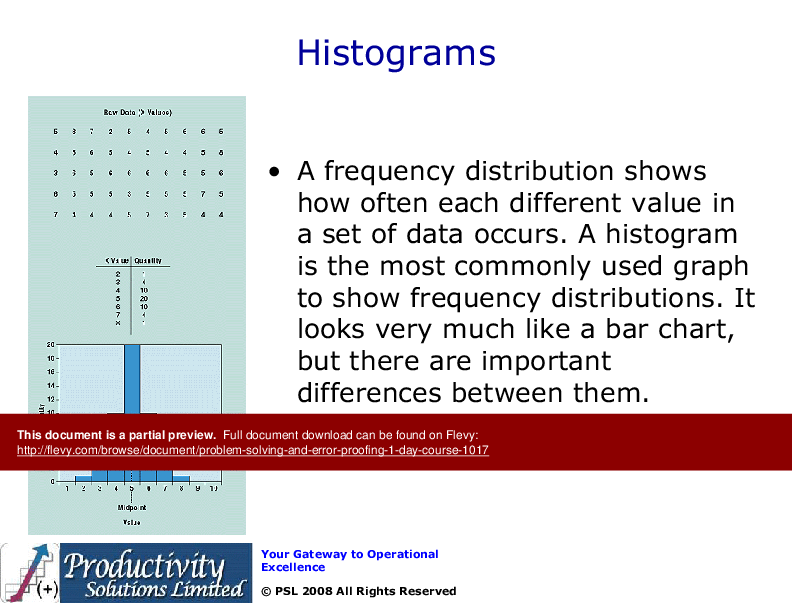
Histogram - A graphical representation of the distribution of numerical data.
•
Scatter Diagram - A graph used to determine relationships between 2 variables.
•
Stratification - A technique for separating data to identify patterns.
•
Flow Chart - A diagram that represents a process step by step.
Source: Best Practices in Problem Solving, RCA, Error Proofing PowerPoint Slides: Problem Solving & Error Proofing - 1 Day Course PowerPoint (PPT) Presentation Slide Deck, OpEx Academy NZ