
 Click main image to view in full screen. Unlock all 18 preview images:
Private Tutoring Center 5-Year Financial Model – Excel XLSX
Excel (XLSX) + supplemental PDF


BENEFITS OF THIS DOWNLOADABLE EXCEL DOCUMENT
- Connect student acquisition, retention, session demand, tutor capacity, hiring and service mix directly to a 60-month integrated financial forecast.
- Evaluate pricing, contribution margin, cash flow, break-even, marketing economics, scenarios and Year 5 EBITDA sensitivities in one editable workbook.
- Use executive dashboards, five-year financial statements and 37 automated integrity checks to support disciplined tutoring-center planning and management review.
EDUCATION EXCEL DESCRIPTION
PRIVATE TUTORING CENTER 5-YEAR FINANCIAL MODEL
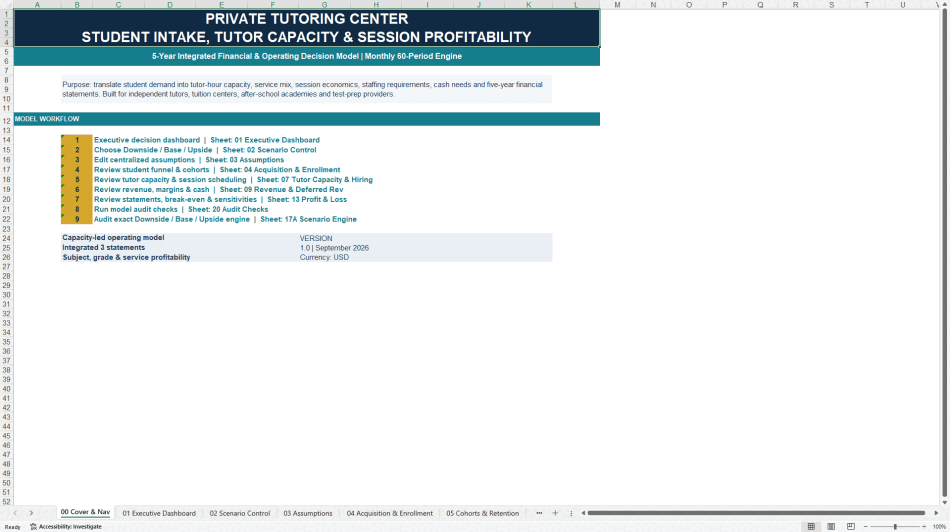
This Excel model is designed for private tutoring centers, tuition academies, after-school learning providers, test-preparation businesses, and independent tutors who are scaling beyond a solo practice. It links the commercial realities of a tutoring operation to an integrated five-year financial forecast.
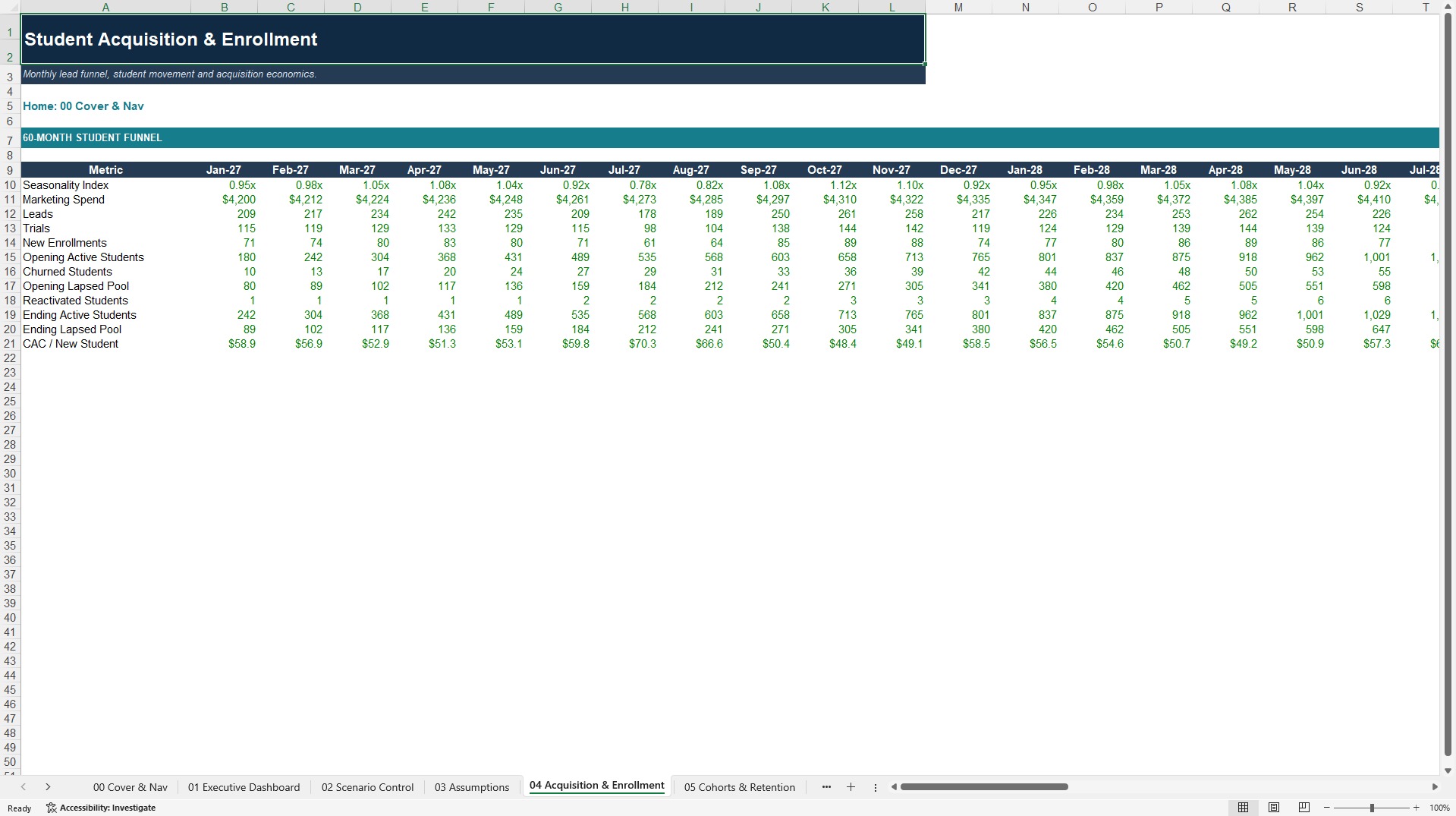
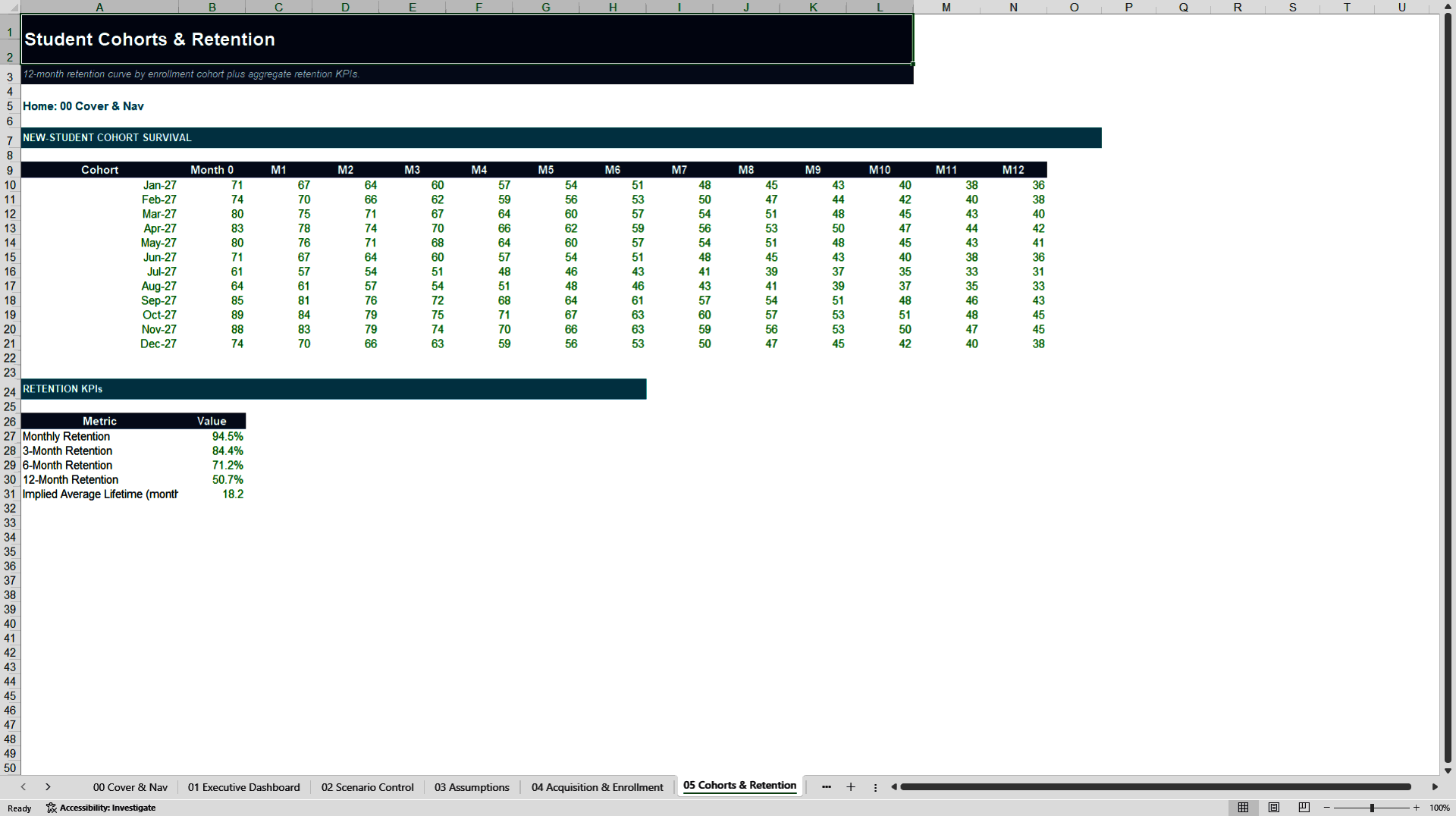
The model begins with the student acquisition funnel. Monthly leads move through trial and enrollment conversion, while active students roll forward through churn and reactivation. A cohort schedule provides a separate view of retention over time. Student activity then drives requested, refunded, make-up, billable, and delivered sessions.
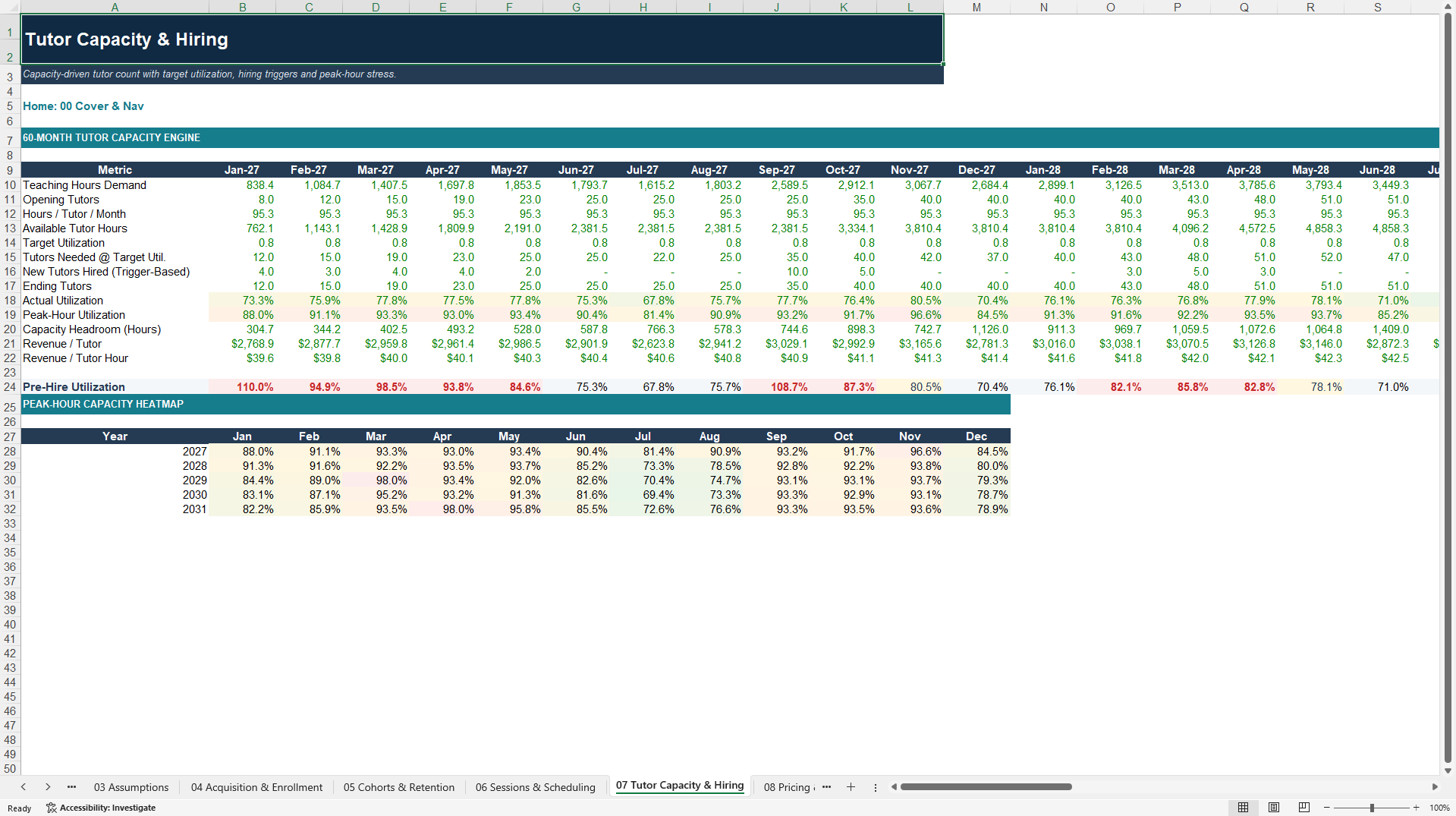
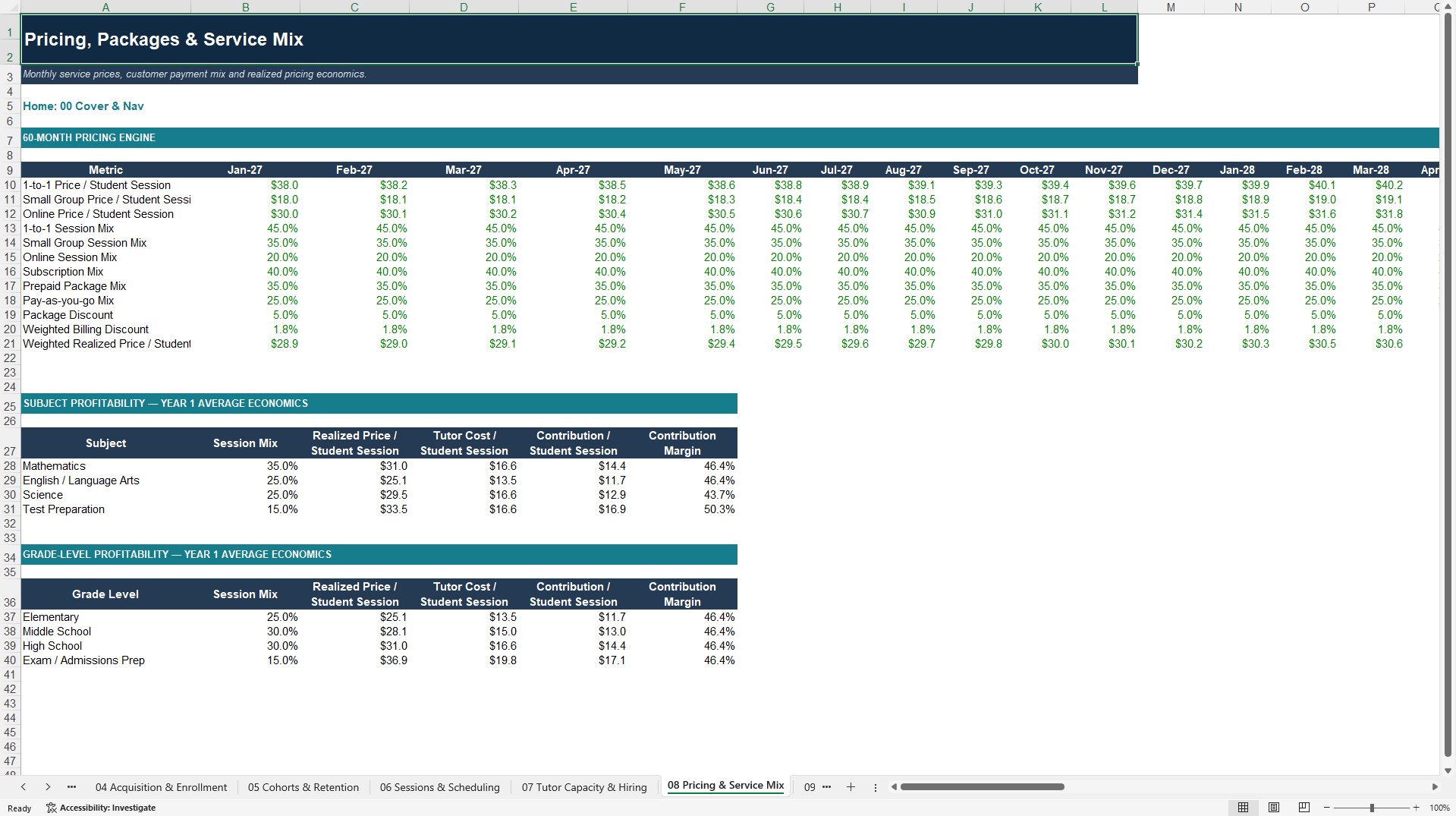
Tutor capacity is built from available teaching hours, peak-time availability, group occupancy, utilization targets, and hiring triggers. The model distinguishes one-to-one in-person, small-group, and online tutoring. It also includes subject and grade-level economic differentiation so operators can assess pricing and contribution performance beyond a simple blended average.
Revenue is calculated by service line and customer payment type, including subscription, prepaid package, and pay-as-you-go structures. The prepaid logic includes deferred revenue and an explicit purchased-versus-delivered-versus-unused session roll-forward. Tutor labor, payroll burden, contribution margin, revenue per tutor hour, and service-line contribution per tutor hour are calculated separately.
The financial section integrates operating expenses, marketing, capital expenditure, depreciation, accounts receivable, accounts payable, deferred revenue, debt amortization, interest, cumulative taxable income, loss carryforward, cash tax, and minimum-cash funding. These schedules feed a five-year profit and loss statement, balance sheet, and cash flow statement.
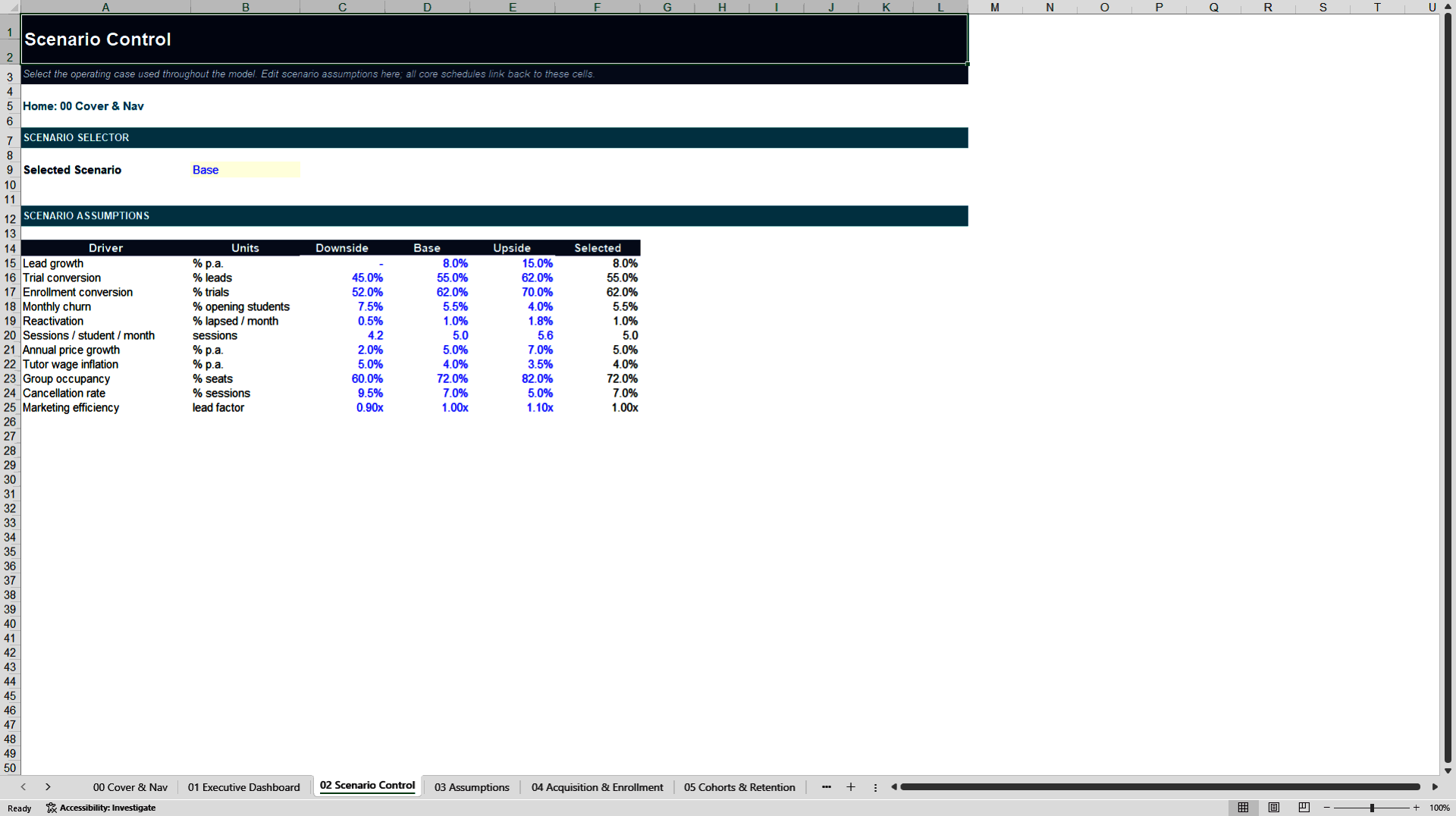
Management analysis includes break-even active students, billable sessions, tutor hours, and tutor utilization. The scenario system supports Downside, Base, and Upside assumptions. A dedicated exact scenario engine calculates all three cases independently, allowing stable comparison of annual revenue and EBITDA. Two sensitivity matrices show the effect of price and tutor utilization, and of retention and tutor wage inflation, on Year 5 EBITDA margin.
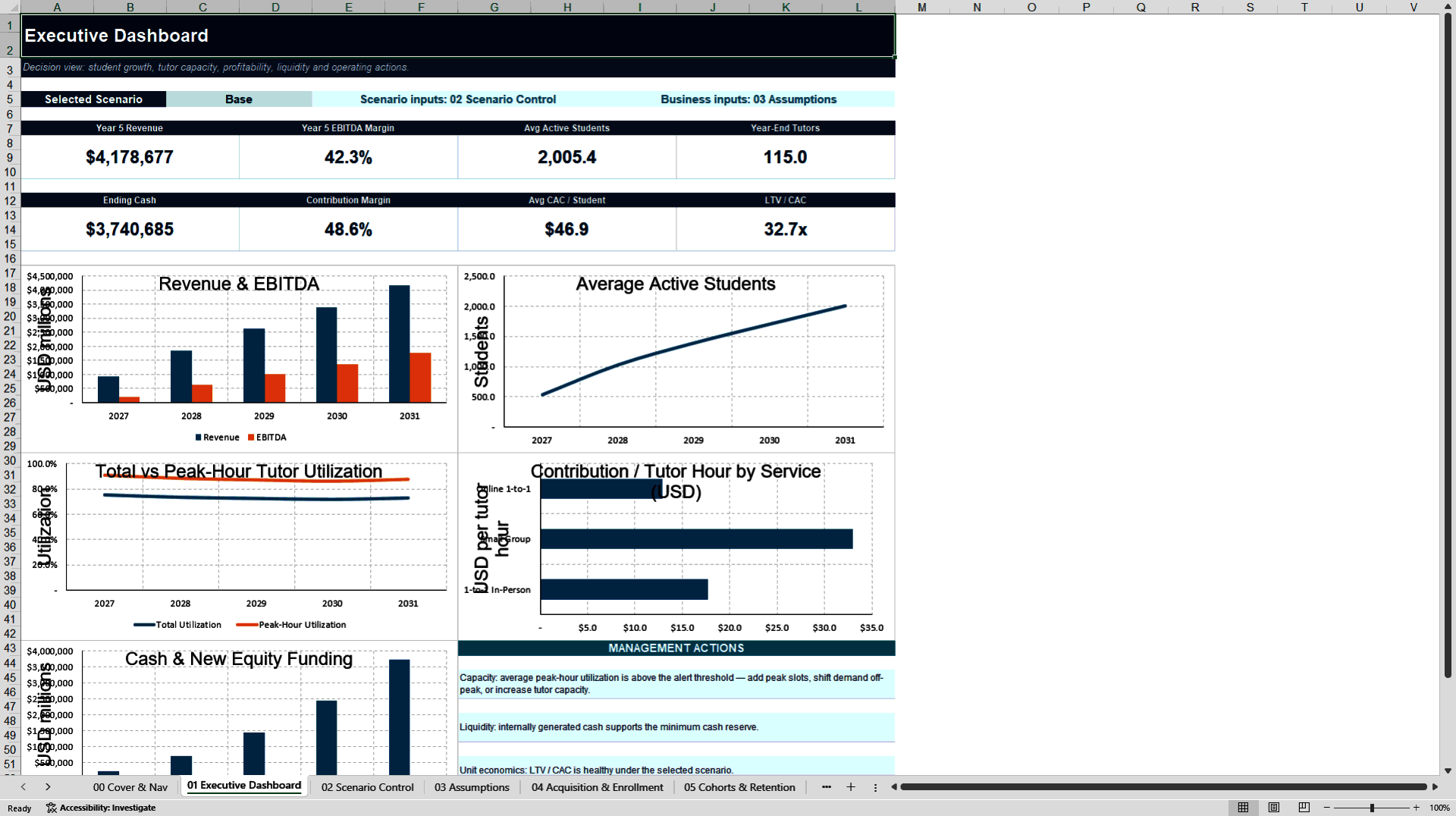
The executive dashboard and KPI scorecard summarize revenue, EBITDA margin, active students, tutors, cash, contribution margin, customer acquisition cost, student lifetime value, LTV to CAC, CAC payback, service revenue mix, tutor utilization, peak-hour utilization, and students per tutor.
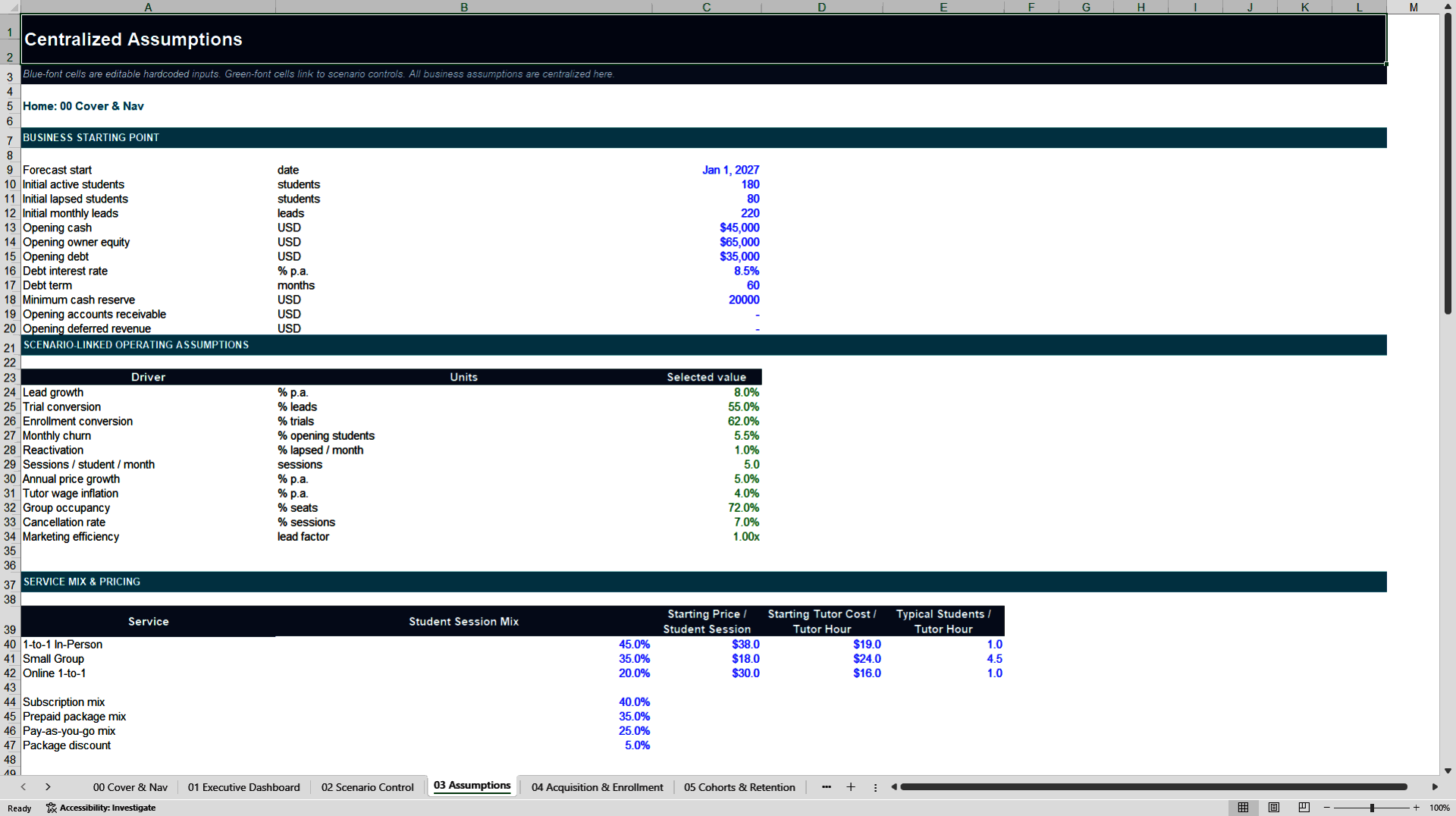
The workbook contains fictional sample assumptions so the model is immediately demonstrable. The user can replace centralized blue-font inputs with business-specific assumptions while preserving linked formulas. The supplied Base case is supported by 37 automated integrity checks covering mix totals, revenue recomputation, session reconciliation, working capital, cash flow, debt, capacity controls, scenario consistency, denominator validity, and balance-sheet balancing.
This model is useful for annual planning, monthly forecasting, staffing decisions, pricing reviews, break-even analysis, marketing economics, package and subscription planning, liquidity management, lender or advisor discussions, and management reporting. It is an operating and financial planning model; it does not include a business valuation schedule.
Got a question about the product? Email us at support@flevy.com or ask the author directly by using the "Ask the Author a Question" form. If you cannot view the preview above this document description, go here to view the large preview instead.
Source: Best Practices in Education, Integrated Financial Model Excel: Private Tutoring Center 5-Year Financial Model Excel (XLSX) Spreadsheet, PDMM Financial Models
ABOUT THE AUTHOR

PDMM Financial Models develops professional, decision-ready Excel models for business owners, entrepreneurs, investors, consultants, analysts, and finance teams. Our objective is to transform complex business assumptions into clear, structured analysis that supports better planning and investment decisions.
Our models cover business planning, forecasting, budgeting, feasibility analysis,
... [read more]
Ask the Author a Question
You must be logged in to contact the author.




























