
 Click main image to view in full screen. Unlock all 20 preview images:
Mobile Phone Shop Financial Model - Repair & Trade-In – Excel XLSX
Excel (XLSX) + supplemental PDF


BENEFITS OF THIS DOWNLOADABLE EXCEL DOCUMENT
- Integrates phone sales, repair capacity, trade-in/refurbishment, accessories, inventory, staffing, and working capital in one 60-month operating model.
- Links operating drivers to Profit & Loss, Balance Sheet, Cash Flow, debt, break-even, scenarios, sensitivities, and valuation for decision-ready planning.
- Provides two management dashboards, six two-way sensitivities, scenario comparison, and built-in integrity checks to accelerate management, lender, and investor review.
RETAIL INDUSTRY EXCEL DESCRIPTION
Mobile Phone Shop Financial Model – Repair & Trade-In is a fully editable 60-month operating and financial model for independent mobile phone retailers, electronics repair shops, entrepreneurs opening a street-front store, and advisers preparing business plans or funding forecasts. The workbook is built around the real operating decisions that determine mobile-shop profitability: customer footfall and conversion, device mix, repair demand, technician capacity, trade-in acceptance, refurbishment yield, accessory attachment, inventory stock cover, obsolescence, staffing, working capital, debt service, and cash generation.
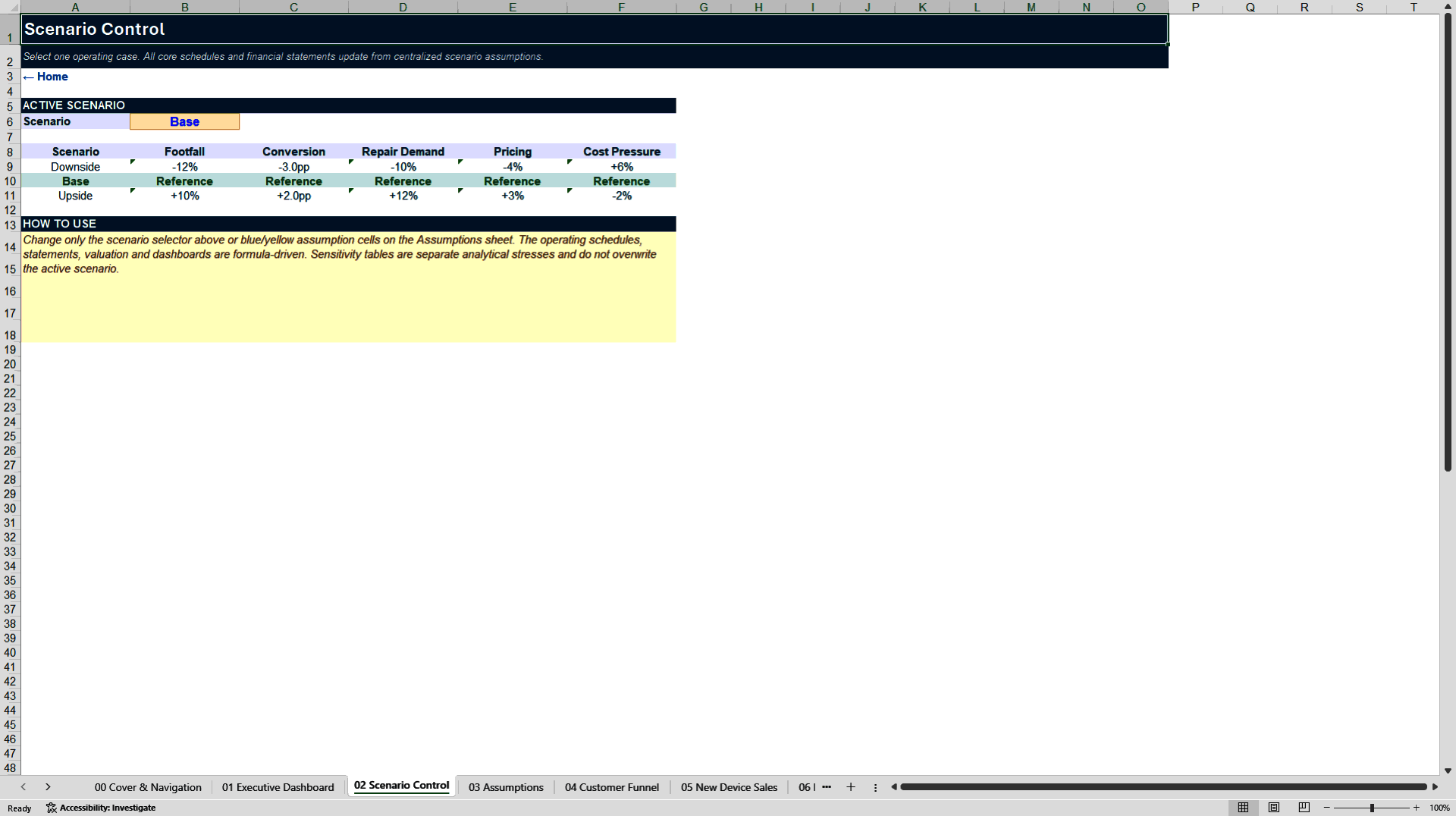
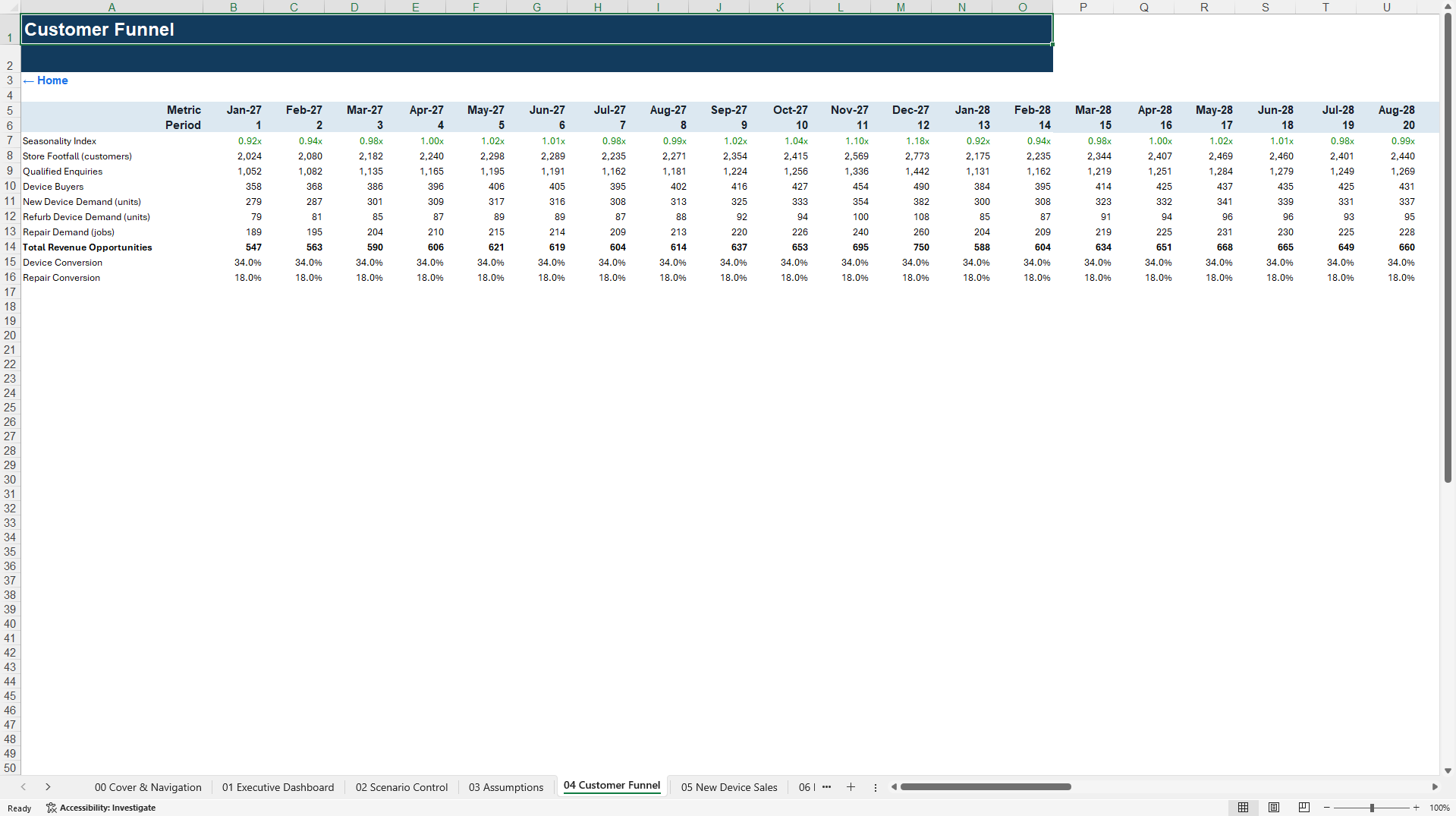
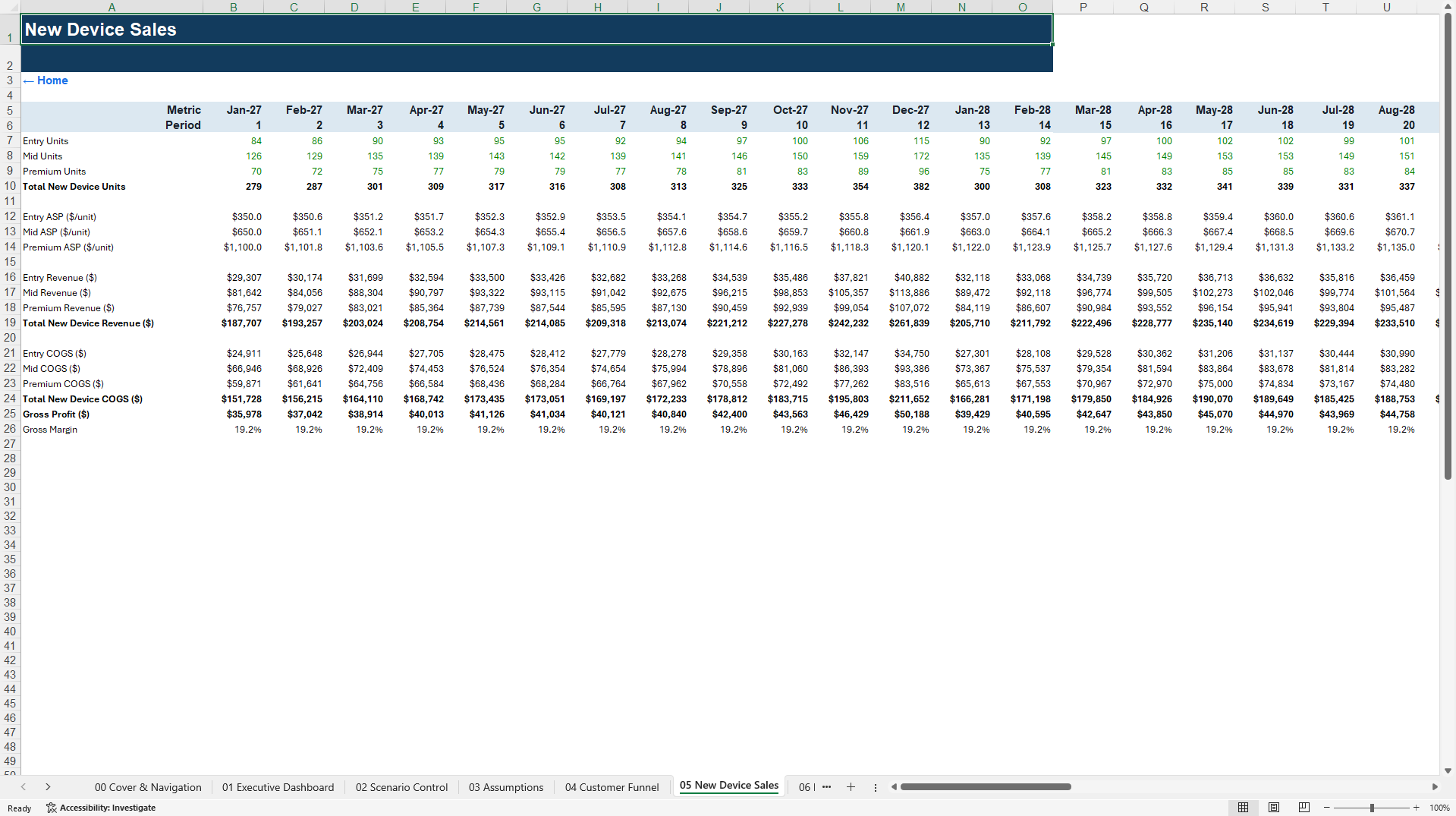
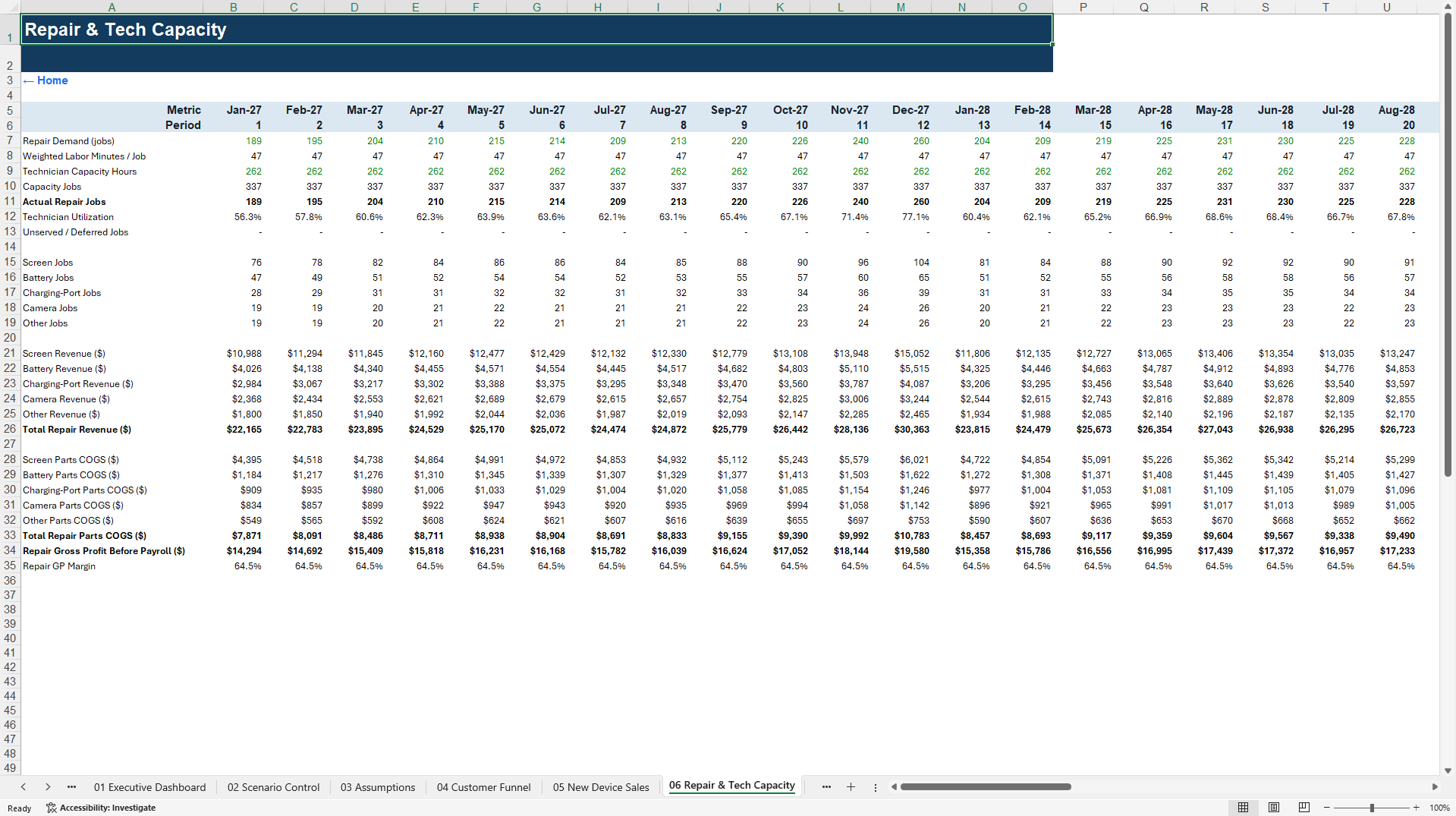
The model begins with a centralized scenario selector and assumptions sheet. Users can choose Downside, Base, or Upside and replace the fictional sample assumptions with business-specific data. The operating schedules then convert store footfall into enquiries, device buyers, new-device demand, refurbished-device demand, and repair jobs. New devices are modeled across Entry, Mid, and Premium tiers. Repair services are separated into screen, battery, charging-port, camera, and other jobs, with labor minutes, parts costs, technician capacity, utilization, deferred demand, revenue, and repair gross profit.
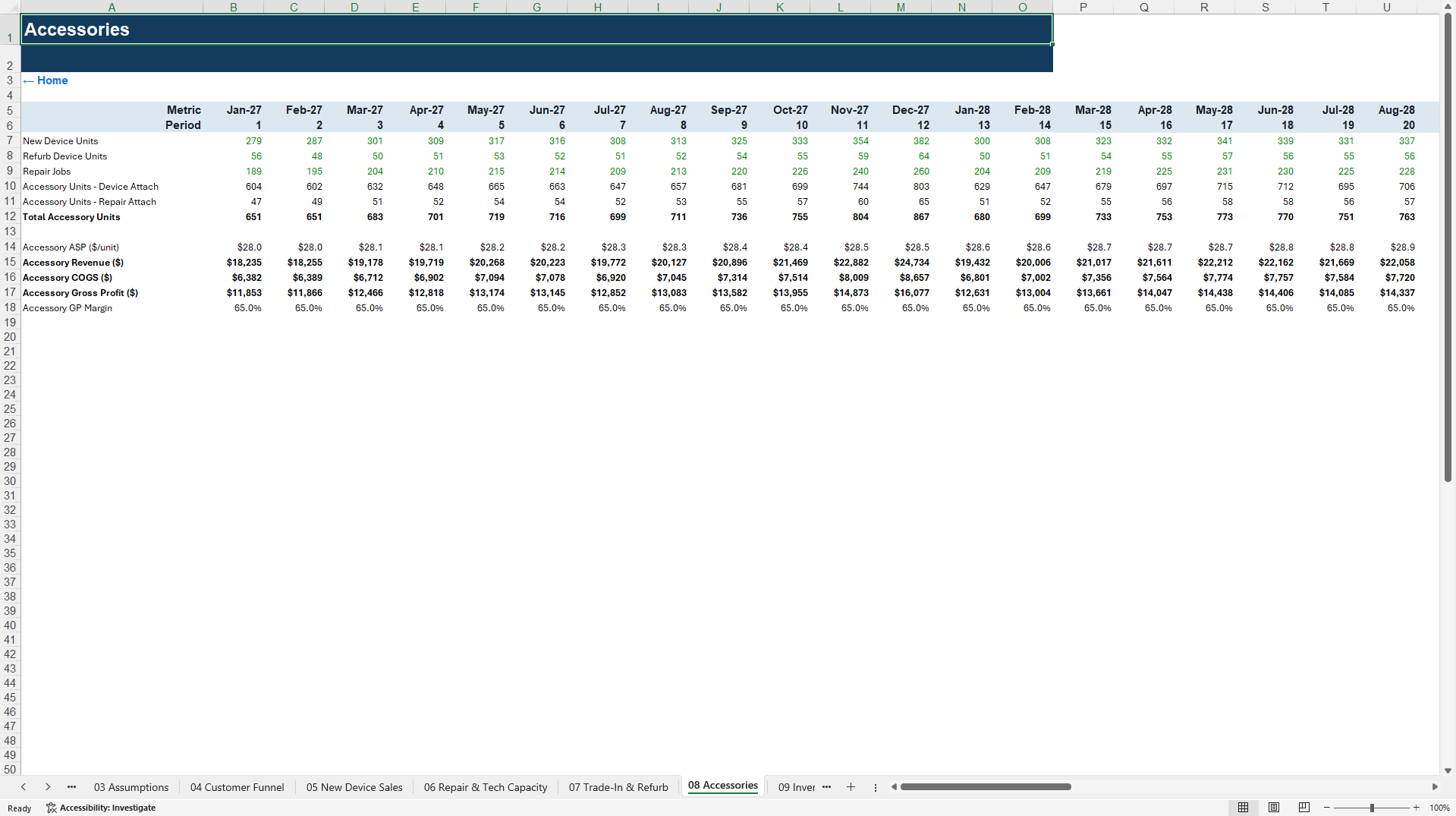
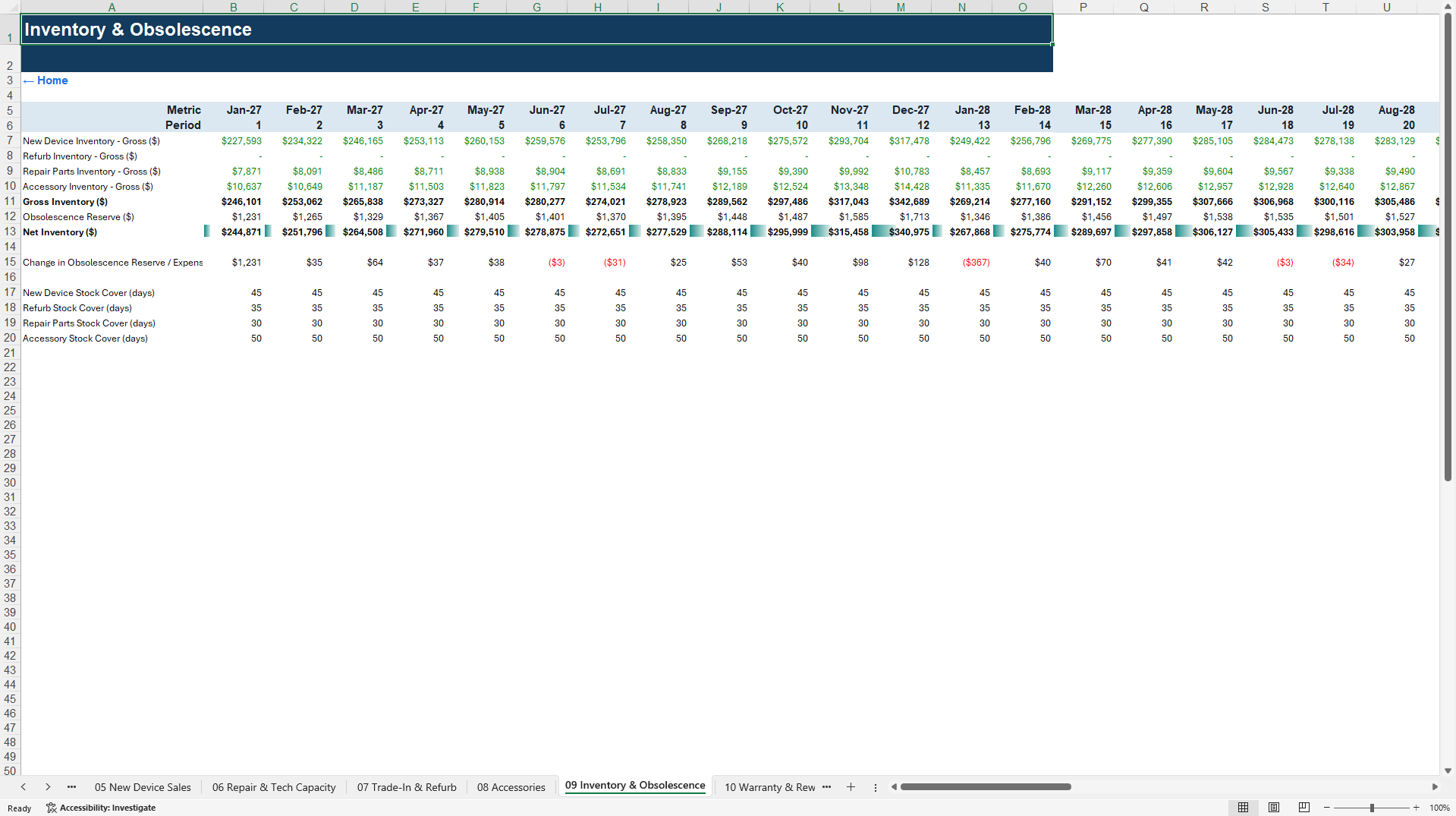
Trade-in and refurbishment economics are modeled as a separate operating engine. The schedule tracks trade-in offers, accepted devices, successfully refurbished units, resale volume, acquisition cost, refurbishment cost, salable unit cost, refurbished revenue, gross profit, supply coverage, and ending units. Accessories are linked to device and repair activity. Inventory is separated into new phones, refurbished phones, repair parts, and accessories, with stock-cover days, an obsolescence reserve, and net inventory.
The operating model feeds payroll and hiring, operating expenses, CapEx and depreciation, working capital, financing, and debt. These schedules flow into a consolidated 60-month forecast and integrated Profit & Loss, Balance Sheet, and Cash Flow statements. Debt analysis includes principal, interest, closing balance, DSCR, and debt-to-annualized-EBITDA leverage.
Decision analytics include break-even revenue, break-even footfall, unit economics, an independent scenario comparison, and six two-way sensitivities covering Year 5 EBITDA, repair gross profit, refurbishment gross profit per unit, accessory gross profit, and incremental cash needs. The valuation section uses unlevered FCFF for DCF, adds an exit-EBITDA-multiple cross-check, and reports equity value, MOIC, IRR, and indicative payback.
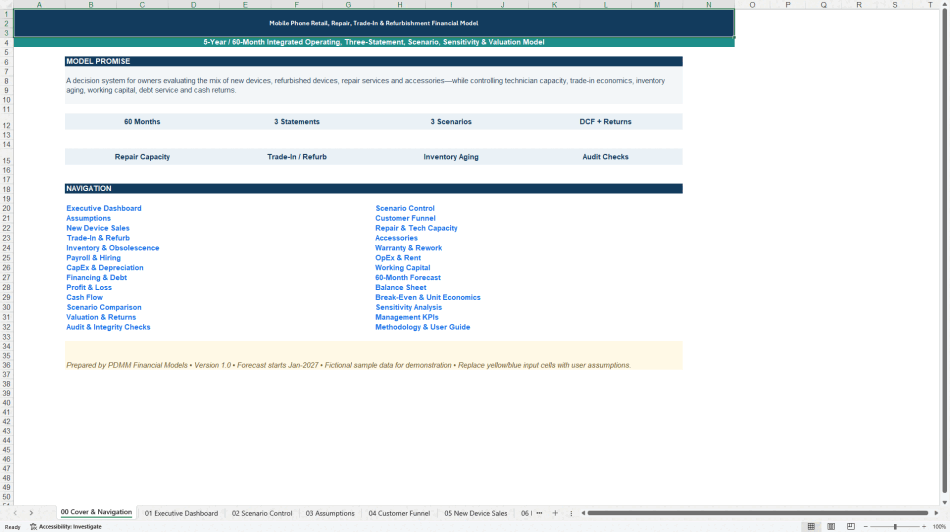
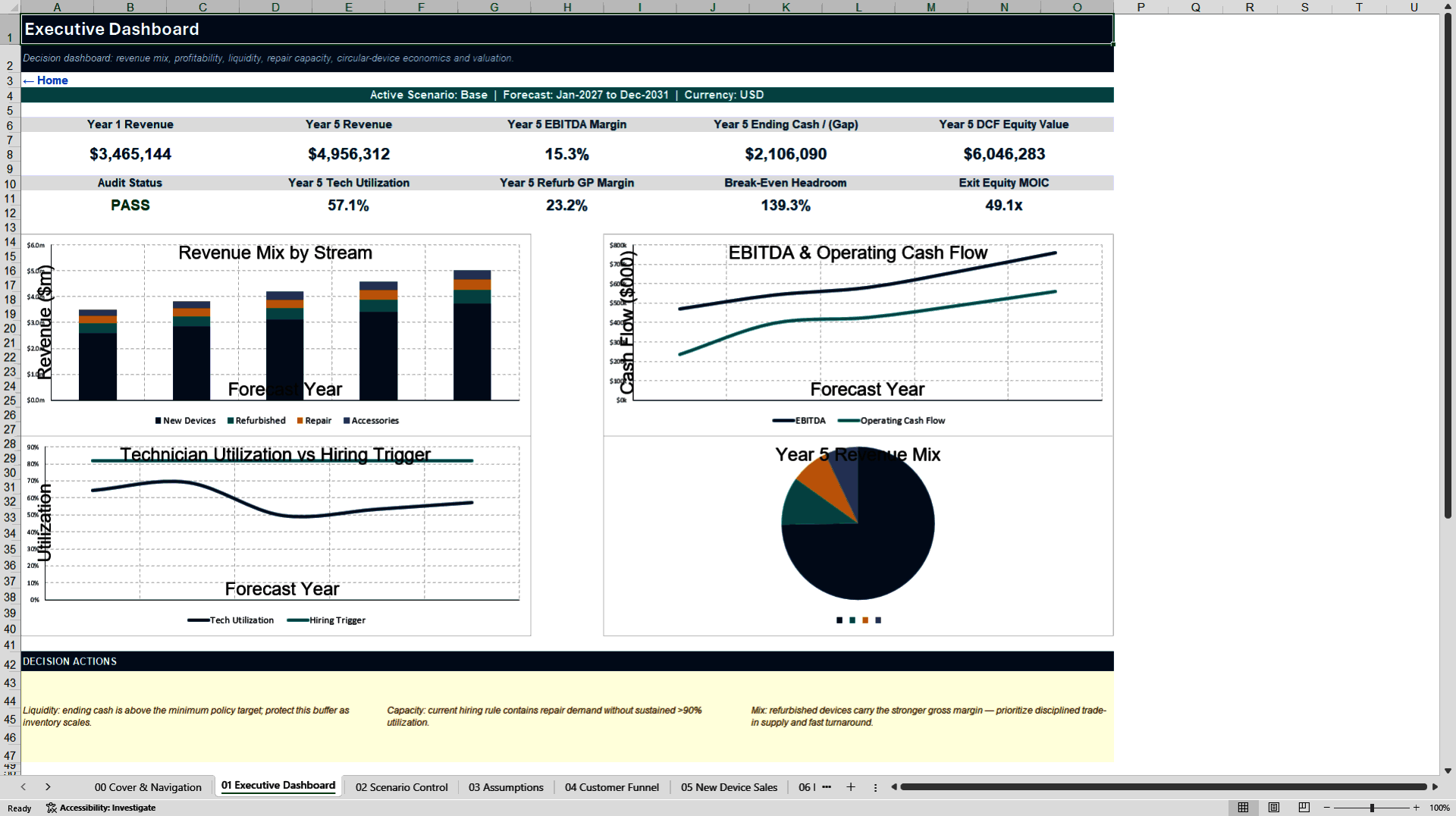
Two management dashboards provide a compact view of revenue mix, EBITDA, operating cash flow, technician utilization, hiring trigger, cash, debt, inventory capital, the trade-in-to-refurbishment funnel, and monthly revenue versus break-even. A dedicated audit sheet independently checks statement balance, revenue and EBITDA recomputation, cash, debt, mix percentages, capacity, scenario validity, valuation bounds, and return consistency. The workbook also includes navigation and a methodology/user guide with source references and model conventions.
This model is especially useful when a shop owner needs to decide whether growth should come from new-device volume, higher-margin refurbished devices, repair throughput, or accessory attachment; whether another technician is required; how much cash inventory growth will absorb; and whether the resulting business plan remains profitable and financeable across multiple operating cases.
Got a question about the product? Email us at support@flevy.com or ask the author directly by using the "Ask the Author a Question" form. If you cannot view the preview above this document description, go here to view the large preview instead.
Source: Best Practices in Retail Industry, Integrated Financial Model Excel: Mobile Phone Shop Financial Model - Repair & Trade-In Excel (XLSX) Spreadsheet, PDMM Financial Models
ABOUT THE AUTHOR

PDMM Financial Models develops professional, decision-ready Excel models for business owners, entrepreneurs, investors, consultants, analysts, and finance teams. Our objective is to transform complex business assumptions into clear, structured analysis that supports better planning and investment decisions.
Our models cover business planning, forecasting, budgeting, feasibility analysis,
... [read more]
Ask the Author a Question
You must be logged in to contact the author.




























