
 Click main image to view in full screen.
Med-Spa Acquisition and SBA Underwriting Model – Excel XLSX
Excel (XLSX) + supplemental PDF


BENEFITS OF THIS DOWNLOADABLE EXCEL DOCUMENT
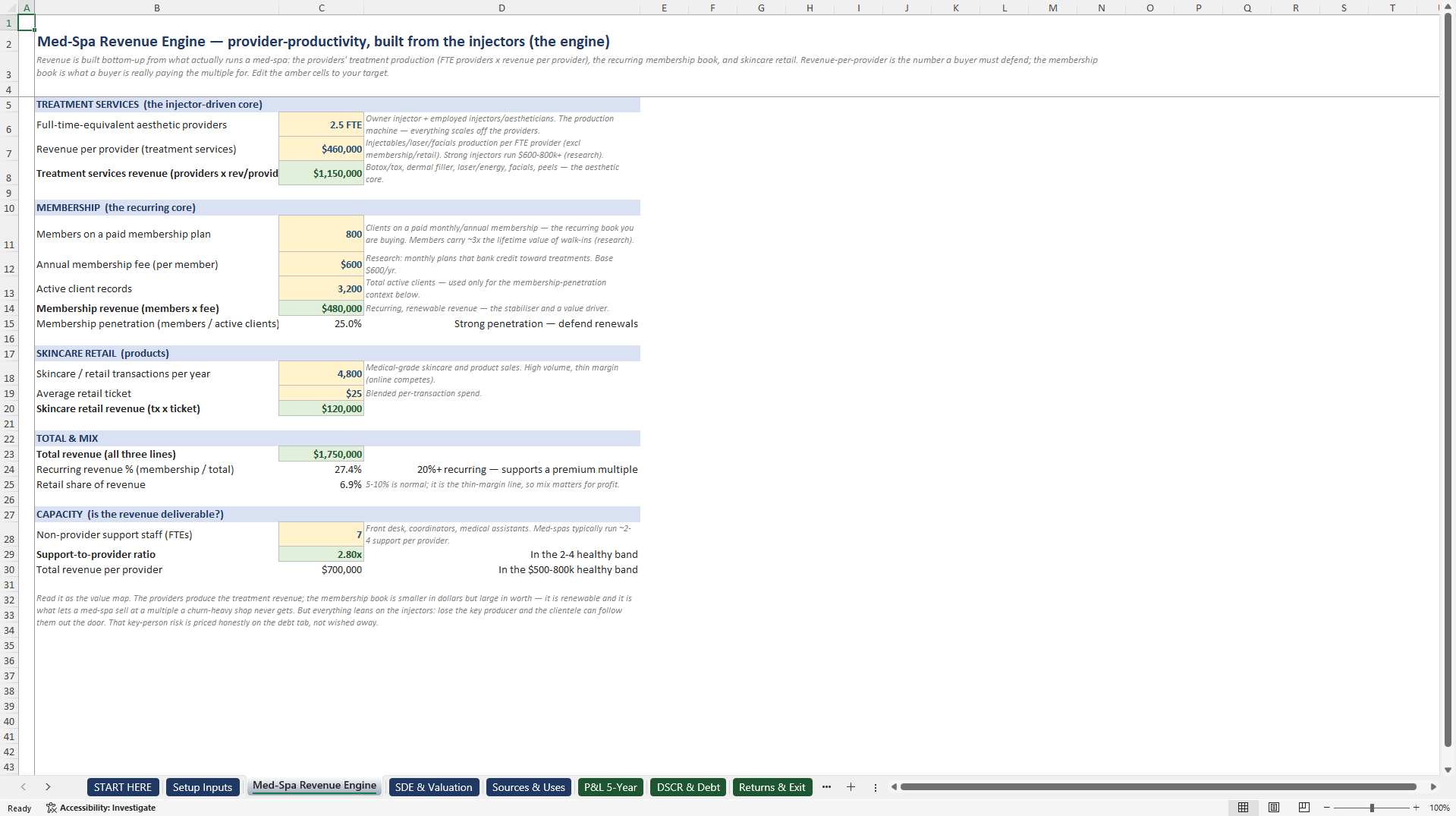
- Revenue is built from injector productivity, the recurring membership book and skincare retail at their own margins, so SDE comes out of a provider mix you can change rather than a single assumed number.
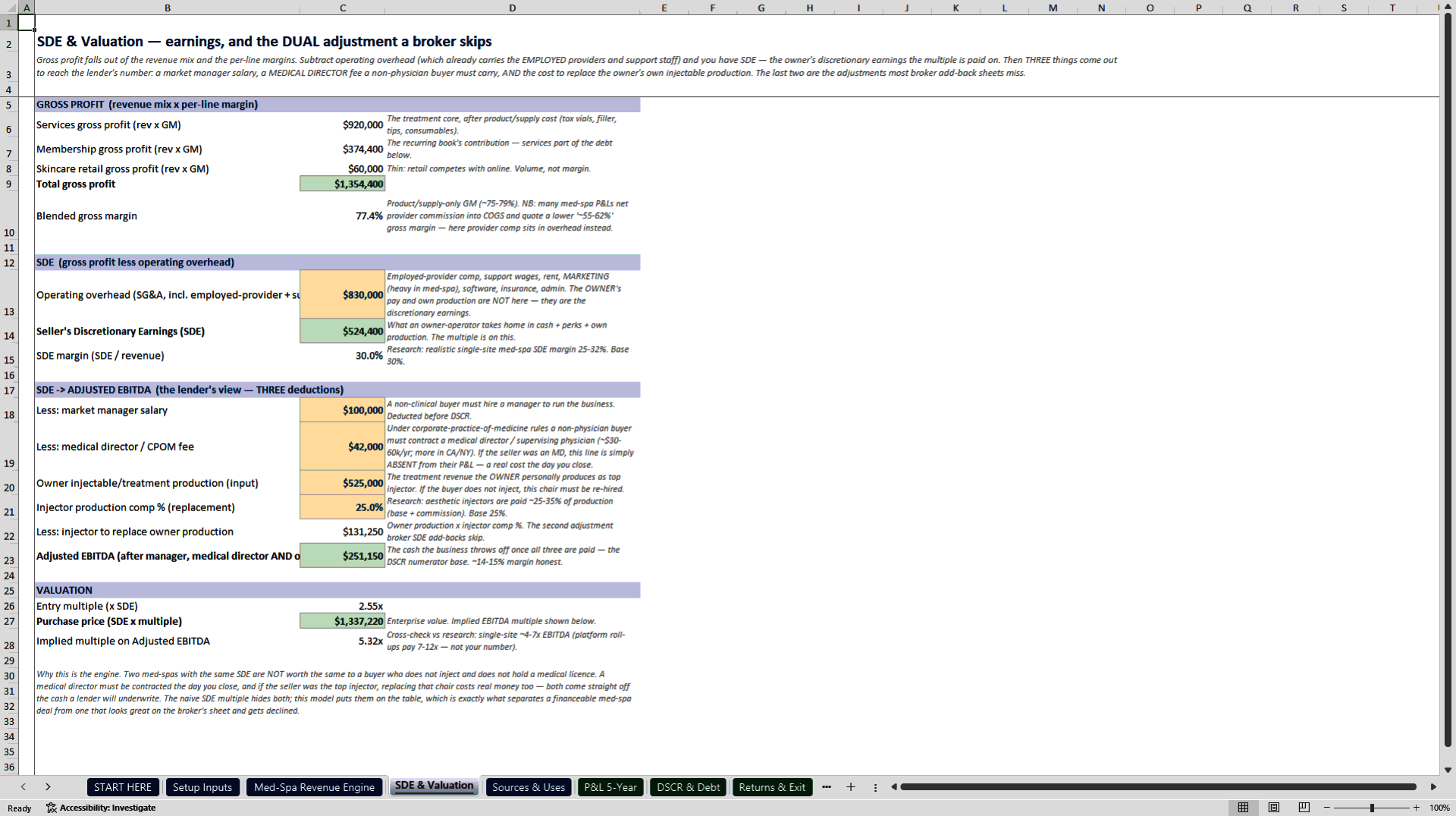
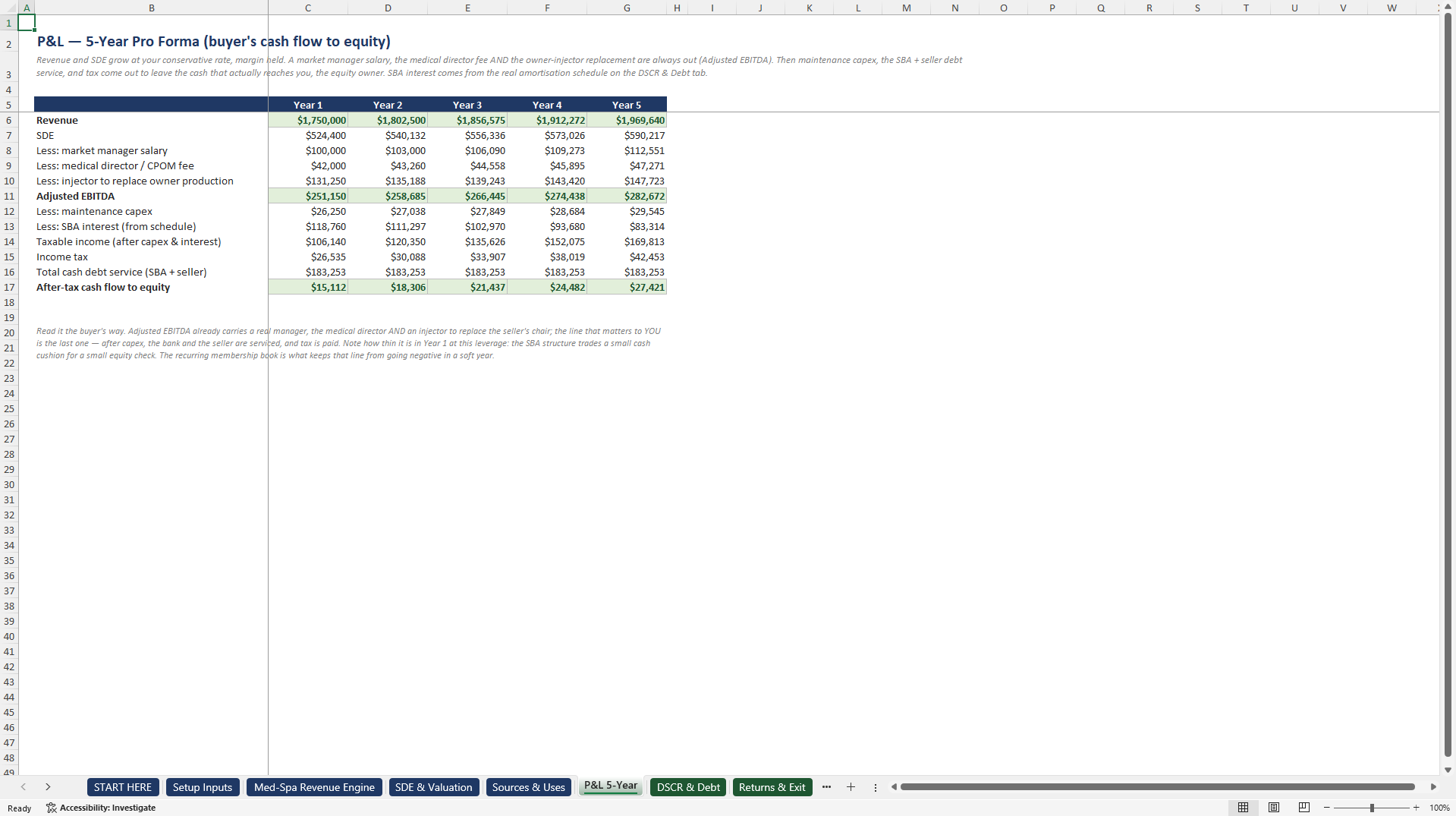
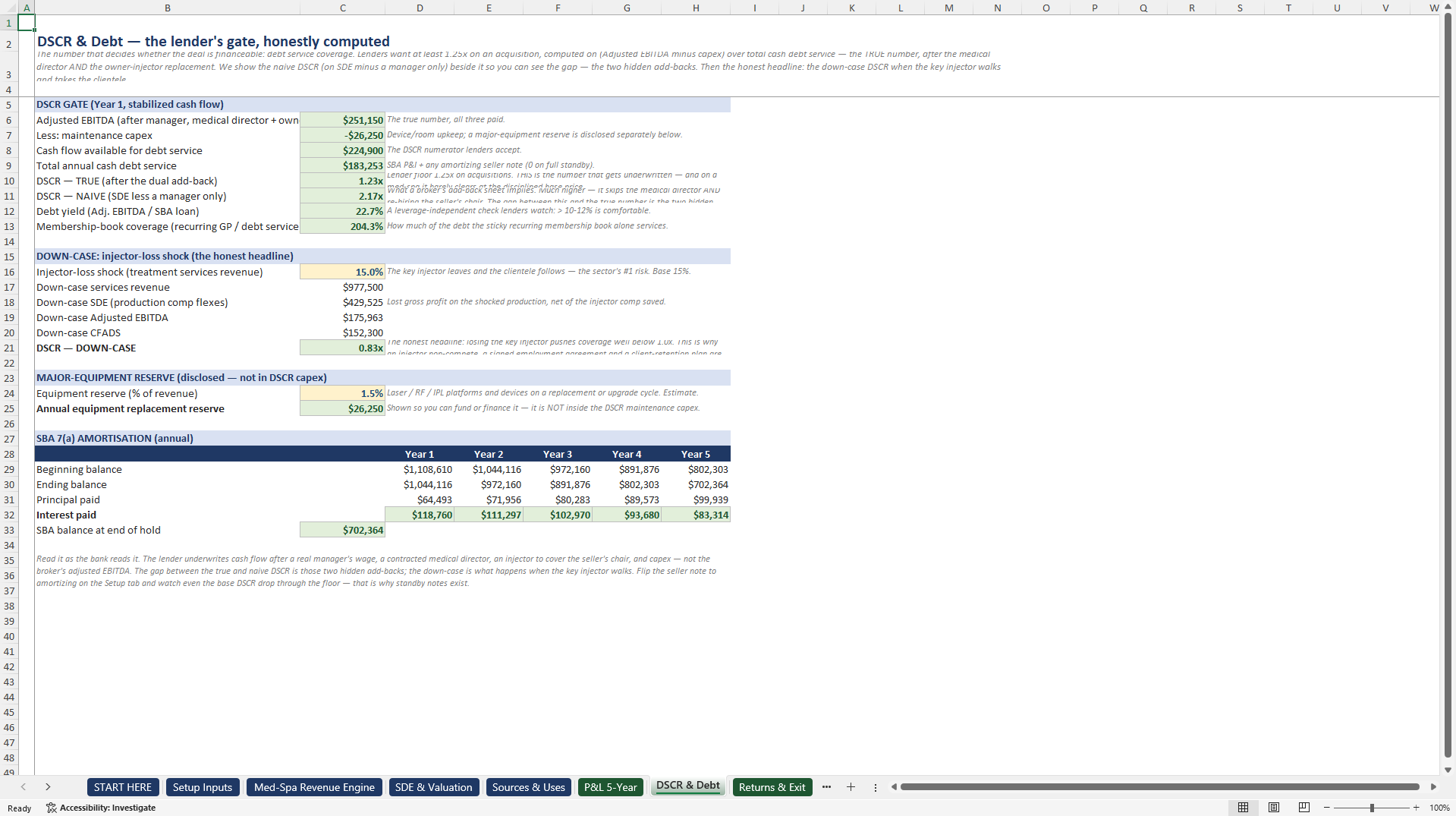
- Adjusted EBITDA is struck after a manager, a CPOM medical-director fee and the injector who replaces the owner's own production, and the resulting 1.23x true DSCR is printed beside the 2.17x naive one.
- The down-case prices the sector's main risk: if the key injector leaves and the clientele follows, DSCR falls to 0.83x, while membership-book coverage shows what the recurring revenue carries on its own.
SALON & SPA EXCEL DESCRIPTION
This is a lender-ready acquisition model for a single-location medical aesthetics practice, written for a buyer financing the purchase with an SBA 7(a) loan.
The valuation error it intercepts sits in the broker's add-back sheet. Two real costs are usually missing from the seller's P&L. First, under corporate-practice-of-medicine rules a non-physician buyer must contract a medical director; if the seller was an MD, that line, roughly $30,000 to $60,000 a year, simply does not appear in the historical numbers. Second, the owner is usually the top injector, so a buyer who does not inject has to re-hire that chair. Neither cost is optional after closing, and both come straight out of the earnings you are paying a multiple on.
The engine builds revenue bottom-up from the providers: FTE injectors times revenue per provider, plus the recurring membership book (members times annual fee) and skincare retail, each carried at its own gross margin, with a support-to-provider ratio and a total-revenue-per-provider capacity check. Gross profit and SDE fall out of that mix rather than being assumed. The model then deducts a manager, the medical director and the owner-injector production replacement to reach Adjusted EBITDA, and prints the true DSCR of 1.23x on the base case directly next to the naive broker-style DSCR of 2.17x. The gap is the dual add-back, and it is what separates a financeable med-spa from one that looks strong on paper and gets declined.
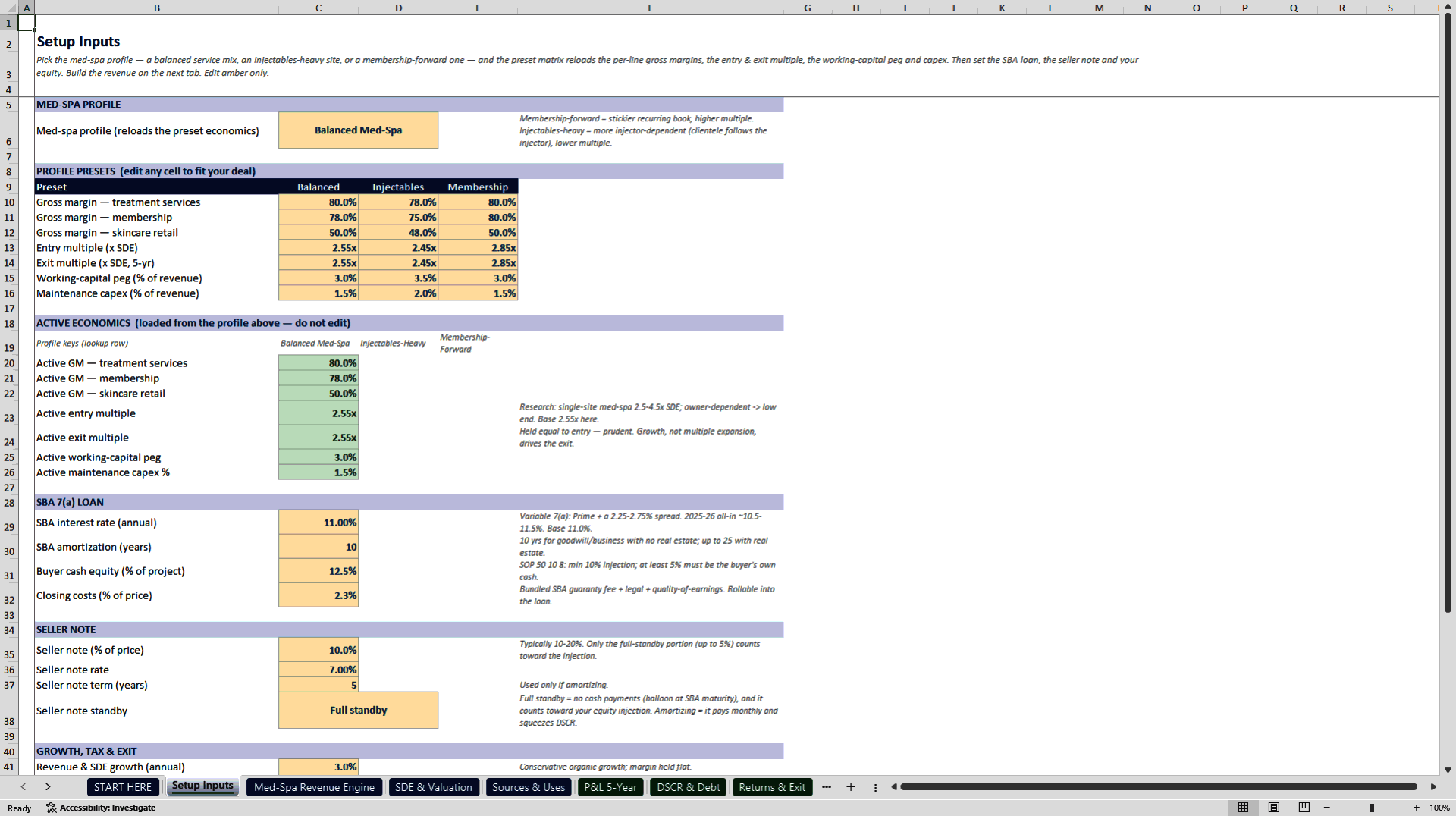
Financing is modelled as a full SBA 7(a) capital stack: buyer equity, a seller note with a full-standby versus amortizing toggle that moves DSCR from declined to bankable, and the loan. The DSCR and debt sheet also shows debt yield and the membership-book coverage, about 204% of debt service, so you can see how much of the payment the recurring book alone carries. A down-case prices the sector's principal risk honestly: when the key injector walks and the clientele follows, DSCR falls to 0.83x.
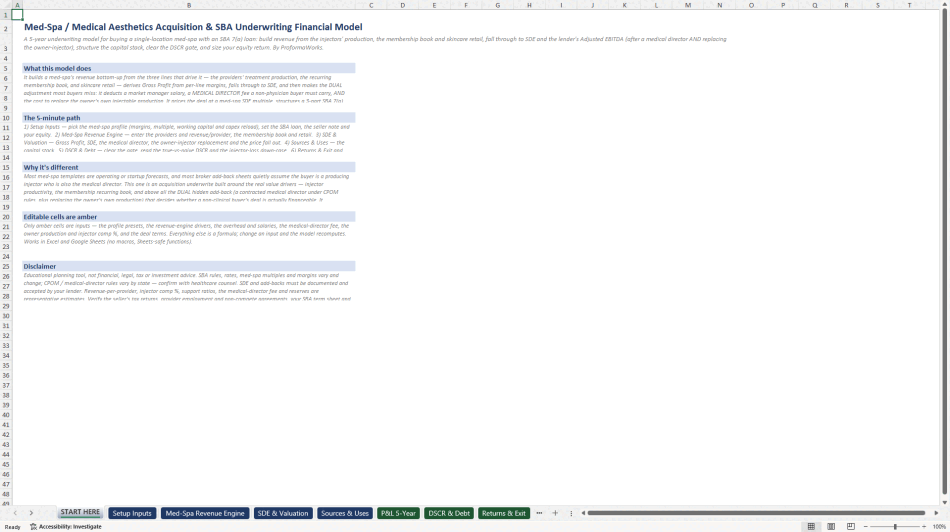
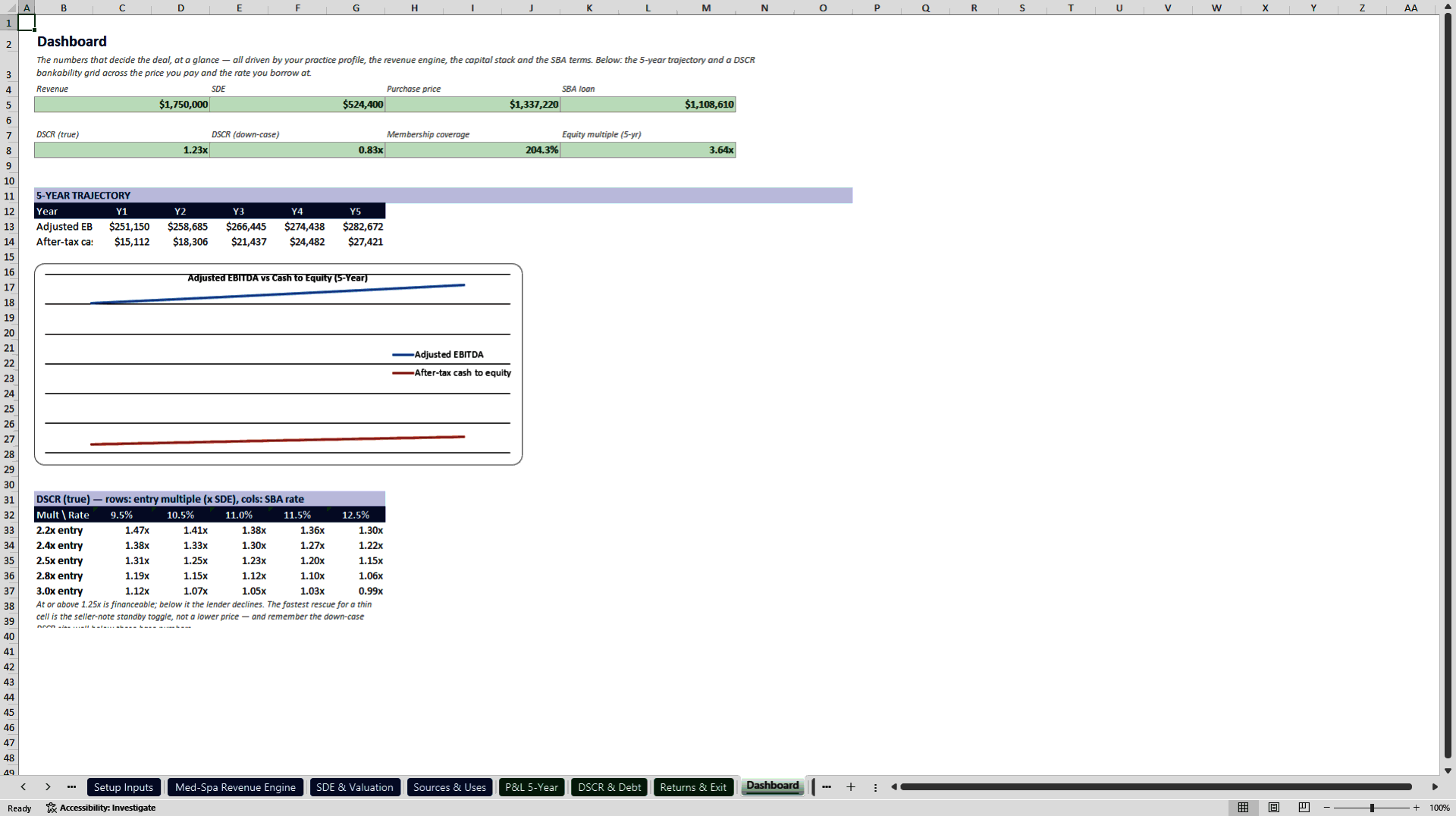
Sheets include START HERE, the med-spa revenue engine, SDE and valuation, sources and uses, the SBA stack, DSCR and debt, a five-year P&L, returns and exit, a dashboard with a DSCR bankability grid across price and rate, and a benchmarks and sources tab carrying the range behind every assumption. A three-way profile toggle (Balanced Med-Spa, Injectables-Heavy, Membership-Forward) reloads margins, multiple, working capital and capex. A 23-page PDF guide is included. The workbook is 10 sheets, machine-verified by 62 automated checks across three engines, and runs in Excel and Google Sheets with no macros.
What the model does not claim: SDE margin is held at a realistic 30% and Adjusted EBITDA at about 14.5% after the dual add-back; single sites are priced at roughly 2.5x SDE, and the platform roll-up's 7x to 12x is not presented as your return. No IRR is headlined, because on one small deal it depends on the exit multiple. CPOM and medical-director rules vary by state; confirm your structure with healthcare counsel. Educational planning tool, not financial, legal, tax or investment advice.
Got a question about the product? Email us at support@flevy.com or ask the author directly by using the "Ask the Author a Question" form. If you cannot view the preview above this document description, go here to view the large preview instead.
Source: Best Practices in Salon & Spa, Integrated Financial Model Excel: Med-Spa Acquisition and SBA Underwriting Model Excel (XLSX) Spreadsheet, ProformaWorks
ABOUT THE AUTHOR

ProformaWorks builds acquisition-grade financial models for Main Street and lower-middle-market businesses - the kind of deal financed with an SBA 7(a) loan or a small commercial facility.
Every model answers one question: does this deal pencil at the bank? That means SDE or NOI rebuilt from the seller's own numbers, the add-backs a lender will and will not accept, a debt-service
... [read more]
Ask the Author a Question
You must be logged in to contact the author.




























