 Click main image to view in full screen. Unlock all 12 preview images:
AI Risk Management Toolkit – Word DOCX
Word (DOCX) 45 Pages


BENEFITS OF THIS DOWNLOADABLE WORD DOCUMENT
- Provides a practical framework for building an AI Risk Management Strategy tailored to your organization.
- Provides a structured approach for governing, assessing, and managing AI risks across your organization.
- Provides a ready-to-use blueprint for implementing AI governance, risk controls, and compliance processes suited to your organization.
ARTIFICIAL INTELLIGENCE WORD DESCRIPTION
Curated by McKinsey-trained Executives
🚀 STOP LETTING AI RISK GROW IN THE SHADOWS: UNINVENTORIED MODELS, SHADOW AI, UNOWNED VENDOR AI, GENERATIVE AI DATA LEAKS, UNTESTED CHATBOTS, EU AI ACT DEADLINES, BOARD QUESTIONS YOU CAN'T ANSWER, AUDITORS ASKING FOR EVIDENCE YOU DON'T HAVE & AI GOVERNANCE THAT LIVES IN SLIDES INSTEAD OF IN PRACTICE
Most executives, Chief Risk Officers, CIOs, CISOs, compliance leaders, AI governance teams and internal auditors don't struggle with AI risk because they lack intelligence or budget. They struggle because they lack a STRUCTURED, END-TO-END AI RISK MANAGEMENT SYSTEM: AN AI GOVERNANCE FRAMEWORK, A RISK-TIERING METHOD, AN APPROVAL WORKFLOW, A CONTROL CATALOGUE AND READY-TO-USE TEMPLATES, ALL BUILT TO SURVIVE BOARD AND REGULATOR SCRUTINY.
They operate with:
• ❌ No complete AI inventory, so nobody knows where AI is used (built, bought, embedded in SaaS or used by staff on public tools)
• ❌ No consistent way to decide which AI use cases are high-risk and which can move fast
• ❌ Generative AI used with no policy, no guardrails and no review of what data goes in
• ❌ Vendor AI accepted on trust, with no due diligence, no contract clauses and no change notification
• ❌ Approval decisions made ad hoc, with no tiering, no named approver and no record
• ❌ Human oversight that exists on paper but rubber-stamps whatever the model says
• ❌ No AI incident playbook, no kill-switch authority and no map of who must be notified, or when
• ❌ EU AI Act dates changing and no clear view of what applies to you now
• ❌ Risk appetite never defined, so "acceptable AI risk" means whatever the loudest team says
• ❌ No board reporting that triggers decisions
That's why AI governance stalls. The gap isn't talent. It's a working system.
🎯 INTRODUCING: THE AI RISK MANAGEMENT TOOLKIT
A Practical Executive Guide to Governing, Assessing, and Managing AI Risk: a 45-page, consulting-style Word (.docx) business guide with 21 ready-to-use templates, checklists and worksheets for AI governance, AI risk assessment, AI compliance and AI assurance.
✅ Complete AI risk management lifecycle: a 7-stage lifecycle from intake to retirement, with named gates, outputs and approvers
✅ AI use-case tiering method: an 8-factor questionnaire that sorts every use case into Tier 1 (Critical) to Tier 4 (Minimal), with override rules for high-impact and prohibited uses
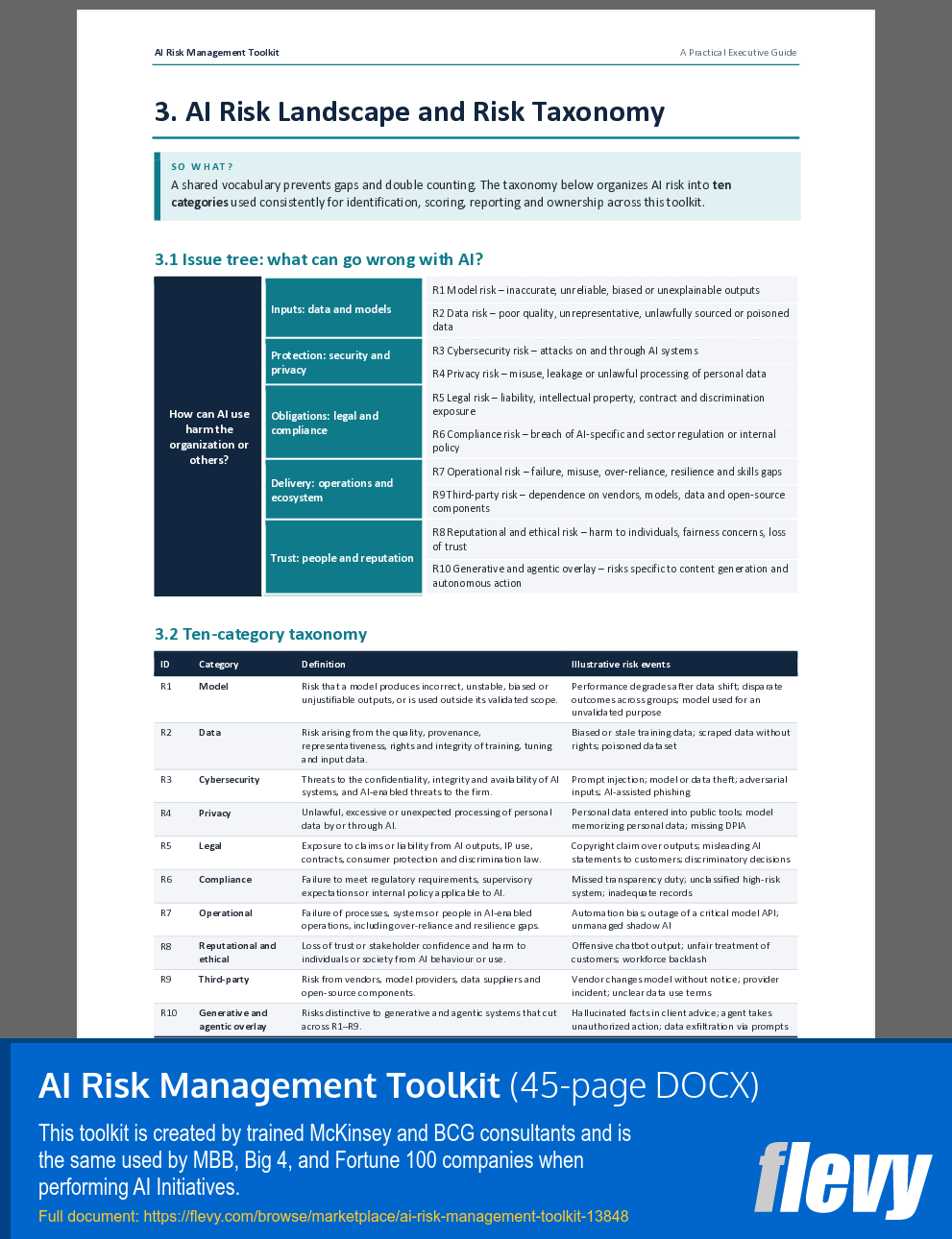
✅ 10-category AI risk taxonomy: model, data, cybersecurity, privacy, legal, compliance, operational, reputational and ethical, third-party, and generative/agentic, with level-2 risk codes
✅ AI risk scoring matrix and heat map: 5×5 likelihood × impact scales, risk bands and a residual-risk convention
✅ Governance operating model: board, council, review board, three lines of defence, role definitions and a full RACI
✅ Generative AI and LLM risk chapter: hallucination, prompt injection, data leakage, excessive agency in agentic AI, IP risk, a deployment-pattern risk ladder and a layered guardrail model
✅ Third-party and vendor AI risk: tiered due diligence, contract protections for AI, concentration and exit planning
✅ Intake and approval framework: authority matrix, decision outcomes, recommended red lines and a fast lane so low-risk AI doesn't stall
✅ AI controls framework: 10 control domains and a 23-control catalogue mapped by tier, with NIST AI RMF anchors
✅ Human oversight and accountability: four oversight models and how to test whether oversight is real
✅ AI incident management: severity model, response process, notification triggers and playbooks
✅ Monitoring, testing and assurance: pre-release testing, production monitoring, and independent validation and audit layers
✅ Regulatory and policy map: mandatory law separated from voluntary frameworks, with an EU AI Act key-dates table reflecting the 2026 Digital Omnibus postponements
✅ Risk appetite and KRIs: appetite scale, illustrative statements by category and KRI design rules
✅ AI governance maturity model: 5 levels across 8 dimensions, with suggested 12-month targets
✅ Implementation roadmap: a 12-month roadmap chart in 3 phases, plus a 90-day plan you can start on Monday
✅ Executive dashboard: an illustrative board-ready dashboard plus a reporting specification
✅ Polished Word formatting: cover page, table of contents, page numbers, headers and footers, callout boxes, "Key takeaway" boxes, landscape pages for wide tables, issue trees and 2×2 matrices
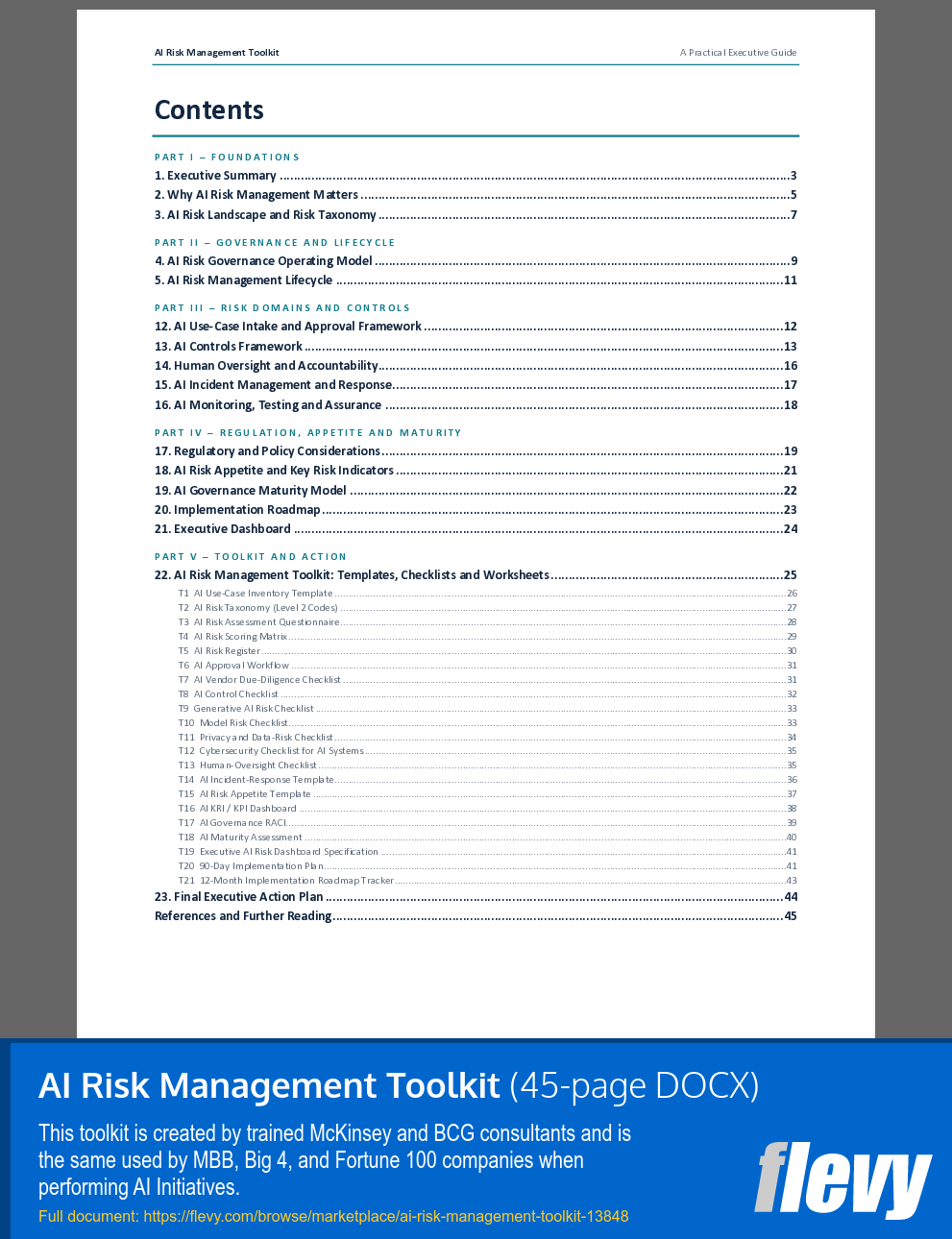
📋 AI RISK MANAGEMENT TOOLKIT: COMPLETE TABLE OF CONTENTS
PART I: FOUNDATIONS
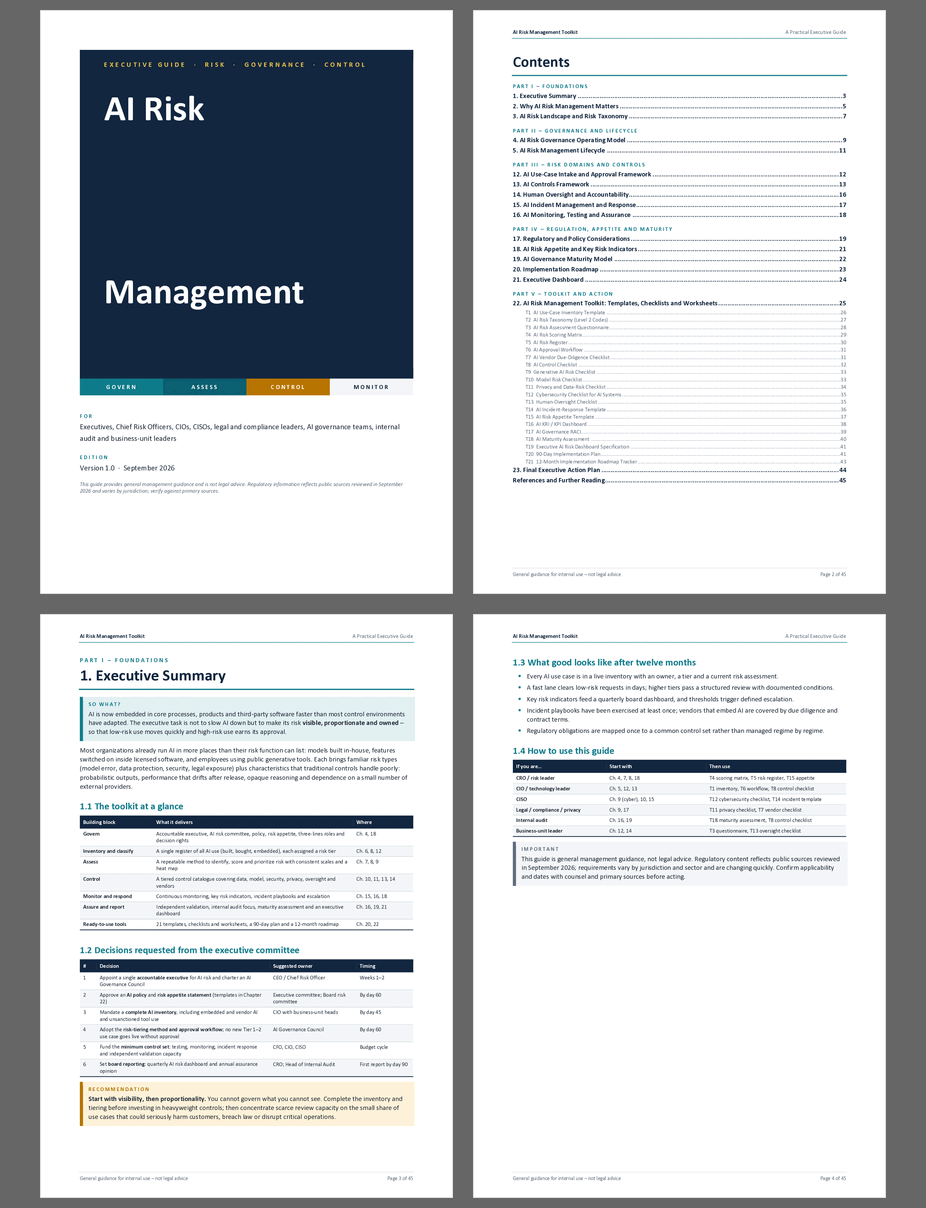
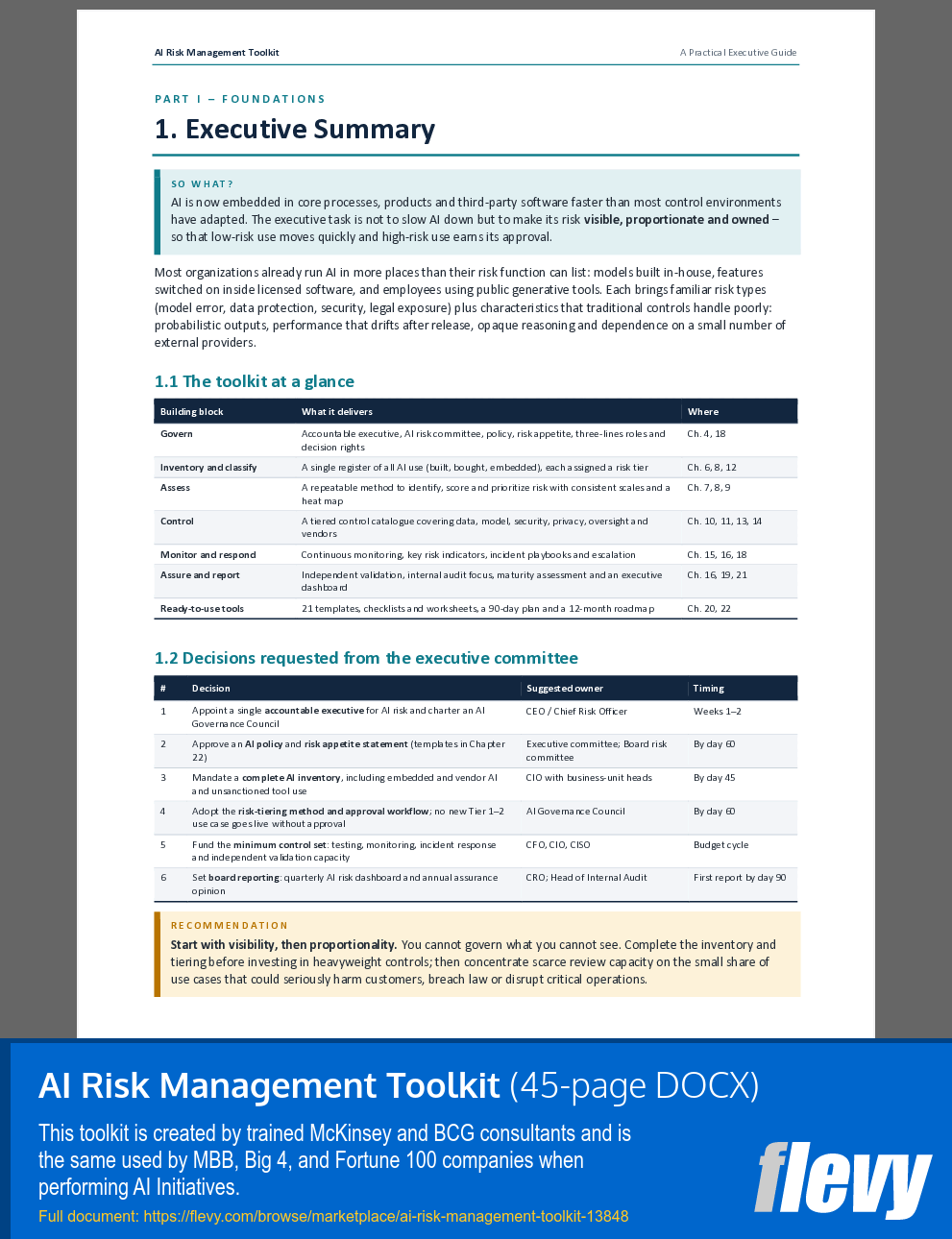
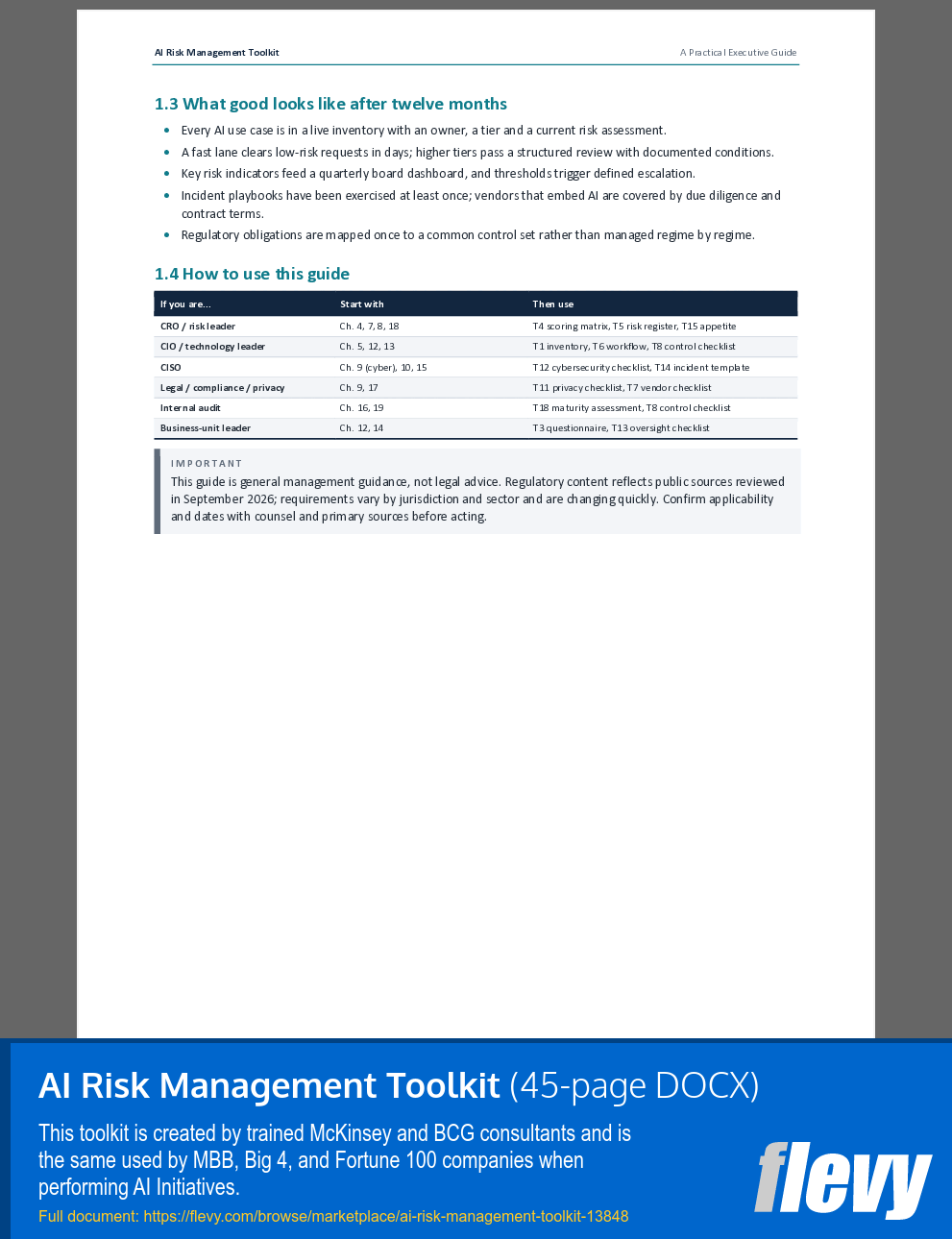
1. Executive Summary: the toolkit at a glance, six decisions for the executive committee, what good looks like after 12 months, and a "where to start" guide by role
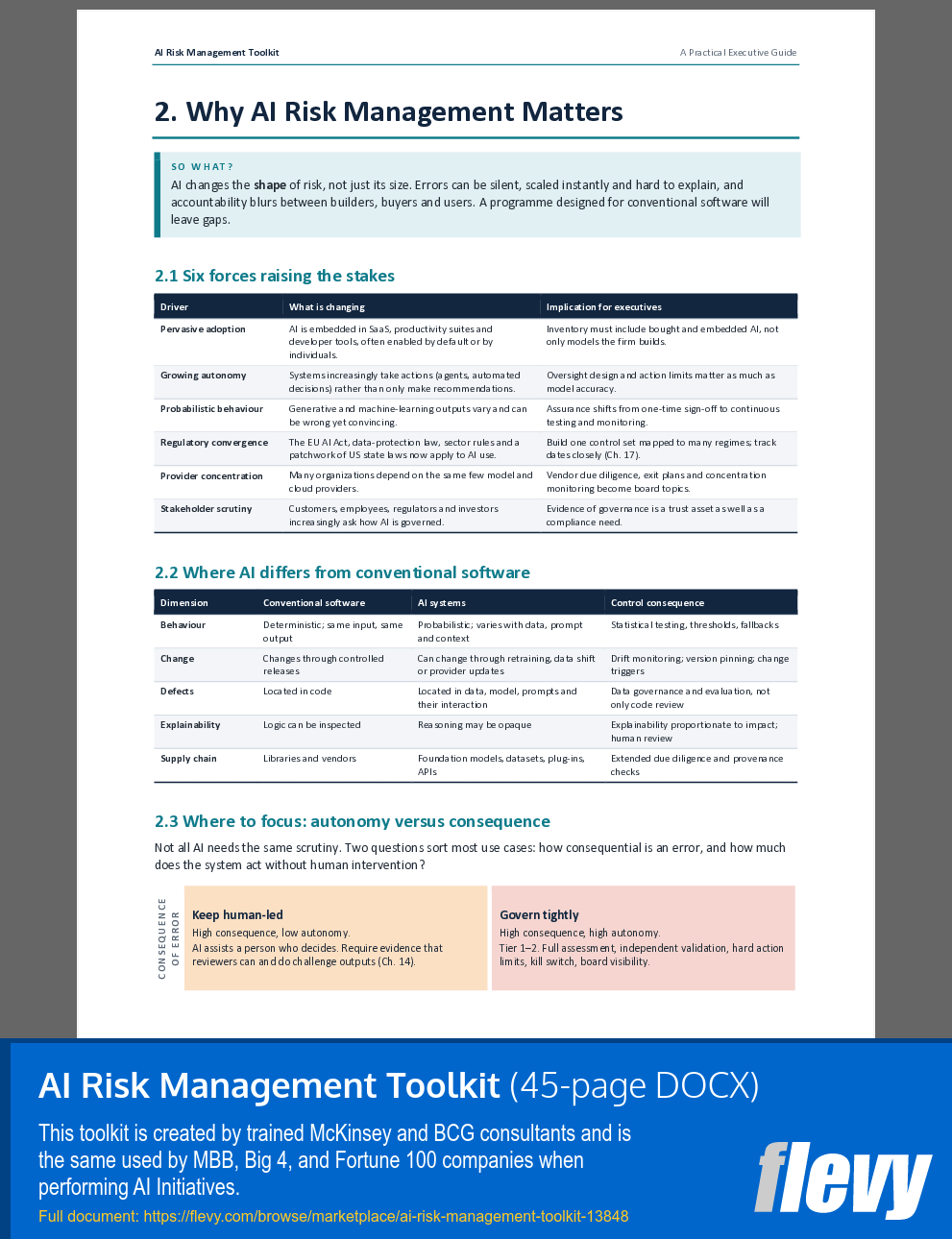
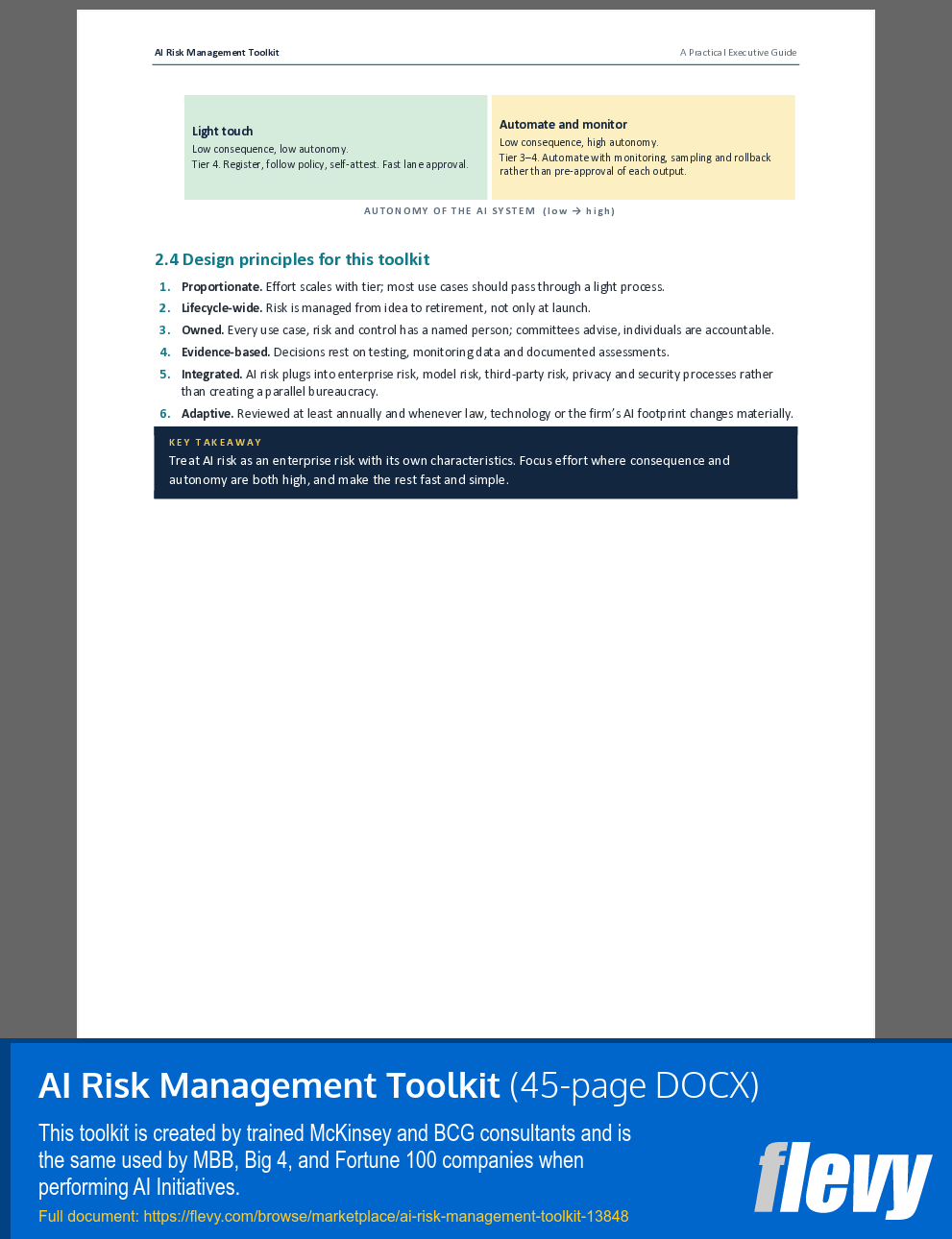
2. Why AI Risk Management Matters: six forces raising the stakes, where AI differs from conventional software, and the autonomy-versus-consequence matrix
3. AI Risk Landscape and Risk Taxonomy: issue tree, ten-category taxonomy and who can be harmed
PART II: GOVERNANCE AND LIFECYCLE
4. AI Risk Governance Operating Model: governance structure, three lines of defence, roles and decision rights
5. AI Risk Management Lifecycle: seven stages, gates and alignment with NIST AI RMF and ISO/IEC 42001
6. AI Risk Identification Framework: finding shadow AI, six-lens issue tree and identification techniques
7. AI Risk Assessment Methodology: six-step method, depth by tier, likelihood and impact scales, and treatment options
8. AI Risk Scoring and Prioritization: tiering questionnaire, override rules, heat map, risk bands, and a severity-versus-effort prioritization matrix
PART III: RISK DOMAINS AND CONTROLS
9. Model, Data, Cybersecurity, Privacy, Legal, Compliance, Operational and Reputational Risks: eight domains, each with failure modes, priority controls and indicators
10. Generative AI and LLM-Specific Risks: distinctive risks, deployment-pattern risk ladder and layered guardrails
11. Third-Party and Vendor AI Risk: sources of vendor AI risk, tiered diligence, contract protections and exit planning
12. AI Use-Case Intake and Approval Framework: authority matrix, decision outcomes and red lines
13. AI Controls Framework: ten control domains and the control catalogue by tier
14. Human Oversight and Accountability: oversight models, effective design and accountability principles
15. AI Incident Management and Response: severity classification, response process, notification triggers and playbooks
16. AI Monitoring, Testing and Assurance: testing, monitoring and independent assurance
PART IV: REGULATION, APPETITE AND MATURITY
17. Regulatory and Policy Considerations: EU AI Act, GDPR, DORA, US federal and state law, UK, China, Canada, key dates, and the recommended standards (NIST, ISO/IEC, OECD, OWASP)
18. AI Risk Appetite and Key Risk Indicators
19. AI Governance Maturity Model
20. Implementation Roadmap
21. Executive Dashboard
PART V: TOOLKIT AND ACTION
22. AI Risk Management Toolkit: Templates, Checklists and Worksheets (all 21 tools below)
23. Final Executive Action Plan: ten actions for the next 30 days and ten questions a board should ask
References and Further Reading
🧰 THE 21 READY-TO-USE TOOLS INSIDE
• T1 AI use-case inventory template
• T2 AI risk taxonomy (level-2 codes)
• T3 AI risk assessment questionnaire
• T4 AI risk scoring matrix and worksheet
• T5 AI risk register
• T6 AI approval workflow and decision record
• T7 AI vendor due-diligence checklist
• T8 AI control checklist
• T9 Generative AI risk checklist
• T10 Model risk checklist
• T11 Privacy and data-risk checklist
• T12 Cybersecurity checklist for AI systems
• T13 Human-oversight checklist
• T14 AI incident-response template
• T15 AI risk appetite template
• T16 AI KRI / KPI dashboard (16 indicators)
• T17 AI governance RACI
• T18 AI maturity assessment
• T19 Executive AI risk dashboard specification
• T20 90-day implementation plan
• T21 12-month implementation roadmap tracker
💥 WHAT MAKES THIS GUIDE DIFFERENT
✅ Tools, not theory. Every template has fields, scoring scales and instructions you can copy straight into your GRC system or spreadsheet.
✅ Proportionate by design. A fast lane for low-risk AI and a rigorous gate for high-risk AI, so governance doesn't become the bottleneck.
✅ Current regulatory picture. Mandatory requirements are clearly separated from recommended practice, and jurisdiction caveats are stated plainly.
✅ Aligned with recognized frameworks. Built to support work with NIST AI RMF, NIST AI 600-1, ISO/IEC 42001, ISO/IEC 23894 and the OECD AI Principles.
✅ Executive format. Strong executive summaries, "so what?" insights, decision frameworks and key-takeaway boxes. No filler.
✅ Fully editable Word file. Adapt the language, branding, thresholds and scales to your organization.
👥 WHO USES THIS GUIDE
• Chief Risk Officers and risk leaders: build and report an AI risk programme
• CIOs and technology leaders: stand up inventory, intake and controls
• CISOs and security teams: secure AI systems and respond to AI incidents
• Legal, compliance and privacy leaders: map obligations and evidence compliance
• AI governance teams and Chief AI Officers: run the operating model day to day
• Internal audit: scope and test AI governance
• Business-unit leaders: get AI use cases approved faster, with the right controls
🎯 THIS GUIDE SOLVES THESE CRITICAL PROBLEMS
❌ You don't know how many AI systems your organization actually uses.
✅ T1 and the discovery methods in Chapter 6 help you build a complete inventory, including vendor-embedded and unsanctioned AI.
❌ You can't tell which AI use cases are high-risk.
✅ The 8-factor tiering questionnaire and override rules classify every use case consistently.
❌ Generative AI is spreading faster than your policy.
✅ Chapter 10 and checklist T9 give you guardrails, a risk ladder and a policy starting point.
❌ Your vendors are adding AI features you never reviewed.
✅ The vendor due-diligence checklist and contract-clause guide give you a repeatable review.
❌ The EU AI Act timeline keeps shifting.
✅ Chapter 17 sets out the key dates, including the 2026 postponements, and how to build one control set mapped to many regimes.
❌ Your board asks about AI risk and you can't answer with evidence.
✅ The executive dashboard, KRI set and ten board questions give you a reporting rhythm.
❌ You don't know where to start.
✅ The 90-day plan and the "ten actions for the next 30 days" give you a clear start.
🚀 IMPLEMENTATION STARTS IMMEDIATELY
Day 1: Read the Executive Summary and the six decisions it asks of your executive committee.
Week 1: Name an accountable executive and launch the inventory with T1.
Weeks 2–4: Tier your use cases with T3 and publish interim generative AI guidance.
Days 31–60: Approve policy and appetite (T15) and design the intake workflow (T6).
Days 61–90: Go live with intake, build the first dashboard (T16, T19) and run a tabletop incident exercise (T14).
💎 WHY THIS GUIDE DELIVERS
✅ Visibility first: you can't govern what you can't see
✅ Accountability: one named executive, clear decision rights, a full RACI
✅ Proportionality: effort scales with risk
✅ Evidence: gates, records and indicators your auditors and regulators can follow
✅ Speed: a 90-day launch path and 12-month roadmap
✅ READY. PRACTICAL. EDITABLE. DOWNLOAD NOW.
AI RISK MANAGEMENT TOOLKIT: Your Executive Blueprint for AI Governance, AI Risk Assessment, Generative AI Controls, Vendor AI Due Diligence and Board-Ready AI Risk Reporting.
Keywords: Process Audit SOPs, Internal Audit Standard Operating Procedures, Process Audit Framework, Control Testing Procedures, Risk Assessment Methodologies, Audit Governance, Process Audit Strategy, Audit Evidence Collection, Compliance Audit SOPs, Continuous Auditing, Process Mapping, Audit Documentation Standards, Audit Quality Assurance, Process Risk Management, Operational Risk Audit, Enterprise Audit Management, Audit Committee Reporting, Audit Analytics, Process Mining, AI-Assisted Auditing, Audit Technology SOPs, Global Process Audit, Audit Playbooks, Audit Templates, Audit Training Programs, Audit Remediation Management, Audit Excellence, Process Audit Toolkit, McKinsey Audit Framework, Audit Best Practices, Enterprise Governance, Internal Control Assessment, Audit Procedures Manual, Audit Program Design, Audit Resource Planning, Audit Scheduling, Audit Efficiency, Audit Effectiveness, Audit Performance Metrics, Audit KPIs, Audit ROI, Audit Value Creation, Process Optimization, Operational Excellence, Business Process Audit, Functional Audit, Departmental Audit, Transactional Audit, Service Audit, Administrative Process Audit, Supply Chain Process Audit, Finance Process Audit, IT Process Audit, HR Process Audit, Procurement Process Audit, Sales Process Audit, Customer Service Audit, Production Audit, Quality Audit, Compliance Testing, Regulatory Audit, Policy Compliance, Procedure Audit, Documentation Audit, Audit Trail Review, Exception Management, Control Design, Control Effectiveness, Control Testing, Preventive Controls, Detective Controls, Corrective Actions, Root Cause Analysis, Finding Classification, Audit Report Writing, Executive Summaries, Audit Communication, Stakeholder Engagement, Process Owner Engagement, Management Accountability, Audit Committee Governance, Audit Charter, Audit Independence, Auditor Ethics, Professional Skepticism, Audit Competency, Audit Training, Audit Certification, Audit Standards (IIA, IAASB), Audit Best Practices, Audit Methodology, Audit Framework, Audit Operating Model, Process Audit Excellence, Audit Mastery, Fortune 500 Audit, Enterprise Audit Operations, Corporate Audit Function, Strategic Audit Planning, Transformation Audit, Digital Audit, Innovation Audit, Benchmarking Audit, Maturity Assessment, Audit Scaling, Audit Outsourcing, Co-Sourcing Models, Vendor Management, Audit Technology Stack, Audit Tools, Audit Software, Continuous Monitoring, Predictive Analytics, Anomaly Detection, Data Quality, Process Intelligence, Workflow Analytics, Business Process Management, Process Automation, RPA Audit, AI Governance, Responsible AI Audit, Cybersecurity Audit, Data Governance Audit, Privacy Audit, Information Security, Audit Evidence Standards, Working Papers, Audit Documentation, Audit File Management, Audit Records Retention, Audit Trail Integrity, Audit Report Confidentiality, Multi-Site Audit Coordination, Global Audit Strategy, International Audit Standards, Regional Audit Compliance, Cultural Considerations in Audit, Localization of Audit Procedures, Process Transformation Audit, Business Reengineering Audit, Change Audit, Operational Change, Audit Change Management, Audit Communication Plan, Audit Stakeholder Communication, Audit Performance Review, Audit Function Review, Strategic Review Process, Audit Leadership Development, Audit Team Development, Audit Coaching, Audit Supervision, Audit Career Progression, Audit Knowledge Management, Audit Playbook Development, Audit Template Library, Audit Standards Documentation, Audit Policy Manual, Lessons Learned Capture, Best Practice Sharing, Audit Continuous Improvement, Audit Methodology Enhancement, Audit Process Optimization, Audit Efficiency Improvement, Audit Effectiveness Enhancement, Audit Quality Improvement, Audit Risk Management, Audit Risk Register, Audit Issue Management, Audit Action Tracking, Audit Metrics Dashboard, Audit Performance Dashboard, Audit Scorecard, Audit Balanced Scorecard, KPI Framework for Audit, Audit Success Factors, Critical Success Factors in Audit, Audit Strategic Objectives, Audit Vision Statement, Audit Mission Statement, Audit Values and Ethics, Audit Culture, Audit Maturity Model, Audit Capability Model, Audit Competency Framework, Professional Development in Audit, Audit Certification Programs, Internal Audit Standards, Audit Best Practices Guide, Audit Reference Manual, Audit Operating Manual, Audit Procedures Manual, Audit Program Manual, McKinsey Audit Excellence, Deloitte Audit Framework, EY Audit Approach, KPMG Audit Methodology, Big 4 Audit Standards, Audit Industry Benchmarks, Audit Industry Standards, Audit Thought Leadership, Audit Innovation, Audit Transformation Program, Audit Digital Transformation, Audit Process Transformation, Audit Service Transformation, Audit Operating Model Transformation, Audit Function Evolution, Audit Future-Proofing, Emerging Trends in Audit, Audit 2025 Roadmap, Audit Strategic Priorities, Audit Strategic Planning, Audit Strategic Execution, Audit Implementation Plan, Audit Deployment Strategy, Audit Rollout Plan, Audit Quick-Start Guide, Audit Implementation Guide, Audit User Guide, Audit Handbook, Audit Manual, Audit Documentation Standard, Audit Work Standards, Audit Quality Standards, Audit Performance Standards, Audit Excellence Standards, Enterprise Audit Excellence, Audit Mastery Program, Audit Excellence Initiative, Audit Excellence Framework, Audit Excellence Culture, Audit Excellence Mindset, Strategic Audit Excellence, Operational Audit Excellence, Financial Audit Excellence, Compliance Audit Excellence, Quality Audit Excellence, Process Audit Excellence, Audit Excellence ROI, Audit Excellence Value Creation, Audit Excellence Competitive Advantage, Audit Excellence Strategic Advantage, Audit Excellence Performance Advantage, Audit Excellence Organizational Advantage, Inventory Management, Demand Planning, Inventory Optimization, Inventory Control, Supply Chain Management, Warehouse Operations, Replenishment Strategy, Inventory Analytics, WIP Reduction, Inventory Accuracy, Distribution Network, Inventory Forecasting, Supply Chain Excellence, Working Capital, Inventory KPIs, Procurement Strategy, Inventory Governance, Inventory SOPs, Continuous Improvement, Supply Chain Transformation, GenAI deployment SOPs, generative AI operating model, enterprise AI governance framework, AI Center of Excellence, responsible AI, AI risk management, AI use case prioritization, GenAI implementation roadmap, AI vendor selection, prompt engineering standards, AI compliance, AI adoption strategy, generative AI across value chain, AI strategy, enterprise transformation, AI implementation, AI scaling framework
Strategy & Transformation, Growth Strategy, Strategic Planning, Strategy Frameworks, Innovation Management, Pricing Strategy, Core Competencies, Strategy Development, Business Transformation, Marketing Plan Development, Product Strategy, Breakout Strategy, Competitive Advantage, Mission, Vision, Values, Strategy Deployment & Execution, Innovation, Vision Statement, Core Competencies Analysis, Corporate Strategy, Product Launch Strategy, BMI, Blue Ocean Strategy, Breakthrough Strategy, Business Model Innovation, Business Strategy Example, Corporate Transformation, Critical Success Factors, Customer Segmentation, Customer Value Proposition, Distinctive Capabilities, Enterprise Performance Management, KPI, Key Performance Indicators, Market Analysis, Market Entry Example, Market Entry Plan, Market Intelligence, Market Research, Market Segmentation, Market Sizing, Marketing, Michael Porter's Value Chain, Organizational Transformation, Performance Management, Performance Measurement, Platform Strategy, Product Go-to-Market Strategy, Reorganization, Restructuring, SWOT, SWOT Analysis, Service 4.0, Service Strategy, Service Transformation, Strategic Analysis, Strategic Plan Example, Strategy Deployment, Strategy Execution, Strategy Frameworks Compilation, Strategy Methodologies, Strategy Report Example, Value Chain, Value Chain Analysis, Value Innovation, Value Proposition, Vision Statement, Corporate Strategy, Business Development, Business plan pdf, business plan, PDF, Business Plan DOC, Business Plan Template, PPT, Market strategy playbook, strategic market planning, competitive analysis tools, market segmentation frameworks, growth strategy templates, product positioning strategy, market execution toolkit, strategic alignment playbook, KPI and OKR frameworks, business growth strategy guide, cross-functional strategy templates, market risk management, market strategy PowerPoint doc, guide, ebook, e-book ,McKinsey Change Playbook, Organizational change management toolkit, Change management frameworks 2025, Influence model for change, Change leadership strategies, Behavioral change in organizations, Change management PowerPoint templates, Transformational leadership in change, supply chain KPIs, supply chain KPI toolkit, supply chain PowerPoint template, logistics KPIs, procurement KPIs, inventory management KPIs, supply chain performance metrics, manufacturing KPIs, supply chain dashboard, supply chain strategy KPIs, reverse logistics KPIs, sustainability KPIs in supply chain, financial supply chain KPIs, warehouse KPIs, digital supply chain KPIs, 1200 KPIs, supply chain scorecard, KPI examples, supply chain templates, Corporate Finance SOPs, Finance SOP Excel Template, CFO Toolkit, Finance Department Procedures, Financial Planning SOPs, Treasury SOPs, Accounts Payable SOPs, Accounts Receivable SOPs, General Ledger SOPs, Accounting Policies Template, Internal Controls SOPs, Finance Process Standardization, Finance Operating Procedures, Finance Department Excel Template, FP&A Process Documentation, Corporate Finance Template, Finance SOP Toolkit, CFO Process Templates, Accounting SOP Package, Tax Compliance SOPs, Financial Risk Management Procedures.
NOTE: Our digital products are sold on an "as is" basis, making returns and refunds unavailable post-download. Please preview and inquire before purchasing. Please contact us before purchasing if you have any questions! This policy aligns with the standard Flevy Terms of Usage.
Got a question about the product? Email us at support@flevy.com or ask the author directly by using the "Ask the Author a Question" form. If you cannot view the preview above this document description, go here to view the large preview instead.
Source: Best Practices in Artificial Intelligence, Risk Management Word: AI Risk Management Toolkit Word (DOCX) Document, SB Consulting
ABOUT THE AUTHOR
SB Consulting is dedicated to empowering businesses to communicate their ideas with impact. This consulting firm specializes in teaching organizations how to create effective corporate and management presentations. With training from top-tier global consulting firms, including McKinsey, BCG, and Porsche Consulting, extensive expertise in presentation design and ... [read more]
Ask the Author a Question
You must be logged in to contact the author.