 Click main image to view in full screen.
AI-DLC Adoption Readiness Assessment – Excel XLSX
Excel (XLSX)


BENEFITS OF THIS DOWNLOADABLE EXCEL DOCUMENT
- Produces a weighted Readiness Score (1–5) with RAG banding and a recommended Adoption Path -- Foundation Needed, Pilot in Bounded Greenfield, or Ready to Scale -- giving leaders a defensible basis for committing budget and a pilot team.
- Scores 25 criteria across five weighted readiness dimensions -- Strategic & Executive, Organisational & Cultural, Technical & Platform, Governance & Risk, and Delivery & Pilot Readiness -- with Technical and Governance weighting increasing automatically
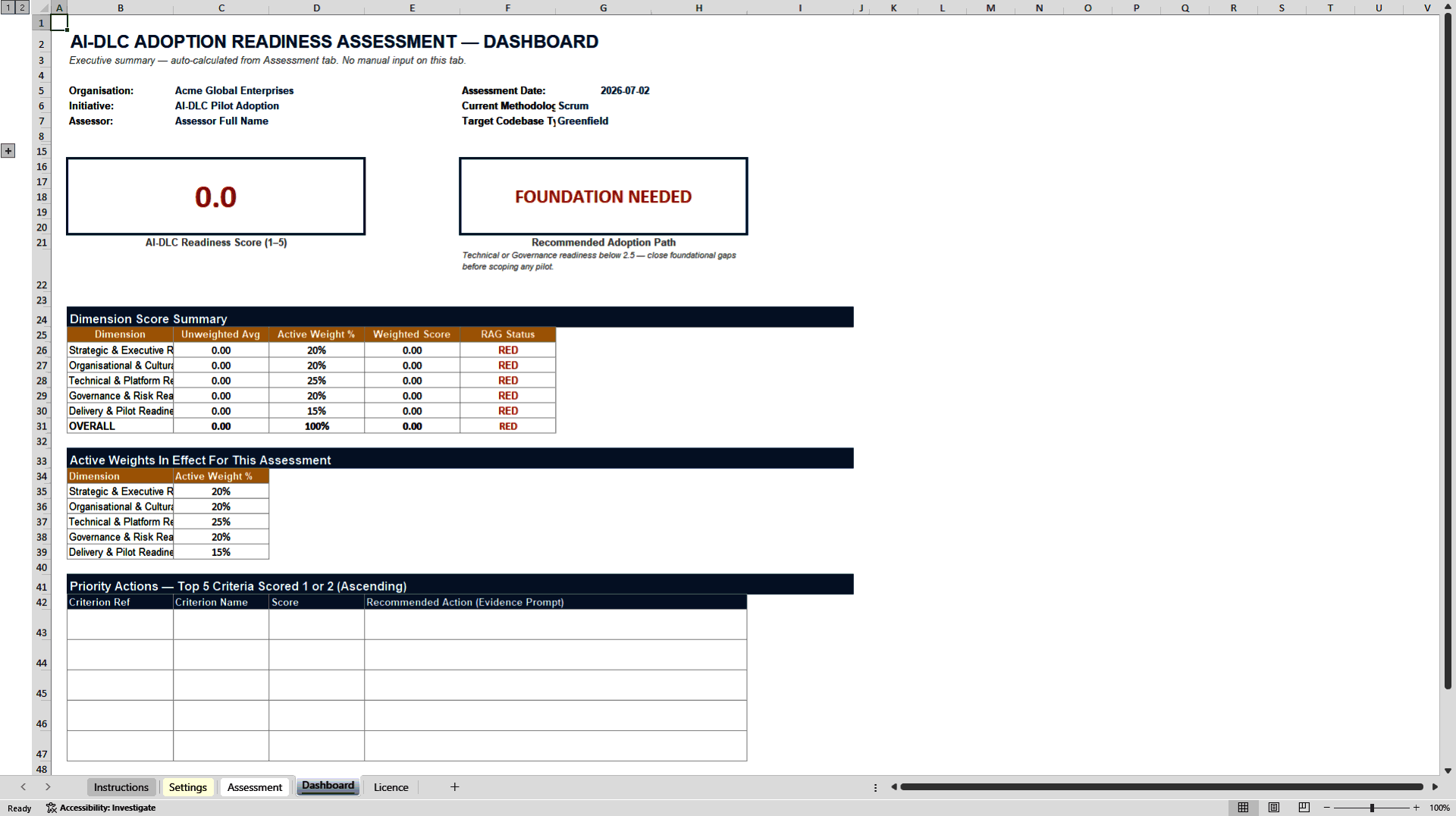
- Generates a ranked Priority Actions list of the five weakest-scoring criteria with remediation guidance, giving teams a concrete sequence of gaps to close before selecting a pilot.
ARTIFICIAL INTELLIGENCE EXCEL DESCRIPTION
Most organisations select an AI-DLC pilot team before checking whether the ground underneath it can hold. Governance gaps, thin technical infrastructure, and cultural resistance to AI-executed cycles typically surface only after a pilot is already underway, by which point the cost of fixing them is far higher than the cost of catching them early. Leaders proposing AI-driven development adoption often have no evidence-anchored answer to the question a steering committee will ask first: are we actually ready, and for how much.
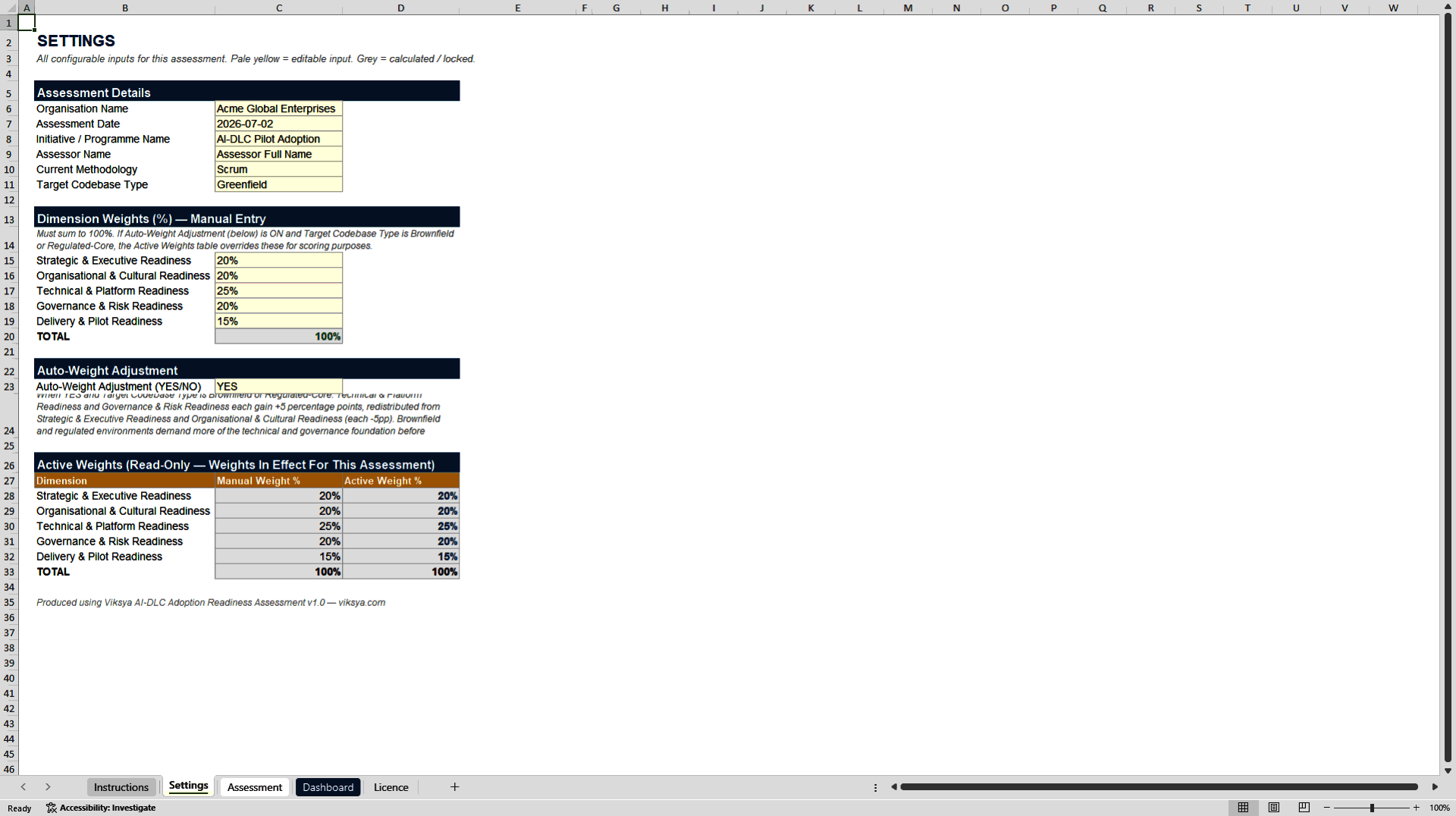
This assessment answers that question with a scored instrument rather than an opinion. It evaluates an organisation against 25 specific criteria spread across five weighted readiness dimensions, then calculates two outputs automatically: a Readiness Score from 1 to 5 with RAG banding, and a recommended Adoption Path of Foundation Needed, Pilot in Bounded Greenfield, or Ready to Scale, driven primarily by the Technical and Governance dimension scores. Where the target codebase is Brownfield or Regulated-Core rather than Greenfield, the weighting on Technical and Governance readiness increases automatically to reflect the added risk.
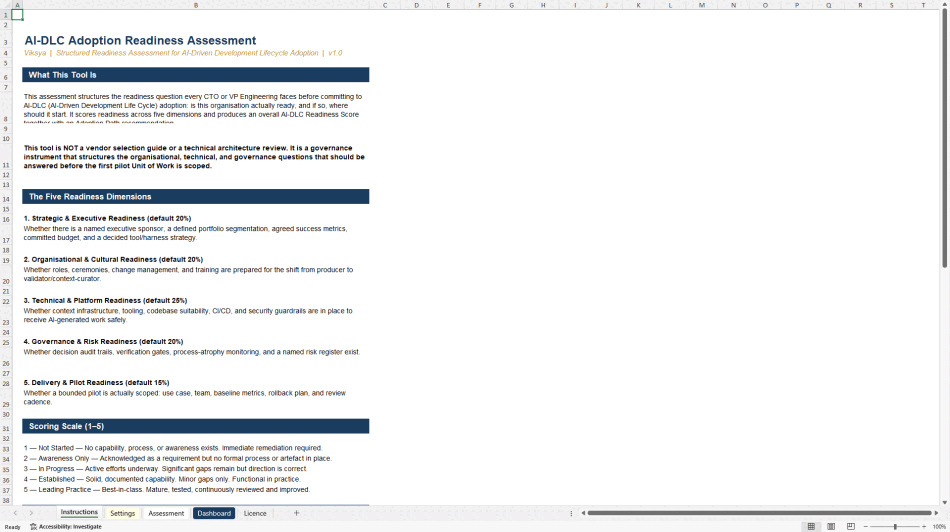
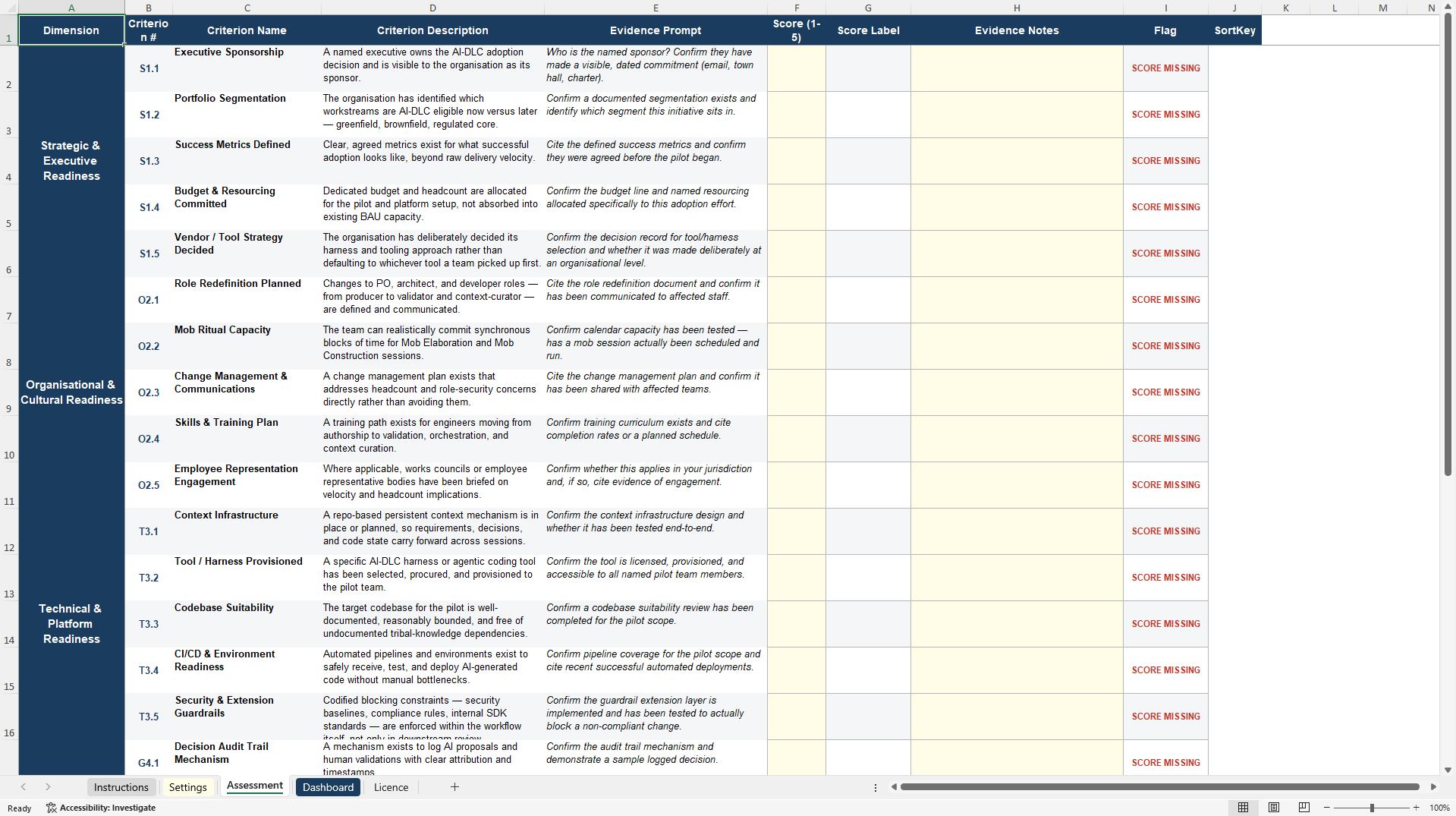
The workbook is organised into four tabs. Instructions walks through setup, scoring, and how to read the outputs. Settings captures organisation and initiative details, target codebase type, and the dimension weights, including the auto-weight toggle. Assessment holds the 25 criteria, five each across Strategic & Executive, Organisational & Cultural, Technical & Platform, Governance & Risk, and Delivery & Pilot Readiness, scored on a 1-to-5 dropdown scale with space for supporting evidence. Dashboard consolidates the results into the Readiness Score, Adoption Path, a RAG summary, and an automatically generated Priority Actions list ranking the five weakest-scoring criteria with remediation guidance, formatted for direct use in a steering committee or board deck.
It is built for CTOs and VPs of Engineering deciding whether to commit budget and a pilot team, platform and engineering leaders scoping which workstreams are eligible now, transformation and PMO leads sequencing a move from SAFe or Agile toward AI-DLC, and management consultants who need a credible, evidence-based instrument for client engagements rather than a blank-page workshop. The criteria reference AI-DLC terminology such as Bolts, Units of Work, and Verification Gates, and are written to be vendor-neutral regardless of which AI tooling an organisation adopts.
Format: Excel (.xlsx), no macros or VBA, no external data connections. Works in Excel 2016 through Microsoft 365.
Published by Viksya. Seller licence terms are included within the document and take precedence over platform defaults
Got a question about the product? Email us at support@flevy.com or ask the author directly by using the "Ask the Author a Question" form. If you cannot view the preview above this document description, go here to view the large preview instead.
Source: Best Practices in Artificial Intelligence Excel: AI-DLC Adoption Readiness Assessment Excel (XLSX) Spreadsheet, Viksya
ABOUT THE AUTHOR

Viksya builds decision frameworks for leaders who answer to a board, not a hunch. Our Excel workbooks and playbooks are developed by a transformation leader with hands-on experience directing $100M+ AI and cloud portfolios inside large enterprises -- the same instruments used to justify, select, estimate, and govern real programmes, productized. The catalog spans three tracks: AI Transformation ... [read more]
Ask the Author a Question
You must be logged in to contact the author.




























