


This framework is developed by a team of former McKinsey and Big 4 consultants. The presentation follows the headline-body-bumper slide format used by global consulting firms.
Editor Summary
Dimensions of Business Process Reengineering (BPR) is a 22-slide PowerPoint framework by LearnPPT Consulting that explains the 2 core BPR dimensions—Breadth (range of activity types) and Depth (extent of organizational change)—and why narrow redesign gains often fail to translate to the bottom line.
Read moreThe deck includes a detailed analysis of 20 organizations, highlights that redesign must change 6 crucial organizational elements, and provides slide templates. Sold as a digital download on Flevy.
Use this framework when process improvement efforts have produced isolated, short-term gains, but failed to improve overall financial performance; it helps expand scope and organizational penetration of redesigns.
Operations managers mapping process scope to cost or customer value across a business unit for broader redesign work.
Transformation leads sequencing changes that must penetrate the organization’s core across the framework’s 6 organizational elements.
Management consultants diagnosing why process wins did not convert to profit, using comparative analysis.
The two-dimension approach pairs scope (breadth) with organizational penetration (depth), reflecting structured diagnostic practice in management consulting.
In all too many organizations, Business Process Reengineering (BPR) has been not only a great success, but – ironically – also a great failure. After months, even years, of careful process redesign, these companies achieve dramatic improvements in individual processes only to watch overall results decline.
Business Process Reengineering (BPR) is a management strategy originally pioneered in the early 1990s, which focuses on the analysis and design of workflows and business processes within an organization. BPR is a practice of rethinking and redesigning the way work is done to better support an organization's mission and reduce costs.
BPR aims to help organizations fundamentally rethink how they do their work in order to improve customer service, cut operational costs, and become world-class competitors. BPR also seeks to help organizations radically restructure their organizations by focusing on the ground-up design of their business processes.
The promise of process reengineering is not empty. It can actually deliver revolutionary process improvements. Major reengineering process efforts are being conducted around the world. Yet, companies cannot translate these results to the bottom line.
This framework discusses the 2 dimensions of Business Process Engineering, which are critical in translating these short-term narrow-focus process improvements into long term profits. Organizations just need to have a good grasp of these dimensions of BPR to effectively manage business process improvements.
This presentation will provide you an in-depth understanding of BPR and the 2 dimensions of BPR:
1. Breadth (of Process Redesigned)
2. Depth (of Business Change)
Breadth and Depth are critical in translating short-term, narrow focus process improvements into long-term profits.
The first dimension of BPR, Bread (of Process Redesign), captures the range of activity types within a business process. The business process to be redesigned must be broadly defined in terms of cost or customer value to improve performance across the entire business unit.
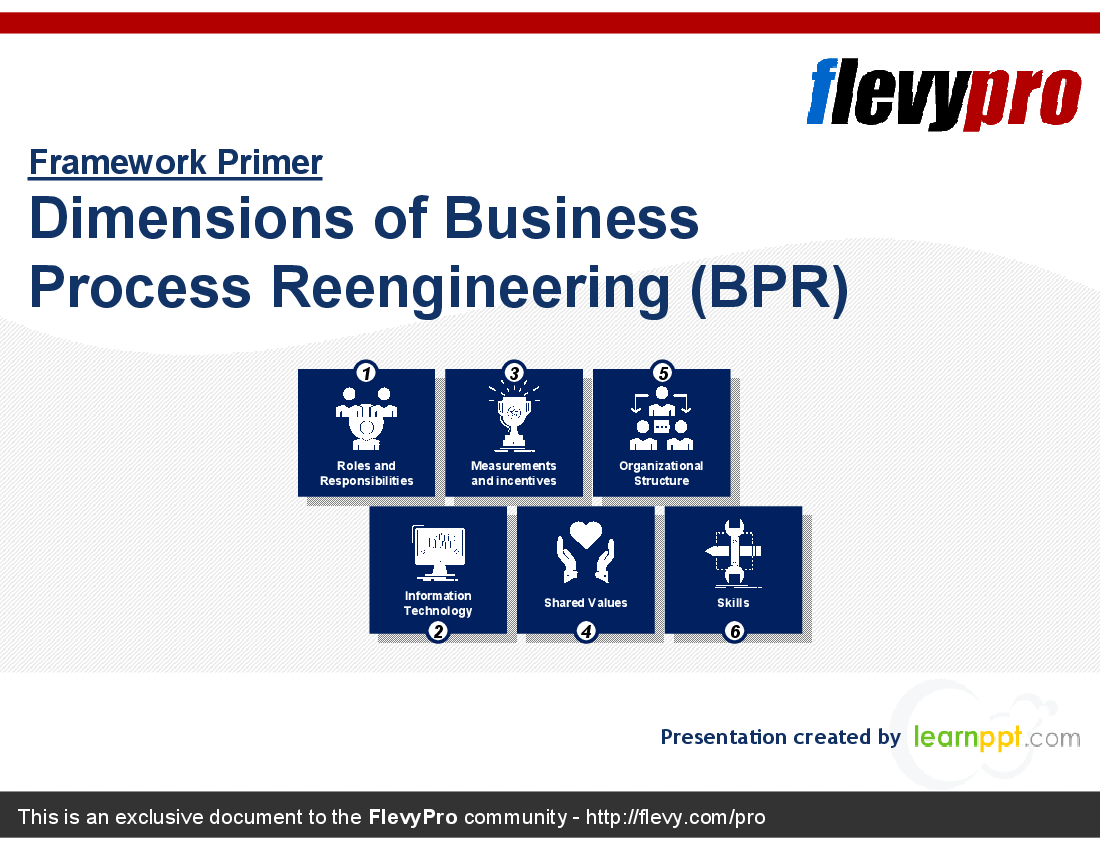
The second dimension of BPR, Depth (of Business Change), captures how many and how much of the depth levers change as a result of process reengineering. Redesign must penetrate to the organization's core, fundamentally changing 6 crucial organizational elements.
These 2 dimensions of Business Process Reengineering are discussed in further deck within the presentation framework.
This deck also includes slide templates for you to use in your own business presentations.
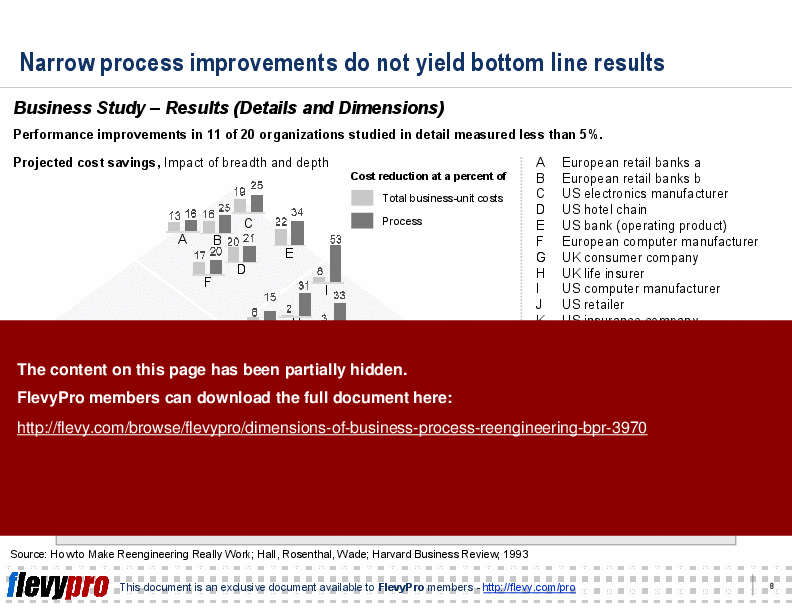
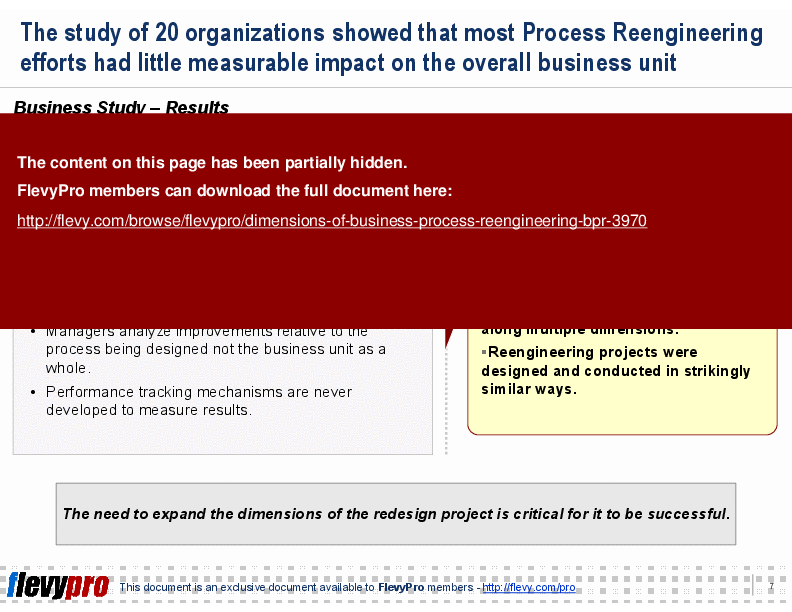
This PPT includes a detailed analysis of 20 organizations to uncover why reengineering efforts often fail to impact the bottom line. It also provides actionable insights into leveraging the breadth and depth dimensions for sustainable business transformation.
What are the 2 dimensions of Business Process Reengineering I should be focusing on?
BPR separates redesign concerns into Breadth and Depth: Breadth captures the range of activity types in the process and should be defined by cost or customer value, while Depth captures how many and how much organizational levers change; together they form the 2 dimensions of BPR.
How does defining breadth by cost or customer value change redesign priorities?
Defining breadth in terms of cost or customer value ensures redesign targets activities that materially affect business-unit performance rather than isolated tasks. The approach shifts scope from narrow process fixes to processes with measurable cost or customer impact, aligning redesign scope with business-unit value.
What does depth mean in BPR and how deep should redesign go?
Depth describes how far redesign penetrates organizational systems and levers; effective BPR should reach the organization’s core and fundamentally change multiple internal elements. The framework emphasizes penetrating 6 crucial organizational elements as part of meaningful depth.
Why do companies see dramatic process improvements, but still miss the bottom line?
Companies often focus on narrowly scoped process improvements that deliver local gains, but do not change organizational structures, incentives, or end-to-end customer value, preventing translation to overall financial results. The presentation’s cross-case work examines this gap across 20 organizations.
How should I choose a BPR slide/template package for a short engagement with a small team?
Prioritize packages that explicitly address both Breadth and Depth, include stakeholder-facing slide templates, and offer case analysis to speed diagnosis. A useful example is Flevy’s Dimensions of Business Process Reengineering (BPR), which is a 22-slide PowerPoint with analysis of 20 organizations.
What is the practical value of slide templates when presenting BPR findings to executives?
Slide templates help structure executive conversations around scope and organizational impact, making it easier to show why isolated process gains didn’t scale and what organizational elements must change. The product provides presentation-ready templates within its 22 slides.
I’m facing declining overall results after redesigns—what framework should I apply first?
Start with a two-dimension diagnostic that expands process Breadth (scope defined by cost/customer value) and assesses Depth (organizational penetration across core elements), then prioritize interventions that alter those elements; the Dimensions of Business Process Reengineering (BPR) framework structures this analysis around Breadth and Depth.
How much case-based evidence exists about why reengineering efforts fail to impact profit?
Empirical reviews exist that compare multiple reengineering efforts; the referenced presentation includes a detailed analysis of 20 organizations to identify failure patterns and lessons for translating process improvements into long-term profits.
This PPT slide outlines opportunities for process improvement through Business Process Reengineering (BPR). It categorizes redesign strategies into 3 areas: eliminating upstream problems, removing delays during handoffs, and combining multi-functional steps. For example, a US computer company reduced costs and errors by addressing misconfigurations in order entry through a cross-functional redesign. A UK insurance company streamlined policy processing from ten handoffs to one, cutting processing time to under 7 days. Additionally, a US electronics manufacturer consolidated roles to enhance provisioning efficiency. BPR provides organizations with pathways to uncover innovative performance enhancements.
This PPT slide outlines the "Breadth of Process Redesigned" in Business Process Reengineering (BPR). It emphasizes identifying critical activities essential for value creation and measuring cost reduction as a percentage of the overall business unit. Including a broader range of activities in the redesign can lead to significant improvements and uncover incremental opportunities that may be overlooked in isolated performance efforts. A common pitfall in reengineering is insufficient process breadth, which can hinder achieving desired outcomes. A thorough examination of process breadth is necessary for successful BPR, encouraging decision-makers to adopt a wide-ranging perspective for comprehensive improvements and value creation.
Source: Best Practices in Process Improvement, Business Process Re-engineering PowerPoint Slides: Dimensions of Business Process Reengineering (BPR) PowerPoint (PPT) Presentation Slide Deck, LearnPPT Consulting
This framework is developed by a team of former McKinsey and Big 4 consultants. The presentation follows the headline-body-bumper slide format used by global consulting firms.
For $10.00 more, you can download this document plus 2 more FlevyPro documents. That's just $13 each.
ABOUT FLEVYPRO
This document is part of the FlevyPro Library, a curated knowledge base of documents for our FlevyPro subscribers.
FlevyPro is a subscription service for on-demand business frameworks and analysis tools. FlevyPro subscribers receive access to an exclusive library of curated business documents—business framework primers, presentation templates, Lean Six Sigma tools, and more—among other exclusive benefits.
The average daily rate of a McKinsey consultant is $6,625 (not including expenses). The average price of a Flevy document is $65.
Trusted by over 10,000+ Client Organizations
Since 2012, we have provided business templates to over 10,000 businesses and organizations of all sizes, from startups and small businesses to the Fortune 100, in over 130 countries.
"FlevyPro provides business frameworks from many of the global giants in management consulting that allow you to provide best in class solutions for your clients."
– David Harris, Managing Director at Futures Strategy
"I am extremely grateful for the proactiveness and eagerness to help and I would gladly recommend the Flevy team if you are looking for data and toolkits to help you work through business solutions."
– Trevor Booth, Partner, Fast Forward Consulting
"As an Independent Management Consultant, I find Flevy to add great value as a source of best practices, templates and information on new trends. Flevy has matured and the quality and quantity of the library is excellent. Lastly the price charged is reasonable, creating a win-win value for
the customer, Flevy and the various authors. This is truly a service that benefits the consulting industry and associated clients. Thanks for providing this service.
"
– Jim Schoen, Principal at FRC Group
"As a consulting firm, we had been creating subject matter training materials for our people and found the excellent materials on Flevy, which saved us 100's of hours of re-creating what already exists on the Flevy materials we purchased."
– Michael Evans, Managing Director at Newport LLC
"I have used Flevy services for a number of years and have never, ever been disappointed. As a matter of fact, David and his team continue, time after time, to impress me with their willingness to assist and in the real sense of the word. I have concluded in fact
that it is not at all just a repository of documents/resources but, in the way that David and his team manage the firm, it is like dealing with consultants always ready to assist, advise and direct you to what you really need, and they always get it right.
I am an international hospitality accomplished senior executive who has worked and lived during the past 35 years in 23 countries in 5 continents and I can humbly say that I know what customer service is, trust me.
Aside from the great and professional service that Flevy's team provide, their wide variety of material is of utmost great quality, professionally put together and most current.
Well done Flevy, keep up the great work and I look forward to continue working with you in the future and to recommend you to a variety of colleagues around the world.
"
– Roberto Pelliccia, Senior Executive in International Hospitality
"Flevy is now a part of my business routine. I visit Flevy at least 3 times each month.
Flevy has become my preferred learning source, because what it provides is practical, current, and useful in this era where the business world is being rewritten.

many challenges and there is the need to make the right decisions in a short time, with so much scattered information, we are fortunate to have Flevy. Flevy investigates, selects, and puts at our disposal the best of the best to help us be successful in our work.
"
– Omar Hernán Montes Parra, CEO at Quantum SFE
"My FlevyPro subscription provides me with the most popular frameworks and decks in demand in today’s market. They not only augment my existing consulting and coaching offerings and delivery, but also keep me abreast of the latest trends, inspire new products and service offerings for my practice, and educate me
in a fraction of the time and money of other solutions. I strongly recommend FlevyPro to any consultant serious about success.
"
– Bill Branson, Founder at Strategic Business Architects
"As a niche strategic consulting firm, Flevy and FlevyPro frameworks and documents are an on-going reference to help us structure our findings and recommendations to our clients as well as improve their clarity, strength, and visual power. For us, it is an invaluable resource to increase our impact and value."
– David Coloma, Consulting Area Manager at Cynertia Consulting
Receive our FREE presentation on Operational Excellence
This 50-slide presentation provides a high-level introduction to the 4 Building Blocks of Operational Excellence. Achieving OpEx requires the implementation of a Business Execution System that integrates these 4 building blocks.
Receive our FREE presentation on Operational Excellence
Get Our FREE Product.
This 50-slide presentation provides a high-level introduction to the 4 Building Blocks of Operational Excellence. Achieving OpEx requires the implementation of a Business Execution System that integrates these 4 building blocks.