 Click main image to view in full screen.
VC Fund Distribution Waterfall & Carried Interest Model – Excel XLSX
Excel (XLSX) + supplemental PDF


BENEFITS OF THIS DOWNLOADABLE EXCEL DOCUMENT
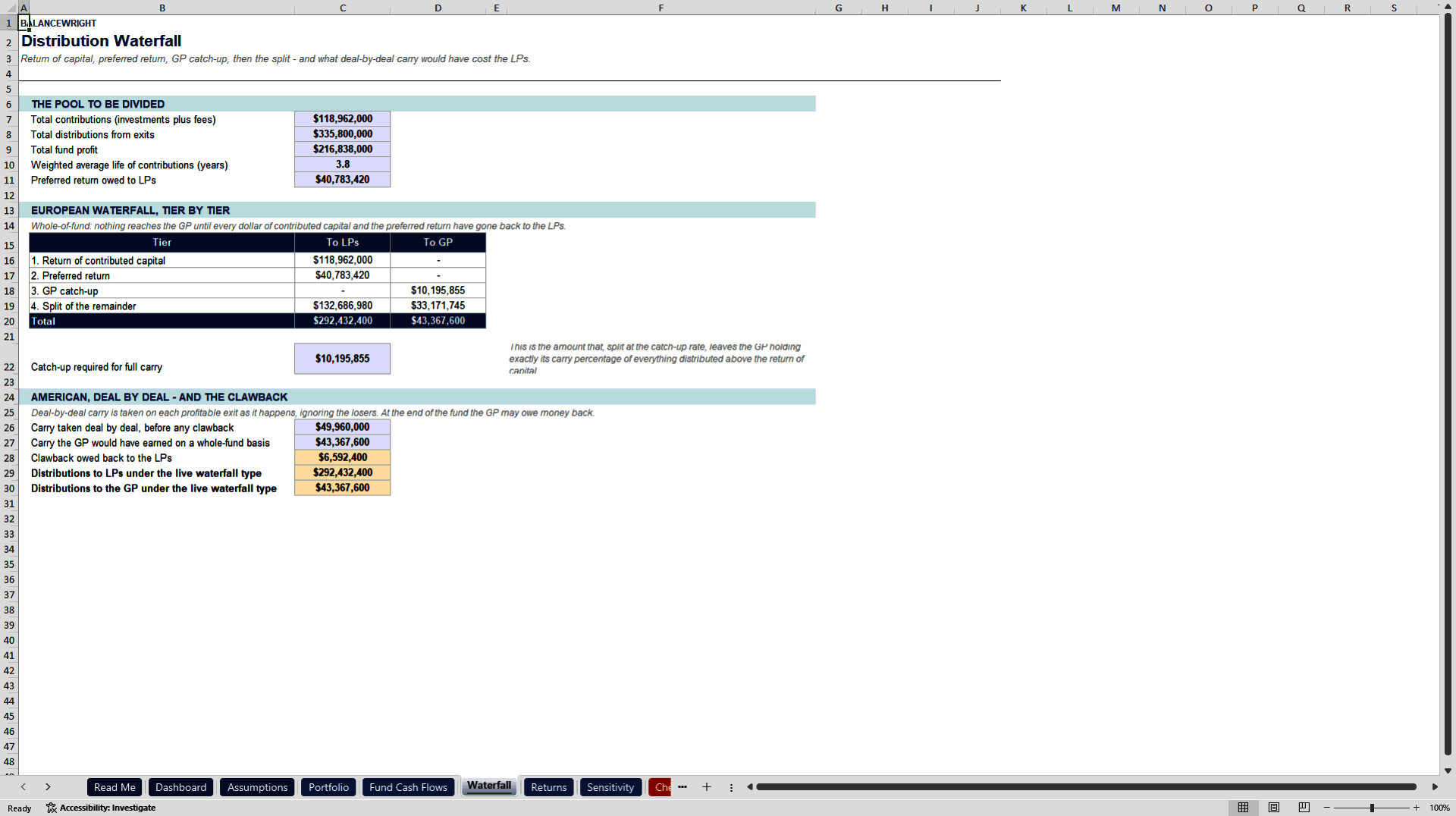
- Runs the whole-of-fund European waterfall tier by tier, computing the GP catch-up exactly rather than approximating it.
- Shows what deal-by-deal American carry would have taken instead, and calculates the clawback the GP would owe back.
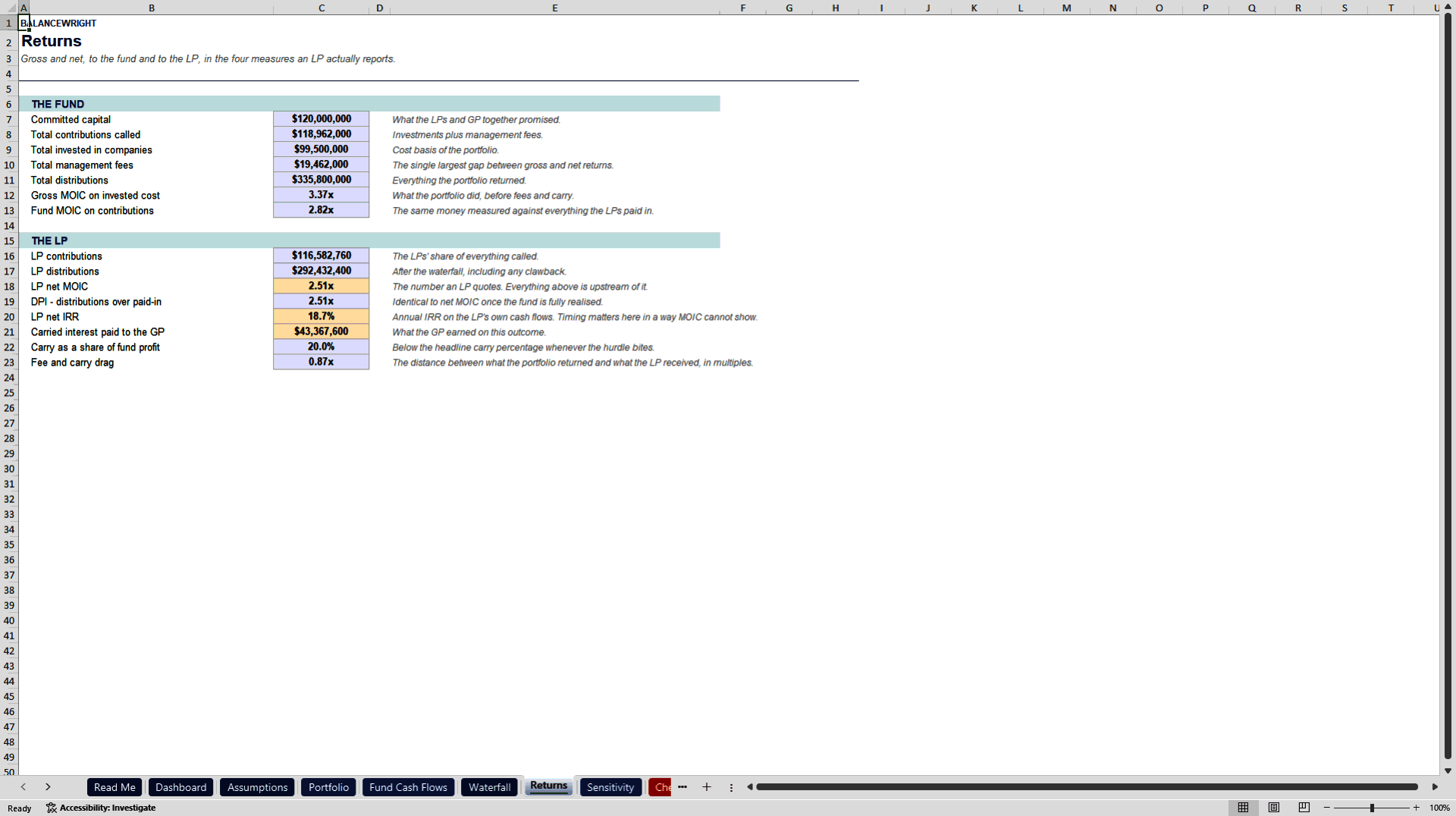
- Reports gross MOIC against LP net MOIC, DPI and net IRR, so the fee and carry drag is a number rather than an argument.
VENTURE CAPITAL EXCEL DESCRIPTION
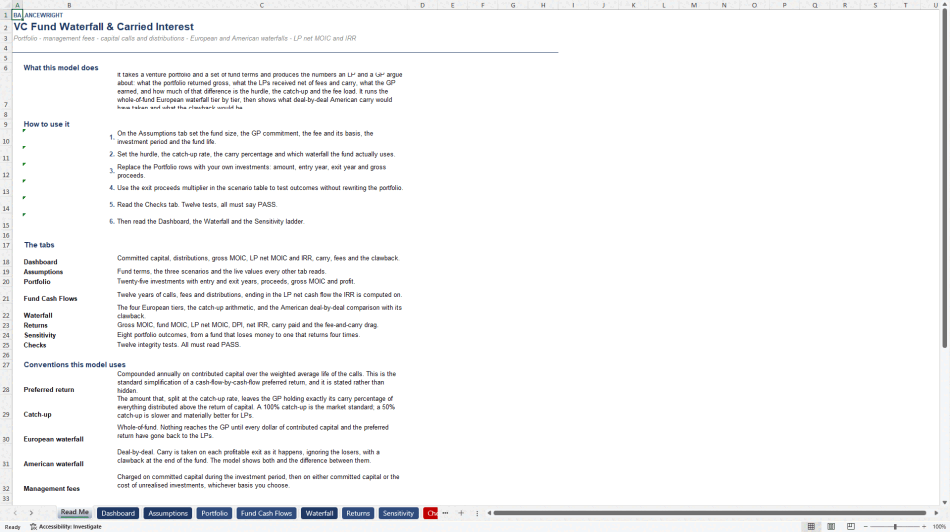
This Excel model takes a venture portfolio and a set of fund terms and produces the numbers LPs and GPs actually argue about.
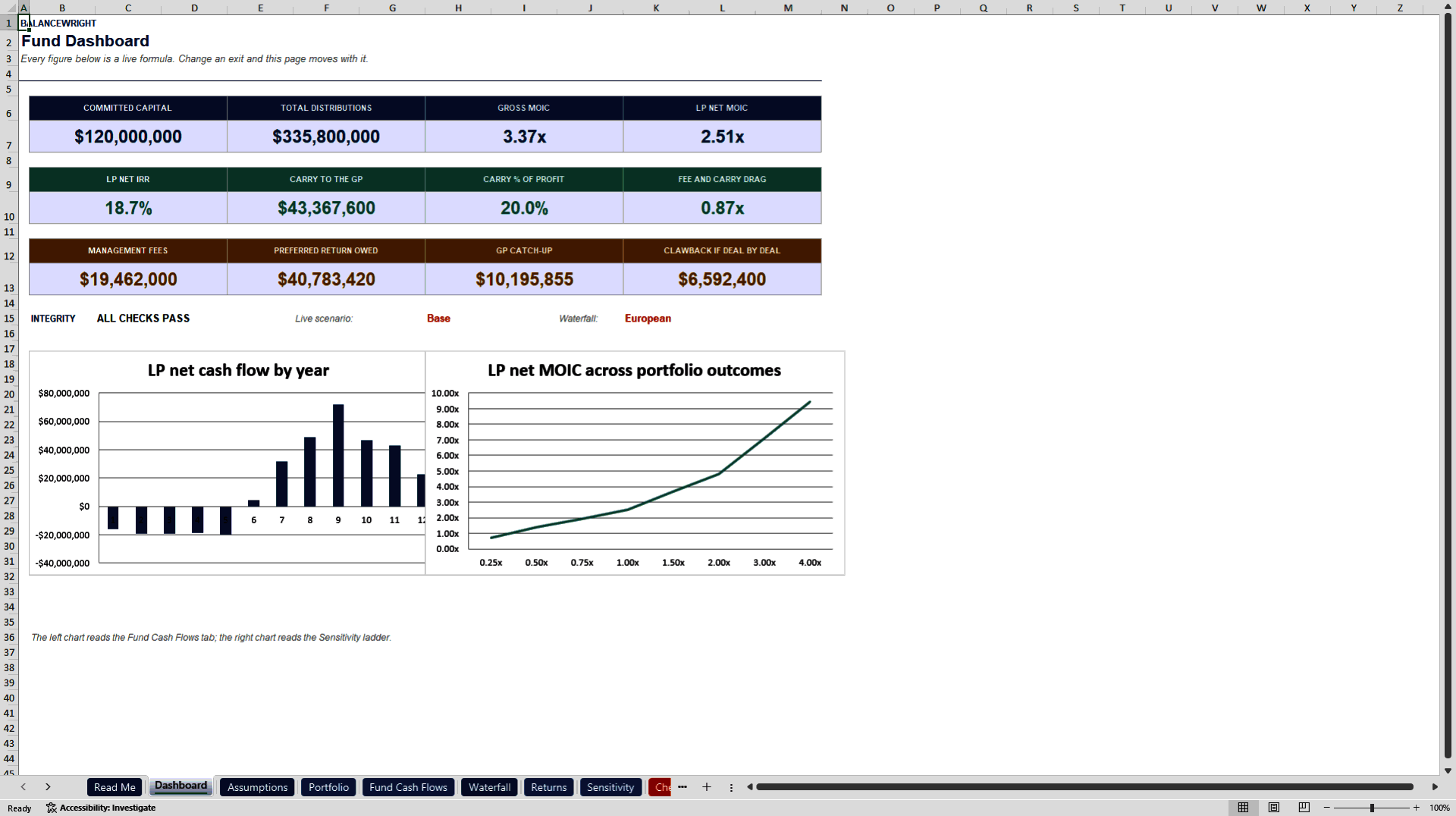
What the portfolio returned gross. What the LPs received net of fees and carry. What the GP earned. And how much of the gap between those is the hurdle, the catch-up and the fee load. Every figure is a live formula.
THE FOUR TIERS, AND THE KINK NOBODY EXPLAINS
A European waterfall pays out in order. First the LPs get every dollar of contributed capital back, not just the money that went into companies, but the management fees too. Then they receive the preferred return, compounded on that capital. Only then does the GP see anything.
The third tier is the one that surprises people. The catch-up exists so that, once the LPs have their preferred return, the GP is brought up to its full carry percentage of everything distributed above the return of capital, as though the hurdle had never applied. At a hundred percent catch-up rate the GP takes every dollar in that band. This model computes the exact catch-up amount rather than approximating it, and an integrity check confirms the GP never ends up past its headline percentage of fund profit.
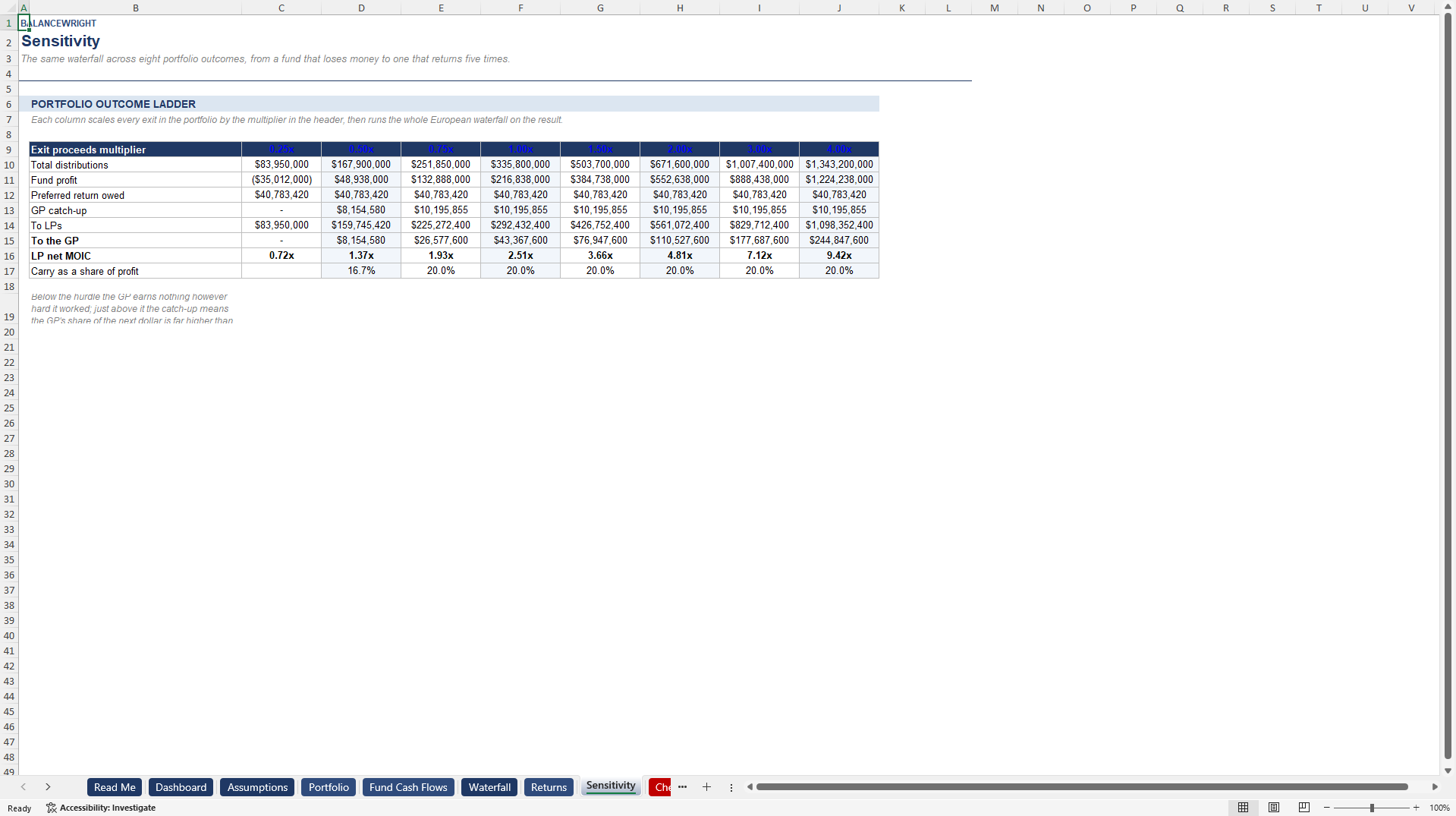
The consequence is a kink: below the hurdle the GP earns nothing however hard it worked, and just above it the GP's share of the next dollar is far higher than the headline carry. That kink is the whole argument about waterfall terms, and the sensitivity ladder makes it visible as a row of numbers rather than a debate.
EUROPEAN AGAINST AMERICAN, AND THE CLAWBACK
A deal-by-deal American waterfall lets the GP take carry on each profitable exit as it happens, ignoring the losers that have not yet been realised. Over a fund's life that can only ever favour the GP, which is why the model checks that the deal-by-deal figure is at least the whole-fund figure and flags it if it is not.
The difference between the two is the clawback: money the GP has already received and, at the end of the fund, owes back. In the worked example a hundred and twenty million dollar fund returning three point four times gross produces a clawback of roughly six point six million. That is not a rounding difference; it is the number an LP negotiates over.
WHAT IS INSIDE
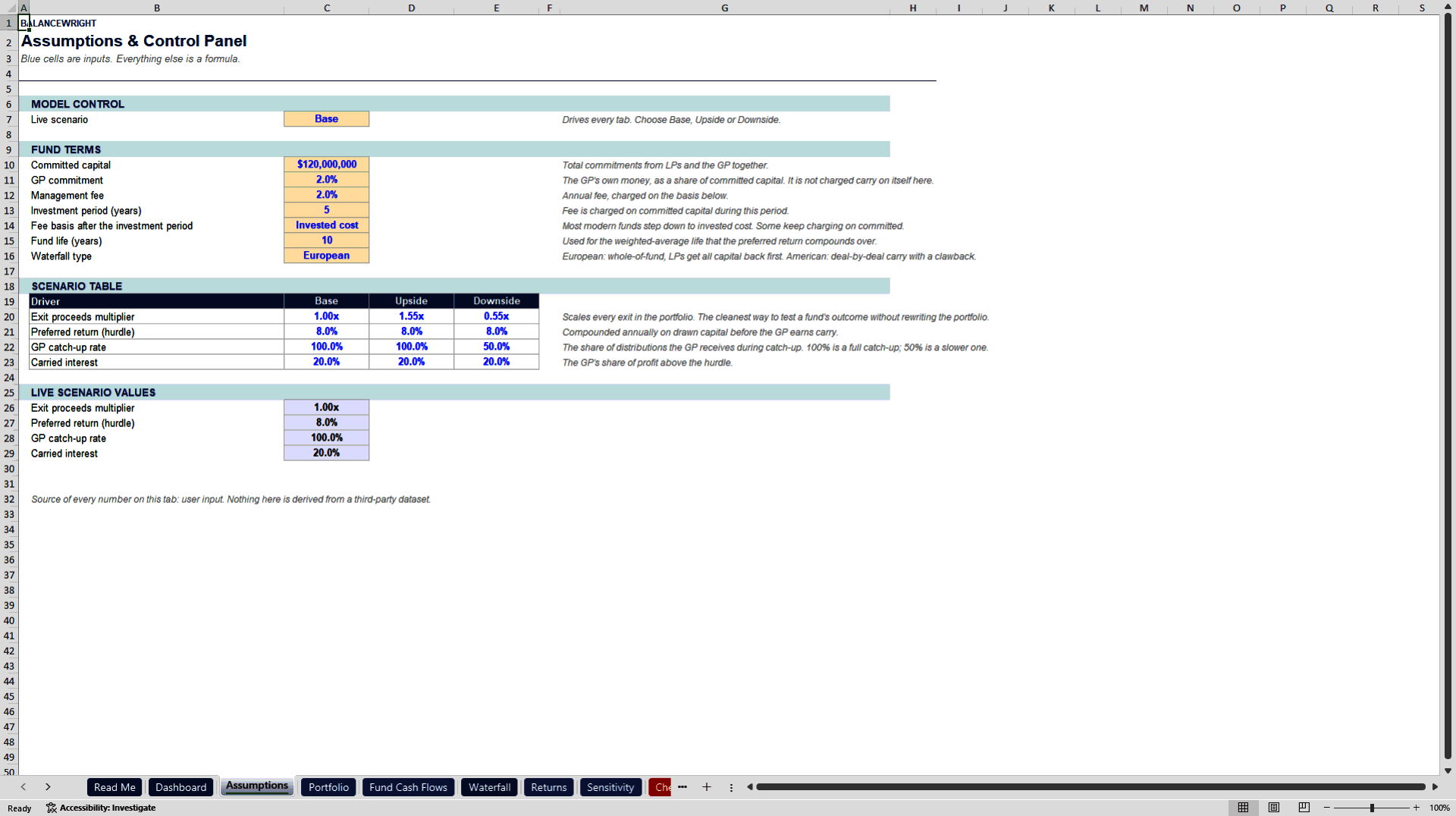
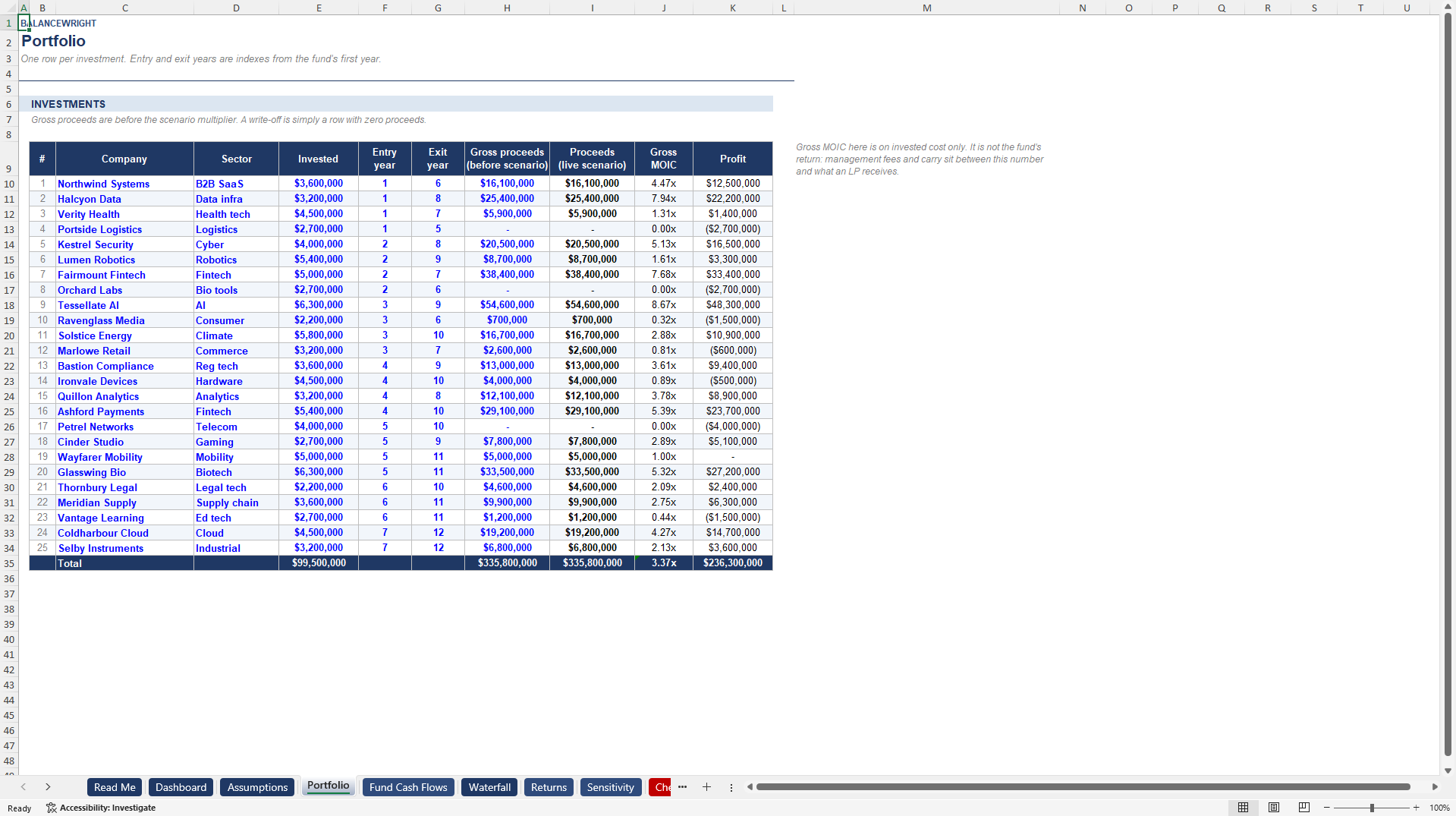
Nine tabs: Read Me, Dashboard, Assumptions, Portfolio, Fund Cash Flows, Waterfall, Returns, Sensitivity, Checks. Twenty-five investments, twelve fund years, three scenarios switched from one cell.
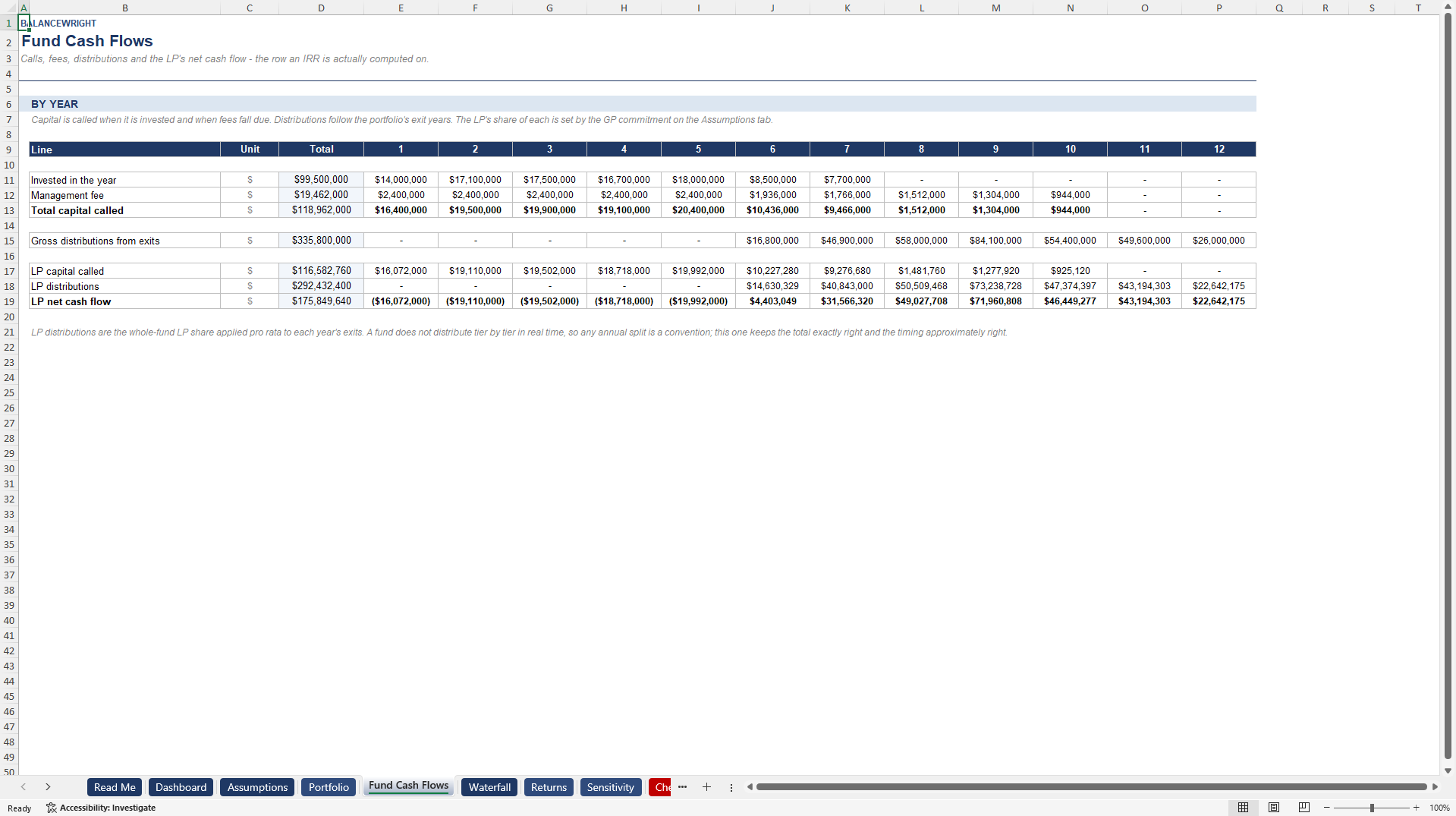
Management fees are charged on committed capital during the investment period and then on either committed capital or the cost of unrealised investments, whichever basis you choose. Capital calls, fees and distributions build a twelve-year LP cash flow, and the net IRR is computed on that row rather than asserted. The Returns tab reports gross MOIC, fund MOIC, LP net MOIC, DPI, net IRR, carry paid, carry as a share of profit, and the fee-and-carry drag expressed as a multiple.
No macros, no add-ins, no external links, no password protection and no locked cells. A five-page PDF guide documents every convention and every limitation. Thirteen integrity checks sit on their own tab and must all read PASS, including one that confirms contributions fit inside the committed capital, because a fund cannot call more than the LPs promised.
This workbook models the arithmetic of fund terms. It is not investment advice, and the sample portfolio is invented.
Building this from scratch takes a competent financial modeller two to four days.
Got a question about the product? Email us at support@flevy.com or ask the author directly by using the "Ask the Author a Question" form. If you cannot view the preview above this document description, go here to view the large preview instead.
Source: Best Practices in Venture Capital, Integrated Financial Model Excel: VC Fund Distribution Waterfall & Carried Interest Model Excel (XLSX) Spreadsheet, Balancewright
ABOUT THE AUTHOR

Balancewright builds working financial models for subscription and recurring-revenue businesses -- cohort retention, revenue movement, unit economics, cash flow and scenario forecasting.
Every model is formula-driven end to end. No locked cells, no passwords, no macros and no external links, so any calculation can be inspected, adapted and audited. Each file ships with a visible
... [read more]
Ask the Author a Question
You must be logged in to contact the author.




























