 Click main image to view in full screen. Unlock all 14 preview images:
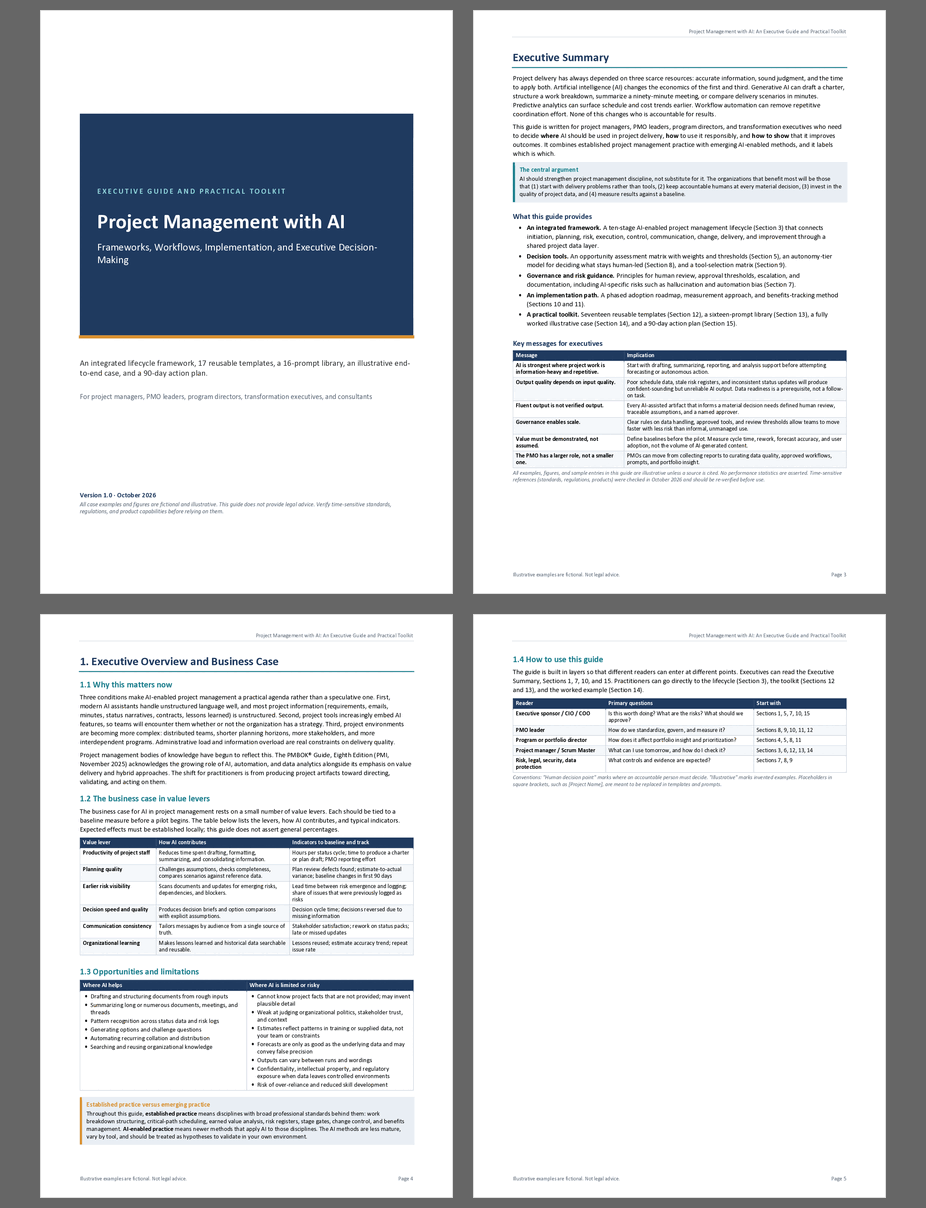
Project Management with AI – Word DOCX
Word (DOCX) 41 Pages


BENEFITS OF THIS DOWNLOADABLE WORD DOCUMENT
- Provides a framework for integrating AI into project management processes tailored to your organization's needs and objectives.
- Offers practical tools and templates for improving project planning, risk management, decision-making, and delivery through responsible AI adoption.
- Guides you in building a measurable AI implementation strategy that strengthens project performance, ensures effective governance, and delivers sustainable business value.
PROJECT MANAGEMENT WORD DESCRIPTION
Curated by McKinsey-trained Executives
Project Management with AI: The Complete Executive Guide and Practical Toolkit for AI-Powered Project Delivery
Stop experimenting with AI without a strategy. Stop wasting hours on project administration. Stop making critical delivery decisions with fragmented data, outdated reports, and untested AI outputs. Discover a practical framework for integrating artificial intelligence into project management—from project selection and planning to risk control, executive reporting, governance, and measurable business value—in one comprehensive executive guide and practical toolkit.
Learn how to use AI to improve project planning, automate repetitive workflows, strengthen risk visibility, support better decisions, and build an AI-enabled project management operating model your organization can actually govern, measure, and scale.
17 reusable templates. 16 practical AI prompts. A ten-stage AI-enabled project management lifecycle. A worked business case. A 90-day implementation plan. One integrated framework for turning AI experimentation into disciplined project delivery.
THE PROBLEM EVERY PROJECT MANAGER AND EXECUTIVE FACES
AI is changing project management. But adopting AI tools is not the same as improving project delivery.
You can have access to the latest AI assistants, automated reporting tools, and intelligent project platforms—and still struggle with the same expensive problems.
❌ Your project managers spend too much time producing reports instead of managing projects. Hours disappear into meeting minutes, status updates, planning documents, stakeholder communications, and manually consolidated information that could be prepared more efficiently.
❌ Your project plans look complete but rest on weak assumptions. AI can generate a work breakdown structure, schedule, budget estimate, or delivery scenario in minutes. But if the source data is incomplete, historical comparisons are poor, or resource constraints are missing, a polished plan can still be dangerously wrong.
❌ Project risks emerge after your options have narrowed. Schedule slippage, resource conflicts, supplier delays, dependencies, and scope changes often become visible only when they are already affecting delivery. AI may help surface warning signals, but only when the right data, review processes, and escalation rules exist.
❌ Your organization is experimenting with AI without a consistent operating model. Different teams use different tools, prompts, standards, and review practices. Results are inconsistent, knowledge is scattered, and nobody has a clear framework for deciding what should be assisted, automated, or kept under human control.
❌ You cannot demonstrate whether AI is creating real business value. Faster drafting does not automatically mean better delivery. Without baselines, adoption measures, cost tracking, and benefits ownership, AI initiatives risk becoming another technology investment whose actual contribution is difficult to prove.
❌ AI introduces risks your existing project processes may not adequately address. Hallucinated facts, incorrect calculations, confidentiality breaches, automation bias, unclear accountability, and inappropriate reliance on generated recommendations can undermine the very decisions AI was supposed to improve.
❌ Scaling a successful experiment is harder than starting one. A workflow that works for one project manager may fail across a PMO, multiple business units, or a complex transformation portfolio. Integration, data quality, security, governance, training, and change management all matter.
The problem is not that your organization lacks AI tools. The problem is that it needs a disciplined method for using them.
AI cannot repair weak project management fundamentals by itself. It can amplify good practices—or amplify bad ones.
The organizations best positioned to benefit are those that combine AI capabilities with sound planning, reliable data, accountable decision-making, effective governance, and measurable outcomes.
That is exactly what this guide is designed to help you build.
INTRODUCING: PROJECT MANAGEMENT WITH AI
The Executive Guide and Practical Toolkit for AI-Powered Project Delivery
Project Management with AI: Frameworks, Workflows, Implementation, and Executive Decision-Making is a practical executive guide for project managers, PMO leaders, program directors, transformation executives, and consultants who want to move beyond isolated AI experiments.
Instead of simply explaining what artificial intelligence can do, this guide shows you how to assess opportunities, integrate AI into project management workflows, establish appropriate human oversight, select tools, implement changes, and measure whether the approach is delivering value.
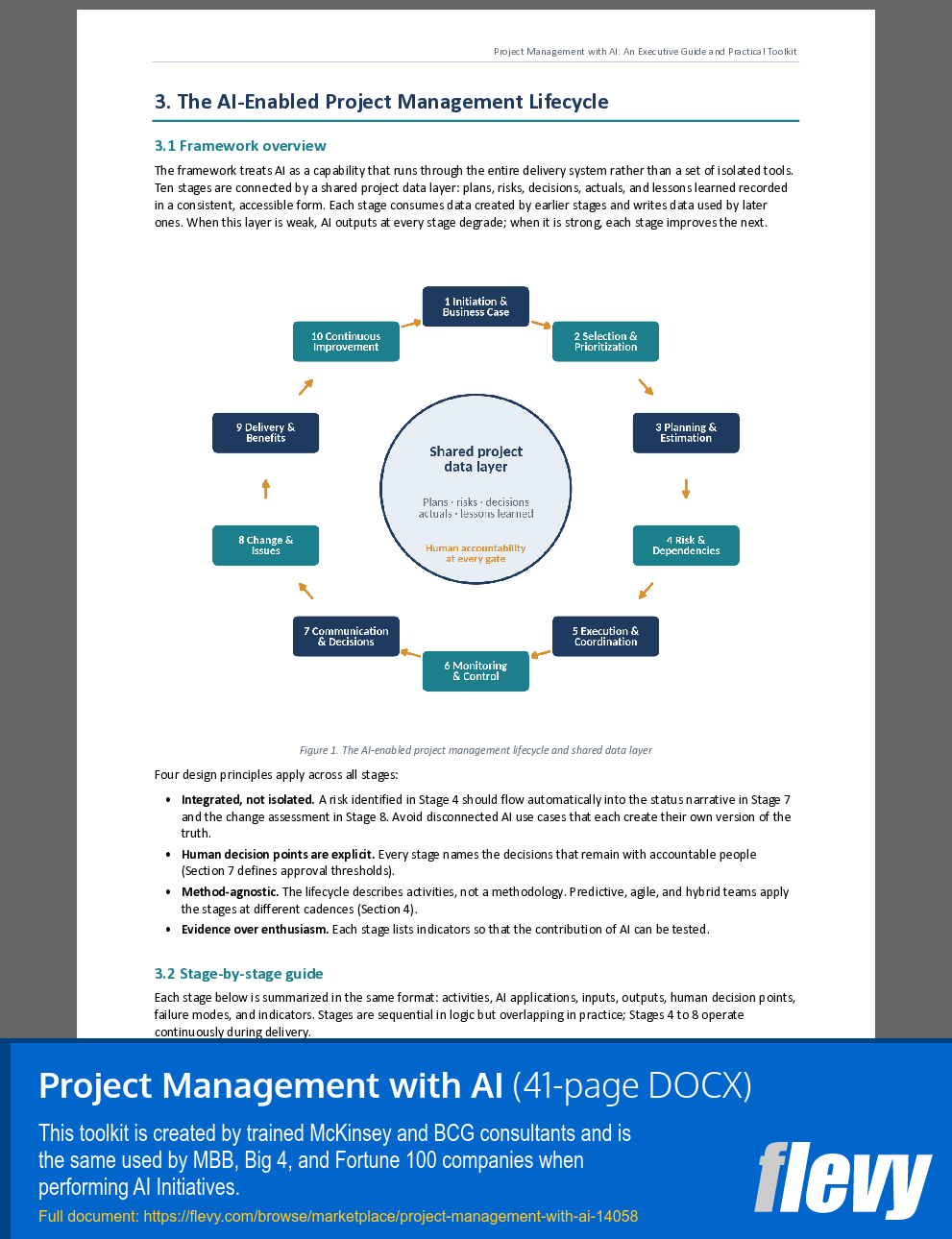
At its core is a ten-stage AI-enabled project management lifecycle connecting the full delivery process:
Initiation → Project Selection → Planning → Risk Management → Execution → Monitoring & Control → Communication → Change Management → Delivery & Benefits Realization → Continuous Improvement
Each stage connects to a shared project data layer, helping you think beyond individual prompts and disconnected AI features toward an integrated project delivery system.
What if you could…
✅ Identify the right AI opportunities before investing time and money. Use a weighted opportunity assessment matrix to compare expected value, feasibility, data readiness, implementation effort, risk exposure, strategic alignment, and adoption readiness.
✅ Integrate AI across the entire project lifecycle. Understand where generative AI, document analysis, predictive analytics, natural language processing, and workflow automation can support initiation, planning, execution, reporting, risk management, and project closure.
✅ Build stronger project plans with AI assistance. Draft work breakdown structures, examine requirements, identify missing assumptions, compare delivery scenarios, challenge estimates, and improve planning completeness—without confusing an AI-generated draft with an approved baseline.
✅ Improve project scheduling and resource planning. Examine dependencies, critical-path implications, delivery scenarios, resource capacity, budget forecasts, and cost variance while keeping accountable project professionals responsible for the final decisions.
✅ Strengthen project risk management. Identify candidate risks, examine emerging dependencies, assess warning signals, prepare response options, and establish escalation rules that keep risk ownership firmly with the people responsible for managing it.
✅ Reduce repetitive project administration. Use AI to prepare meeting agendas, summarize discussions, extract decisions and action items, draft stakeholder updates, consolidate status information, and support recurring reporting workflows.
✅ Establish clear boundaries for AI automation. Apply a three-tier operating model—Human-Led, AI-Assisted, and Controlled Automation—to determine which activities require direct human involvement, which can benefit from reviewed AI outputs, and which may be automated within tested controls.
✅ Improve executive reporting and decision support. Turn verified project data into clearer status reports, variance narratives, dashboards, decision briefs, and steering committee materials that explain what happened, what may happen next, and what decisions are needed.
✅ Choose AI tools based on business needs, not hype. Compare general-purpose AI assistants, AI-enabled project platforms, workflow automation, predictive analytics, document intelligence, and specialized project solutions using structured evaluation criteria.
✅ Protect your organization against AI-related risks. Establish human review, approval thresholds, data-handling rules, traceable assumptions, audit trails, escalation processes, and controls for third-party platforms and AI-assisted workflows.
✅ Build a measurable AI implementation roadmap. Move from assessment and preparation to controlled pilots, evaluation, and expansion using a phased approach designed around readiness, evidence, and organizational adoption.
✅ Measure the business value of AI-enabled project management. Establish baselines and track administrative effort, forecast accuracy, rework, decision cycle time, adoption, realized benefits, and total implementation costs—including the effort required to review AI output.
You do not need another collection of AI tips. You need a system for deciding where AI belongs, how to use it responsibly, and how to determine whether it is working. This guide gives you that system.
Table of Contents
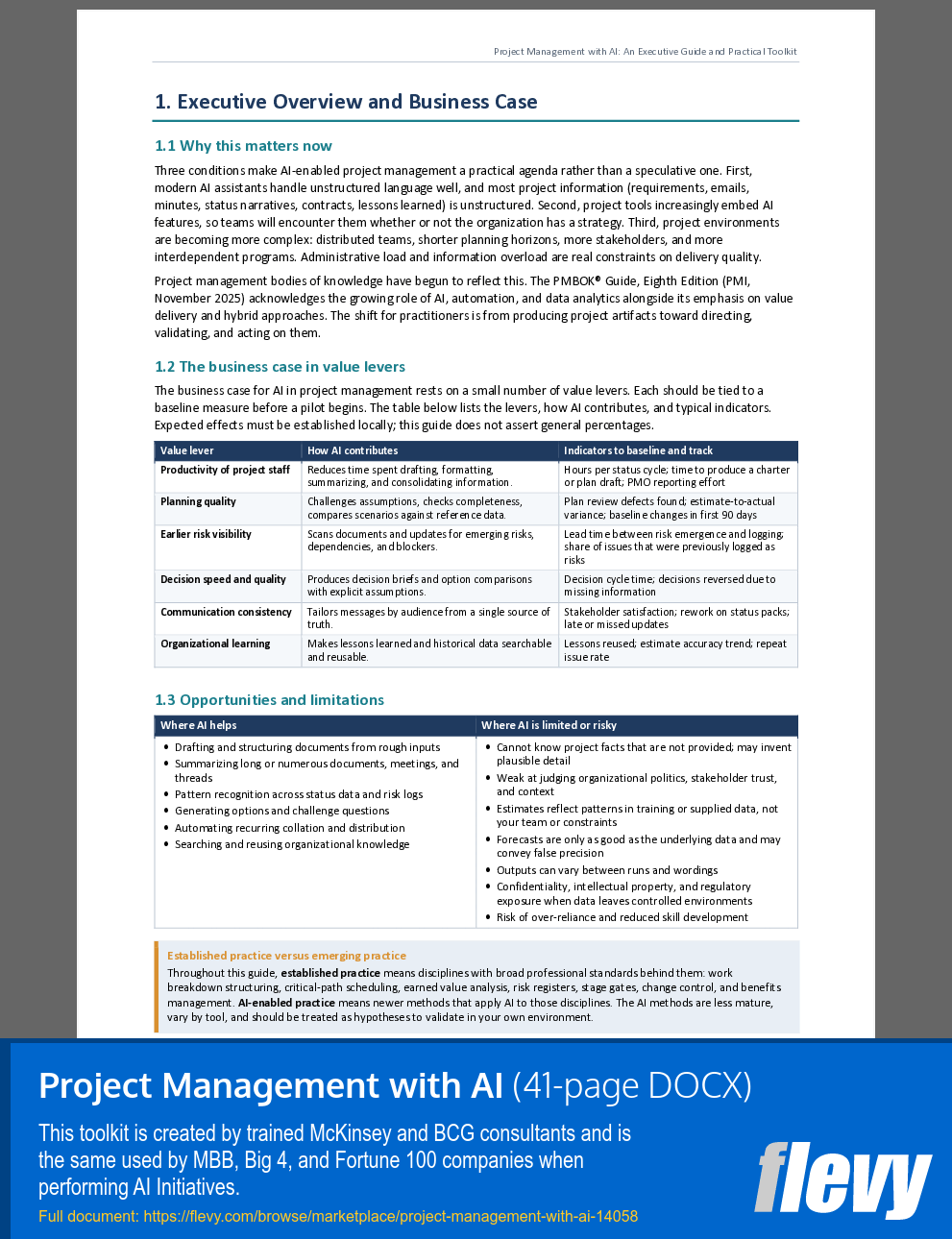
1. Executive Overview and Business Case
1.1 Why This Matters Now
1.2 The Business Case in Value Levers
1.3 Opportunities and Limitations
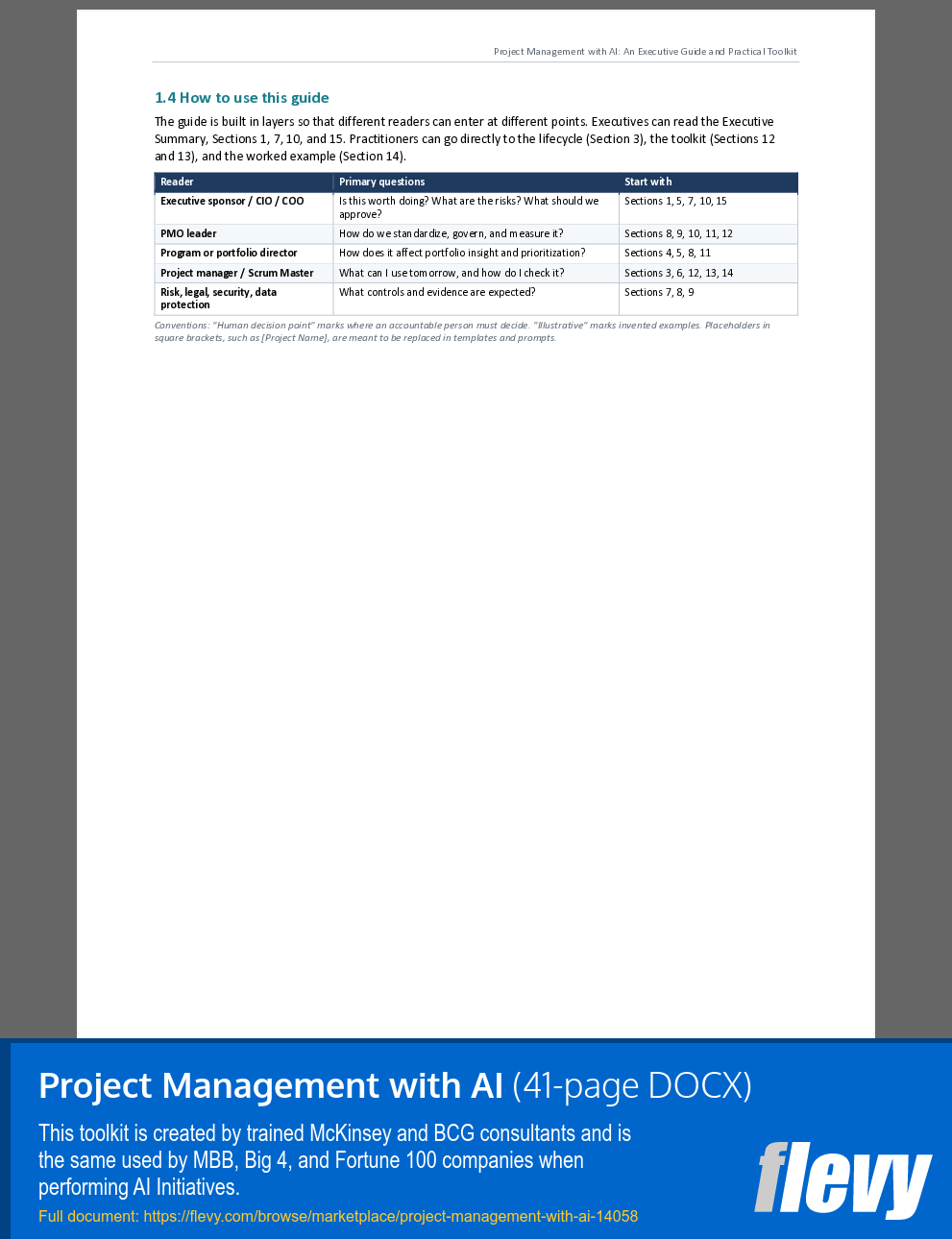
1.4 How to Use This Guide
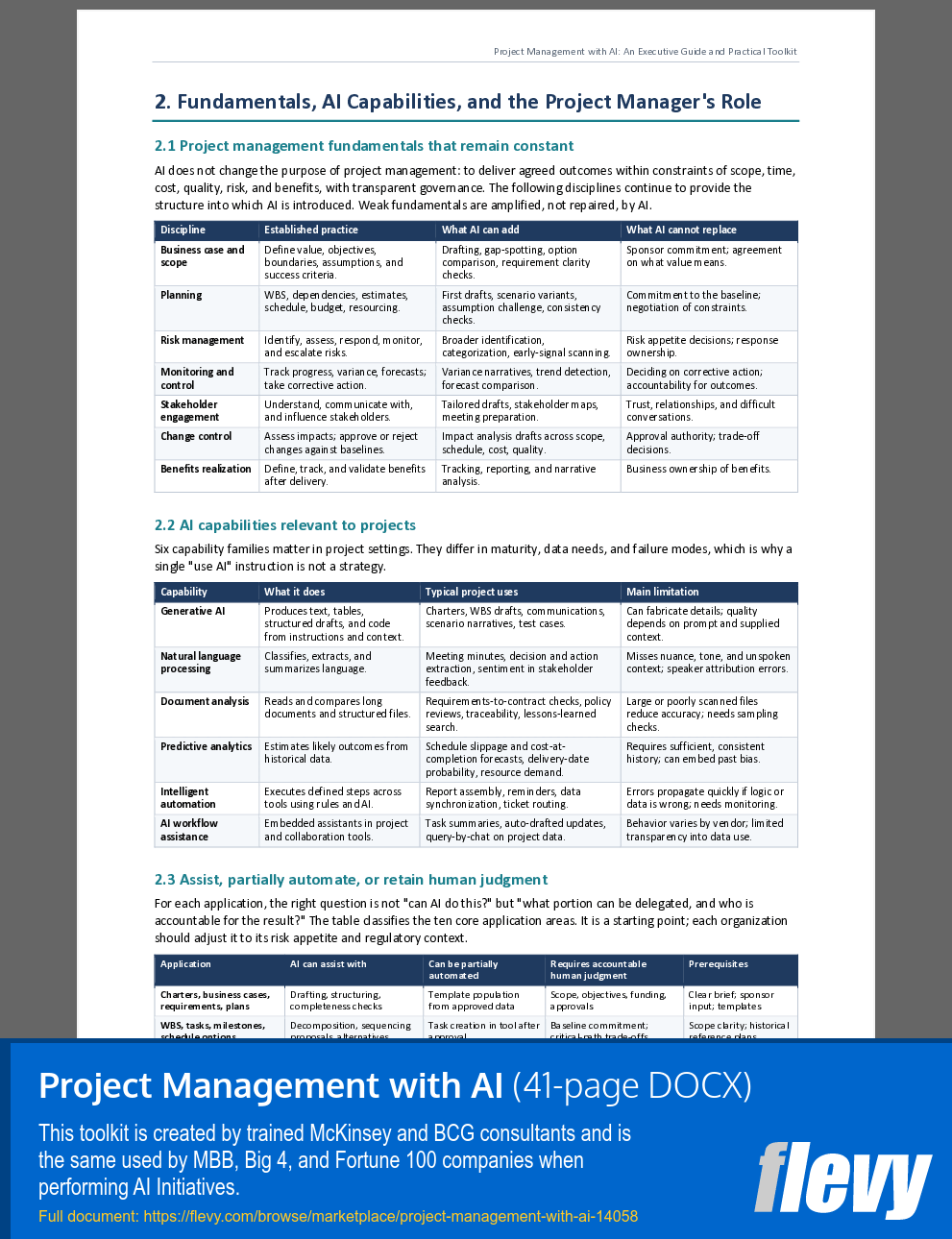
2. Fundamentals, AI Capabilities, and the Project Manager's Role
2.1 Project Management Fundamentals That Remain Constant
2.2 AI Capabilities Relevant to Projects
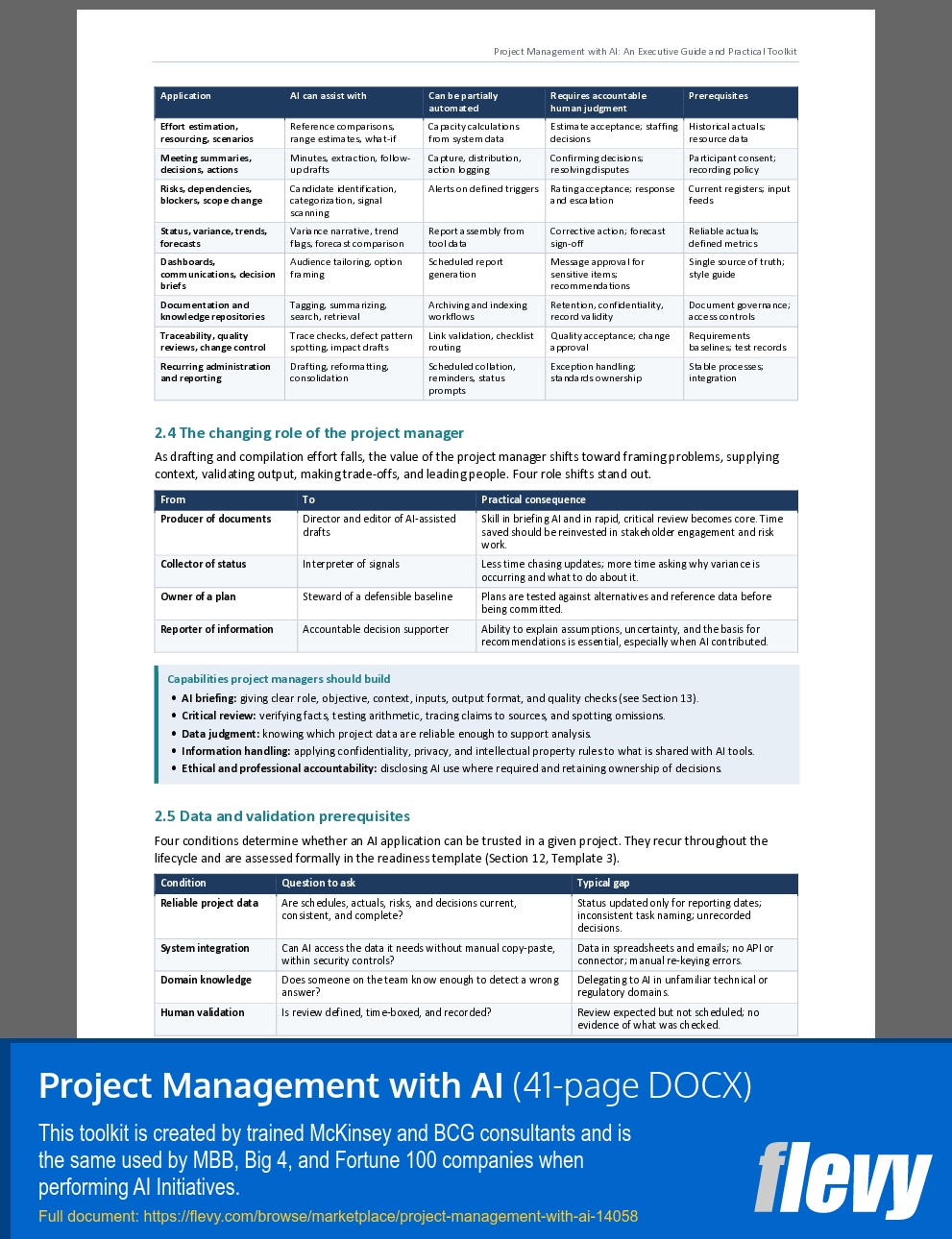
2.3 Assist, Partially Automate, or Retain Human Judgment
2.4 The Changing Role of the Project Manager
2.5 Data and Validation Prerequisites
3. The AI-Enabled Project Management Lifecycle
3.1 Framework Overview
3.2 Stage-by-Stage Guide
3.3 How the Stages Integrate
4. Project Management Methods and AI Integration
4.1 AI by Delivery Approach
4.2 Complexity, Uncertainty, and Cadence
4.3 Cross-Functional, Distributed, and Resource-Constrained Teams
5. Assessing, Selecting, and Prioritizing AI Opportunities
5.1 Dimensions to Assess
5.2 Opportunity Assessment Matrix
5.3 Illustrative Scoring of Five Candidate Use Cases
5.4 Comparing Opportunities: Value, Feasibility, and Risk
6. AI-Enabled Planning, Scheduling, and Resource Management
6.1 Requirements, Scope, and Work Breakdown
6.2 Estimating: Effort, Duration, Cost, and Resources
6.3 Dependencies, Critical Path, and Scenarios
6.4 Capacity, Budget Forecasting, and Cost Variance
6.5 Baselines, Change Control, and Unrealistic Assumptions
6.6 Worked Example: Building a Defensible Baseline (Illustrative)
7. Execution, Risk Management, Governance, and Human Oversight
7.1 Execution and Collaboration
7.2 Integrated Risk Management
7.3 Strengthening Risk Visibility Without False Certainty
7.4 Human Oversight: Principles and Approval Thresholds
7.5 Audit Trails and Documentation of Material Decisions
7.6 Policies, Law, and Regulation
7.7 Controls for Third-Party and Platform Dependencies
8. The AI-Enabled Project Operating Model
8.1 Three Autonomy Tiers
8.2 Roles and Responsibilities
8.3 Standard Workflows
8.4 Data, Integration, and Knowledge Management
8.5 Evolving the PMO
9. AI Tools, Technology, and Integration Strategy
9.1 Tool Categories
9.2 Evaluation Criteria
9.3 Tool-Selection Matrix
9.4 Decision Process
10. Implementation, Adoption, and Scaling
10.1 Phased Implementation Roadmap
10.2 Common Failure Modes
10.3 Communicating Change and Building Trust
11. Measurement, Reporting, Benefits Realization, and Continuous Improvement
11.1 Measurement Framework
11.2 Reporting and Dashboards
11.3 Benefits Realization and ROI
11.4 Assurance and Continuous Improvement
12. Practical Templates and Executive Toolkit
Templates 1–17: Opportunity Assessment to Lessons Learned
13. Reusable AI Prompt Library
14. Worked End-to-End Example: Order-to-Delivery Modernization
14.1 Context
14.2 Business Case, Charter, and Success Criteria (Stage 1)
14.3 AI Opportunities, Readiness, and Governance (Stages 2 and 10)
14.4 Planning and Baseline (Stage 3)
14.5 Risks, Dependencies, and Resources (Stage 4)
14.6 Execution, Monitoring, and Control (Stages 5 to 8)
14.7 Outcomes and Benefits Assessment (Stage 9)
14.8 Lessons Learned (Stage 10)
15. Key Principles and the 90-Day Action Plan
15.1 Ten Principles for AI-Enabled Project Management
15.2 The 90-Day Action Plan
15.3 Executive Readiness Checklist for Expansion
WHAT YOU GET
When you get Project Management with AI: The Executive Guide and Practical Toolkit, you receive:
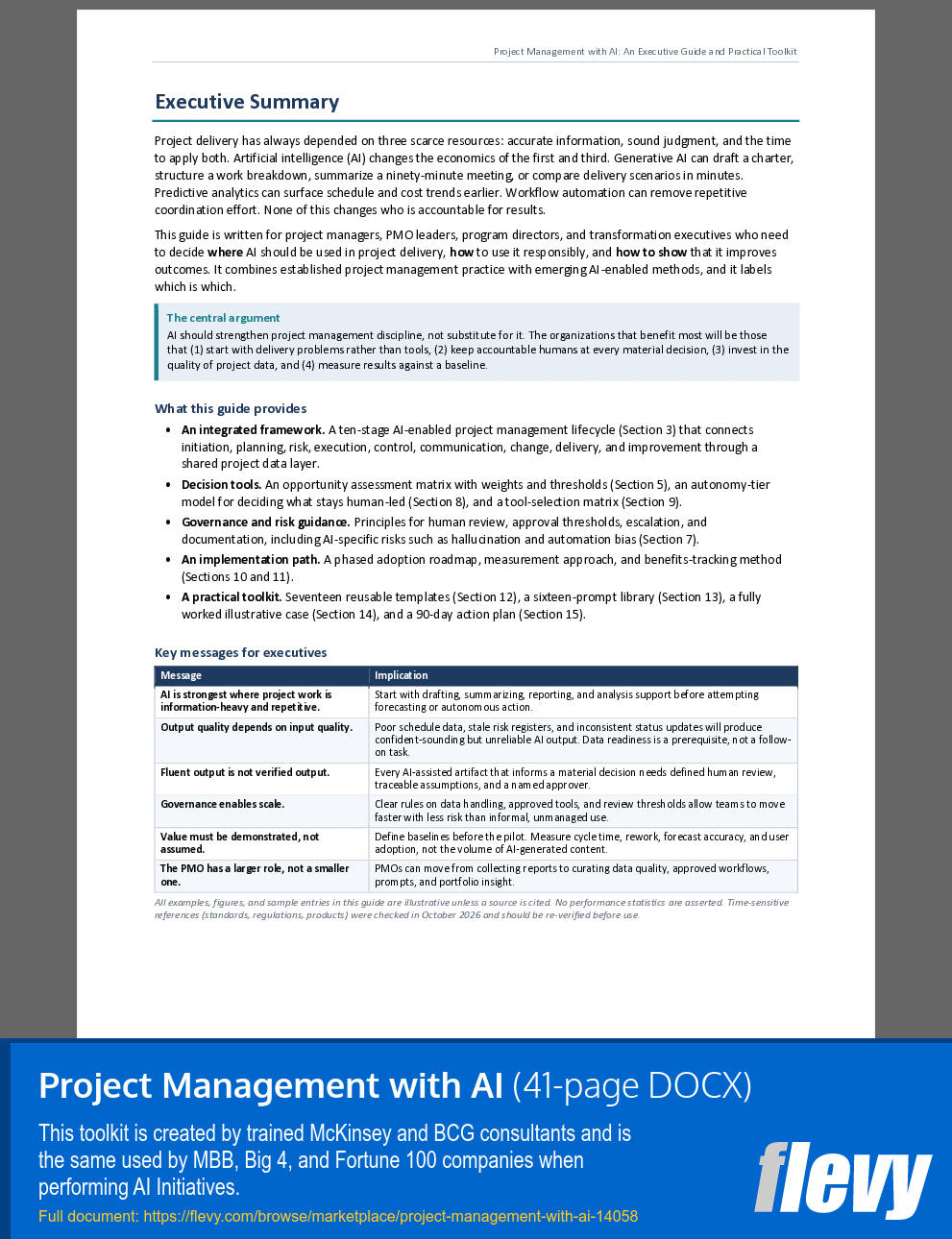
✅ A comprehensive 41-page executive guide covering AI-enabled project management frameworks, implementation, governance, and executive decision-making.
✅ A ten-stage AI-enabled project management lifecycle connecting initiation, planning, execution, risk, monitoring, communication, change, delivery, and continuous improvement.
✅ 17 reusable project management and AI implementation templates to support opportunity assessment, readiness, planning, governance, tool selection, implementation, and benefits tracking.
✅ 16 practical AI prompts for applying AI to project management tasks more systematically.
✅ An AI opportunity assessment matrix with weighted criteria, scoring guidance, decision thresholds, and an illustrative comparison of candidate use cases.
✅ A three-tier AI operating model to distinguish human-led work, AI-assisted activities, and controlled automation.
✅ A practical AI tool-selection framework to compare technology options according to functionality, security, integration, usability, cost, governance, and business value.
✅ A governance and human-oversight framework covering validation, approval thresholds, accountability, audit trails, confidentiality, and risk management.
✅ A worked end-to-end business case demonstrating AI-assisted project planning, scenario comparison, implementation, and benefits assessment.
✅ A phased 90-day action plan for assessing readiness, preparing a pilot, measuring outcomes, and making informed decisions about scaling.
✅ Practical measurement and ROI guidance that helps distinguish measurable benefits from assumptions, with explicit attention to implementation and review costs.
All examples and case figures are identified as illustrative. The guide is designed to help you adapt the framework to your own environment, not to promise a predetermined financial result.
WHO THIS GUIDE IS FOR
Project Management with AI is designed for professionals who want to use artificial intelligence to improve project delivery without sacrificing control, accountability, or sound management practice.
✅ Project managers who want to use AI for planning, scheduling, risk analysis, meeting summaries, reporting, and decision support.
✅ PMO leaders who need consistent AI project management standards, approved workflows, reusable templates, data quality controls, and measurable benefits.
✅ Program and portfolio directors managing complex initiatives, cross-project dependencies, resource constraints, prioritization, and portfolio-level reporting.
✅ Transformation executives and business leaders evaluating how AI can support operational improvement, project delivery, and organizational change.
✅ Executive sponsors, CIOs, and COOs who need a structured way to evaluate AI investments, understand implementation risks, and make informed approval decisions.
✅ Agile practitioners and Scrum Masters looking for practical ways to apply AI to backlog refinement, sprint summaries, dependency analysis, retrospectives, and team coordination.
✅ Project consultants and transformation specialists who need a repeatable framework for assessing AI opportunities and advising clients on implementation.
✅ Risk, security, compliance, and data-protection professionals involved in evaluating AI-enabled workflows, sensitive information, governance, and human oversight.
✅ Organizations moving from AI experimentation to enterprise adoption that need an approach connecting technology, project management discipline, governance, measurement, and change management.
Whether you manage a single project, lead a PMO, or oversee a portfolio of transformation initiatives, the framework can be adapted to your delivery environment.
## WHY THIS GUIDE BEATS GENERIC AI ADVICE
### 1. It connects AI to the entire project lifecycle
❌ Generic AI advice focuses on individual prompts and isolated tasks.
✅ This guide connects AI-enabled activities across ten project stages, from business case and prioritization to delivery, benefits realization, and continuous improvement.
### 2. It goes beyond AI-generated content
❌ Producing a polished project plan or status report does not prove that the information is correct.
✅ Learn how to validate outputs, challenge assumptions, check source data, document decisions, and preserve human accountability.
### 3. It gives you a structured way to prioritize AI investments
❌ Choosing tools based on excitement, demonstrations, or feature lists can lead to wasted implementation effort.
✅ Use weighted assessment criteria to compare value, feasibility, risk, readiness, and strategic alignment before committing resources.
### 4. It addresses governance as part of implementation
❌ Uncontrolled AI adoption can introduce confidentiality, reliability, accountability, and compliance risks.
✅ Learn how to define autonomy tiers, review thresholds, approved workflows, audit trails, and escalation rules before scaling.
### 5. It helps you choose technology based on fit
❌ The most sophisticated platform is not necessarily the best solution for your project or organization.
✅ Compare technology categories and evaluate tools against practical requirements, existing systems, security, cost, and measurable value.
### 6. It includes reusable templates and prompts
❌ General advice leaves you to design your own assessments, workflows, and implementation documents.
✅ Start with 17 templates and 16 prompts you can adapt to your own project management processes.
### 7. It includes an end-to-end worked example
❌ Abstract discussions of AI benefits rarely show what happens when generated plans encounter real constraints.
✅ Follow an illustrative modernization project that demonstrates assumption testing, scenario comparison, validation, risk management, and benefits assessment.
### 8. It focuses on evidence instead of inflated promises
❌ Unsupported productivity claims and attractive ROI percentages can create unrealistic expectations.
✅ Learn to establish baselines, include implementation and review costs, measure adoption, and count only benefits that can be supported by evidence.
### 9. It gives you a practical implementation horizon
❌ Knowing that AI could help is not the same as knowing what to do next.
✅ Use the 90-day action plan to move from assessment to a controlled pilot, evaluate the results, and decide what should happen next.
This is not just an AI project management guide. It is a framework for making AI useful, accountable, and measurable in project delivery.
THE 90-DAY IMPLEMENTATION ADVANTAGE
You do not need to transform your entire organization overnight.
You need a sensible starting point, a clearly defined use case, reliable inputs, accountable owners, and a way to measure the results.
The guide's 90-day action plan helps you approach that challenge in stages.
DAYS 1–30: ASSESS AND PREPARE
Understand current workflows, administrative effort, data quality, existing tools, organizational readiness, and the potential value of candidate AI use cases.
Establish a baseline and identify the practical and governance requirements for a controlled pilot.
DAYS 31–60: PILOT AND VALIDATE
Apply the framework to a selected use case. Test the workflow, review AI outputs, document errors and exceptions, collect user feedback, and measure performance against the baseline.
Keep accountable people responsible for decisions and approval.
DAYS 61–90: EVALUATE AND DECIDE
Assess the evidence, compare benefits with costs, review risks, identify process improvements, and determine whether the use case should be expanded, refined, or stopped.
By the end of this process, the objective is to have a more informed basis for deciding how AI should be used in your project environment—not merely another AI demonstration.
The 90-day plan gives you a disciplined path from experimentation toward repeatable, evidence-based AI adoption.
YOUR INVESTMENT IN BETTER PROJECT MANAGEMENT
Project Management with AI: The Executive Guide and Practical Toolkit
A practical resource for AI-enabled project management, executive decision support, and implementation planning.
Get a connected framework covering the project lifecycle, AI opportunity assessment, planning and scheduling, risk management, governance, tool selection, adoption, measurement, and continuous improvement.
Your guide includes:
• A ten-stage AI-enabled project management lifecycle.
• 17 reusable templates.
• 16 reusable AI prompts.
• An opportunity assessment and prioritization matrix.
• A three-tier AI operating model.
• A structured AI tool-selection framework.
• Practical governance and human-oversight guidance.
• An illustrative end-to-end business case.
• A 90-day AI implementation action plan.
DOWNLOAD PROJECT MANAGEMENT WITH AI TODAY
One poorly assessed AI initiative can consume time, implementation resources, training effort, and management attention without delivering the expected value. One uncontrolled workflow can create risks that outweigh its convenience.
This guide helps you approach AI adoption with a clearer framework for assessing opportunities, managing risks, validating outputs, and measuring results.
Rather than investing blindly in tools or automating processes before they are ready, build your approach around evidence, accountability, and practical implementation.
READY TO MOVE BEYOND AI EXPERIMENTATION?
AI is not a substitute for project management discipline.
It is an opportunity to strengthen it.
Stop treating AI as a collection of disconnected prompts. Stop accepting polished outputs without validation. Stop investing in AI initiatives without a clear way to assess risk and measure value.
Start connecting AI to the full project lifecycle.
Start building repeatable workflows with clear ownership and human oversight.
Start evaluating AI opportunities according to business value, feasibility, risk, and organizational readiness.
Start measuring whether your AI-enabled project management practices are making a meaningful difference.
Get Project Management with AI: The Executive Guide and Practical Toolkit today.
Build a more structured approach to AI-powered project delivery—one project, one validated workflow, and one measurable improvement at a time.
Project Management with AI
*Frameworks, Workflows, Implementation, and Executive Decision-Making*
✅ Assess first. Identify AI opportunities by value, feasibility, and risk.
✅ Integrate intelligently. Connect AI to planning, execution, reporting, and continuous improvement.
✅ Govern responsibly. Keep humans accountable and make validation part of the workflow.
✅ Measure outcomes. Establish baselines, track costs, and evaluate realized benefits.
✅ Scale what works. Use evidence, reusable templates, and standard workflows to build organizational capability.
Your next step toward more intelligent, controlled, and measurable project delivery starts here.
Keywords: Process Audit SOPs, Internal Audit Standard Operating Procedures, Process Audit Framework, Control Testing Procedures, Risk Assessment Methodologies, Audit Governance, Process Audit Strategy, Audit Evidence Collection, Compliance Audit SOPs, Continuous Auditing, Process Mapping, Audit Documentation Standards, Audit Quality Assurance, Process Risk Management, Operational Risk Audit, Enterprise Audit Management, Audit Committee Reporting, Audit Analytics, Process Mining, AI-Assisted Auditing, Audit Technology SOPs, Global Process Audit, Audit Playbooks, Audit Templates, Audit Training Programs, Audit Remediation Management, Audit Excellence, Process Audit Toolkit, McKinsey Audit Framework, Audit Best Practices, Enterprise Governance, Internal Control Assessment, Audit Procedures Manual, Audit Program Design, Audit Resource Planning, Audit Scheduling, Audit Efficiency, Audit Effectiveness, Audit Performance Metrics, Audit KPIs, Audit ROI, Audit Value Creation, Process Optimization, Operational Excellence, Business Process Audit, Functional Audit, Departmental Audit, Transactional Audit, Service Audit, Administrative Process Audit, Supply Chain Process Audit, Finance Process Audit, IT Process Audit, HR Process Audit, Procurement Process Audit, Sales Process Audit, Customer Service Audit, Production Audit, Quality Audit, Compliance Testing, Regulatory Audit, Policy Compliance, Procedure Audit, Documentation Audit, Audit Trail Review, Exception Management, Control Design, Control Effectiveness, Control Testing, Preventive Controls, Detective Controls, Corrective Actions, Root Cause Analysis, Finding Classification, Audit Report Writing, Executive Summaries, Audit Communication, Stakeholder Engagement, Process Owner Engagement, Management Accountability, Audit Committee Governance, Audit Charter, Audit Independence, Auditor Ethics, Professional Skepticism, Audit Competency, Audit Training, Audit Certification, Audit Standards (IIA, IAASB), Audit Best Practices, Audit Methodology, Audit Framework, Audit Operating Model, Process Audit Excellence, Audit Mastery, Fortune 500 Audit, Enterprise Audit Operations, Corporate Audit Function, Strategic Audit Planning, Transformation Audit, Digital Audit, Innovation Audit, Benchmarking Audit, Maturity Assessment, Audit Scaling, Audit Outsourcing, Co-Sourcing Models, Vendor Management, Audit Technology Stack, Audit Tools, Audit Software, Continuous Monitoring, Predictive Analytics, Anomaly Detection, Data Quality, Process Intelligence, Workflow Analytics, Business Process Management, Process Automation, RPA Audit, AI Governance, Responsible AI Audit, Cybersecurity Audit, Data Governance Audit, Privacy Audit, Information Security, Audit Evidence Standards, Working Papers, Audit Documentation, Audit File Management, Audit Records Retention, Audit Trail Integrity, Audit Report Confidentiality, Multi-Site Audit Coordination, Global Audit Strategy, International Audit Standards, Regional Audit Compliance, Cultural Considerations in Audit, Localization of Audit Procedures, Process Transformation Audit, Business Reengineering Audit, Change Audit, Operational Change, Audit Change Management, Audit Communication Plan, Audit Stakeholder Communication, Audit Performance Review, Audit Function Review, Strategic Review Process, Audit Leadership Development, Audit Team Development, Audit Coaching, Audit Supervision, Audit Career Progression, Audit Knowledge Management, Audit Playbook Development, Audit Template Library, Audit Standards Documentation, Audit Policy Manual, Lessons Learned Capture, Best Practice Sharing, Audit Continuous Improvement, Audit Methodology Enhancement, Audit Process Optimization, Audit Efficiency Improvement, Audit Effectiveness Enhancement, Audit Quality Improvement, Audit Risk Management, Audit Risk Register, Audit Issue Management, Audit Action Tracking, Audit Metrics Dashboard, Audit Performance Dashboard, Audit Scorecard, Audit Balanced Scorecard, KPI Framework for Audit, Audit Success Factors, Critical Success Factors in Audit, Audit Strategic Objectives, Audit Vision Statement, Audit Mission Statement, Audit Values and Ethics, Audit Culture, Audit Maturity Model, Audit Capability Model, Audit Competency Framework, Professional Development in Audit, Audit Certification Programs, Internal Audit Standards, Audit Best Practices Guide, Audit Reference Manual, Audit Operating Manual, Audit Procedures Manual, Audit Program Manual, McKinsey Audit Excellence, Deloitte Audit Framework, EY Audit Approach, KPMG Audit Methodology, Big 4 Audit Standards, Audit Industry Benchmarks, Audit Industry Standards, Audit Thought Leadership, Audit Innovation, Audit Transformation Program, Audit Digital Transformation, Audit Process Transformation, Audit Service Transformation, Audit Operating Model Transformation, Audit Function Evolution, Audit Future-Proofing, Emerging Trends in Audit, Audit 2025 Roadmap, Audit Strategic Priorities, Audit Strategic Planning, Audit Strategic Execution, Audit Implementation Plan, Audit Deployment Strategy, Audit Rollout Plan, Audit Quick-Start Guide, Audit Implementation Guide, Audit User Guide, Audit Handbook, Audit Manual, Audit Documentation Standard, Audit Work Standards, Audit Quality Standards, Audit Performance Standards, Audit Excellence Standards, Enterprise Audit Excellence, Audit Mastery Program, Audit Excellence Initiative, Audit Excellence Framework, Audit Excellence Culture, Audit Excellence Mindset, Strategic Audit Excellence, Operational Audit Excellence, Financial Audit Excellence, Compliance Audit Excellence, Quality Audit Excellence, Process Audit Excellence, Audit Excellence ROI, Audit Excellence Value Creation, Audit Excellence Competitive Advantage, Audit Excellence Strategic Advantage, Audit Excellence Performance Advantage, Audit Excellence Organizational Advantage, Inventory Management, Demand Planning, Inventory Optimization, Inventory Control, Supply Chain Management, Warehouse Operations, Replenishment Strategy, Inventory Analytics, WIP Reduction, Inventory Accuracy, Distribution Network, Inventory Forecasting, Supply Chain Excellence, Working Capital, Inventory KPIs, Procurement Strategy, Inventory Governance, Inventory SOPs, Continuous Improvement, Supply Chain Transformation, GenAI deployment SOPs, generative AI operating model, enterprise AI governance framework, AI Center of Excellence, responsible AI, AI risk management, AI use case prioritization, GenAI implementation roadmap, AI vendor selection, prompt engineering standards, AI compliance, AI adoption strategy, generative AI across value chain, AI strategy, enterprise transformation, AI implementation, AI scaling framework
Strategy & Transformation, Growth Strategy, Strategic Planning, Strategy Frameworks, Innovation Management, Pricing Strategy, Core Competencies, Strategy Development, Business Transformation, Marketing Plan Development, Product Strategy, Breakout Strategy, Competitive Advantage, Mission, Vision, Values, Strategy Deployment & Execution, Innovation, Vision Statement, Core Competencies Analysis, Corporate Strategy, Product Launch Strategy, BMI, Blue Ocean Strategy, Breakthrough Strategy, Business Model Innovation, Business Strategy Example, Corporate Transformation, Critical Success Factors, Customer Segmentation, Customer Value Proposition, Distinctive Capabilities, Enterprise Performance Management, KPI, Key Performance Indicators, Market Analysis, Market Entry Example, Market Entry Plan, Market Intelligence, Market Research, Market Segmentation, Market Sizing, Marketing, Michael Porter's Value Chain, Organizational Transformation, Performance Management, Performance Measurement, Platform Strategy, Product Go-to-Market Strategy, Reorganization, Restructuring, SWOT, SWOT Analysis, Service 4.0, Service Strategy, Service Transformation, Strategic Analysis, Strategic Plan Example, Strategy Deployment, Strategy Execution, Strategy Frameworks Compilation, Strategy Methodologies, Strategy Report Example, Value Chain, Value Chain Analysis, Value Innovation, Value Proposition, Vision Statement, Corporate Strategy, Business Development, Business plan pdf, business plan, PDF, Business Plan DOC, Business Plan Template, PPT, Market strategy playbook, strategic market planning, competitive analysis tools, market segmentation frameworks, growth strategy templates, product positioning strategy, market execution toolkit, strategic alignment playbook, KPI and OKR frameworks, business growth strategy guide, cross-functional strategy templates, market risk management, market strategy PowerPoint doc, guide, ebook, e-book ,McKinsey Change Playbook, Organizational change management toolkit, Change management frameworks 2025, Influence model for change, Change leadership strategies, Behavioral change in organizations, Change management PowerPoint templates, Transformational leadership in change, supply chain KPIs, supply chain KPI toolkit, supply chain PowerPoint template, logistics KPIs, procurement KPIs, inventory management KPIs, supply chain performance metrics, manufacturing KPIs, supply chain dashboard, supply chain strategy KPIs, reverse logistics KPIs, sustainability KPIs in supply chain, financial supply chain KPIs, warehouse KPIs, digital supply chain KPIs, 1200 KPIs, supply chain scorecard, KPI examples, supply chain templates, Corporate Finance SOPs, Finance SOP Excel Template, CFO Toolkit, Finance Department Procedures, Financial Planning SOPs, Treasury SOPs, Accounts Payable SOPs, Accounts Receivable SOPs, General Ledger SOPs, Accounting Policies Template, Internal Controls SOPs, Finance Process Standardization, Finance Operating Procedures, Finance Department Excel Template, FP&A Process Documentation, Corporate Finance Template, Finance SOP Toolkit, CFO Process Templates, Accounting SOP Package, Tax Compliance SOPs, Financial Risk Management Procedures.
NOTE: Our digital products are sold on an "as is" basis, making returns and refunds unavailable post-download. Please preview and inquire before purchasing. Please contact us before purchasing if you have any questions! This policy aligns with the standard Flevy Terms of Usage.
Got a question about the product? Email us at support@flevy.com or ask the author directly by using the "Ask the Author a Question" form. If you cannot view the preview above this document description, go here to view the large preview instead.
Source: Best Practices in Project Management, Artificial Intelligence Word: Project Management with AI Word (DOCX) Document, SB Consulting
ABOUT THE AUTHOR

SB Consulting is dedicated to empowering businesses to communicate their ideas with impact. This consulting firm specializes in teaching organizations how to create effective corporate and management presentations. With training from top-tier global consulting firms, including McKinsey, BCG, and Porsche Consulting, extensive expertise in presentation design and ... [read more]
Ask the Author a Question
You must be logged in to contact the author.