 Click main image to view in full screen. Unlock all 13 preview images:
Professional Lease Financial Modeling Toolkit - 25 Models – Excel XLSX
Excel (XLSX)


BENEFITS OF THIS DOWNLOADABLE EXCEL DOCUMENT
- Consolidates 25 specialized lease financial models into one integrated toolkit, enabling finance professionals to evaluate operating, finance, fleet, equipment, vehicle, and other lease structures without building separate spreadsheets from scratch.
- Automates lease payment calculations, financing charges, residual value analysis, 60-month amortization schedules, and cash-flow projections, improving financial visibility and supporting more informed lease evaluation and budgeting decisions.
- Provides model-specific financial charts, a centralized navigation index, and a comprehensive user manual to simplify scenario analysis, compare leasing arrangements, and understand the financial implications of different contractual structures.
FINANCING EXCEL DESCRIPTION
25-Model Lease Financial Calculator | Comprehensive Lease Payment, Amortization & Financial Analysis Toolkit
Overview
The 25-Model Lease Financial Calculator is a comprehensive financial modeling and decision-support workbook designed to help finance professionals, business owners, CFOs, financial analysts, accountants, fleet managers, equipment buyers, and corporate decision-makers calculate, analyze, compare, and evaluate different types of lease arrangements.
Rather than providing a single-purpose lease payment calculator, this workbook brings together 25 distinct lease financial models in one integrated Excel-based solution. Each model has its own dedicated worksheet, calculation structure, input fields, automatically generated financial results, 60-month amortization and cash-flow schedule, and graphical analysis.
The toolkit addresses a common challenge in corporate finance and asset management: lease agreements can have significantly different payment structures, residual value arrangements, financing costs, ownership options, maintenance responsibilities, and end-of-term obligations. Comparing these arrangements manually can be time-consuming and prone to inconsistencies.
This workbook provides a standardized calculation environment for evaluating these different structures, understanding their financial implications, and examining how changes in contractual assumptions affect lease payments and total costs.
Whether you are evaluating a vehicle lease, equipment financing arrangement, commercial property lease, fleet agreement, sale-and-leaseback transaction, or specialized financing structure, this toolkit provides dedicated models to support your analysis.
1. What Is Included? 25 Specialized Lease Financial Models
The workbook contains 25 lease models organized into five logical categories.
A. Structural & Core Lease Models (6 Models)
"1. Operating Lease"
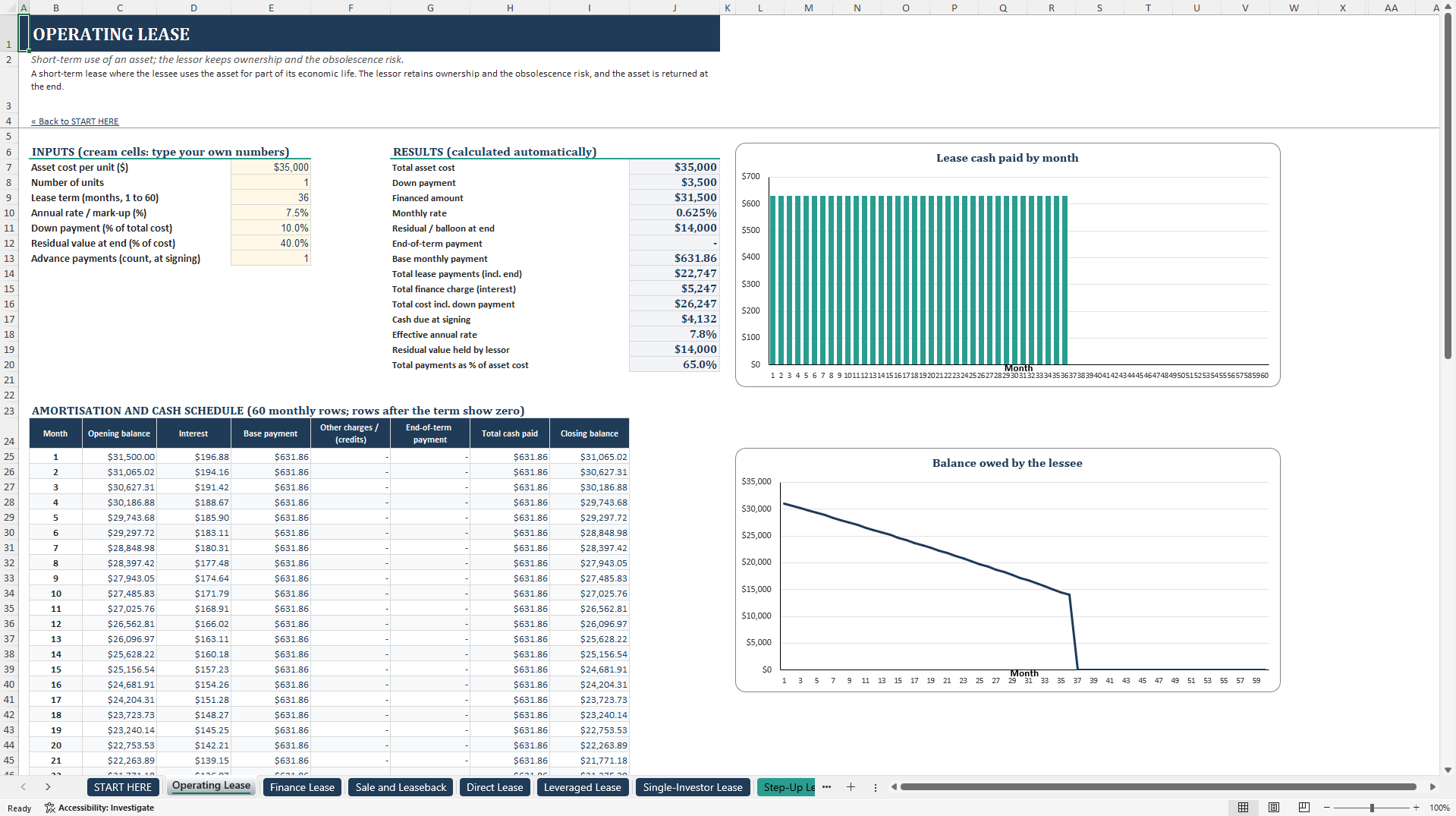
Analyze lease arrangements in which the lessee uses an asset for a defined period while the lessor retains ownership and residual value exposure. Calculate monthly rental payments, financing charges, total lease costs, and the residual value retained by the lessor.
"2. Finance Lease"
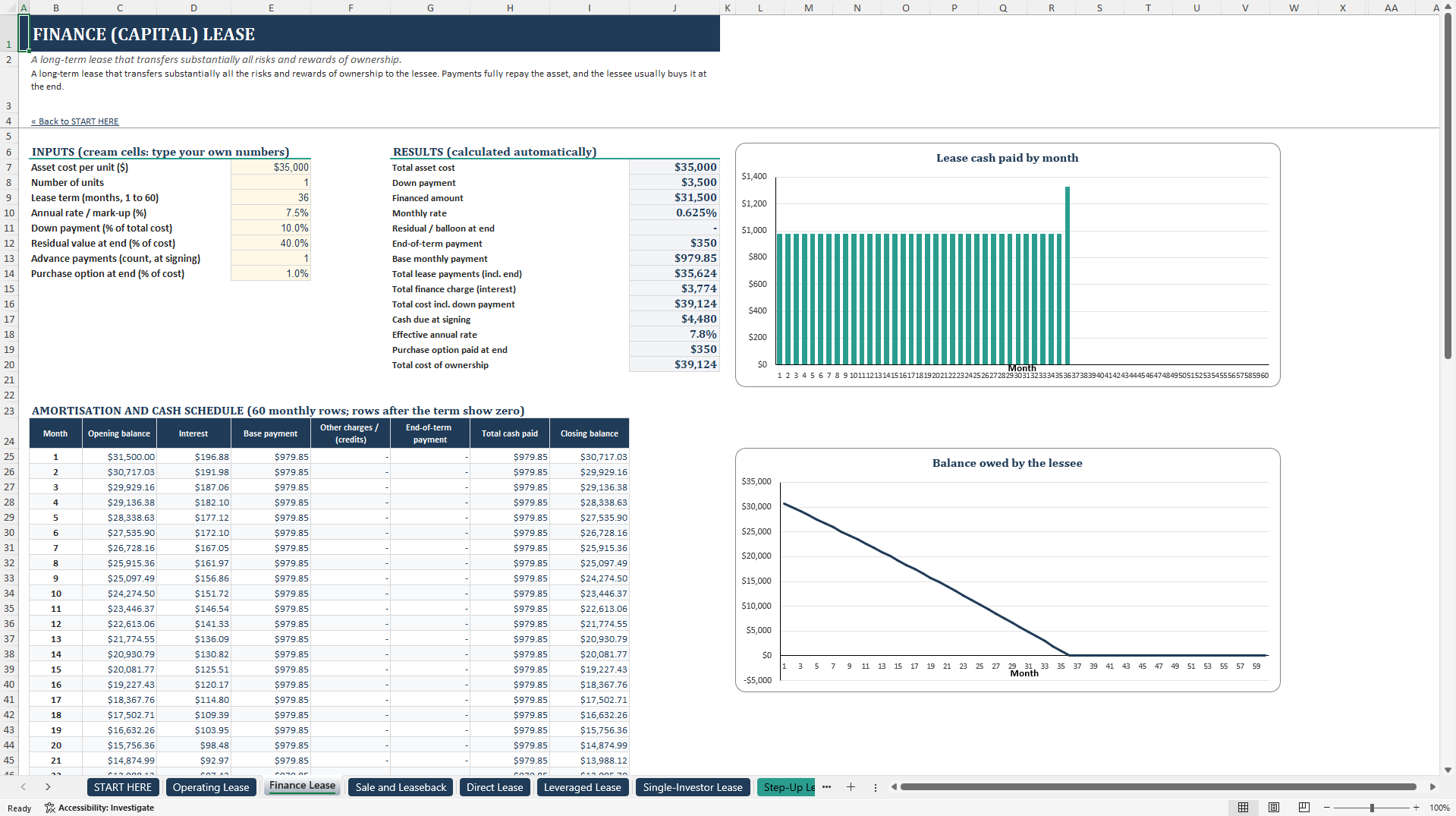
Evaluate longer-term financing arrangements where payments are structured to recover the asset cost. Model financing costs, repayment schedules, purchase options, and total cost of ownership.
"3. Sale and Leaseback"
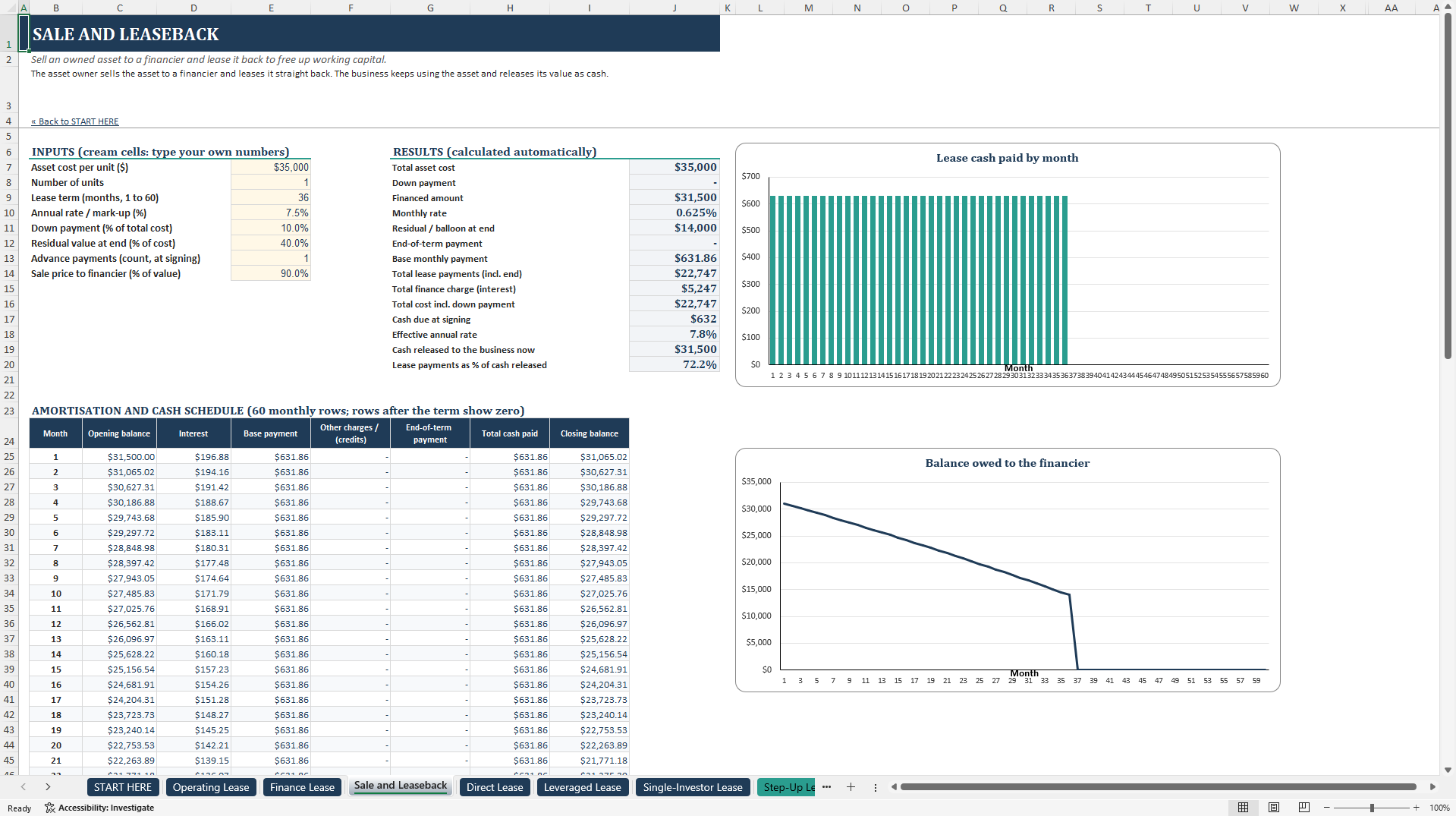
Evaluate transactions in which a business sells an existing asset to a financier and leases it back. Analyze the cash released from the transaction, subsequent lease payments, and the financial implications of retaining operational use of the asset.
"4. Direct Lease"
Analyze direct leasing arrangements in which the lessor acquires the asset from the supplier and leases it to the lessee. Evaluate the monthly payment and arrangement fees.
"5. Leveraged Lease"
Model a financing structure involving an equity-funded lessor and external borrowing. Examine the lender's financing share, debt service, lender interest rate, and the spread between lease rentals and financing obligations.
"6. Single-Investor Lease"
Evaluate a lease funded entirely through the lessor's own equity. Analyze the required return, lease payment structure, and residual value exposure.
B. Payment & Cash-Flow Lease Structures (5 Models)
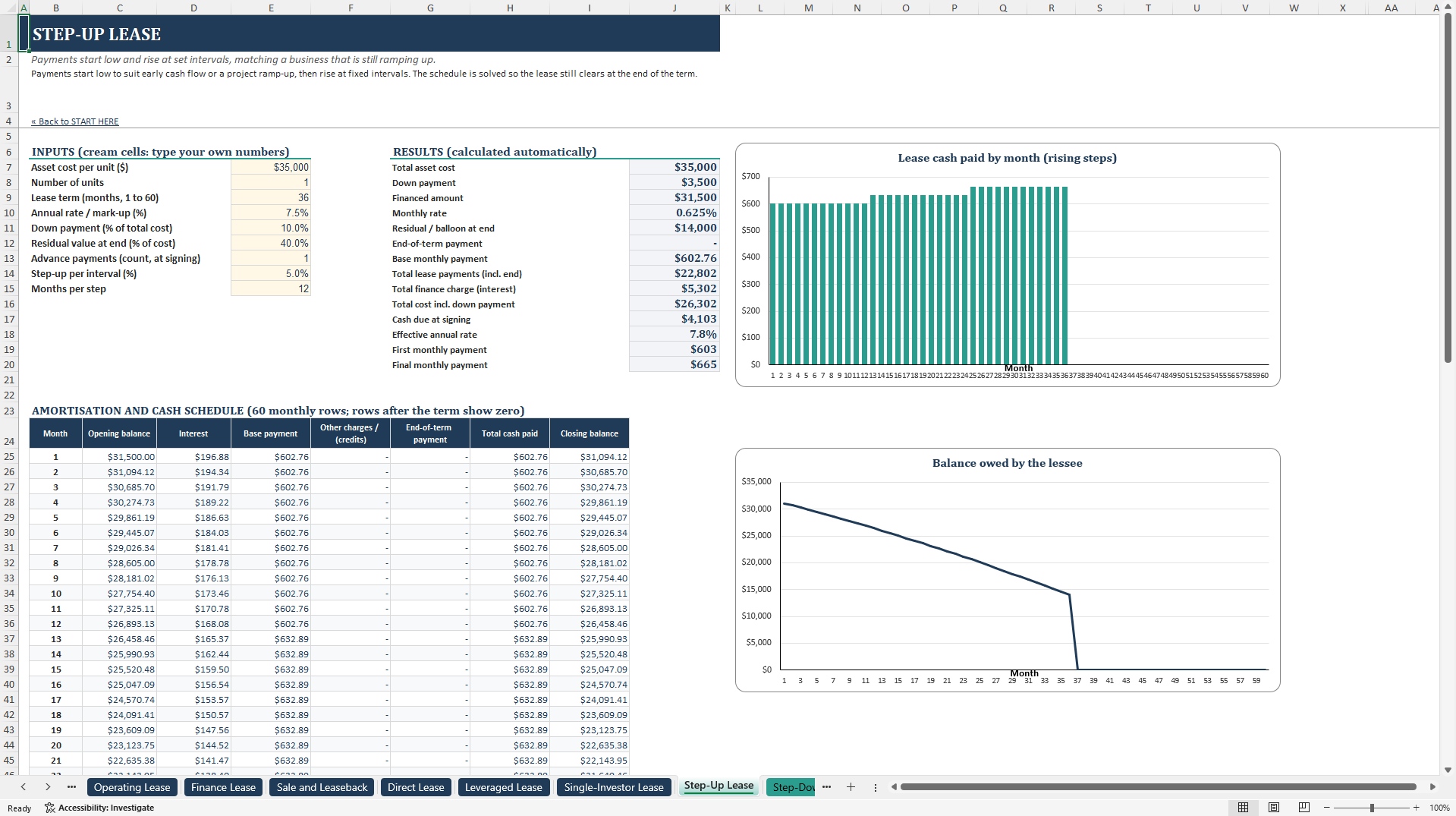
"7. Step-Up Lease"
Model lease arrangements where payments begin at a lower level and increase at specified intervals. Useful for businesses expecting revenue growth, project ramp-ups, or gradually increasing cash-flow capacity.
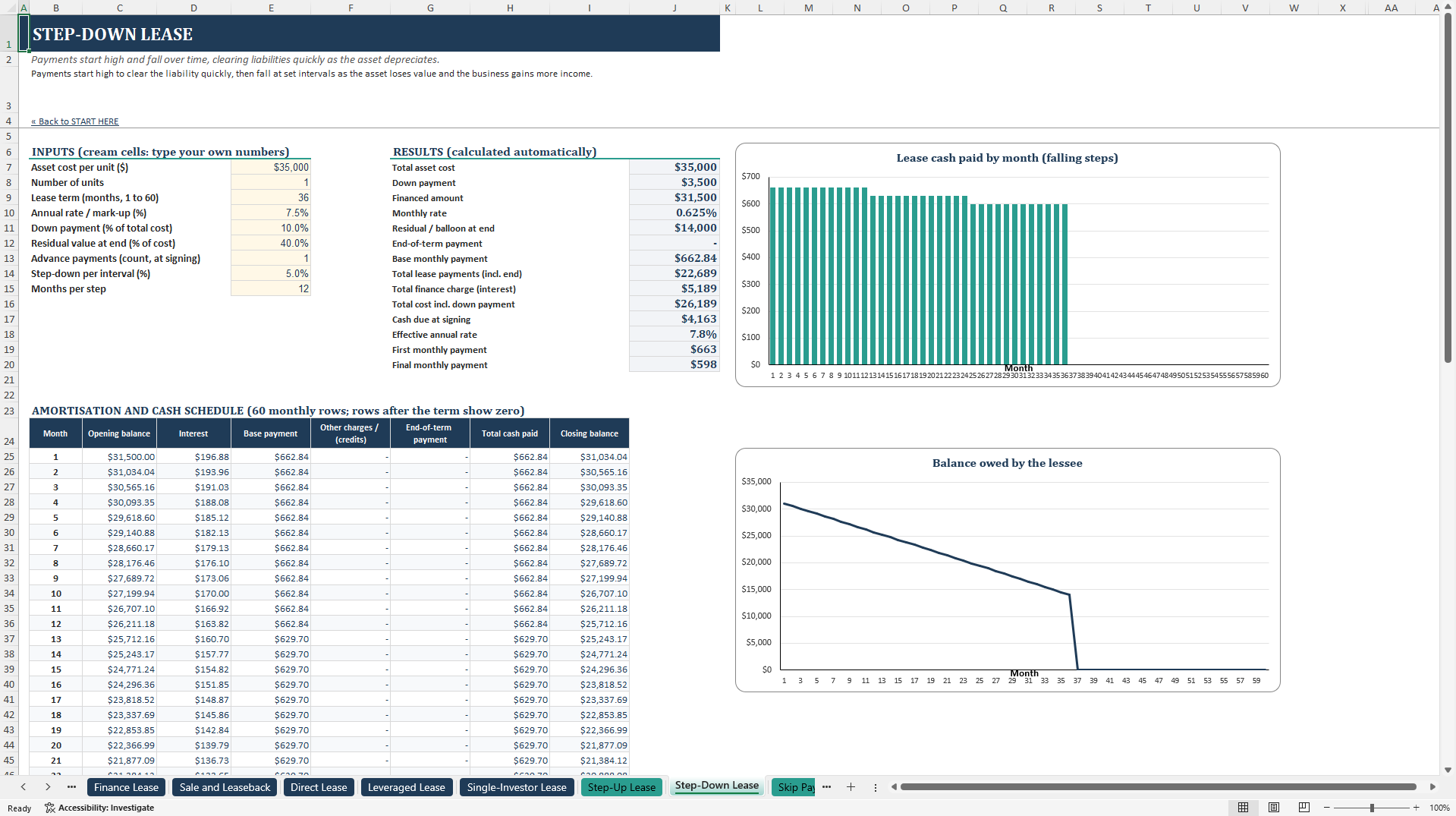
"8. Step-Down Lease"
Calculate arrangements where payments start higher and decrease over time. Examine the impact of accelerated early payments and declining future payment obligations.
"9. Skip Payment Lease"
Evaluate seasonal payment arrangements that allow two selected calendar months to have no scheduled base payment. The remaining payment pattern is adjusted to reflect the selected payment structure.
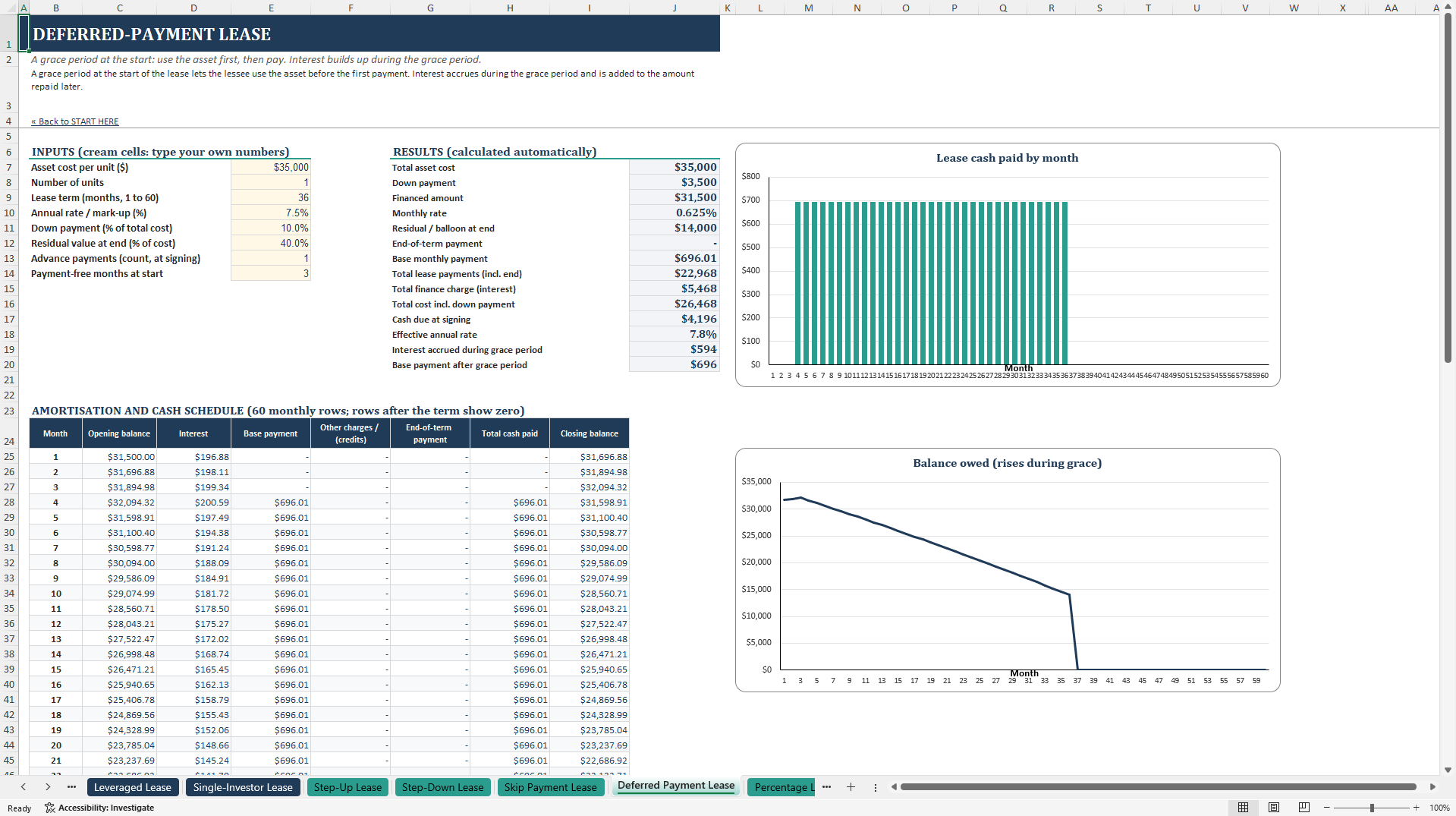
"10. Deferred Payment Lease"
Analyze lease structures with an initial payment-free grace period. Examine the interest accumulated during the deferral period and how it affects subsequent repayment obligations.
"11. Percentage Lease"
Model percentage-based rental arrangements commonly associated with retail property. Incorporate base rental assumptions and percentage-based charges linked to monthly sales.
C. Asset-End & Purchase Option Models (5 Models)
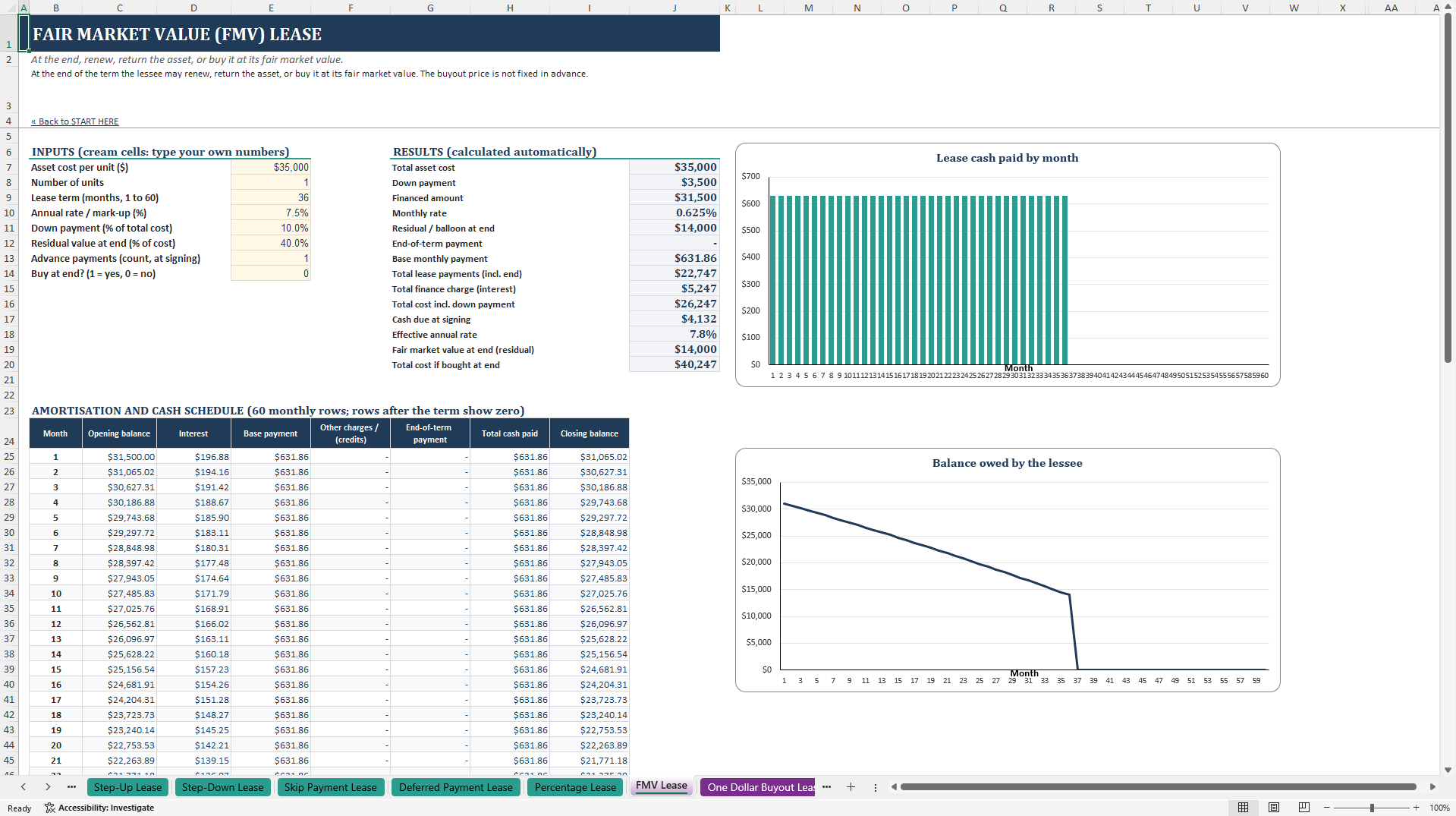
"12. Fair Market Value (FMV) Lease"
Evaluate arrangements where the lessee may return, renew, or purchase the asset at its fair market value. Examine the financial implications of the residual value and optional purchase decision.
"13. One Dollar Buyout Lease"
Model lease arrangements in which the lessee acquires ownership at the end of the agreement through a nominal $1 purchase option.
"14. 10% Purchase Option Lease"
Calculate arrangements with a predetermined purchase option equal to 10% of the original asset cost. Examine the purchase price and total ownership cost.
"15. Open-End Lease"
Evaluate residual value guarantee arrangements. Enter the guaranteed residual value and expected asset sale value to calculate any shortfall payable by the lessee.
"16. Closed-End Car Lease"
Analyze vehicle leasing arrangements where the lessor carries the residual value risk. Incorporate vehicle cost, lease duration, interest rate, residual value, and potential excess-wear or mileage charges.
D. Specialized & Asset-Specific Lease Models (4 Models)
"17. Master Whole Fleet Lease"
Evaluate fleet-wide leasing arrangements using asset cost per vehicle, fleet size, lease term, financing assumptions, residual value, and monthly fleet management fees. Examine aggregate fleet costs and the base monthly cost per vehicle.
"18. Synthetic Lease"
Analyze the financial structure of a synthetic lease, including residual value guarantees and modeled financing costs. The workbook presents the specified accounting and tax perspectives as analytical assumptions, not as a determination of applicable accounting or tax treatment.
"19. Vendor Lease"
Evaluate manufacturer-supported financing arrangements. Incorporate the standard financing rate and vendor subsidy to calculate the subsidized rate and resulting financing charges.
"20. Cross-Border Lease"
Analyze international leasing arrangements by incorporating withholding tax on interest. Examine the modeled tax impact and total lease cost including the entered withholding tax assumption.
E. Maintenance & Risk-Sharing Lease Models (5 Models)
"21. Full-Service Wet Lease"
Evaluate leasing arrangements where maintenance, insurance, servicing, and repairs are provided by the lessor. Incorporate monthly service fees to calculate the all-in monthly cost.
"22. Net Dry Lease"
Model leasing arrangements where the lessee bears additional operating expenses. Incorporate annual maintenance and insurance costs to examine the complete monthly financial commitment.
"23. Full-Payout Lease"
Evaluate arrangements in which lease rentals are intended to recover the full asset cost and the lessor's target return during the lease term. Examine cost recovery through rentals and down payments.
"24. Non-Full-Payout Lease"
Analyze arrangements where rentals during the initial lease term do not recover the entire asset cost. Examine the role of residual value and the lessor's remaining asset recovery exposure.
"25. Sublease"
Evaluate arrangements where an original lessee rents the asset to a third party while remaining liable to the original lessor. Incorporate expected sublease income and calculate the modeled net monthly exposure.
2. Standardized Financial Calculation Engine
All 25 models follow a consistent input-and-output approach, making it easier to work across different lease structures.
Users enter their assumptions into the designated cream-colored input cells. The workbook then automatically calculates the corresponding financial outputs.
Depending on the selected lease model, inputs include:
• Asset acquisition cost per unit.
• Number of assets or vehicles.
• Lease duration, from 1 to 60 months.
• Annual financing rate or mark-up.
• Down payment percentage.
• Residual value percentage.
• Number of advance payments due at signing.
• Purchase option or end-of-term payment.
• Additional contractual charges and credits.
• Specialized model-specific assumptions, such as vendor subsidies, maintenance costs, withholding tax, management fees, and sublease income.
The standardized calculation engine incorporates the financed amount, monthly financing rate, payment pattern, residual value, and applicable additional cash flows.
3. Automatically Calculated Financial Outputs
Each model provides a dedicated results section with relevant financial indicators.
Common calculated outputs include:
• Total asset cost.
• Down payment.
• Financed amount.
• Monthly financing rate.
• Residual value or balloon payment.
• Base monthly lease payment.
• Total lease payments.
• Total finance charge (interest).
• Total cost including down payment.
• Cash due at signing.
• Effective annual rate.
Specialized models also provide additional outputs relevant to their particular structure, including:
• Cash released through sale and leaseback.
• Monthly debt service and financing spread.
• First and final step-up or step-down payments.
• Accrued interest during payment deferral.
• Percentage-based rental charges.
• Purchase price at the end of the lease.
• Residual value shortfall.
• Fleet cost per vehicle.
• Vendor-subsidized financing rate.
• Withholding tax on interest.
• All-in monthly service and maintenance costs.
• Cost recovery percentage.
• Net monthly sublease exposure.
These calculations help users understand not just the headline monthly payment, but also the broader financial commitment associated with each arrangement.
4. 60-Month Amortization & Cash-Flow Schedule
Every lease model includes its own 60-month amortization and cash-flow schedule.
The schedule provides a month-by-month breakdown containing:
• Month number.
• Opening balance.
• Interest expense.
• Base lease payment.
• Other charges or credits.
• End-of-term payment.
• Total cash paid.
• Closing balance.
The schedule automatically reflects the selected lease term. Rows beyond the specified term display zero.
This provides a structured view of how the lease obligation evolves throughout the agreement.
Users can examine the monthly financing burden, track outstanding balances, identify payment-free periods, analyze deferred payments, and understand how residual values or final payments affect the overall arrangement.
For finance teams and business analysts, this is particularly useful when evaluating financing offers, preparing cash-flow forecasts, assessing contractual payment commitments, and comparing different lease structures.
5. Two Financial Charts for Every Model
Each of the 25 model worksheets includes two automatically updating charts.
"Monthly Cash Payment Bar Chart"
Visualizes the monthly cash paid throughout the lease term, helping users identify periods of higher or lower cash requirements and understand the impact of changing payment structures.
Outstanding Balance Line Chart
Visualizes the balance remaining over the lease term, helping users monitor the modeled repayment progression and identify how residual values, deferred payments, and other structural features affect the closing balance.
Together, these charts provide a visual representation of both payment obligations and outstanding financial exposure.
The workbook contains 50 model-specific charts in total.
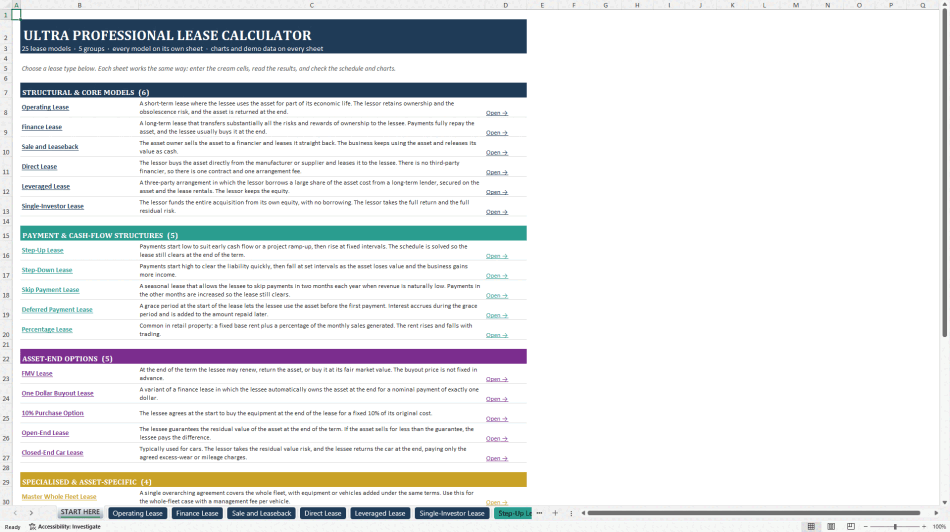
6. START HERE Navigation Dashboard
The workbook includes a dedicated START HERE index that organizes all 25 lease models into five categories.
Each model is accompanied by a short explanation of its purpose and a navigation link to its dedicated worksheet.
This allows users to identify the appropriate lease structure without searching through the workbook manually.
7. Comprehensive User Manual
A separate User Manual is included within the workbook.
It explains:
• How to get started with the calculator.
• How to enter common financial assumptions.
• How the underlying calculation engine works.
• How payment-pattern factors operate.
• How other charges and end-of-term payments are incorporated.
• How to interpret the amortization schedule.
• How to read and understand the two financial charts.
• How to use each of the 25 specialized models.
• Important calculation assumptions and limitations.
• Common troubleshooting scenarios.
Each model also includes its own brief usage instructions directly within its worksheet.
This combination of model-specific guidance and centralized documentation makes the workbook easier to navigate and use.
8. Who Should Use This Toolkit?
This financial modeling toolkit is particularly relevant to:
• Chief Financial Officers (CFOs).
• Finance Directors and Finance Managers.
• Corporate Finance Professionals.
• Financial Analysts and Financial Modelers.
• Accountants and Management Accountants.
• Treasury and Financial Planning Teams.
• Fleet and Vehicle Managers.
• Procurement and Equipment Acquisition Managers.
• Business Owners and Entrepreneurs.
• Leasing and Asset Finance Professionals.
• Management Consultants.
• MBA, Finance, and Accounting Students.
• Business Schools and Corporate Training Professionals.
It can support analysis across automotive, manufacturing, transportation, logistics, retail, commercial property, aviation, equipment financing, and other asset-intensive industries.
9. How This Toolkit Can Benefit Your Organization
"Reduce Manual Financial Modeling Work"
Instead of constructing separate spreadsheets for different lease arrangements, users can work with 25 dedicated models in one organized workbook.
"Improve Lease Offer Comparisons"
Evaluate different payment patterns, residual assumptions, financing rates, purchase options, and additional charges using a standardized calculation environment.
"Improve Cash-Flow Visibility"
Use monthly payment schedules and graphical analysis to understand the timing and scale of lease-related cash requirements.
"Understand Total Lease Costs"
Look beyond the advertised monthly rental to examine financing charges, down payments, service costs, ancillary expenses, purchase options, and end-of-term obligations.
"Support Asset Acquisition Decisions"
Examine alternative financing and leasing structures before entering into vehicle, equipment, fleet, or other asset-related agreements.
"Improve Financial Planning and Budgeting"
Use the model outputs to support internal budgeting, scenario analysis, financing evaluations, and management discussions.
*"Save Time and Improve Analytical Consistency"
Work with a common calculation framework across 25 different lease structures rather than repeatedly building separate calculation schedules.
10. What You Receive
The purchase includes one comprehensive Microsoft Excel workbook containing:
• 25 dedicated lease financial calculator worksheets.
• 5 organized model categories.
• 1 START HERE navigation index.
• 25 individual 60-month amortization and cash-flow schedules.
• 50 automatically updating financial charts.
• 25 model-specific instruction sections.
• 1 comprehensive User Manual.
• 1 License & Terms worksheet.
• Illustrative demonstration data.
• Editable input cells and automatically calculated financial outputs.
11. Product Specifications
"Product Type". Professional Financial Modeling Toolkit / Excel Calculator.
"Material & Forma". Microsoft Excel workbook (.xlsx).
"Workbook Size"'. 28 worksheets.
"Models Included"'. 25 specialized lease models.
"Schedule Capacity". Up to 60 monthly periods per model.
"Visual Analysis". Two charts per model.
"Customization". Editable financial assumptions and model inputs. The underlying formulas and structure are provided as designed.
"Personalization". No personalized or bespoke customization is included.
"Delivery". Digital product. No physical item will be shipped.
"Intended Use". Financial analysis, lease evaluation, cash-flow planning, asset financing, and educational purposes.
12. Important Notes, Assumptions & Usage Terms
This workbook is designed as a financial planning, modeling, and educational tool. It does not constitute financial, investment, tax, accounting, legal, or professional leasing advice.
Results depend on the assumptions and figures entered by the user. Actual lease contracts, tax treatments, accounting standards, regulatory requirements, interest calculations, and legal obligations may differ by jurisdiction and contractual arrangement.
The workbook uses illustrative demonstration figures. Users should replace these with their own contractual assumptions and independently verify important calculations and applicable requirements with qualified professionals before making financial or contractual decisions.
The purchase includes a single-user license for personal or business use. Reselling, redistributing, republishing, or commercially distributing the workbook or its underlying formulas is not permitted.
"A Complete Lease Financial Modeling Toolkit in One Workbook"
From operating and finance leases to complex payment structures, residual guarantees, fleet financing, wet and dry leases, and sublease arrangements, this 25-model toolkit provides a structured environment for analyzing the financial implications of diverse leasing arrangements.
Instead of starting from scratch with every lease calculation, work with 25 dedicated models, automated financial outputs, detailed amortization schedules, and visual cash-flow analysis in one comprehensive solution.
Got a question about the product? Email us at support@flevy.com or ask the author directly by using the "Ask the Author a Question" form. If you cannot view the preview above this document description, go here to view the large preview instead.
Source: Best Practices in Financing, Loans Excel: Professional Lease Financial Modeling Toolkit - 25 Models Excel (XLSX) Spreadsheet, MW & Digitelax Consulting
ABOUT THE AUTHOR

Welcome to the official enterprise resource hub of MW & Digitelax Consulting. Directed by a seasoned banking executive, corporate risk consultant, and financial content strategist with over 28 years of institutional leadership experience, our practice delivers deployment-ready frameworks designed to drive enterprise efficiency, enforce regulatory compliance, and eliminate systemic model risk. ... [read more]
Ask the Author a Question
You must be logged in to contact the author.