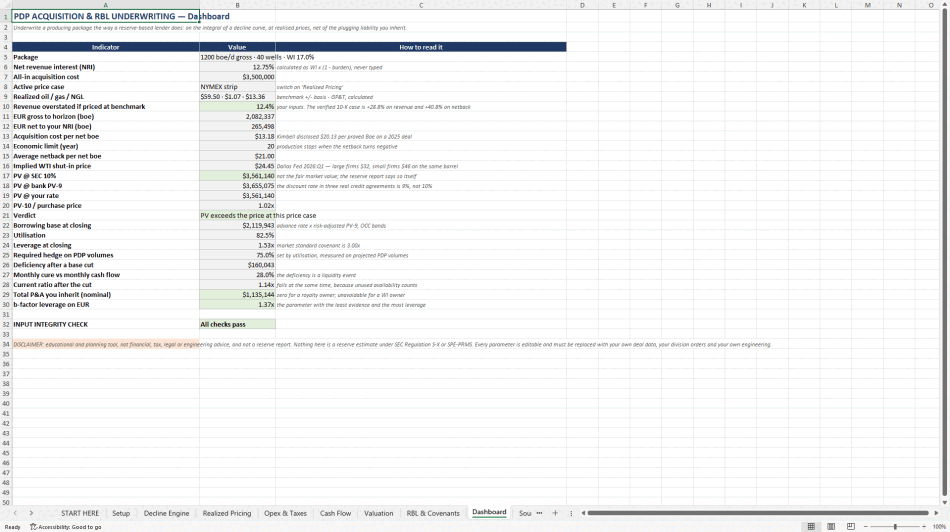
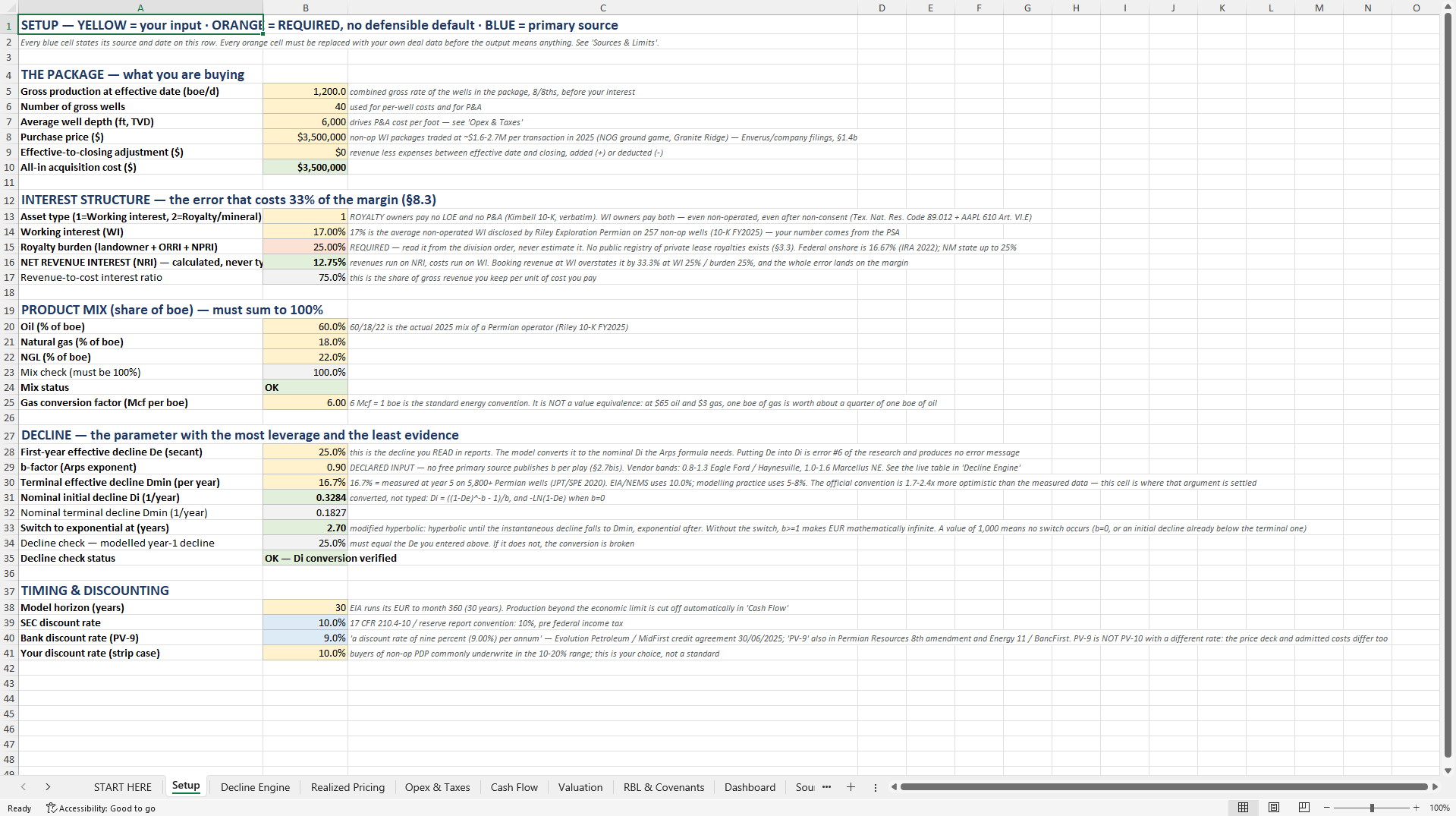
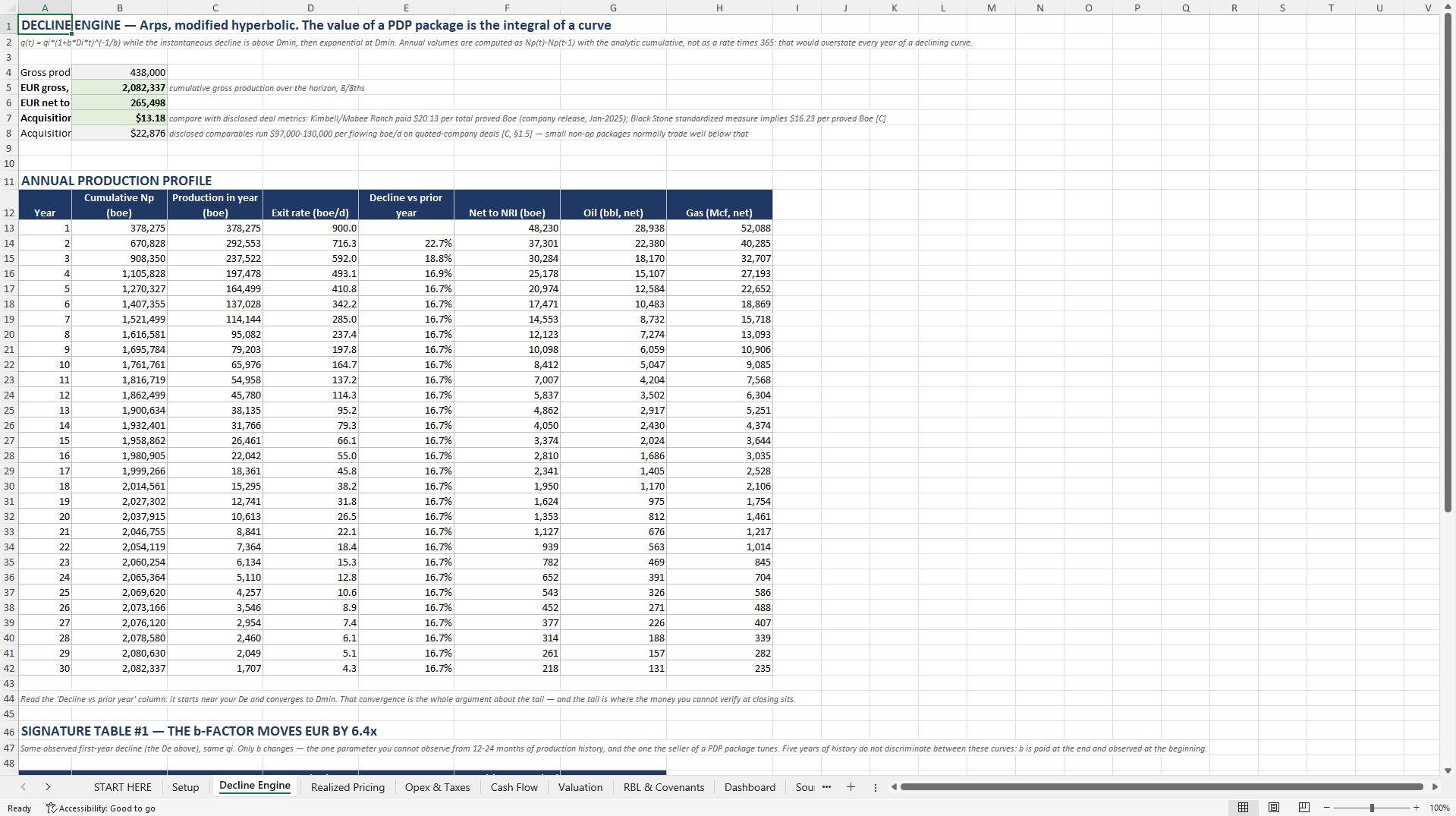
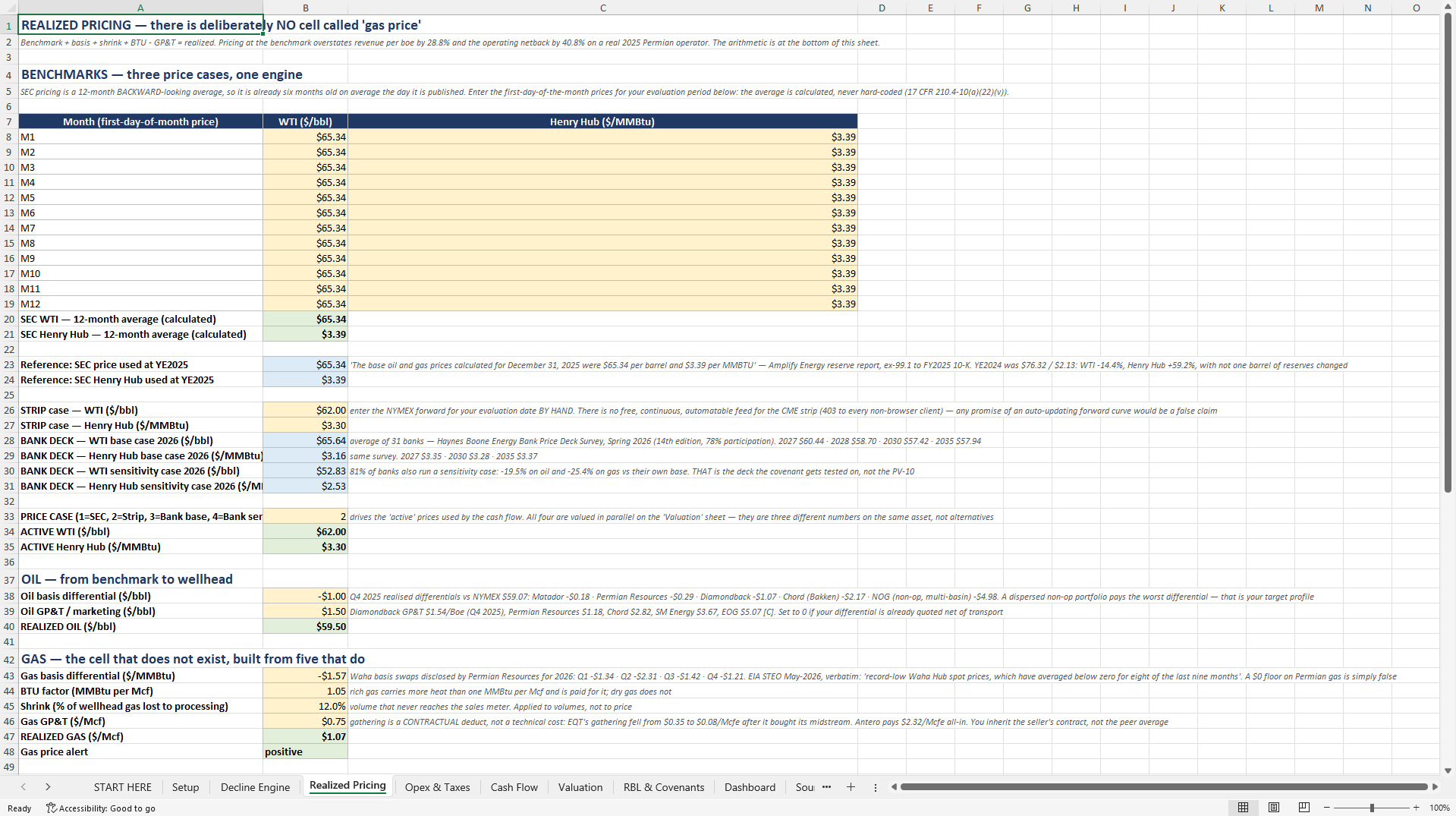
 Click main image to view in full screen.
PDP Oil & Gas Acquisition & RBL Underwriting Model – Excel XLSX
Excel (XLSX) + supplemental PDF


BENEFITS OF THIS DOWNLOADABLE EXCEL DOCUMENT
- Value a producing package on the integral of an Arps decline curve, with the modified hyperbolic terminal switch that stops the tail from running away.
- Build realised wellhead prices from benchmark, basis, BTU, shrinkage and midstream deducts, instead of pricing at the benchmark and overstating your netback by 40 percent.
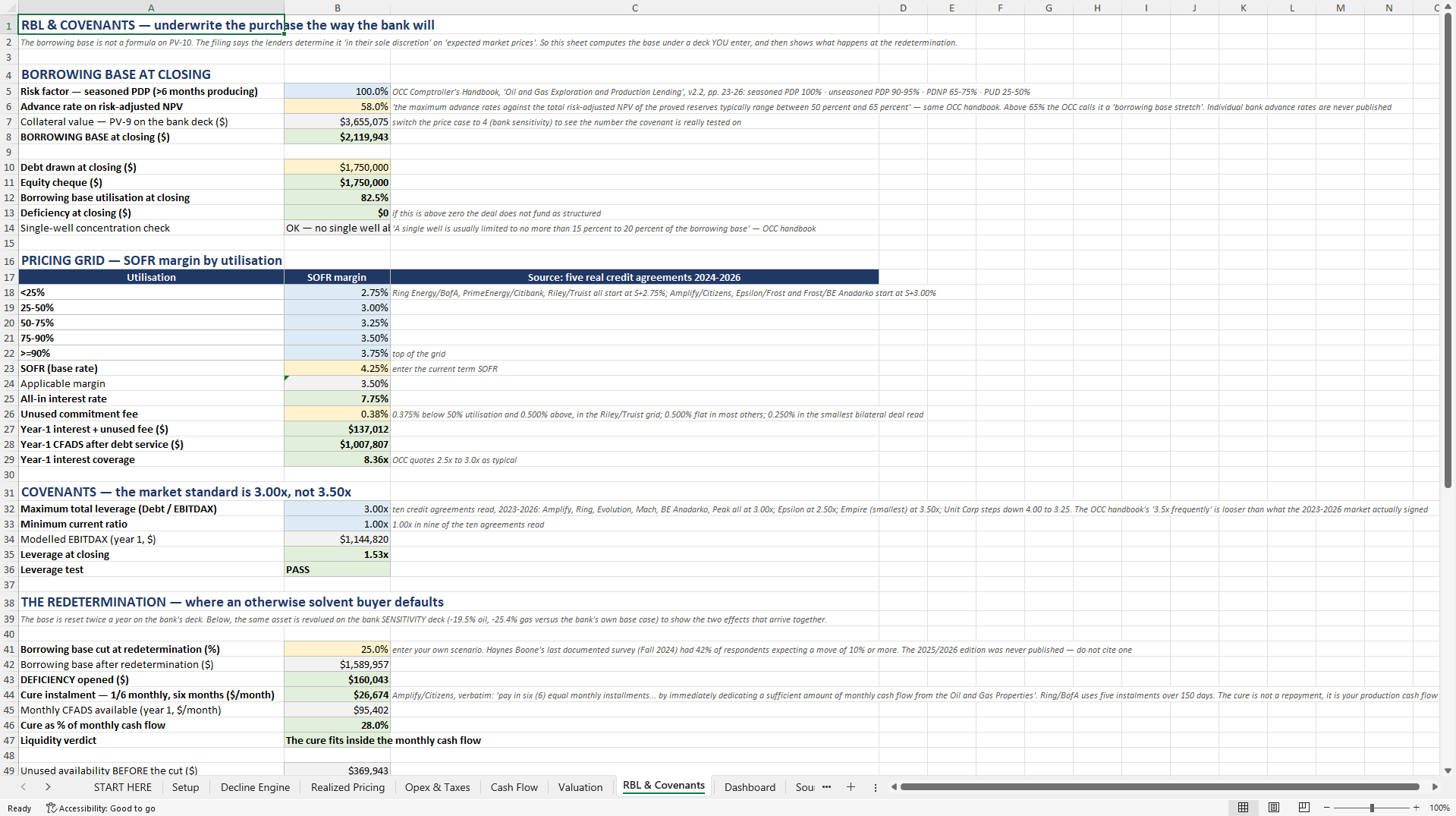
- Size a borrowing base with published regulatory advance rates, then cut it and watch the deficiency and the current ratio breach together.
OIL & GAS EXCEL DESCRIPTION
Underwrite a producing oil and gas package the way a reserve-based lender does.
This is an acquisition model for interests in wells that are already producing: non-operated working interests, mineral interests and royalty interests. It is not a drilling model, not an LNG or refinery project model, and not a reserve report.
The economic constraint here is different from any other business you might buy. A laundromat is worth a multiple of its earnings. A producing oil and gas package is worth the integral of a decline curve: production falls on its own, every year, whatever you do, and most of the value sits in a tail you cannot verify at closing.
Four modelling errors move more money than any negotiation over price, and this workbook is built to intercept each one in dollars, on the face of a sheet, rather than burying them in a risk premium.
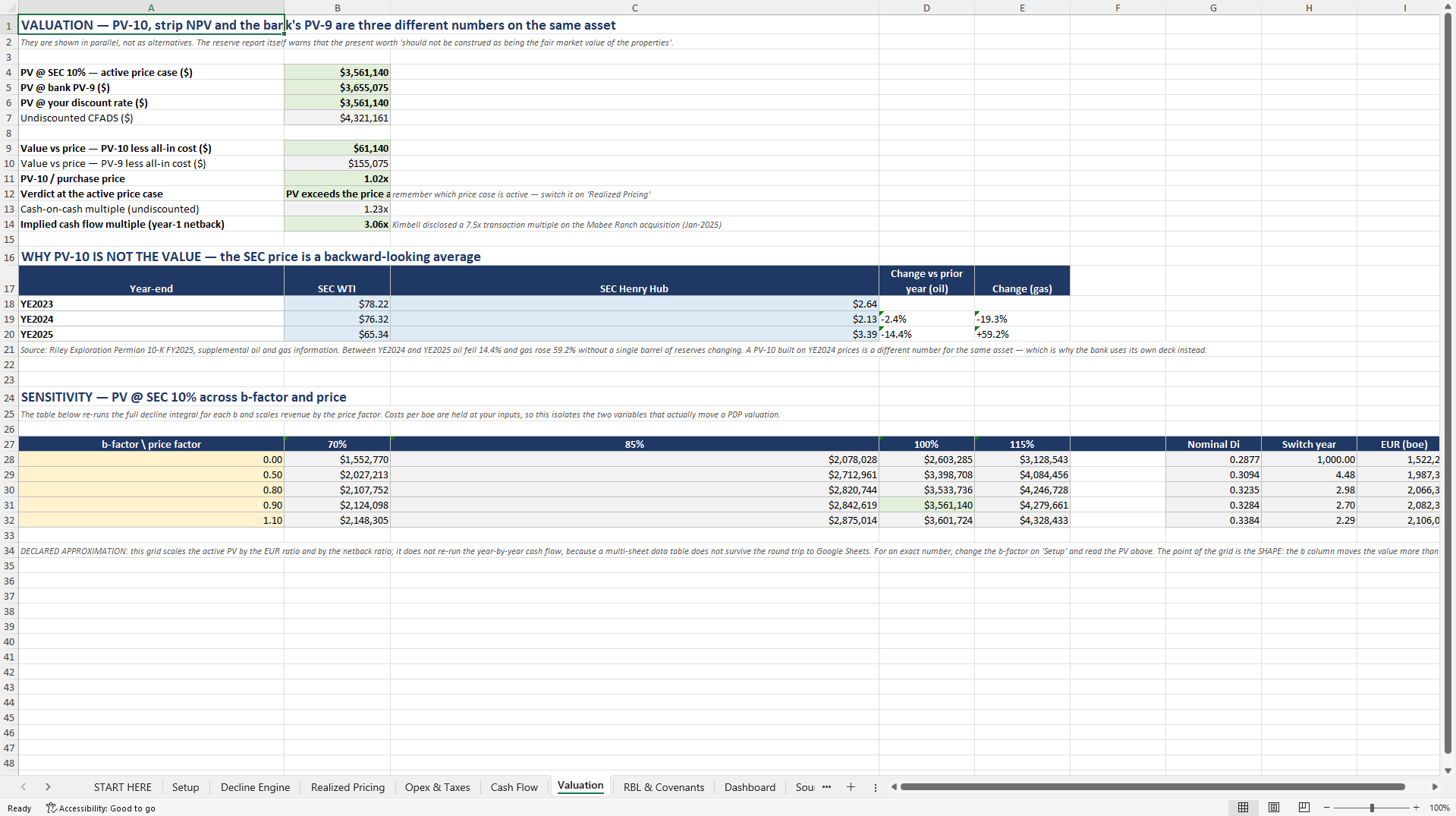
First, the b-factor. Holding the observed first-year decline fixed at 60 percent, the Arps b-factor alone moves estimated recovery from 39,835 barrels to 256,418, a factor of 6.4, and at a b-factor of 1 or more the integral does not converge at all, so recovery is mathematically infinite. Five years of production history cannot separate those curves. A live table recomputes this on your own inputs, and the model implements the modified hyperbolic terminal switch that the industry uses to stop the tail running away.
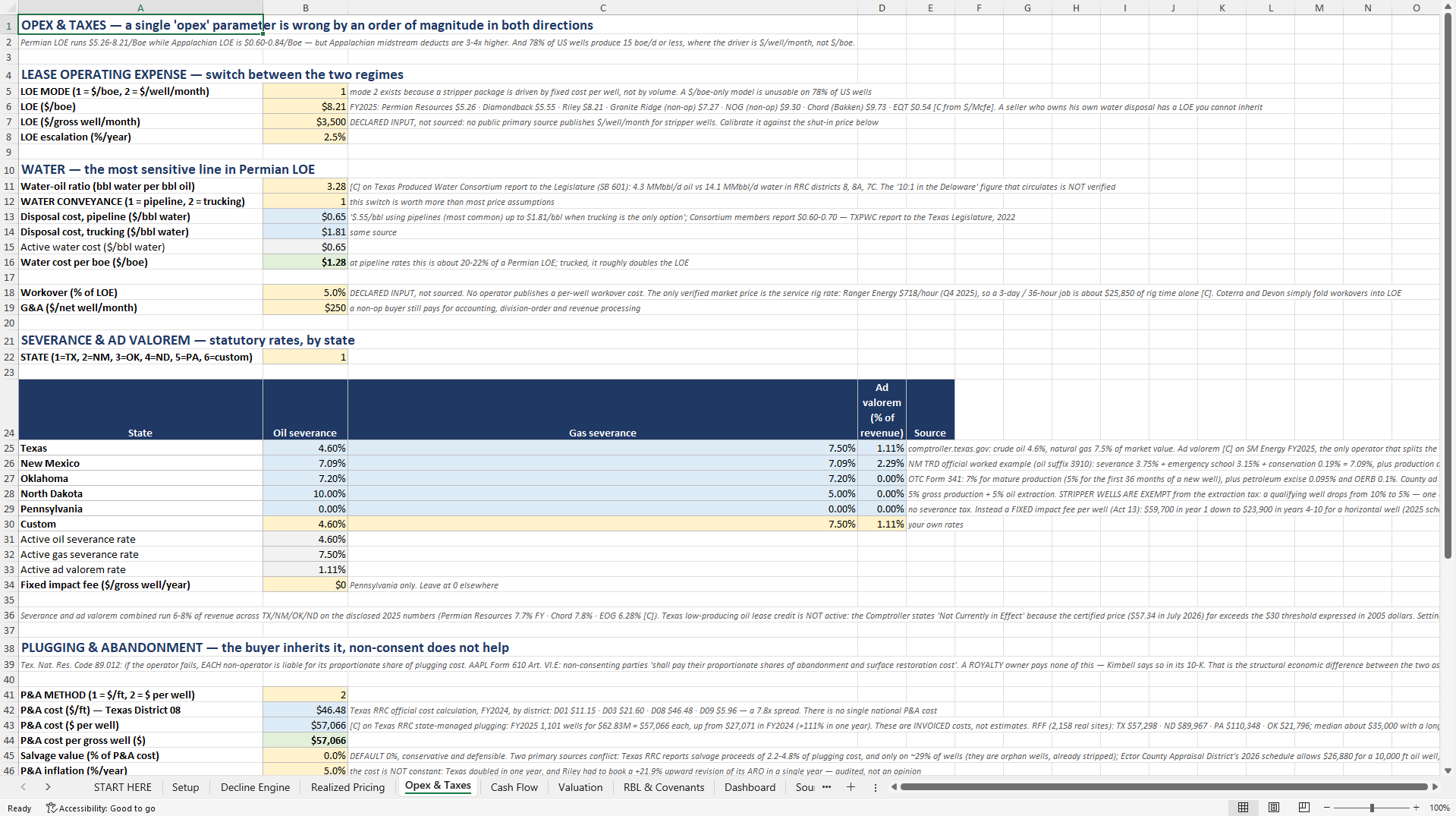
Second, pricing at the benchmark. There is deliberately no cell called gas price. Instead there is a benchmark, a basis differential, a BTU factor, a shrinkage percentage and a gathering, processing and transportation deduct, with the realised price calculated from them. The reason is a filed annual report: a Permian operator reported realised prices for 2025 of 62.95 dollars per barrel of oil, minus 0.28 dollars per Mcf of gas and minus 1.27 dollars per barrel of NGL, against SEC benchmarks of 65.34 and 3.39 dollars. Pricing at the benchmark overstates revenue per boe by 28.8 percent and the operating netback by 40.8 percent. The model raises an alert when a realised price turns negative, and keeps working when it does.
Third, the difference between working interest and net revenue interest. Revenues run on the net revenue interest and costs run on the working interest, in visibly separate columns, and the net revenue interest is always calculated rather than typed.
Fourth, the plugging liability and the redetermination. A working interest owner inherits the obligation to plug even without operating and even after electing non-consent. And when a borrowing base is cut it hits twice: the deficiency opens, and because the contractual definition of current assets includes unused availability, the current ratio falls in the same quarter.
Ten sheets: START HERE, Setup, Decline Engine, Realized Pricing, Opex and Taxes, Cash Flow, Valuation, RBL and Covenants, Dashboard, and a Sources and Limitations sheet. That last sheet lists every sourced value with its source, and separately the thirteen things this model does not claim to know. Excel and Google Sheets compatible, with no macros and no external links.
The package also includes a second document: an eleven page PDF user guide that explains the four errors in detail, sets out sector benchmarks for operating costs, differentials, severance taxes and plugging costs by state, and lists the free public data sources you can use to run your own due diligence.
Got a question about the product? Email us at support@flevy.com or ask the author directly by using the "Ask the Author a Question" form. If you cannot view the preview above this document description, go here to view the large preview instead.
Source: Best Practices in Oil & Gas, Integrated Financial Model Excel: PDP Oil & Gas Acquisition & RBL Underwriting Model Excel (XLSX) Spreadsheet, ProformaWorks
ABOUT THE AUTHOR

ProformaWorks builds acquisition-grade financial models for Main Street and lower-middle-market businesses - the kind of deal financed with an SBA 7(a) loan or a small commercial facility.
Every model answers one question: does this deal pencil at the bank? That means SDE or NOI rebuilt from the seller's own numbers, the add-backs a lender will and will not accept, a debt-service
... [read more]
Ask the Author a Question
You must be logged in to contact the author.




























