 Click main image to view in full screen. Unlock all 11 preview images:
MSP & IT Services Financial Model - 5-Year, SBA – PDF
PDF document + Zip archive file (ZIP) 18 Pages


BENEFITS OF THIS DOWNLOADABLE PDF DOCUMENT
- Turns one 3,100-seat roster into the full five-year picture - statements, ratios, technician capacity, cohort retention - with every number tied to a named range a reviewer can audit.
- Prices the acquisition you would actually do - SBA 7(a) sources and uses, DSCR per year, equity injection gate - instead of a bare EBITDA multiple.
- Tells you which assumption moves the answer before you argue about it - Downside, Base, Upside, plus six elasticities measured against the live model.
INFORMATION TECHNOLOGY PDF DESCRIPTION
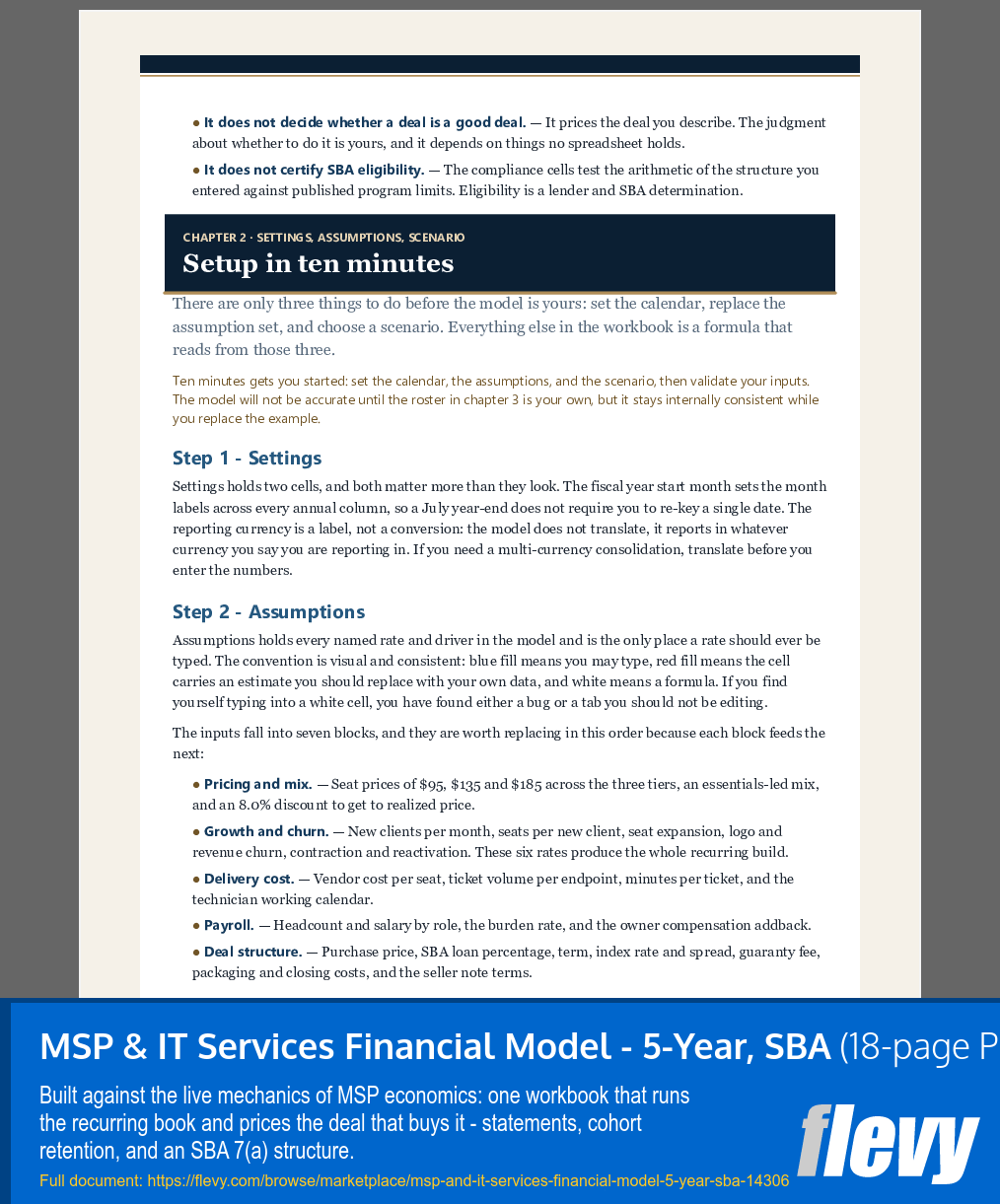
Most MSP models are a P&L with a churn line. This one is an engine.
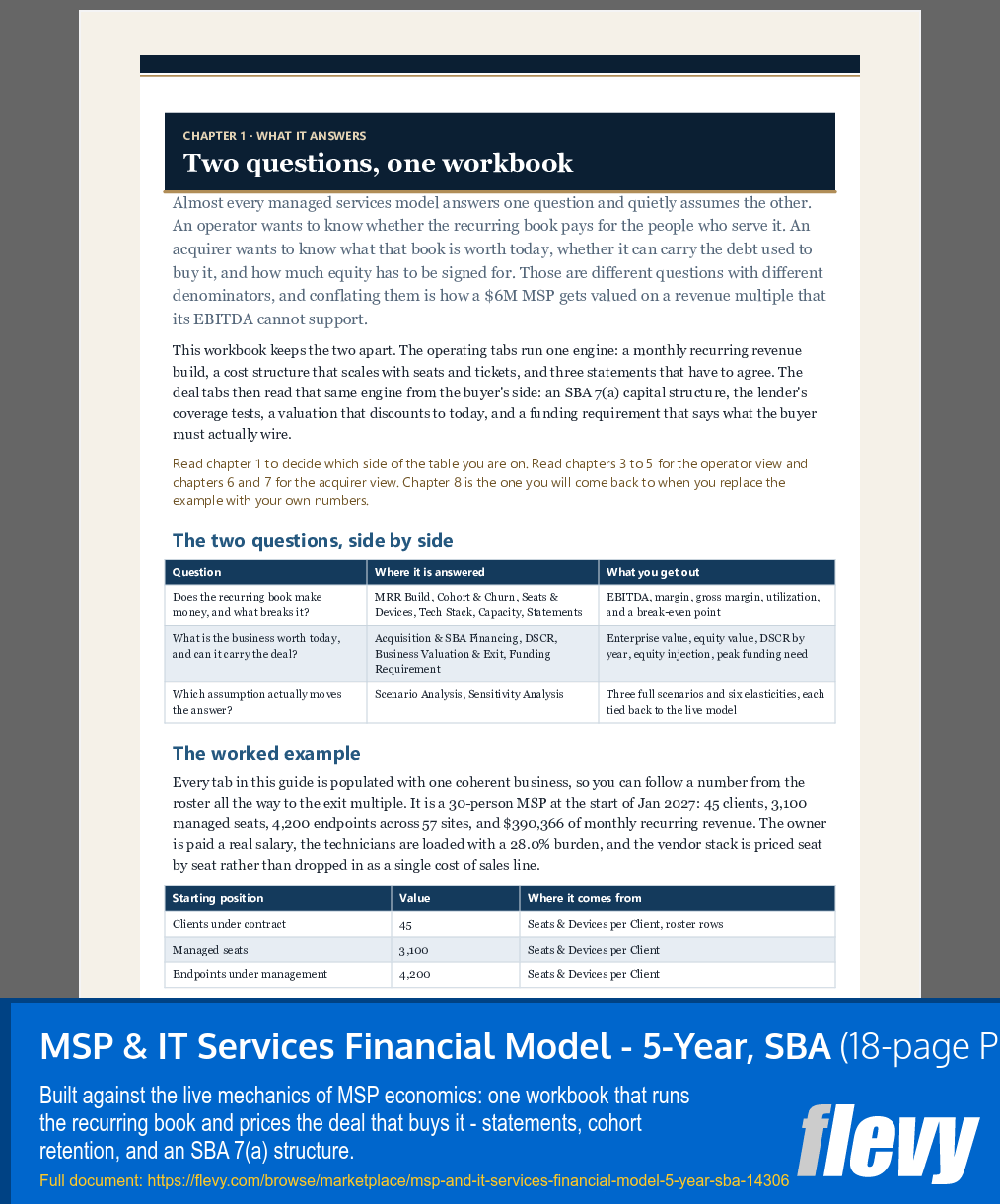
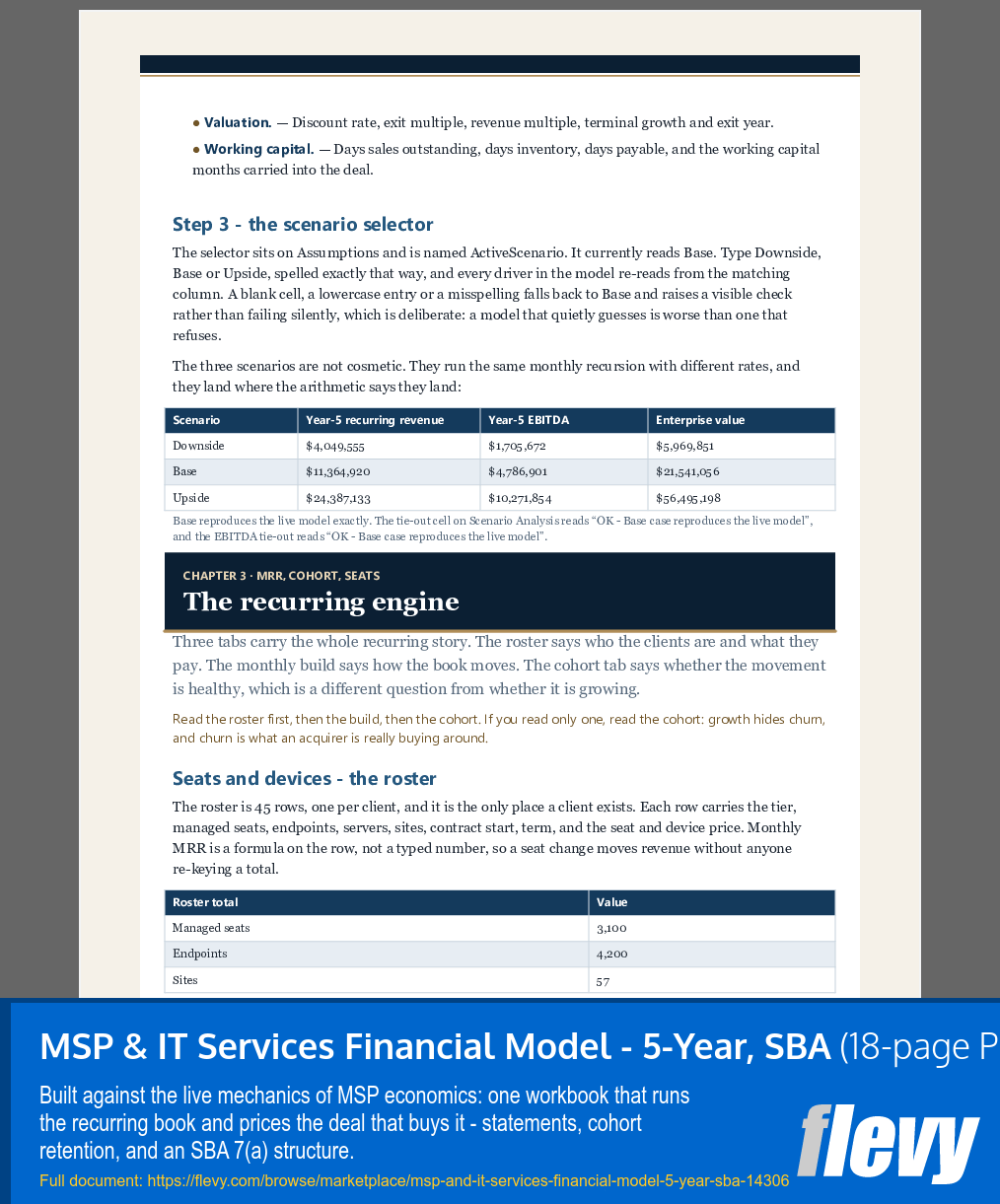
It starts where the business actually starts: the client roster. Seats, endpoints, servers, sites, tier prices, discounts, contract terms – every client, one row, live formulas. The recurring book builds forward month by month for 60 months and annually for five years: new logos, expansion, contraction, reactivation, churn, annual price increases. Every rate is named, visible and replaceable.
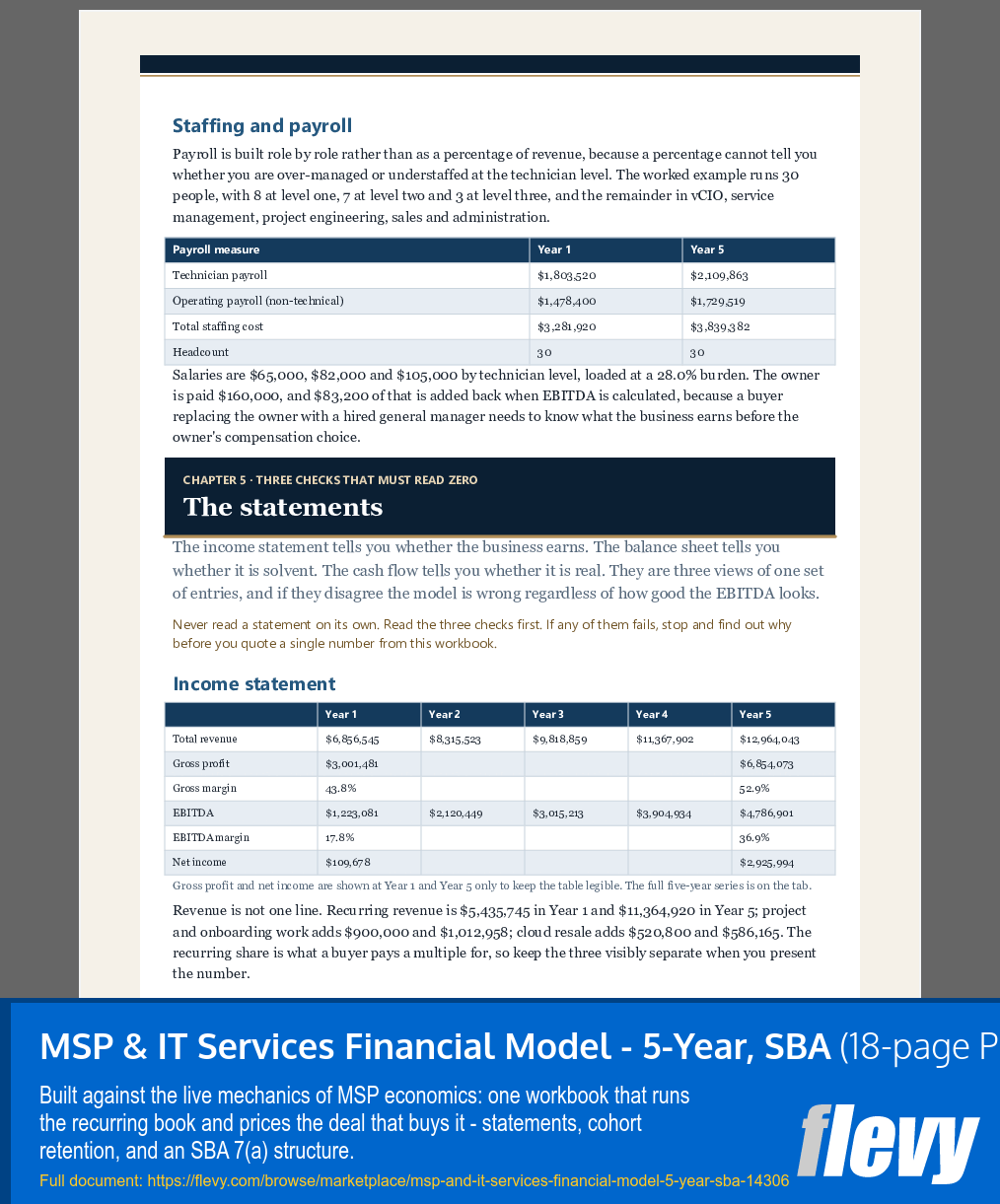
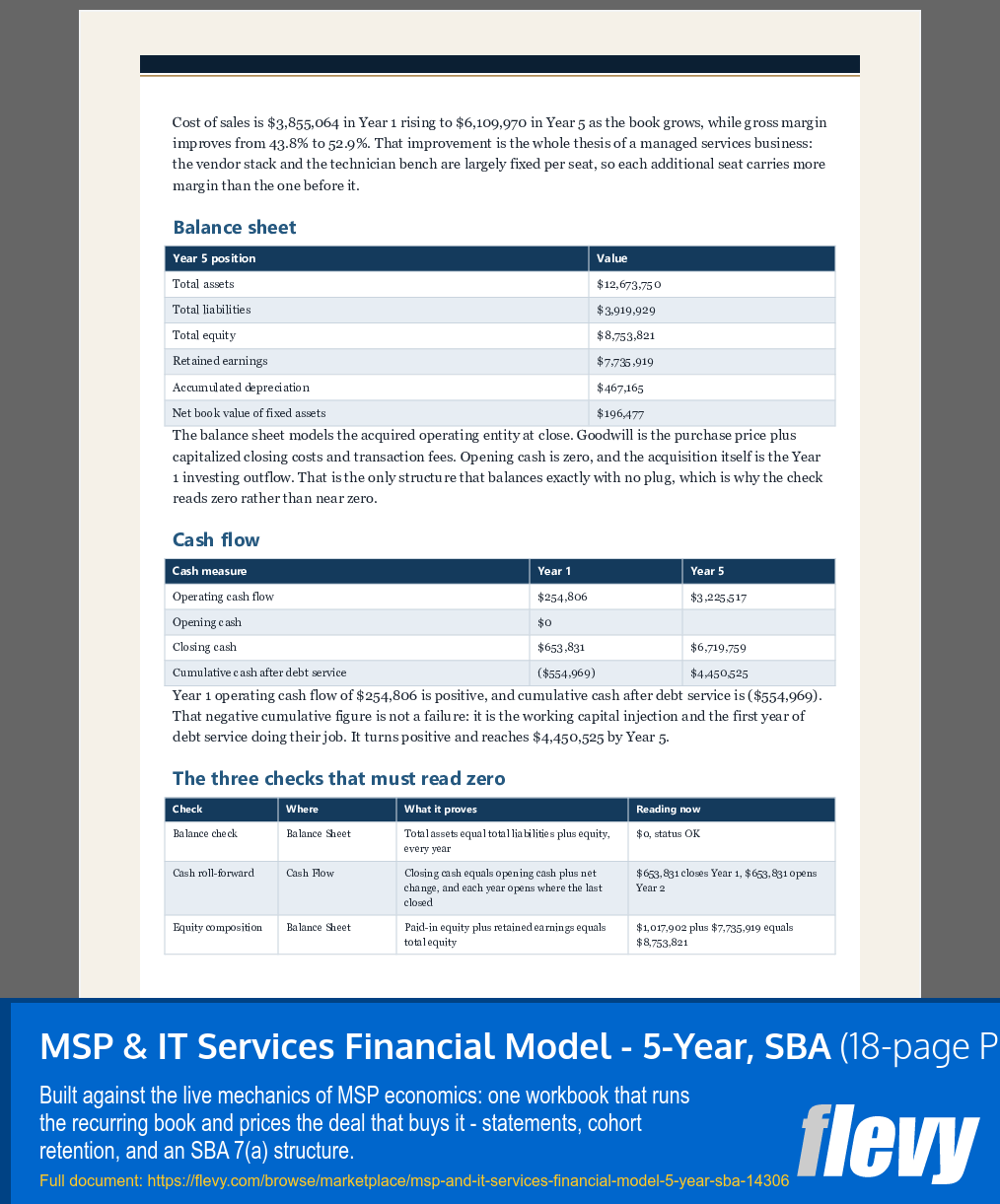
The delivery side is priced the way an MSP actually costs money. The vendor stack is line by line – RMM, PSA, EDR, backup, M365, DNS, monitoring, documentation – not a lump cost of sales. Technician capacity comes from billable hours with a utilization target, so over-selling shows up as a number, not a surprise. Help desk and SLA attainment are measured per month. Payroll is built role by role, with the owner addback stated explicitly. Three statements – income, balance sheet, cash flow – tie out to zero in every one of the five years.
The deal side answers the questions a buyer and a lender actually ask. The acquisition tab builds the SBA 7(a) capital structure from the purchase price outward: 120-month amortization, the tiered FY2027 guaranty fee, packaging fee, seller note with an interest-only period, working capital injection, and a sources and uses table that balances. Five compliance gates are computed and labeled, never approximated: equity injection at 10% of project cost, the $5,000,000 program maximum, the base-plus-3.0% rate cap, the sources and uses tie, and post-close liquidity. DSCR is computed per year against the 1.25x floor – not just in Year 1.
The lender view does not stop at the projection. A Historical Underwriting tab puts three fiscal years of revenue, reported EBITDA, supported add-backs, capex, working capital and debt service beside the forecast, then computes historical DSCR and historical coverage of the proposed debt service. It also runs the SOP 50 10 8.1 Quality of Earnings gate: the transaction classification, the $3m purchase-price threshold, the owner-buyout and ESOP exemptions, and the lender-commissioned evidence checklist. The purchase-price allocation separates goodwill from identifiable intangibles, expenses acquisition costs through the income statement, and amortizes both the intangibles and the debt issuance costs.
The valuation tabs lead with the exit multiple applied to Year-5 EBITDA – how managed services businesses actually transact – and keep Gordon growth beside it as a cross-check. Enterprise value is a value today: debt is netted at closing, not at exit, and all three terminal methods are discounted to today before they are blended. Returns are expressed both ways – equity MOIC on the cheque, and MOIC on total capital for the lender's committee.
A named scenario switch runs the same monthly recursion in Downside, Base and Upside, each tied back to the live model. Six elasticities tell you which assumption moves the answer before you argue about it.
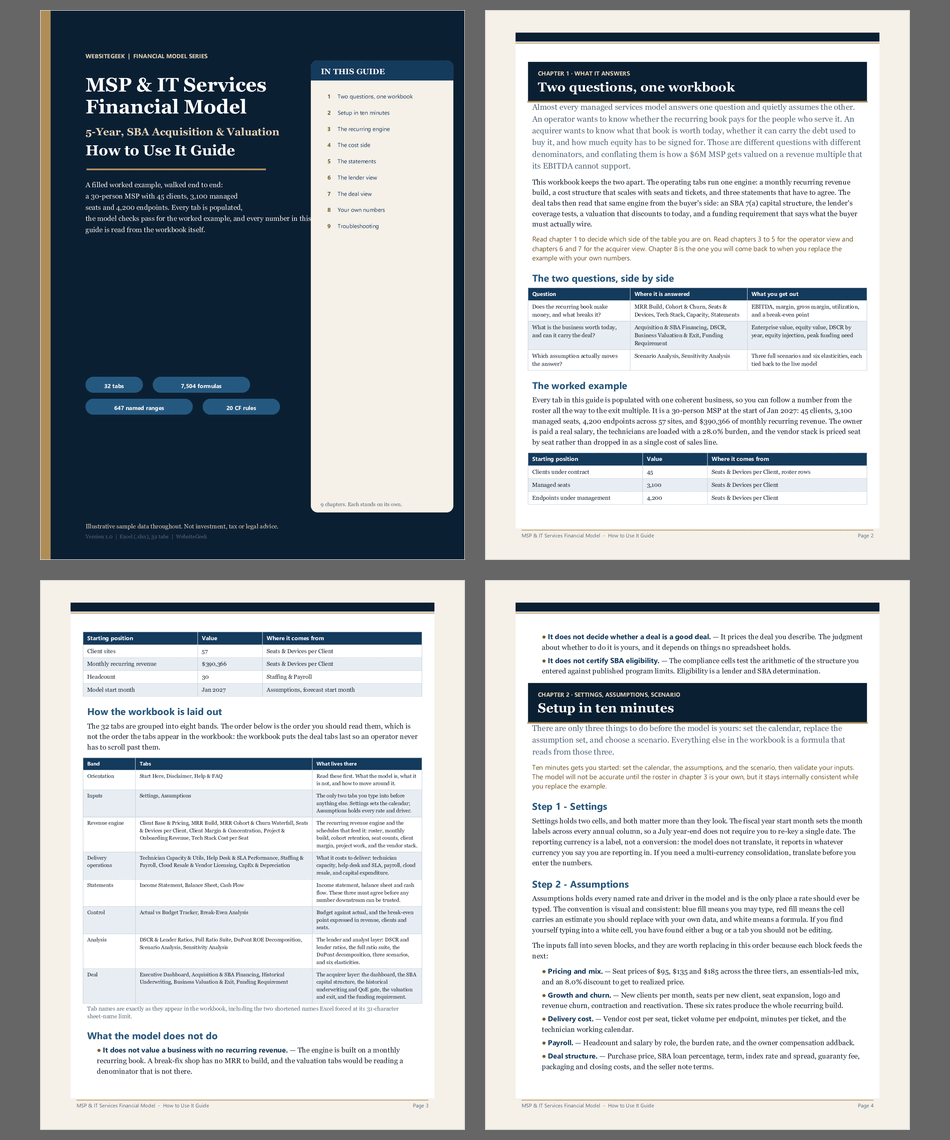
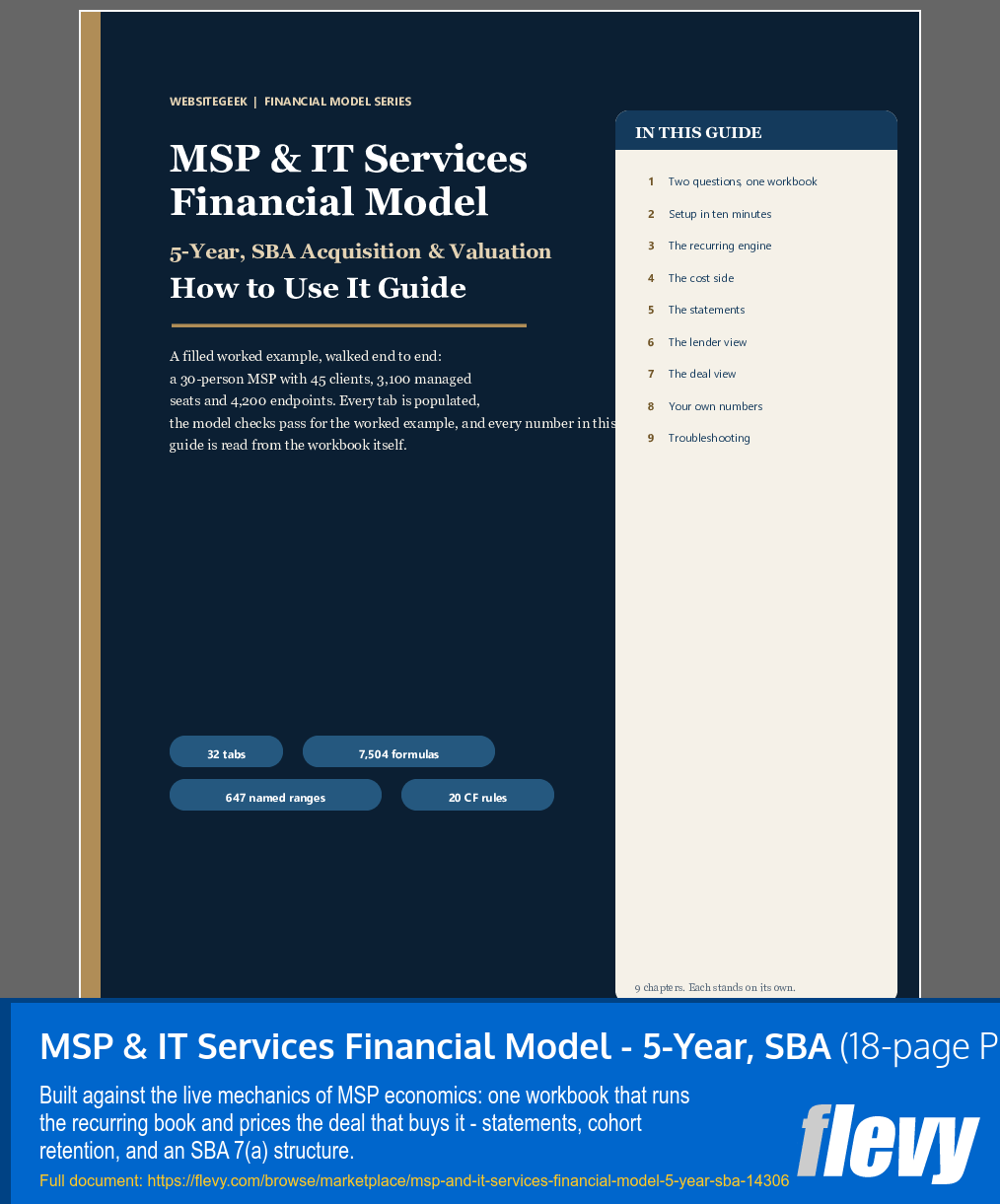
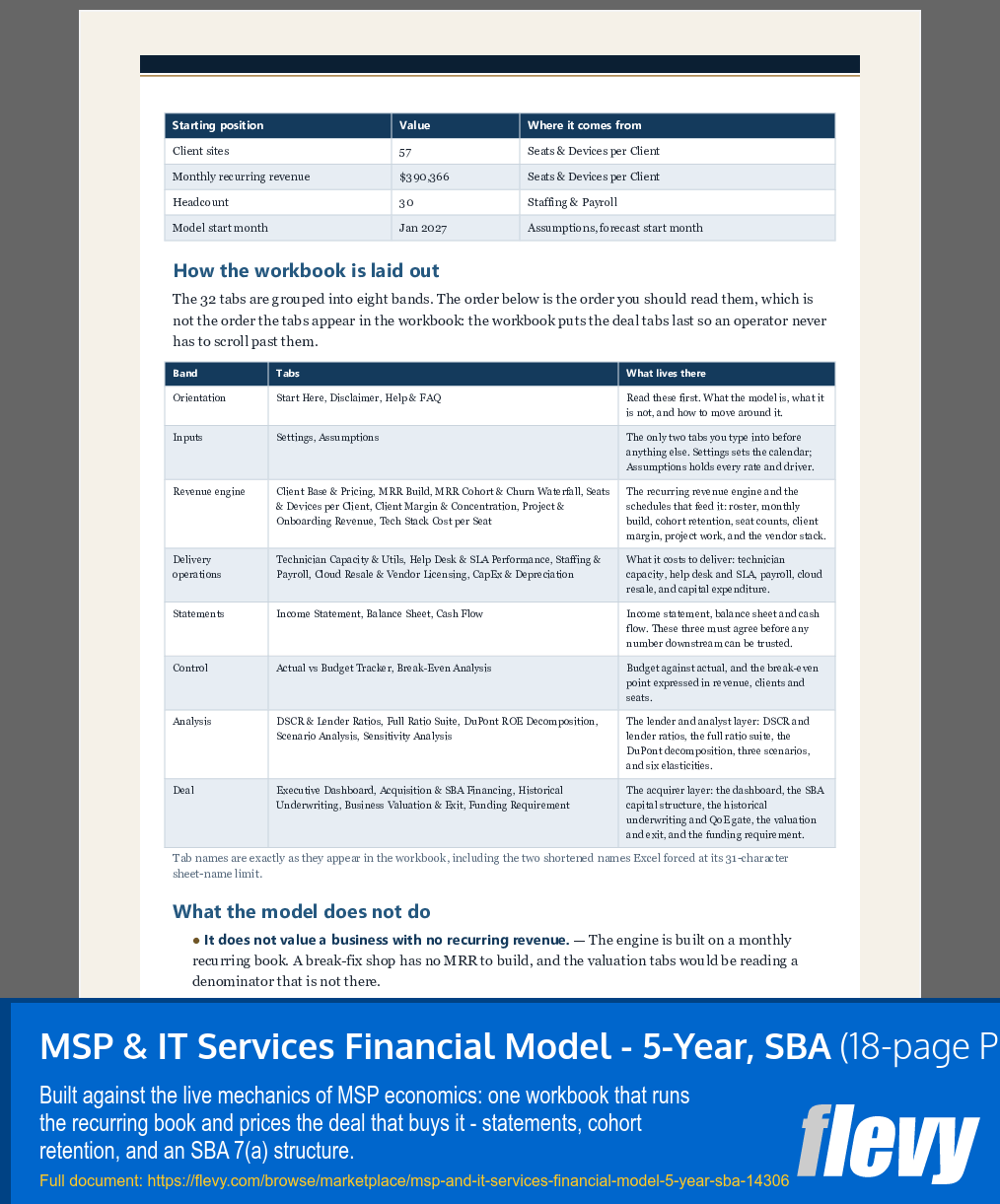
What you get: 32 live tabs, 7,504 formulas, 647 named ranges, no macros and no add-ins, plus an 18-page How-To guide that walks the filled example end to end – a 30-person, 45-client MSP with 3,100 managed seats. The model checks pass for the example, and every number in the guide is read from the workbook, not typed.
Who it is for: MSP operators who want to know whether the book pays and what breaks it; acquirers and search funds pricing an MSP; lenders and brokers who need the structure, not the pitch; consultants who advise both sides.
Educational material, not investment, tax or legal advice. The guaranty-fee tiers follow the FY2027 SBA Information Notice and are calculated on the guaranteed portion; the thresholds and rates are editable because SBA republishes the schedule each fiscal year. The Quality of Earnings report must be commissioned by the lender, and projected DSCR is not an eligibility test.
Got a question about the product? Email us at support@flevy.com or ask the author directly by using the "Ask the Author a Question" form. If you cannot view the preview above this document description, go here to view the large preview instead.
Source: Best Practices in Information Technology, Integrated Financial Model PDF: MSP & IT Services Financial Model - 5-Year, SBA PDF (PDF) Document, WebsiteGeek
ABOUT THE AUTHOR

We provide ready-to-use digital tools and business solutions for small businesses, entrepreneurs, and professionals to improve business performance, manage finances, streamline operations, and simplify compliance -- saving your time and effort.
Ask the Author a Question
You must be logged in to contact the author.