 Click main image to view in full screen.
Liquor Store Acquisition and SBA Underwriting Model – Excel XLSX
Excel (XLSX) + supplemental PDF


BENEFITS OF THIS DOWNLOADABLE EXCEL DOCUMENT
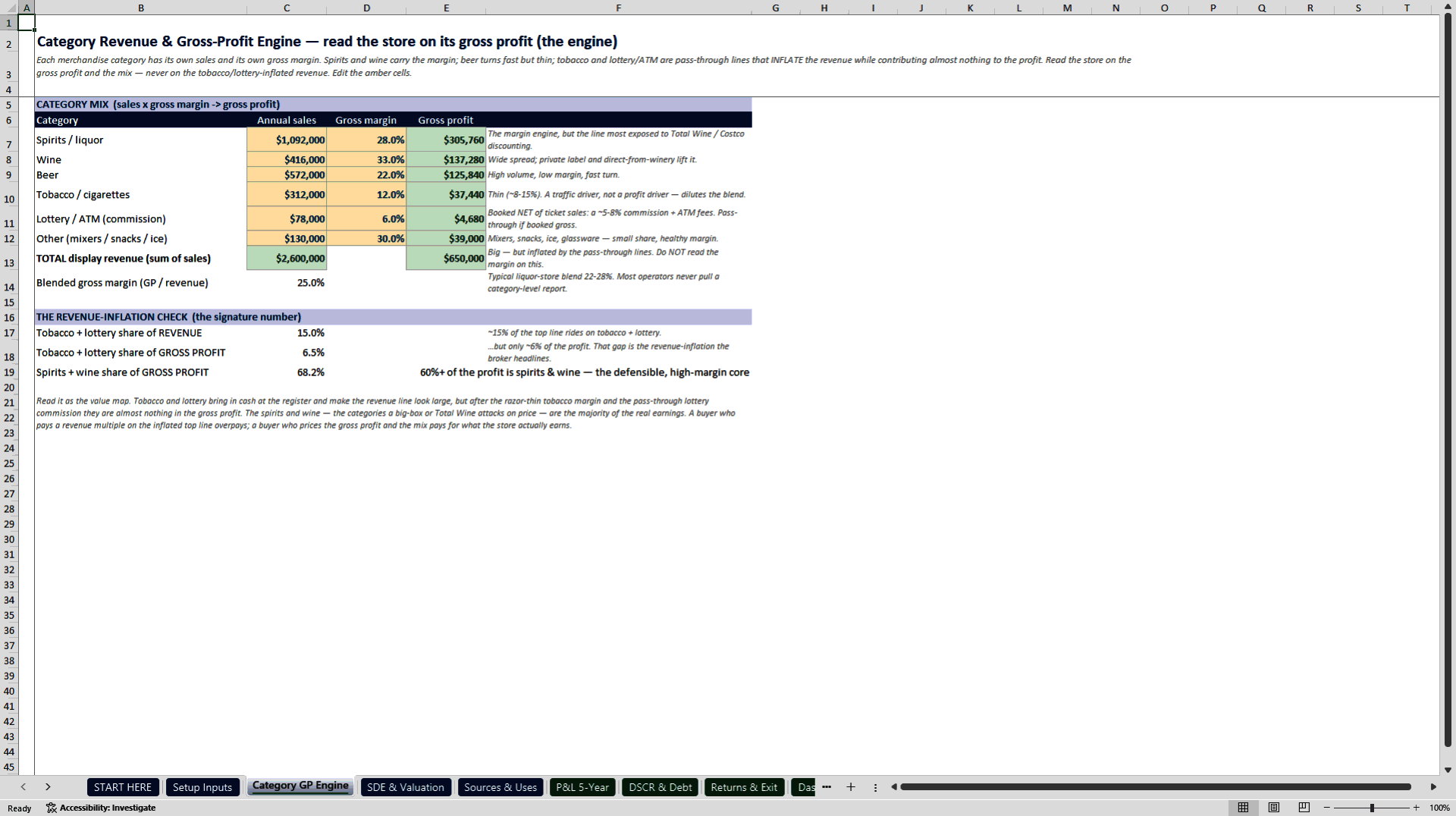
- Gross profit is built category by category at its own margin, so you can see that spirits and wine carry about 68% of the profit while tobacco and lottery inflate the revenue line without moving it.
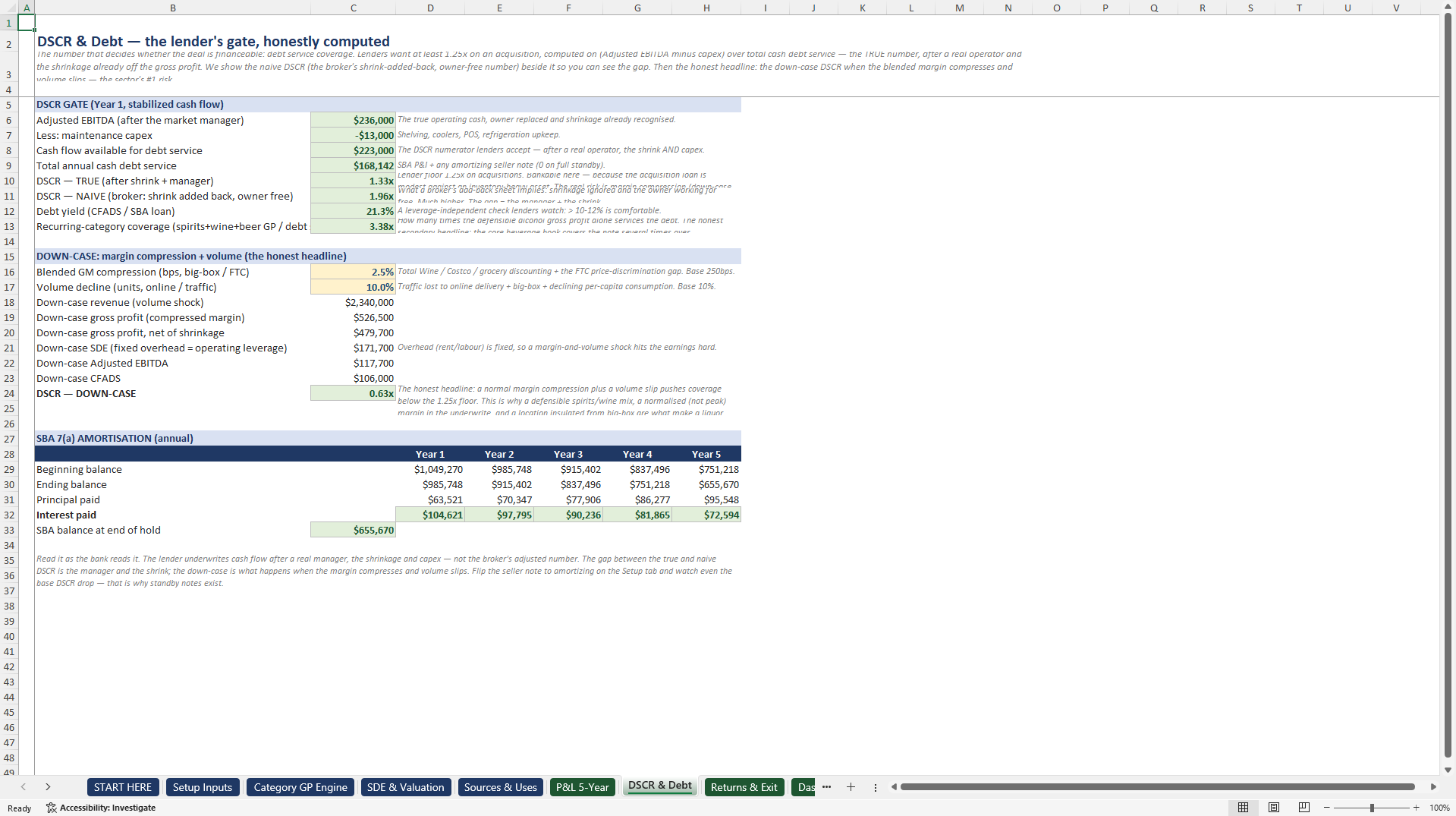
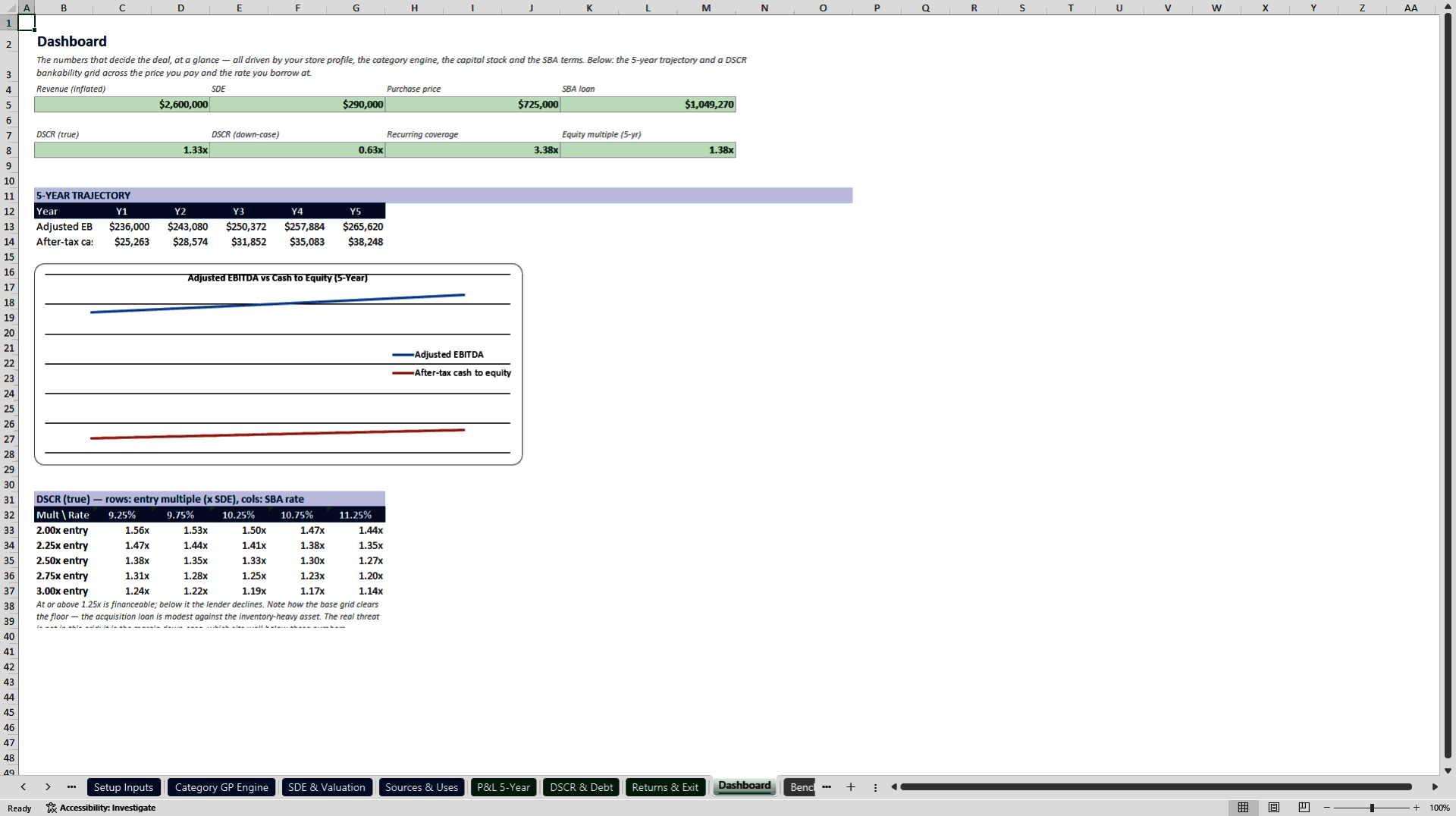
- The true DSCR of 1.33x is printed next to the naive broker-style 1.96x, and the gap is exactly the market-rate manager who replaces the owner behind the counter plus the 2% shrinkage line.
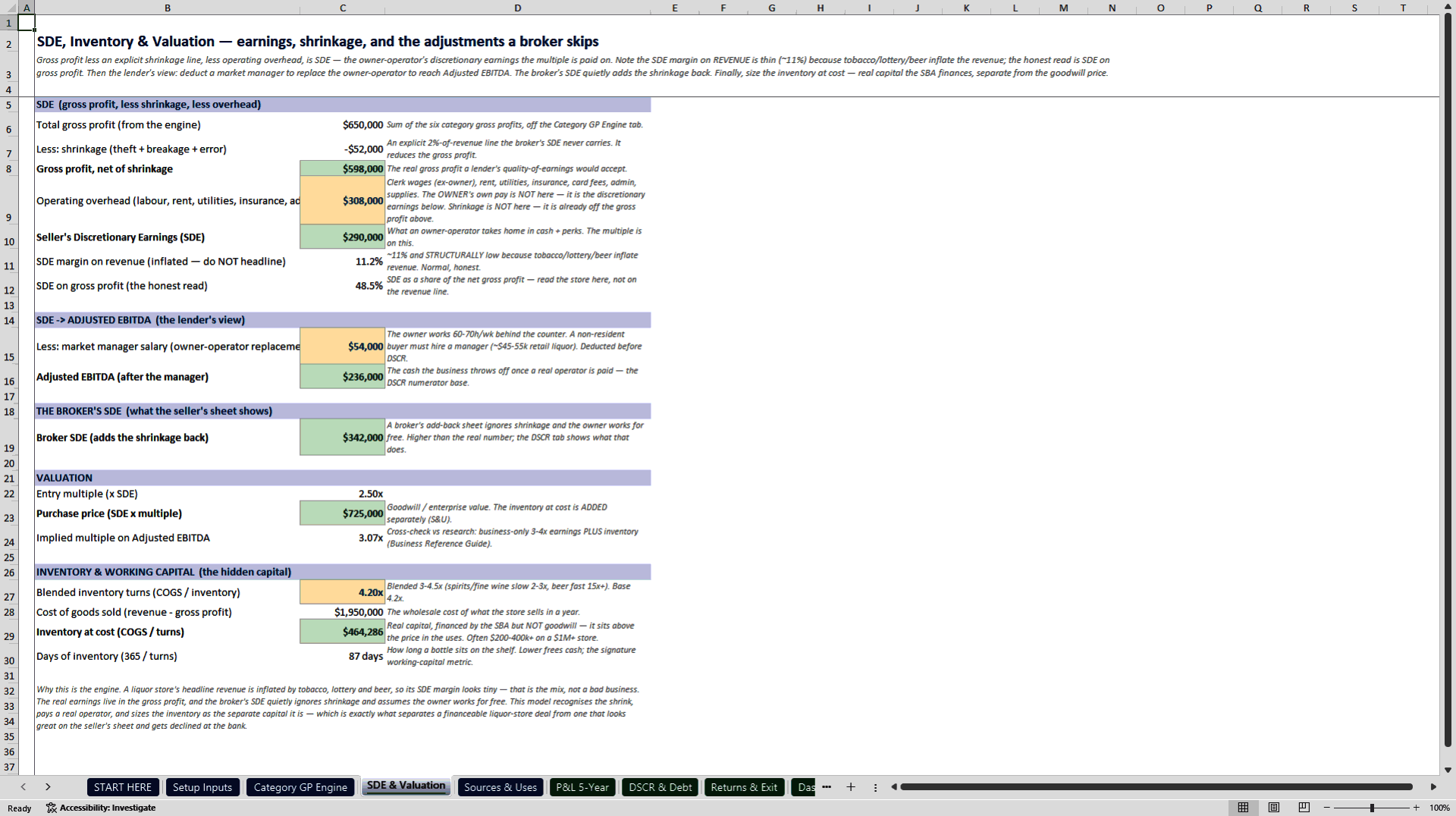
- Inventory is sized from your turns and carried at cost in Sources and Uses (about $464,000 at 87 days), so the capital you fund on top of the goodwill price is visible before you sign.
INTEGRATED FINANCIAL MODEL EXCEL DESCRIPTION
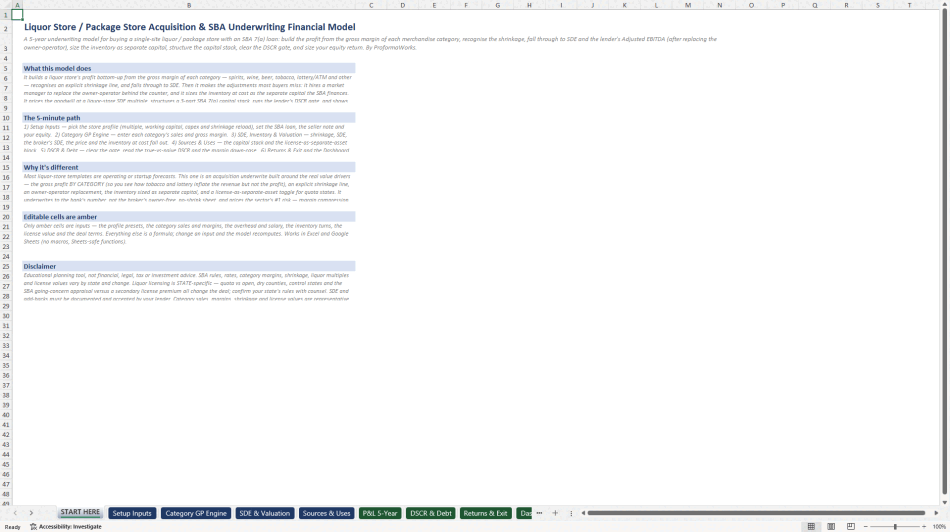
This is an acquisition underwrite for a buyer purchasing a single-site liquor or package store with an SBA 7(a) loan, and for the lender who has to approve it. Most liquor-store templates are startup or operating forecasts; this one prices a deal.
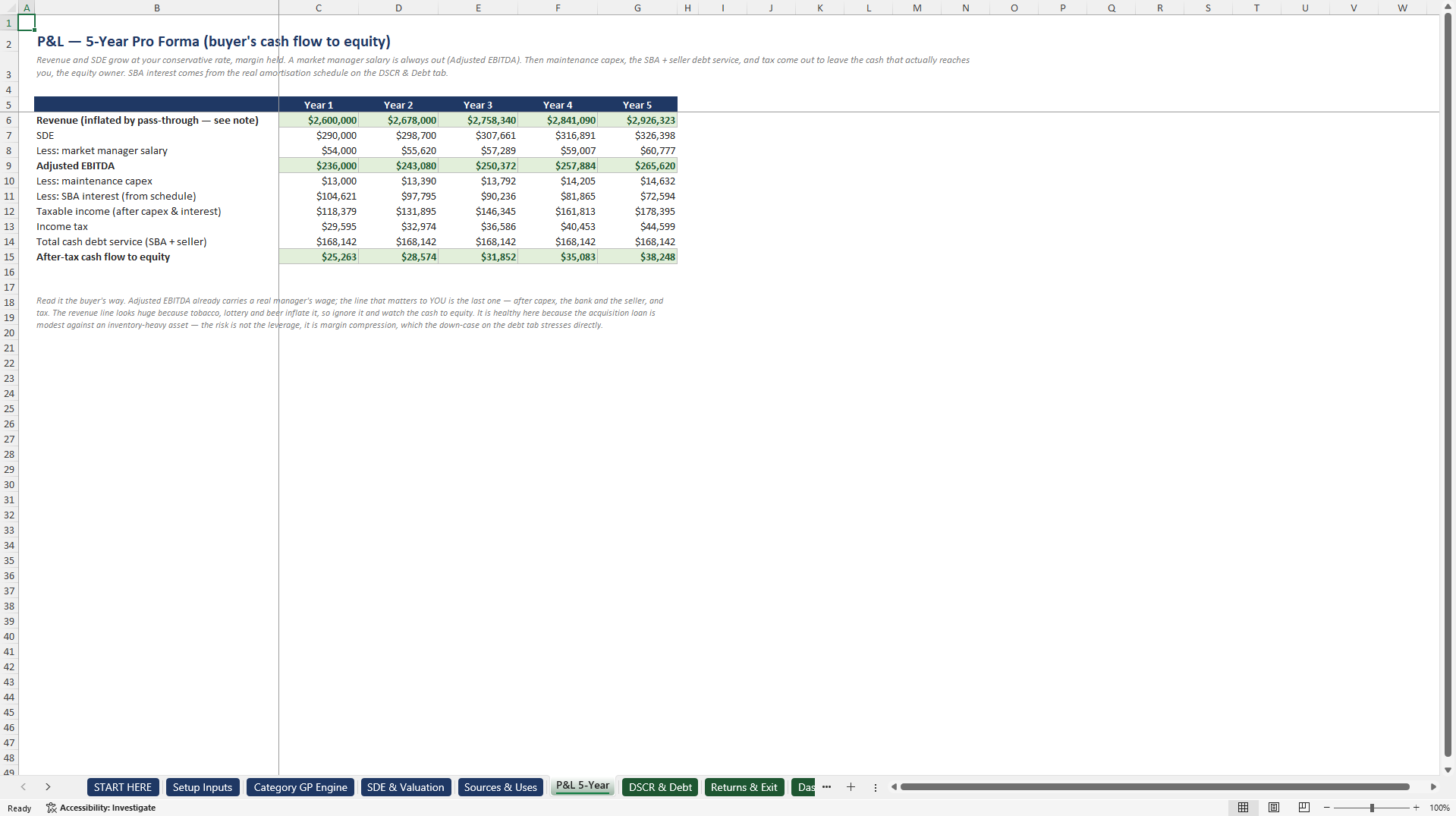
The valuation error it intercepts is the headline revenue number. A package store's revenue is inflated: tobacco runs about 12% of sales at a razor-thin margin, and lottery and ATM income is pass-through commission. Together they are roughly 15% of the revenue and only about 6.5% of the gross profit. Pay a multiple on that revenue and you overpay for dollars that never reach the bottom line.
The engine builds gross profit bottom-up by category: spirits, wine, beer, tobacco, lottery and ATM, and other, each carried at its own gross margin, blending to about 25% on a $2.6M store. You can see where the money is, since spirits and wine make up roughly 68% of the gross profit. The model then recognises shrinkage at 2% of revenue (theft, breakage, receiving errors) as an explicit line, hires a market-rate manager to replace an owner who works 60 to 70 hours a week behind the counter, and prices the deal on the SDE that survives both. The result is a true DSCR of 1.33x printed next to the naive broker-style DSCR of 1.96x. The gap is the manager and the shrink.
Inventory is treated as capital, not a rounding error: about $464,000 at roughly 87 days on the base case, sized from your inventory turns and carried at cost in Sources and Uses on top of the goodwill price. A licence toggle covers open and administration states, where the licence is worth $0, and quota states, where a transferable licence can be worth $250,000 to $1,000,000 or more, with the appraisal-versus-price gap bridged by a seller note. The SBA 7(a) capital stack sizes buyer equity, the seller note (full-standby or amortizing, which is the main DSCR lever) and the loan that fills the rest, against the lender's coverage gate.
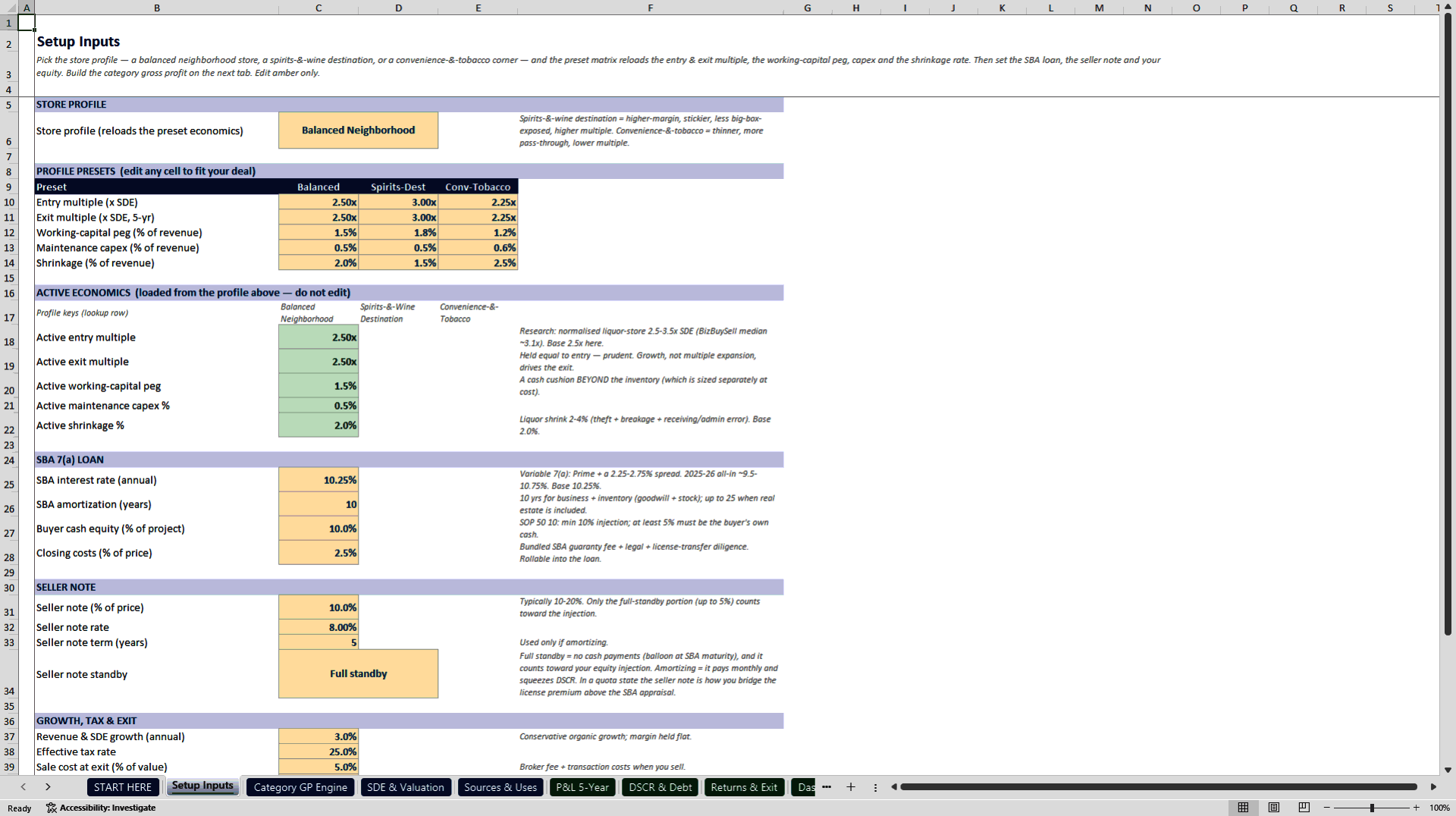
You get a 10-sheet Excel workbook in which every calculation is a formula, with no macros, plus a 20-plus page PDF guide and a benchmarks sheet with sourced ranges. Three store profiles, Balanced Neighborhood, Spirits and Wine Destination, and Convenience and Tobacco, reload the multiple, the working-capital peg, capex and shrink.
What the model does not claim: that the deal is safe. A combined 250 basis point gross-margin compression plus a 10% volume loss, the big-box, FTC 2024 price-discrimination and online-delivery down-case, drops DSCR to 0.63x, well under the 1.25x floor. No IRR is printed, deliberately, because on one small deal it is hostage to the exit multiple. Educational planning tool, not financial, legal, tax or investment advice.
Got a question about the product? Email us at support@flevy.com or ask the author directly by using the "Ask the Author a Question" form. If you cannot view the preview above this document description, go here to view the large preview instead.
Source: Best Practices in Integrated Financial Model Excel: Liquor Store Acquisition and SBA Underwriting Model Excel (XLSX) Spreadsheet, ProformaWorks
ABOUT THE AUTHOR
ProformaWorks builds acquisition-grade financial models for Main Street and lower-middle-market businesses - the kind of deal financed with an SBA 7(a) loan or a small commercial facility.
Every model answers one question: does this deal pencil at the bank? That means SDE or NOI rebuilt from the seller's own numbers, the add-backs a lender will and will not accept, a debt-service
... [read more]
Ask the Author a Question
You must be logged in to contact the author.




























