 Click main image to view in full screen.
Landscaping & Snow Removal Acquisition Underwriting Model – Excel XLSX
Excel (XLSX) + supplemental PDF


BENEFITS OF THIS DOWNLOADABLE EXCEL DOCUMENT
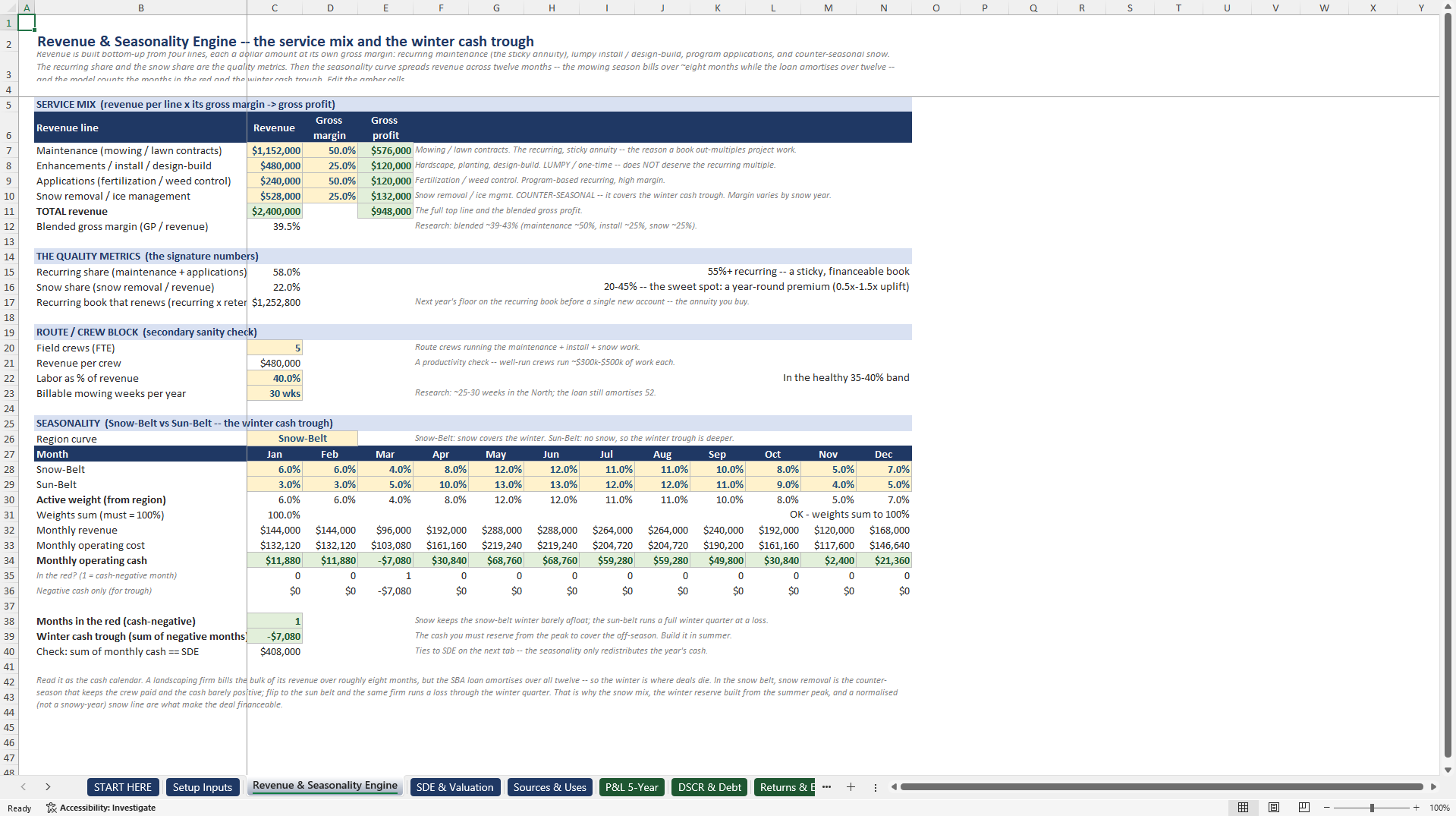
- Spreads four revenue lines, recurring maintenance, lumpy install, applications and snow, across a twelve-month curve and counts the months in the red, one in a snow belt and three in a sun belt.
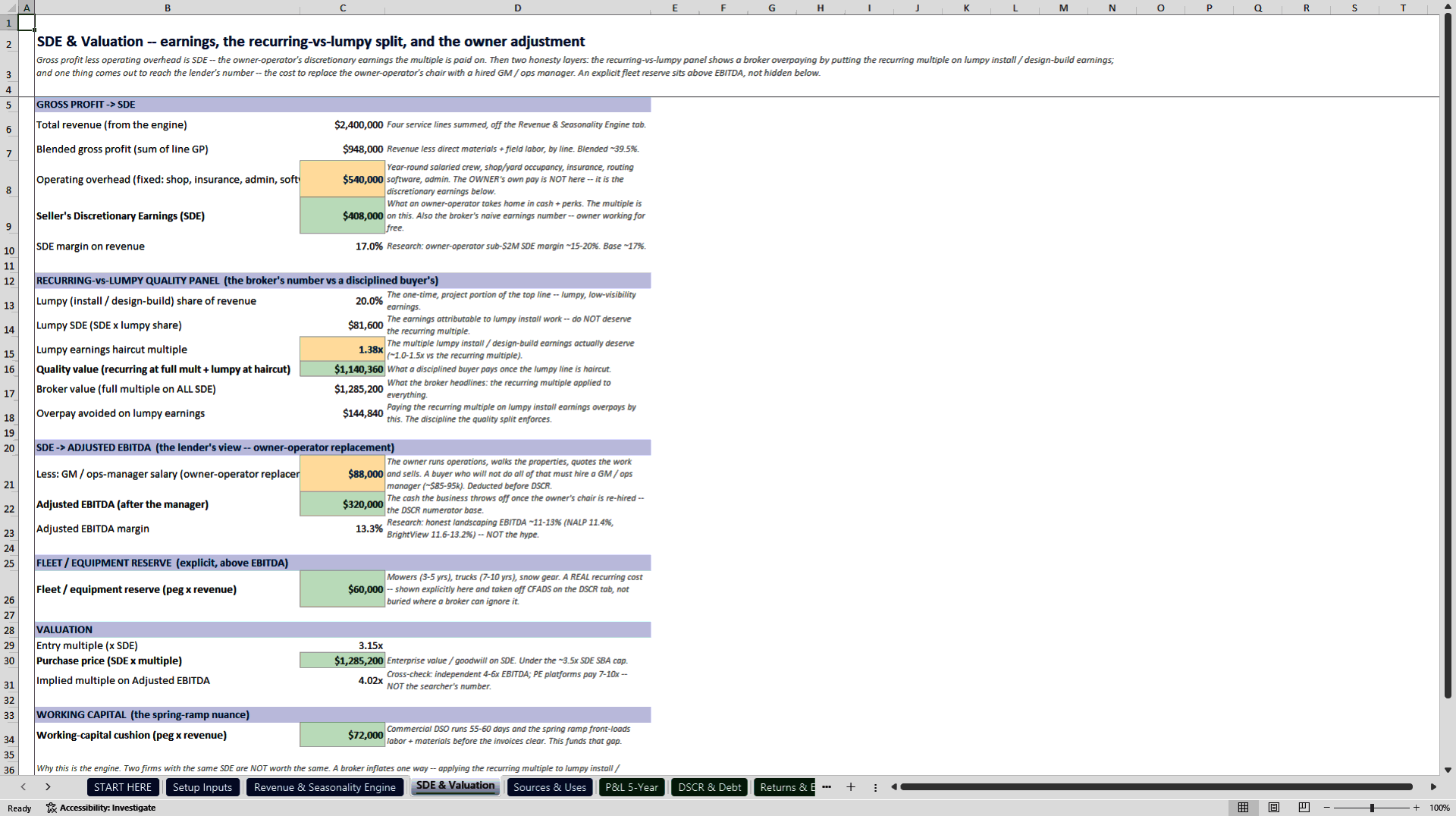
- Re-rates the lumpy install work so one-off jobs stop earning a recurring-maintenance multiple, surfacing $144,840 of overpay to negotiate out of the price.
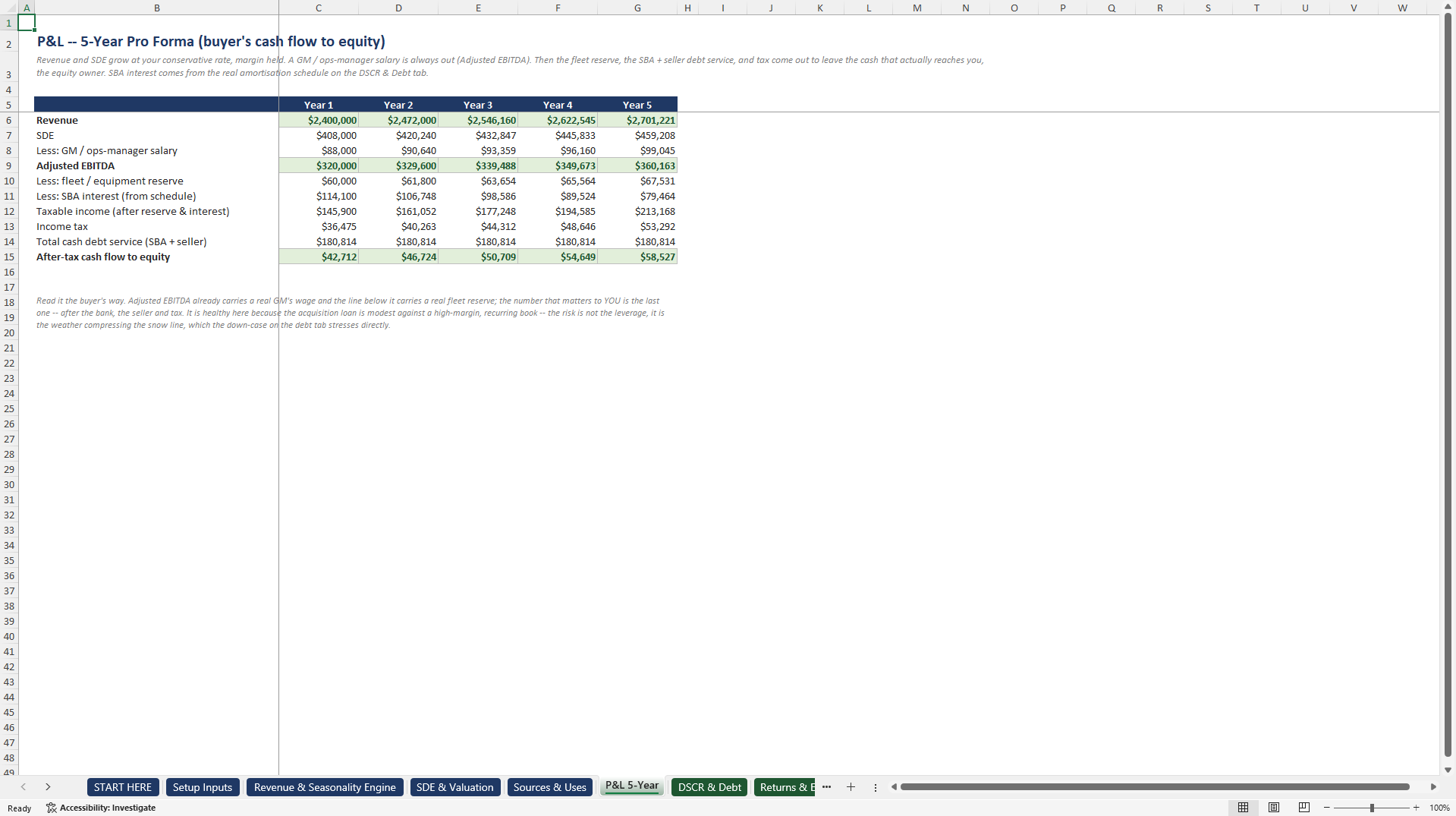
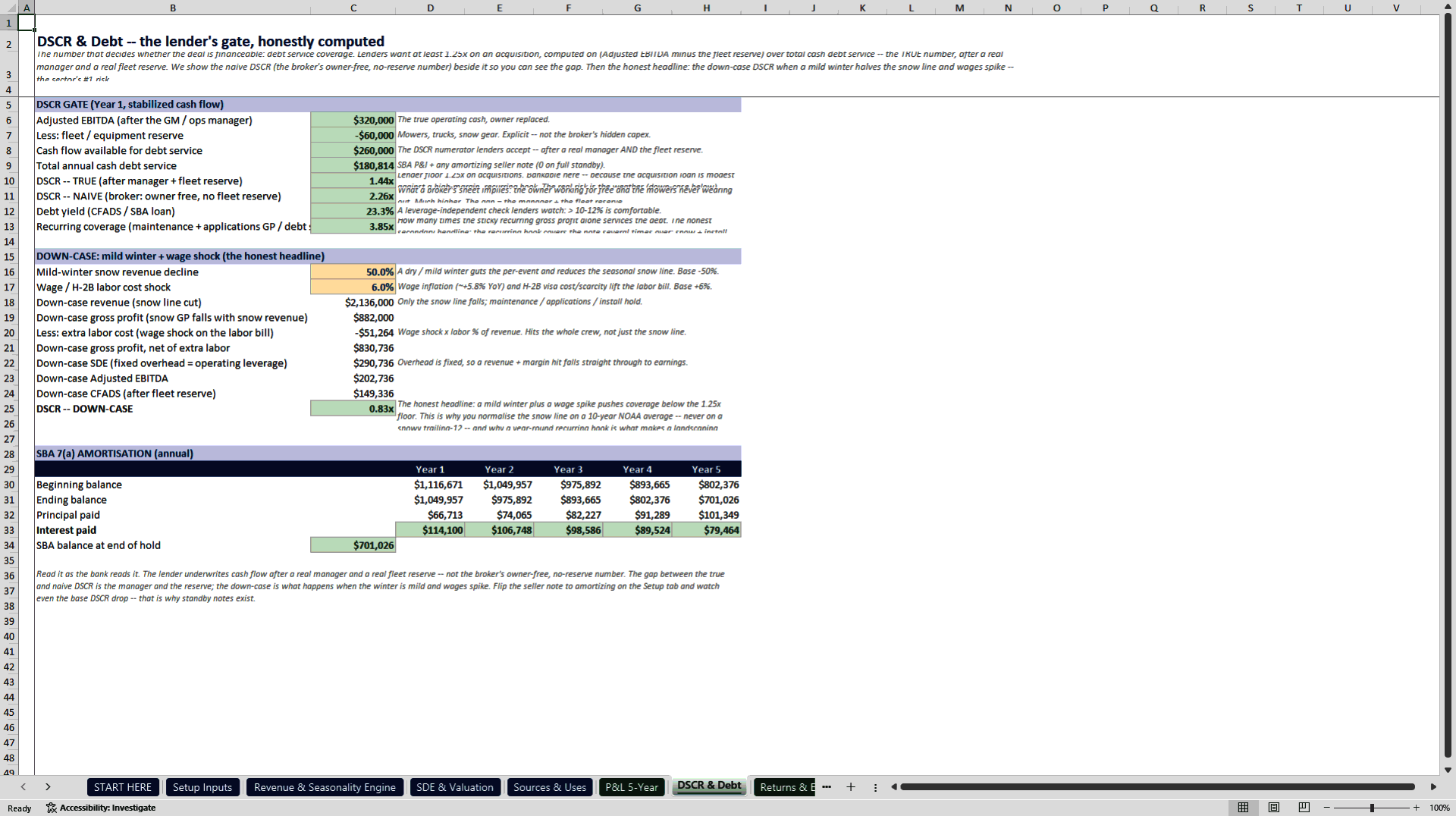
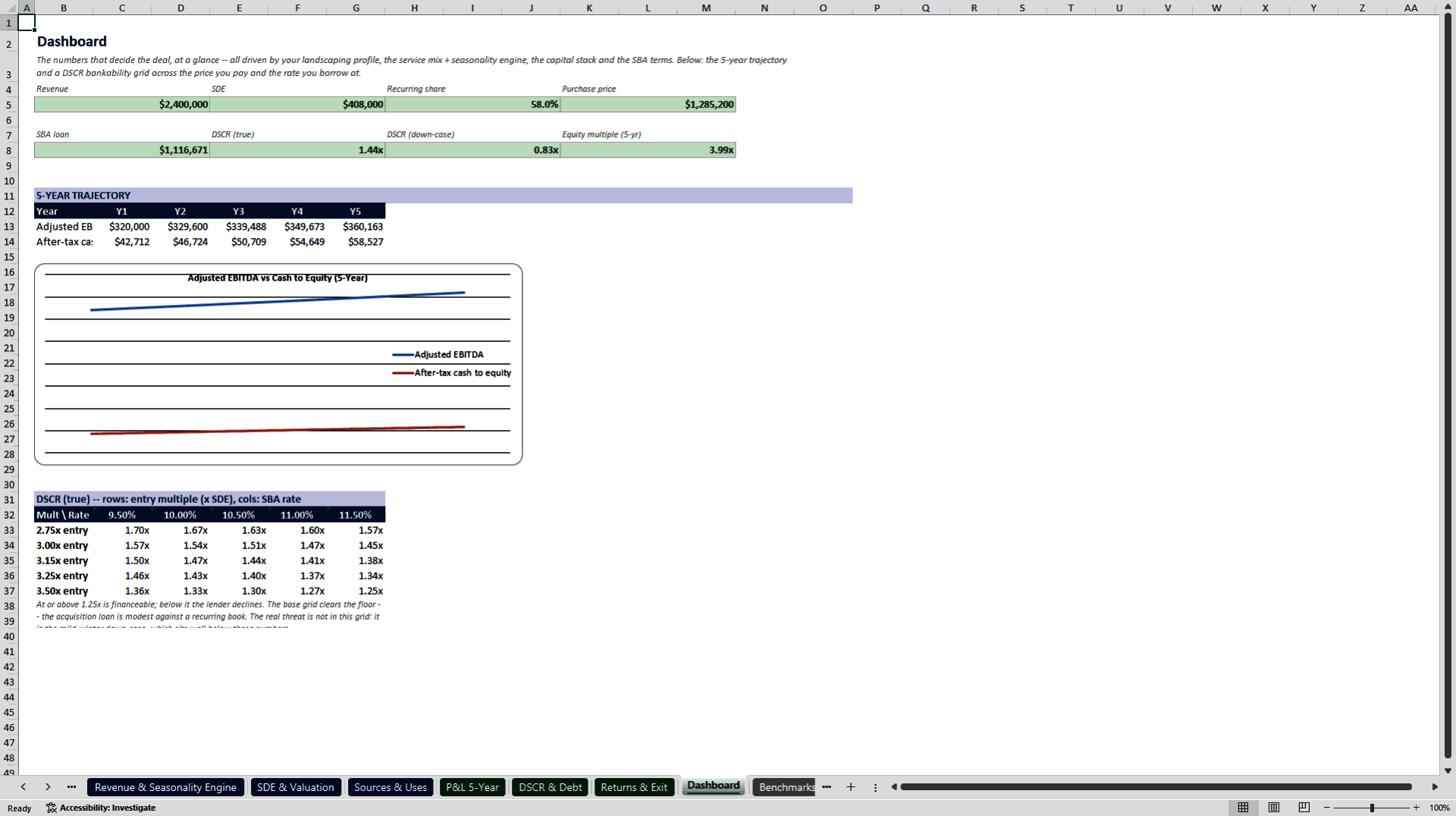
- Pays a real owner-operator and books an explicit $60,000 fleet reserve above the coverage line, giving a true DSCR of 1.44x against a naive 2.26x and a mild-winter down-case of 0.83x.
INTEGRATED FINANCIAL MODEL EXCEL DESCRIPTION
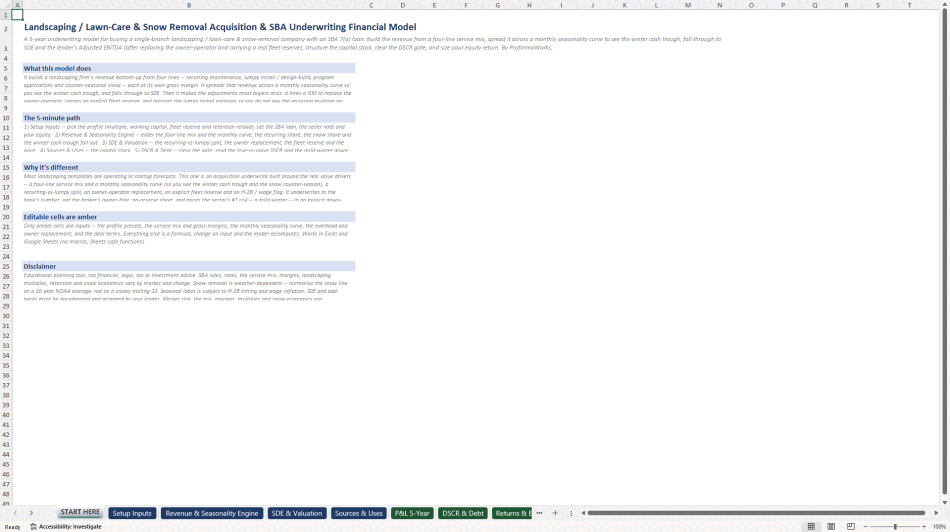
Most landscaping templates are startup or operating forecasts, and most brokers annualise the top line and headline a margin. But a landscaping and lawn-care firm bills in roughly eight warm months while its SBA loan amortises over all twelve, and the owner is usually a working crew leader rather than an absentee investor. This is a five-year, lender-ready model for buying a single-branch landscaping, lawn-care and snow-removal company with an SBA 7(a) loan.
The engine is a seasonal revenue curve combined with a service mix. Four revenue lines, recurring maintenance, lumpy install and design-build, applications, and snow, each carry their own gross margin and are spread across a twelve-month curve. On the base case the recurring share is about 58% and the snow share about 22%, inside the 20 to 45% band where snow genuinely carries the winter. Those two shares, not the annual top line, decide the deal.
Because the calendar is modelled rather than averaged, the model counts the months in the red: one in a snow belt, where snow barely covers winter fixed cost, and three in a sun belt, with a deeper trough of minus $40,200. A snow-belt versus sun-belt toggle flips the whole curve, so you can size the working-capital line to the real seasonality instead of to an annual average that never goes negative.
Three corrections separate it from a broker's sheet. A real owner-operator is paid to replace the owner who sells jobs and runs a crew. An explicit fleet and equipment reserve of $60,000 a year is booked above the coverage line. And the lumpy install work is re-rated, because one-off jobs do not deserve a recurring-maintenance multiple: that carve-out surfaces $144,840 of overpay to negotiate out. The result is a true DSCR of 1.44x printed next to the naive broker DSCR of 2.26x.
The down-case is the sector's real risk. Snow revenue down 50% plus a wage shock drops coverage to 0.83x, below the 1.25x floor, because year-round staff, facility and fleet costs are fixed. Profitable in a normal year, under pressure when the snow does not come. The cushion is the recurring maintenance book, which covers debt service 3.85x.
Base case figures: revenue $2,400,000, gross profit $948,000 at 39.5%, SDE $408,000 at 17.0%, Adjusted EBITDA $320,000 at 13.3%, a purchase price of $1,285,200 at 3.15x SDE and 4.02x Adjusted EBITDA, an SBA loan of $1,116,670 at 80.4% leverage, cash-on-cash of 20.5% in year one and a five-year equity multiple of 3.99x.
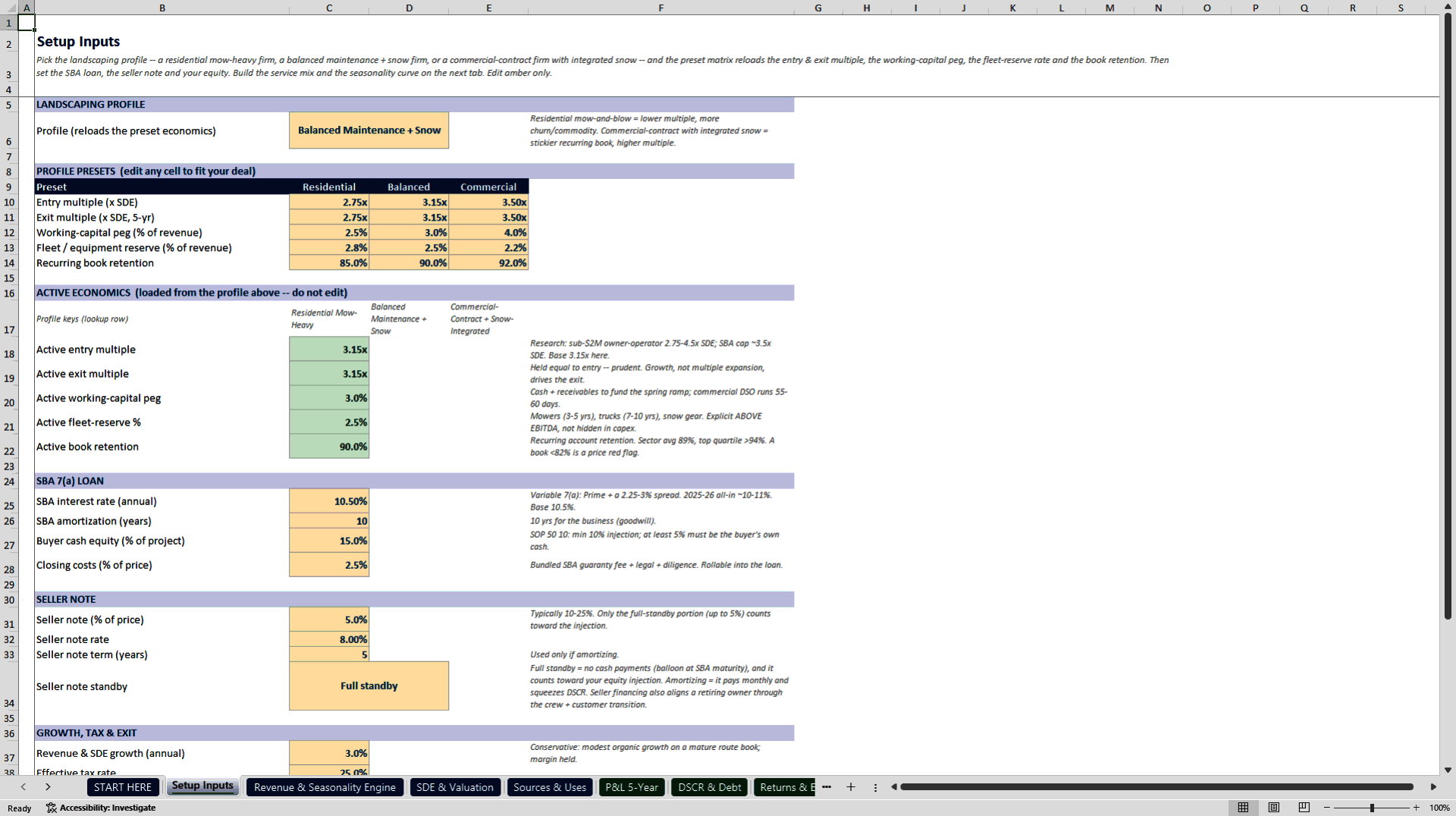
Ten sheets, every calculation a formula, Google Sheets safe and no macros, with a PDF user guide of more than twenty pages and a benchmarks sheet of sourced ranges. Three firm profiles, residential mow-heavy, balanced maintenance plus snow, and commercial-contract with snow integrated, reload the multiple, the working-capital peg, the fleet-reserve rate and book retention. No IRR is printed, deliberately, because single-deal timing is too fragile. Educational planning tool, not financial, legal, tax or investment advice.
Got a question about the product? Email us at support@flevy.com or ask the author directly by using the "Ask the Author a Question" form. If you cannot view the preview above this document description, go here to view the large preview instead.
Source: Best Practices in Integrated Financial Model Excel: Landscaping & Snow Removal Acquisition Underwriting Model Excel (XLSX) Spreadsheet, ProformaWorks
ABOUT THE AUTHOR

ProformaWorks builds acquisition-grade financial models for Main Street and lower-middle-market businesses - the kind of deal financed with an SBA 7(a) loan or a small commercial facility.
Every model answers one question: does this deal pencil at the bank? That means SDE or NOI rebuilt from the seller's own numbers, the add-backs a lender will and will not accept, a debt-service
... [read more]
Ask the Author a Question
You must be logged in to contact the author.




























