
 Click main image to view in full screen. Unlock all 15 preview images:
Journal Entry Testing & Fraud Analytics Excel Model Dashboard – Excel XLSX
Excel (XLSX) + supplemental PDF


BENEFITS OF THIS DOWNLOADABLE EXCEL DOCUMENT
- Converts a raw journal-entry population into a traceable audit workflow covering completeness, risk prioritization, sample selection, testing documentation, exceptions, and reviewer conclusions.
- Provides transparent, editable fraud-risk rules and scenario sensitivity across manual journals, timing, users, accounts, amounts, duplicates, reversals, related-party indicators, and Benford screening.
- Improves repeatability and reviewability with formula-driven integrity checks, reproducible sampling, workpaper sign-off fields, exception aging, and an executive decision dashboard.
AUDIT MANAGEMENT EXCEL DESCRIPTION
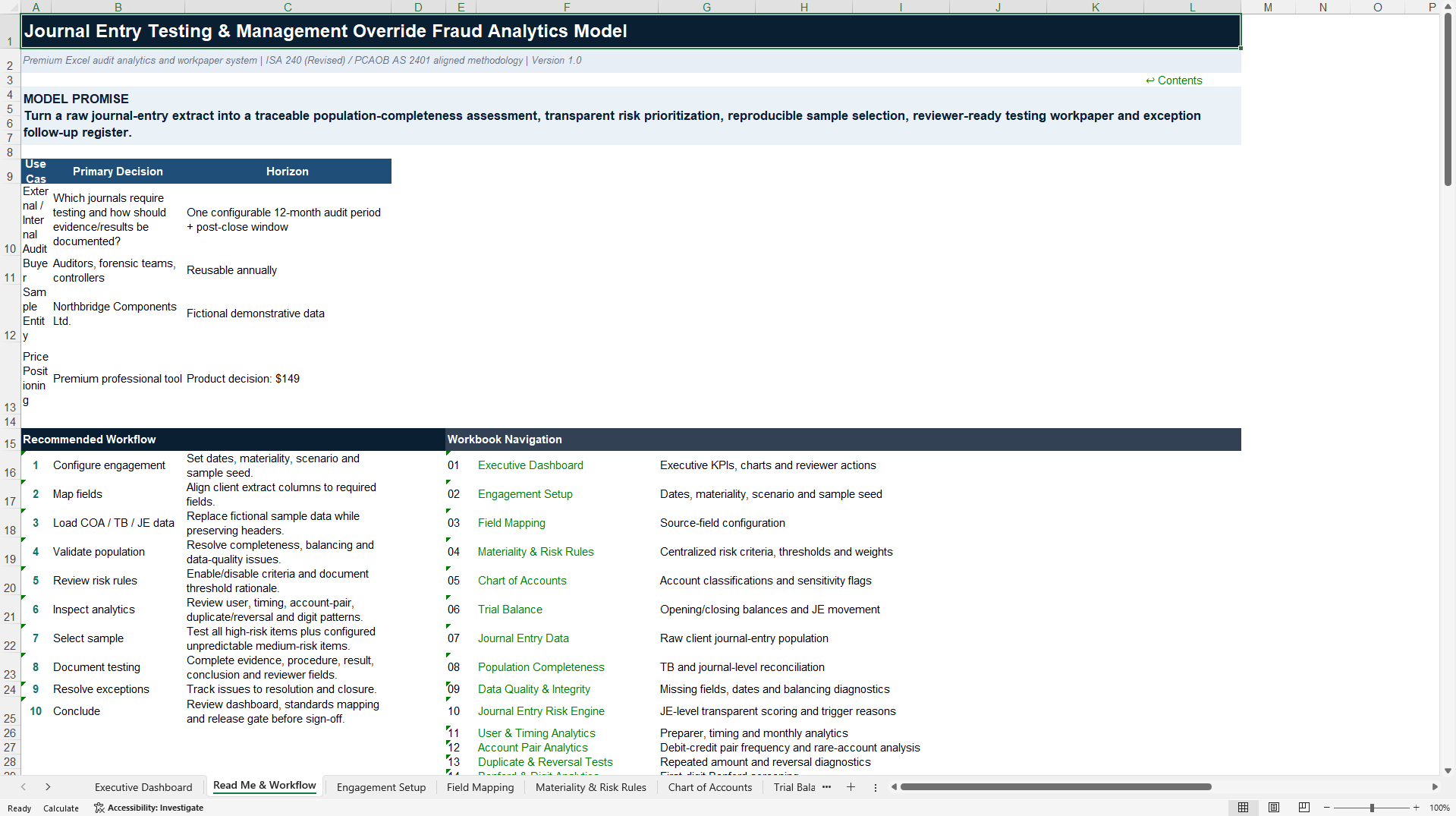
Journal Entry Testing & Fraud Analytics Excel Model is a fully editable audit analytics workbook designed to organize journal-entry testing from source population through reviewer conclusion. It is built for external audit, internal audit, forensic accounting, audit consulting, and controllership teams that need a transparent Excel workflow for management-override and journal-entry procedures.
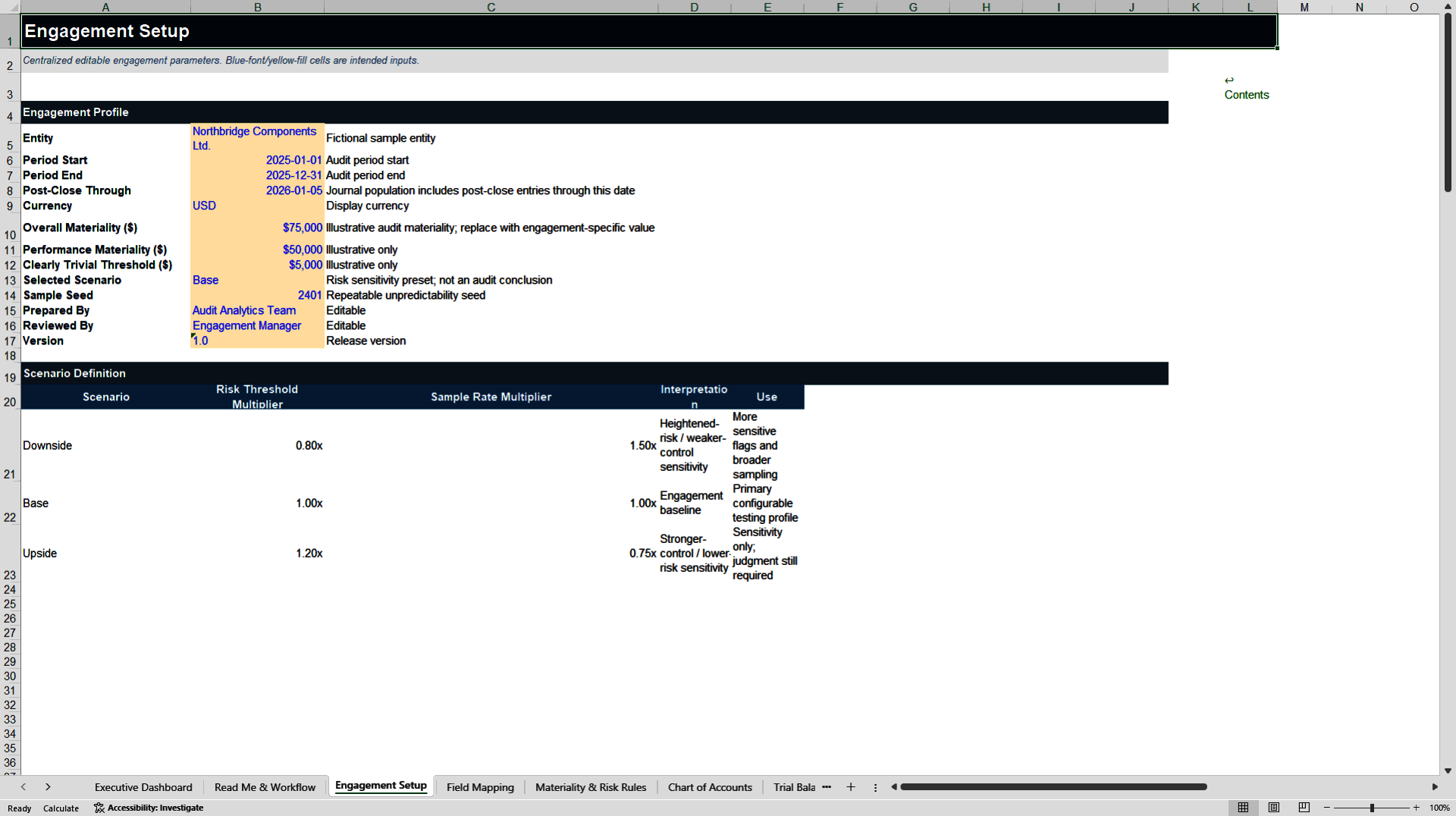
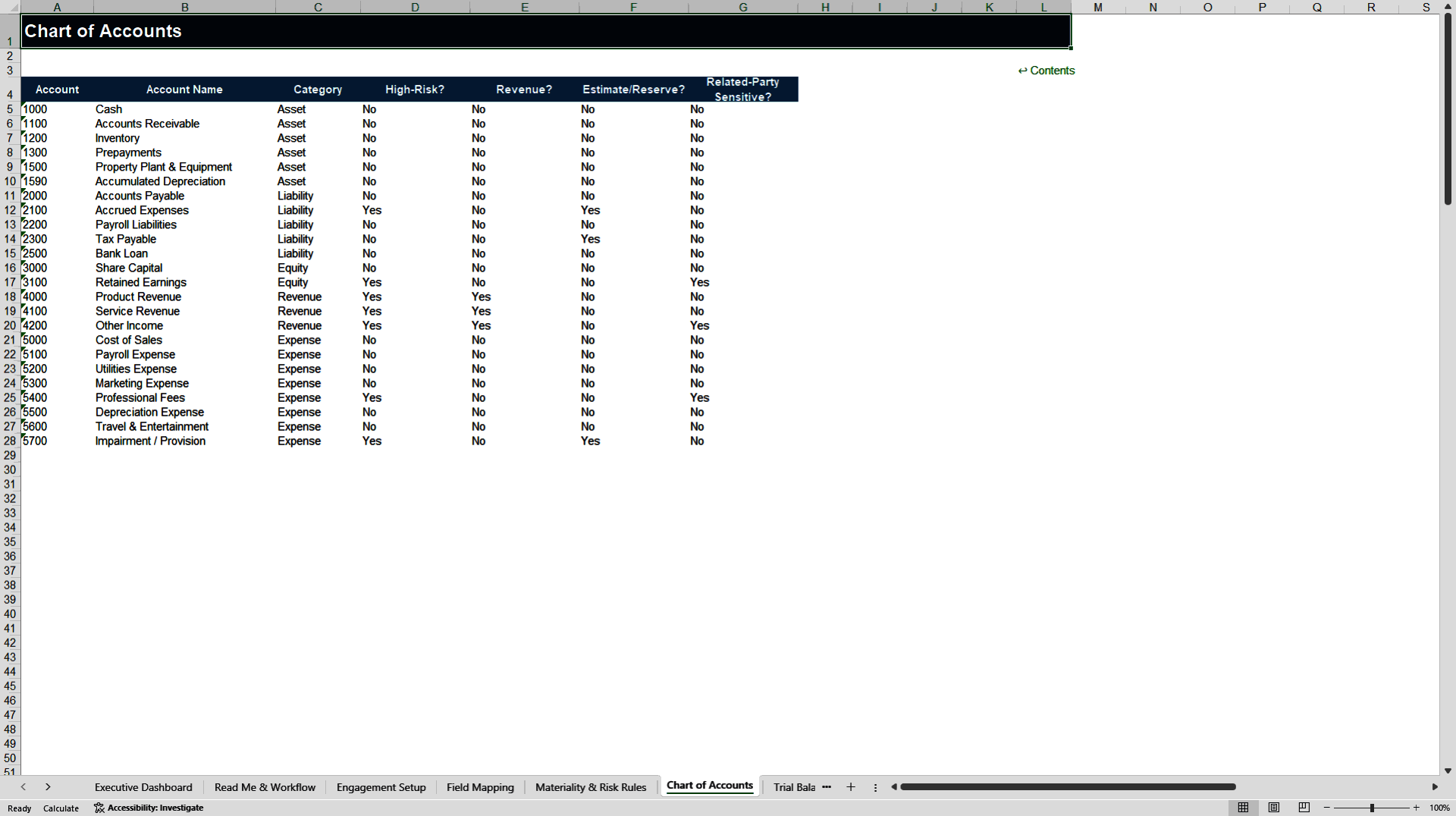
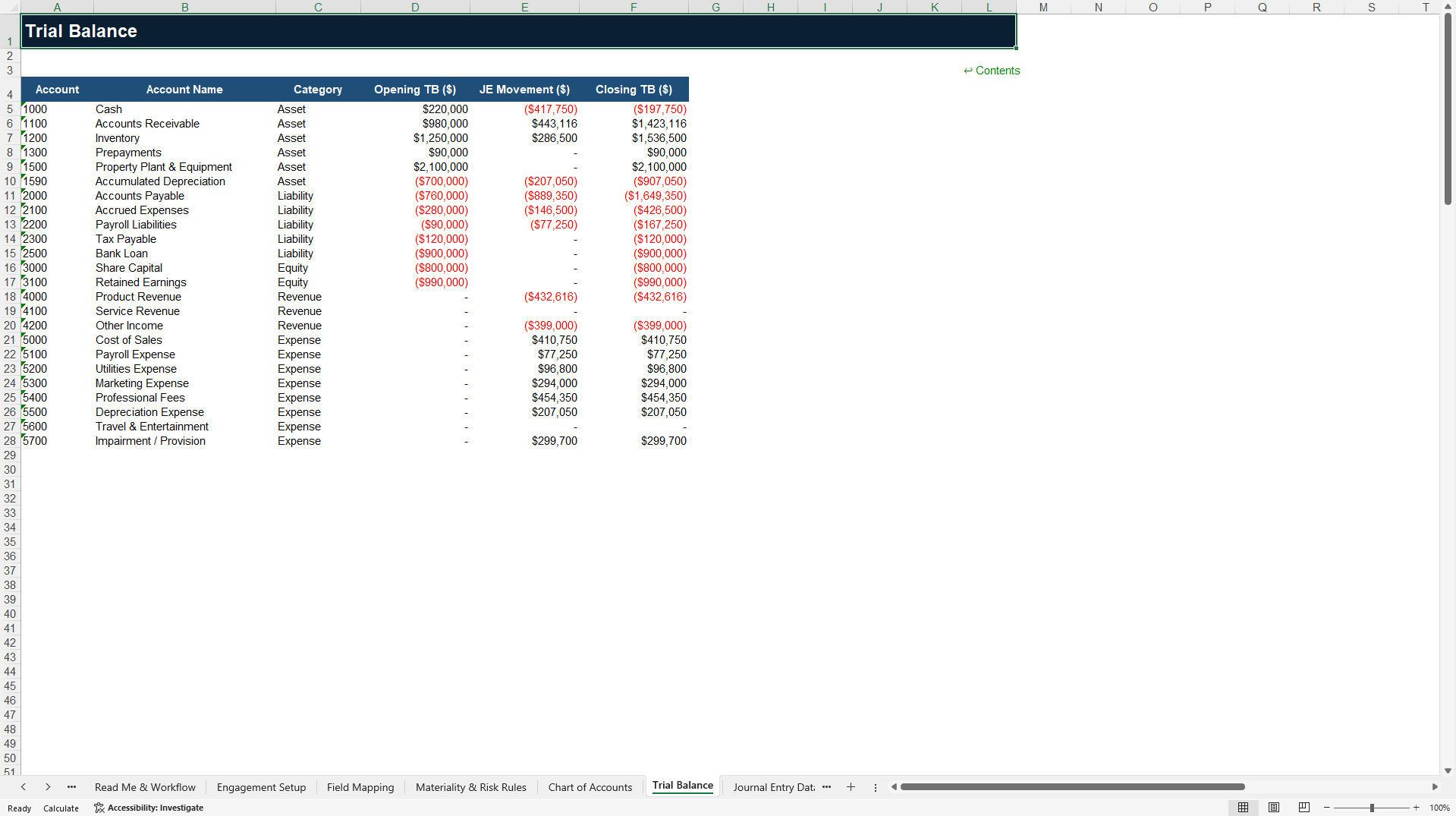
The model starts with engagement setup, including audit period, post-close window, reporting currency, materiality levels, selected risk scenario, a repeatable sample seed, and preparer/reviewer fields. A source-system-neutral field-mapping sheet helps users align a client journal extract to the required model structure. Separate Chart of Accounts, Trial Balance, and Journal Entry Data sheets provide the core data foundation.
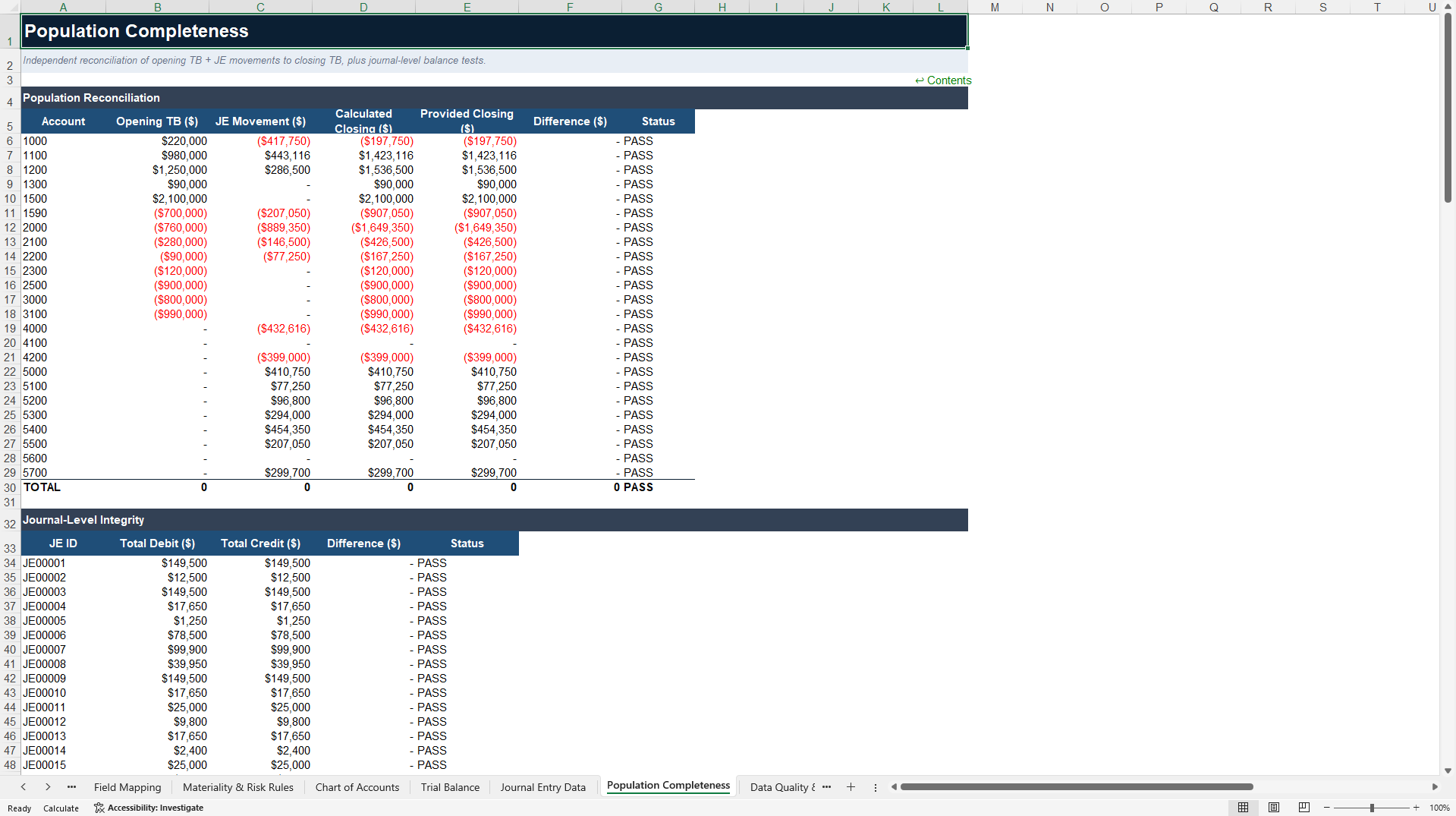
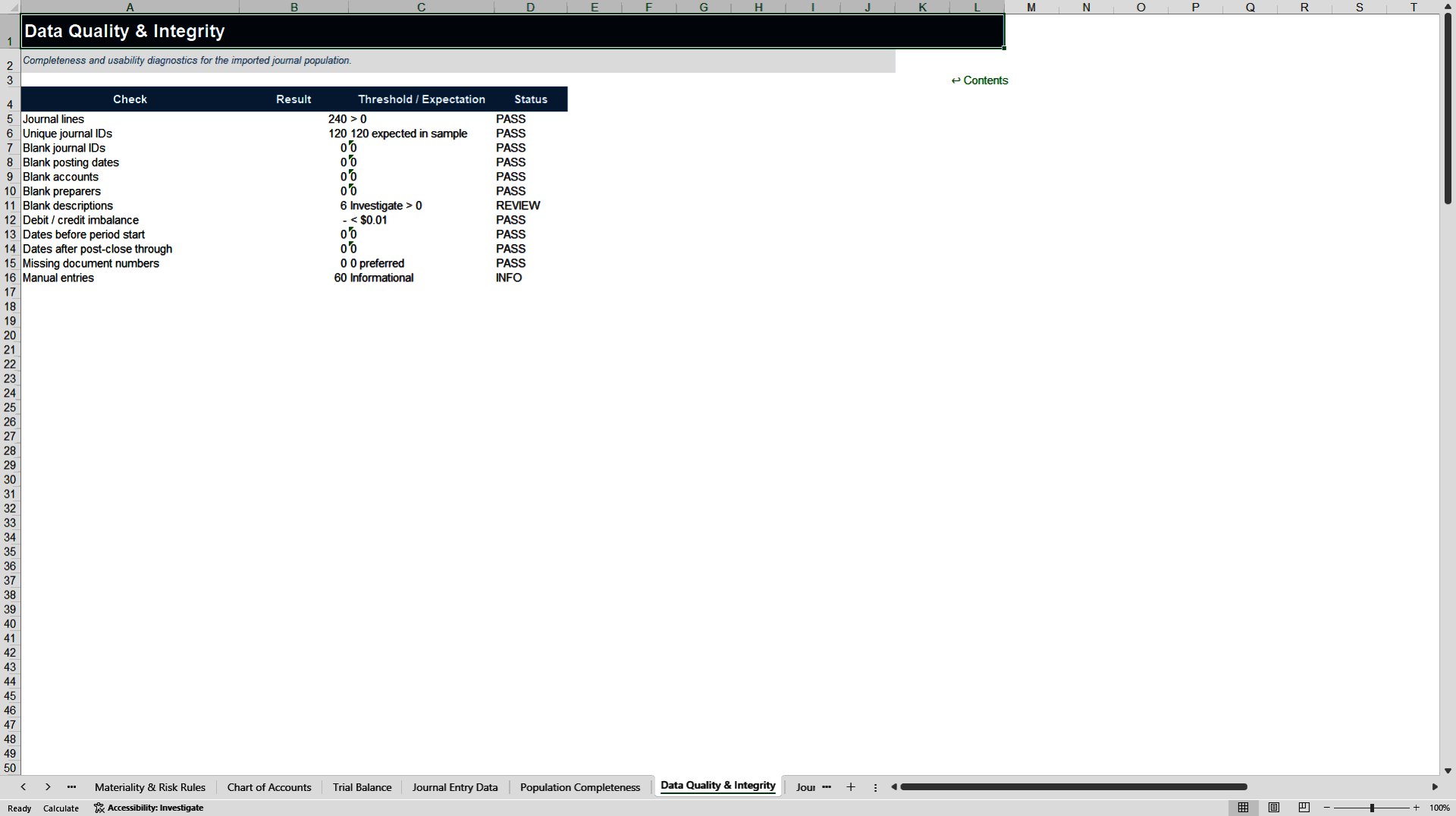
Population Completeness reconciles opening trial balance plus journal movement to closing trial balance and tests individual journals for debit/credit balance. Data Quality & Integrity then identifies missing IDs, missing dates, missing accounts, date-bound issues, and other reliability problems before the analytics are used.
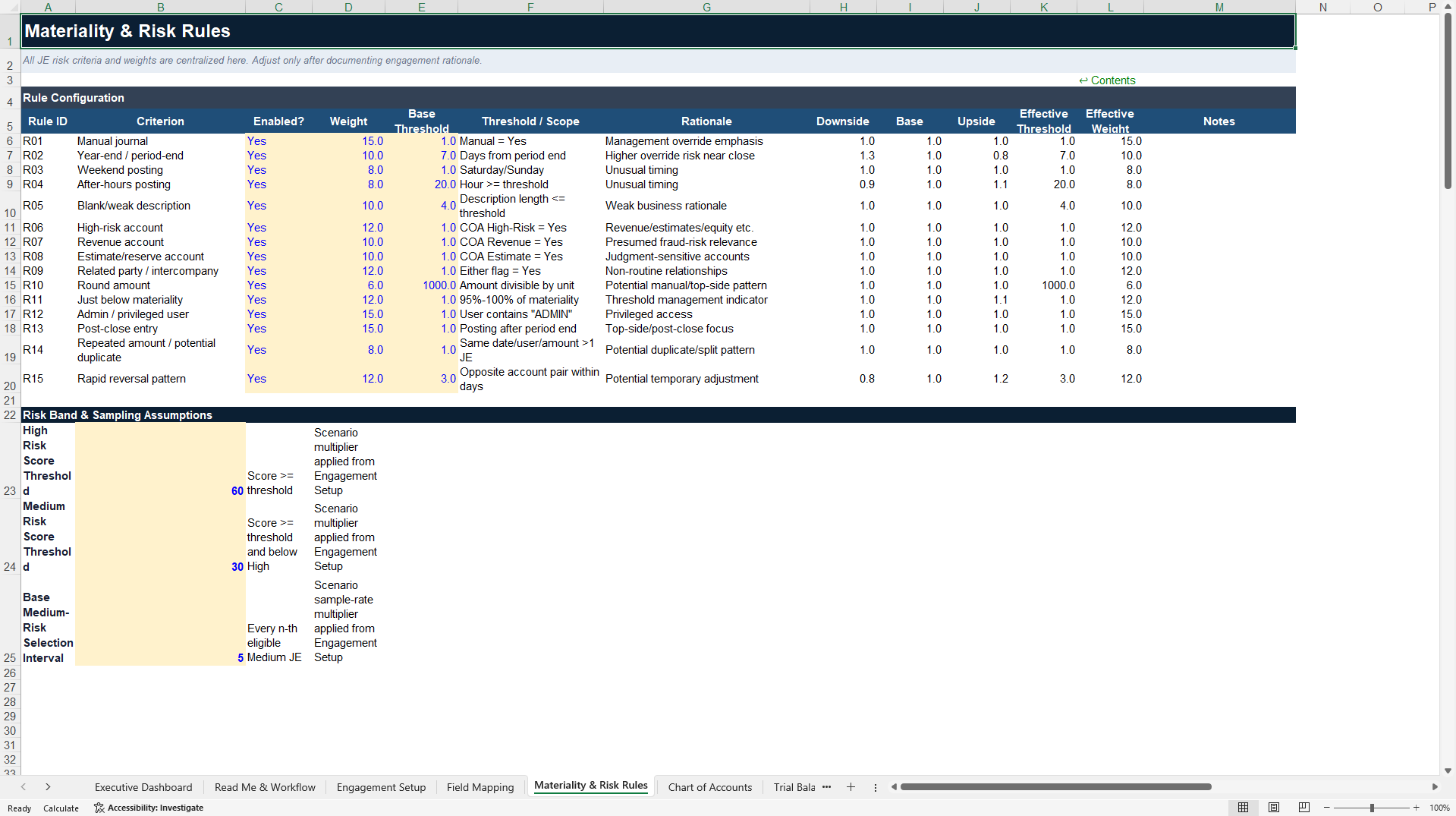
The Journal Entry Risk Engine applies 15 visible and configurable criteria. These include manual journals, period-end entries, weekend postings, after-hours postings, weak descriptions, high-risk accounts, revenue accounts, estimate or reserve accounts, related-party or intercompany activity, round amounts, amounts just below materiality, admin or privileged users, post-close entries, repeat amounts, and rapid reversals. Each journal shows its trigger flags, risk score, High/Medium/Low band, triggered-criteria narrative, selection status, testing status, and reviewer note area.
The workbook includes additional analytics for preparers and timing, monthly journal activity, debit-credit account pairs, duplicate and reversal patterns, and Benford first-digit screening. Sample Selection automatically includes High-risk journals and applies deterministic, repeatable Medium-risk selection using the configured seed and sample interval.
The JE Testing Workpaper provides fields for evidence references, management explanations, procedures performed, results, exception types, conclusions, preparer, reviewer, review date, and status. Exceptions & Follow-Up provides ownership, opened and due dates, aging, status, resolution, and reviewer tracking.
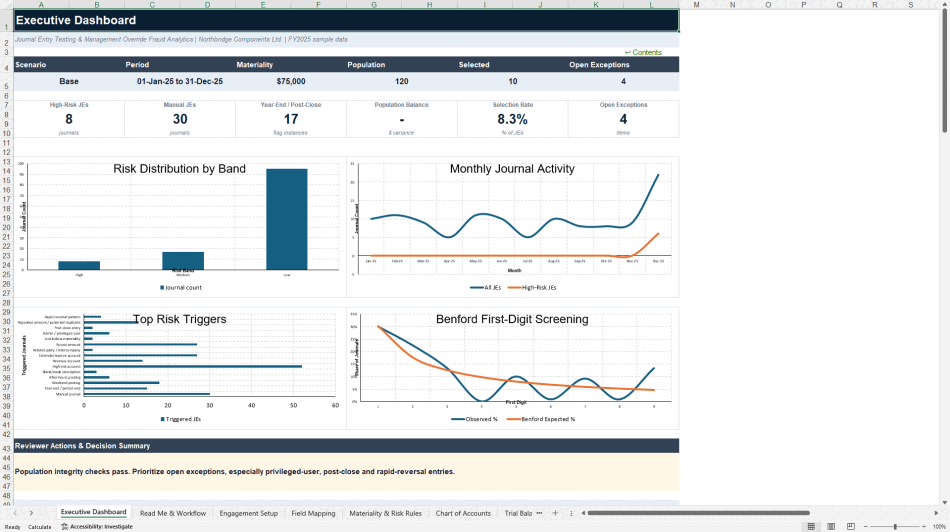
A compact Executive Dashboard summarizes the selected scenario, materiality, population, selected sample, open exceptions, High-risk journals, manual journals, year-end/post-close flags, population balance, and selection rate. Native Excel charts display risk distribution, monthly activity, leading risk triggers, and observed versus expected Benford first-digit patterns.
Downside, Base, and Upside settings function as audit-risk sensitivity presets. Users can also edit rule weights, thresholds, enabled criteria, risk-band cut-offs, account classifications, and sampling assumptions. The model uses fictional sample data so the complete workflow is visible immediately and can then be replaced with engagement-specific data.
The delivered workbook contains 20 purpose-built worksheets, internal navigation, formula-driven release checks, professional formatting, and no macros. It is suitable for teams that want a reusable, reviewable journal-entry testing process in Excel rather than a disconnected set of filters and checklists.
Got a question about the product? Email us at support@flevy.com or ask the author directly by using the "Ask the Author a Question" form. If you cannot view the preview above this document description, go here to view the large preview instead.
Source: Best Practices in Audit Management, Fraud Excel: Journal Entry Testing & Fraud Analytics Excel Model Excel (XLSX) Spreadsheet, PDMM Financial Models
ABOUT THE AUTHOR

PDMM Financial Models develops professional, decision-ready Excel models for business owners, entrepreneurs, investors, consultants, analysts, and finance teams. Our objective is to transform complex business assumptions into clear, structured analysis that supports better planning and investment decisions.
Our models cover business planning, forecasting, budgeting, feasibility analysis,
... [read more]
Ask the Author a Question
You must be logged in to contact the author.




























