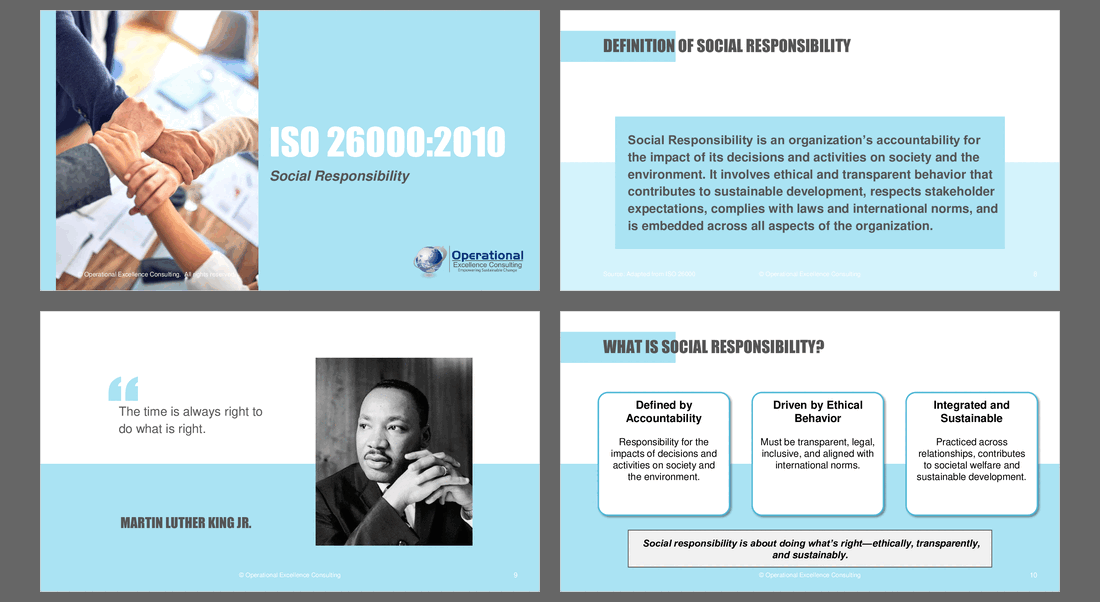

 Click main image to view in full screen. Unlock all 29 preview images:
ISO 26000:2010 (Social Responsibility) Awareness Training – PowerPoint PPTX Template
PowerPoint (PPTX) 100 Slides


BENEFITS OF THIS DOWNLOADABLE POWERPOINT DOCUMENT
- Practical & Insightful Content – Covers core principles, real-world applications, and actionable guidance for integrating Social Responsibility.
- Supports ESG & Sustainability Goals – Helps organizations align with global standards, build trust, and drive sustainable impact.
- Ready-to-Use & Customizable – Professionally designed slides aligned with ISO 26000, ready for immediate use or easy adaptation.
CORPORATE SOCIAL RESPONSIBILITY PPT TEMPLATE DESCRIPTION
In today's fast-evolving global landscape, organizations are under increasing pressure to operate transparently, ethically, and sustainably. ISO 26000:2010 offers comprehensive guidance for embedding Social Responsibility (SR) into all aspects of an organization—empowering businesses to act with integrity while contributing to long-term economic, environmental, and social well-being.
This presentation delivers a clear and practical introduction to ISO 26000, helping organizations understand and apply its core principles, integrate SR across operations, and build meaningful stakeholder relationships. Rooted in global norms and aligned with frameworks like the UN Sustainable Development Goals, ISO 26000 supports companies in navigating complex expectations from customers, investors, employees, and communities.
Participants will explore the seven core subjects of SR, learn how to assess their current state, set improvement priorities, and build SR into governance, strategy, and communications.
Whether you're a business leader, public sector manager, or part of a civil society organization, this deck is a customizable training tool designed to inspire responsible decision-making and sustainable value creation.
Note: The ISO 26000:2010 guidance standard itself was last reviewed and confirmed in 2025 by the ISO/TMBG technical committee. This awareness presentation is based on that latest confirmed version of the standard.
LEARNING OBJECTIVES
1. Understand the Core Concepts of Social Responsibility
Grasp the definition, principles, stakeholder importance, and global frameworks that shape ISO 26000.
2. Apply ISO 26000 Core Subjects and Practices
Learn how to implement practical improvements in each of the 7 core subjects, using ISO 26000 as a guide.
3. Integrate and Communicate SR Across the Organization
Discover how to embed SR into strategy, governance, and stakeholder engagement for long-term impact.
CONTENTS
1. Understanding Social Responsibility & ISO 26000
• The Definition and Scope of Social Responsibility
• Purpose, Structure, and Non-certifiable Nature of ISO 26000
• Relevance to Modern Business: Sustainability, ESG, and Global Trends
• Alignment with the UN Global Compact and SDGs
• Benefits of Adopting ISO 26000
• Real-world Success Stories and the Growing Importance of SR in Today's World
2. Core Content of ISO 26000
• The 7 Principles of Social Responsibility (e.g., accountability, transparency)
• The 7 Core Subjects: Organizational governance, Human rights, Labor practices, The environment, Fair operating practices, Consumer issues, and Community involvement & development
• Stakeholder Engagement: Definitions, Identification, Communication Strategies
3. How to Use ISO 26000
• How to Use ISO 26000
• Setting Direction for Social Responsibility
• Embedding SR into Governance and Operations
• Identification of Social Responsibility Issues
• Examples of Stakeholder Identification and Engagement
• Who are your Stakeholders?
• Establishing Priorities
• Assessing Responsibilities in your Sphere of Influence
• "Due diligence" – Investigating Risks and Impacts
• Communicating about your Social Responsibility
• Reporting Tools and Formats for SR Communication
• Reviewing and Improving Social Responsibility Performance
Also included:
• Additional resources and guidance materials
• Questions for discussion
Got a question about the product? Email us at support@flevy.com or ask the author directly by using the "Ask the Author a Question" form. If you cannot view the preview above this document description, go here to view the large preview instead.
PRESENTATION DEEP DIVE ANALYSIS
This deep-dive analysis was generated from the full 100-slide PowerPoint presentation.
Source: Best Practices in Corporate Social Responsibility, ISO 26000 PowerPoint Slides: ISO 26000:2010 (Social Responsibility) Awareness Training PowerPoint (PPTX) Presentation Slide Deck, Operational Excellence Consulting
ABOUT THE AUTHOR

Operational Excellence Consulting, founded in 2009 by Allan Ung, draws from extensive experience at Microsoft, IBM, and Underwriters Laboratories (UL). We specialize in strategy deployment, customer experience design, and operational excellence, applying Design Thinking, Lean, and Systems Thinking to maximize customer value and minimize waste.
Our
... [read more]
Ask the Author a Question
You must be logged in to contact the author.




























