 Click main image to view in full screen. Unlock all 22 preview images:
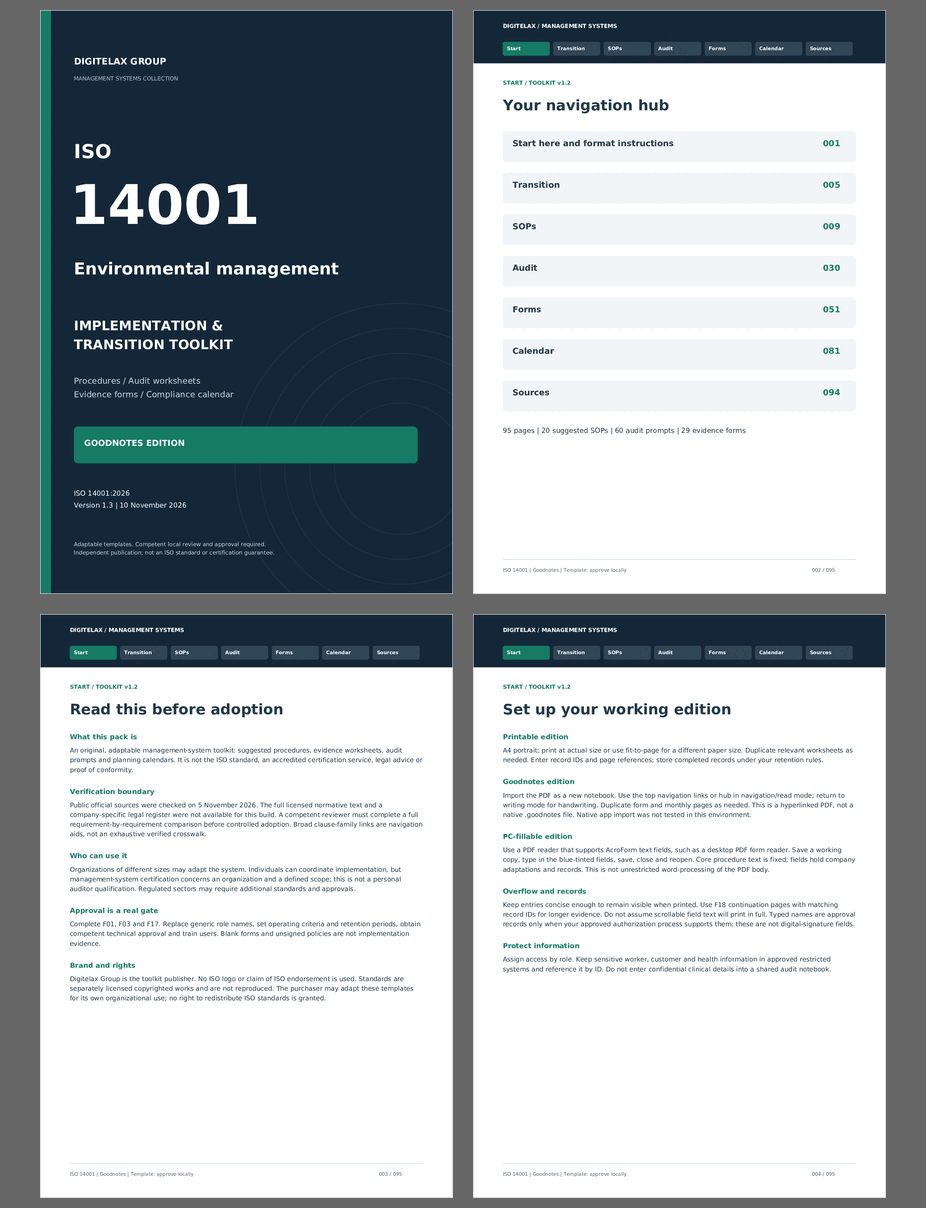
ISO 14001:2026 EMS Implementation & Transition Toolkit – PDF
PDF document + Zip archive file (ZIP) 95 Pages


BENEFITS OF THIS DOWNLOADABLE PDF DOCUMENT
- Delivers a complete, controlled ISO 14001:2026 EMS foundation with 20 SOPs, multi-format forms, Control Desk, registers, and aligned training materials ready for local adaptation and formal release.
- Significantly reduces implementation and transition time by providing interconnected procedures, evidence tools, and tracking mechanisms instead of disconnected templates.
- Strengthens audit readiness and document-control discipline through clear version identification, evidence linkage, adoption checklist, and consistent cross-referencing across the entire package.
SUSTAINABILITY PDF DESCRIPTION
If you are responsible for implementing or transitioning an Environmental Management System to ISO 14001:2026, you already know that understanding the standard is only the beginning. The real challenge lies in converting requirements into a controlled, consistent, and auditable system that can be operated day-to-day and defended during certification. Most organizations discover too late that assembling procedures, forms, registers, tracking tools, and training materials from separate sources creates version conflicts, gaps in evidence, and unnecessary rework. This toolkit was created to solve that problem directly.
The ISO 14001:2026 EMS Implementation and Transition Toolkit is a complete, professionally structured package designed for organizations that need a production-ready foundation rather than a loose collection of templates. It supports both first-time certification and structured transition from earlier editions. Every major component has been developed to function as part of a single, coherent system so that procedures, records, tracking mechanisms, and training materials reinforce one another instead of operating in isolation.
The cost of building an EMS documentation set from a blank page is rarely limited to writing time. It includes the hidden costs of inconsistent forms, unclear document control, training that does not match the written processes, and the repeated corrections that arise when internal or external auditors identify missing or misaligned evidence. This package is engineered to remove those inefficiencies. It supplies controlled content, practical tools, and explicit release discipline so that teams can move from decision to audit-ready system with greater speed and lower risk.
The toolkit follows the natural sequence of EMS establishment and transition. It begins with twenty fully developed controlled Word SOPs that address the complete clause structure of ISO 14001:2026, supported by field work instructions. These procedures define purpose, scope, responsibilities, triggers, required records, and clear points for local adaptation. They are written to be reviewed, approved, and released as controlled documents within the organization's own document-control system.
Supporting the procedures is a comprehensive suite of evidence forms and registers. These are supplied in four practical formats so that users can work according to their existing processes while preserving content integrity and stable record identity:
• Editable Word masters for formal controlled-document management
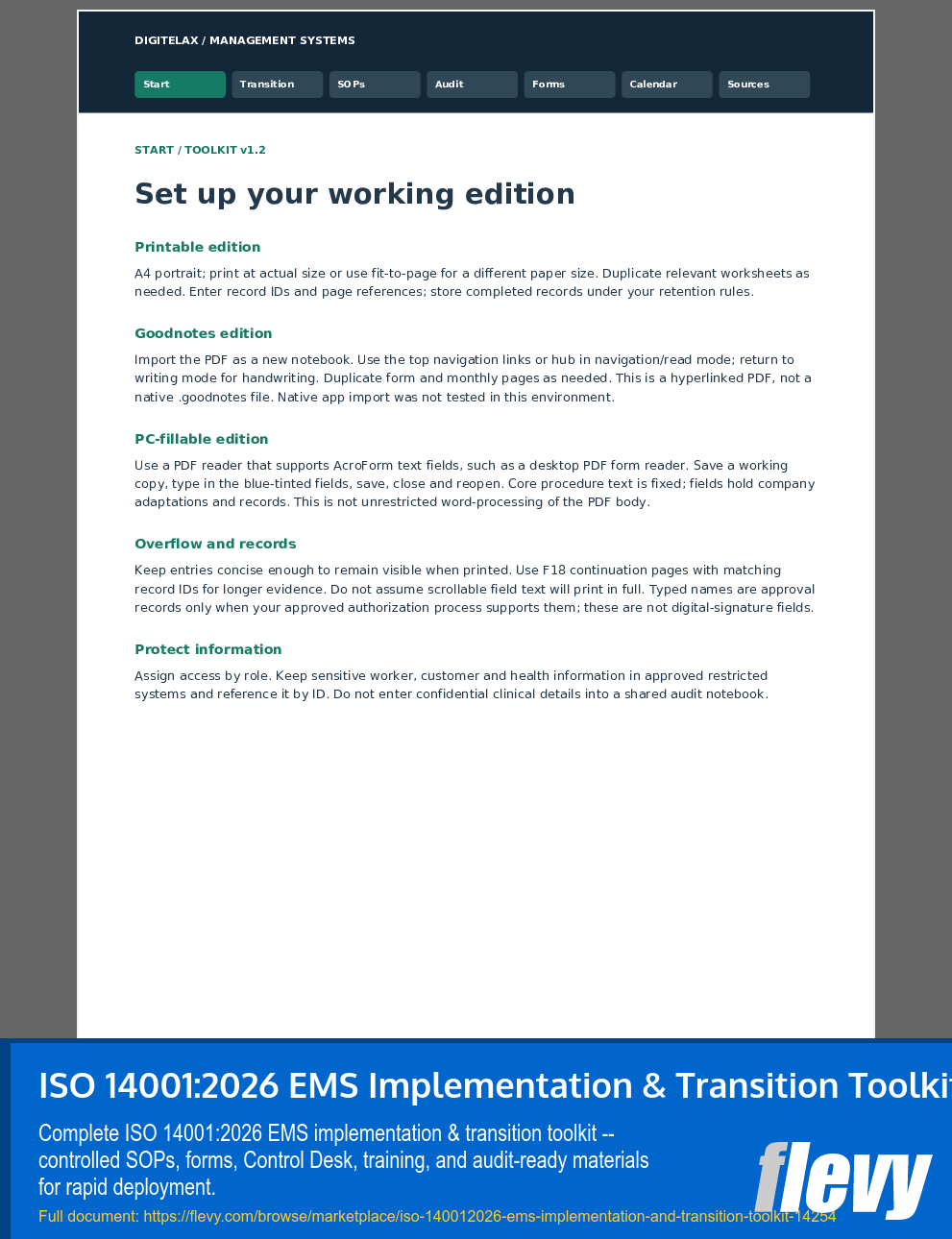
• PC-fillable PDFs for efficient desktop data entry
• Printable PDFs for hard-copy or scanned workflows
• Goodnotes-optimized versions for tablet annotation and field use
This multi-format approach eliminates a frequent source of friction. Teams are no longer forced to adapt their workflow to a single file type. They select the format best suited to the task while operating from the same controlled content base.
Operational coordination is provided by the EMS Control Desk, an Excel workbook that functions as the live management hub of the system. It offers structured views for gap analysis, action tracking, evidence linkage, and weekly prioritization. Instead of relying on scattered spreadsheets, informal lists, or email trails, organizations gain a single controlled location in which progress, ownership, due dates, and supporting evidence can be maintained and reviewed. Complementary registers address specialized environmental data and equipment calibration and event history. An optional Scope 3 GHG activity screening workbook is included for organizations that wish to examine selected value-chain data in a structured and transparent manner.
Competence and awareness are treated as integral elements of the system rather than optional additions. The package includes a full training and briefing suite designed to support demonstrable capability. Resources cover employee training, environmental management competence, workplace training modules, a leadership briefing presentation, a 120-minute staff awareness session, a 90-minute transition workshop, and a practice mini-audit with an accompanying 30-day action pack. These materials are aligned with the same procedures and forms that people will use in daily operations, enabling organizations to build and evidence competence in a consistent and auditable way.
Document control is embedded throughout the package. Current controlled files are clearly distinguished from reference and historical material. A current file inventory and the latest internal audit report allow users to identify authoritative versions with certainty. A formal adoption checklist guides the essential pre-release steps: confirmation of the applicable edition and transition requirements with the certification body, approval of sample records, verification of workbook functionality in the local computing environment, and formal authorization of the system for operational use.
All worked examples provided in the toolkit are fictional. They exist solely to illustrate structure, expected content depth, and cross-referencing logic. They must be replaced with organization-specific, approved content before the system is issued. This design reinforces a core principle: the toolkit supplies a complete professional foundation, but local knowledge, competent judgment, and formal approval remain the responsibility of the adopting organization.
The practical advantages of this approach are significant. The most immediate is time. Constructing a full set of controlled procedures, matched forms, operational registers, a live tracking desk, and aligned training materials from scratch typically consumes weeks or months of specialist effort. This toolkit compresses that effort by delivering interconnected, controlled content that is ready for adaptation and formal approval.
Consistency is the second major advantage. Because procedures, forms, registers, the Control Desk, and training materials were developed as one system, the risk of misaligned content is substantially reduced. Procedures reference the correct forms. Forms feed the appropriate registers. Training reinforces the processes people are expected to follow. Cross-references are intentional and record identities remain stable across the package.
Audit readiness forms the third advantage. The structure supports efficient demonstration of conformity. The Control Desk links identified gaps and actions directly to supporting evidence. Forms and registers are designed to capture the information auditors expect to examine. Training materials provide a foundation for competence claims that extends beyond simple attendance records.
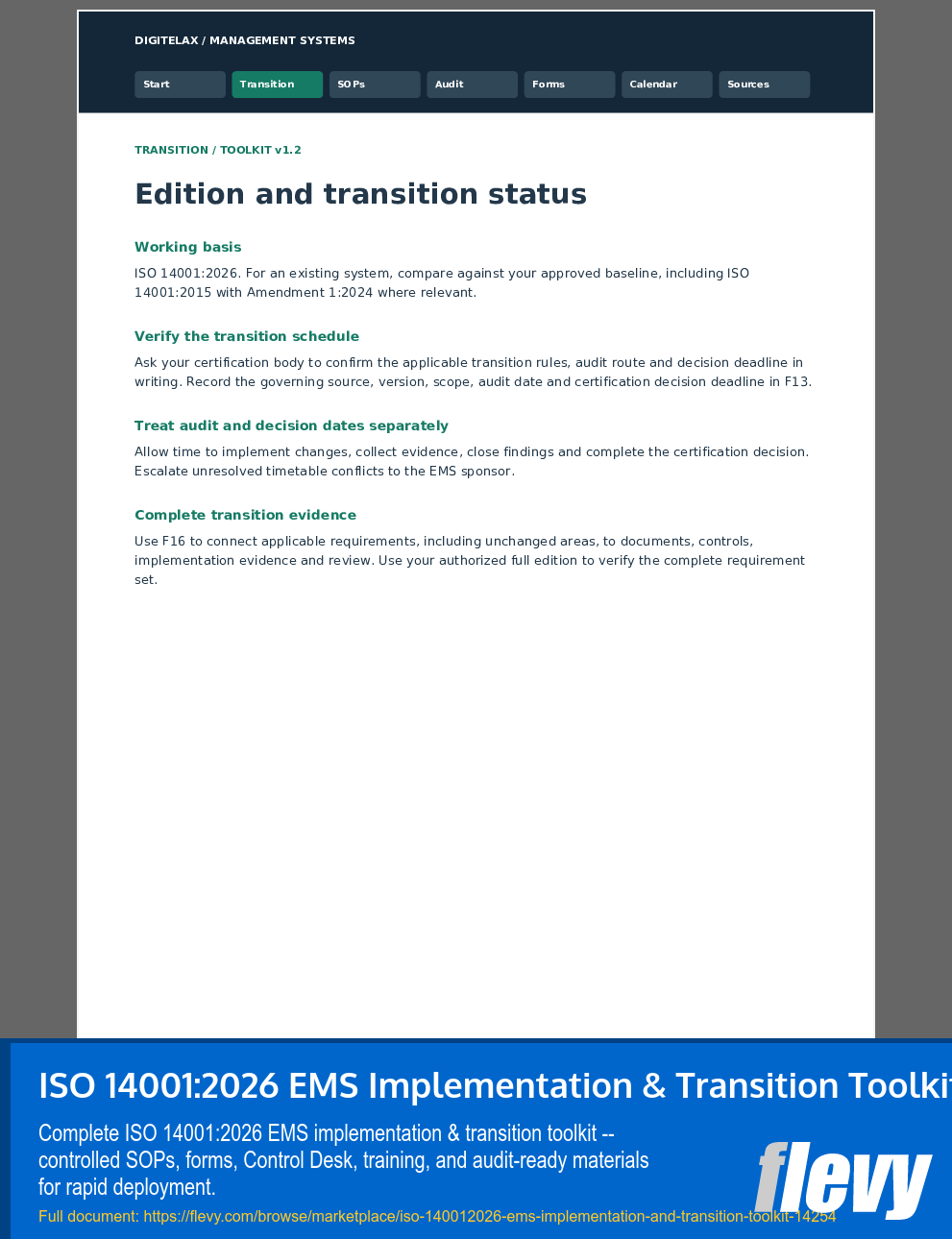
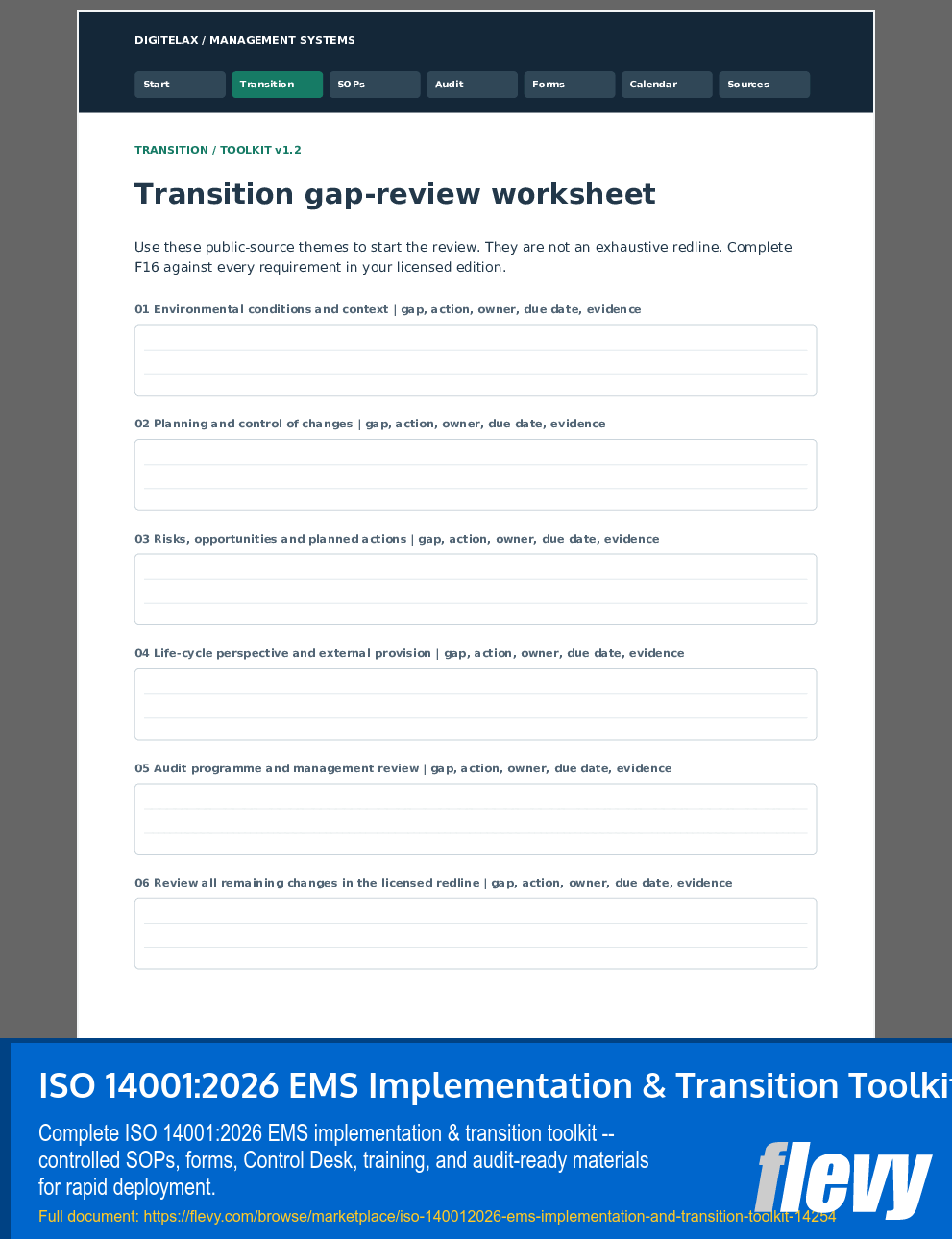
Transition confidence constitutes the fourth advantage. The 2026 edition introduces changes that many organizations are still clarifying. The toolkit offers a practical route for assessing the current baseline against the new requirements, identifying gaps, and closing them in a controlled and documented manner. The transition workshop and related materials help leadership and staff understand both the nature of the changes and their operational implications.
Flexibility remains fully with the adopting organization. Every document is supplied as an editable master. Scope, compliance obligations, operational controls, competence criteria, and evidence requirements are adapted to the specific context of the organization, its sites, activities, products, services, and interested parties. Formal approval and release decisions rest entirely with the organization. The toolkit does not impose an external rigid structure; it provides a professional, complete starting point that already satisfies the documentary and structural expectations of a modern EMS.
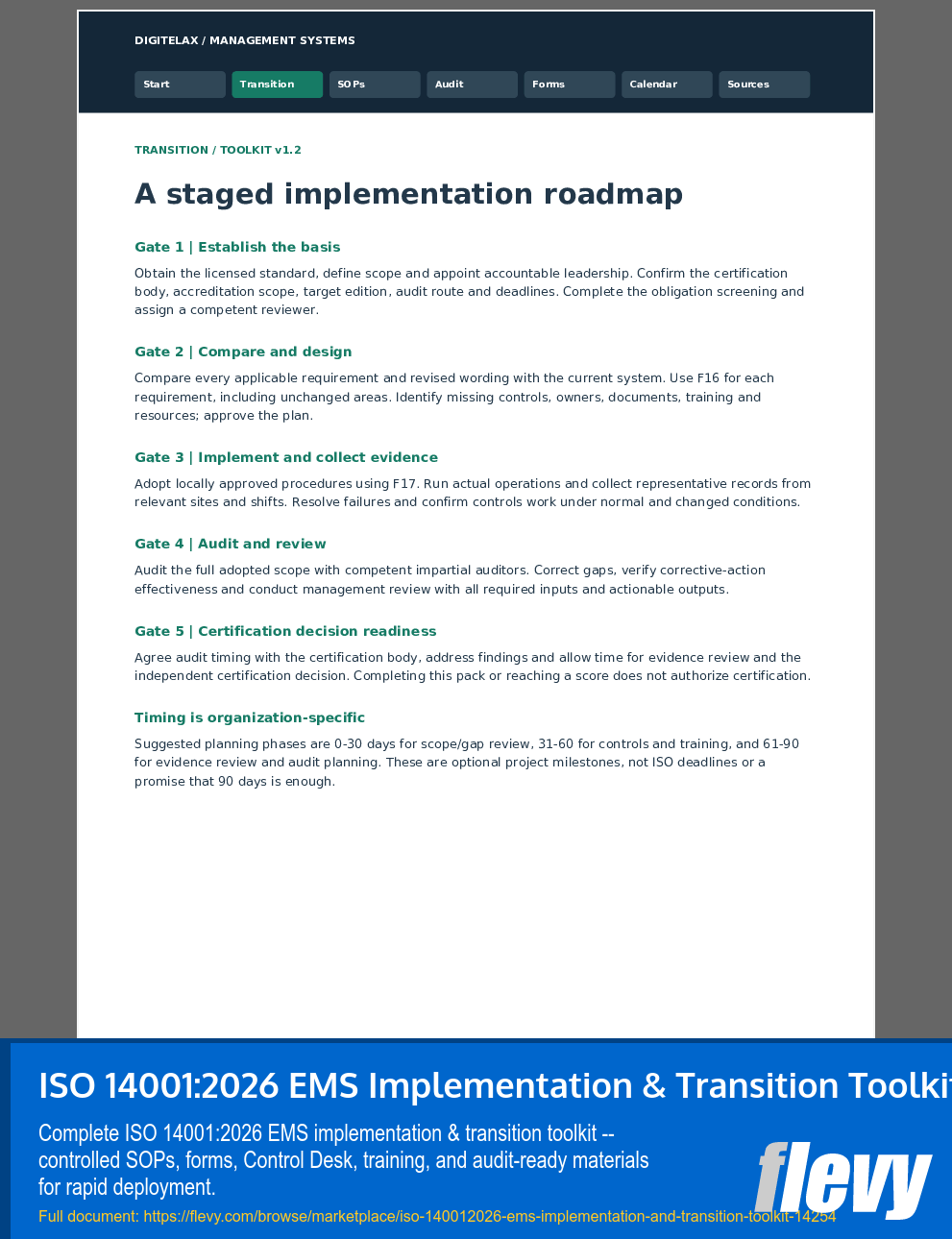
The recommended path for adoption is deliberate. Begin with the quick-start guidance and release notes to identify the current controlled files. Establish the Control Desk and capture initial gaps and priorities. Approve the organizational profile, context, and scope using the relevant forms. Progress through the procedures in logical order, adapting and formally approving each one. Populate the registers with real operational data. Deliver the appropriate training. Conduct the practice audit and close resulting actions. Complete management review. Only then authorize the system for operational use. This sequence protects against the common risk of releasing incomplete or unapproved material and creates a clear, auditable record of the adoption process.
It is important to state clearly what the toolkit does not replace. It does not substitute for competent local determination of environmental aspects, compliance obligations, risks, and operational controls. It does not remove the need to confirm transition timelines and accreditation scope with the relevant certification body. It does not eliminate the requirement to ensure that individuals are competent for the tasks they perform. The package provides structure, content foundation, and practical tools. The organization supplies local knowledge, formal approvals, and ongoing operational discipline.
In practical terms, this ISO 14001:2026 EMS Implementation and Transition Toolkit delivers a complete, coordinated, and controlled foundation for organizations that must achieve or maintain certification under the 2026 edition of the standard. It combines twenty controlled procedures, multi-format evidence forms and registers, a live Control Desk, specialized environmental and equipment registers, a full training and awareness suite, and explicit document-control and release guidance. The result is a professional system that can be adapted, approved, operated, and defended in audit, while substantially reducing the time, cost, and risk associated with building such a system from the ground up.
For environmental managers, management system leads, internal auditors, consultants, and leadership teams who need to move from intention to a working, controlled EMS with clarity and confidence, this package provides the structure, the content, and the practical tools required to do so effectively and efficiently.
Move forward with a complete, controlled foundation. Secure the ISO 14001:2026 EMS Implementation and Transition Toolkit today and equip your organization with the procedures, forms, registers, tracking tools, and training materials needed to implement or transition with discipline, consistency, and audit readiness.
Got a question about the product? Email us at support@flevy.com or ask the author directly by using the "Ask the Author a Question" form. If you cannot view the preview above this document description, go here to view the large preview instead.
Source: Best Practices in Sustainability, ISO 14001 PDF: ISO 14001:2026 EMS Implementation & Transition Toolkit PDF (PDF) Document, MW & Digitelax Consulting
ABOUT THE AUTHOR

Welcome to the official enterprise resource hub of MW & Digitelax Consulting. Directed by a seasoned banking executive, corporate risk consultant, and financial content strategist with over 28 years of institutional leadership experience, our practice delivers deployment-ready frameworks designed to drive enterprise efficiency, enforce regulatory compliance, and eliminate systemic model risk. ... [read more]
Ask the Author a Question
You must be logged in to contact the author.