 Click main image to view in full screen.
Intelligent Automation Business Case and Portfolio Model – Excel XLSX
Excel (XLSX) + supplemental PDF


BENEFITS OF THIS DOWNLOADABLE EXCEL DOCUMENT
- Derives your cost per bot from effort, delivery model and rework rather than assuming a flat rate that cannot be defended
- Separates hard cash saving from released capacity, so the business case survives its first post-implementation review
- Quantifies what compressing discovery costs across your portfolio, and what your vendor's blended rate implies about staffing
BUSINESS CASE DEVELOPMENT EXCEL DESCRIPTION
Most automation business cases are built on a number nobody can defend.
A flat cost per bot. Zero rework. One automation rate applied across every process. Hours saved counted as money saved. Each of those assumptions looks reasonable on the day funding is approved, and each of them falls apart at the first post-implementation review.
This toolkit replaces all four. It does not assume a cost per bot. It derives one, from effort, delivery model, discovery rigour, and the rework that actually occurs between requirements sign-off and UAT.
WHAT YOU GET
A single Excel workbook of seven fully formula-driven tabs, plus a seven-page implementation guide.
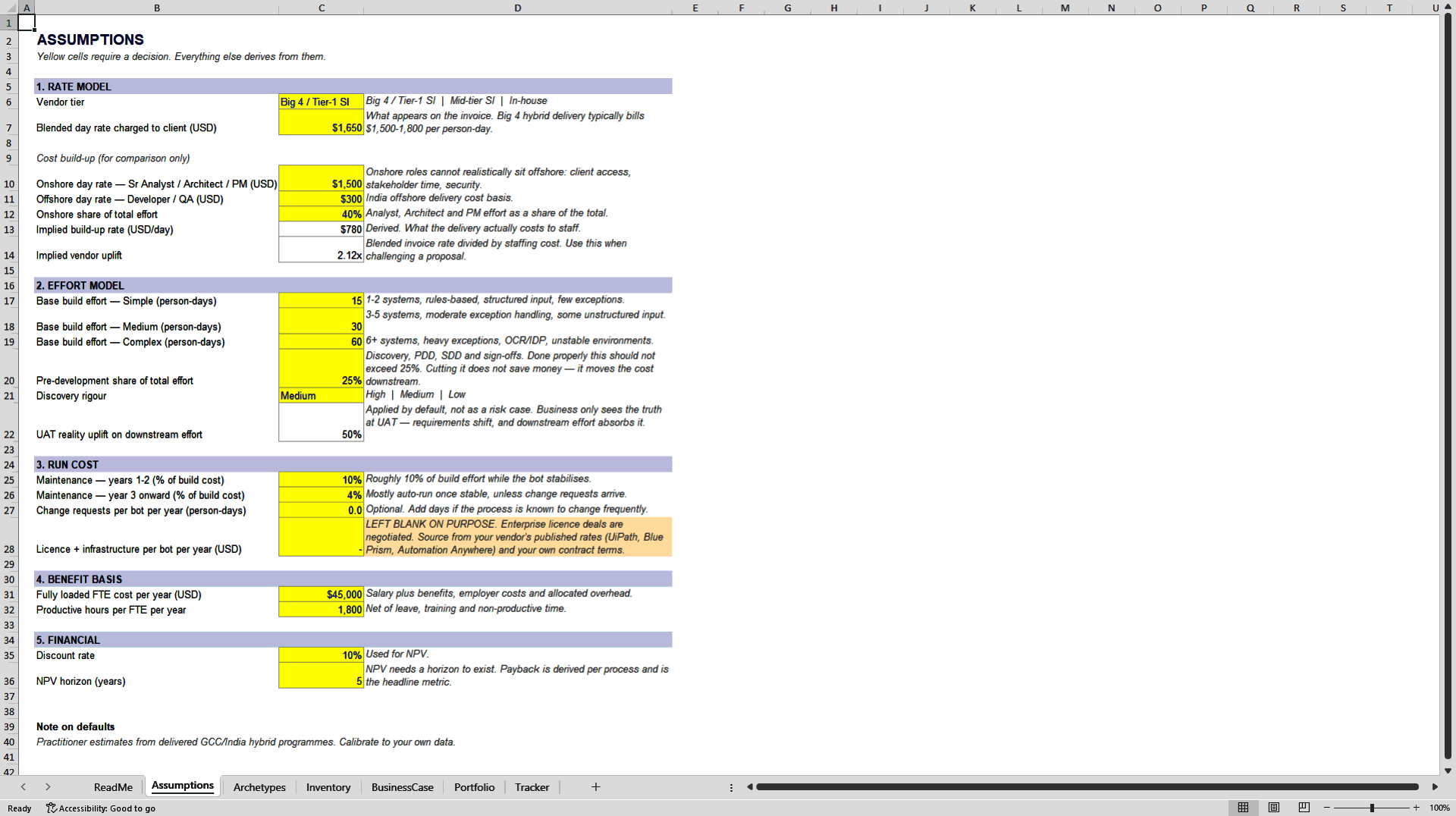
Assumptions. Your rate model, effort baselines by complexity tier, discovery rigour setting, run cost profile, benefit basis and financial parameters.
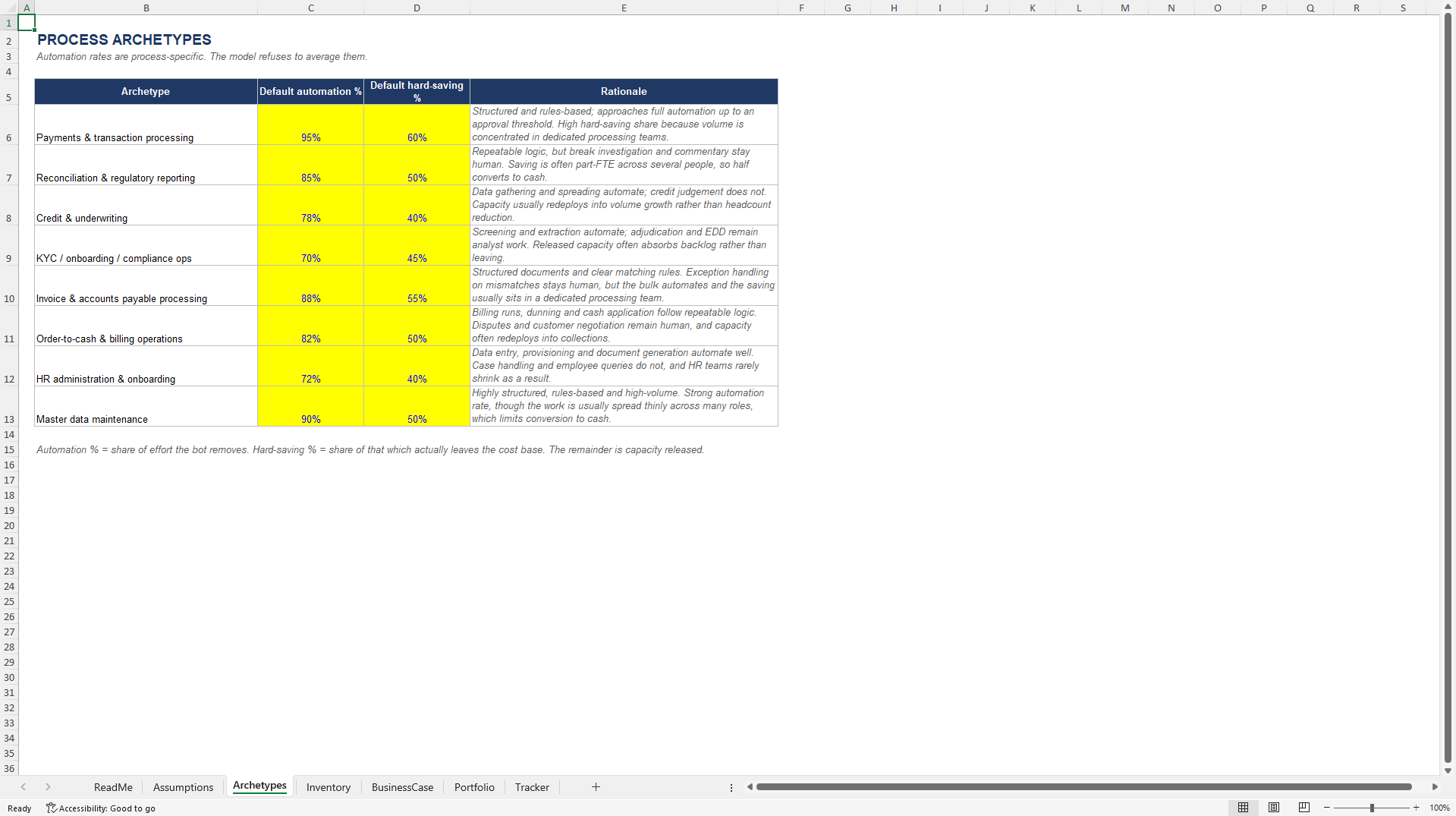
Archetypes. Process families carrying distinct automation rates and hard-saving rates, fully editable to your own delivered data.
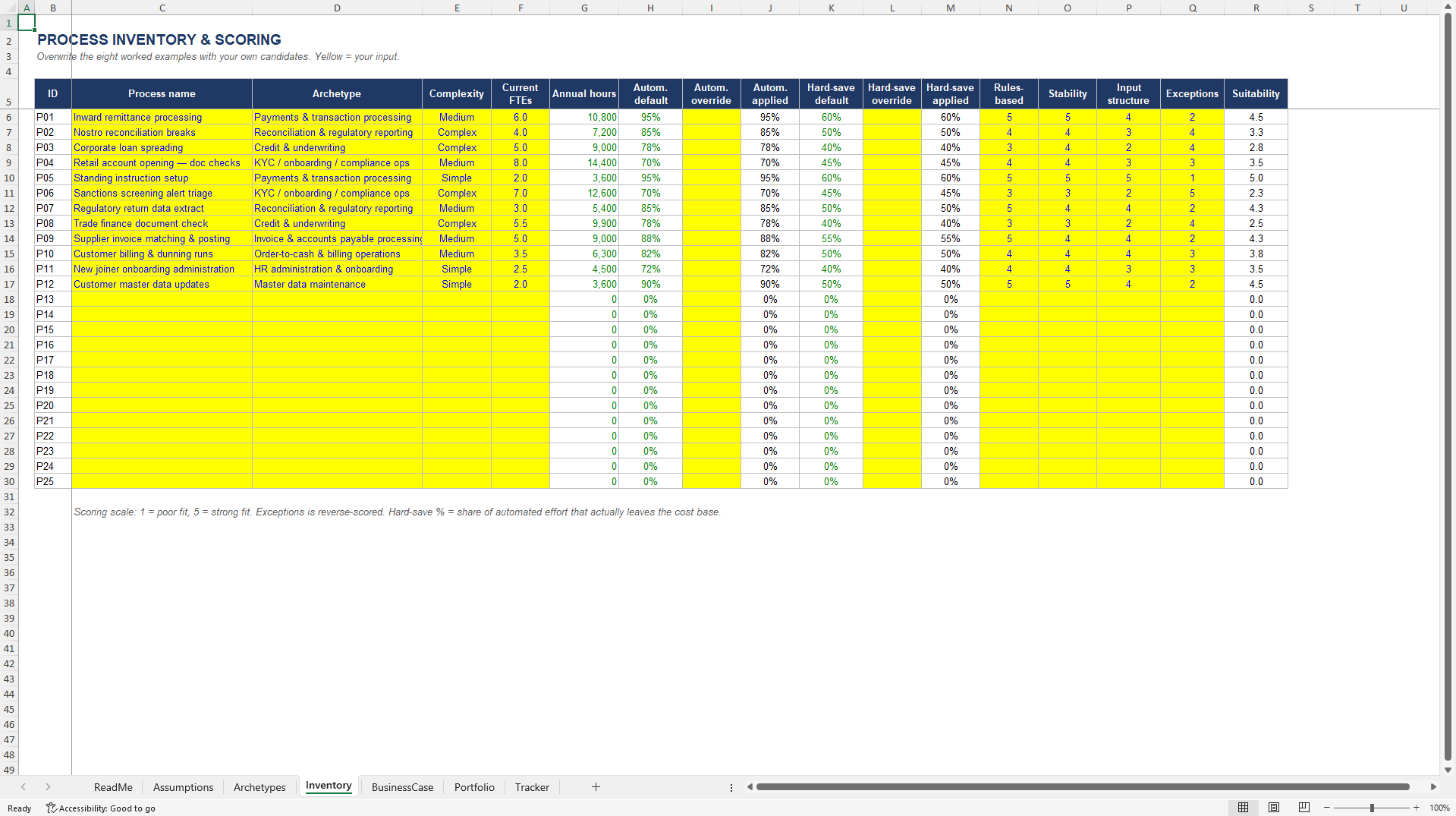
Inventory. Your candidate processes, scored on rules basis, environment stability, input structure and exception volume to produce a suitability ranking.
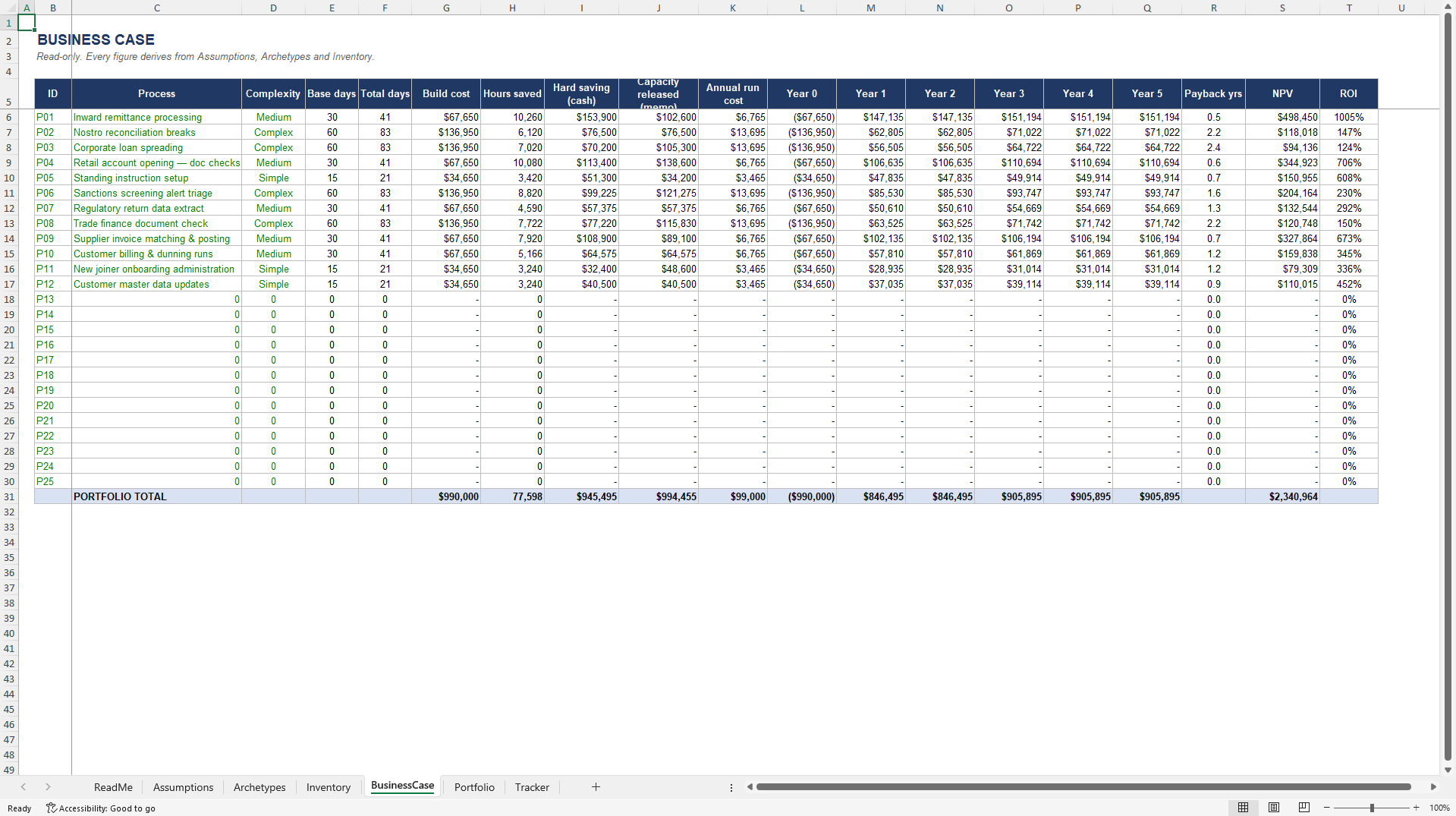
Business Case. Derived build effort, cost, benefit, payback, NPV and ROI for every process, calculated individually rather than averaged.
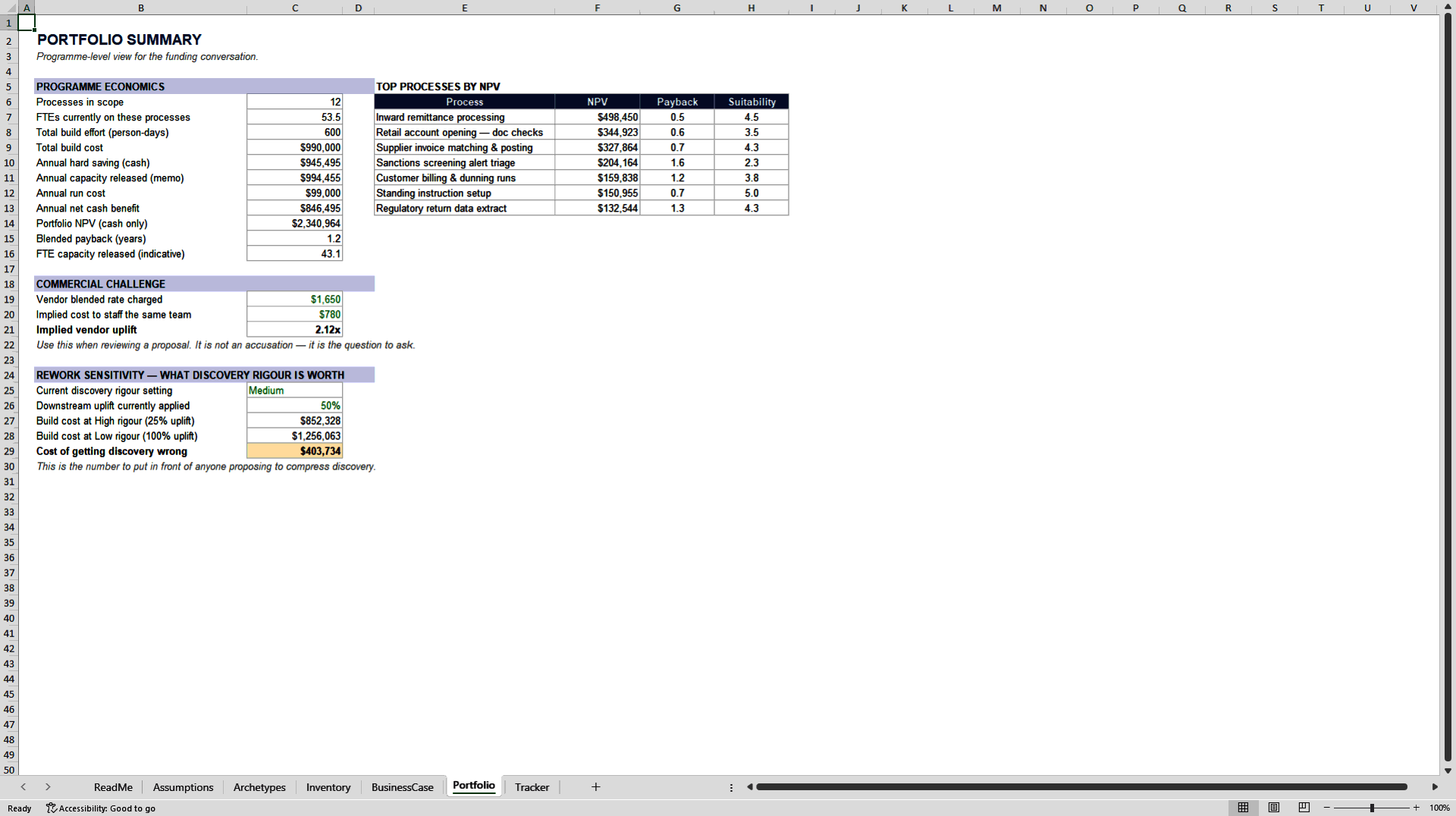
Portfolio. Programme-level roll-up, a vendor rate challenge view, and a discovery sensitivity analysis quantifying what compressed mobilisation actually costs.
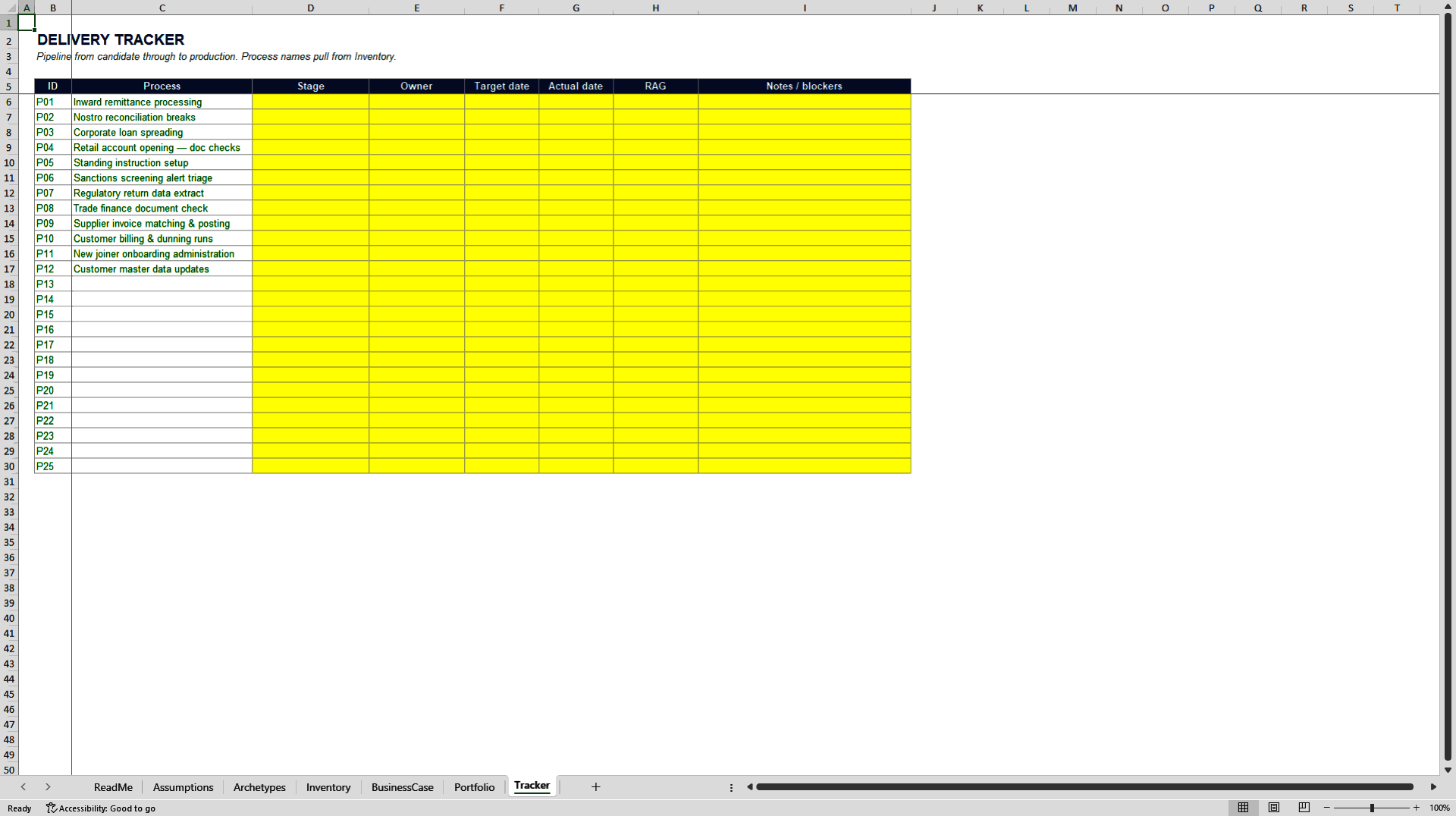
Delivery Tracker. Pipeline management from candidate through discovery, build, SIT, UAT, hypercare and production.
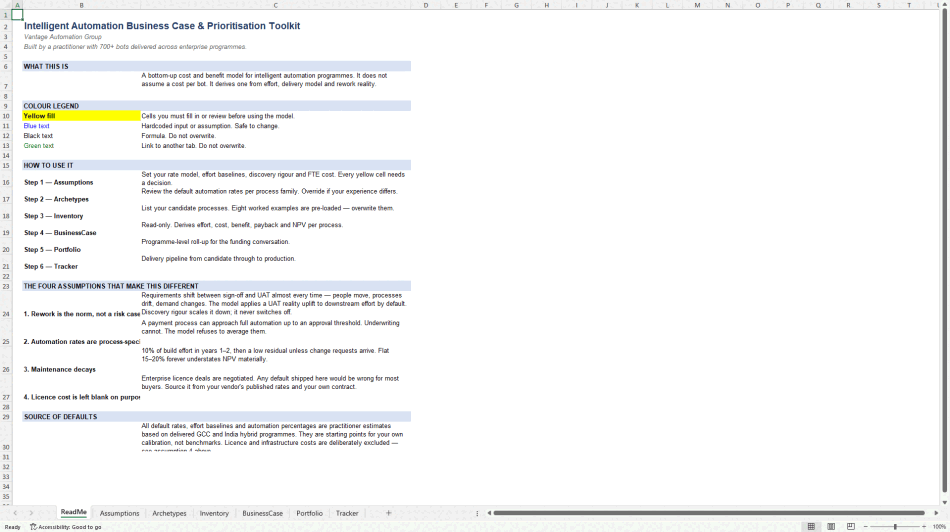
Read Me. Colour legend, orientation and the reasoning behind each core assumption.
Twelve worked processes are pre-loaded across banking operations and cross-industry back office, so the model runs the moment you open it.
WHAT MAKES IT DIFFERENT
Rework is modelled as normal, not as a risk scenario. Requirements shift between sign-off and UAT in almost every programme, because people move, processes drift and business demand changes. The model applies a downstream uplift by default. Discovery rigour scales that uplift; it never switches it off. The workbook then quantifies precisely what compressing discovery costs across your portfolio, which is the single most useful number to hold when someone proposes shortening mobilisation to hit a date.
Hard cash saving is separated from released capacity. This is the assumption that most often discredits an automation programme a year after approval. A bot removes two thousand hours spread across forty people, nobody leaves, and the saving never reaches the cost base. This model splits the two. NPV, payback and ROI are calculated on cash that genuinely leaves the cost base. Released capacity is reported separately as a memo line, so it can be presented honestly and put to a named use rather than quietly inflating the return.
Automation rates are process-specific. Highly structured transactional processing can approach full automation up to an approval threshold. Judgement-led processes such as underwriting or adjudication cannot. The model refuses to average them.
Maintenance decays rather than staying flat. Support runs at around ten percent of build effort while a process stabilises, then falls to a low residual unless change requests arrive. Assuming a flat fifteen to twenty percent in perpetuity materially understates net present value.
Blended commercial rates are compared against build-up cost. Delivery is typically hybrid across onshore and offshore locations, while commercials are quoted as a single blended day rate. The model derives what a team costs to staff and compares it with what is being charged, producing an implied uplift figure. That gives you a specific question to put to any vendor proposal rather than a general sense that the rate looks high.
WHO IT IS FOR
Automation and transformation leads building a funding case. Consultants and advisory firms who need a defensible costing model for client work. Systems integrators and delivery partners constructing proposals. Finance and investment committee members reviewing an automation business case that has been put in front of them.
The cost engine is industry-agnostic and applies to any function where repetitive, rules-based work is a candidate for automation: finance and accounting operations, shared services, customer operations, supply chain administration, HR administration, claims handling and regulated back-office processing. The included archetype library spans transaction processing, reconciliation, credit and underwriting, compliance operations, accounts payable, order-to-cash, HR administration and master data maintenance, drawing on banking and financial services operations where automation programmes have run at the greatest scale and the cost evidence is strongest. Archetypes are editable, so the library extends to your own process families in minutes.
FORMAT AND CALIBRATION
Microsoft Excel workbook and PDF implementation guide. Fully unlocked, no macros, no protected cells, no external dependencies.
Every default value is an indicative practitioner estimate drawn from delivered enterprise programmes. They are calibration starting points, not benchmarks, and the guide explains how to replace each one with your own measured data after your first few deployments.
Licence and infrastructure costs are deliberately excluded. Enterprise licence agreements are negotiated and vary by platform, volume, runtime type and contract term, so any default shipped here would be wrong for most buyers and would undermine the credibility of everything else in the model. The guide explains where to source these figures and how to model a discount scenario alongside list pricing.
Got a question about the product? Email us at support@flevy.com or ask the author directly by using the "Ask the Author a Question" form. If you cannot view the preview above this document description, go here to view the large preview instead.
Source: Best Practices in Business Case Development, Automation Excel: Intelligent Automation Business Case and Portfolio Model Excel (XLSX) Spreadsheet, Vantage Automation Group
ABOUT THE AUTHOR
Vantage Automation Group publishes decision-grade frameworks, financial models and operating model blueprints for people running large-scale operations and transformation programmes.
The material is drawn from nineteen years of enterprise delivery -- across global consulting firms and industry -- covering operations transformation, target operating model design, operational resilience and
... [read more]
Ask the Author a Question
You must be logged in to contact the author.




























