
 Click main image to view in full screen. Unlock all 15 preview images:
HVAC Contractor Financial Model - 5-Year Forecast – Excel XLSX
Excel (XLSX) + Zip archive file (ZIP)


BENEFITS OF THIS DOWNLOADABLE EXCEL DOCUMENT
- Build an integrated 5-year HVAC forecast connecting service calls, installations, maintenance contracts, technician capacity, job costs, staffing, financing, and all three financial statements.
- Analyze break-even revenue, required service and installation volumes, Downside/Base/Upside scenarios, funding needs, and Technician Utilization × Service Ticket sensitivity.
- Turn HVAC operating assumptions into management-ready insights with an Executive Dashboard, 15-slide presentation deck, and detailed 28-page user guide.
CONSTRUCTION EXCEL DESCRIPTION
🔧 HVAC CONTRACTOR 5-YEAR FINANCIAL MODEL
Build a structured financial forecast for an HVAC contracting and service business with a professional model that connects service demand, installation projects, recurring maintenance contracts, technician capacity, job costs, payroll, operating expenses, financing, and liquidity.
This package combines a fully integrated 5-Year Three-Statement Financial Model, a professional 15-slide Investor / Management PowerPoint Deck, and a detailed 28-page How-to-Use Guide.
It is designed for HVAC contractors, service companies, founders, business owners, consultants, finance teams, and management professionals who need a transparent framework for planning business growth and financial performance.
📦 WHAT IS INCLUDED
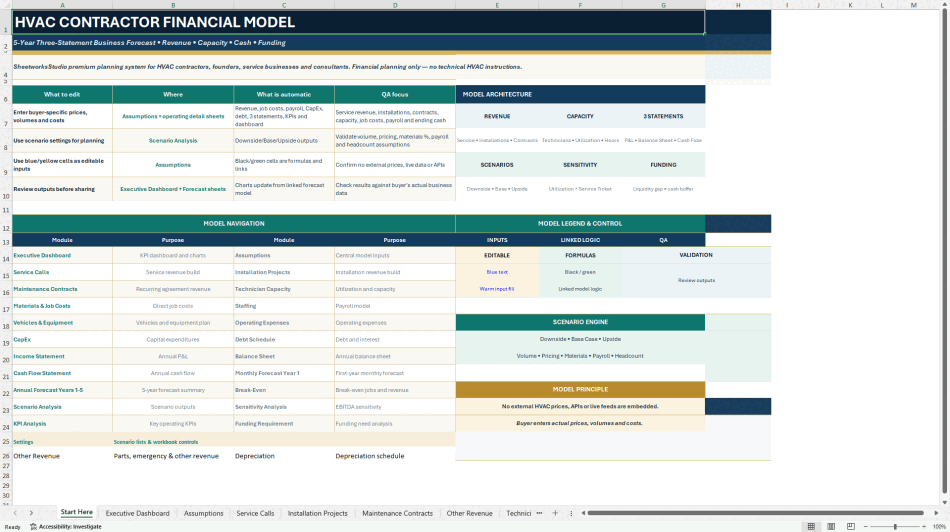
✓ Premium financial model with 27 worksheets
✓ 5-year forecast with illustrative sample data for 2029–2033
✓ Integrated Income Statement, Balance Sheet, and Cash Flow Statement
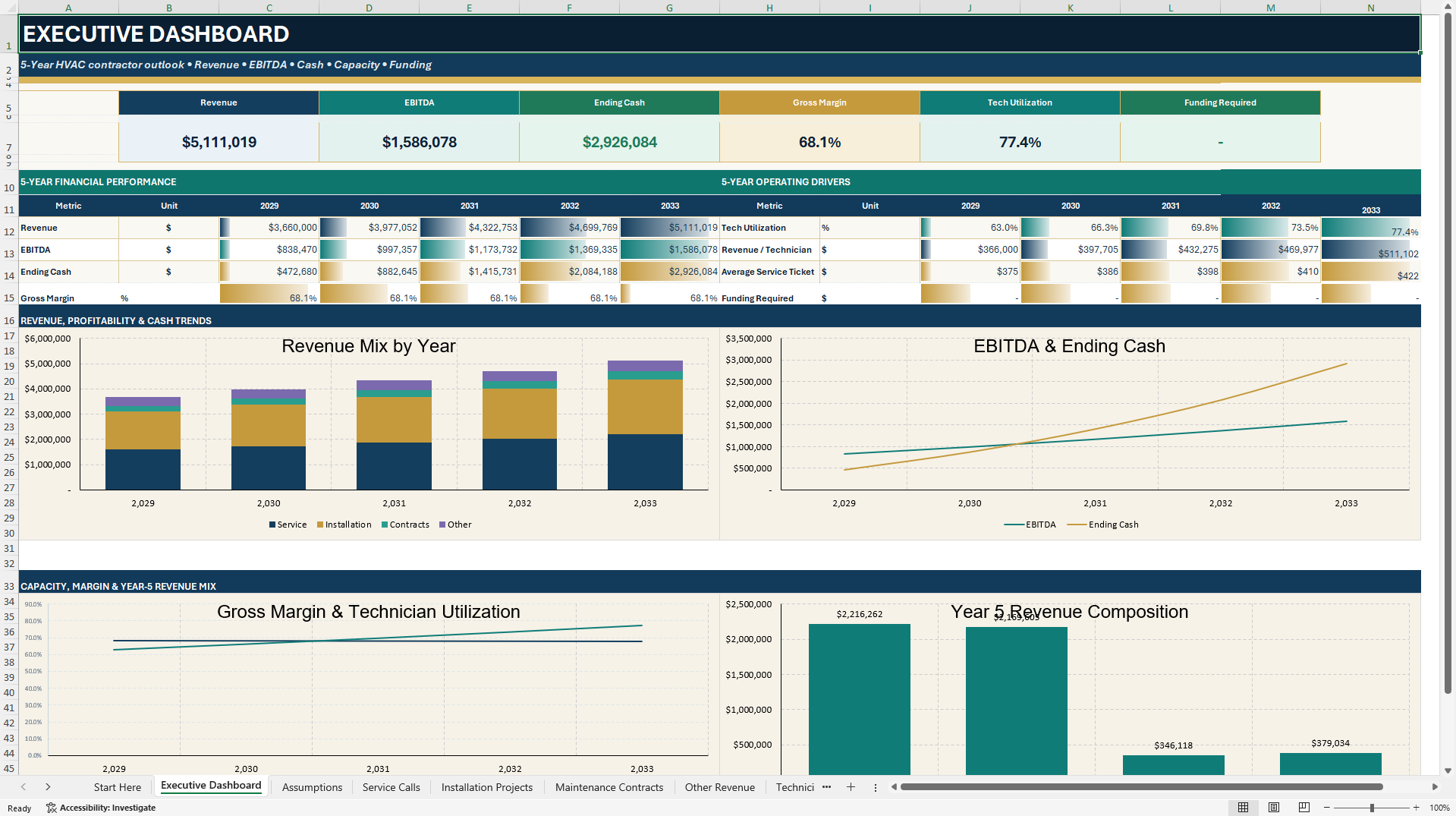
✓ Executive Dashboard with financial and operating KPIs
✓ 15-slide Investor / Management PowerPoint Deck
✓ 28-page How-to-Use PDF Guide
✓ Break-Even Analysis
✓ Downside / Base / Upside Scenario Analysis
✓ Technician Utilization × Average Service Ticket Sensitivity Analysis
✓ Funding Requirement Analysis
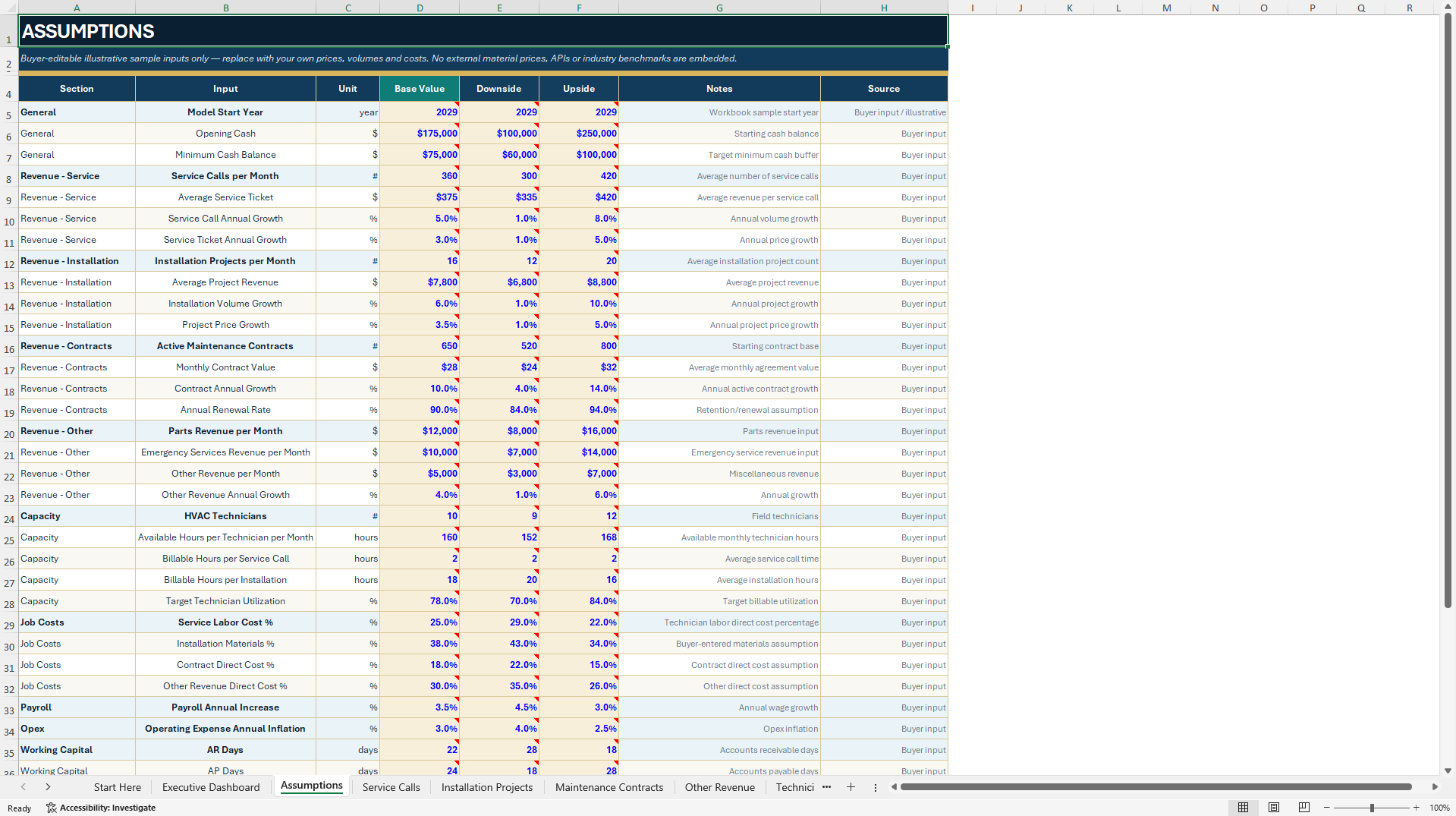
✓ Fully editable key assumptions
✓ No macros or VBA
✓ No APIs or live-data connections
✓ No embedded external material prices or HVAC industry pricing benchmarks
✓ All files and content provided in English
All included assumptions and sample figures are illustrative and can be replaced with company-specific operating and financial data.
🔧 SERVICE CALL REVENUE
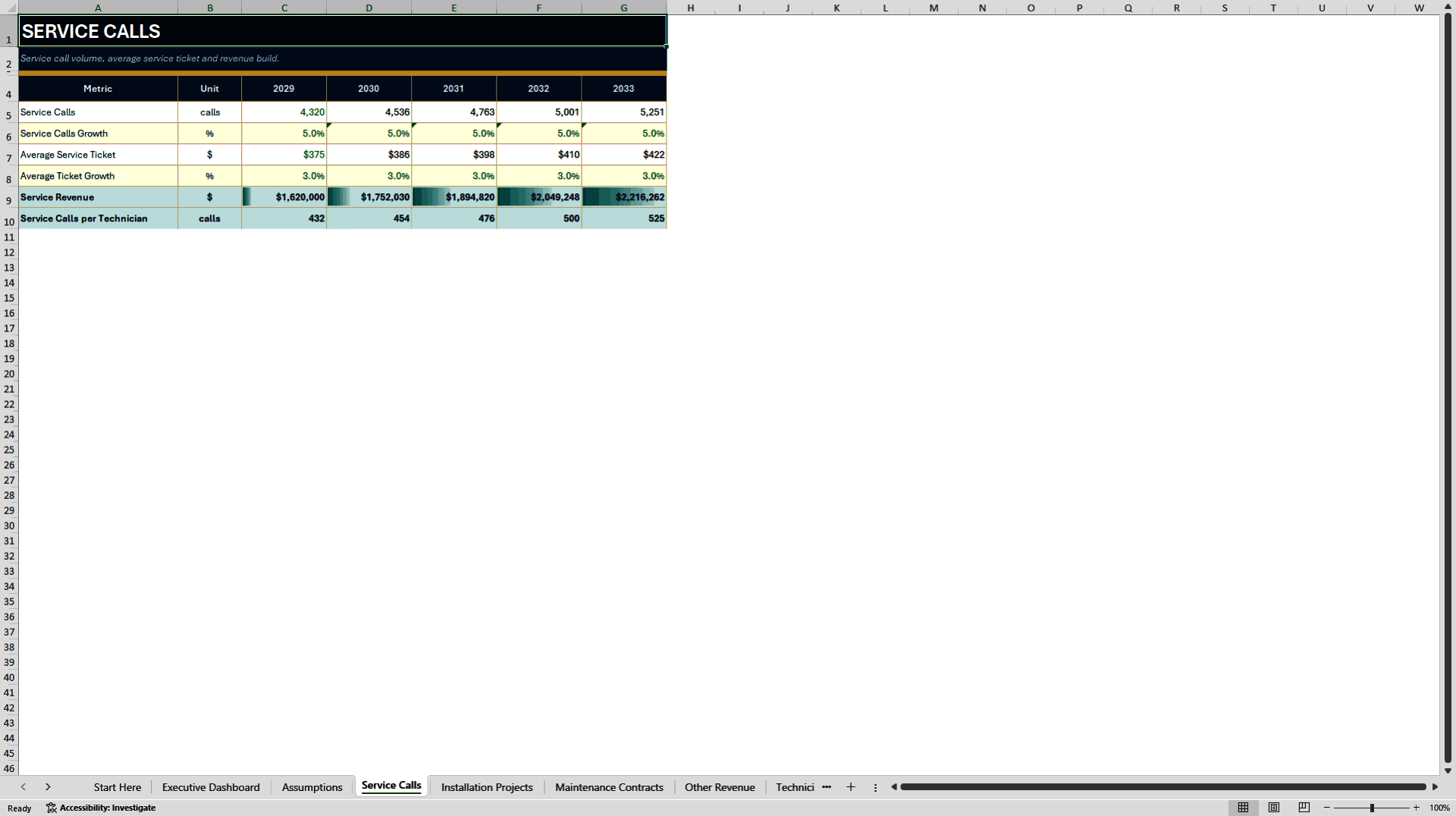
The model provides structured planning for recurring HVAC service activity.
Users can plan:
✓ Service Calls per Month
✓ Average Service Ticket
✓ Annual Service Volume Growth
✓ Service Ticket Price Growth
✓ Service Revenue
These drivers connect directly with technician capacity, direct job costs, profitability, and cash-flow projections.
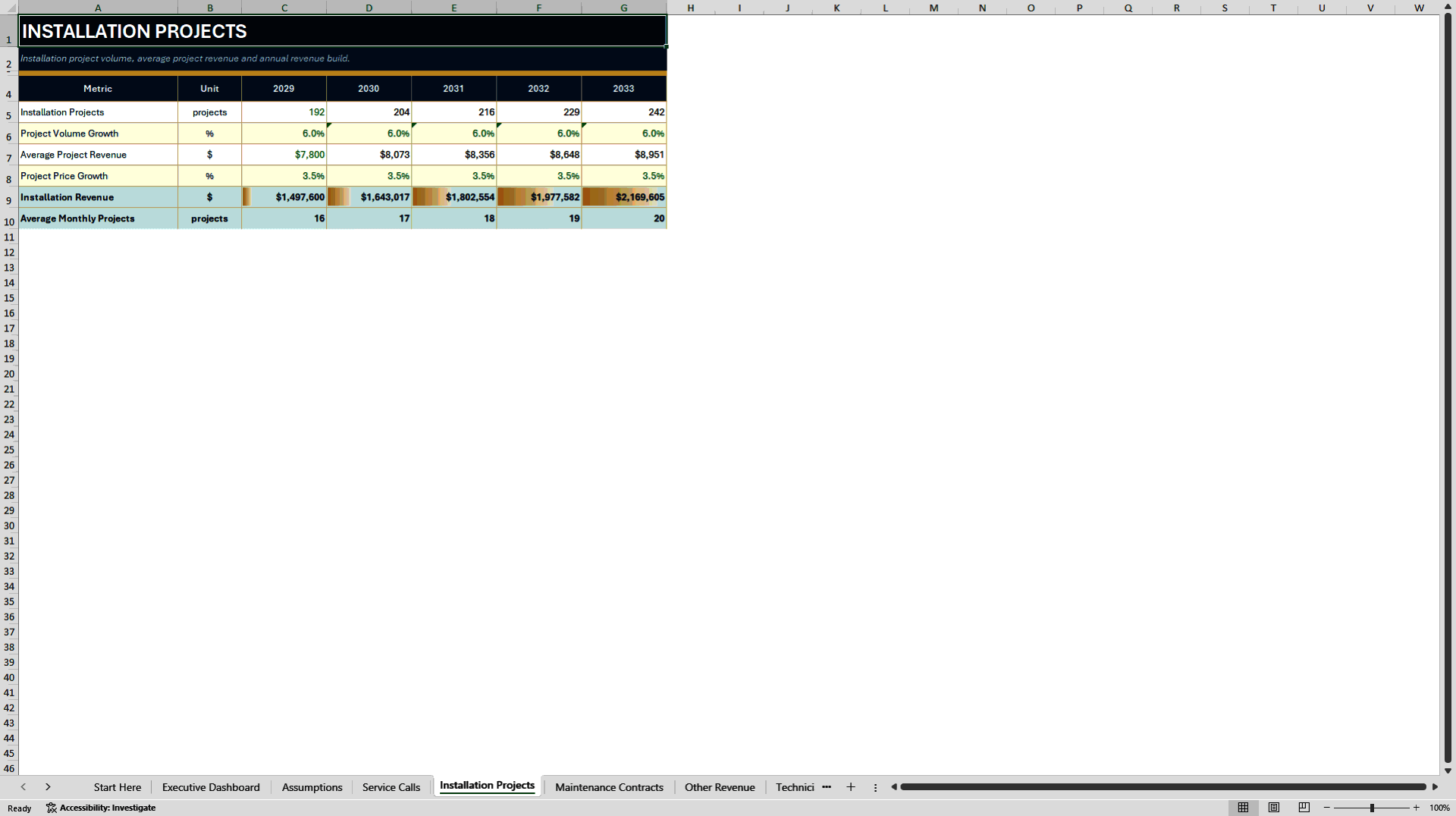
🏗️ INSTALLATION PROJECTS
Installation revenue can be planned separately from recurring service work.
The model includes:
✓ Installation Projects per Month
✓ Average Project Revenue
✓ Installation Volume Growth
✓ Project Price Growth
✓ Required Technician Hours
✓ Installation Revenue
This provides clearer visibility into the financial contribution of larger project-based work.
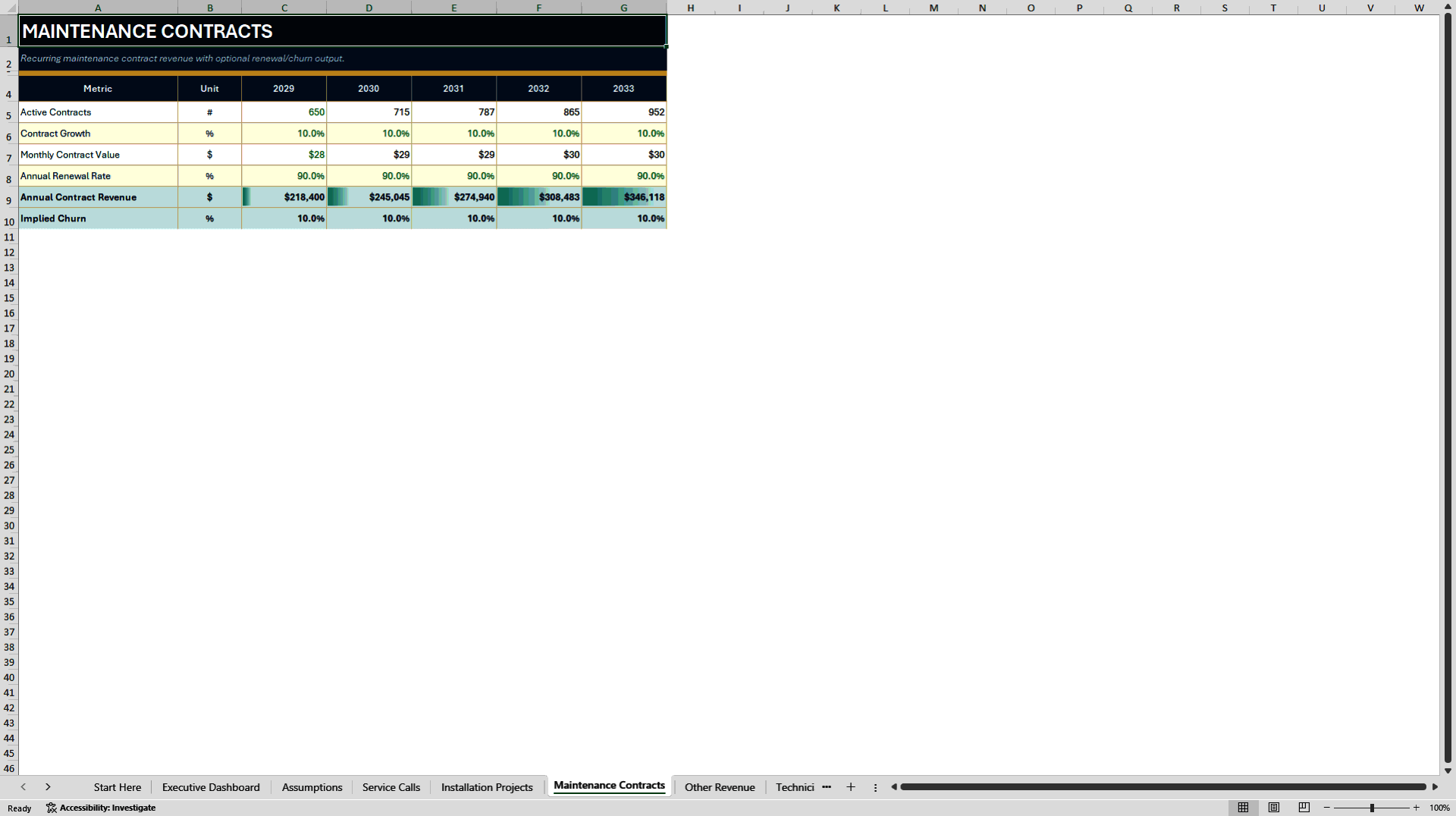
🔁 MAINTENANCE CONTRACTS
Recurring maintenance agreements are modeled separately.
Users can plan:
✓ Active Maintenance Contracts
✓ Monthly Contract Value
✓ Contract Growth
✓ Annual Renewal Rate
✓ Recurring Contract Revenue
This allows recurring revenue to be evaluated alongside service and installation activity.
💰 OTHER REVENUE
Additional revenue streams can include:
✓ Parts Revenue
✓ Emergency Service Revenue
✓ Other Service Revenue
These assumptions remain user-editable and flow into the overall forecast.
👨🔧 TECHNICIAN CAPACITY
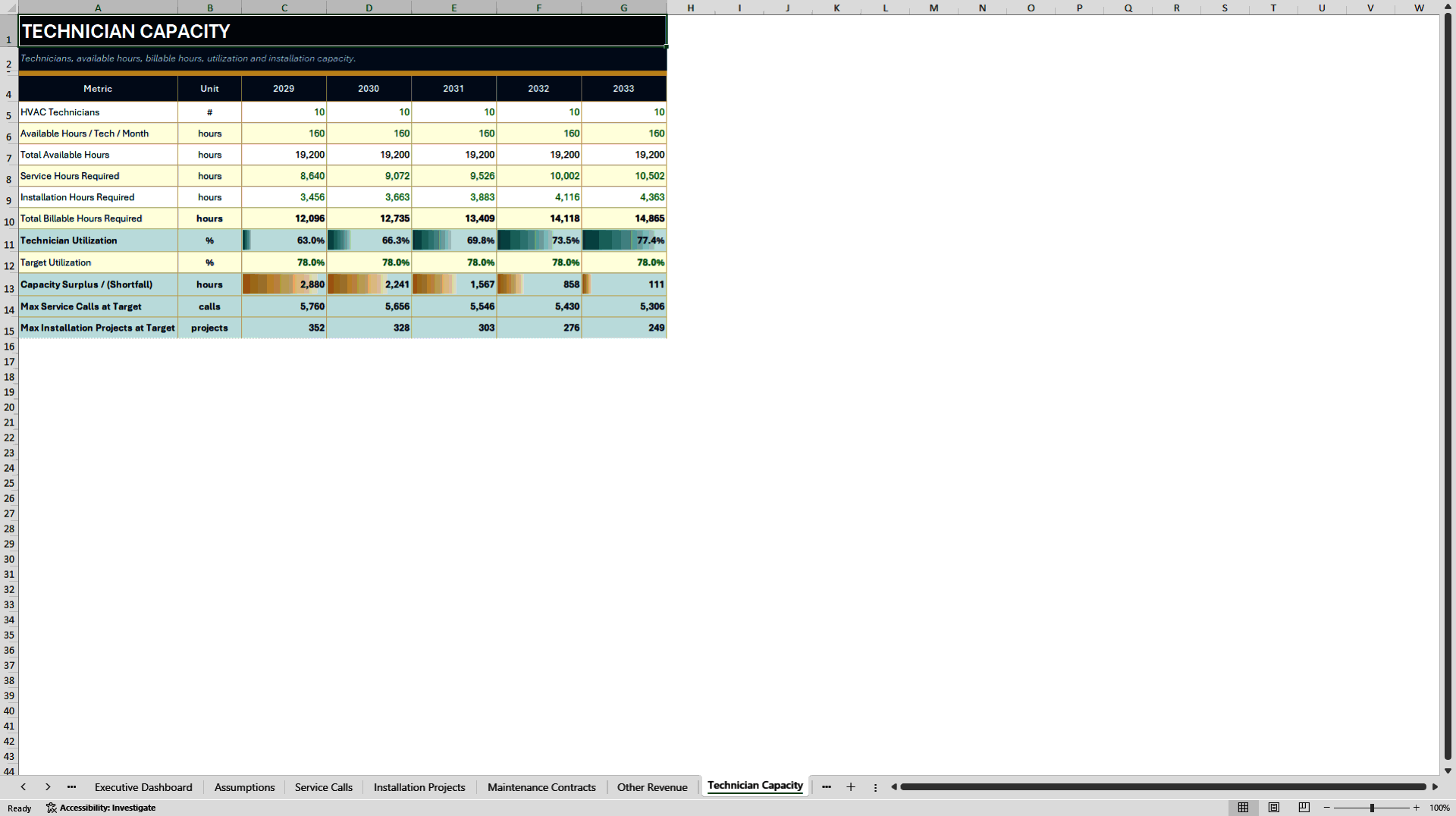
The Technician Capacity section connects workload with available field-service capacity.
Metrics include:
✓ HVAC Technician Headcount
✓ Available Hours per Technician
✓ Total Available Hours
✓ Service Hours Required
✓ Installation Hours Required
✓ Total Billable Hours Required
✓ Technician Utilization
✓ Target Utilization
✓ Capacity Surplus / Shortfall
✓ Maximum Service Call Capacity
✓ Maximum Installation Capacity
This helps users understand whether planned growth remains supportable within the modeled technician workforce.
🧰 MATERIALS & JOB COSTS
The model includes direct-cost assumptions for:
✓ Service Labor
✓ Installation Materials
✓ Maintenance Contracts
✓ Other Revenue
✓ Equipment and Job Costs
✓ Subcontractor-related costs where applicable
All assumptions are transparent and buyer-controlled rather than based on automatic industry benchmarks.
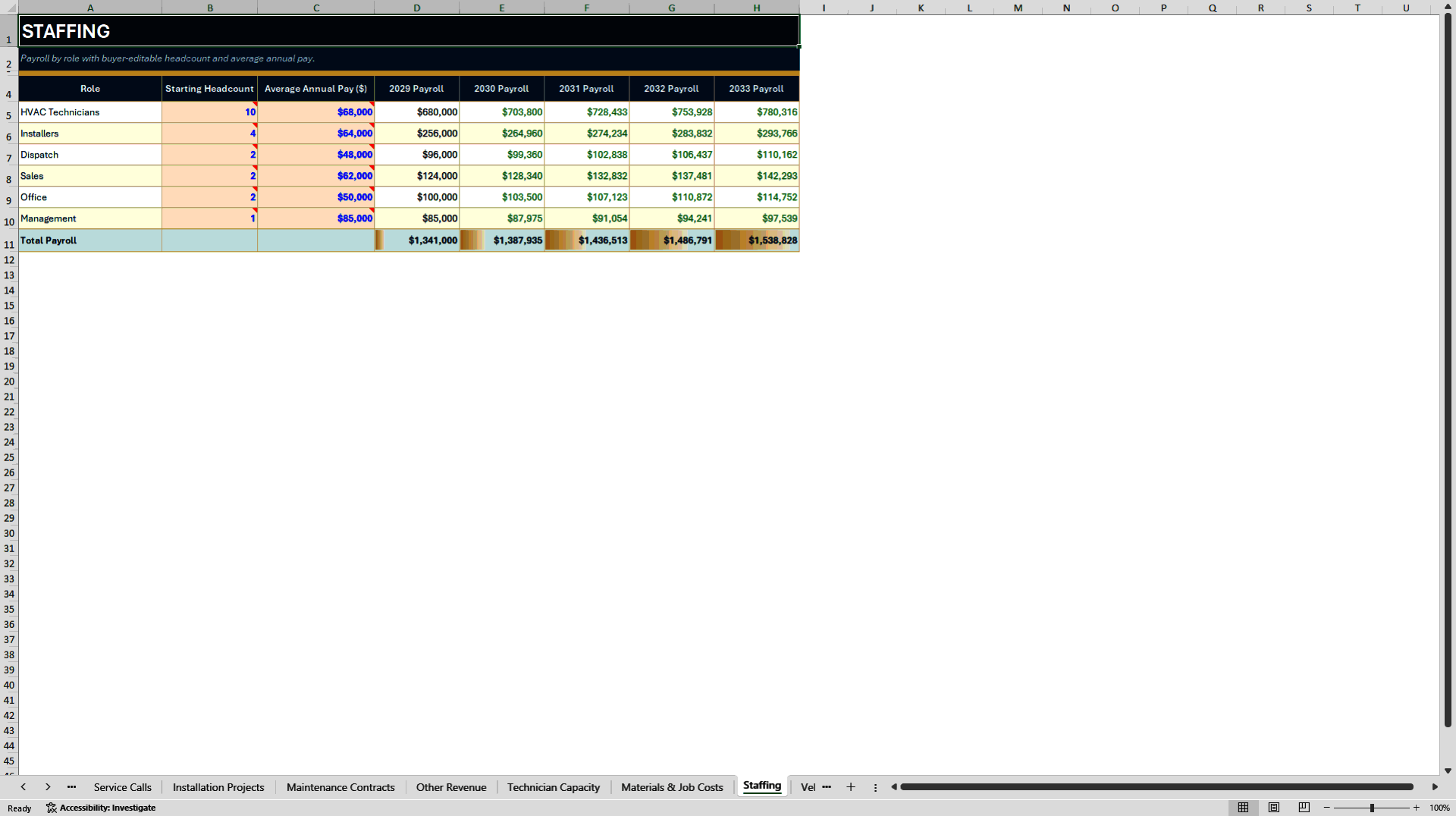
👥 STAFFING & PAYROLL
The staffing model supports workforce planning across roles such as:
✓ Technicians
✓ Installers
✓ Dispatch
✓ Sales
✓ Office / Administration
✓ Management
Payroll and annual wage-growth assumptions connect directly with the financial forecast.
🚐 VEHICLES & EQUIPMENT
HVAC-specific operating assets can be planned separately, including:
✓ Service Vans
✓ Tools
✓ Diagnostic Equipment
✓ Warehouse Equipment
✓ IT Equipment
✓ Replacement Investments
🏢 OPERATING EXPENSES
Operating expenses are modeled independently from direct job costs and payroll, helping users understand fixed and semi-fixed business costs.
🏗️ CAPEX, DEPRECIATION & DEBT
The model includes dedicated schedules for:
✓ Capital Expenditure
✓ Depreciation
✓ Existing Debt
✓ Interest Expense
✓ Principal Repayment
✓ Financing
These schedules flow into the three financial statements and liquidity forecast.
🧾 INTEGRATED THREE-STATEMENT MODEL
The workbook includes fully connected:
✓ Income Statement
✓ Balance Sheet
✓ Cash Flow Statement
Revenue, job costs, staffing, operating expenses, CapEx, working capital, debt, tax, and funding requirements flow through one integrated financial structure.
📅 MONTHLY & FIVE-YEAR FORECAST
The model combines:
✓ Monthly Forecast – Year 1
✓ Annual Forecast – Years 1 to 5
This provides detailed short-term planning together with a full five-year financial outlook.
📊 EXECUTIVE DASHBOARD
The Executive Dashboard consolidates important HVAC operating and financial KPIs.
Metrics include:
✓ Revenue
✓ EBITDA
✓ Ending Cash
✓ Gross Margin
✓ Technician Utilization
✓ Revenue per Technician
✓ Average Service Ticket
✓ Funding Required
The dashboard also provides visual five-year financial and operating trends for management review.
🎯 BREAK-EVEN ANALYSIS
The Break-Even section evaluates:
✓ Fixed Costs
✓ Gross Margin
✓ Break-Even Revenue
✓ Average Service Ticket
✓ Break-Even Service Calls
✓ Average Installation Revenue
✓ Break-Even Installation Jobs
This helps users understand the modeled business volume required to support the company's fixed-cost structure.
🔄 SCENARIO ANALYSIS
The model provides:
✓ Downside Case
✓ Base Case
✓ Upside Case
Scenario assumptions can vary:
✓ Service Volume
✓ Average Service Ticket
✓ Installation Volume
✓ Materials Cost
✓ Payroll
Outputs include Year 5 EBITDA and Ending Cash.
Scenarios are management-planning tools and are not market predictions.
🌡️ SENSITIVITY ANALYSIS
The sensitivity matrix evaluates how different combinations of:
✓ Technician Utilization
✓ Average Service Ticket
may affect projected Year 5 EBITDA.
This provides a clear view of the relationship between field-service capacity, pricing, and profitability while other modeled assumptions remain unchanged.
🏦 FUNDING REQUIREMENT
The Funding Requirement section evaluates liquidity against the defined Minimum Cash Balance.
It includes:
✓ Beginning Cash
✓ Operating Cash Flow
✓ CapEx
✓ Debt Principal
✓ Ending Cash Before New Funding
✓ Minimum Cash Balance
✓ External Funding Required
✓ Cash After Funding
This helps users identify whether the modeled business plan may require additional financing.
🖥️ 15-SLIDE INVESTOR / MANAGEMENT DECK
The included PowerPoint Deck provides a professional structure for communicating key operating assumptions, revenue drivers, technician capacity, profitability, cash flow, scenarios, and financial projections.
It can be adapted for management reviews, business-planning discussions, financing preparation, consultant deliverables, and professional presentations.
📘 28-PAGE HOW-TO-USE GUIDE
The detailed PDF guide explains the complete model workflow, including setup, assumptions, service revenue, installation projects, maintenance contracts, technician capacity, job costs, staffing, financial statements, Break-Even, Scenario Analysis, Sensitivity Analysis, KPIs, Funding Requirement, and Dashboard interpretation.
👥 WHO THIS MODEL IS FOR
✓ HVAC Contractors
✓ HVAC Service Companies
✓ Small and Mid-Sized Service Businesses
✓ HVAC Founders and Startups
✓ Business Owners
✓ Finance and Management Teams
✓ Consultants and Advisors
✓ Business Plan Preparation
✓ Funding Discussions
✓ Growth and Scenario Planning
💻 COMPATIBILITY
The primary model is provided in Microsoft Excel XLSX format.
Supplemental files include Microsoft PowerPoint PPTX and PDF.
The workbook may also be imported into Google Sheets where practical. Microsoft Excel remains the reference environment, and formatting or certain functionality may vary after import.
⚠️ IMPORTANT INFORMATION
This product is a financial-planning and business-modeling template. It does not contain technical HVAC installation, repair, maintenance, engineering, or safety instructions.
No external material prices, labor rates, or HVAC-industry pricing benchmarks are automatically embedded.
All sample figures and assumptions are illustrative and should be replaced with the user's own pricing, costs, staffing, capacity, financing, tax, and operating information.
⚖️ IMPORTANT DISCLAIMER
This product does not constitute financial, investment, tax, legal, accounting, valuation, engineering, HVAC technical, or other professional advice.
All forecasts and outputs depend on the assumptions entered by the user and do not guarantee future financial performance, financing approval, profitability, or business results.
Users remain responsible for reviewing all assumptions and outputs and should consult qualified professionals where appropriate.
All SheetworksStudio templates are independently created and unofficial. SheetworksStudio is not affiliated with, endorsed by, or sponsored by Microsoft, Google, or any other third-party brand.
Got a question about the product? Email us at support@flevy.com or ask the author directly by using the "Ask the Author a Question" form. If you cannot view the preview above this document description, go here to view the large preview instead.
Source: Best Practices in Construction, Integrated Financial Model Excel: HVAC Contractor Financial Model - 5-Year Forecast Excel (XLSX) Spreadsheet, SheetworksStudio
ABOUT THE AUTHOR

SheetworksStudio creates premium Excel-based business templates, dashboards, trackers, financial models, and management systems for professionals, consultants, entrepreneurs, and organizations.
Our portfolio covers finance, project management, operations, risk management, compliance, AI governance, HR, supply chain, performance management, and business planning. Each product is designed to
... [read more]
Ask the Author a Question
You must be logged in to contact the author.




























