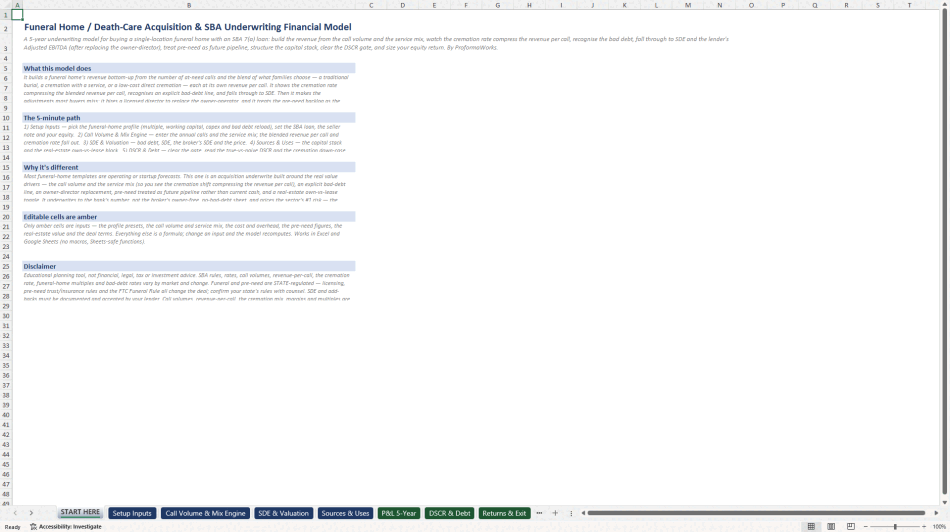
 Click main image to view in full screen.
Funeral Home Acquisition and SBA Underwriting Model – Excel XLSX
Excel (XLSX) + supplemental PDF


BENEFITS OF THIS DOWNLOADABLE EXCEL DOCUMENT
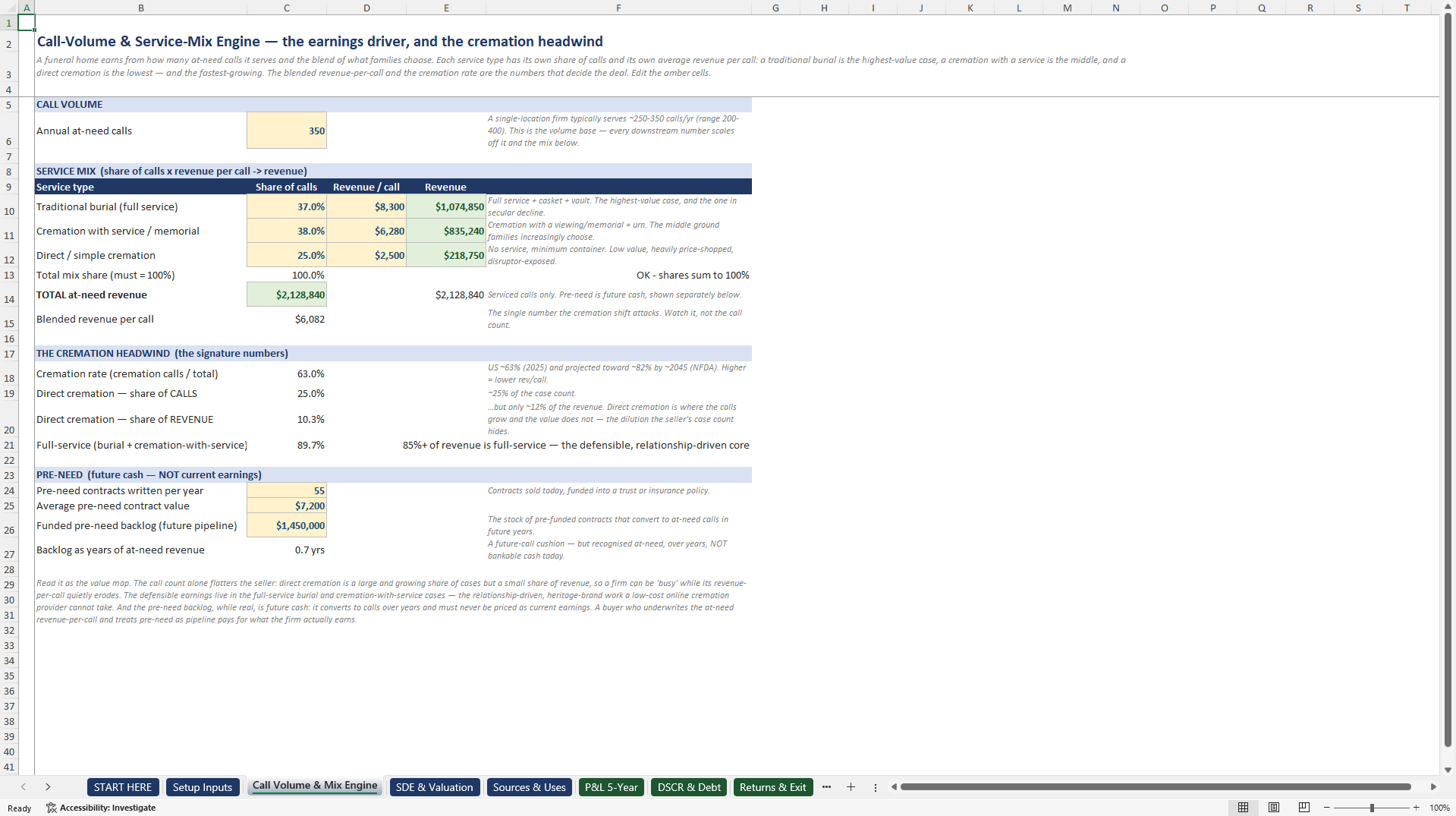
- Builds revenue from call volume times a blended revenue per call across traditional burial, cremation with service and direct cremation, so you underwrite the mix rather than the raw call count.
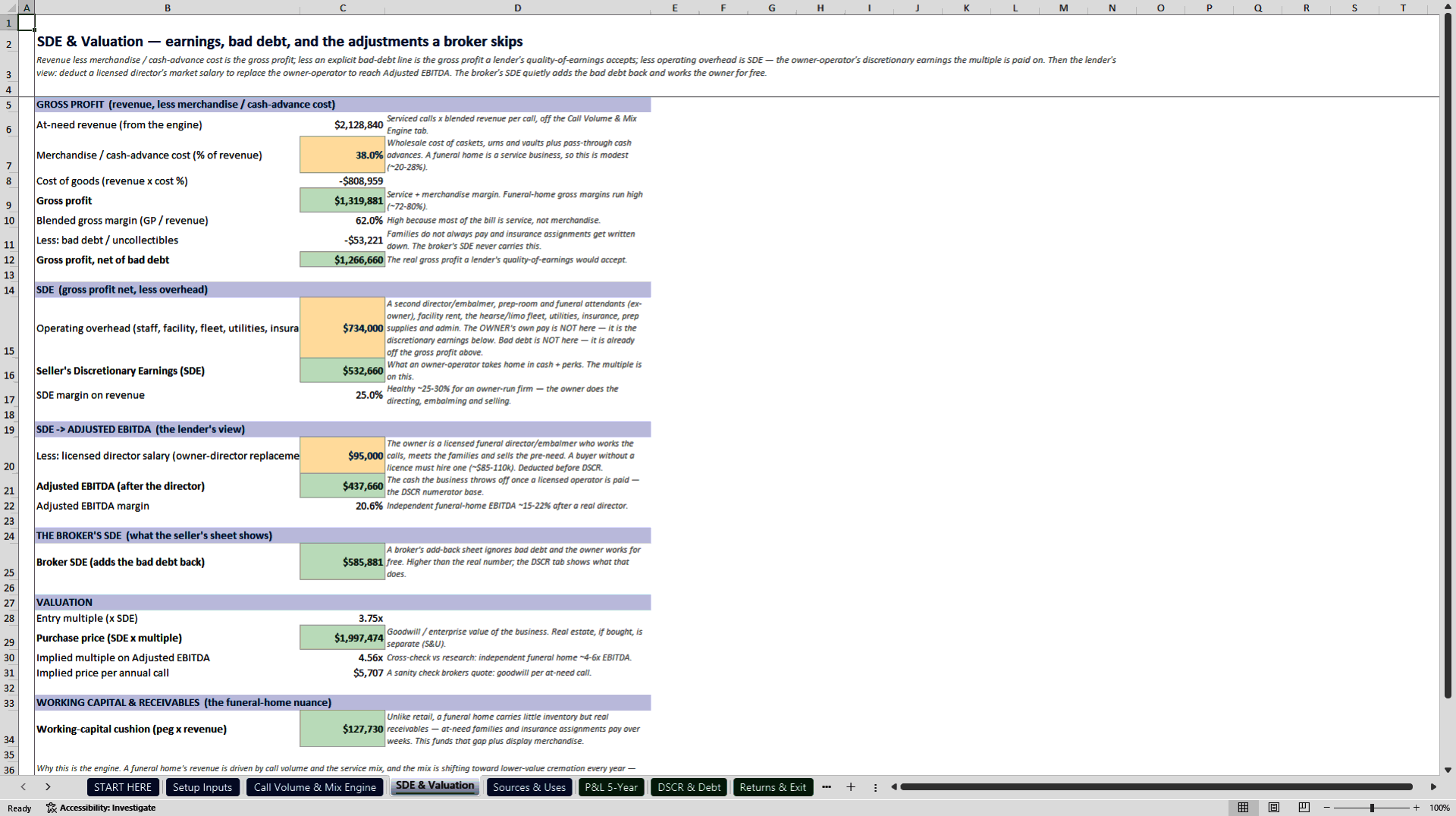
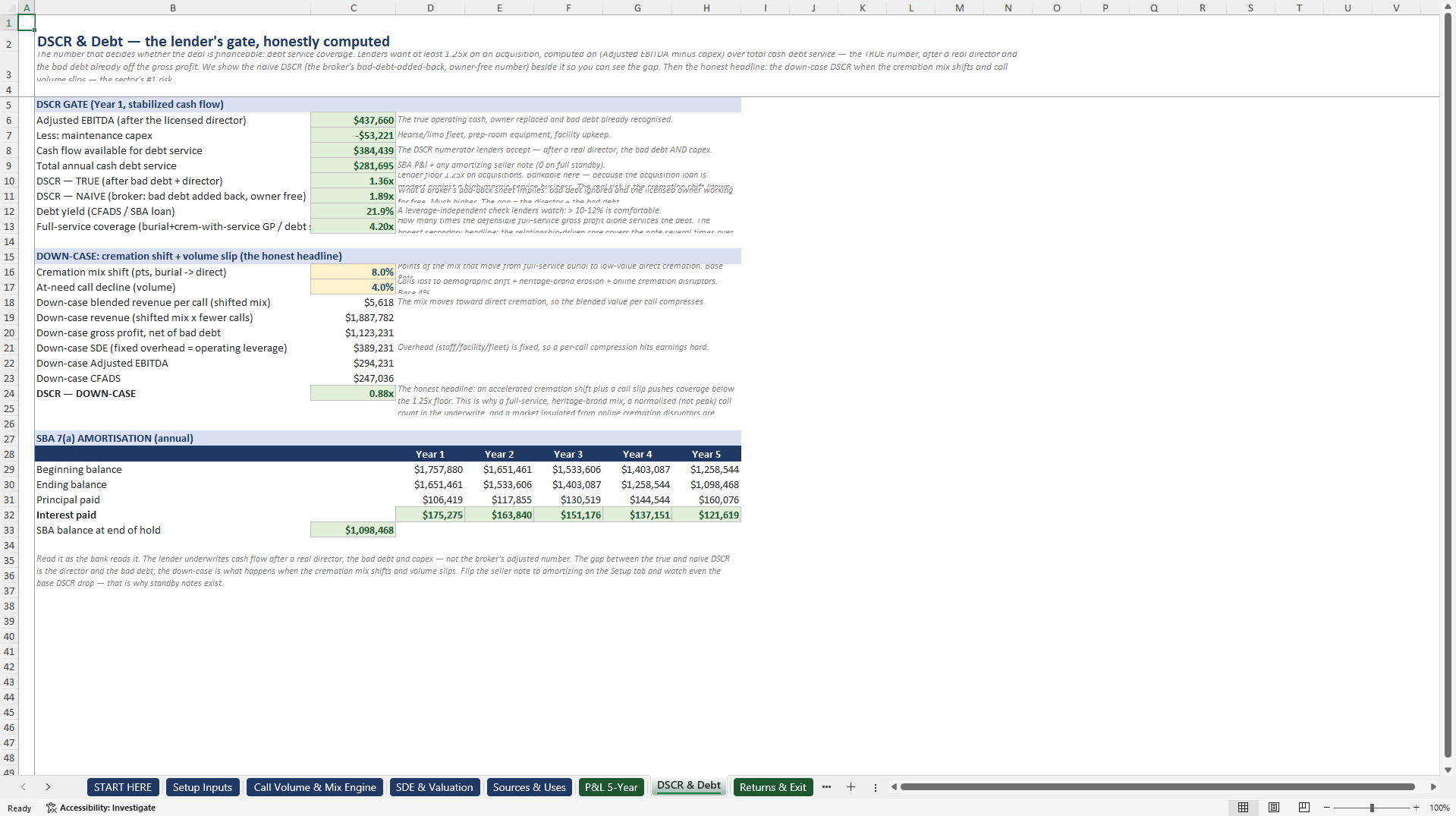
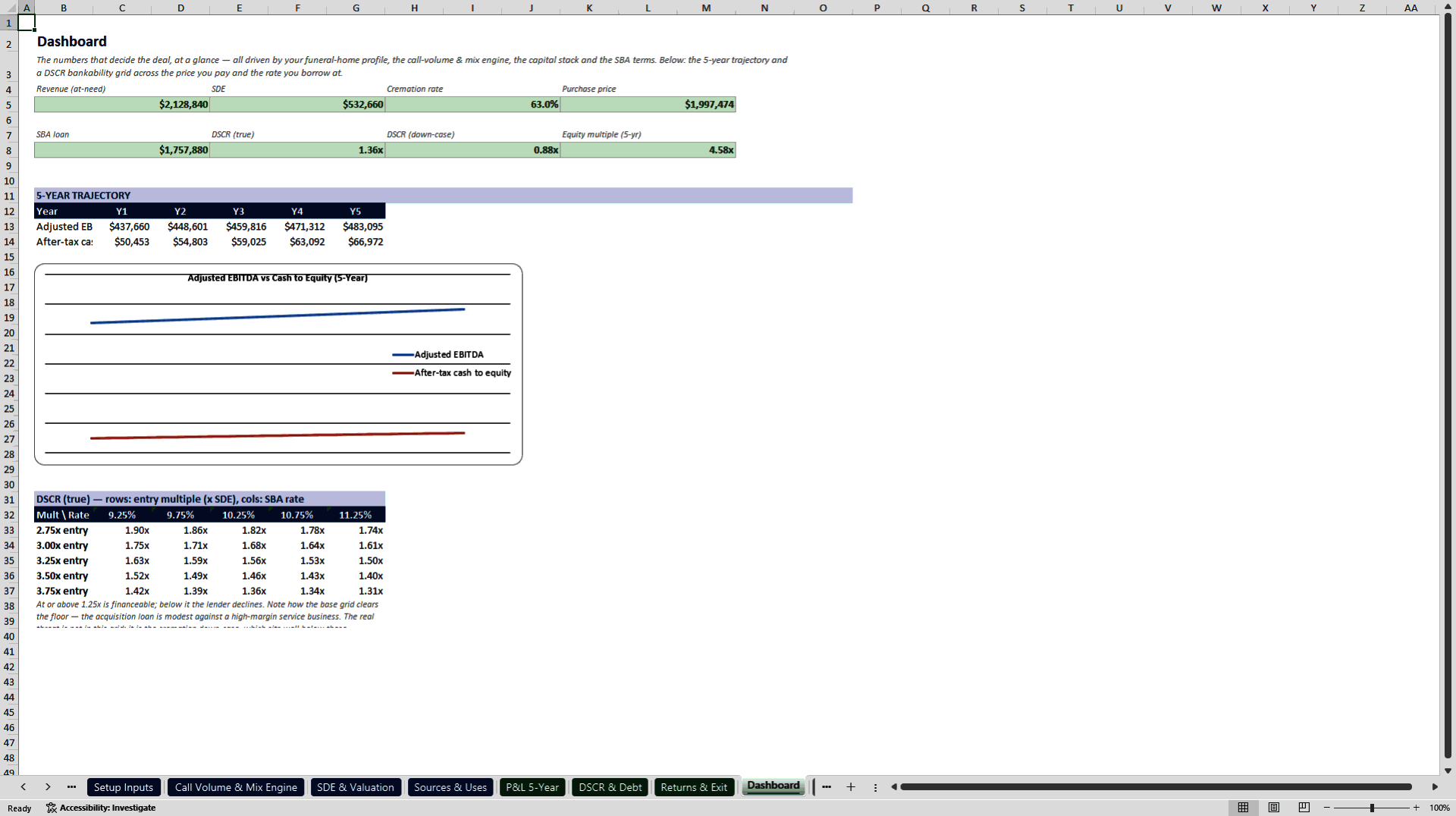
- Recognizes bad debt as an explicit line and hires a licensed funeral director to replace the working owner, producing a true DSCR of 1.36x against the naive 1.89x.
- Treats the pre-need backlog as future coverage funded into trust or insurance rather than current cash flow, so you do not pay a current-earnings multiple on it.
INTEGRATED FINANCIAL MODEL EXCEL DESCRIPTION
Most funeral-home templates are startup or operating forecasts, and most brokers headline a call count. But the earnings of a single-location funeral home hinge on revenue per call, and the service mix is moving. This is a five-year, lender-ready model for buying one location with an SBA 7(a) loan, and it reads the firm the way a disciplined buyer and a lender do: on blended revenue per call, on normalized SDE, and on the trend.
The engine is call volume times a blended revenue per call built from three service types, each at its own price: a traditional burial, a cremation with a service, and a low-cost direct cremation. On the base case the blended revenue per call is about $6,082 at a cremation rate of about 63%. Direct cremation is roughly 25% of the calls but only about 10% of the revenue, which is the value dilution a seller's raw call count hides. The US cremation rate is around 63% and rising toward roughly 82% by the mid-2040s according to NFDA, so a firm can look busy while its revenue per call quietly erodes.
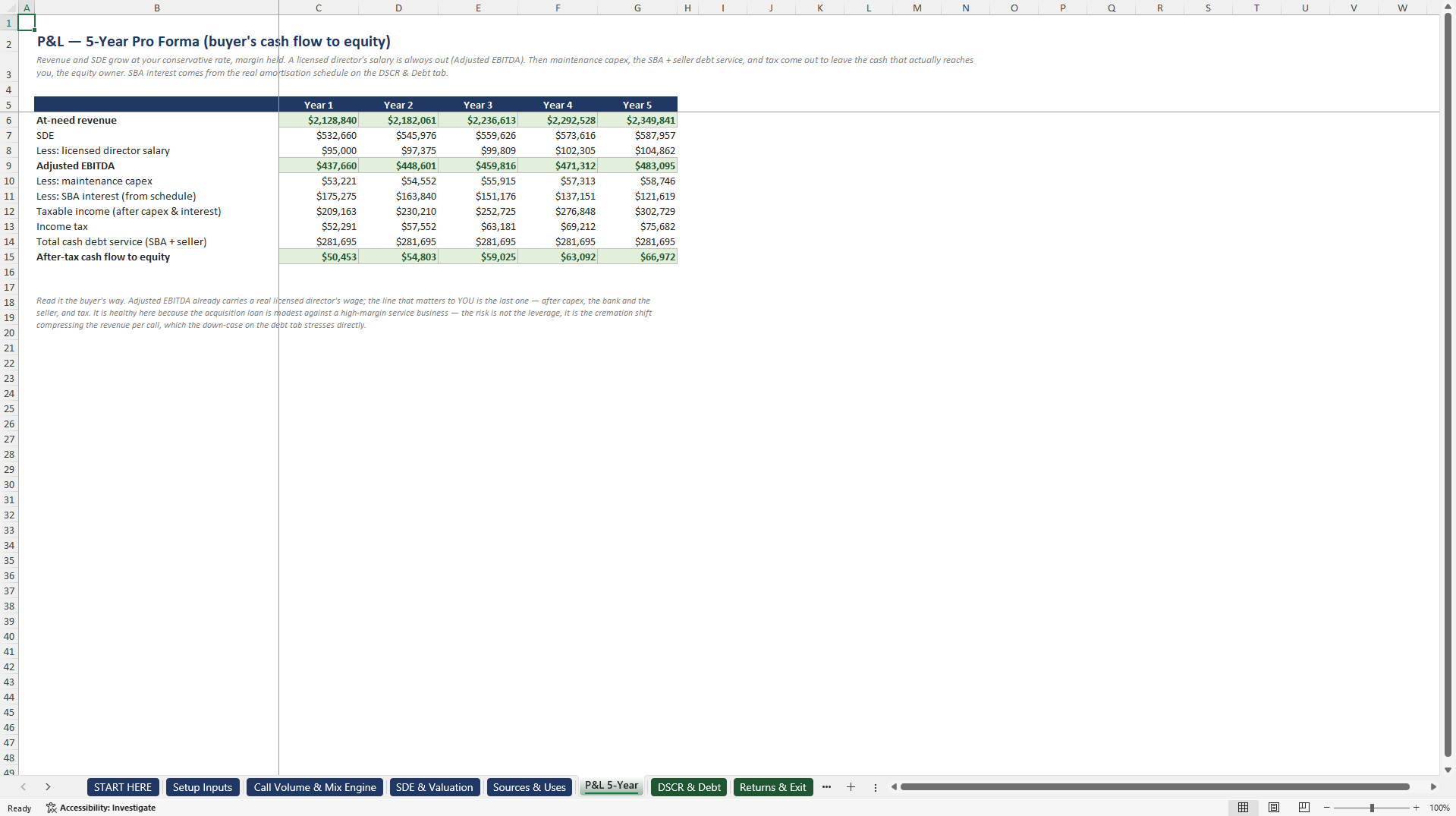
Three corrections separate this from a broker's sheet. Bad debt and uncollectibles are recognized as an explicit line, because families do not always pay and insurance assignments get written down. A licensed funeral director is hired to replace the owner who works the calls, meets the families and sells pre-need. And the price is set on SDE after both, not on the seller's owner-free, no-bad-debt number. The result is a true DSCR of 1.36x printed next to the naive broker DSCR of 1.89x; the gap is the director and the bad debt.
Pre-need is treated as pipeline, not cash. The backlog is real, but it is funded into a trust or an insurance policy and recognized at need, over years. A lender will not treat it as today's cash flow and you should not pay a current-earnings multiple on it, so the model prices the at-need business and shows the backlog separately as future coverage. A toggle switches between a leasehold base case, with rent in overhead and a ten-year term, and a fee-simple purchase of the building and any crematory, added to the uses on a twenty-five-year term.
The down-case is the one that matters in this sector: an eight-point mix shift toward direct cremation plus a 4% call slip drops coverage to 0.88x, below the 1.25x floor, because staff, facility and fleet costs are fixed. Profitable today, under pressure as cremation rises.
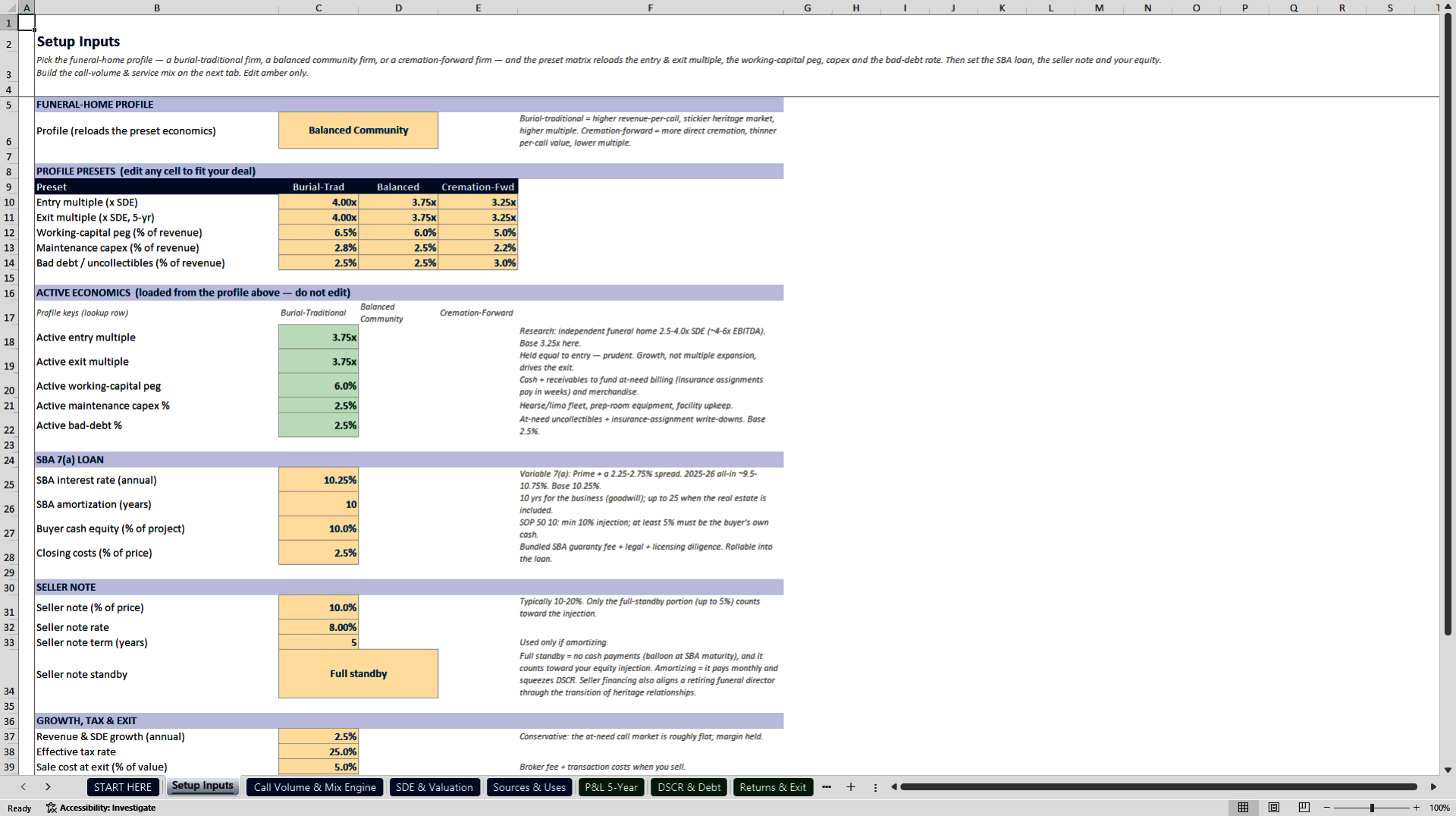
Ten sheets, every calculation a formula, Google Sheets safe and no macros, plus a PDF user guide of more than twenty pages and a benchmarks sheet with sourced ranges. Three firm profiles, burial-traditional, balanced community and cremation-forward, reload the multiple, the working-capital peg, capex and the bad-debt rate. No IRR is printed, deliberately, because on one small deal it is hostage to the exit multiple. Educational planning tool, not financial, legal, tax or investment advice.
Got a question about the product? Email us at support@flevy.com or ask the author directly by using the "Ask the Author a Question" form. If you cannot view the preview above this document description, go here to view the large preview instead.
Source: Best Practices in Integrated Financial Model Excel: Funeral Home Acquisition and SBA Underwriting Model Excel (XLSX) Spreadsheet, ProformaWorks
ABOUT THE AUTHOR
ProformaWorks builds acquisition-grade financial models for Main Street and lower-middle-market businesses - the kind of deal financed with an SBA 7(a) loan or a small commercial facility.
Every model answers one question: does this deal pencil at the bank? That means SDE or NOI rebuilt from the seller's own numbers, the add-backs a lender will and will not accept, a debt-service
... [read more]
Ask the Author a Question
You must be logged in to contact the author.




























