
 Click main image to view in full screen. Unlock all 9 preview images:
Farm & Ranch Acquisition Underwriting Model – Excel XLSX
Excel (XLSX) + supplemental PDF


BENEFITS OF THIS DOWNLOADABLE EXCEL DOCUMENT
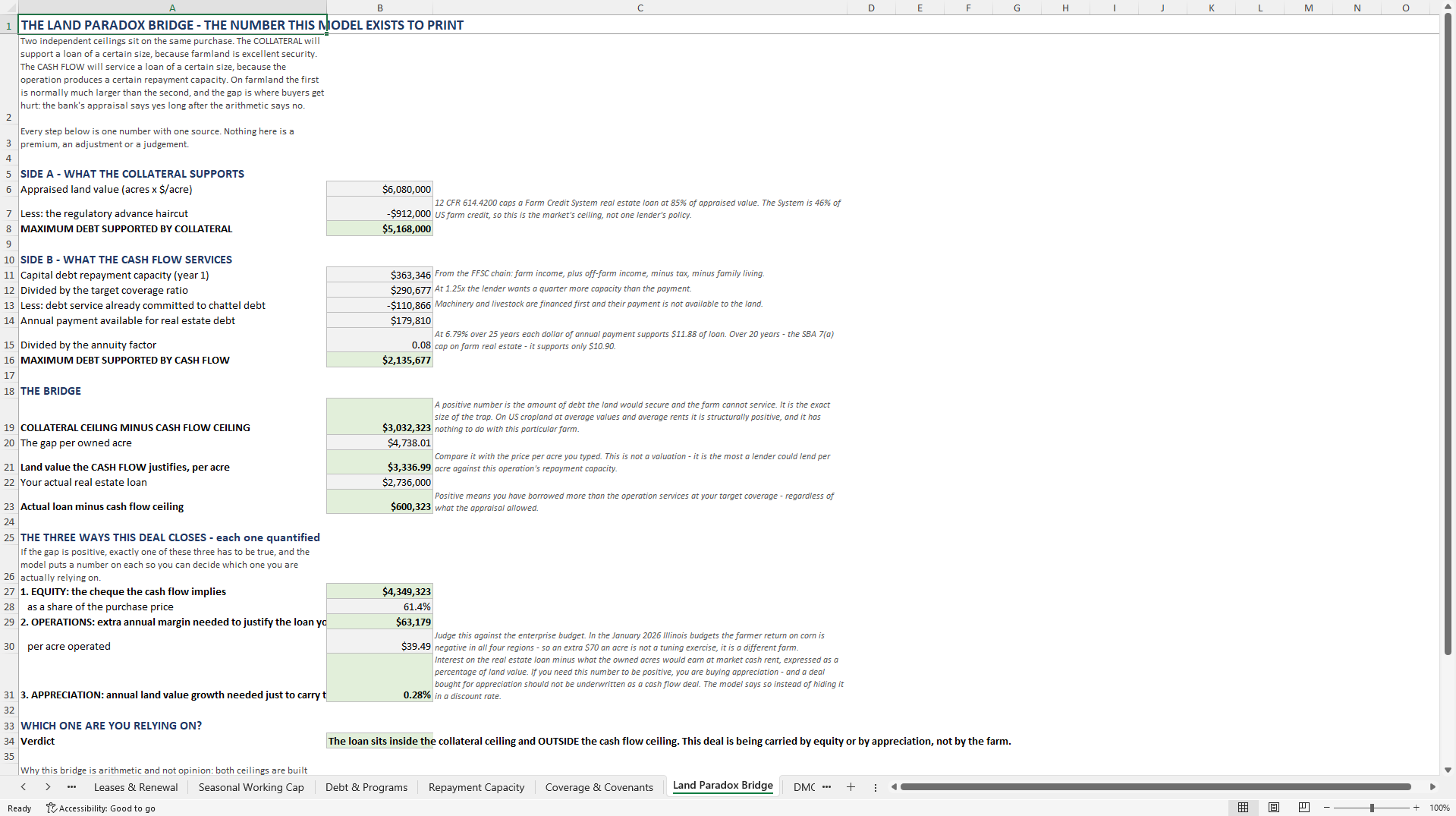
- Prints, in dollars, the gap between the debt your collateral supports and the debt your cash flow can service.
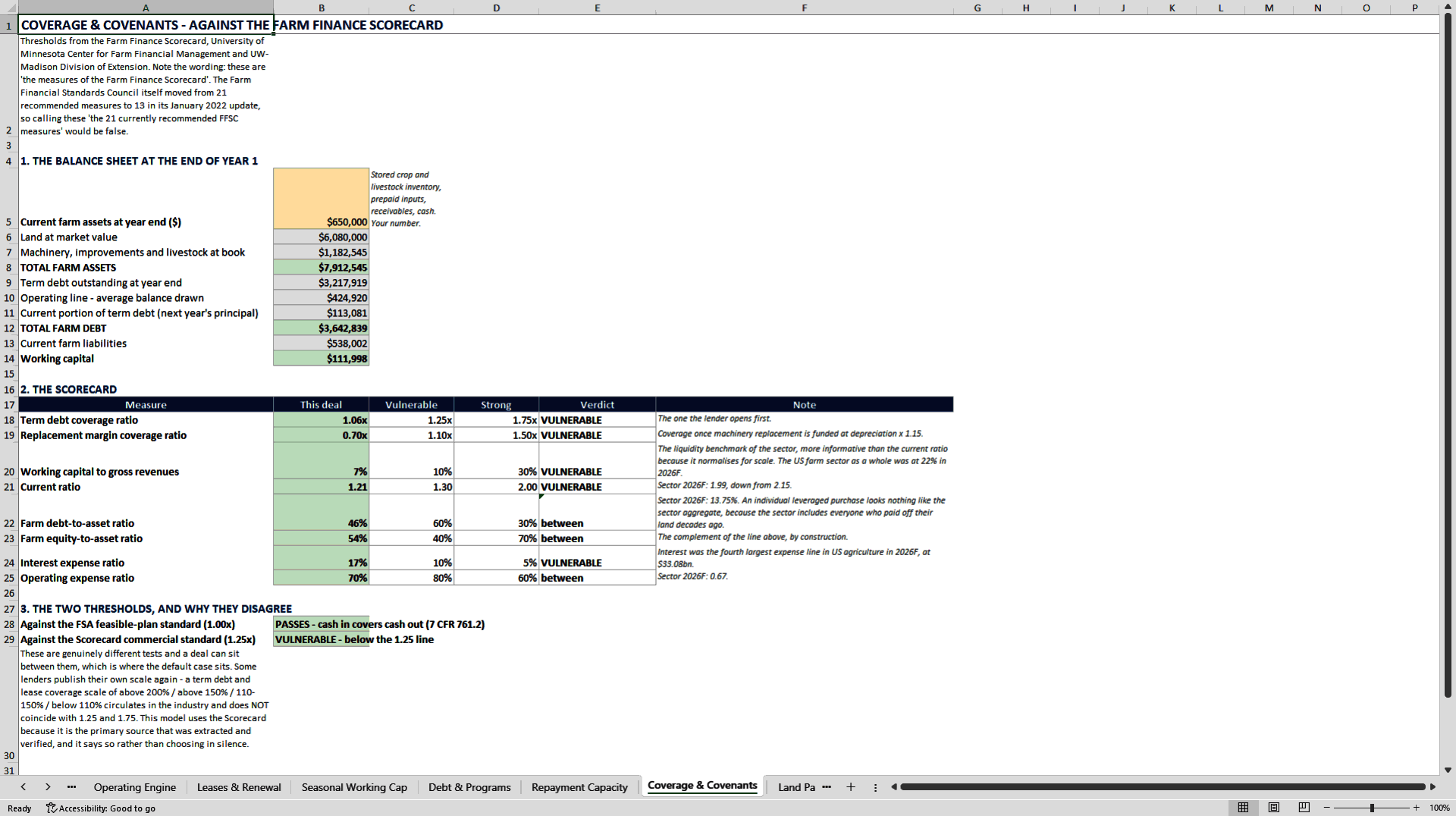
- Uses the Farm Financial Standards Council term debt coverage ratio instead of a corporate DSCR, and shows how much the corporate ratio overstates repayment capacity.
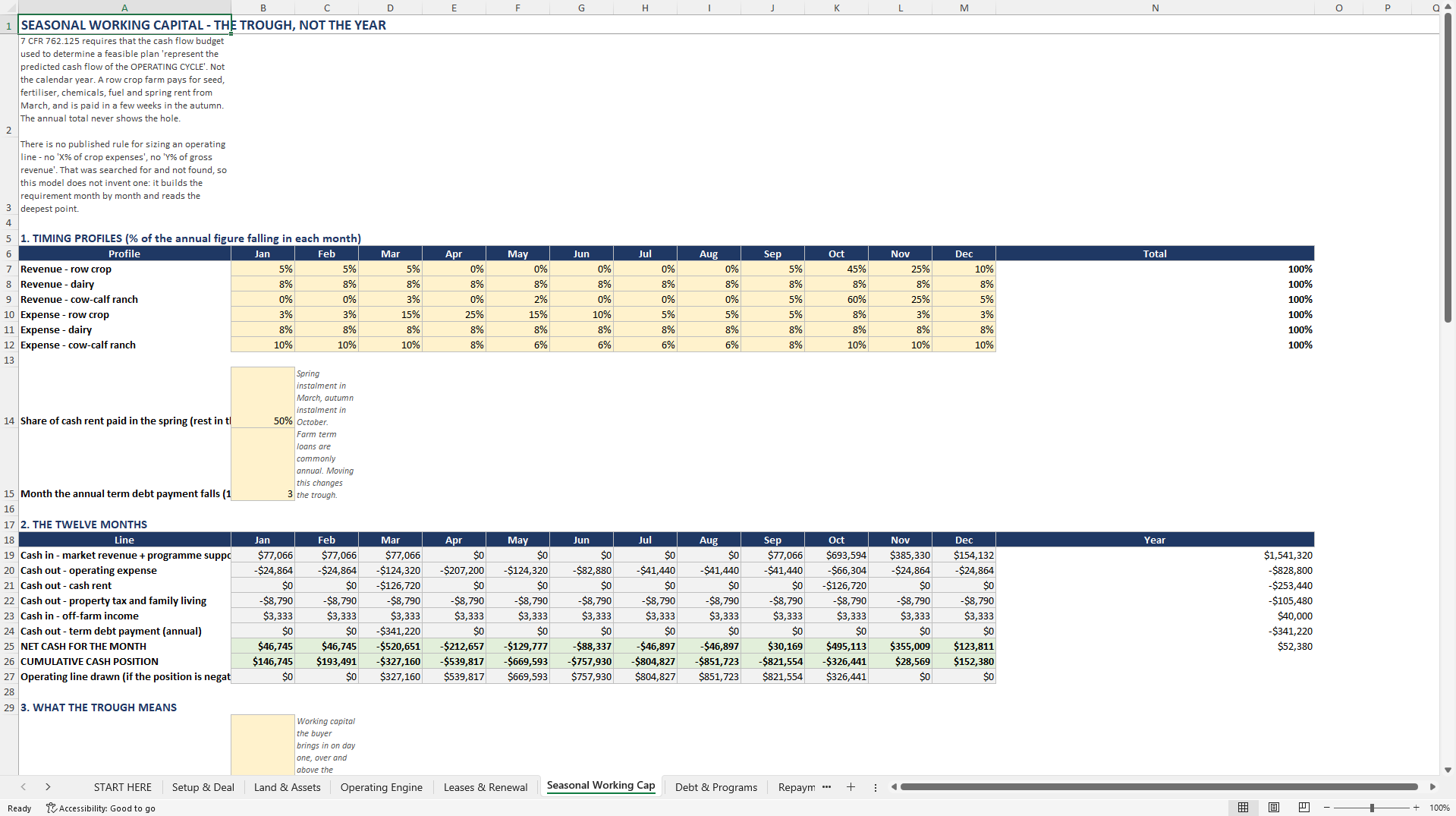
- Sizes the operating line on the intra-year cash trough, as the FSA regulation requires, instead of on an annual total that never goes negative.
AGRICULTURE INDUSTRY EXCEL DESCRIPTION
Every farm template on the market is a ten-year forecast for someone who is STARTING a farm. This one underwrites the purchase of a farm that already exists, the way the lender will.
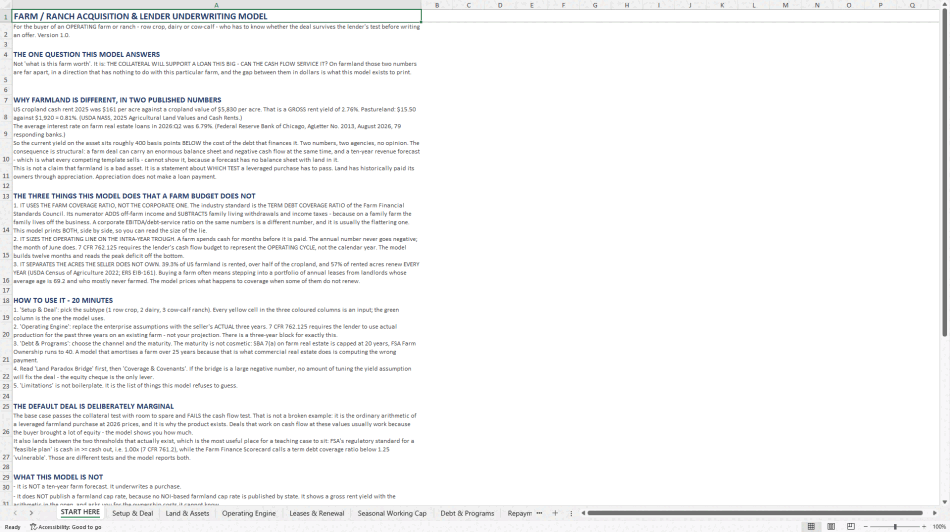
It is built around two published numbers. United States cropland rented for 161 dollars an acre in 2025 against a cropland value of 5,830 dollars an acre, which is a gross rent yield of 2.76 percent (USDA National Agricultural Statistics Service). The average interest rate on farm real estate loans in the second quarter of 2026 was 6.79 percent (Federal Reserve Bank of Chicago, AgLetter No. 2013, 79 responding banks). The current income of the asset therefore sits roughly four hundred basis points below the cost of the debt that finances it. Two numbers, two agencies, no opinion in between. The consequence is structural: a farm deal can carry an enormous balance sheet and negative cash flow at the same time, and a revenue forecast cannot show that, because a forecast has no balance sheet with land in it.
So the model prints two ceilings on the same purchase. What the COLLATERAL supports, capped at the 85 percent loan-to-value limit of 12 CFR 614.4200. And what the CASH FLOW services, built from the Farm Financial Standards Council capital debt repayment capacity at your target coverage. The gap between them, in dollars, tells you whether the deal is being carried by the farm, by your equity, or by an expectation of appreciation. Neither side contains a risk premium or a discount rate: one is a regulation, the other is a published definition and an annuity factor.
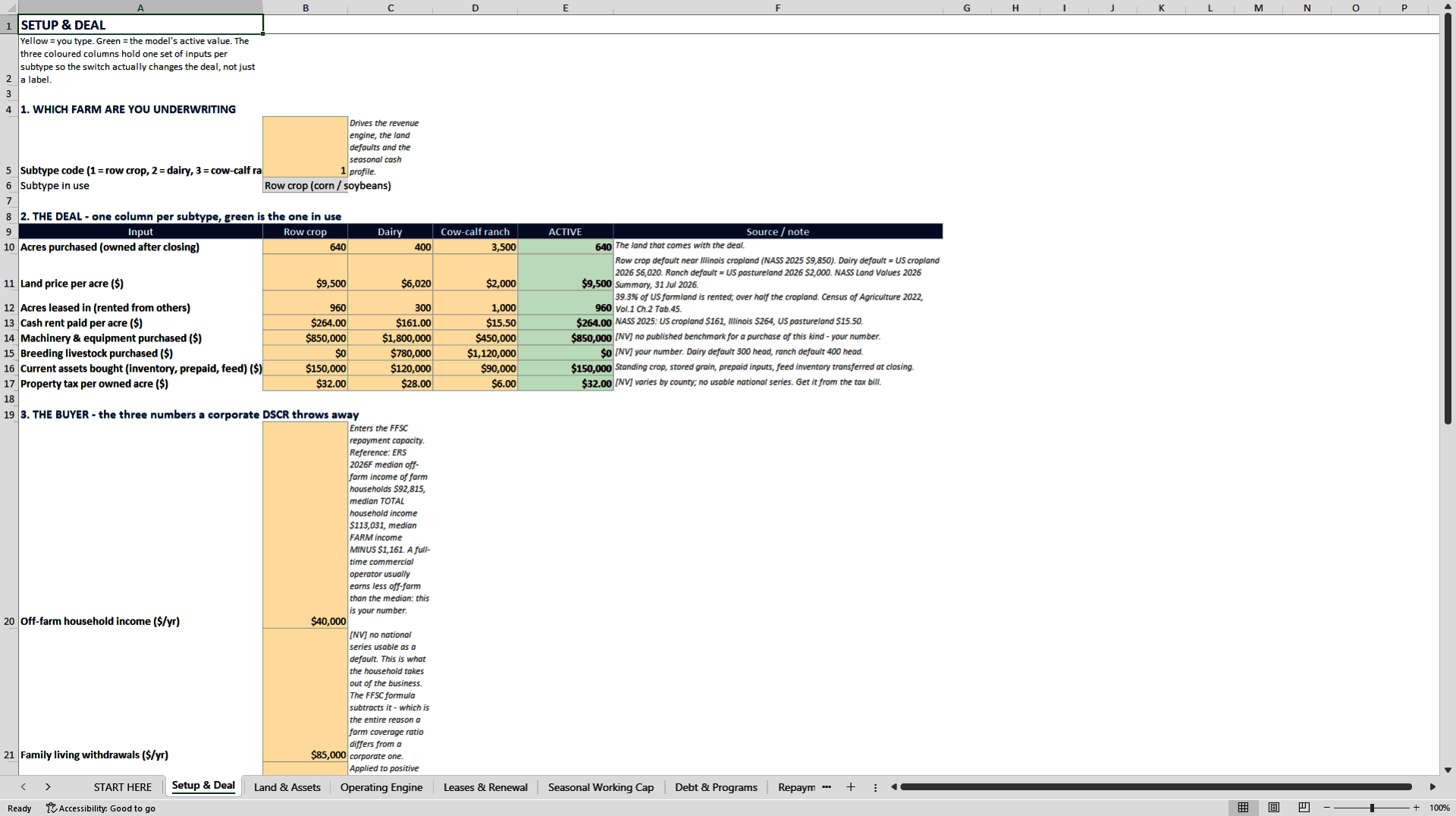
Three things it does that a farm budget does not. It uses the TERM DEBT COVERAGE RATIO, whose numerator adds off-farm income and subtracts family living withdrawals and income taxes, and it prints the corporate DSCR beside it so you can read the size of the overstatement on identical numbers. It builds twelve months of cash and sizes the operating line on the intra-year trough, because 7 CFR 762.125 requires the lender to model the operating cycle rather than the calendar year. And it separates the acres the seller does not own: 39.3 percent of United States farmland is rented and 57 percent of rented acres renew every single year, so the model prices what a failed renewal does to coverage.
Government payments sit on their own line and coverage is reported without them. They were 28.9 percent of United States net farm income in the 2026 forecast against 7.9 percent in 2024, and roughly 78 percent of the 2026 figure was ad hoc rather than programmatic.
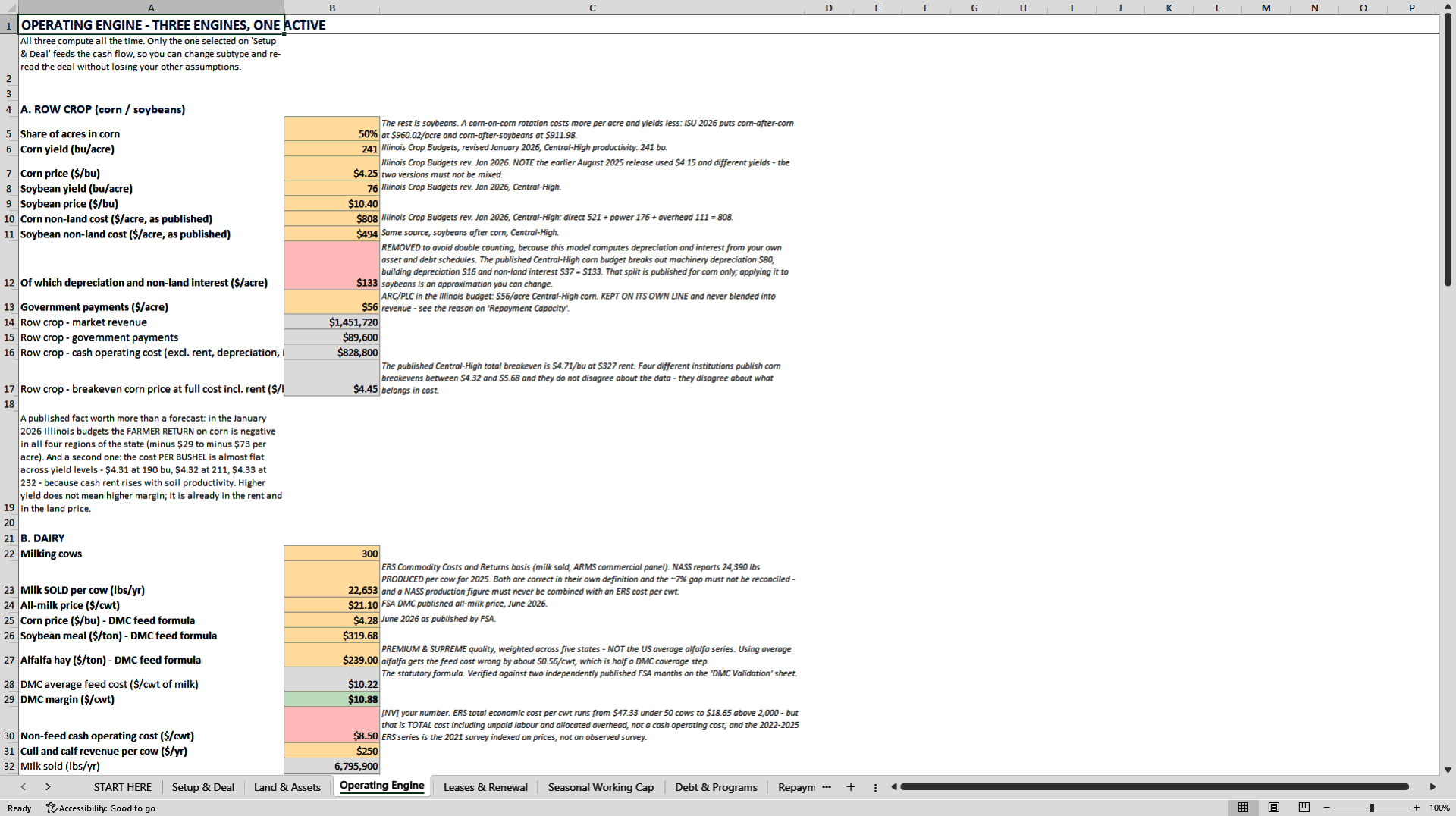
Three subtypes run on one switch: row crop, dairy and cow-calf ranch, each with its own revenue engine and its own set of inputs. The dairy feed-cost engine reproduces two months of Dairy Margin Coverage values published independently by USDA Farm Service Agency, to the cent, on a sheet you can check rather than trust.
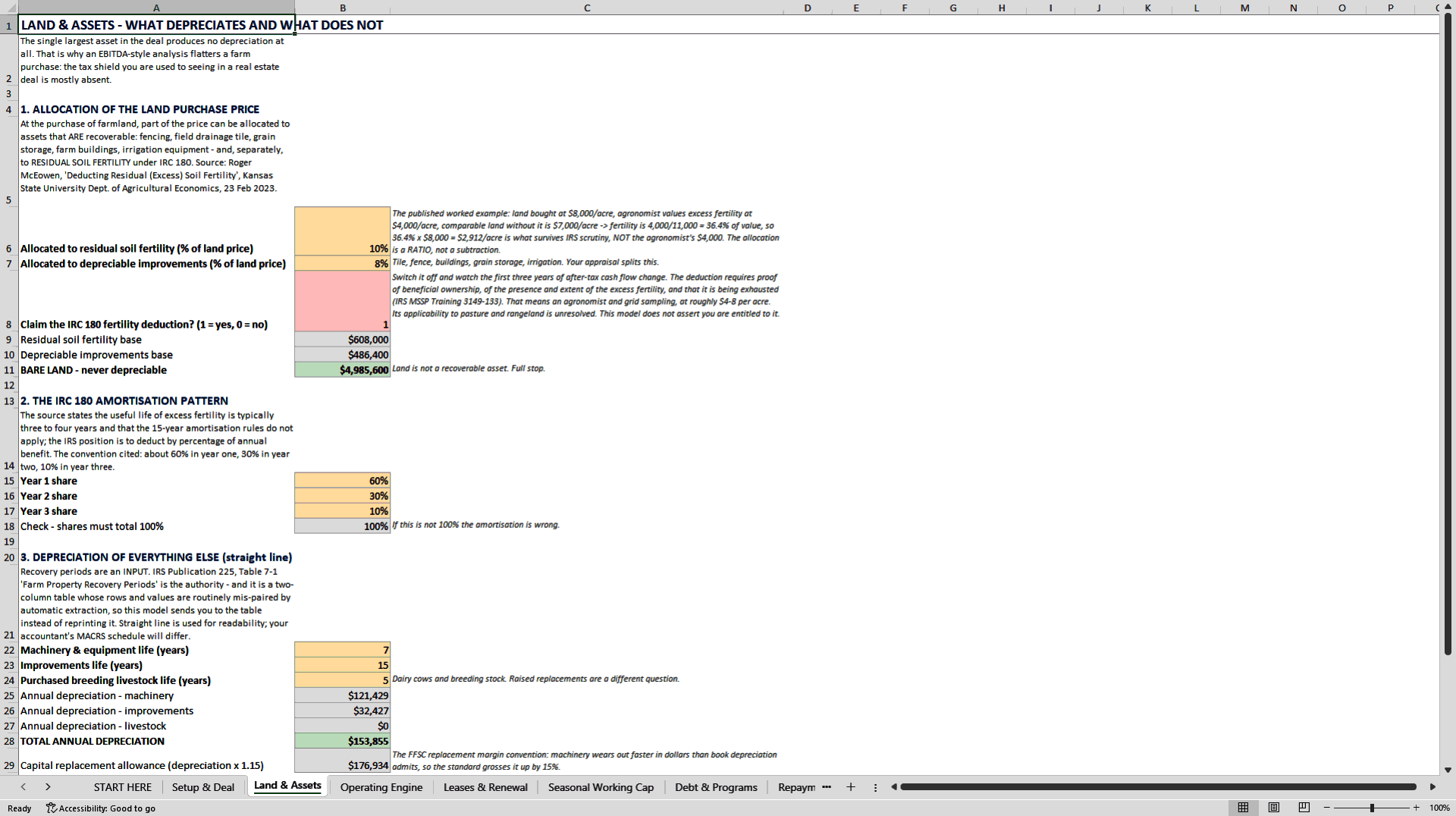
Fourteen sheets. Excel and Google Sheets, no macros, no external links, no iterative calculation. Every benchmark carries its source and its date, and where no published benchmark exists the sheet says so instead of inventing one: no farmland capitalisation rate, no acres per animal unit, no operating line sizing rule.
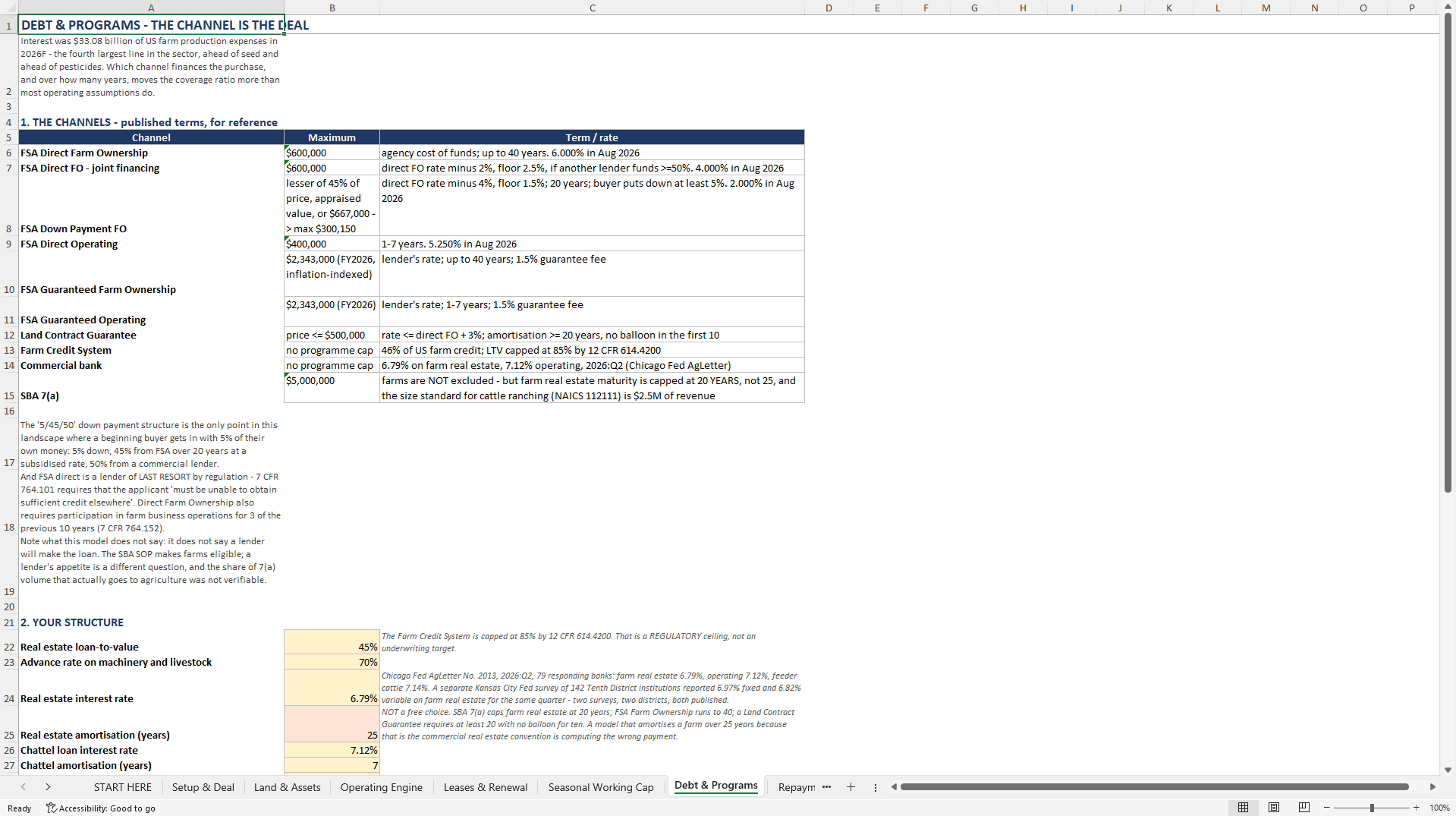
The second document included with this workbook is a nine-page user guide in PDF, which walks through the bridge, the repayment capacity chain, the financing channels and their maturities, the seasonal cash cycle, and the list of things the model deliberately refuses to guess.
Got a question about the product? Email us at support@flevy.com or ask the author directly by using the "Ask the Author a Question" form. If you cannot view the preview above this document description, go here to view the large preview instead.
Source: Best Practices in Agriculture Industry, Integrated Financial Model Excel: Farm & Ranch Acquisition Underwriting Model Excel (XLSX) Spreadsheet, ProformaWorks
ABOUT THE AUTHOR
ProformaWorks builds acquisition-grade financial models for Main Street and lower-middle-market businesses - the kind of deal financed with an SBA 7(a) loan or a small commercial facility.
Every model answers one question: does this deal pencil at the bank? That means SDE or NOI rebuilt from the seller's own numbers, the add-backs a lender will and will not accept, a debt-service
... [read more]
Ask the Author a Question
You must be logged in to contact the author.




























