 Click main image to view in full screen. Unlock all 15 preview images:
Direct Lithium Extraction & Geothermal Brine Model – Excel XLSX
Excel (XLSX) + supplemental PDF


BENEFITS OF THIS DOWNLOADABLE EXCEL DOCUMENT
- Model 25 years of brine supply, lithium extraction, recovery efficiency and carbonate/hydroxide production with 300 monthly financial periods.
- Connect optional geothermal energy, lithium sales, operating costs and CAPEX with debt financing, three financial statements, NPV, IRR and DSCR.
- Test five selectable operating scenarios, explore indicative sensitivities and identify liquidity gaps, recovery risks and financing pressure.
MINING INDUSTRY EXCEL DESCRIPTION
◈ DIRECT LITHIUM EXTRACTION & GEOTHERMAL BRINE | 25-YEAR PREMIUM FINANCIAL MODEL
Brine Resource Economics • Lithium Recovery • Chemical Conversion • Geothermal Integration • Project Finance
ONE RESOURCE FLOW. TWO LITHIUM PRODUCT ROUTES. TWENTY-FIVE YEARS OF CONNECTED FINANCIAL PLANNING.
How much lithium can a geothermal brine resource deliver? How do recovery efficiency, processing capacity and product conversion affect commercial output? What happens to project economics when lithium prices decline, chemical costs rise or construction is delayed?
The Direct Lithium Extraction & Geothermal Brine Financial Model by SheetworksStudio connects these questions in a structured, editable Excel financial planning system.
Developed for lithium project developers, geothermal brine operators, critical mineral analysts, infrastructure investors and finance professionals, the model connects resource throughput, lithium recovery, chemical production, optional geothermal energy and long-term financing.
The workbook contains 25 connected worksheets, 300 monthly forecast periods, 25 annual summaries, five selectable scenarios, eight native Excel dashboard charts and dedicated financial statements.
All included resource data, project costs, operating assumptions and financial projections are fictional and illustrative.
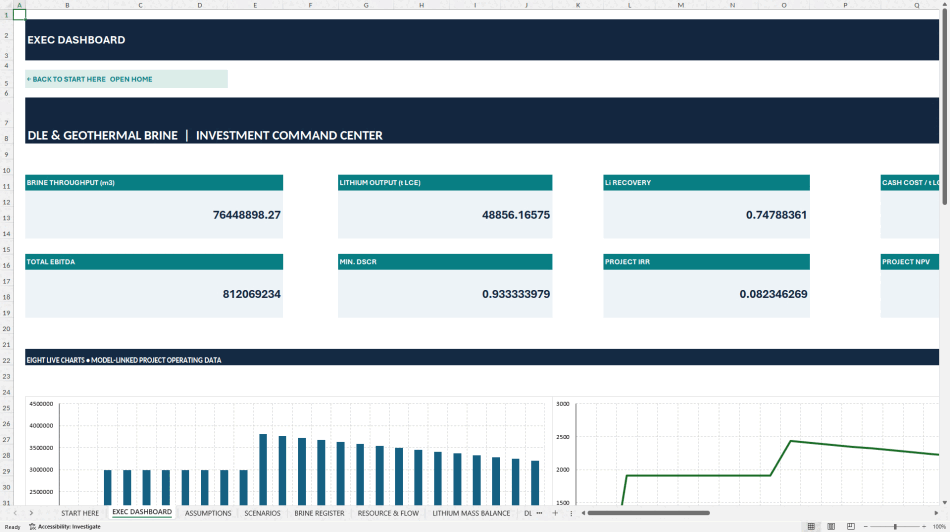
📊 01 | EXECUTIVE DASHBOARD & EIGHT NATIVE CHARTS
The Executive Dashboard brings physical production and financial performance into one coordinated management view.
Eight executive KPI fields include:
• Brine Throughput
• Lithium Production
• Lithium Recovery Efficiency
• Unit Production Costs
• Project EBITDA
• Debt Service Coverage Ratio
• Internal Rate of Return
• Net Present Value
Eight native Excel charts present production, commercial revenue, operating costs, capital expenditure, cash flow, financing and scenario economics.
The dashboard is connected to the workbook's calculation schedules rather than relying on manually prepared presentation figures.
Use the dashboard to assess how resource and commercial assumptions influence the long-term financial outlook.
⚙️ 02 | BRINE RESOURCE REGISTER & SUPPLY PLANNING
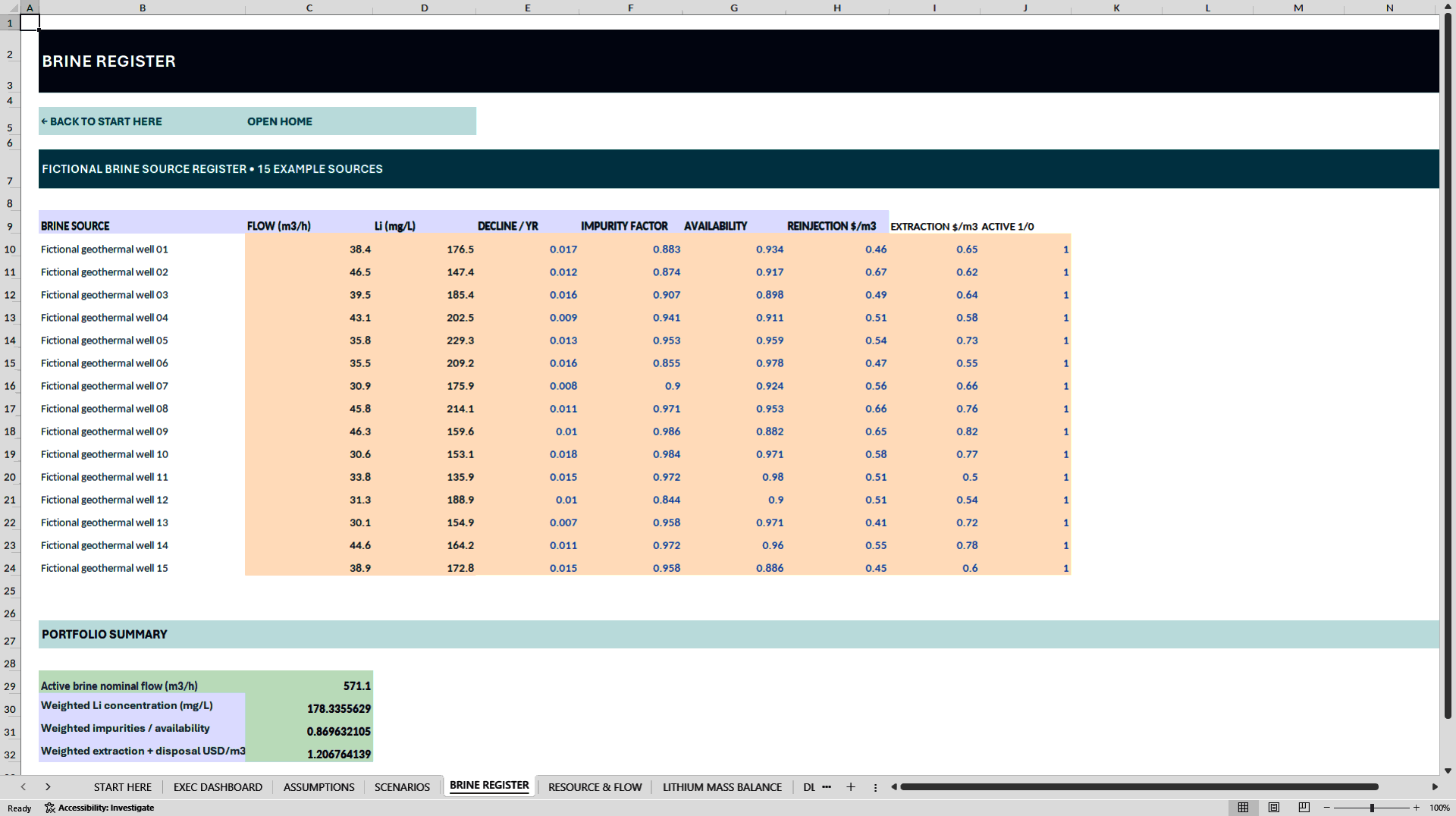
The BRINE REGISTER includes 15 fictional resource records.
Configure individual brine sources using assumptions such as:
• Brine Flow Rate
• Lithium Concentration
• Operating Availability
• Resource Decline
• Impurity Factors
• Brine Extraction Costs
• Reinjection Costs
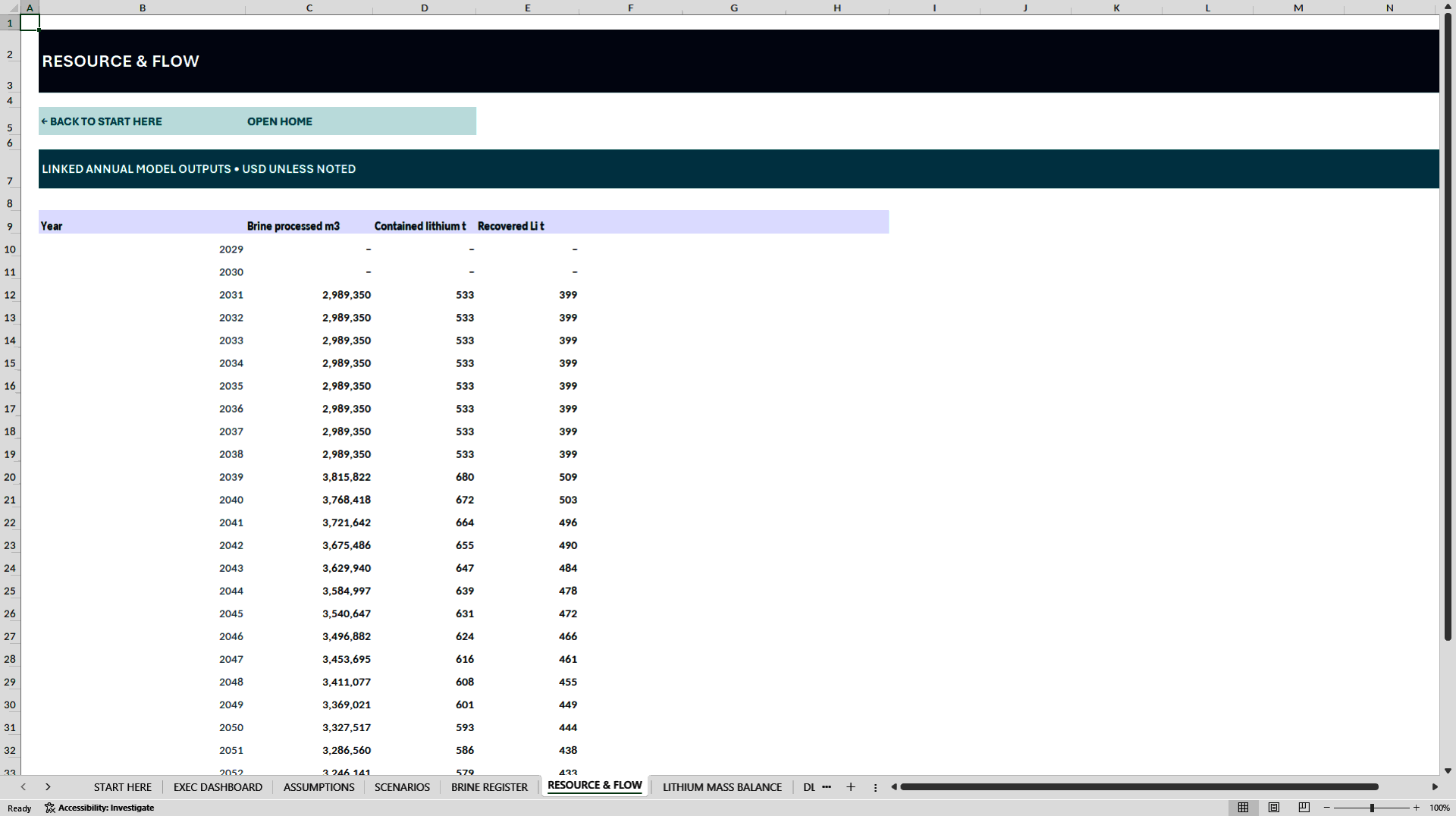
The RESOURCE & FLOW worksheet connects these inputs with the available processing resource.
The model distinguishes gross available brine from the quantity that can be processed under installed equipment capacity constraints.
These calculations support preliminary project evaluation and resource-based financial planning.
They do not establish mineral resources or reserves under a certified reporting standard.
🔬 03 | LITHIUM MASS BALANCE & RECOVERY
The LITHIUM MASS BALANCE worksheet traces lithium through the modeled extraction process.
Follow the relationship between:
• Available Brine
• Lithium Concentration
• Contained Lithium
• Processing Capacity
• Lithium Recovery Efficiency
• Recovered Lithium
• Commercially Available Output
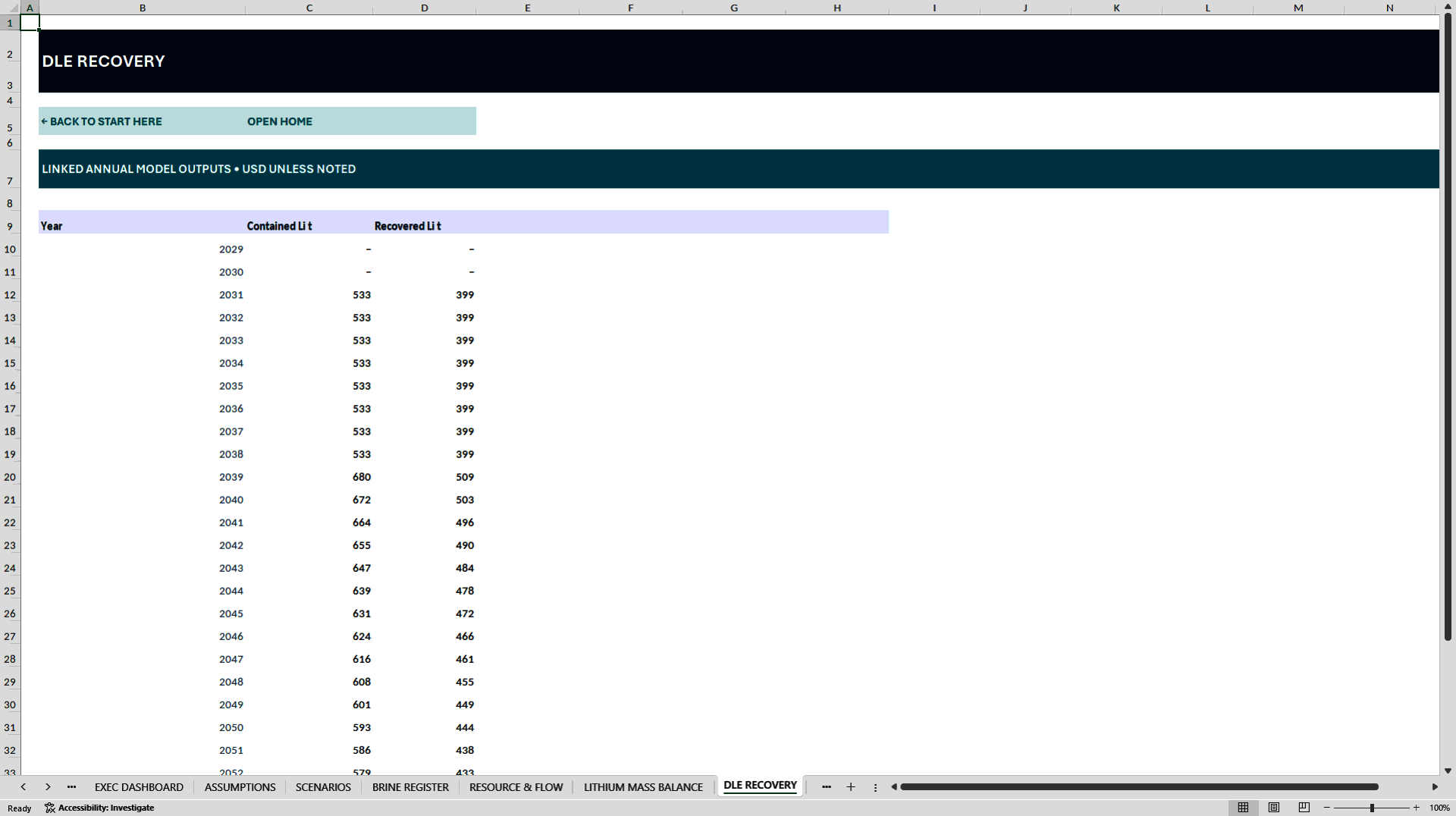
The DLE RECOVERY worksheet applies relevant operating and recovery assumptions to estimate lithium output.
Processing capacity and resource availability are treated as separate constraints.
This helps distinguish the lithium physically contained in the brine from the lithium recovered through the modeled process.
Recovery factors are editable planning assumptions, not guaranteed technical performance.
Actual extraction efficiency depends on the brine chemistry, technology, operating conditions and independently verified process data.
◈ 04 | LITHIUM CARBONATE & HYDROXIDE PRODUCT ROUTES
The CHEMICAL CONVERSION worksheet supports two lithium chemical product routes.
LITHIUM CARBONATE
Allocate recovered lithium to carbonate production using editable chemical conversion and recovery assumptions.
LITHIUM HYDROXIDE MONOHYDRATE
Allocate recovered lithium to the hydroxide route through a separate conversion process.
Each product route includes relevant assumptions for:
• Product Allocation
• Conversion Yield
• Chemical Production Efficiency
• Product Purity
• Commercial Shipment Fractions
• Product Selling Prices
The model distinguishes actual chemical product tonnes from lithium carbonate equivalent (LCE).
This is important because lithium carbonate and lithium hydroxide monohydrate have different molecular weights and commercial pricing characteristics.
The model uses configurable lithium-to-product conversion factors.
It is a simplified economic representation of chemical conversion, not a complete chemical engineering mass-and-energy-balance simulator.
⚡ 05 | OPTIONAL GEOTHERMAL ENERGY INTEGRATION
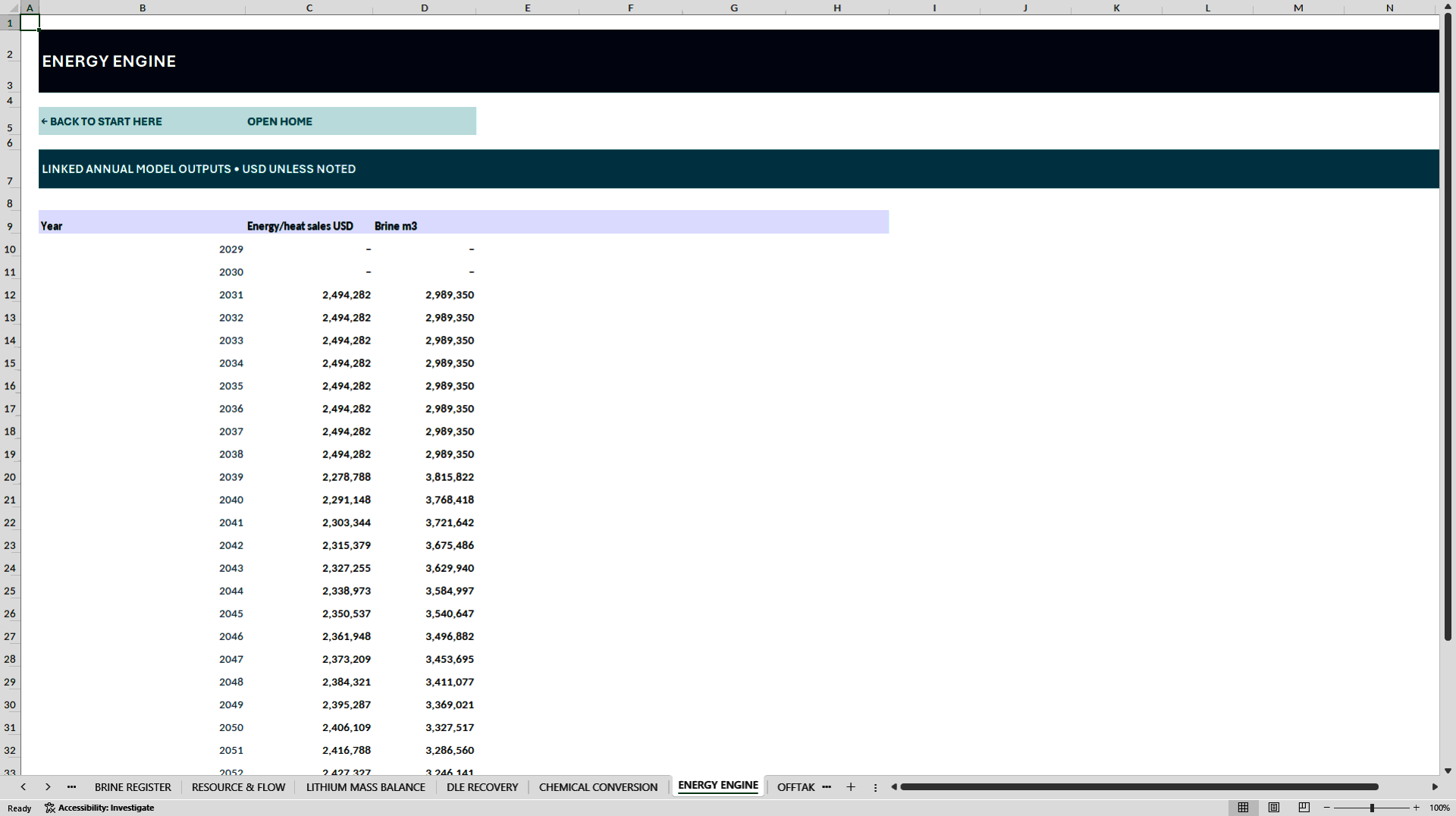
The ENERGY ENGINE models optional geothermal electricity and heat contributions alongside lithium extraction.
Review:
• Geothermal Electricity Generation
• DLE Electricity Requirements
• Internal Electricity Consumption
• Grid Electricity Purchases
• Surplus Electricity Exports
• Optional Heat Sales
• Energy Costs and Commercial Value
The model allocates electricity used internally before calculating surplus power available for third-party sales.
This avoids treating the same generated electricity as both fully self-consumed and fully exported.
Explore how geothermal integration may influence project operating costs and potential additional revenue.
Actual electricity generation, interconnection rights and commercial energy sales require independent verification.
💰 06 | LITHIUM PRICING, OFFTAKE & REVENUE
The REVENUE worksheet combines modeled lithium product deliveries with commercial pricing assumptions.
Revenue planning includes:
• Lithium Carbonate Selling Prices
• Lithium Hydroxide Selling Prices
• Product Shipment Fractions
• Price Escalation
• Contracted Sales Share
• Illustrative Price Floors
• Commercial Discounts
• Optional Geothermal Energy Revenues
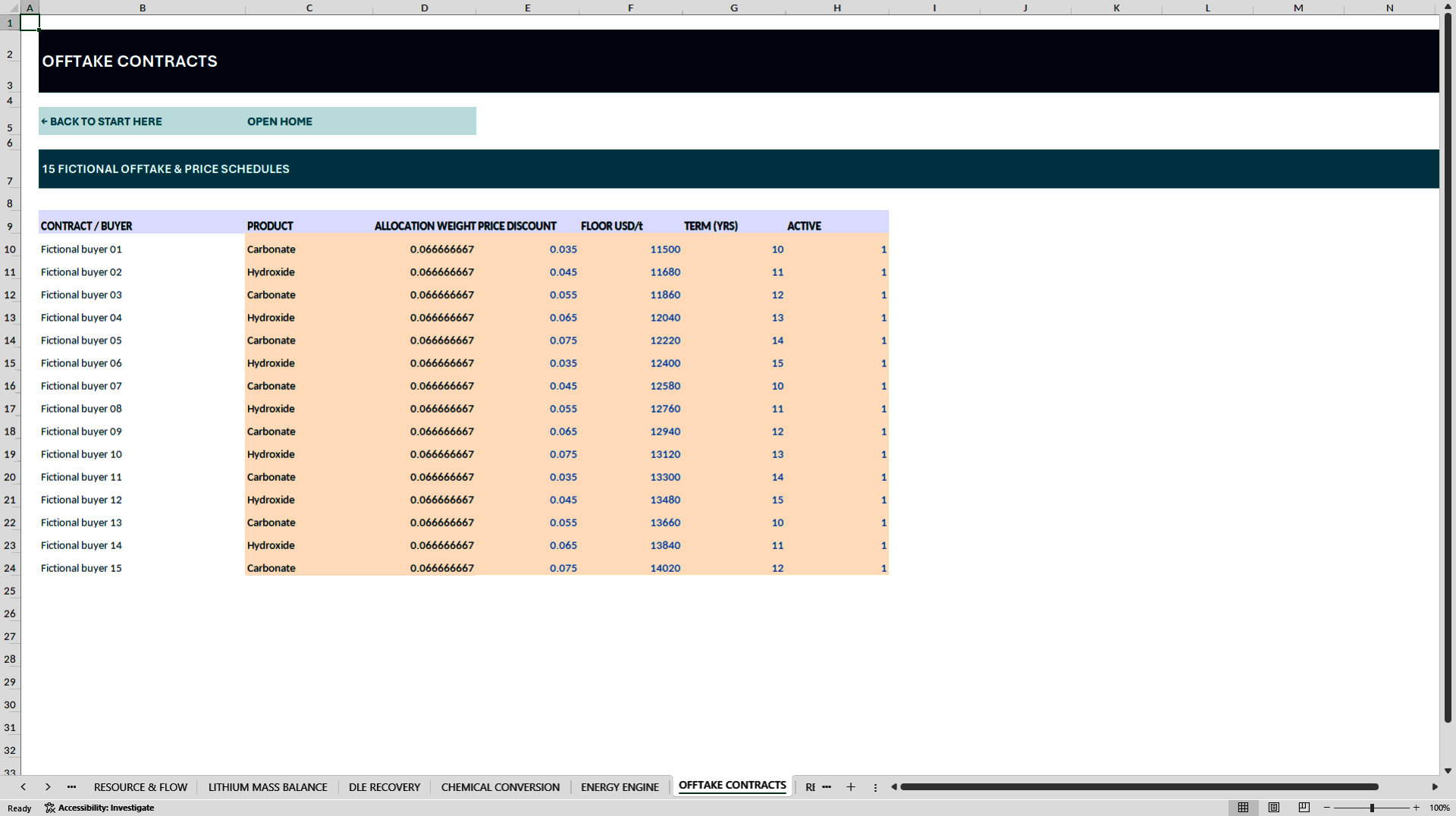
The OFFTAKE CONTRACTS worksheet includes 15 fictional contract records.
IMPORTANT MODEL DISTINCTION
The offtake register is an illustrative commercial planning tool.
The central revenue calculation uses global blended commercial assumptions rather than calculating every revenue line independently from each individual buyer record.
Users should not interpret the contract register as a complete buyer-level invoicing, shipment allocation or contract settlement engine.
🏗️ 07 | CAPITAL EXPENDITURE & PROJECT DEVELOPMENT
The CAPEX worksheet supports the project's initial and ongoing investment requirements.
Cost categories may include:
• Brine Extraction Infrastructure
• Production and Reinjection Wells
• DLE Processing Modules
• Chemical Conversion Equipment
• Geothermal Facilities
• Supporting Utilities
• Construction and Installation
• Capacity Expansion
• Equipment Replacement
• Project Contingencies
The model connects capital investment with financing, depreciation and monthly project cash flow.
Review how construction expenditure, equipment capacity and replacement requirements affect long-term financial outcomes.
The workbook uses simplified development and capital-spending assumptions rather than a detailed engineering procurement and construction scheduling system.
📉 08 | OPERATING COSTS & WORKING CAPITAL
The OPEX worksheet includes 15 illustrative operating-cost records.
Operating costs cover:
• Brine Processing
• Chemical Conversion
• Electricity Purchases
• Feedstock and Reagent Requirements
• Labor and Personnel
• Logistics and Transportation
• Maintenance
• Administrative Overhead
• Other Project Operating Costs
The WORKING CAPITAL worksheet connects simplified receivables, payables and relevant operating assumptions with cash-flow requirements.
This allows users to distinguish revenue recognition and operating profitability from the timing of project cash generation.
🏦 09 | DEBT FINANCING & SPONSOR EQUITY
The FINANCING worksheet connects project investment with debt and equity funding assumptions.
Review:
• Project Debt
• Sponsor Equity
• Financing Costs
• Interest Expense
• Principal Repayment
• Outstanding Debt
• Debt Service
• Cash Availability
• Financing Shortfalls
The workbook includes Debt Service Coverage Ratio (DSCR) calculations.
DSCR provides an illustrative indication of the relationship between modeled cash flow available for debt service and scheduled debt obligations.
A result below 1.00x indicates insufficient modeled coverage under that calculation convention.
The financing framework is not a lender-approved debt-sizing system or a complete contractual project finance waterfall.
📑 10 | THREE LINKED FINANCIAL STATEMENTS
The workbook includes dedicated P&L, BALANCE SHEET and CASH FLOW worksheets.
PROFIT & LOSS
Review lithium and energy revenues, operating costs, EBITDA, depreciation, financing costs, simplified taxes and net income.
BALANCE SHEET
Monitor project assets, working capital, cash, outstanding debt, liabilities and equity.
CASH FLOW
Trace operating cash generation, capital investment, financing movements and closing liquidity.
The MONTHLY ENGINE integrates operating and financial calculations across 300 monthly periods.
ANNUAL SUMMARY consolidates the results into 25 financial reporting periods.
The statements support structured financial planning under simplified accounting conventions.
They are not a substitute for independently audited statutory statements.
📈 11 | PROJECT VALUATION & INVESTMENT RETURNS
The INVESTMENT RETURNS worksheet provides long-term financial and investment analysis.
Key outputs include:
• Project IRR
• Equity IRR
• Project NPV
• Equity NPV
• Minimum Positive Operating DSCR
• Payback Status
• Financing Shortfalls
• Project and Equity Cash Flow
The model uses editable discount rates and its documented cash-flow conventions.
Under the supplied fictional Base Case, stored outputs include:
Project IRR: approximately 8.23%
Equity IRR: approximately 8.39%
Project NPV: approximately negative USD 40.59 million
Equity NPV: approximately negative USD 43.91 million
Minimum Positive Operating DSCR: approximately 0.93x
Maximum Reported Financing Shortfall: approximately USD 18.33 million
These results illustrate material investment and financing pressure under the supplied demonstration assumptions.
A positive IRR does not necessarily imply a positive NPV at the selected discount rate.
Negative cash balances and financing warnings are preserved rather than automatically corrected with fictional funding.
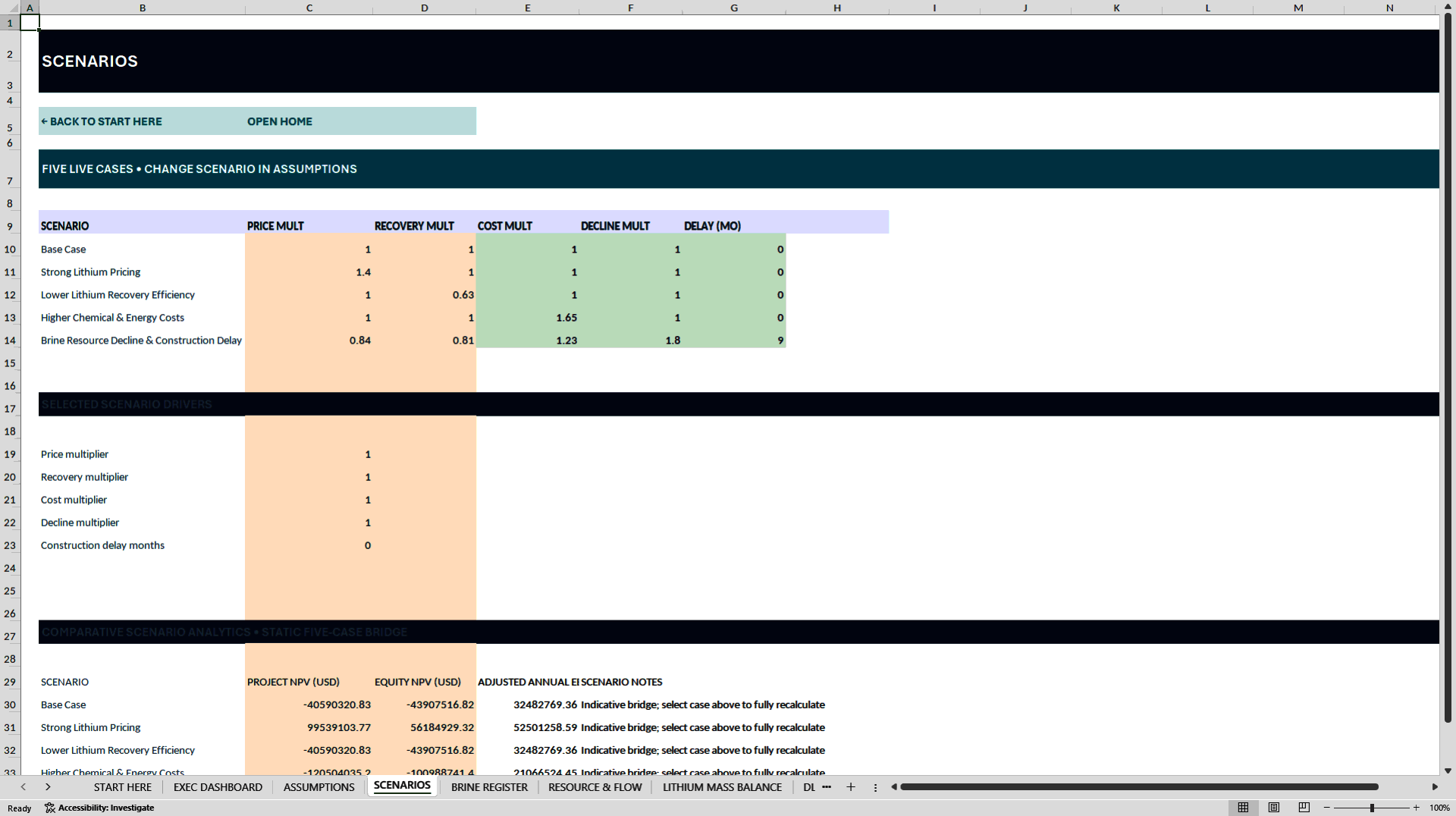
🔀 12 | FIVE SELECTABLE OPERATING SCENARIOS
The workbook includes five scenarios.
BASE CASE
Central illustrative resource, recovery, pricing and financing assumptions.
STRONG LITHIUM PRICING
Explores more favorable carbonate and hydroxide commercial prices.
LOWER LITHIUM RECOVERY EFFICIENCY
Tests reduced recovery performance and lower lithium output.
HIGHER CHEMICAL & ENERGY COSTS
Models increased operating expenses associated with conversion and energy requirements.
BRINE RESOURCE DECLINE & CONSTRUCTION DELAY
Combines weaker resource assumptions with additional project development pressure.
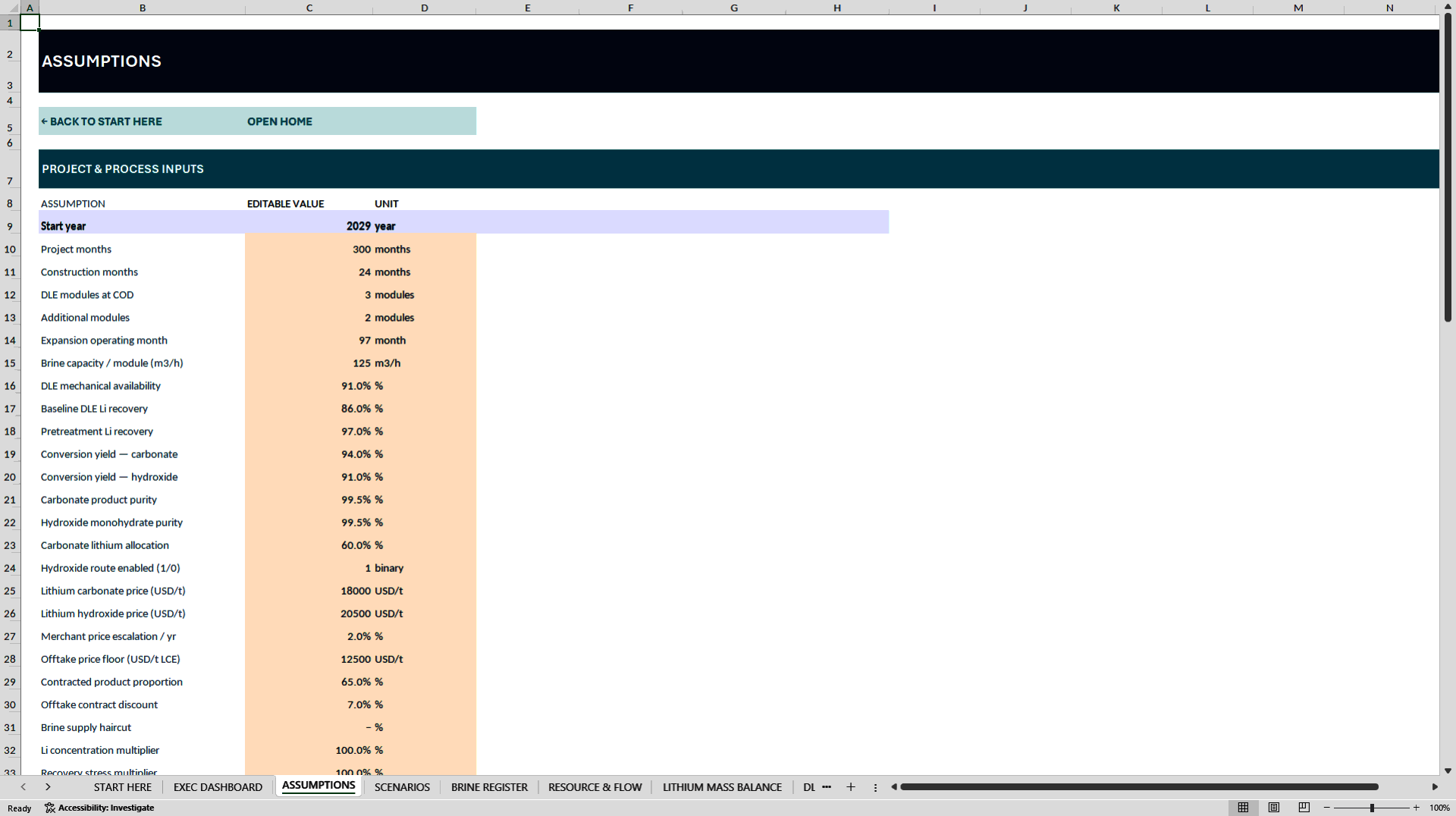
Select the active case in ASSUMPTIONS to evaluate the main model under the chosen scenario drivers.
IMPORTANT SCENARIO LIMITATION
The separate five-case comparison table is an indicative economic bridge rather than five independently recalculated 300-month project finance models.
In the supplied workbook, the static comparison does not correctly incorporate the recovery multiplier into the lower-recovery case's displayed comparison results.
For recovery-related decisions, select the Lower Lithium Recovery Efficiency scenario in the main model and review the connected production, revenue and investment outputs.
The static comparison must not be treated as a validated standalone project valuation for that case.
📊 13 | SENSITIVITY ANALYSIS
The SENSITIVITY worksheet provides illustrative operating and economic sensitivity calculations.
Review how changes in key project assumptions influence selected outputs.
The sensitivity tables are designed for early-stage planning and relative-risk screening.
They are not complete independent project-finance recalculations for every assumption combination.
For a detailed evaluation, modify the underlying assumptions and recalculate the main model.
✅ 14 | MODEL CHECKS & FUNDING WARNINGS
The MODEL CHECKS worksheet includes selected operating, physical and financial controls.
Its tests address:
• Contained and Recovered Lithium
• Recovery Efficiency Bounds
• Processing Capacity Limits
• Balance Sheet Reconciliation
• Sources and Uses
• Nonnegative Product Output
• Debt Balance Integrity
• Product Allocation
• Brine Impurity Factors
Additional alerts identify:
• Unfunded Minimum Liquidity Requirements
• Negative Cash Balances
These financial warnings are separate from the model's arithmetic reconciliation checks.
A PASS result confirms that the implemented check condition is satisfied.
It does not prove technical feasibility, resource certification, adequate funding or commercial viability.
📦 WHAT YOU RECEIVE
PRIMARY DOCUMENT – EDITABLE FINANCIAL MODEL
• 25 Structured Excel Worksheets
• 300 Monthly Forecast Periods
• 25 Annual Summaries
• 15 Fictional Brine Resource Records
• 15 Illustrative Offtake Contract Records
• 15 Operating Cost Examples
• Eight Native Dashboard Charts
• Five Selectable Scenarios
• Brine Resource and Flow Calculations
• Lithium Recovery and Mass Balance
• Lithium Carbonate and Hydroxide Product Routes
• Optional Geothermal Electricity and Heat
• Revenue, CAPEX and OPEX Schedules
• Working Capital and Debt Financing
• Three Linked Financial Statements
• NPV, IRR and DSCR Analysis
• Sensitivity Tables and Model Checks
• START HERE Navigation and Embedded User Guide
SUPPLEMENTARY DOCUMENT – 20-PAGE PDF GUIDE
The English How-to-Use Guide explains workbook setup, model architecture, resource and flow inputs, lithium mass balance, extraction recovery, chemical conversion, geothermal integration, commercial revenue, financing, scenarios, model checks and troubleshooting.
🧭 15 | GETTING STARTED
1. Save a working copy of the Excel workbook.
2. Open START HERE and review the PDF guide.
3. Configure the project in ASSUMPTIONS.
4. Replace the fictional BRINE REGISTER records.
5. Review RESOURCE & FLOW and LITHIUM MASS BALANCE.
6. Configure DLE RECOVERY and CHEMICAL CONVERSION.
7. Review geothermal energy integration and electricity use.
8. Customize commercial prices, operating expenses and CAPEX.
9. Examine the financial statements and INVESTMENT RETURNS.
10. Select scenarios individually and investigate MODEL CHECKS.
👥 16 | WHO THIS MODEL IS FOR
• Direct Lithium Extraction Project Developers
• Geothermal Brine Operators
• Lithium and Critical Minerals Analysts
• Mining and Infrastructure Finance Teams
• Chemical Processing Project Developers
• Energy and Resource Consultants
• Project Finance Professionals
• Financial Modeling Educators
⚙️ 17 | TECHNICAL SPECIFICATIONS
File Format: Editable Microsoft Excel XLSX.
Forecast: 300 monthly periods and 25 annual periods.
Default Illustrative Start Year: 2029.
Worksheets: 25.
Dashboard Charts: Eight native Excel chart objects.
Selectable Scenarios: Five.
Macros / VBA: None.
External Workbook Connections: None required.
Recommended Application: Microsoft Excel Desktop.
Google Sheets import has not been independently verified.
A complete independent Microsoft Excel Desktop recalculation and scenario stress test have not been completed for the supplied package.
The workbook is a simplified financial planning model. It is not a certified mineral resource assessment, detailed chemical processing simulator, physical inventory management platform, engineering feasibility study or lender-approved debt-sizing model.
🛡️ 18 | INDEPENDENT TEMPLATE DISCLAIMER
This is an independent, unofficial financial planning and educational template developed by SheetworksStudio.
All demonstration brine resources, lithium concentrations, recovery yields, production estimates, product prices, operating costs and investment returns are fictional and illustrative.
The product is not audited, certified, regulator-approved, bank-approved or endorsed by a mineral reporting authority, lithium producer, financial institution, technology provider or software vendor.
Actual DLE projects require independent validation of resource quality, brine chemistry, process recovery, product conversion, geothermal integration, financing, taxation and commercial contracts.
No resource availability, lithium recovery, product quality, financing, profitability or investment return is guaranteed.
This template does not provide individualized financial, investment, engineering, geological, chemical processing, accounting, tax or legal advice.
Digital product only. No physical equipment, lithium products, drilling services or software subscription is included.
ONE RESOURCE FLOW. TWO PRODUCT ROUTES. TWENTY-FIVE YEARS OF CONNECTED FINANCIAL PLANNING.
Got a question about the product? Email us at support@flevy.com or ask the author directly by using the "Ask the Author a Question" form. If you cannot view the preview above this document description, go here to view the large preview instead.
Source: Best Practices in Mining Industry, Integrated Financial Model Excel: Direct Lithium Extraction & Geothermal Brine Model Excel (XLSX) Spreadsheet, SheetworksStudio
ABOUT THE AUTHOR

SheetworksStudio creates premium Excel-based business templates, dashboards, trackers, financial models, and management systems for professionals, consultants, entrepreneurs, and organizations.
Our portfolio covers finance, project management, operations, risk management, compliance, AI governance, HR, supply chain, performance management, and business planning. Each product is designed to
... [read more]
Ask the Author a Question
You must be logged in to contact the author.