
Customer Relationship Management (CRM) in Modern Business   87-slide PPT PowerPoint presentation slide deck (PPTX)
$55.00

Customer Relationship Management (CRM) in Modern Business (87-slide PPT PowerPoint presentation slide deck (PPTX)) Preview Image
Log in to unlock full preview.
Customer Relationship Management (CRM) in Modern Business (87-slide PPT PowerPoint presentation slide deck (PPTX)) Preview Image
Arrow   Click main image to view in full screen.

Customer Relationship Management (CRM) in Modern Business (PowerPoint PPTX Slide Deck)

PowerPoint (PPTX) 87 Slides

$55.00
Developed by a team of experts with global consulting experience at McKinsey, Deloitte, and Capgemini.
Add to Cart


Immediate download
Fully editable PowerPoint
Free lifetime updates

CRM PPT DESCRIPTION

Editor Summary 87-slide PowerPoint presentation on Customer Relationship Management (CRM) in Modern Business that outlines CRM concepts, relationship phases, churn reduction, customer lifetime value (CLV), types of CRM systems, and implementation guidance. Read more

Elevating Customer Relationships for Sustainable Growth

CRM: Beyond Software, a Comprehensive Philosophy

In today's customer-centric business landscape, Customer Relationship Management (CRM) emerges as a paramount strategy across industries. It transcends mere software solutions, embodying a comprehensive philosophy aimed at enriching customer interactions, fostering loyalty, and driving business growth. At its core, CRM revolves around harnessing customer data to glean valuable insights, transforming transactions into enduring relationships through personalized and meaningful interactions.

Efficient Communication and Engagement

CRM facilitates seamless communication by integrating customer information from diverse touchpoints. This paves the way for consistent, tailored experiences that resonate with individual customers, leading to heightened satisfaction, loyalty, and advocacy. Moreover, CRM empowers data-driven decision-making by providing actionable insights into customer trends, enabling businesses to fine-tune strategies for optimal results.

Versatile Implementations

CRM boasts diverse implementations. Operational CRM optimizes sales, marketing, and customer service processes, enhancing their efficiency and effectiveness. Analytical CRM dives deep into data analysis, unveiling patterns and trends to inform strategic decisions. Collaborative CRM fosters cross-departmental communication, ensuring a unified approach to customer engagement.

Critical Success Factors

Successful CRM implementation hinges on several factors. The choice of a suitable CRM system, aligned with organizational goals and processes, is crucial. Data quality and accuracy are paramount, emphasizing the need for regular updates and maintenance. Equally vital is user adoption, necessitating employee training and engagement to unlock the full potential of CRM.

Embracing the Future of CRM

As technology advances, the future of CRM is laden with exciting possibilities. Innovations in artificial intelligence, machine learning, and automation are revolutionizing CRM capabilities, enabling predictive analytics and hyper-personalized experiences. This document underscores the enduring relevance of CRM in shaping modern business success, where understanding, engaging, and serving customers form the bedrock of sustainable growth.

Explore the Essence of CRM:

This 87-slide customizable document delves deep into CRM's significance as a multifaceted approach centered around understanding, engaging, and nurturing customer relationships. Unlock the potential of CRM in elevating your organization's customer-centric success.

Got a question about the product? Email us at support@flevy.com or ask the author directly by using the "Ask the Author a Question" form. If you cannot view the preview above this document description, go here to view the large preview instead.

MARCUS OVERVIEW

This synopsis was written by Marcus [?] based on the analysis of the full 87-slide presentation.


Executive Summary
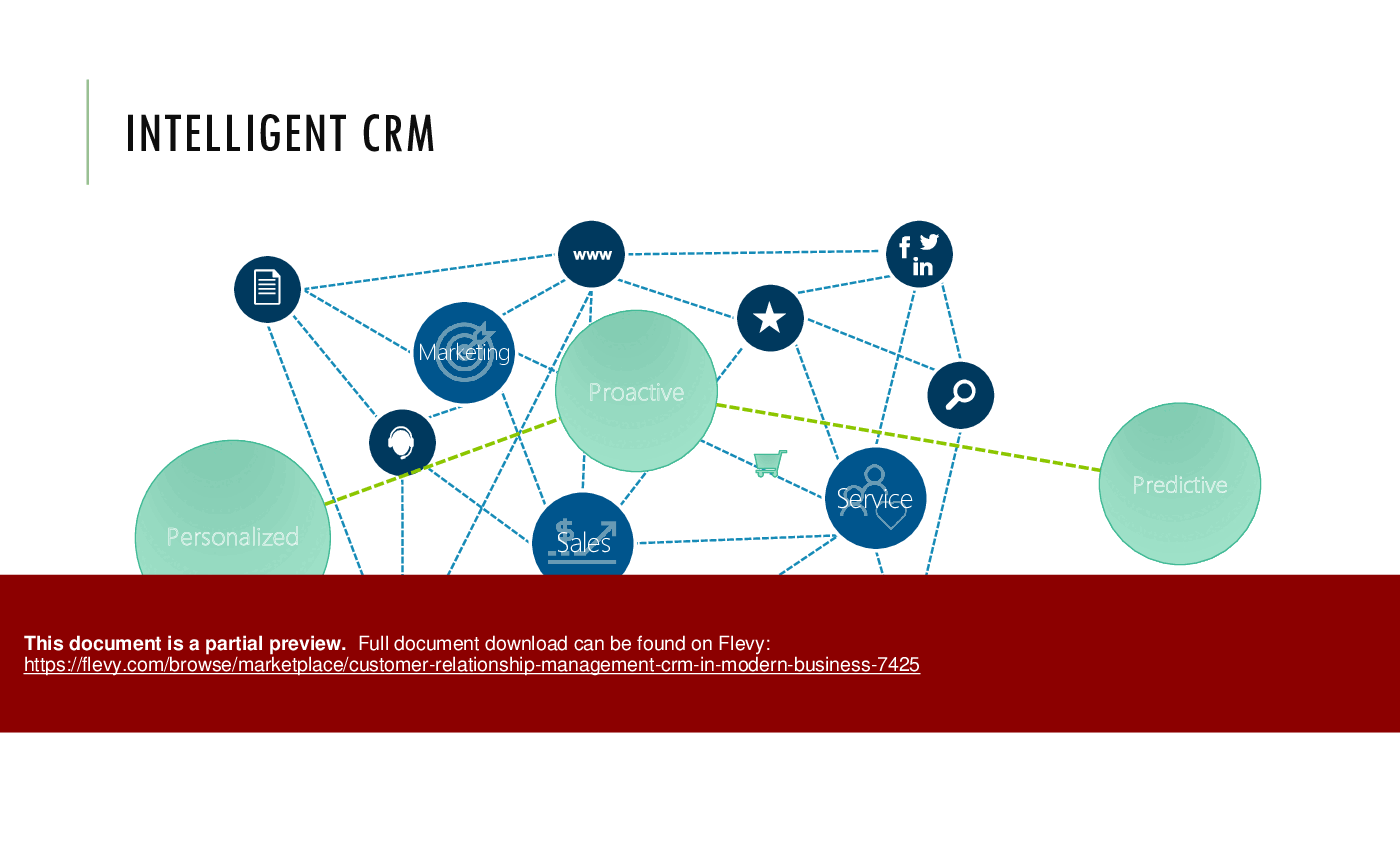
This presentation on Customer Relationship Management (CRM) is designed to equip corporate executives and consultants with the knowledge to foster lasting business success through effective customer engagement. It outlines the critical importance of understanding customer relationships, the evolution of these relationships, and the strategies to enhance customer satisfaction and loyalty. By leveraging intelligent CRM systems, organizations can improve their sales, service, and marketing efforts, ultimately driving business performance and customer retention.

Who This Is For and When to Use

•  Corporate executives seeking to enhance customer engagement strategies
•  Marketing teams focused on improving customer acquisition and retention
•  Sales leaders aiming to optimize the sales process and customer interactions
•  Customer service managers looking to enhance service delivery and customer satisfaction
•  Business consultants advising clients on CRM implementation and strategy

Best-fit moments to use this deck:
•  During strategic planning sessions focused on customer engagement
•  When evaluating CRM software solutions and their implementation
•  For training sessions aimed at improving customer service and sales techniques
•  In workshops aimed at understanding customer journey mapping

Learning Objectives

•  Define the concept of customer relationships and their importance in business
•  Identify the phases of customer-supplier relationship evolution
•  Establish strategies for reducing customer churn and improving retention
•  Analyze customer lifetime value (CLV) and its implications for business strategy
•  Develop actionable CRM strategies to enhance customer satisfaction and loyalty
•  Implement intelligent CRM systems to streamline sales, service, and marketing processes

Table of Contents

•  Introduction to CRM (page 2)
•  Understanding Customer Relationships (page 5)
•  The Customer Experience Delivery Gap (page 10)
•  Phases of Relationship Development (page 15)
•  Customer Churn and Retention Strategies (page 20)
•  Customer Lifetime Value (CLV) (page 25)
•  Types of CRM Systems (page 30)
•  Implementing a Successful CRM Strategy (page 35)
•  Key Benefits of CRM (page 40)
•  Conclusion and Next Steps (page 45)

Primary Topics Covered

•  Customer Relationships - A relationship is defined as a series of interactive episodes between parties over time, emphasizing the importance of emotional content and trust.
•  Customer Experience Delivery Gap - A significant disparity exists between companies' perceptions of their service quality and customer agreement, highlighting the need for improved customer insights.
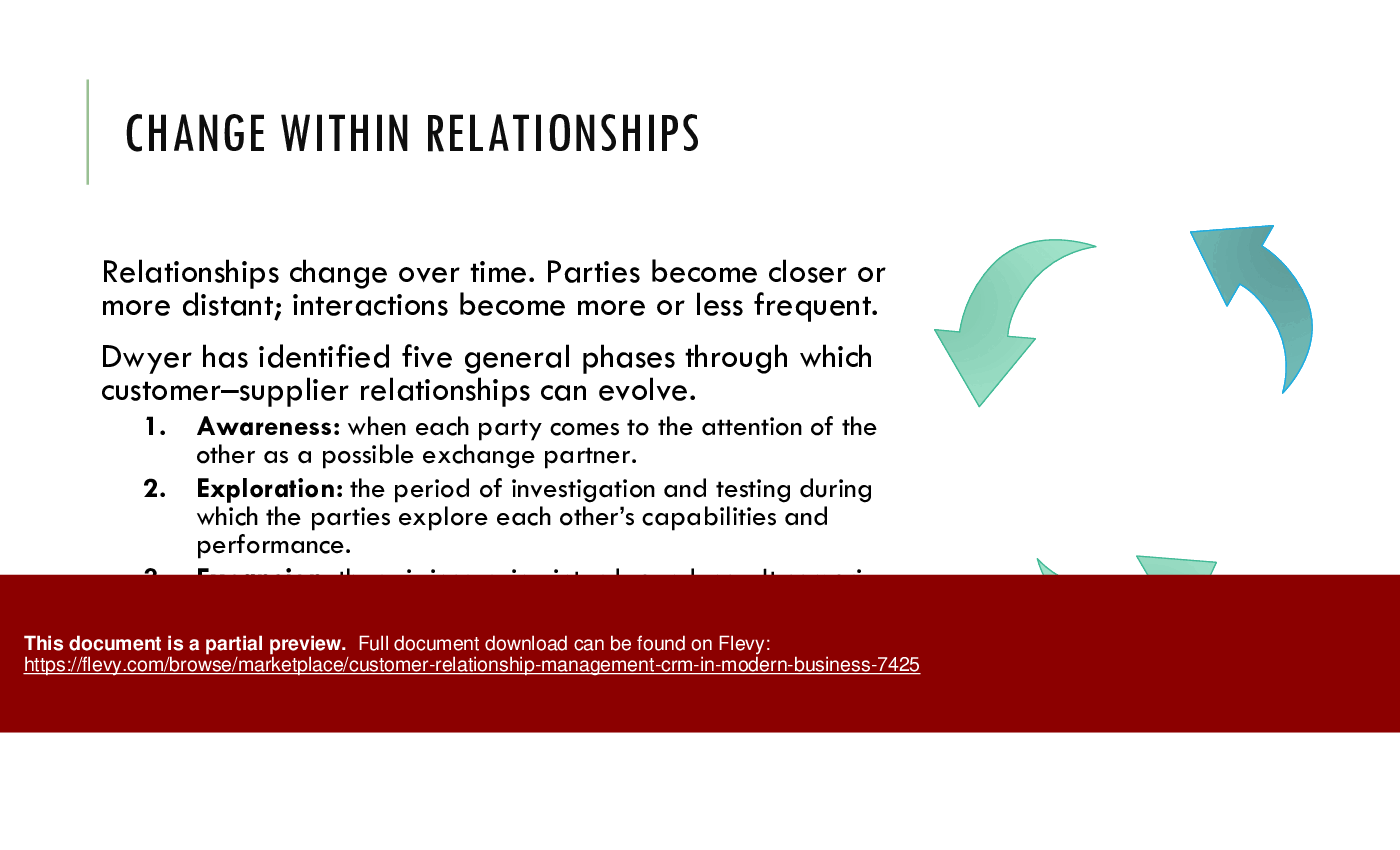
•  Phases of Relationship Development - Relationships evolve through awareness, exploration, expansion, commitment, and potential dissolution, each phase requiring different engagement strategies.
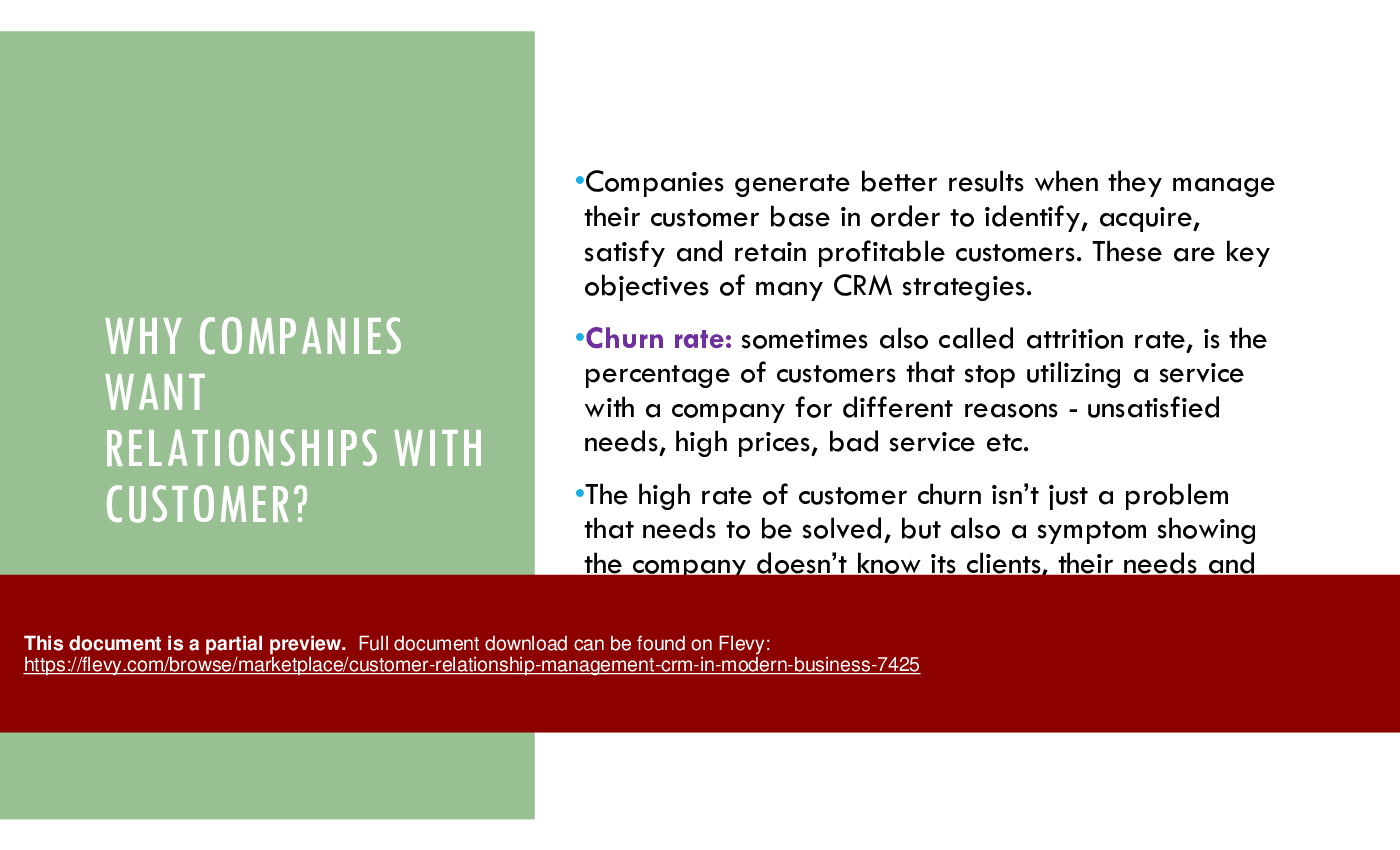
•  Customer Churn - Understanding churn rates is crucial for identifying reasons customers leave and implementing strategies to retain them.
•  Customer Lifetime Value (CLV) - CLV is a critical metric that quantifies the total revenue a customer generates over their lifetime, influencing retention strategies.
•  Types of CRM Systems - Different CRM systems (strategic, operational, analytical, collaborative) serve various business needs and processes, impacting customer engagement strategies.

Deliverables, Templates, and Tools

•  Customer relationship mapping template to visualize customer interactions
•  Customer churn analysis model to identify retention strategies
•  Customer lifetime value calculator to assess long-term profitability
•  CRM implementation checklist to guide software selection and deployment
•  Customer feedback survey template to gather insights on satisfaction
•  Best practices guide for enhancing customer service delivery

Slide Highlights

•  Visual representation of the customer experience delivery gap
•  Diagram illustrating the phases of relationship development
•  Statistical analysis of customer churn rates by industry
•  Case study on Delta Airlines' customer satisfaction strategies
•  Framework for understanding customer lifetime value

Potential Workshop Agenda

CRM Strategy Overview (60 minutes)
•  Discuss the importance of CRM in modern business
•  Review the phases of customer relationship development
•  Identify key metrics for measuring success

Customer Churn and Retention (90 minutes)
•  Analyze churn rates and their implications
•  Develop strategies for improving customer retention
•  Share best practices for customer engagement

Implementing CRM Systems (120 minutes)
•  Evaluate different types of CRM systems
•  Discuss implementation challenges and solutions
•  Create an action plan for CRM deployment

Customization Guidance

•  Tailor the customer journey mapping to reflect specific customer segments
•  Adjust churn analysis models to align with industry benchmarks
•  Incorporate company-specific metrics into the customer lifetime value calculator
•  Modify feedback survey templates to capture relevant customer insights

Secondary Topics Covered

•  The role of technology in enhancing customer relationships
•  Ethical considerations in data collection and customer privacy
•  The impact of social media on customer engagement
•  Strategies for leveraging customer feedback for continuous improvement
•  The importance of cross-functional collaboration in CRM

Topic FAQ

What are the typical phases of customer relationship development and how do they affect engagement tactics?

Customer relationships progress through awareness, exploration, expansion, commitment, and potential dissolution. Each phase requires different engagement tactics—awareness focuses on acquisition, exploration on trial and fit, expansion on cross-sell, commitment on loyalty programs, and dissolution on win-back efforts—across the 5 phases.

How is Customer Lifetime Value (CLV) typically used to shape CRM strategy?

CLV quantifies expected revenue from a customer over the relationship and helps prioritize retention investment, segment customers, and tailor offers. Teams use CLV to compare acquisition versus retention trade-offs and allocate resources; a practical tool for this purpose is a customer lifetime value calculator.

What types of CRM systems exist and what business needs do they address?

CRM systems are commonly categorized as strategic, operational, analytical, and collaborative. Operational CRM supports sales and service processes, analytical CRM extracts insights from data, collaborative CRM enables cross-functional communication, and strategic CRM aligns long-term relationship goals with business strategy across 4 types.

What practical steps do companies take to reduce customer churn?

Companies reduce churn by diagnosing why customers leave, improving service quality, tailoring interventions, and implementing loyalty or retention programs. Data-driven churn analysis is used to identify at-risk segments and test retention tactics; many organizations start with a customer churn analysis model.

What should I prioritize in a CRM toolkit if I have limited budget and time?

Prioritize editable templates and diagnostic tools that accelerate decision-making: customer journey maps, churn-analysis models, a CLV calculator, and a CRM implementation checklist to guide software selection and deployment. Choose modular slide content that can be adapted quickly, such as a toolkit offering 87 slides and a checklist.

How long should workshops be to evaluate CRM strategy and implementation needs?

A practical workshop approach splits topics into focused modules: a CRM strategy overview (60 minutes), a customer churn and retention deep-dive (90 minutes), and an implementing CRM systems session (120 minutes). These session lengths reflect a staged agenda for evaluation and planning: 60, 90, and 120 minute sessions.

I need to align sales and customer service on the customer journey—what tools or frameworks help?

Use customer journey mapping to visualize touchpoints, collaborative CRM to share data across teams, and a standardized feedback survey to capture customer experience gaps. Facilitated cross-functional workshops that use a customer relationship mapping template help align roles and processes; start with the mapping template.

From a strategic perspective, how should I evaluate CRM software options for my organization?

Evaluate alignment with organizational goals, how the system supports required CRM types (operational, analytical, collaborative), data quality and governance capabilities, and likely user adoption needs. Use an implementation checklist to compare vendors and deployment readiness; begin with a CRM implementation checklist.

Document FAQ
These are questions addressed within this presentation.


What is CRM?
CRM stands for Customer Relationship Management, a strategy and software system used to manage customer interactions and data throughout the customer lifecycle.

Why is customer retention important?
Customer retention is crucial as it is often more cost-effective to retain existing customers than to acquire new ones. Higher retention rates lead to increased customer lifetime value.

What are the phases of customer relationship development?
The phases include awareness, exploration, expansion, commitment, and dissolution, each requiring different engagement strategies.

How can companies reduce customer churn?
Companies can reduce churn by understanding customer needs, improving service quality, and implementing loyalty programs.

What is customer lifetime value (CLV)?
CLV is the total revenue a business can expect from a single customer account throughout the business relationship.

What types of CRM systems exist?
There are 4 main types: strategic, operational, analytical, and collaborative, each serving different business needs.

How can CRM improve customer satisfaction?
CRM systems provide insights into customer preferences and behaviors, enabling businesses to tailor their offerings and improve service delivery.

What are the key benefits of implementing a CRM system?
Key benefits include improved customer satisfaction, increased sales, enhanced customer retention, and streamlined processes.

Glossary

•  Customer Relationship Management (CRM) - A system for managing a company's interactions with current and potential customers.
•  Customer Churn Rate - The percentage of customers who stop using a service during a given time period.
•  Customer Lifetime Value (CLV) - The total revenue a business can expect from a single customer account throughout the relationship.
•  Operational CRM - Systems that support customer-facing applications such as sales and service.
•  Analytical CRM - Systems that analyze customer data to improve business decisions.
•  Collaborative CRM - Systems that facilitate communication and collaboration between different business units and customers.
•  Customer Satisfaction - A measure of how products and services meet or exceed customer expectations.
•  Customer Retention Rate - The percentage of customers who continue to do business with a company over a specific period.
•  Sales Force Automation (SFA) - Technology that automates sales tasks and processes.
•  Marketing Automation - Software that automates marketing tasks and workflows.
•  Enterprise Marketing Management (EMM) - Tools for managing marketing campaigns and customer interactions.
•  Data Mining - The process of analyzing data to discover patterns and insights.
•  Customer Feedback - Information provided by customers about their experience with a product or service.
•  Customer Journey - The complete sum of experiences that customers go through when interacting with a company.
•  Trust - The belief that one party will act in the interests of another in a relationship.
•  Commitment - The intention to maintain a relationship and invest in it over time.
•  Customer Segmentation - The process of dividing customers into groups based on shared characteristics.
•  Personalization - Tailoring products or services to meet individual customer preferences.
•  Loyalty Programs - Marketing strategies designed to encourage customers to continue to shop at or use the services of a business.
•  Customer Insights - Understanding customer behavior and preferences through data analysis.

Source: Best Practices in CRM PowerPoint Slides: Customer Relationship Management (CRM) in Modern Business PowerPoint (PPTX) Presentation Slide Deck, RadVector Consulting


$55.00
Developed by a team of experts with global consulting experience at McKinsey, Deloitte, and Capgemini.
Add to Cart
  

ABOUT THE AUTHOR

Additional documents from author: 183

We are a group of aviation experts & specialists (PhDs, Engineers, Pilots, Navigators, ...), leaders in helping organizations to transform their business performance using Methodologies and Principles of Lean, Agile, Six Sigma, and Innovation.

Ask the Author a Question

You must be logged in to contact the author.

Click here to log in Click here register

Did you know?
The average daily rate of a McKinsey consultant is $6,625 (not including expenses). The average price of a Flevy document is $65.


Trusted by over 10,000+ Client Organizations
Since 2012, we have provided business templates to over 10,000 businesses and organizations of all sizes, from startups and small businesses to the Fortune 100, in over 130 countries.
AT&T GE Cisco Intel IBM Coke Dell Toyota HP Nike Samsung Microsoft Astrazeneca JP Morgan KPMG Walgreens Walmart 3M Kaiser Oracle SAP Google E&Y Volvo Bosch Merck Fedex Shell Amgen Eli Lilly Roche AIG Abbott Amazon PwC T-Mobile Broadcom Bayer Pearson Titleist ConEd Pfizer NTT Data Schwab


Read Customer Testimonials

 
"I am extremely grateful for the proactiveness and eagerness to help and I would gladly recommend the Flevy team if you are looking for data and toolkits to help you work through business solutions."

– Trevor Booth, Partner, Fast Forward Consulting
 
"Flevy is now a part of my business routine. I visit Flevy at least 3 times each month.

Flevy has become my preferred learning source, because what it provides is practical, current, and useful in this era where the business world is being rewritten.

In today's environment where there are so "

– Omar Hernán Montes Parra, CEO at Quantum SFE
 
"If you are looking for great resources to save time with your business presentations, Flevy is truly a value-added resource. Flevy has done all the work for you and we will continue to utilize Flevy as a source to extract up-to-date information and data for our virtual and onsite presentations!"

– Debbi Saffo, President at The NiKhar Group
 
"I have used Flevy services for a number of years and have never, ever been disappointed. As a matter of fact, David and his team continue, time after time, to impress me with their willingness to assist and in the real sense of the word. I have concluded in fact "

– Roberto Pelliccia, Senior Executive in International Hospitality
 
"As a small business owner, the resource material available from FlevyPro has proven to be invaluable. The ability to search for material on demand based our project events and client requirements was great for me and proved very beneficial to my clients. Importantly, being able to easily edit and tailor "

– Michael Duff, Managing Director at Change Strategy (UK)
 
"FlevyPro provides business frameworks from many of the global giants in management consulting that allow you to provide best in class solutions for your clients."

– David Harris, Managing Director at Futures Strategy

 
"I like your product. I'm frequently designing PowerPoint presentations for my company and your product has given me so many great ideas on the use of charts, layouts, tools, and frameworks. I really think the templates are a valuable asset to the job."

– Roberto Fuentes Martinez, Senior Executive Director at Technology Transformation Advisory
 
"I have found Flevy to be an amazing resource and library of useful presentations for lean sigma, change management and so many other topics. This has reduced the time I need to spend on preparing for my performance consultation. The library is easily accessible and updates are regularly provided. A wealth of great information."

– Cynthia Howard RN, PhD, Executive Coach at Ei Leadership


Customers Also Like These Documents

Explore Templates on Related Management Topics


Your Recently Viewed Documents
Download our FREE Digital Transformation Templates

Download our free compilation of 50+ Digital Transformation slides and templates. DX concepts covered include Digital Leadership, Digital Maturity, Digital Value Chain, Customer Experience, Customer Journey, RPA, etc.








