
 Click main image to view in full screen. Unlock all 10 preview images:
Covenant Headroom Monitor: Debt Compliance Excel Model – Excel XLSX
Excel (XLSX) + Zip archive file (ZIP)


BENEFITS OF THIS DOWNLOADABLE EXCEL DOCUMENT
- Translate ratio headroom into the EBITDA loss available before a covenant fails.
- Identify the first forecast breach across the base case and five downside scenarios rather than waiting for the next certificate date.
- Record adjusted EBITDA definitions, permitted add-backs, caps and open terms against the executed agreement before they enter the compliance calculation.
DEBT EXCEL DESCRIPTION
# Covenant Headroom Monitor Excel Model: See the First Breach Before the Certificate Is Due
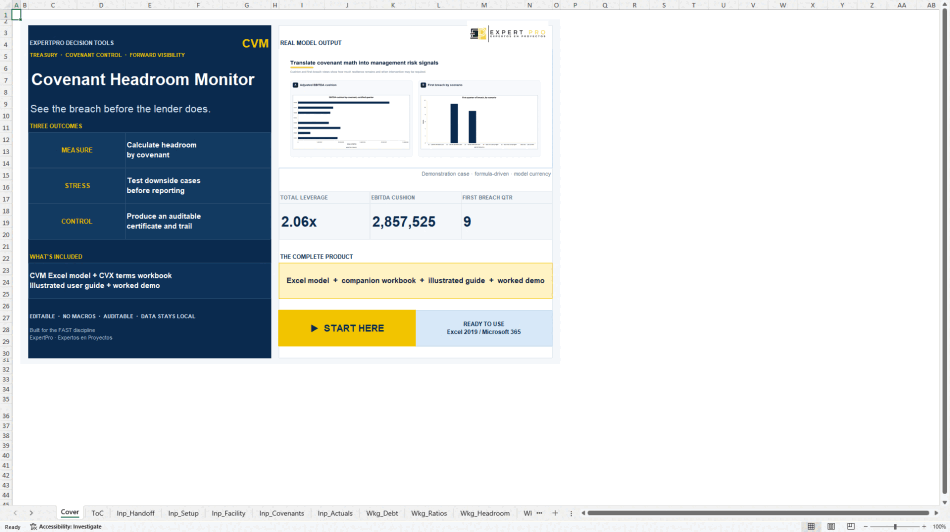
Covenant risk rarely appears on certificate day. It builds between reporting dates as EBITDA softens, rates move and add-backs meet contractual caps. This package captures the governing terms, tests eight covenants over sixteen quarters and shows the first forecast breach in both ratio and EBITDA terms, giving borrower-side finance teams time to challenge assumptions and prepare action.
## Three Decisions This Package Helps You Make
1. Decide how much operating downside the business can absorb. Translate ratio headroom into the EBITDA loss available before a covenant fails.
2. Decide when intervention is required. Identify the first forecast breach across the base case and five downside scenarios rather than waiting for the next certificate date.
3. Decide which adjustments can be defended. Record adjusted EBITDA definitions, permitted add-backs, caps and open terms against the executed agreement before they enter the compliance calculation.
## What's Included
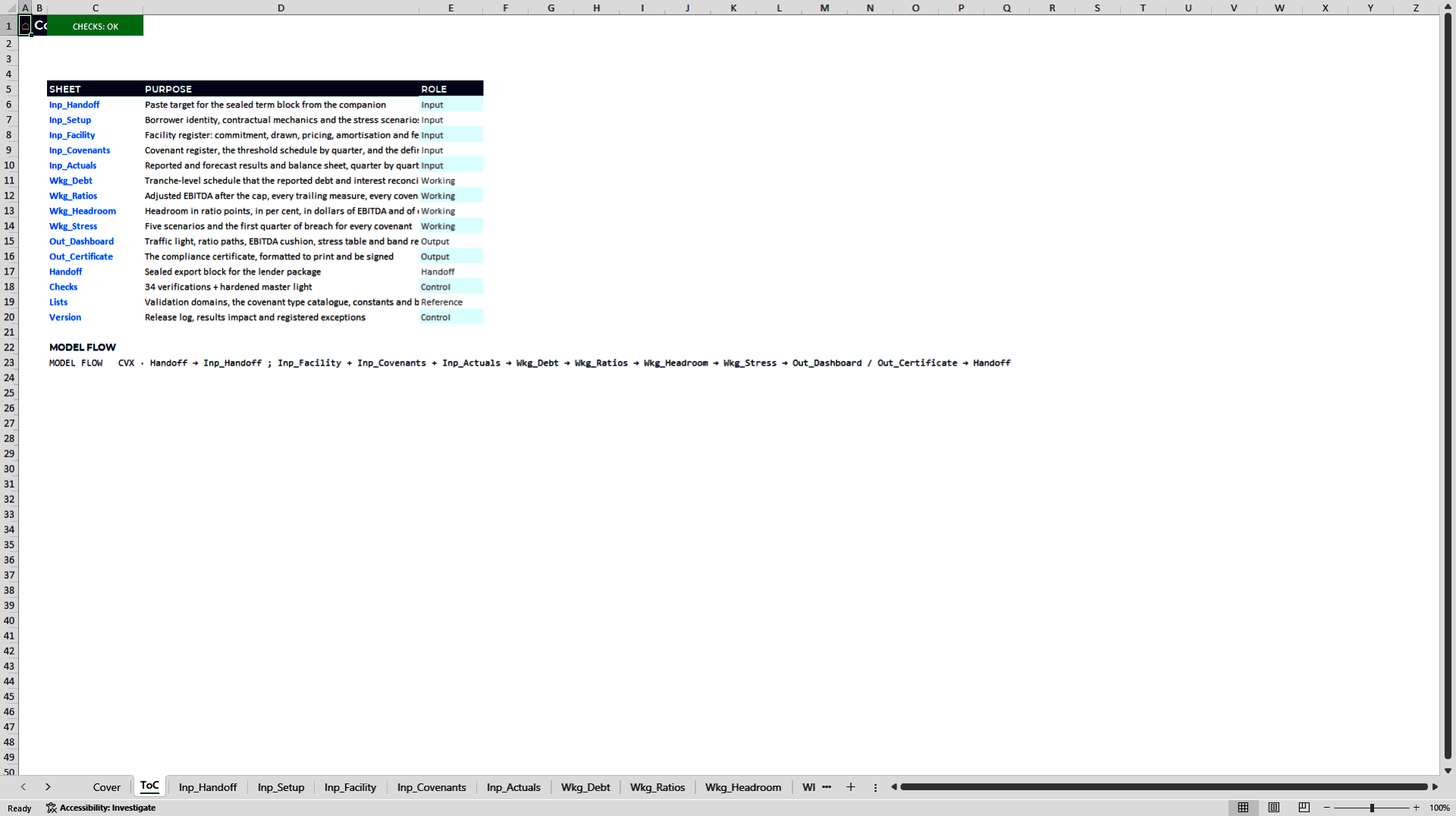
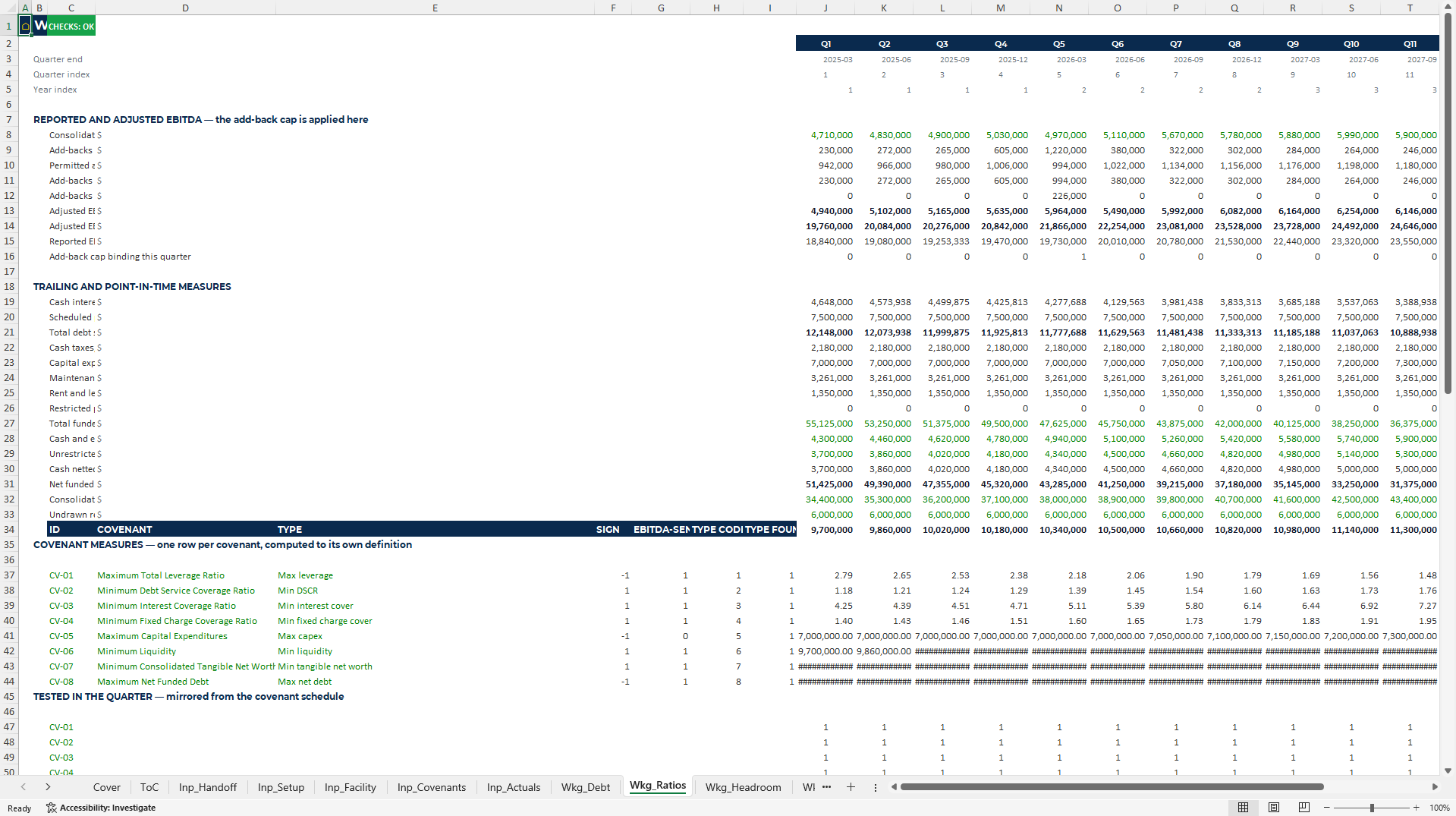
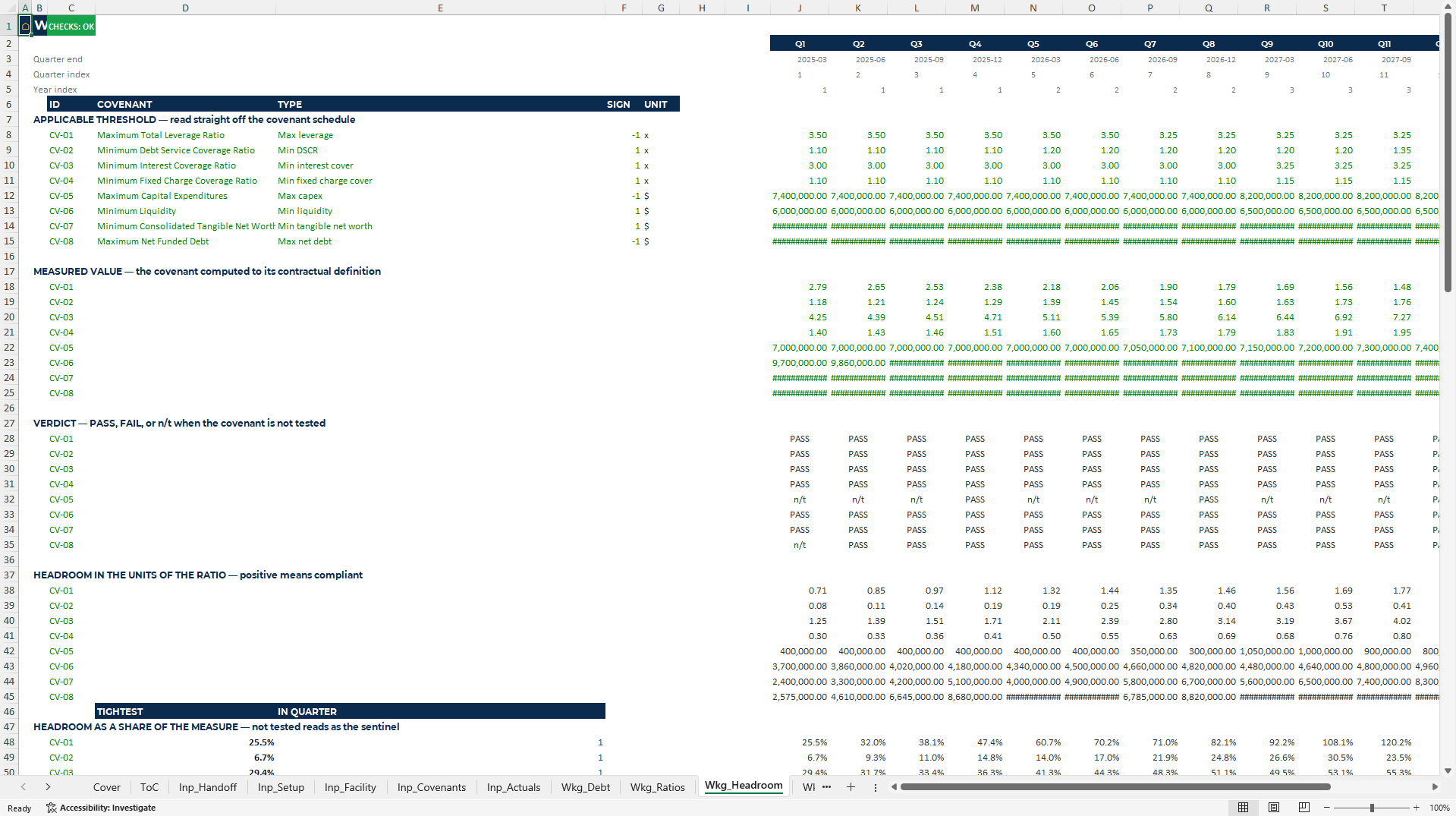
• `CVM_Covenant_Headroom_Monitor_Commercial_Edition_v1` – the 17-sheet monitor for covenant calculations, quarterly headroom, scenario testing and the printable compliance certificate.
• `CVX_Credit_Agreement_Terms_Commercial_Edition_v1` – the 15-sheet companion for capturing agreement definitions, add-backs, caps, calendars, cure mechanics and unconfirmed terms.
• `CVM_User_Manual.pdf` – a 51-page illustrated user manual with the operating workflow and worked example.
Both Excel workbooks open on a complete borrower-side demo. You can inspect the finished covenant bridge, scenarios and certificate before entering your own data. The package is published by ExpertPro Decision Tools.
## Capabilities Tied to Decisions
| Capability | Business outcome | Decision supported |
|—-|—-|—-|
| Capture agreement terms before they enter the model | Separates confirmed provisions from assumptions and unresolved points | Which inputs are safe to certify? |
| Test eight covenants against stepped thresholds over 16 quarters | Makes future pressure visible between certificate dates | When does headroom become insufficient? |
| Convert ratio room into an EBITDA cushion | Expresses covenant risk in an operating unit management can act on | How much EBITDA downside is available? |
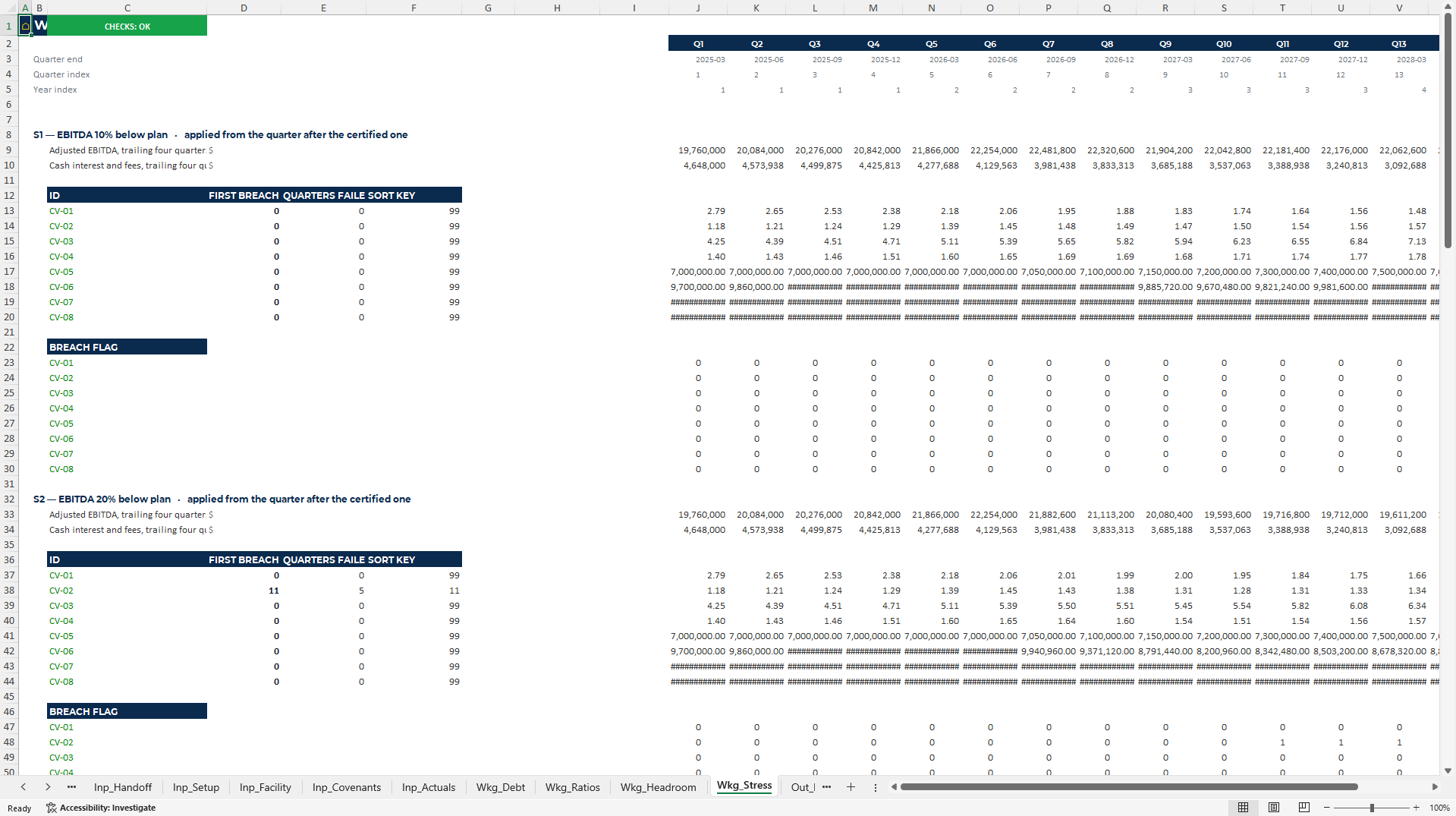
| Run five downside scenarios for EBITDA and base rates | Shows the first failure by covenant and quarter | Which contingency should be prepared now? |
| Produce a one-page certificate with clause references and adjusted EBITDA derivation | Connects the calculation to a reviewable reporting output | What can the officer sign, subject to agreement review? |
## How the Model Works
Inputs → Analysis → Controls → Outputs → Decision
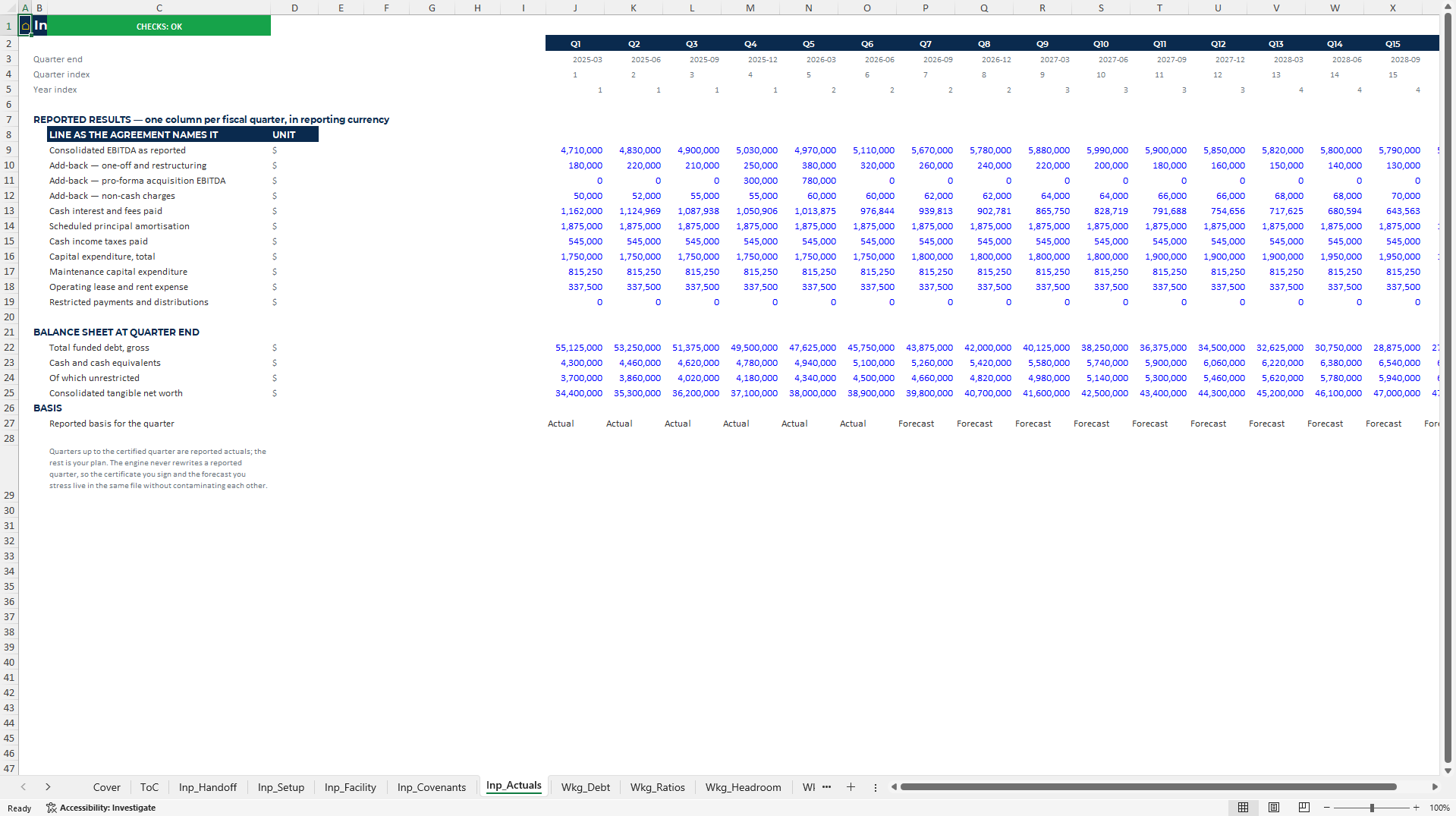
1. Inputs: Capture agreement definitions, covenant thresholds, add-back rules, debt tranches, actuals and quarterly plan.
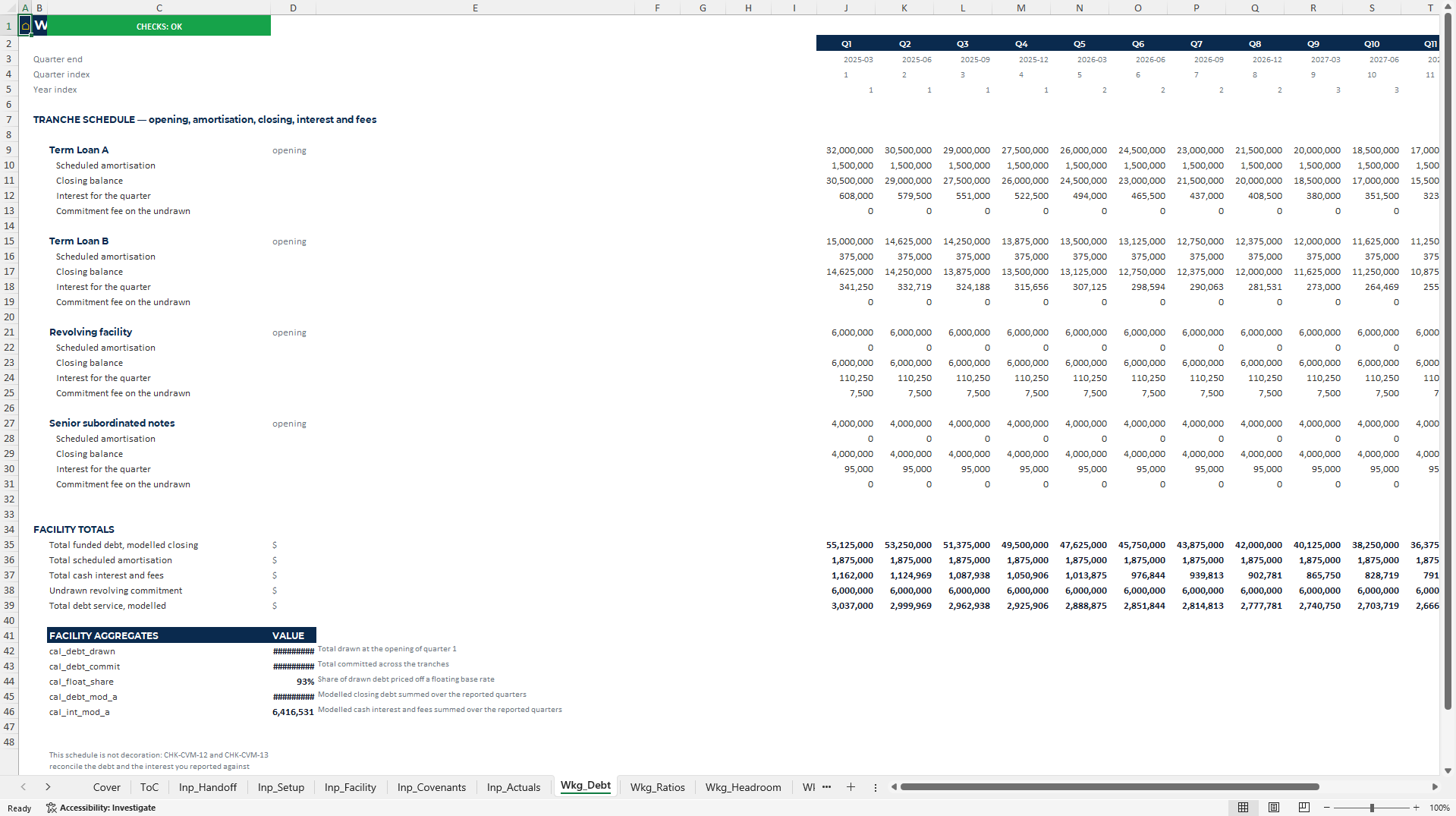
2. Analysis: Calculate adjusted EBITDA, debt and debt-service measures, then test every covenant across the base case and five scenarios.
3. Controls: Compare modelled caps and deadlines with the captured agreement terms and consolidate 63 named verifications into one master status light.
4. Outputs: Review ratio headroom, EBITDA cushion, first-breach quarter, scenario results and the printable certificate.
5. Decision: Confirm open terms, revise the forecast, prepare a mitigation or cure discussion, and complete the certificate review.
## Worked Demo Evidence
The included case models a fabricated-metals borrower with four debt tranches, eight covenants and 16 quarters of actuals and plan.
| Demo result | Evidence shown in the model |
|—-|—-:|
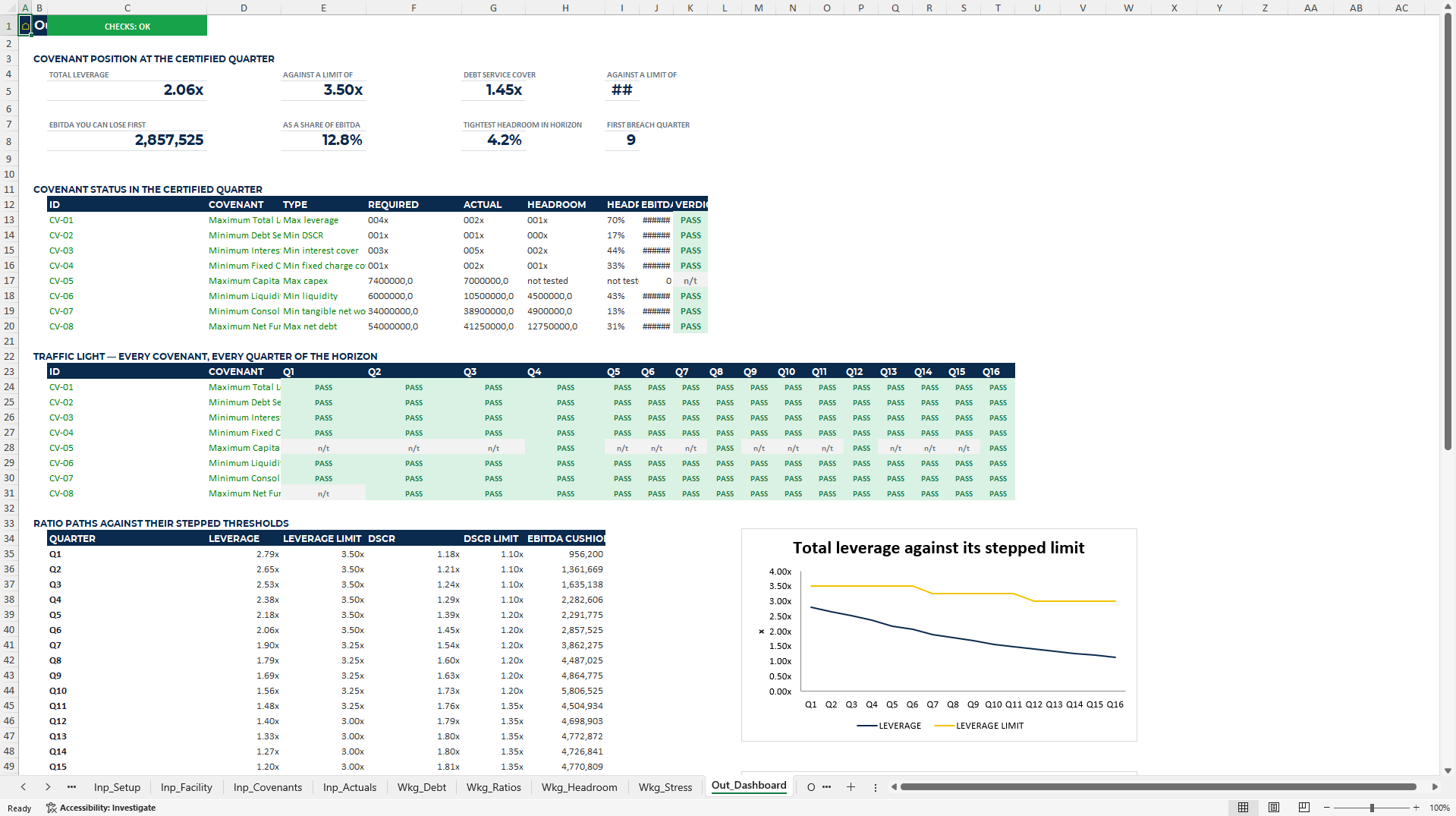
| Leverage in the certified quarter | 2.06x vs 3.50x limit |
| Debt-service cover in the certified quarter | 1.45x vs 1.20x minimum |
| EBITDA cushion | USD 2,857,525 |
| Tightest headroom in the forecast horizon | 4.2% vs 15% benchmark |
| First modelled breach | Quarter 9 |
| Add-backs claimed | USD 2,244,000 |
| Add-backs refused by the 20% contractual cap | USD 226,000 |
The first modelled breach occurs four quarters after the quarter being certified. The companion records 20 definition elements, 12 add-backs and 32 registered terms, with 28 confirmed and four open. These figures illustrate how the package works; they do not predict a purchaser's covenant outcome.
## Built for Trust
• Built to the FAST modelling standard 02c, with a controlled function set and repeatable row logic.
• 401 named ranges, six charts and 63 named verification checks across the two workbooks.
• Four controls compare modelled caps and deadlines with the terms captured from the agreement.
• No macros, volatile functions, external links or hidden sheets.
• A frozen run date supports repeatable reporting for the same quarter.
• Inputs carry units, sources and a defined status; benchmark bands carry a source and date.
• Data remains in your local Excel files and does not connect to your ledger.
• Designed for Microsoft Excel 2019 and Microsoft 365 desktop.
## Who It Is For
The package is designed for borrower-side CFOs, treasurers, finance directors, controllers, FP&A teams and advisers who prepare, review or challenge maintenance-covenant calculations.
Typical uses include quarterly compliance preparation, monthly headroom monitoring, downside planning, refinancing readiness, add-back governance and early lender-engagement planning.
## Honest Limitations
• The package records agreement terms but does not read or interpret the credit agreement. It is not legal advice.
• It monitors modelled maintenance covenants; it does not calculate incurrence tests, baskets or restricted-payment capacity.
• It does not build a three-statement forecast. You supply quarterly actuals and plan.
• It does not connect to the general ledger or debt-administration systems.
• A lender or agent may require a prescribed certificate form. Compare the output with the executed agreement and required form before use.
• Scenario results depend on the inputs and assumptions supplied; they are not a prediction or guarantee.
## Frequently Asked Questions
### Is this built for lenders or borrowers?
It is designed for the borrower-side finance team: the people monitoring headroom, preparing the certificate and explaining the result internally.
### Do I need a separate financial forecast?
Yes. The monitor uses quarterly actuals and plan that you provide; it does not generate a three-statement forecast.
### Does the companion interpret my credit agreement automatically?
No. It provides a controlled structure for recording definitions, caps, deadlines, cure mechanics and unresolved terms. A qualified reviewer must confirm those entries against the executed document.
### How are add-back caps handled?
The model calculates the claimed amount against the captured cap and discloses the refused amount rather than retaining it silently in adjusted EBITDA.
### Is the compliance certificate ready to sign?
The workbook produces a printable one-page certificate with clause references and calculation support. It must still be compared with any prescribed form and reviewed under the executed agreement.
### Can I stress-test rates and EBITDA?
Yes. The demo includes five scenarios covering EBITDA reductions of 10%, 20% and 30% and base-rate increases of 100 and 200 basis points.
### Which version of Excel is required?
The workbooks are designed for Microsoft Excel 2019 and Microsoft 365 desktop. Other spreadsheet applications are not part of the supported configuration.
## Put Time Between the First Warning and the First Breach
Open the worked demo, trace the certified result back to the captured agreement terms, then replace the inputs with your own actuals and plan. Choose the Covenant Headroom Monitor when management needs a reviewable view of headroom, downside and certificate support before the reporting deadline.
Got a question about the product? Email us at support@flevy.com or ask the author directly by using the "Ask the Author a Question" form. If you cannot view the preview above this document description, go here to view the large preview instead.
Source: Best Practices in Debt Excel: Covenant Headroom Monitor: Debt Compliance Excel Model Excel (XLSX) Spreadsheet, ExpertPro Consulting
ABOUT THE AUTHOR

ExpertPro is an advisory firm that builds the financial and decision infrastructure behind capital projects. Our work sits at the intersection of project finance, engineering economics and data: we model, stress-test and document infrastructure investments so that sponsors, lenders and investment committees can decide on evidence rather than intuition.
The practice is led by Eduard Kofman, .
... [read more]
Ask the Author a Question
You must be logged in to contact the author.




























