Carbon Numbers: GHG Inventory, Financed Emissions, CBAM – Document Bundle


DESCRIPTION
Carbon arithmetic arrives from three directions and is almost never bought together. Your own operations produce an inventory. A lender or investor has to attribute the emissions of everything it finances. An importer into the EU now has a certificate bill on the carbon embedded in what it brings in. This set is those three calculations plus the published dataset that the price and allocation assumptions inside them are checked against.
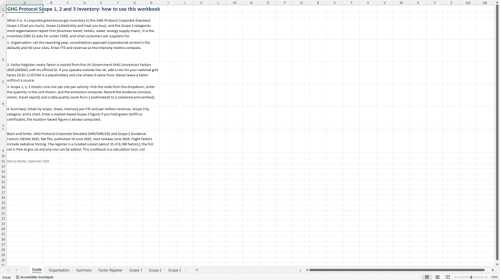
The inventory workbook is a corporate greenhouse gas inventory to the GHG Protocol Corporate Standard: Scope 1 for the fuel you burn, Scope 2 for the electricity and heat you buy, and the Scope 3 categories most organisations report first. It carries 35 emission factors copied from the UK Government GHG Conversion Factors 2025 published by DESNZ, each with its official ID, so every line traces to a public source, and it leaves room to add your own country grid factor with a citation. Scope 2 is reported location-based with market-based alongside, and the evidence and data-quality columns build the audit trail ESRS E1-6 expects.
The financed emissions calculator applies the PCAF Global GHG Accounting and Reporting Standard for the Financial Industry, Part A, third edition, position by position across eight asset classes: listed equity, corporate bonds, business loans, unlisted equity, project finance, commercial real estate, mortgages and motor vehicle loans. The denominator changes with the asset class and the workbook picks it: EVIC for listed equity and bonds, total equity plus debt for loans and unlisted equity, project equity plus debt for project finance, property value at origination for real estate. Data quality is scored 1 to 5 per exposure and reported as a weighted average, which is the part reviewers read first.
The CBAM calculator runs the definitive period that started on 1 January 2026 out to 2034, when free allocation is gone. Enter up to 20 product lines with sector, quantity, embedded emissions and origin carbon price, and the sheet applies the Annex II rule itself: indirect emissions count for cement and fertilisers and not for steel, aluminium or hydrogen. The phase-in percentage for each year is on the sheet with its source, and the carbon price and benchmark can be stressed in one place.
The dataset is the European Environment Agency's EU ETS Union Registry table, values unchanged, as a tidy CSV of 84,056 rows with plain-English activity labels, plus a pivot workbook covering all 19 published measures by country and by activity from 2005 to 2025, and free allocation cover computed per country and year.
Three Excel workbooks with live formulas and no macros, each with a Guide sheet, and one dataset in CSV and workbook form. They are working papers, not an assurance opinion and not a customs filing.
Got a question about the product? Email us at support@flevy.com or ask the author directly by using the "Ask the Author a Question" form.
Source: Carbon Numbers: GHG Inventory, Financed Emissions, CBAM () Document, Bindler
THERE ARE 4 PRODUCTS IN THIS BUNDLE:
|
|
A corporate greenhouse gas inventory to the GHG Protocol Corporate Standard: Scope 1 (fuel you burn), Scope 2 (electricity and heat you buy), and the Scope 3... [read more]
Individual Price: $29.00
|
|
|
Banks, asset managers and insurers report financed emissions to the PCAF Global GHG Accounting and Reporting Standard for the Financial Industry. This workbook applies Part A... [read more]
Individual Price: $39.00
|
|
|
CBAM's definitive period started on 1 January 2026. Importers of steel, aluminium, cement, fertilisers, hydrogen and electricity now buy certificates against the carbon... [read more]
Individual Price: $29.00
|
|
|
The European Environment Agency publishes the EU ETS Union Registry data as one long table. This product is that table, unchanged in its values, made usable in an afternoon... [read more]
Individual Price: $49.00
|
ABOUT THE AUTHOR

Bindler builds Excel workbooks that turn a regulation or a financing structure into live formulas: CSRD double materiality, GHG Protocol inventory, EU Taxonomy, SFDR PAI, PCAF, green bond reporting, IFRS S2, ESRS E1 transition plans, CBAM, the EU AI Act, UAE Corporate Tax, and project finance models for solar, onshore wind and battery storage.
Every workbook is built from the primary text
... [read more]
Ask the Author a Question
You must be logged in to contact the author.




























