EU Sustainability Reporting: CSRD, Taxonomy, IFRS S2 – Document Bundle


DESCRIPTION
A company preparing its first sustainability statement does four exercises in a fixed order, and each one is usually bought, built or improvised separately. This set is the four of them, built to the same pattern by one author, so the vocabulary and the evidence columns match across the sequence.
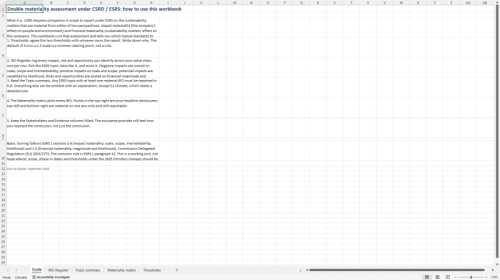
First, the material topics. The double materiality workbook holds an IRO register of up to 60 impacts, risks and opportunities across all ten topical standards, E1 to G1, and scores each one the way ESRS 1 asks: impact materiality on scale, scope and irremediability, likelihood-weighted where the impact is potential, financial materiality on magnitude and likelihood. Thresholds are editable and visible rather than buried, and the reasoning sits beside the score where an auditor reads it.
Second, the climate plan. The ESRS E1 workbook holds gross reduction targets per scope with a base year, 2030 and five-year steps to 2050, computes the absolute values and the share of the combined target by scope, tests progress to date against a linear on-track line, and compares the 2030 target with a 4.2 percent per year linear reference pathway for the statement E1-4 paragraph 34(e) asks for. Levers and actions carry their CapEx and OpEx and the workbook shows the remainder that no lever yet explains, which is the number that gets asked about.
Third, the Taxonomy numbers. The alignment screen carries a criteria library of 16 climate change mitigation activities from Annex I of the Climate Delegated Act, screens each of your activities for substantial contribution, DNSH and minimum safeguards, computes the turnover, CapEx and OpEx alignment KPIs from the activity register, fills the Annex II Template 1 and Template 2 rows that apply from 1 January 2026 under Delegated Regulation (EU) 2026/73, and applies the 10 percent non-material rule.
Fourth, IFRS S2, for the group that reports to the ISSB standards as well as to the ESRS, or instead of them. That workbook is the paragraph 29 cross-industry metrics and the paragraph 33 to 37 target facts as registers, Scope 3 across all fifteen GHG Protocol categories, Scope 2 location-based with market-based alongside, and the UK SRS S2 differences flagged where they apply.
All four are Excel workbooks with live formulas and no macros, each with its own Guide sheet and a Sources sheet naming the article, paragraph or delegated regulation behind every threshold. They are working papers for a reporting team, not a substitute for legal advice or for an assurance engagement.
Got a question about the product? Email us at support@flevy.com or ask the author directly by using the "Ask the Author a Question" form.
Source: EU Sustainability Reporting: CSRD, Taxonomy, IFRS S2 () Document, Bindler
THERE ARE 4 PRODUCTS IN THIS BUNDLE:
|
|
CSRD reporting starts with one exercise: deciding which sustainability matters are material to your company from both directions, your impact on the world and the world's... [read more]
Individual Price: $39.00
|
|
|
ESRS E1-1 asks for a transition plan with ten specific elements, E1-4 for gross reduction targets per scope with 2030 and five-year steps, and E1-3 for the actions and money... [read more]
Individual Price: $39.00
|
|
|
Article 8 of the Taxonomy Regulation asks every in-scope company for three numbers: the share of turnover, CapEx and OpEx that is Taxonomy-aligned. Getting there means screening... [read more]
Individual Price: $39.00
|
|
|
IFRS S2 (and UK SRS S2, its UK-endorsed twin with the same paragraph numbers) asks every reporter for the same seven cross-industry metrics and the same list of facts... [read more]
Individual Price: $29.00
|
ABOUT THE AUTHOR

Bindler builds Excel workbooks that turn a regulation or a financing structure into live formulas: CSRD double materiality, GHG Protocol inventory, EU Taxonomy, SFDR PAI, PCAF, green bond reporting, IFRS S2, ESRS E1 transition plans, CBAM, the EU AI Act, UAE Corporate Tax, and project finance models for solar, onshore wind and battery storage.
Every workbook is built from the primary text
... [read more]
Ask the Author a Question
You must be logged in to contact the author.




























