
 Click main image to view in full screen. Unlock all 12 preview images:
Bitcoin Mining Financial Model | 10-Year ASIC & Power Costs – Excel XLSX
Excel (XLSX) + supplemental PDF


BENEFITS OF THIS DOWNLOADABLE EXCEL DOCUMENT
- Plan 120 months of ASIC deployment and replacement, and trace how fleet capacity translates into expected BTC production, power consumption and CAPEX.
- See how electricity costs, retained BTC and debt repayments affect liquidity across three linked financial statements.
- Compare five operating scenarios and test how BTC price and electricity tariffs affect project NPV, while keeping funding gaps visible.
BITCOIN EXCEL DESCRIPTION
A mining operation can report positive EBITDA and still need more cash when ASICs must be replaced or mined BTC is retained rather than sold. This editable Bitcoin Mining Financial Model helps you see when those pressures arise and test how changes in electricity costs, network difficulty and BTC prices affect the project.
The model connects ASIC fleet deployment, expected BTC production, power consumption and financing to 120 monthly forecast periods, ten annual summaries and three linked financial statements. It is designed for mining operators, infrastructure developers, finance teams, analysts and consultants evaluating an illustrative Bitcoin mining project.
⚙️ PLAN ASIC DEPLOYMENT AND REPLACEMENT
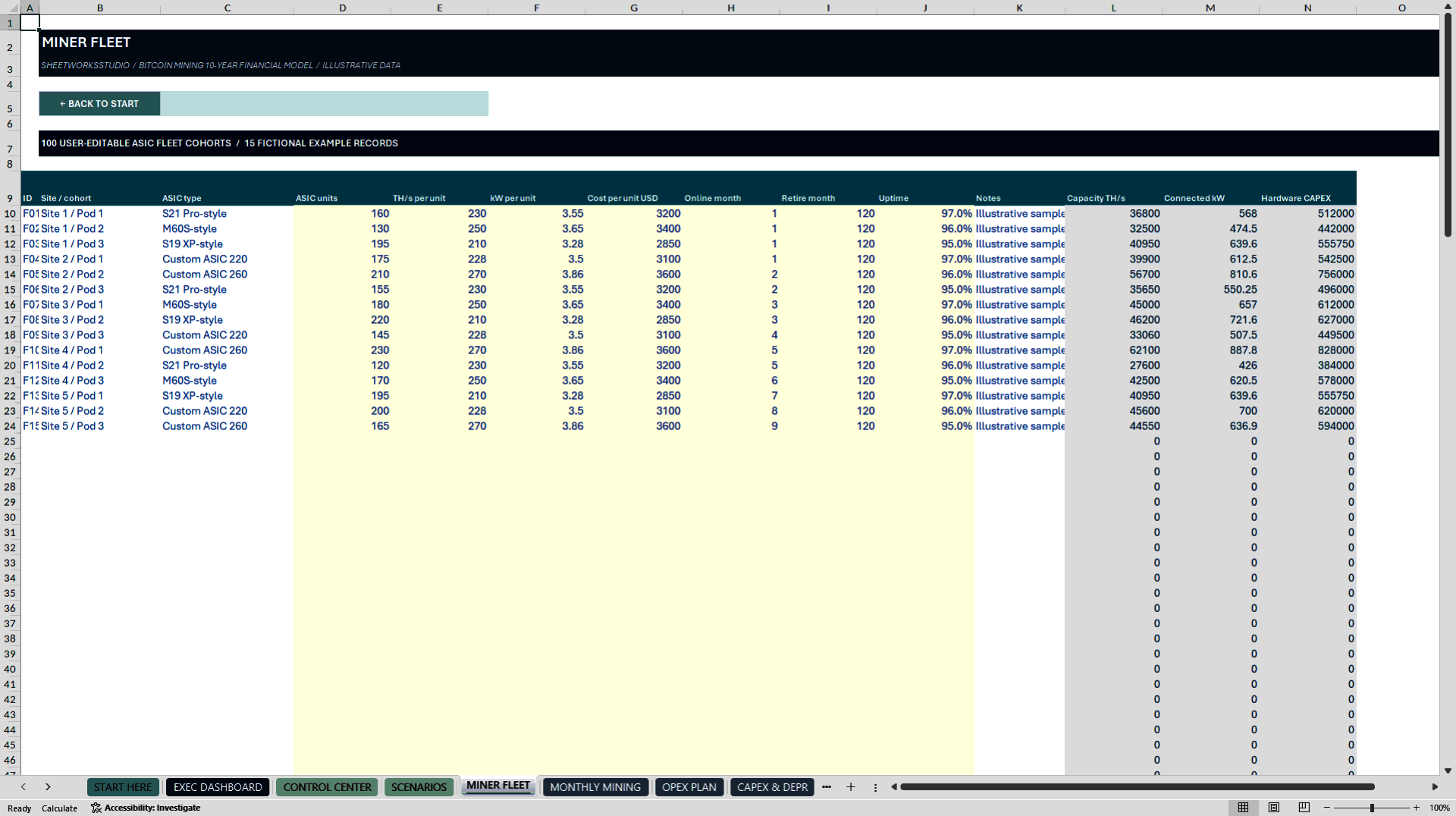
Use 100 prepared fleet cohort positions, including 15 fictional examples. Configure hardware quantities, hashrate, machine power consumption, purchase costs, commissioning and retirement months, and uptime. The workbook links these inputs to effective hashrate, electricity demand, expected production and capital expenditure.
The fleet schedule represents groups of machines rather than individual equipment records. Simplified degradation and replacement assumptions let you test the effect of refresh cycles without tracking individual devices.
₿ FORECAST EXPECTED BTC PRODUCTION AND REVENUE
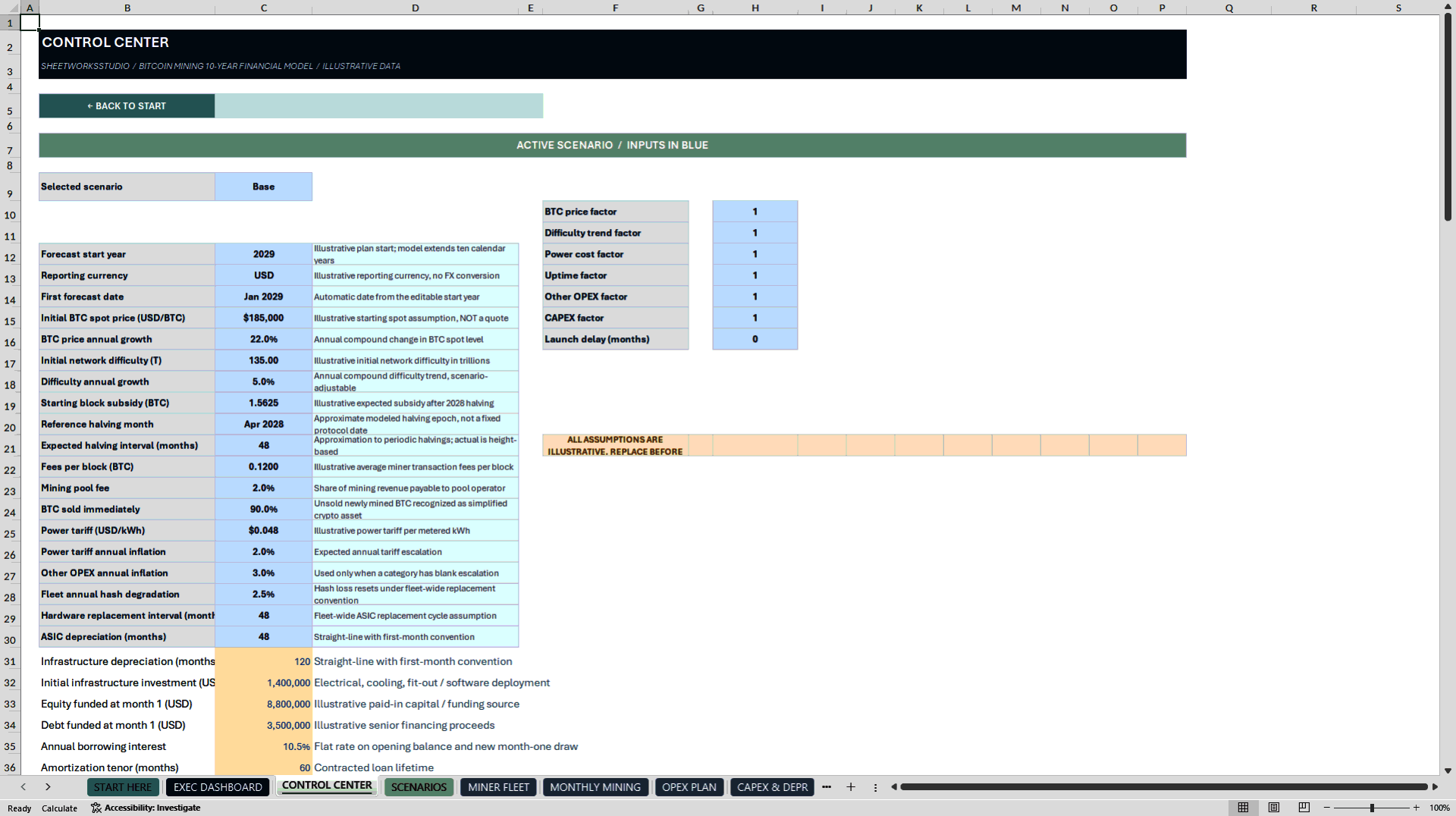
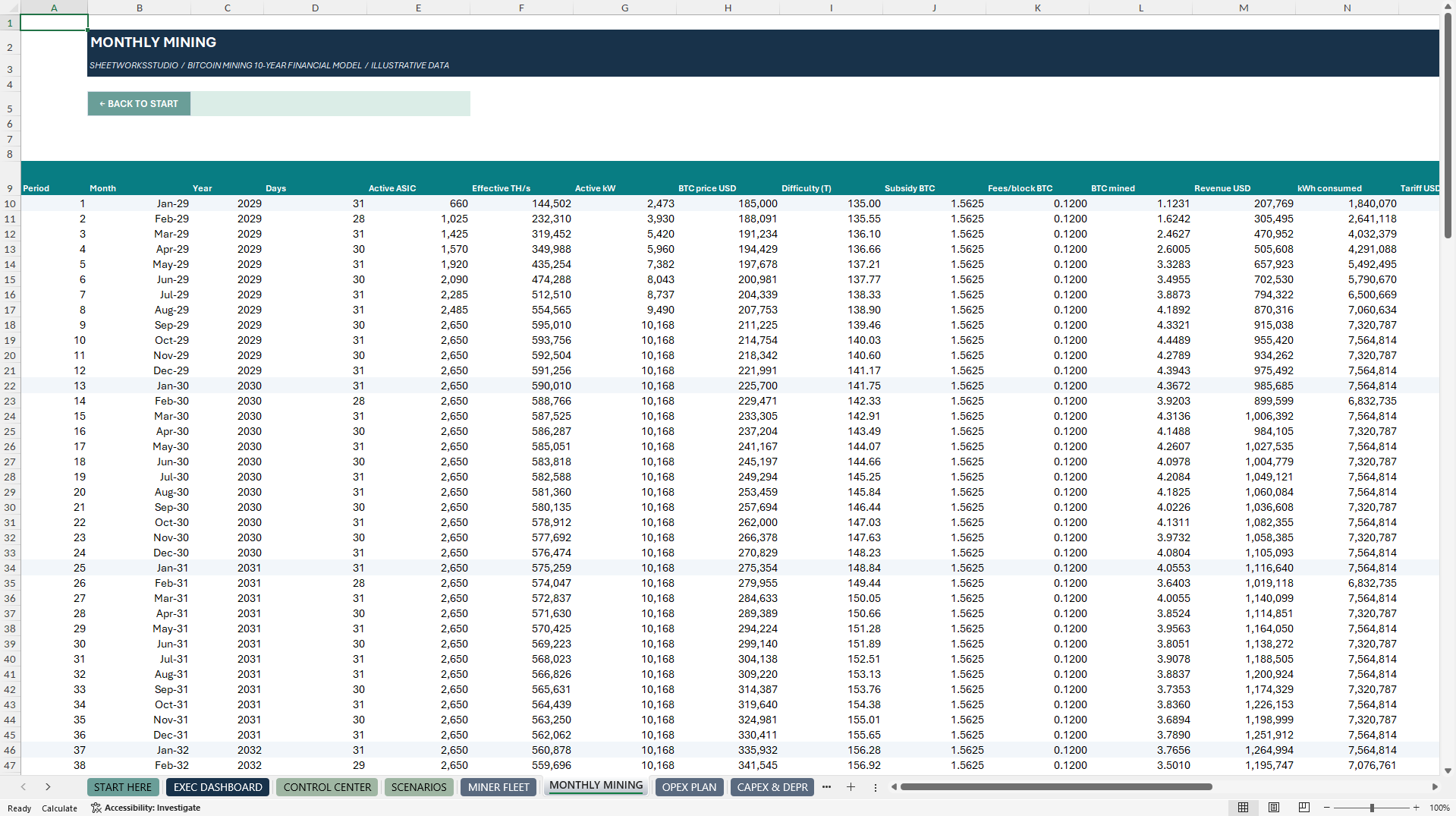
Estimate monthly production from effective hashrate, network difficulty, block subsidy and assumed transaction fees. Adjust BTC prices, difficulty growth, mining pool fees and the share of production sold immediately. Future halvings follow a configurable calendar approximation rather than projected blockchain heights.
The production schedule calculates expected values. It does not simulate the variability of individual mining rewards or pull live network or market data.
⚡ UNDERSTAND ELECTRICITY COST AND COST PER BTC
Connect ASIC power consumption to facility electricity use through a configurable Power Usage Effectiveness (PUE) assumption. Test electricity tariffs, tariff escalation and facility efficiency, then trace their effect on operating cost per BTC, EBITDA and cash flow.
The OPEX schedule includes 15 editable cost categories for expenses such as maintenance, personnel, security and facility services. Detailed utility contracts, demand penalties, curtailment and grid connection constraints are outside the model's scope.
🏗️ CONNECT CAPITAL EXPENDITURE AND FINANCING TO CASH
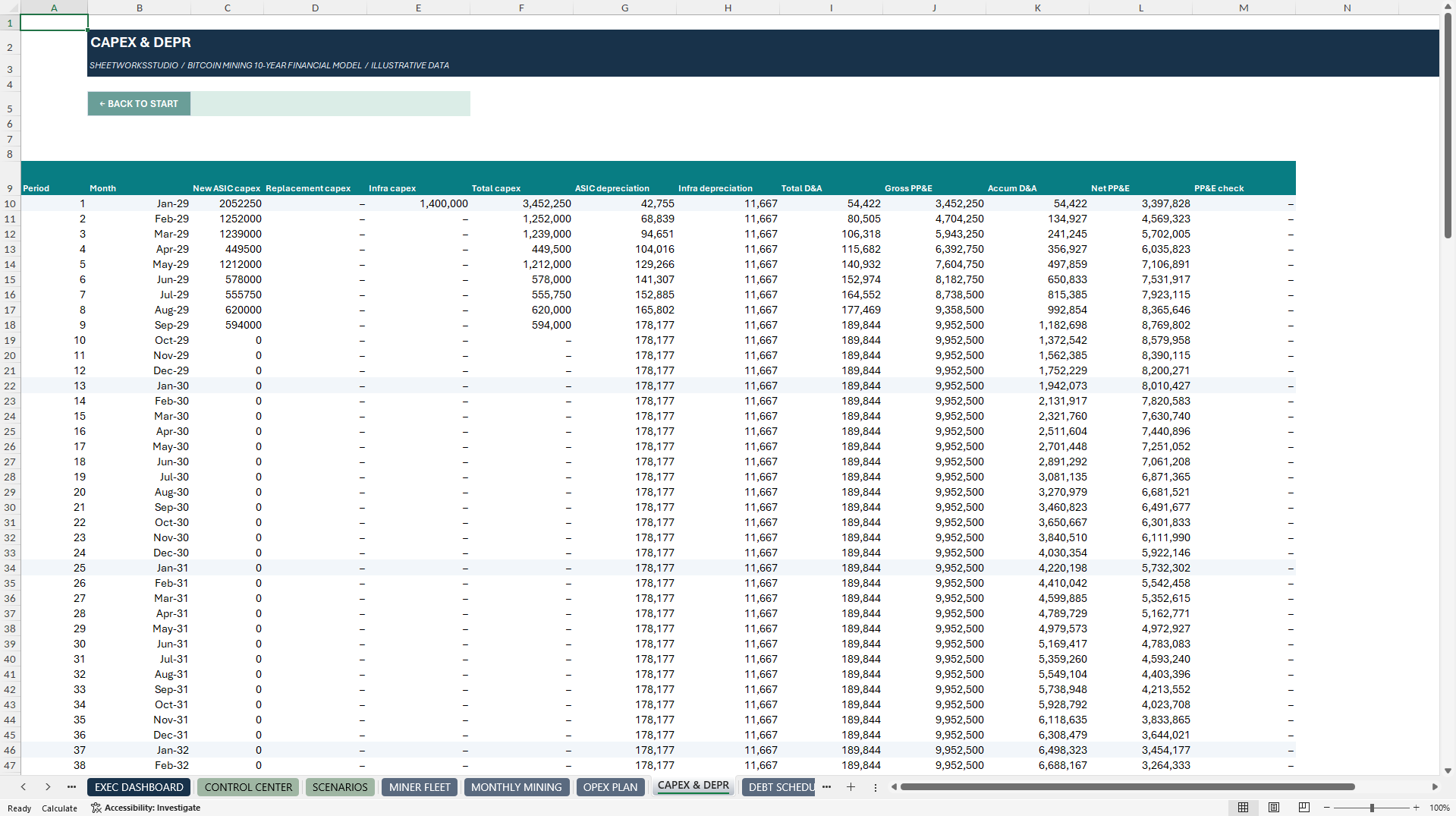
Plan initial hardware and infrastructure investment, simplified ASIC replacement CAPEX and depreciation. Review initial equity and term-loan funding, interest, principal repayments and outstanding debt.
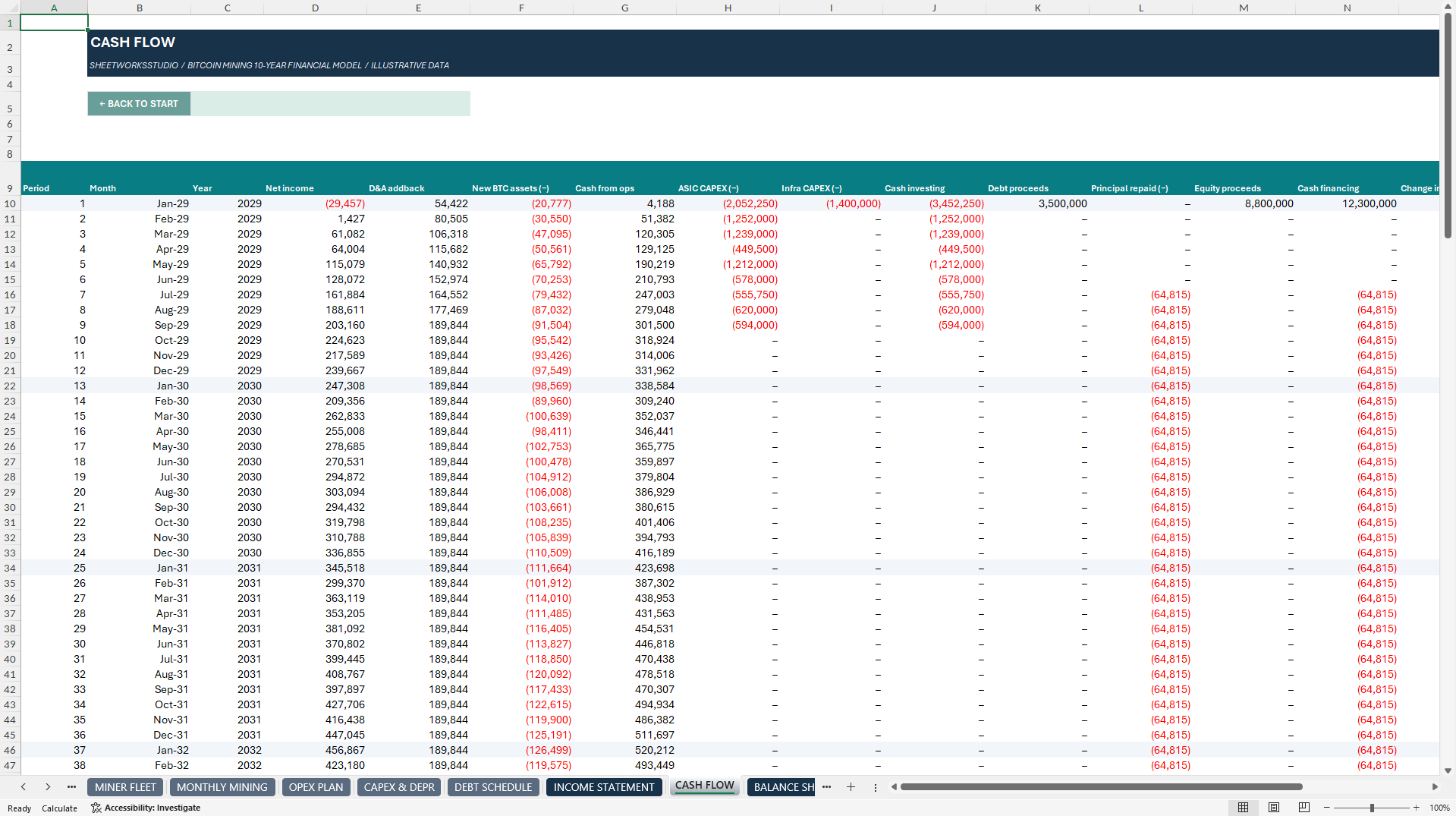
The linked Income Statement, Cash Flow and Balance Sheet distinguish mining revenue from cash receipts. BTC that is not immediately sold is recorded using a simplified carrying-value convention, without subsequent token-sale or fair-value schedules. If available funding is insufficient, the cash deficit stays visible. The workbook does not automatically add borrowing or equity.
🔄 COMPARE FIVE SCENARIOS AND TEST PROJECT VALUE
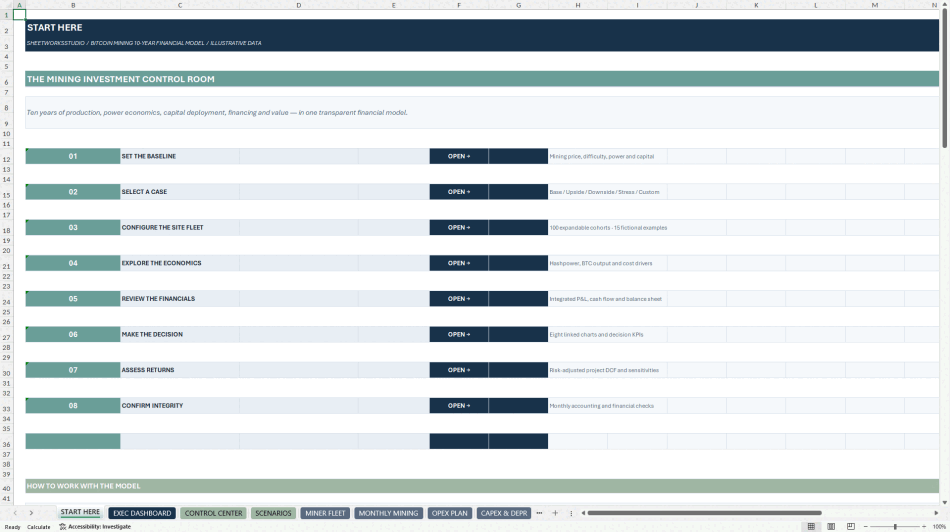
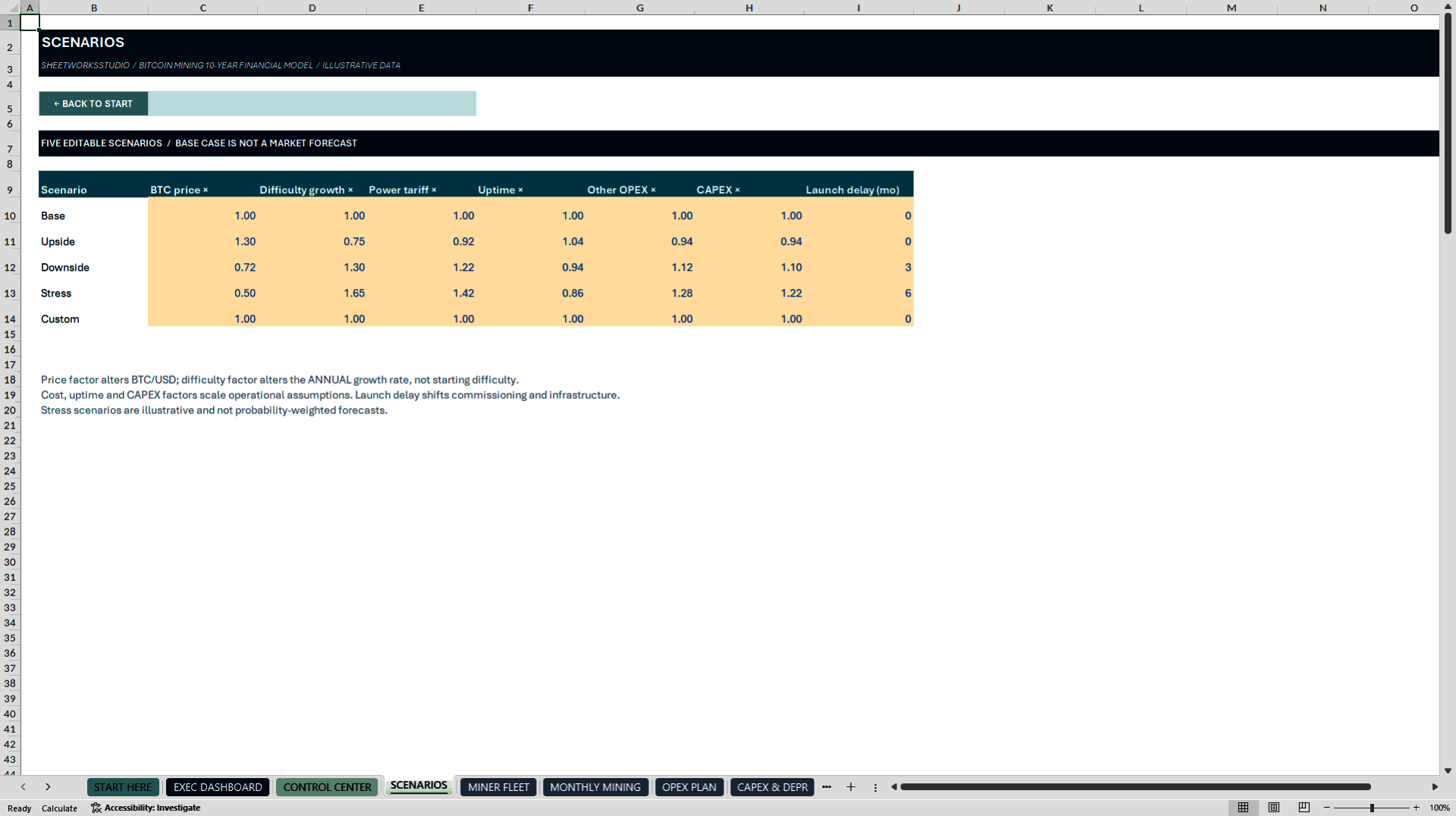
Select Base, Upside, Downside, Stress or Custom. Test changes in BTC price, difficulty growth, electricity tariff, uptime, operating costs, CAPEX and deployment timing. The active scenario drives the monthly schedules, annual summary, dashboard and valuation.
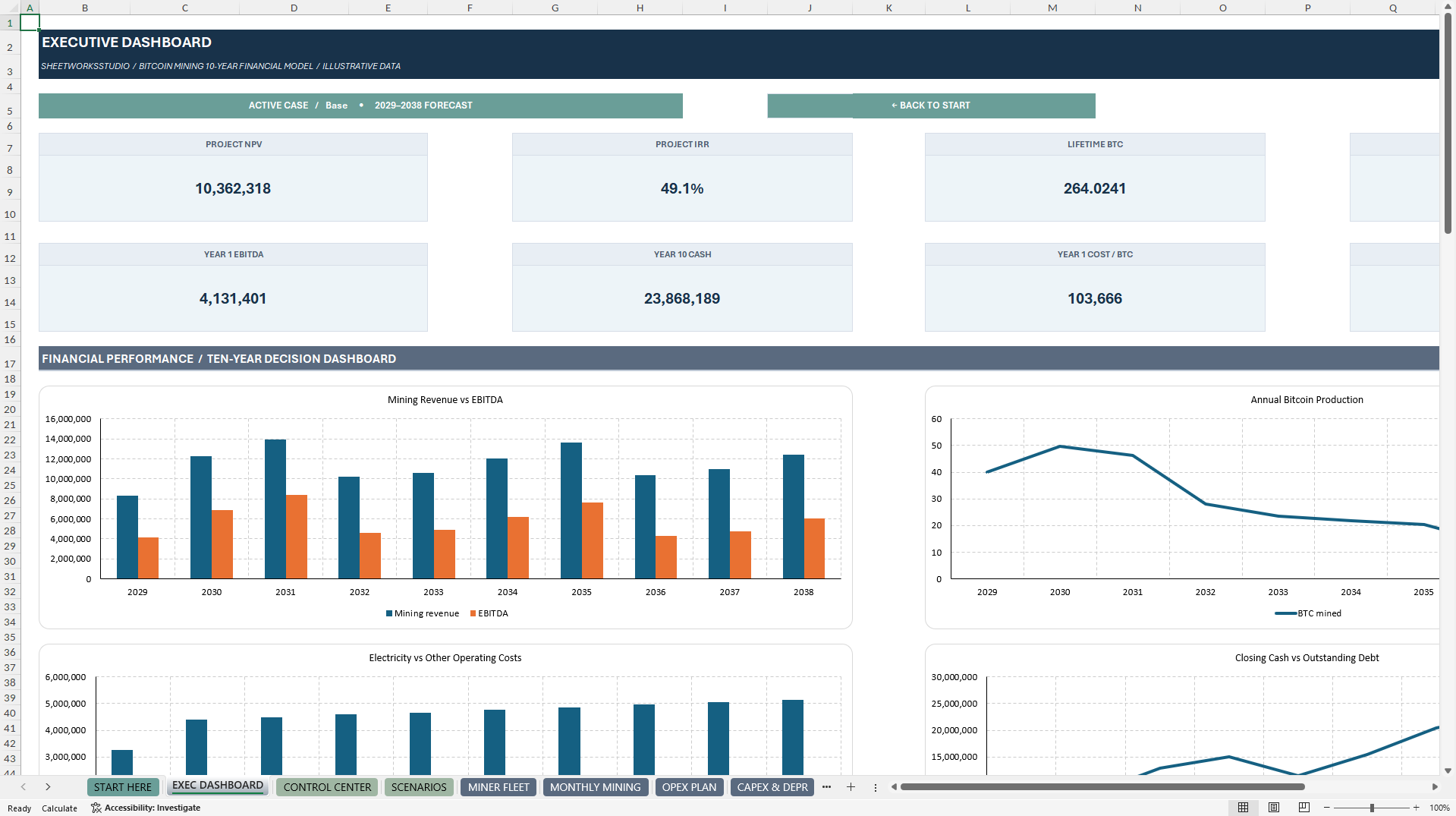
The valuation includes project NPV, annual project IRR, indicative payback and an optional final-year EBITDA exit multiple. NPV discounts annual year-end project cash flows. The IRR uses ten annual project cash flows without a separate year-zero outflow. It is not an equity-investor IRR or XIRR, and a displayed 0% can indicate that the calculation did not return a valid IRR.
A 7×7 sensitivity grid estimates how BTC price and electricity tariff changes affect NPV. It is an approximation. Use the Custom scenario when you want the full model to recalculate.
📊 REVIEW KEY RESULTS AND FUNDING WARNINGS
Eight KPI cards and eight native Excel charts show mining revenue, production, electricity costs, cash, debt, cost per BTC, CAPEX, EBITDA margin and hashrate. Use MODEL QA to review accounting checks and funding warnings separately. A reconciled balance sheet does not mean the project is profitable or fully funded.
📦 WHAT YOU RECEIVE
• Primary Document – Editable, macro-free Excel workbook (.xlsx) with 18 worksheets, 120 monthly forecast periods, ten annual summaries, five selectable scenarios, three linked financial statements, eight KPI cards and eight native Excel charts.
• Supplementary Document – 32-page English How-to-Use Guide (PDF) covering setup, fleet inputs, production, energy costs, financing, financial statements, valuation, sensitivities and troubleshooting.
⚙️ COMPATIBILITY AND SCOPE
The illustrative forecast runs from January 2029 through December 2038. The start year is editable. The reporting currency setting is a label and does not perform FX conversion. No macros, live market data or required external connections are included. Microsoft Excel Desktop is recommended. Google Sheets import has not been independently verified.
This is an independent, unofficial financial planning template by SheetworksStudio. All sample inputs and forecasts are fictional. It is not an audited model, a live mining simulator, a cryptocurrency accounting platform or a guarantee of profitability or funding. It does not provide financial, investment, accounting, tax, engineering or legal advice. No hardware, cryptocurrency or data subscription is included.
Got a question about the product? Email us at support@flevy.com or ask the author directly by using the "Ask the Author a Question" form. If you cannot view the preview above this document description, go here to view the large preview instead.
Source: Best Practices in Bitcoin, Integrated Financial Model Excel: Bitcoin Mining Financial Model | 10-Year ASIC & Power Costs Excel (XLSX) Spreadsheet, SheetworksStudio
ABOUT THE AUTHOR

SheetworksStudio creates premium Excel-based business templates, dashboards, trackers, financial models, and management systems for professionals, consultants, entrepreneurs, and organizations.
Our portfolio covers finance, project management, operations, risk management, compliance, AI governance, HR, supply chain, performance management, and business planning. Each product is designed to
... [read more]
Ask the Author a Question
You must be logged in to contact the author.