
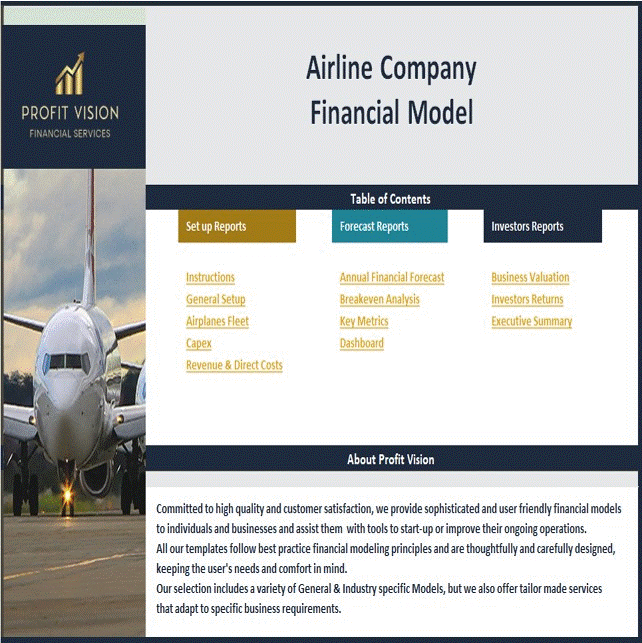

 Click main image to view in full screen. Unlock all 11 preview images:
Airline Company Financial Model - Dynamic 10 Year Forecast – Excel XLSX
Excel (XLSX)


BENEFITS OF THIS DOWNLOADABLE EXCEL DOCUMENT
- Presents a business scenario of an Airline Company providing air transport services for traveling passengers and freight.
- Suitable for either a startup or operating company
AIRLINE INDUSTRY EXCEL DESCRIPTION
Financial model presenting a business scenario of an Airline Company providing air transport services for traveling passengers and freight.
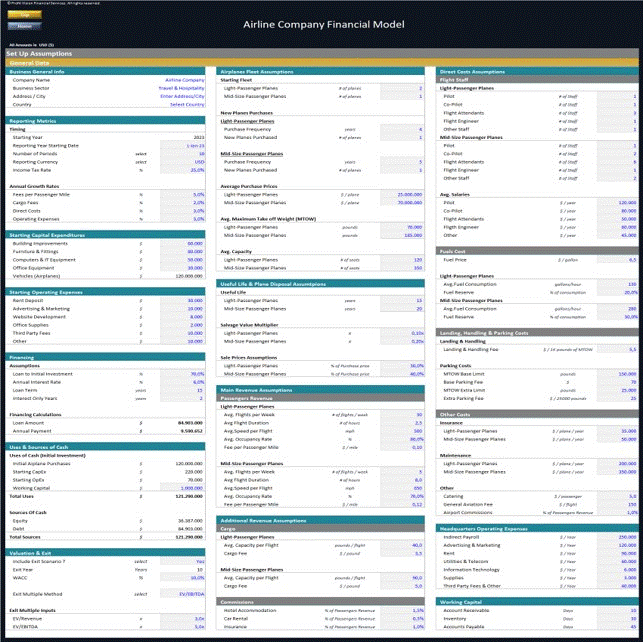
Suitable for either a startup or an operating Airline Company, the model is a flexible tool for owners to calculate operating activities and analyze business profitability. It includes assumptions and calculations of the Total Airplane Fleet (number of planes, purchase prices, MTOW, Capacity), Salvage Value and Disposal, Revenue per Passenger Mile assumptions (Total Flight Hours, Avg. Speed per Flight, Distance Traveled, Occupancy Rates and Price per Mile), Additional Revenue Sources (Cargo and Commissions), Direct Costs (Payroll, Fuels, Landing & Handling, Parking, Maintenance, General Aviation Fees, Insurance, etc.), Headquarters Operating Expenses, Capital Expenditures, Financing through Debt & Equity and Valuation & Exit Multiples in case of a potential sale of the business.
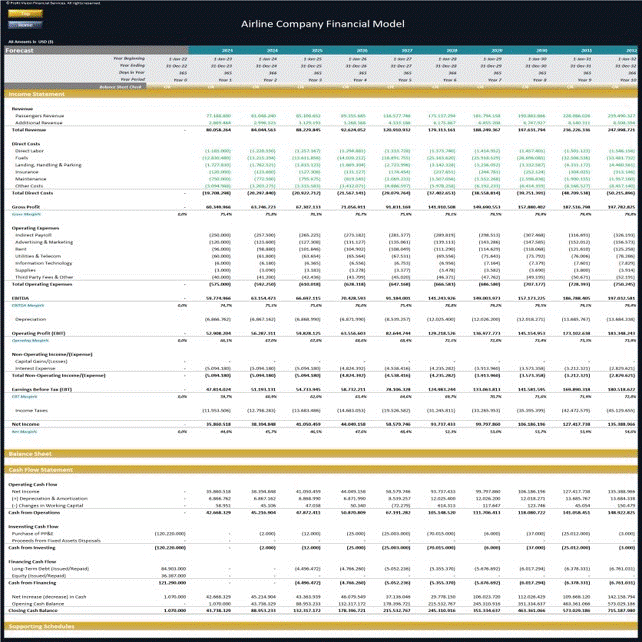
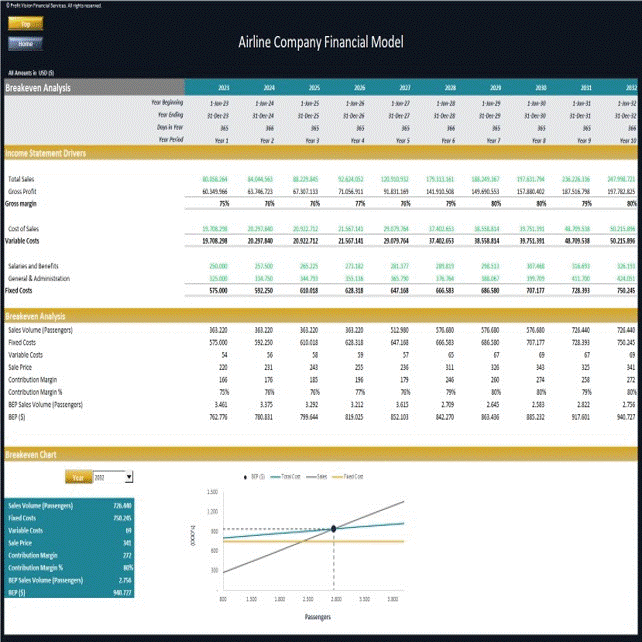
Outputs of the template include forecasted Annual Financial Statements (3 Statement Model), Breakeven Analysis, various KPI and Financial Ratios, Performance Dashboard, Business Valuation and Sensitivity Analysis, Investors Returns Waterfall and a professional Executive Summary presenting company's results.
The template structure follows Financial Modeling Best Practices principles and is fully customizable with a dynamic functionality allowing users to select the desired forecasted Years (1 to 10). Output Reports & Charts are updated based on the selected forecast period.
Detailed instructions on the use of the model are included in the Excel file.
Model Structure
Inputs & Model Calculations:
• General Business Info
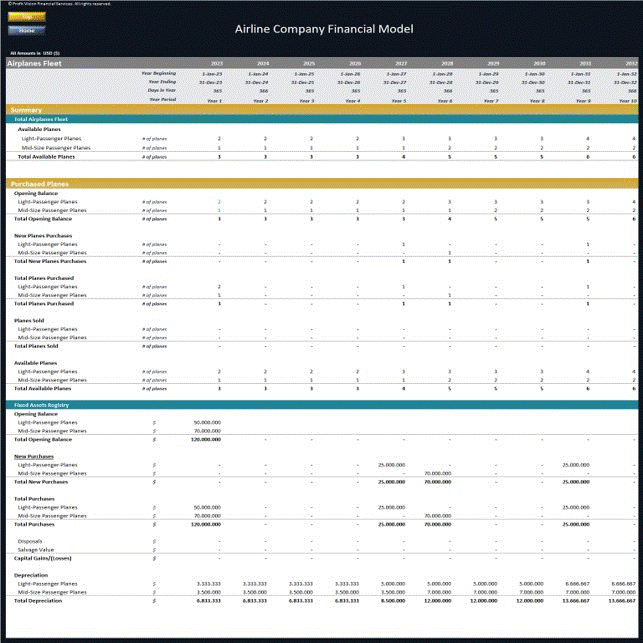
• Airplane Fleet (Purchases, MTOW, Capacity) for Light and Mid-Size Passenger Planes
• Assets (planes) Disposal Assumptions and Calculations incl. Useful Life, Salvage Value Multiplier, Sale Prices, and Capital Gains (Losses)
• Passengers, Cargo and Commissions Revenue
• Direct Costs (Payroll, Fuels, Landing, Parking, Maintenance, etc.)
• Headquarters Operating Expenses
• Capital Expenditures & Depreciation
• Financing & Capital Structure – Uses & Sources of Cash analysis (Financing through Equity & Debt)
• Exit Year Scenario & Valuation Multiples (EV/Revenue and EV/EBITDA)
Outputs:
• Dynamic 10-Year Forecast (3 Statement Model)
• Breakeven Analysis
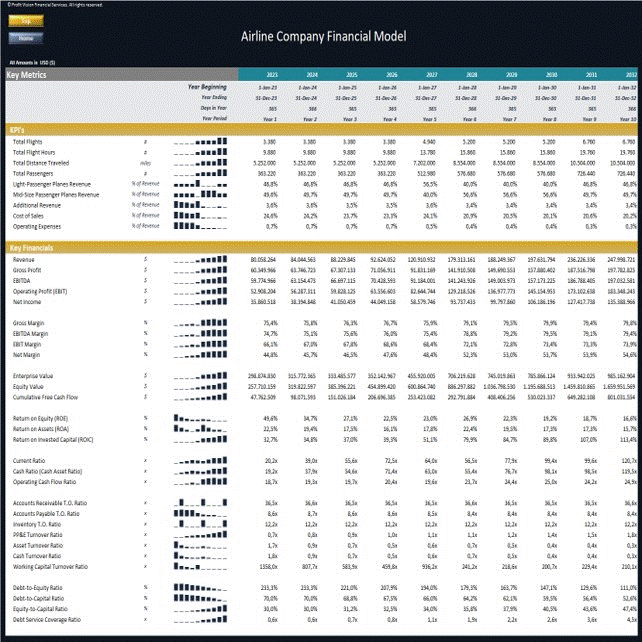
• Summary of various KPIs and Financial Ratios (Operating Metrics, Profit Margins, ROE, ROA, etc.)
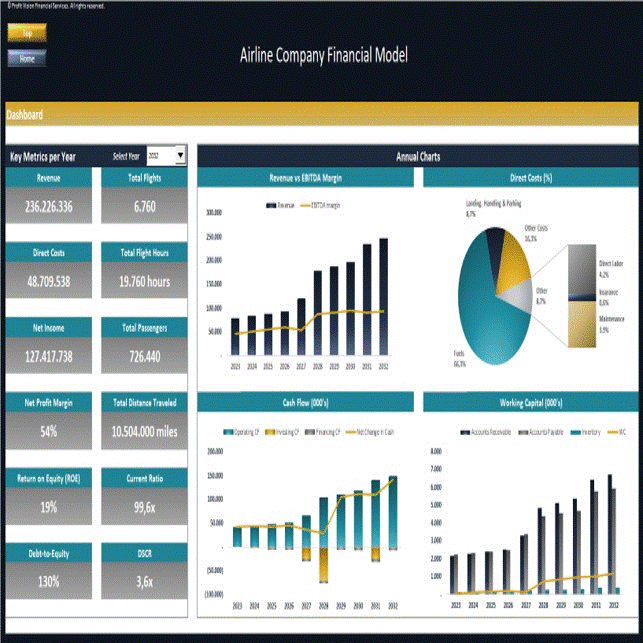
• Dynamic Performance Dashboard
• Business Valuation (incl. Enterprise & Equity Value, DCF, Terminal Value, Unlevered & Levered Cash Flow, Project Return Metrics & Sensitivity Analysis)
• Investor Returns (4-tier IRR hurdle waterfall model to distribute proceeds between investors)
• Exit Year Executive Summary (can be used for investment decisions)
Help & Support
Committed to high quality and customer satisfaction, all our templates follow best practice financial modeling principles and are thoughtfully and carefully designed, keeping the user's needs and comfort in mind.
Whether you have no experience or are well versed in finance, accounting, and the use of Microsoft Excel, our professional financial models are the right tools to boost your business operations!
If you experience any difficulty while using this template and cannot find the appropriate guidance in the provided instructions, please feel free to contact us for assistance.
If you need a template customized for your business requirements, please e-mail us and explain your specific needs briefly.
The template offers a comprehensive breakdown of key financial metrics, including revenue, direct costs, and net income, all displayed with clear visual charts. Users can easily navigate through detailed sections such as breakeven analysis, key metrics, and investor returns, ensuring a thorough understanding of the financial outlook.
Got a question about the product? Email us at support@flevy.com or ask the author directly by using the "Ask the Author a Question" form. If you cannot view the preview above this document description, go here to view the large preview instead.
TOPIC FAQ
What components should an airline financial model include for accurate forecasts?
Core components include airplane fleet assumptions (number, purchase prices, MTOW, capacity), passenger and cargo revenue drivers, direct operating costs (fuel, maintenance, landing/handling), headquarters expenses, capex and depreciation, financing and capital structure, plus valuation outputs like DCF and exit multiples; together these support a 3-statement model.How is passenger revenue typically modeled for an airline projection?
Passenger revenue is modeled from Revenue per Passenger Mile assumptions using total flight hours, average speed per flight, distance traveled, occupancy rates, and price per mile, often combined with additional revenue streams such as cargo and commissions to produce consolidated revenue forecasts.What valuation methods are appropriate for valuing an airline business?
Common methods include discounted cash flow analysis producing enterprise and equity values, plus market-based exit multiples such as EV/Revenue and EV/EBITDA; sensitivity analysis and terminal value calculations are used to test valuation ranges in the model.How does an investor returns waterfall work in a financing model?
An investor returns waterfall allocates exit proceeds across investor tiers according to specified IRR hurdles and distribution rules; this template includes a structured 4-tier IRR hurdle waterfall to model distributions between investors and sponsors.What should I look for when choosing an airline financial template for fundraising?
Look for integrated 3-statement forecasting, explicit fleet and disposal assumptions, capex and depreciation schedules, valuation outputs (DCF and exit multiples), sensitivity analysis, and investor returns modeling; the ability to switch forecast length dynamically between 1 and 10 years is also important.How much Excel experience is required to use a downloadable airline financial model?
Templates include detailed instructions and are designed for users with varying levels of finance and Excel experience, allowing both less-experienced users and seasoned analysts to follow setup and input procedures using the provided guidance in the Excel file.Which model elements help compare purchase versus disposal or salvage outcomes for aircraft?
Useful elements are airplane purchase price inputs, useful life and depreciation schedules, salvage value multipliers, sale price calculations, and capital gains/losses computations; these features enable analysis of asset disposal and salvage scenarios.What outputs should an investor-facing executive summary for an airline include?
An investor executive summary should present forecasted financial statements, key KPIs and ratios, breakeven analysis, enterprise and equity valuation (DCF, terminal value), sensitivity testing, and investor returns details such as the IRR waterfall and presentable dashboard visuals.Source: Best Practices in Airline Industry, Integrated Financial Model Excel: Airline Company Financial Model - Dynamic 10 Year Forecast Excel (XLSX) Spreadsheet, Profit Vision
ABOUT THE AUTHOR

Profit Vision provides Consulting & Outsourced Financial Services as well as Financial Planning & Performance analysis to small and mid-size businesses by implementing efficient and effective tools to assist them with start-up business plans or improve their ongoing operations.
Our range of services include Financial & Operational Analysis, Business Planning, Budgeting & Forecasting, Cash Flow
... [read more]
Ask the Author a Question
You must be logged in to contact the author.