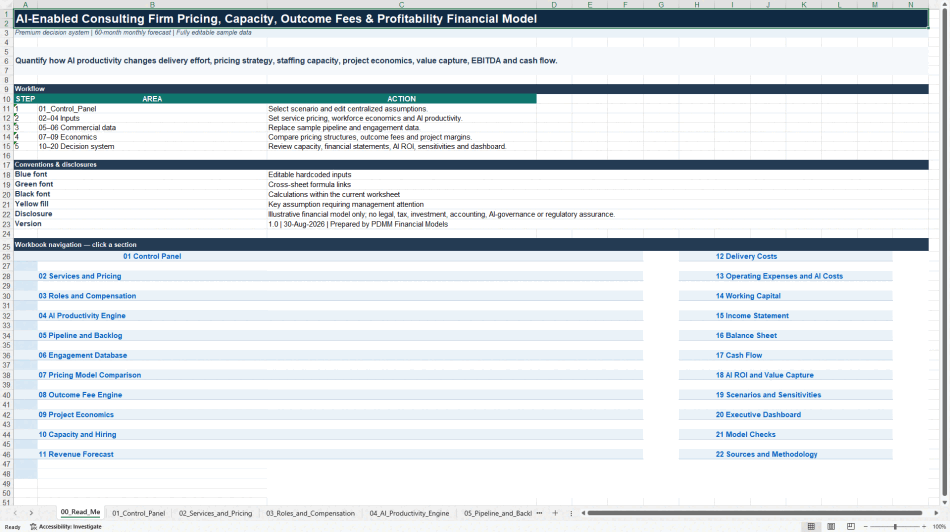

 Click main image to view in full screen. Unlock all 23 preview images:
AI Consulting Pricing, Capacity & Profitability Model – Excel XLSX
Excel (XLSX) + supplemental PDF


BENEFITS OF THIS DOWNLOADABLE EXCEL DOCUMENT
- Connects AI delivery productivity to consulting pricing, engagement margins, staffing capacity, utilization, EBITDA and cash flow in one integrated Excel decision model.
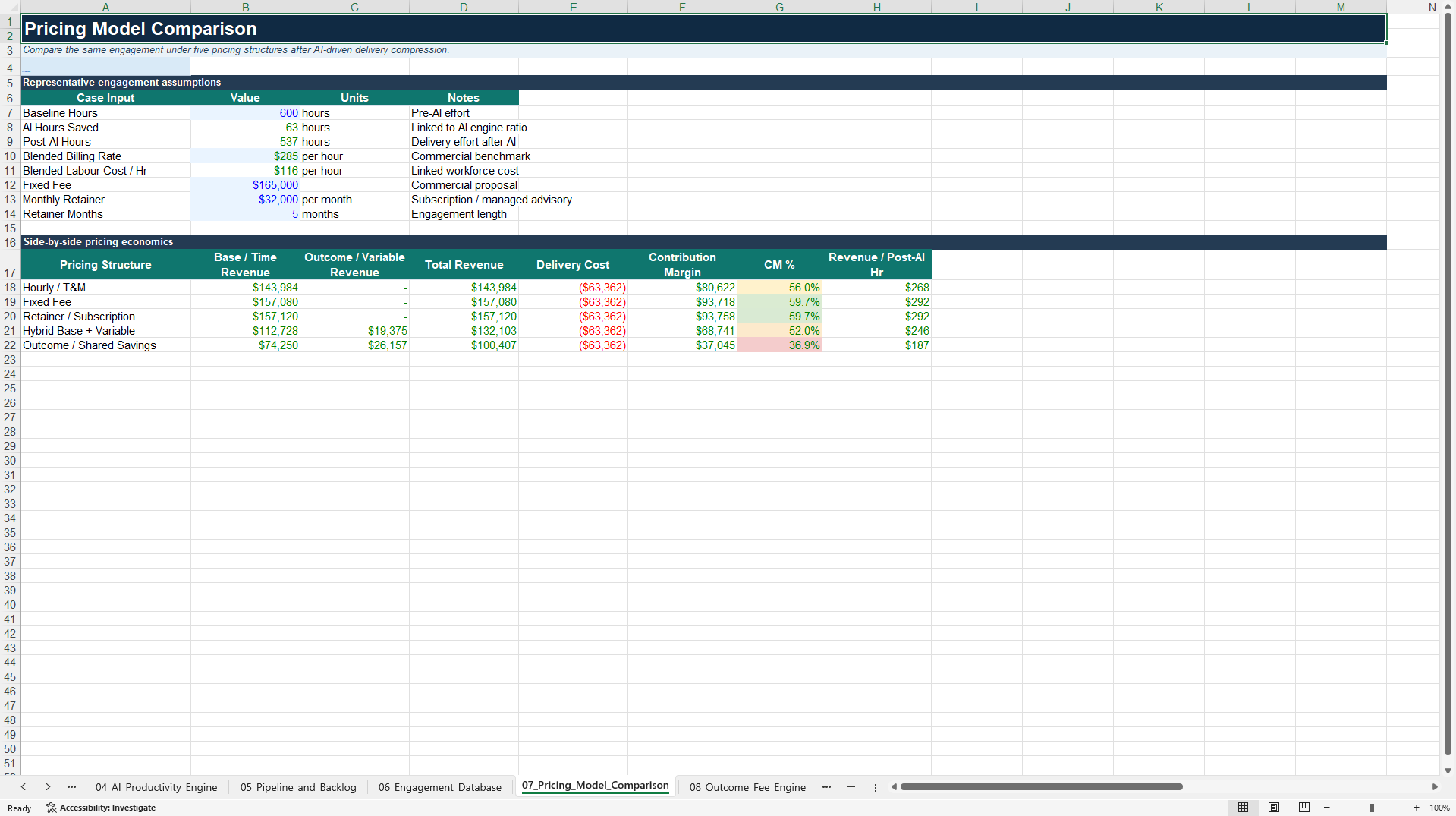
- Compares T&M, fixed fee, retainer, hybrid and outcome-linked structures while quantifying service-line economics, AI price compression and expected outcome fees.
- Supports planning with a 60-month forecast, integrated financial statements, hiring and contractor logic, three scenarios, four sensitivities, an executive dashboard and model checks.
ARTIFICIAL INTELLIGENCE EXCEL DESCRIPTION
AI Consulting Pricing, Capacity & Profitability Model is a fully editable Excel decision model for boutique consulting firms, professional-services operators, advisory practices and AI-enabled consultancies that need to translate delivery productivity into pricing, staffing and financial outcomes.
The model addresses a practical management problem. AI can reduce research, analysis, reporting and documentation effort, but a reduction in hours does not automatically create economic value for the consulting firm. Management still has to decide whether the efficiency should be retained as contribution margin, reflected in lower client pricing, converted into additional delivery capacity, used to change the staffing pyramid, or incorporated into fixed, retainer, hybrid or outcome-linked commercial structures. This workbook connects those decisions rather than analyzing them in isolation.
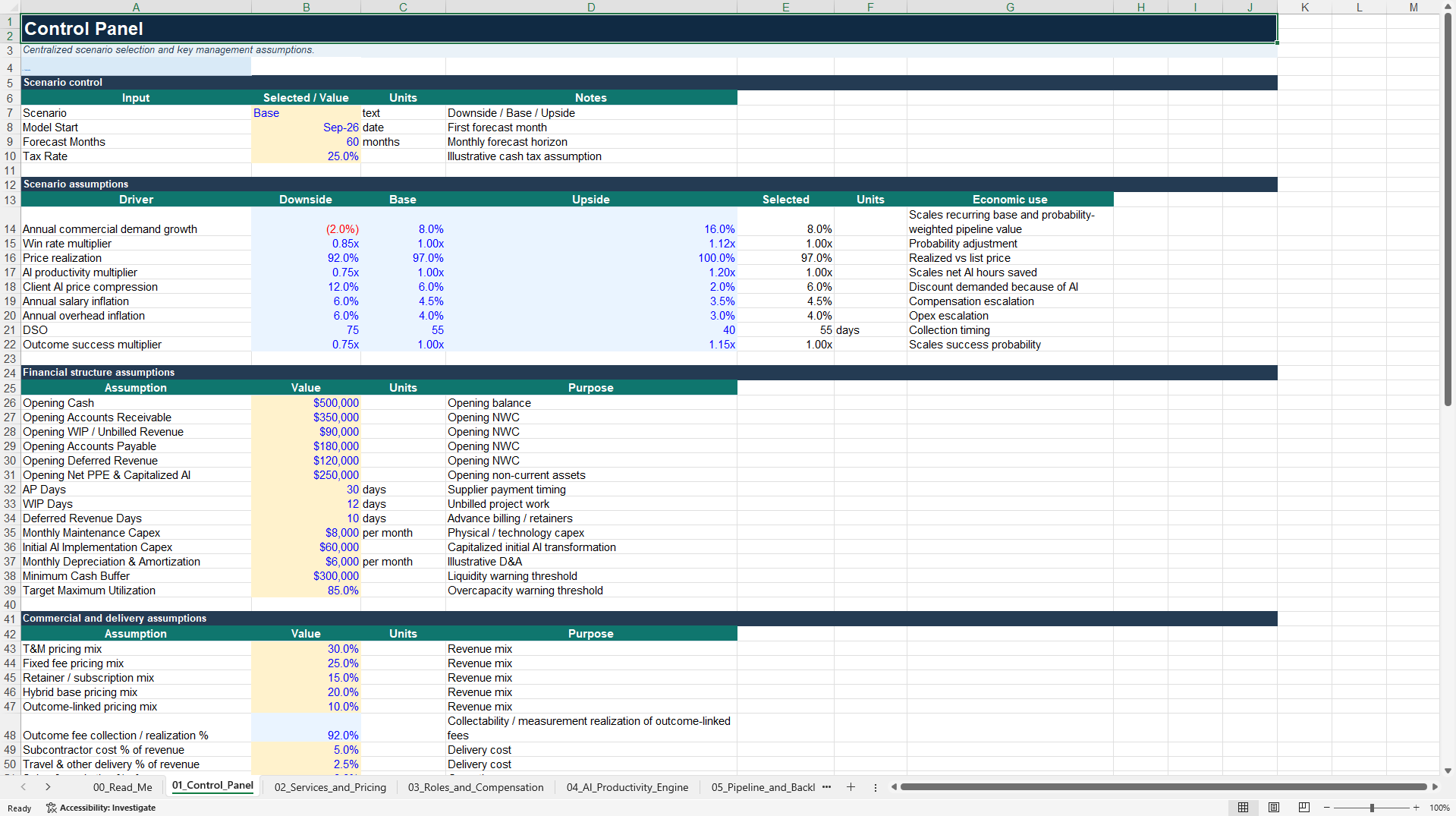
The model contains 23 worksheets and a 60-month monthly forecast. A centralized control panel selects Downside, Base or Upside scenarios and stores commercial growth, win-rate, price realization, AI productivity, client price compression, salary and overhead inflation, DSO, outcome success, financial structure, pricing mix, delivery, billing, leakage and AI price-compression assumptions.
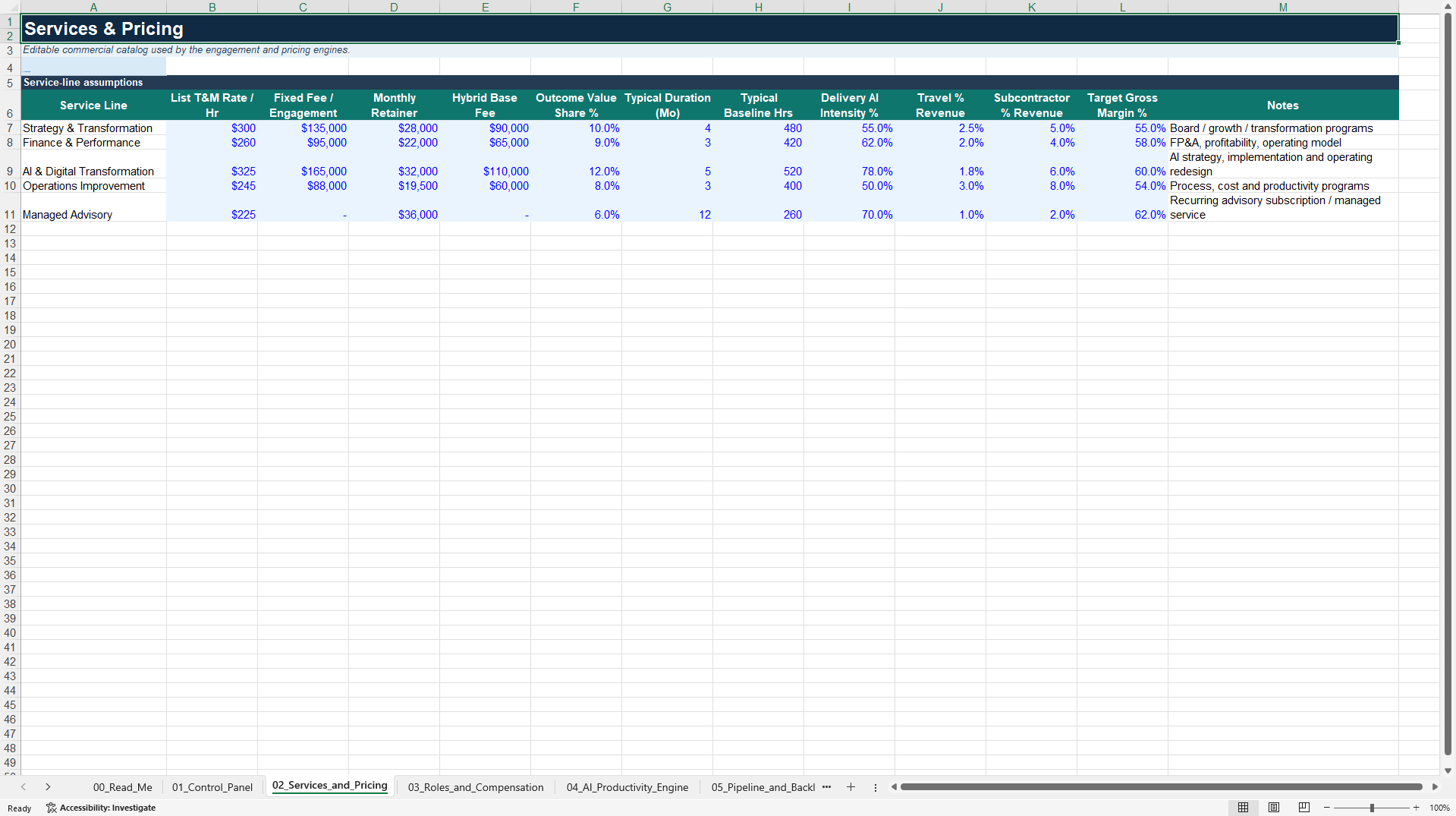
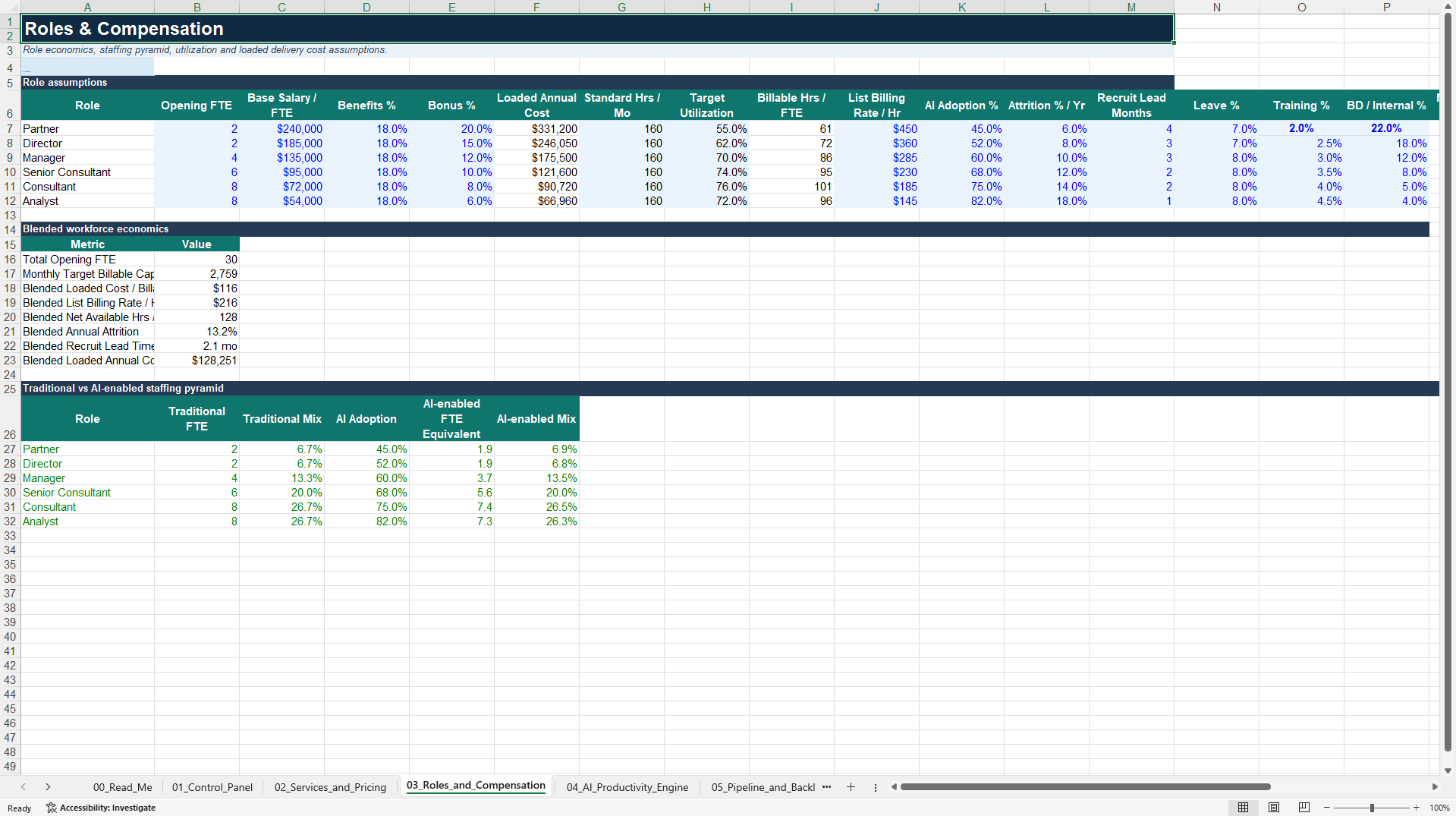
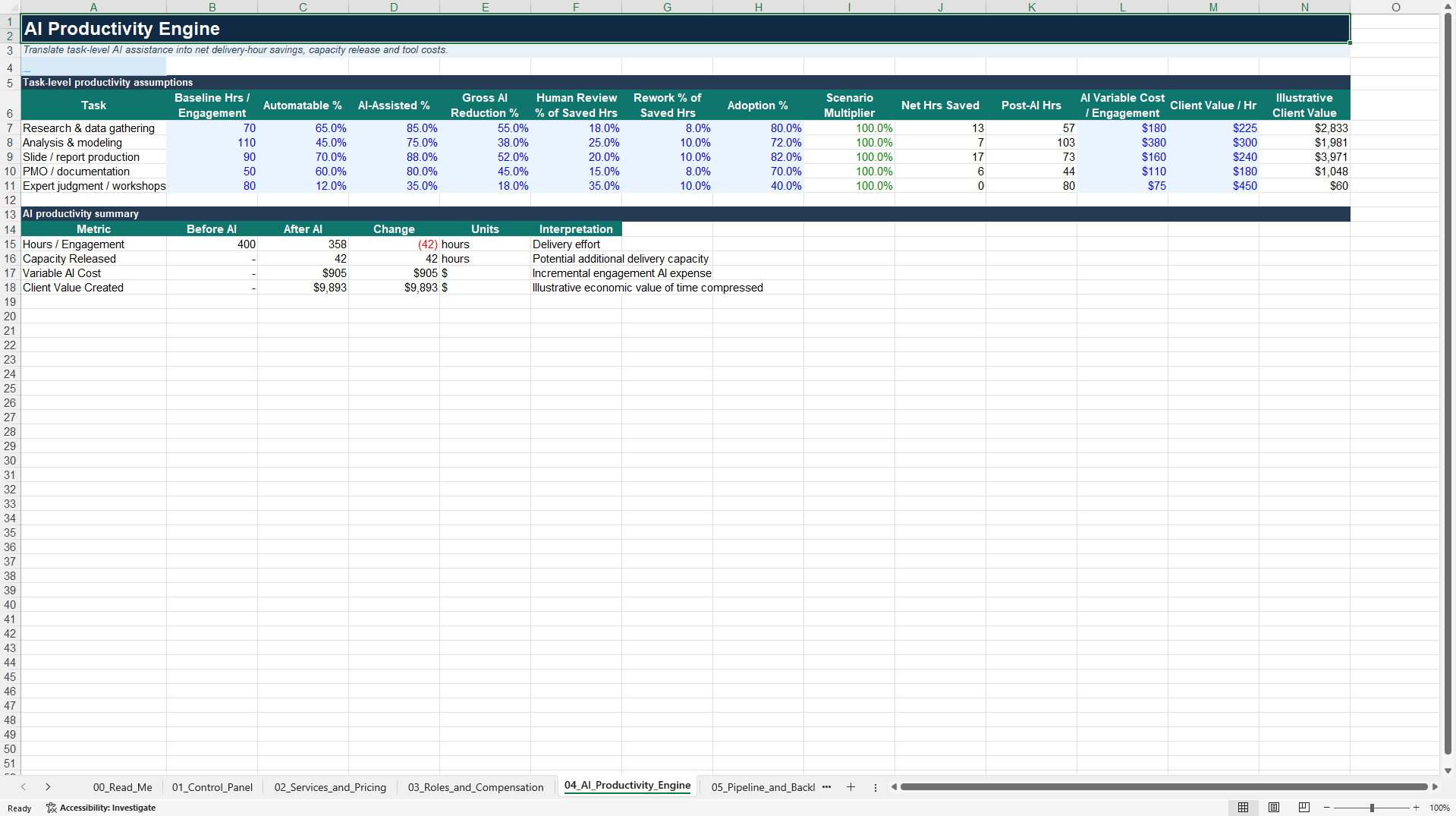
Service-line inputs cover Strategy & Transformation, Finance & Performance, AI & Digital Transformation, Operations Improvement and Managed Advisory. Workforce logic covers Partner, Director, Manager, Senior Consultant, Consultant and Analyst roles with FTE, compensation, available hours, target utilization, billing rates, AI adoption, attrition and recruitment lead time. The AI productivity engine models task-level automation, assisted work, human review, rework, adoption, net hours saved, variable AI cost and illustrative client value.
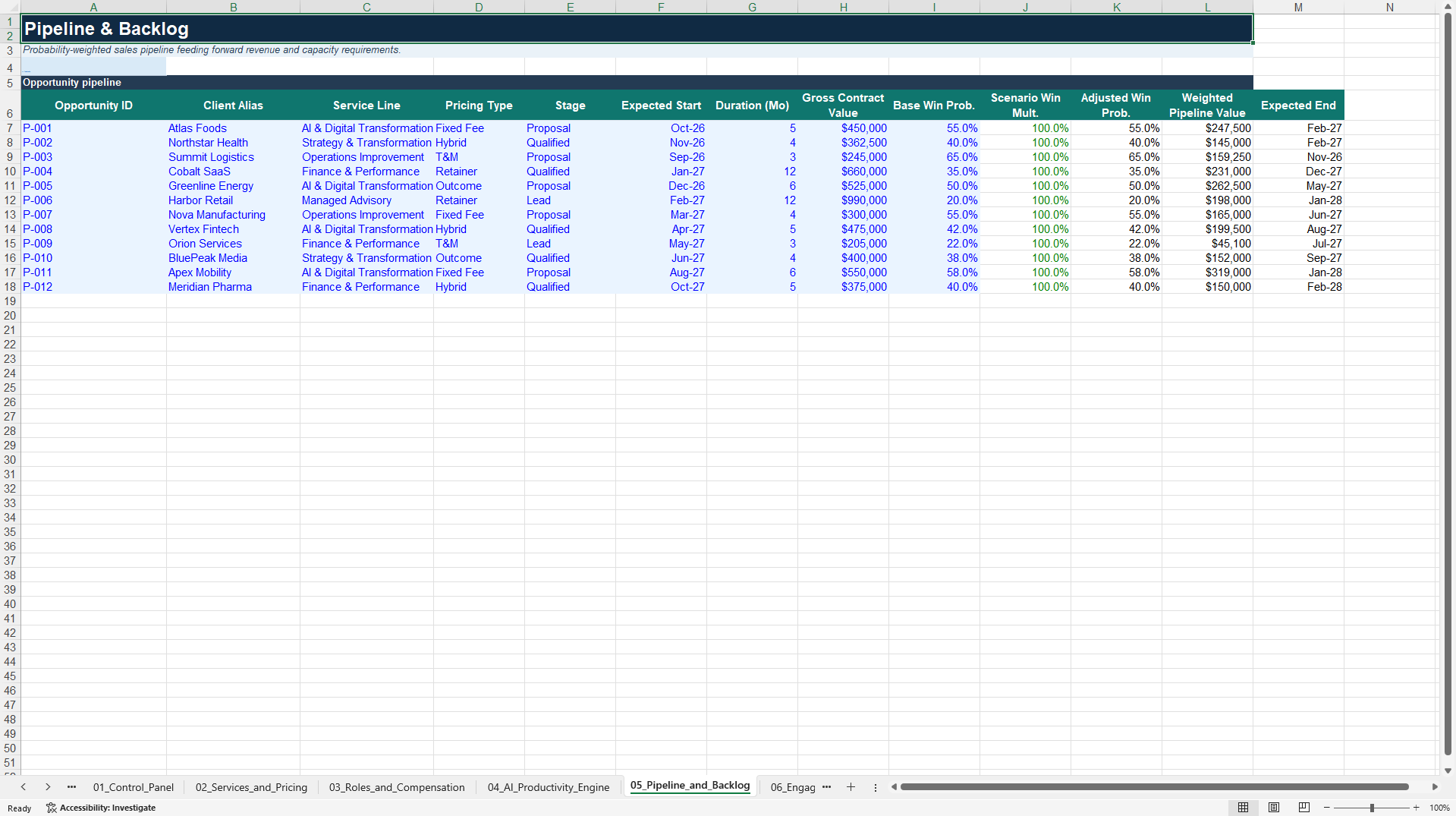
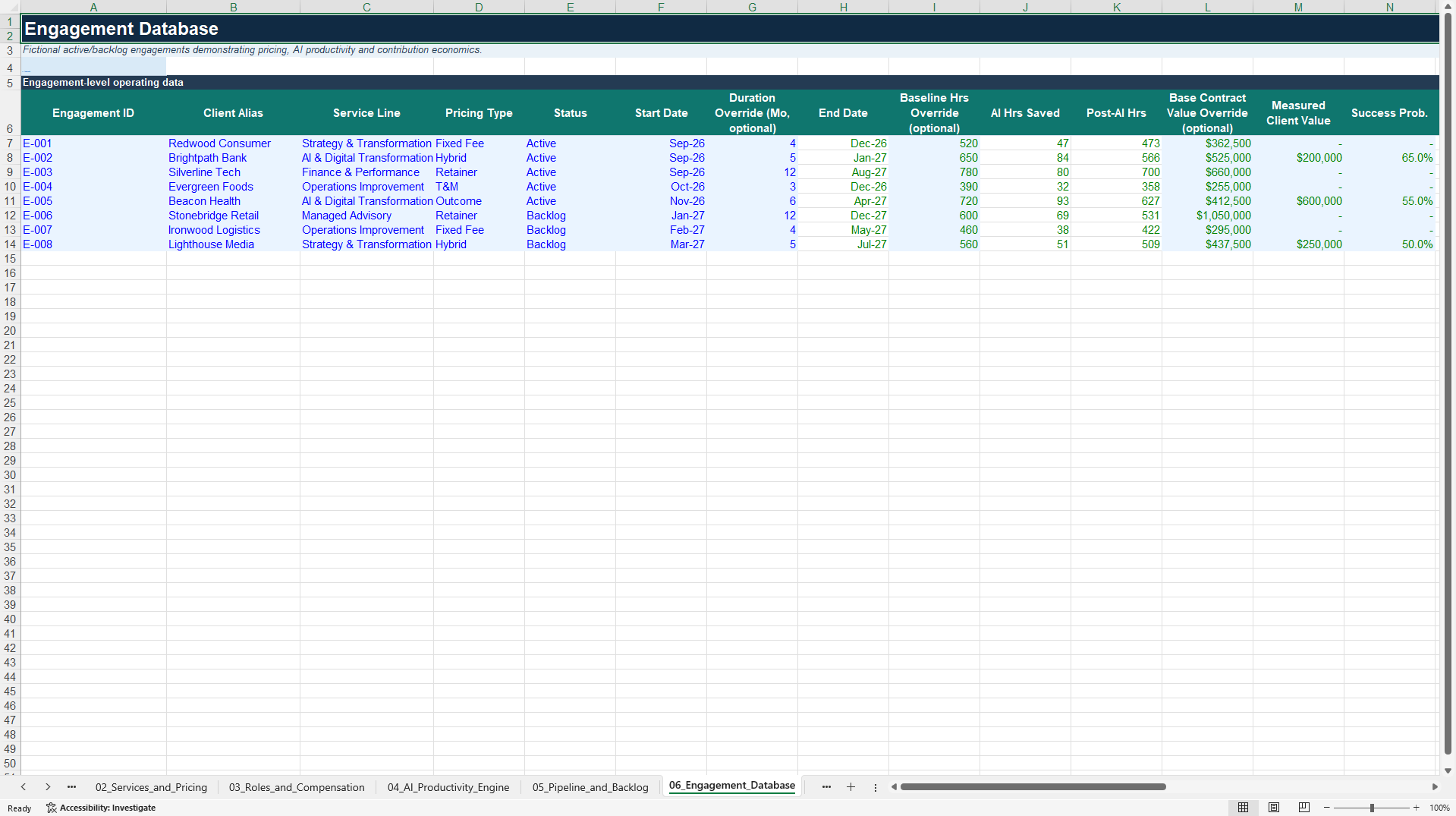
Pipeline and engagement databases feed the commercial forecast using pricing type, timing, duration, value and probability. The engagement model supports service-line defaults for baseline hours and duration when overrides are not entered. T&M, fixed fee, retainer/subscription, hybrid and outcome/shared-savings economics are compared on revenue, delivery cost, contribution margin, margin percentage and revenue per post-AI hour. Outcome fees are modeled from measured client value, value share, success probability, thresholds, floor, cap and collection realization.
Capacity planning rolls FTE forward for hires and attrition, applies onboarding productivity and calculates net available hours, demand after AI, utilization, recommended incremental FTE, recruitment starts and contractor overflow. The monthly financial model then integrates revenue, delivery costs, operating expenses, AI costs, working capital, Income Statement, Balance Sheet and Cash Flow.
Decision support includes AI ROI and value-capture analysis, four two-variable sensitivity tables and an executive dashboard with six KPI cards, management actions and four native Excel charts. The sensitivity analysis tests AI productivity against client price compression, utilization against billing rate, outcome attainment against value share, and hiring pace against pipeline conversion. A dedicated model-check sheet tests core reconciliations, bounds and linkages, including cash roll-forward and balance-sheet balancing.
The workbook is populated with editable sample assumptions so users can understand the mechanics before replacing the inputs with their own service mix, staffing, pipeline, engagement, pricing and financial data. It is intended as a reusable operating and financial planning tool for pricing reviews, annual plans, hiring discussions, service-line economics, partner meetings and AI transformation decisions.
Got a question about the product? Email us at support@flevy.com or ask the author directly by using the "Ask the Author a Question" form. If you cannot view the preview above this document description, go here to view the large preview instead.
Source: Best Practices in Artificial Intelligence, Consulting Sales Excel: AI Consulting Pricing, Capacity & Profitability Model Excel (XLSX) Spreadsheet, PDMM Financial Models
ABOUT THE AUTHOR

PDMM Financial Models develops professional, decision-ready Excel models for business owners, entrepreneurs, investors, consultants, analysts, and finance teams. Our objective is to transform complex business assumptions into clear, structured analysis that supports better planning and investment decisions.
Our models cover business planning, forecasting, budgeting, feasibility analysis,
... [read more]
Ask the Author a Question
You must be logged in to contact the author.




























