 Click main image to view in full screen.
Accounting Firm Acquisition and SBA Underwriting Model – Excel XLSX
Excel (XLSX) + supplemental PDF


BENEFITS OF THIS DOWNLOADABLE EXCEL DOCUMENT
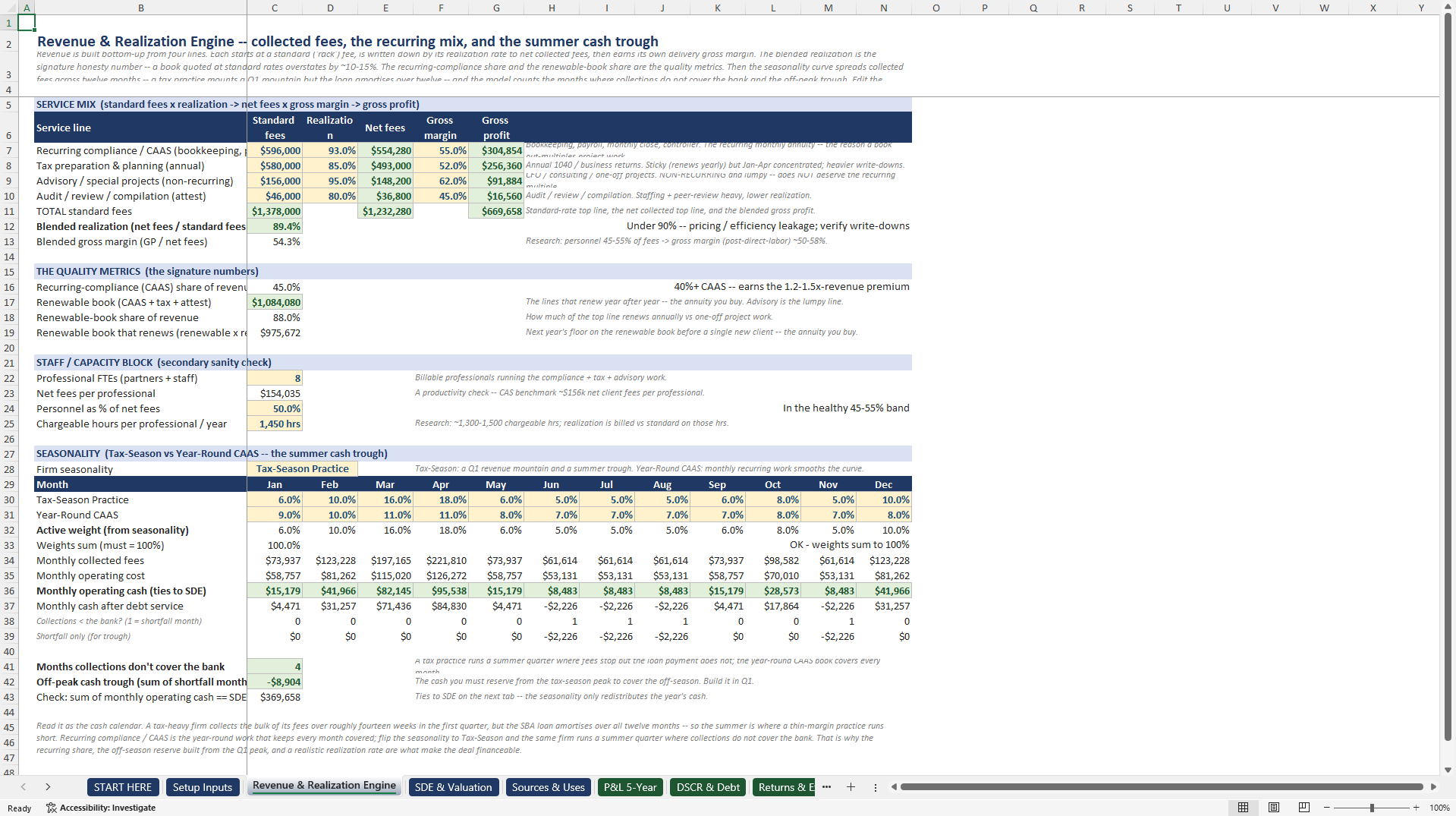
- Four service lines are written down by their own realization rate, so a standard-rate schedule of $1,378,000 becomes $1,232,280 of collected fees, a blended 89.4% that a price set at 1x gross fees never sees.
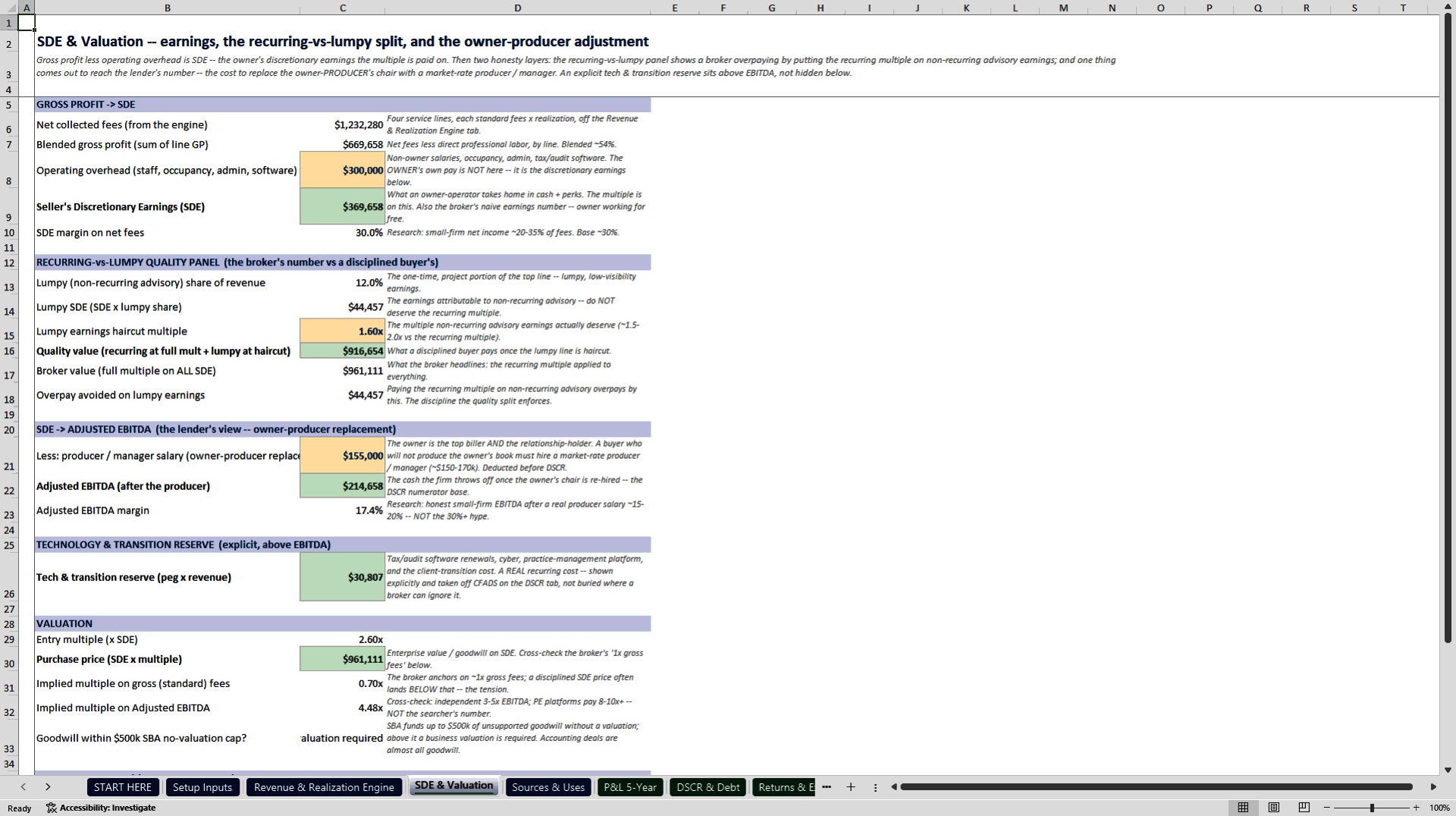
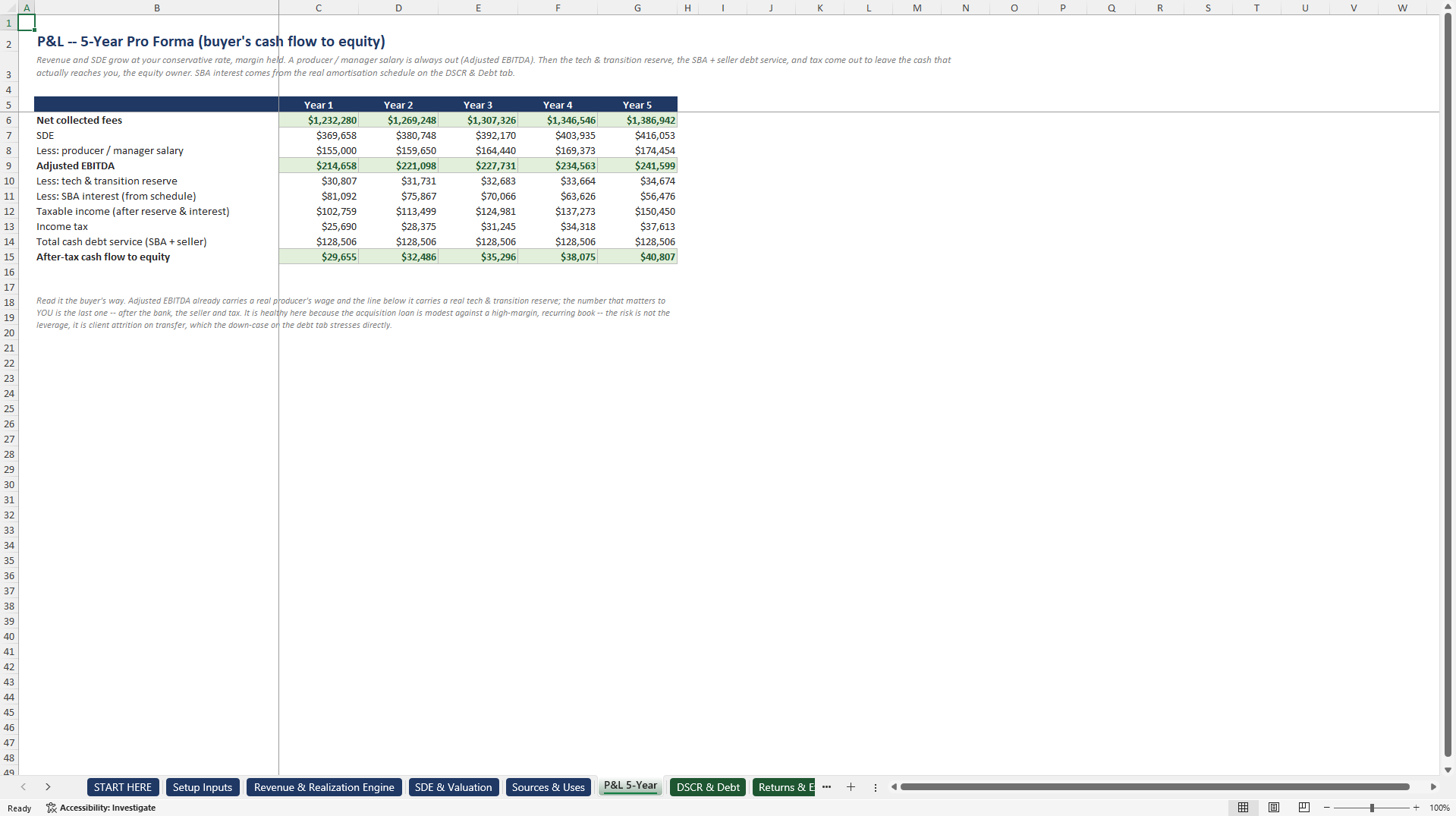
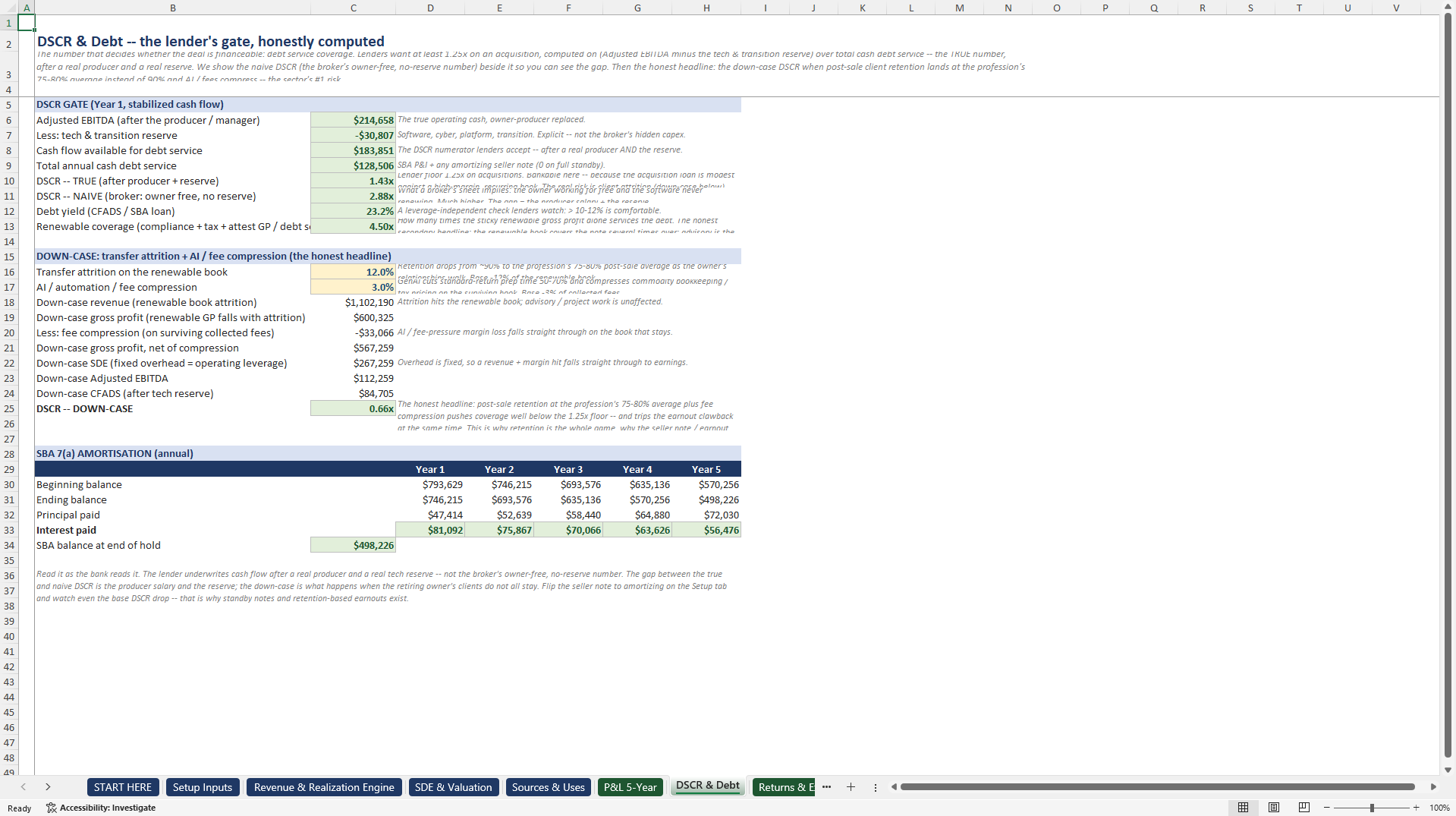
- Replacing the owner-biller with a $155,000 market-rate producer and funding a technology and transition reserve moves the same deal from a naive 2.88x DSCR to a true 1.43x, and to 0.66x in the attrition down case.
- A tax-season cash curve counts the months when collections do not cover the bank payment: four for a tax-weighted book, zero for a year-round CAAS book, with an off-peak trough of -$8,904.
INTEGRATED FINANCIAL MODEL EXCEL DESCRIPTION
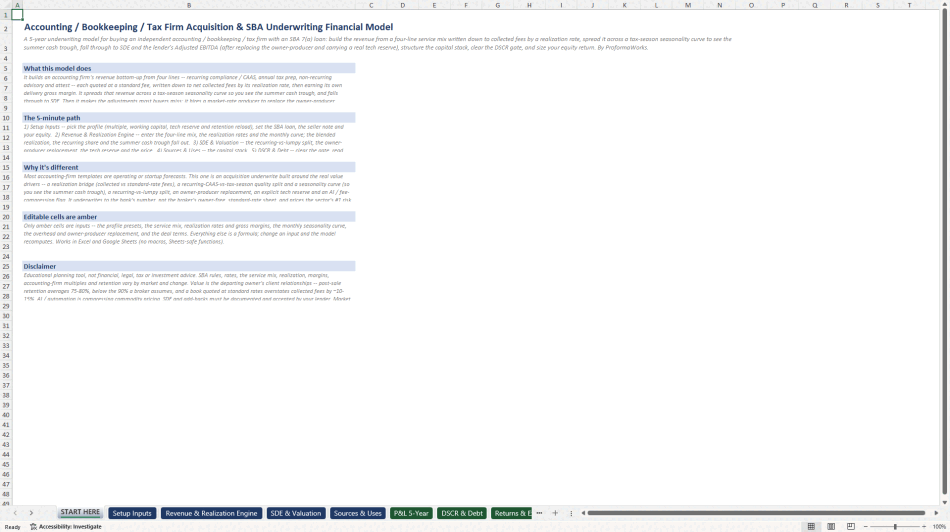
This model is built for the buyer underwriting a single accounting, bookkeeping or tax practice with an SBA 7(a) loan, and for the advisor or lender who has to check that deal before it funds. Most accounting-firm templates on the market are startup or operating forecasts, and brokers anchor the asking price on roughly 1x gross fees taken from the standard-rate fee schedule. That is the valuation error this model is designed to intercept.
The engine reads the book on collected fees rather than standard rates. Four service lines are modelled separately: recurring compliance and CAAS work, annual tax preparation, non-recurring advisory, and attest. Each is written down by its own realization rate. In the base case, standard fees of $1,378,000 become net collected fees of $1,232,280, a blended realization of 89.4%. A book read at standard rates therefore overstates the practice by about 11% before any other adjustment is made. Blended gross margin lands at 54.3%, the net revenue mix runs 45% CAAS, 40% tax, 12% advisory and 3% attest, and 88% of the book is renewable.
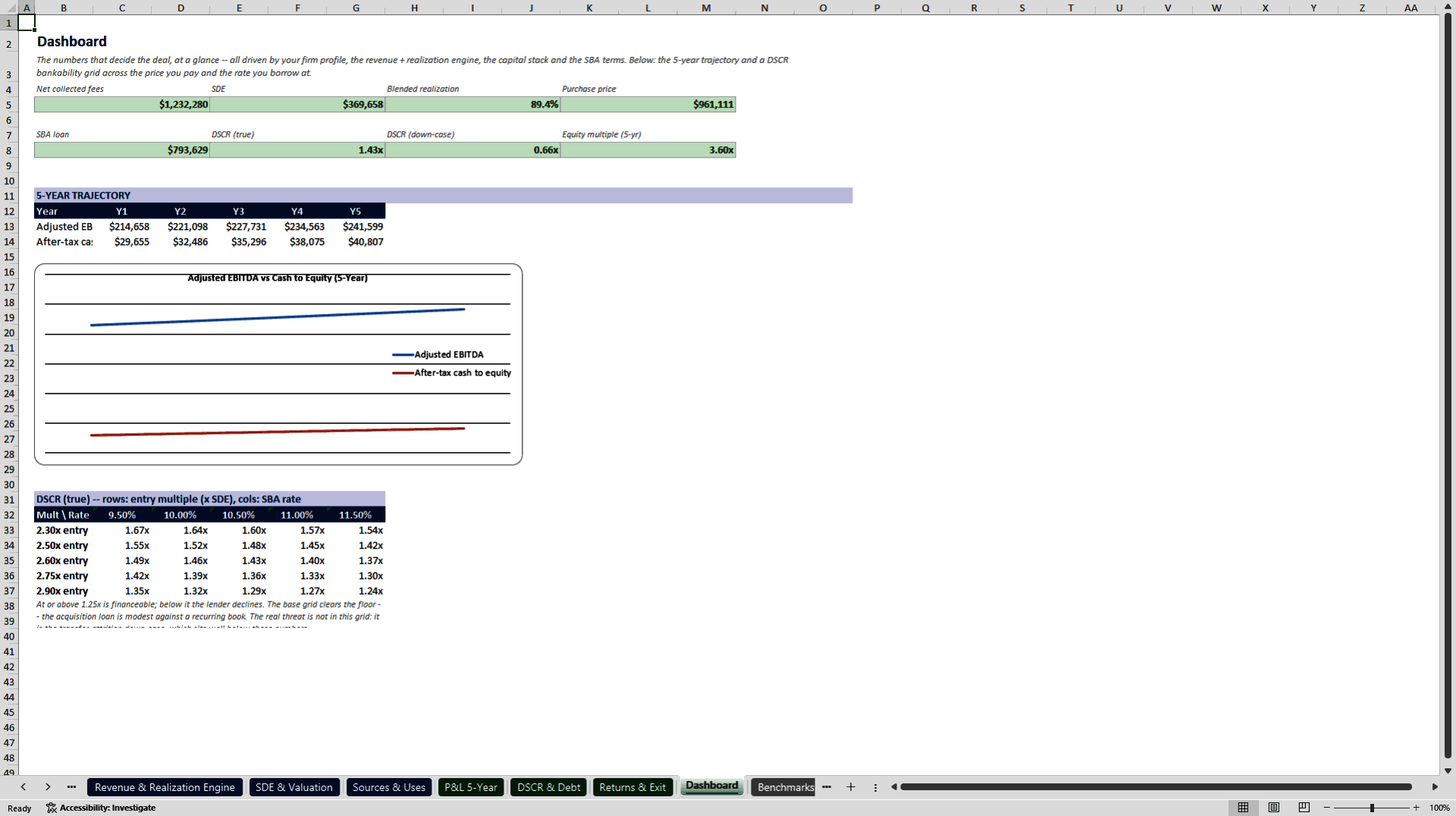
From there the model deducts what a seller's add-back sheet tends to leave out. A market-rate producer replaces the owner-biller at $155,000, an explicit technology and transition reserve is funded, and SDE of $369,658 (30.0% of collected fees) becomes Adjusted EBITDA of $214,658 (17.4%). At a price of $961,111, which is 2.60x SDE, about 0.70x gross fees and 4.48x Adjusted EBITDA, the total project cost is $1,046,753 and the SBA loan is $793,629, at 75.8% leverage with a 20.0% equity injection. True DSCR reads 1.43x next to the broker's naive 2.88x, renewable coverage is 4.50x and debt yield is 23.2%.
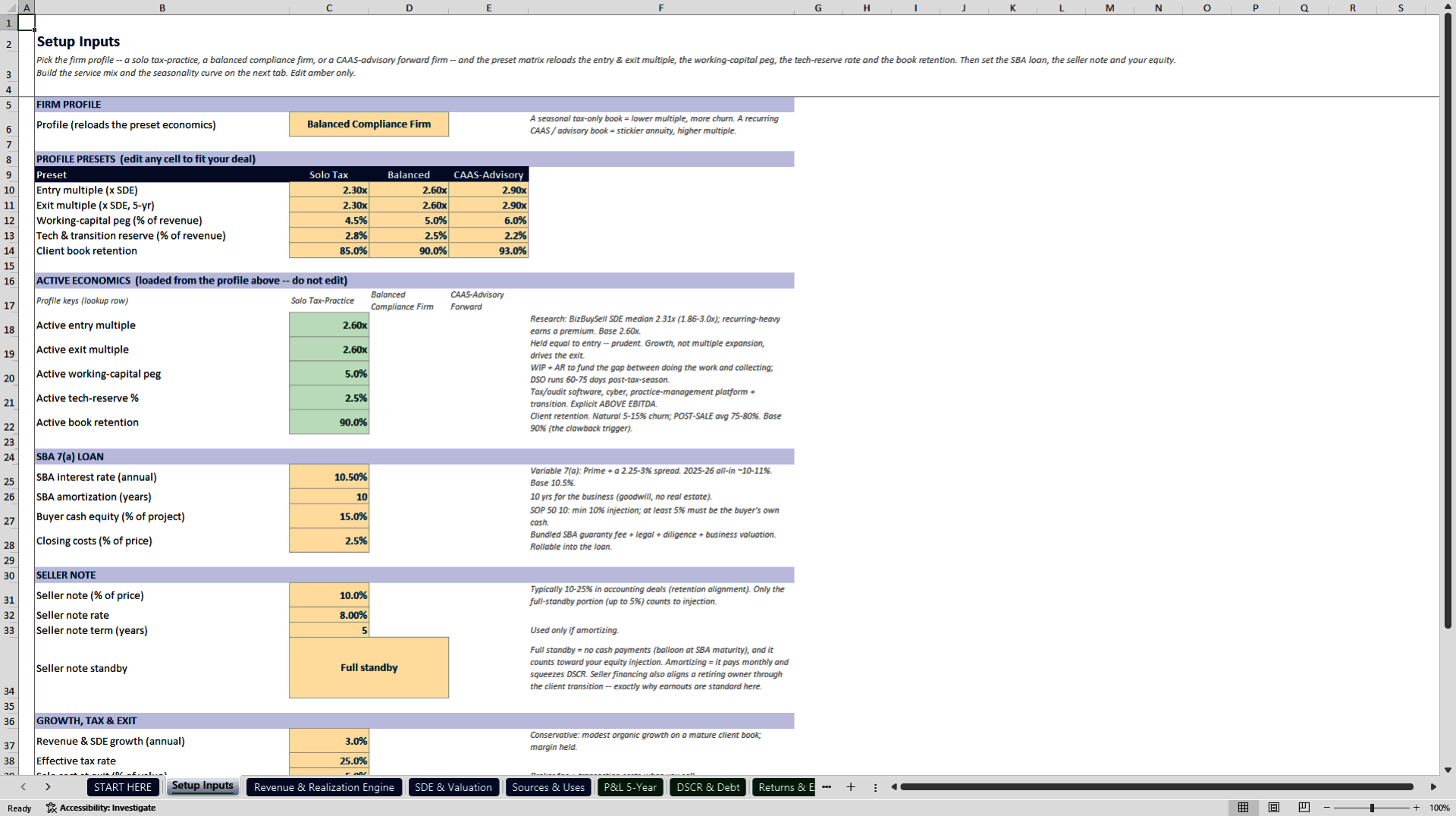
A transfer-attrition down case applies the profession's 75-80% post-sale retention average instead of 90%, together with fee compression on commodity work. DSCR falls to 0.66x, below the 1.25x program floor, and the earnout clawback trips. A tax-season cash curve then counts the months in which collections do not cover the bank payment: four months for a tax-season-weighted firm, zero for a year-round CAAS book, with an off-peak trough of -$8,904. Three profiles run at 2.30x, 2.60x and 2.90x SDE, and the exit is expressed as a five-year MOIC of 3.60x with a Year-1 cash-on-cash of 18.9%.
What the model does not do is equally deliberate. It publishes no IRR. It makes no claim to be the first accounting template, since adjacent acquisition and operating templates exist. It is an educational planning tool, not financial, tax or lending advice, and every reference band is meant to be replaced with the target firm's own realization reports and tax returns. Delivered as an Excel workbook that also opens in Google Sheets, verified by 85 automated checks across three independent engines.
Got a question about the product? Email us at support@flevy.com or ask the author directly by using the "Ask the Author a Question" form. If you cannot view the preview above this document description, go here to view the large preview instead.
Source: Best Practices in Integrated Financial Model Excel: Accounting Firm Acquisition and SBA Underwriting Model Excel (XLSX) Spreadsheet, ProformaWorks
ABOUT THE AUTHOR

ProformaWorks builds acquisition-grade financial models for Main Street and lower-middle-market businesses - the kind of deal financed with an SBA 7(a) loan or a small commercial facility.
Every model answers one question: does this deal pencil at the bank? That means SDE or NOI rebuilt from the seller's own numbers, the add-backs a lender will and will not accept, a debt-service
... [read more]
Ask the Author a Question
You must be logged in to contact the author.




























