 Click main image to view in full screen.
2026 Payroll Withholding Model: Federal and Illinois – Excel XLSX
Excel (XLSX) + Zip archive file (ZIP)


BENEFITS OF THIS DOWNLOADABLE EXCEL DOCUMENT
- Traces every figure back to the published table it came from, through a 4,393-row verification log that names the source document, page and date for each one, every row recorded as a match.
- Calculates federal withholding, Social Security with the wage base prorated across the period in which it is crossed, Medicare with the 0.9% surcharge, and state withholding for Arizona, Georgia, Illinois, North Carolina and Virginia.
- Leaves every formula visible and every cell unlocked, with no sheet protection anywhere, so a reviewer can check the arithmetic instead of taking it on trust.
PAYROLL EXCEL DESCRIPTION
WHAT THIS IS
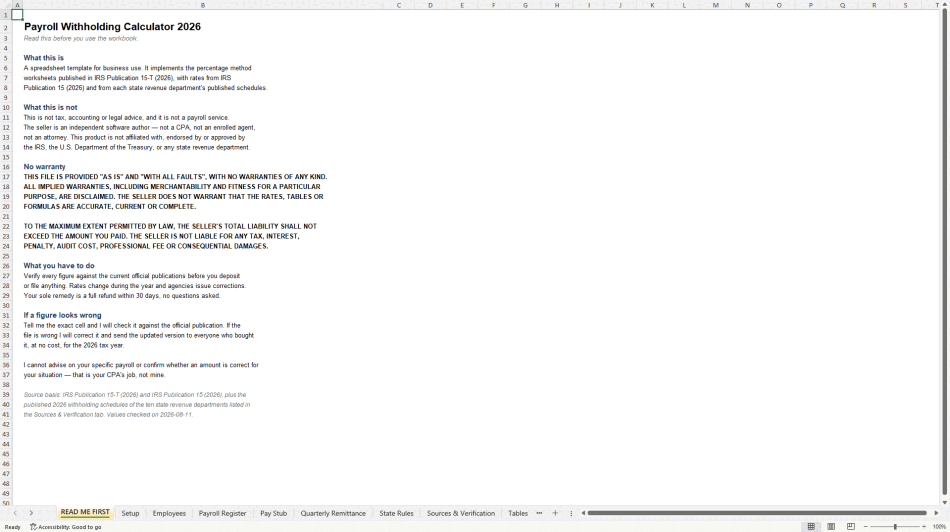
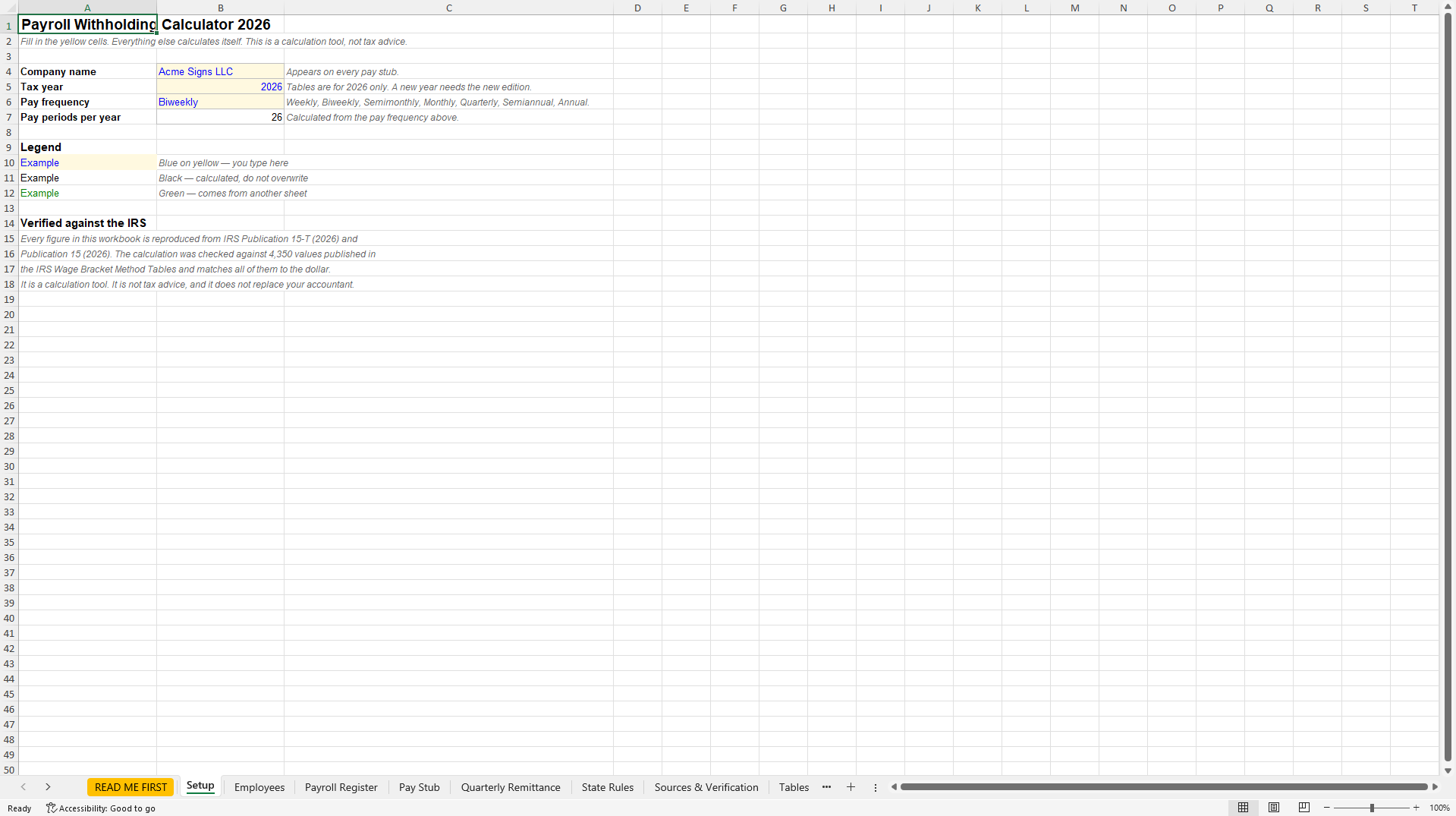
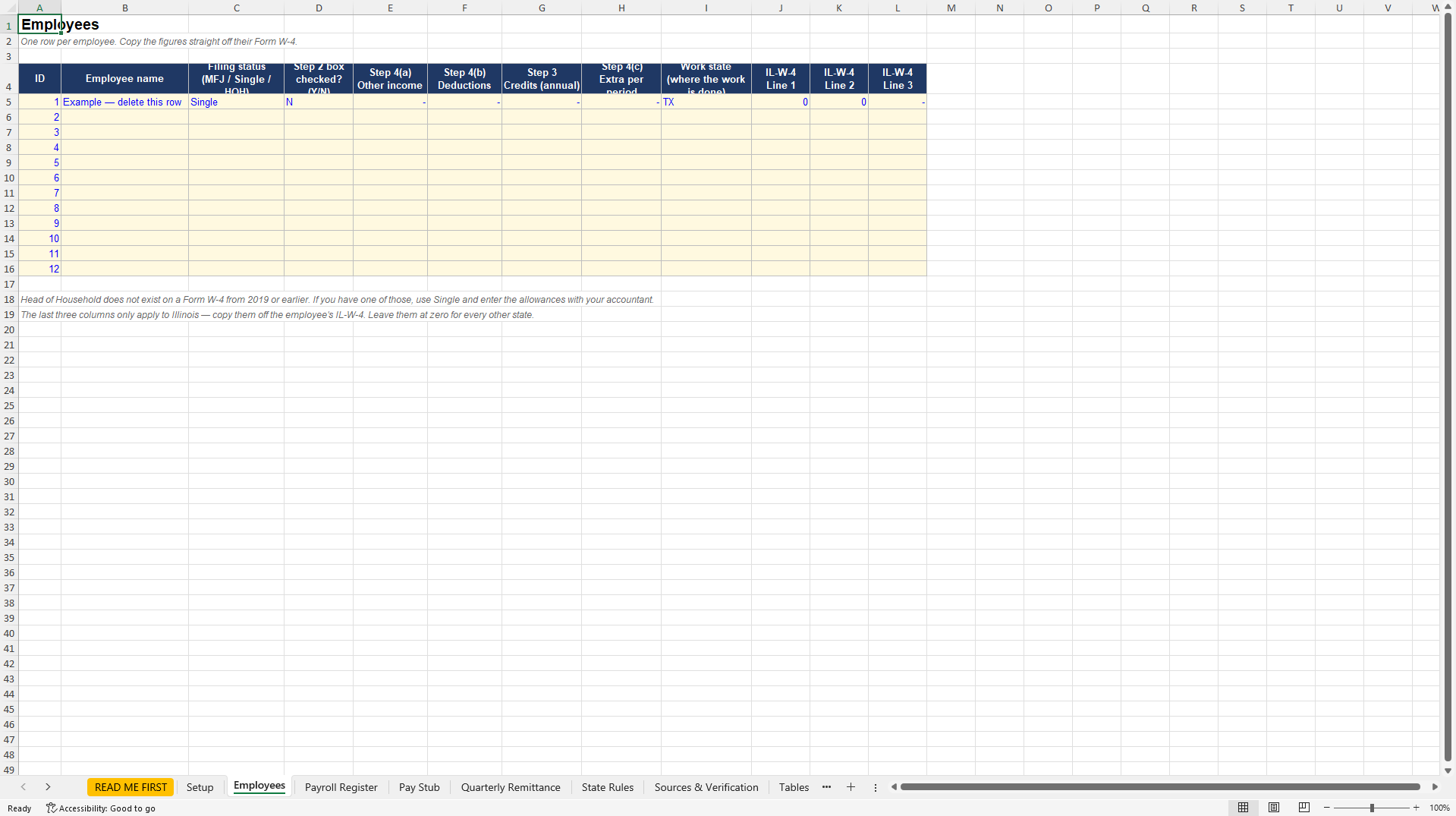
An Excel payroll withholding model for US employers, delivered together with the calculation engine and the test suite that prove its figures. Nine tabs, 15,063 formula cells, no macros and no add-ins. Every formula is visible, every cell is unlocked, and every tab is laid out to print cleanly on paper.
It implements the percentage method of Publication 15-T (2026), Worksheet 1A, issued by the IRS, with constants from Publication 15 (2026) and with state rates taken from each state revenue department's own published schedules.
This is a working document, not a demonstration. It is built for the finance team or adviser who has to show a reviewer how a number was reached.
SCOPE – READ THIS BEFORE BUYING
Coverage is federal withholding plus 14 states. That is the whole list, and the honest way to buy this model is to check your state against it first.
Five of the 14 levy an income tax and are calculated in full:
• Arizona – employee-elected rate from Form A-4, 0.5% to 3.5%, defaulting to 2.0% until a completed A-4 is on file
• Georgia – 5.19% through 10 May 2026 and 4.99% from 11 May 2026 under HB 463; the file switches on the pay date. Standard deduction $15,000 / $30,000, and where both spouses of a married couple have income the state directs them to use $15,000, which the file reads from the Step 2 box on Form W-4
• Illinois – 4.95%, allowances of $2,925 and $1,000
• North Carolina – 4.09% (the 3.99% income tax rate plus 0.1%), rounded to the nearest whole dollar per the state's own formula, standard deduction $12,750 / $19,125
• Virginia – progressive 2% to 5.75% calculated from a bracket table, allowances of $930 and $800, standard deduction $8,750
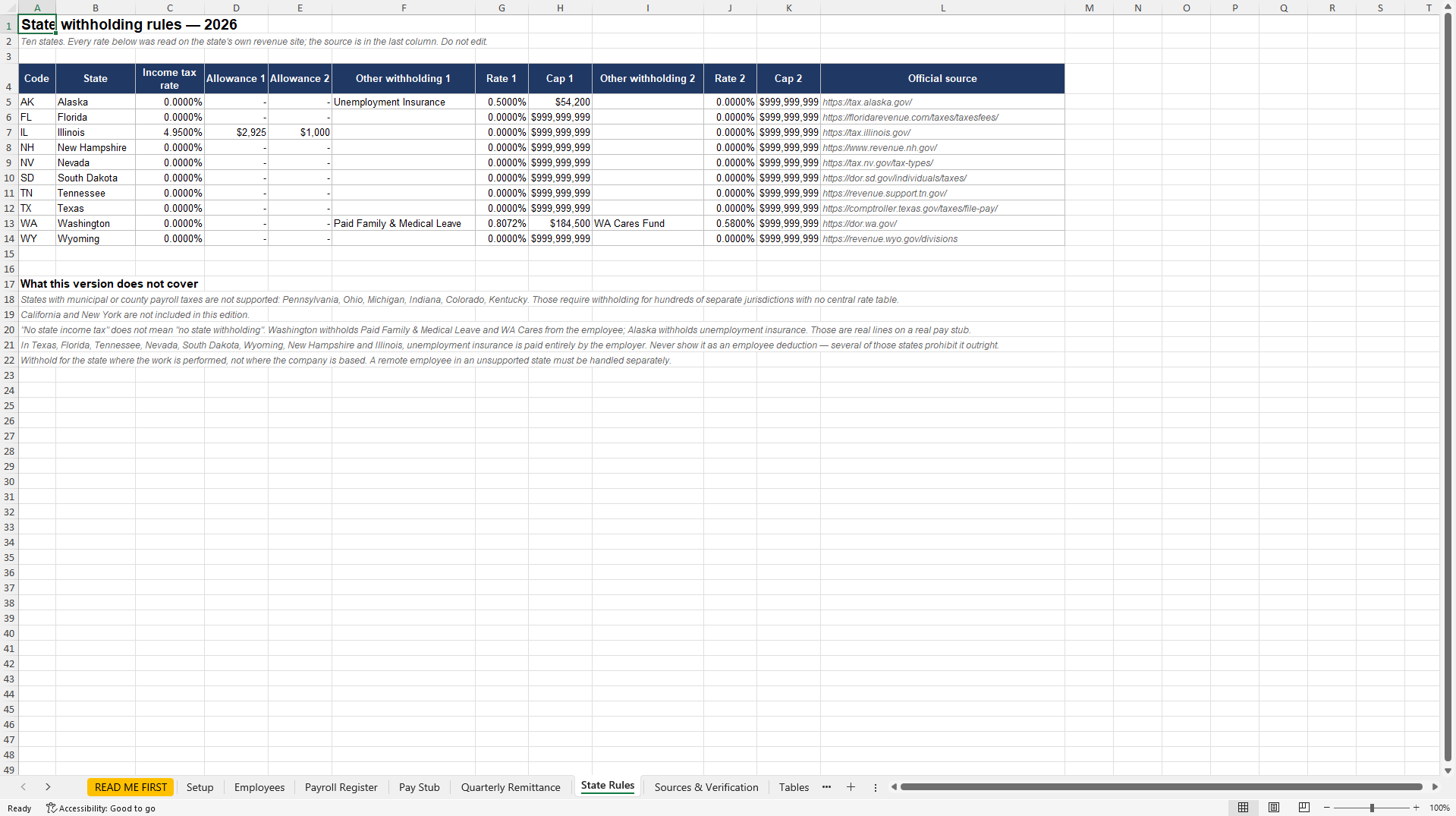
Nine of the 14 levy no state income tax: Alaska, Florida, Nevada, New Hampshire, South Dakota, Tennessee, Texas, Washington, Wyoming.
WHAT THIS MODEL DOES NOT DO
• It does not calculate California or New York. New York is excluded because New York City and Yonkers levy their own resident income tax that the employer withholds, so a state-only figure would be wrong for many New York employees. California is excluded because its exact-calculation method requires 28 published tables plus State Disability Insurance.
• It does not calculate the other states that levy an income tax and are not on the list above.
• It does not handle local, municipal or county payroll taxes, so Pennsylvania, Ohio, Michigan, Indiana, Colorado and Kentucky are not covered.
• Where a state is not supported, the model says so rather than returning a figure.
"No state income tax" is not the same as "no state withholding". Washington withholds Paid Family & Medical Leave at 0.8072% up to $184,500 and WA Cares at 0.58%; Alaska withholds unemployment insurance from the employee at 0.5% up to $54,200. Both are handled. The State Rules tab records the published source for every rate.
WHY A REVIEWER CAN TRUST THE NUMBERS
Most payroll templates ask you to take the tables on faith. This one ships the audit.
• A verification log of 4,393 rows, every one of them recorded as "Match". Each row carries its input, the published value, the calculated value, the result, the source document, the page or table reference, the source reference and the date checked.
• 4,350 of those rows reproduce values from the Publication 15-T (2026) wage-bracket tables published by the IRS, pages 14-16, 17-19, 20-22 and 23-25. Three more come from Worksheet 1A of the same publication. Seven are constants read in Publication 15 (2026). The remaining 33 are state figures read on each state's own revenue site.
• Dates checked: 4,375 rows on 2026-08-11 and 18 rows on 2026-09-15, the latter covering the states added most recently.
• The Python engine that generated the log is included, with its test suites. You can re-run it yourself.
• A parity test shows that the workbook and the engine return the same figure to the cent across every scenario, including the 37% band and the Social Security wage base crossed in the middle of a pay period.
• A year-over-year regression test runs 2026 against 2025 and fails loudly if a constant was left un-updated. That test is as much the product as the spreadsheet is.
WHAT THE MODEL CALCULATES
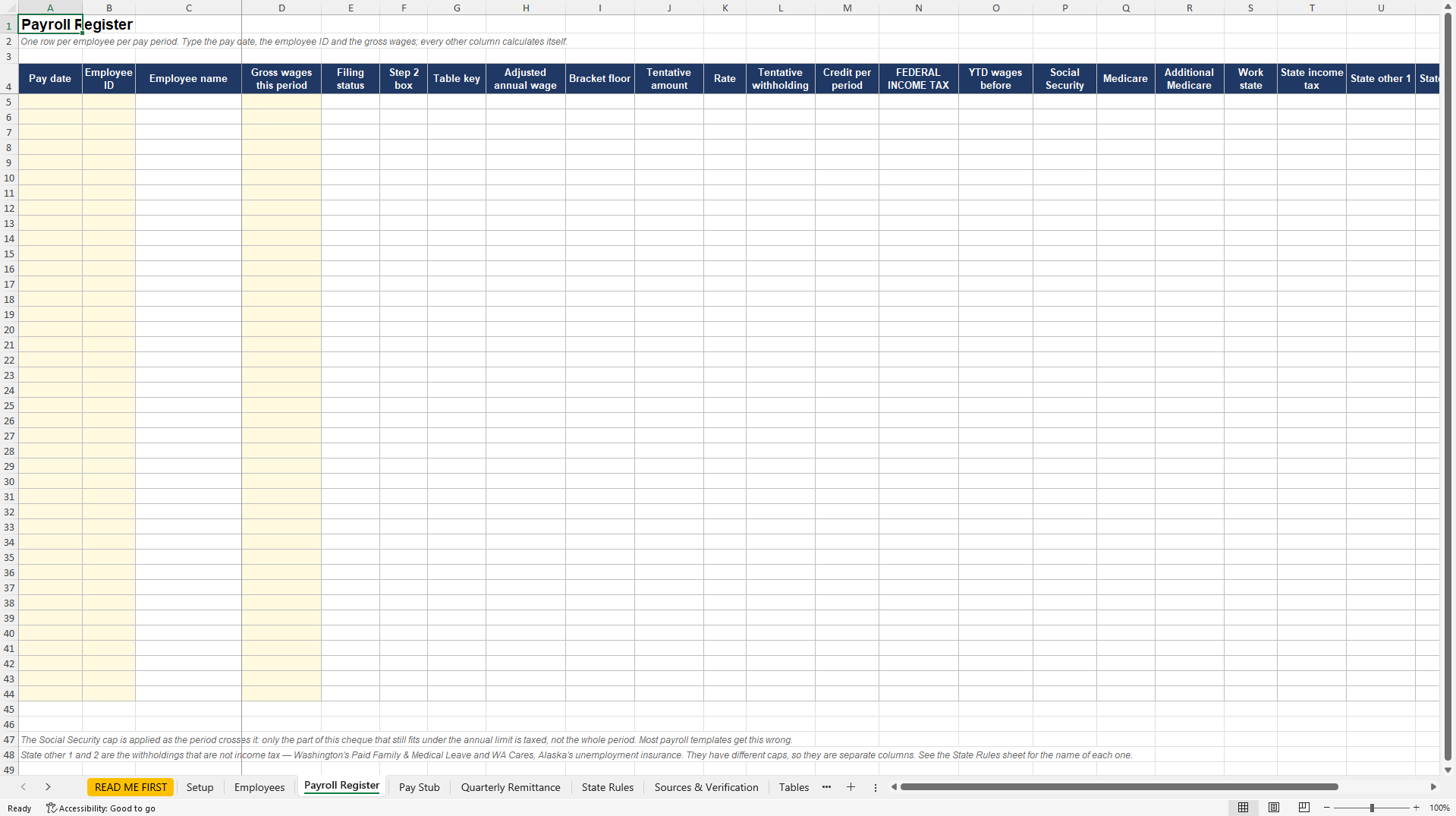
• Federal income tax – percentage method, Publication 15-T (2026) Worksheet 1A, including the Step 2 checkbox and pre-2020 Forms W-4
• Social Security at 6.2% up to the 2026 wage base, prorated across the pay period in which the base is crossed rather than applied all-or-nothing
• Medicare at 1.45%, plus the 0.9% Additional Medicare surcharge above $200,000 year to date
• State income tax for the five states listed above, and the state-level employee withholding described above for Washington and Alaska
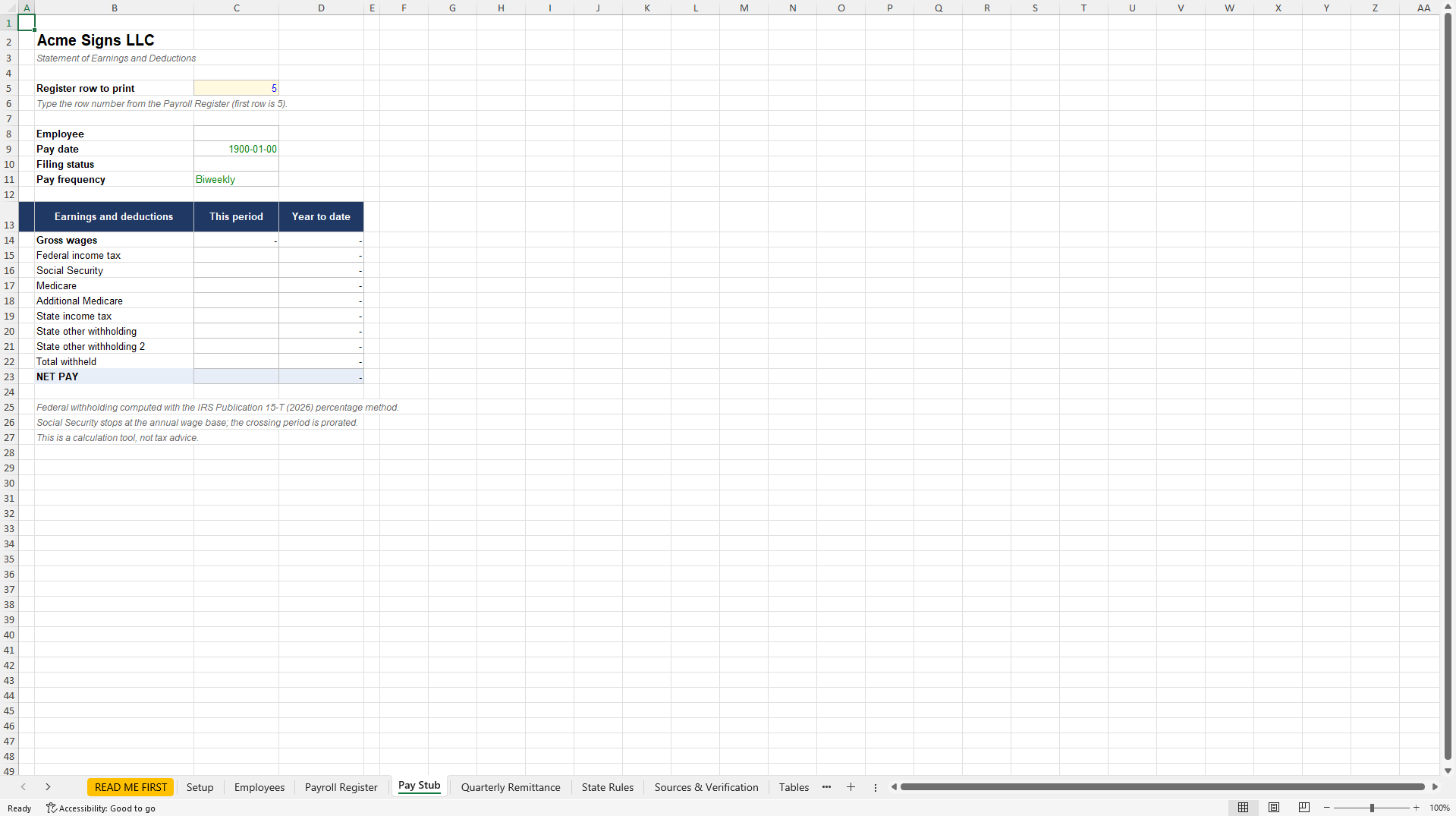
• A printable one-page pay stub with year-to-date figures
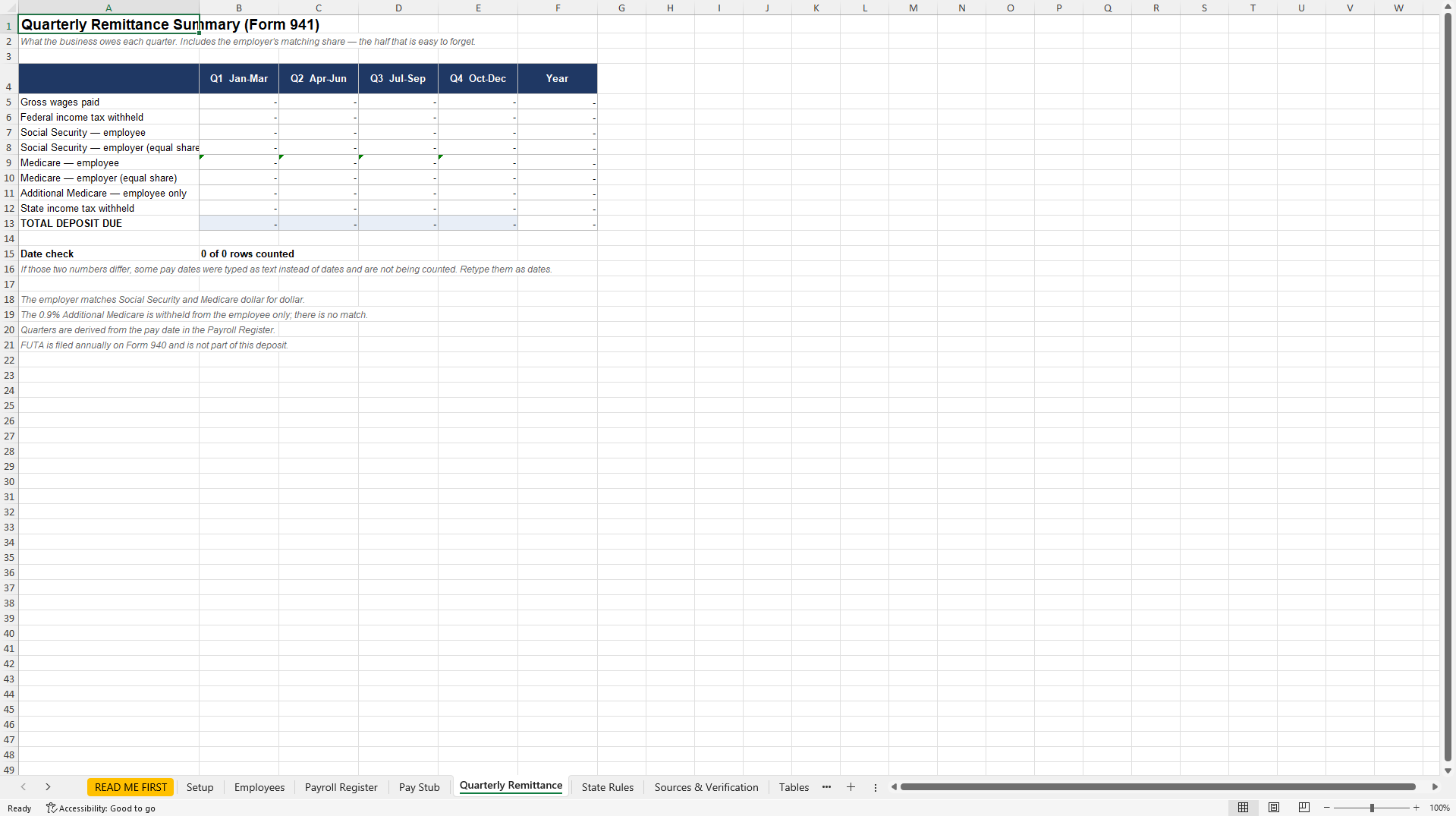
• A quarterly summary laid out for Form 941, employer share included
WHAT IT DOES NOT CALCULATE
Federal unemployment tax, which the employer files once a year on Form 940, is not calculated and is not part of the quarterly deposit; the Quarterly Remittance tab says so on the face of the tab. State unemployment insurance paid by the employer, and local, municipal or county payroll taxes, are also outside the model.
THE NINE TABS
READ ME FIRST, Setup, Employees, Payroll Register, Pay Stub, Quarterly Remittance, State Rules, Sources & Verification, Tables.
The 15,063 formula cells sit mainly in the Payroll Register (14,976), with 46 in Quarterly Remittance, 40 in the Pay Stub and 1 in Setup.
DOCUMENT CONDITION
The workbook is supplied print-ready: print areas set, headers and footers clean, no leftover review notes, no prior revisions and no working comments left in the cells. Each tab prints as a reviewer would expect to receive it.
WHAT IS IN THE DOWNLOAD
• Payroll Withholding Calculator – 9 tabs, 15,063 formula cells
• Verification log – 4,393 checked figures with their sources
• START – a 4-page guide
• A verification/ folder of 17 files: the Python calculation engine (, , tables_2026.json, golden_2026.json, build_verification_log.py, extract_golden.py, year_snapshot.json), four test suites (test_federal.py, test_states.py, test_parity.py, test_new_year.py), the four execution reports those suites produced (, , , ), and two READMEs
The secondary download is a single ZIP holding the verification log, the START HERE guide and the verification folder.
Works in Microsoft Excel 2016 or later, Microsoft 365, and LibreOffice Calc. No macros, no add-ins, no subscription. Google Sheets is not supported.
INTENDED USER
Bookkeepers, accountants, analysts and finance teams running payroll for a small US employer in one of the 14 covered states, and reviewers who need to see how a figure was reached rather than be told that it is correct. Consultants use it as a working file inside a client engagement.
LICENCE
The workbook carries its own licence note on the READ ME FIRST tab, and those terms govern this document. In short: the purchasing organisation may use and modify the file for its own work and for its own clients' work, and may not redistribute, resell, sublicense or publish the file or any derivative of it.
NOT TAX ADVICE
This is a calculation tool sold by an independent software author – not a CPA, not an enrolled agent, not an attorney. It is not affiliated with, endorsed by or approved by any tax authority or state revenue department, and nothing in it is tax, legal or accounting advice.
Payroll rules change during the year and agencies issue corrections. Verify every figure against the current official publications before you deposit or file anything. You remain responsible for your filings. The dates on which each figure was checked are recorded in the verification log and named in the Sources & Verification tab.
REFUND
If the model does not do what this page says, contact the author through this marketplace within 7 days of purchase for a full refund.
Got a question about the product? Email us at support@flevy.com or ask the author directly by using the "Ask the Author a Question" form. If you cannot view the preview above this document description, go here to view the large preview instead.
Source: Best Practices in Payroll, Tax Excel: 2026 Payroll Withholding Model: Federal and Illinois Excel (XLSX) Spreadsheet, Maket




























